
0 ITEMS

Understanding What is Yield to Maturity and Why It Matters

Yield to maturity (YTM) is a key metric for passive investors analyzing bond investments and fixed-income securities.
- YTM measures the total return an investor can expect from a bond if held until maturity, factoring in purchase price, coupon payments, and remaining time.
- It assumes the bond is reinvested at the same YTM rate, which may not always be realistic.
- YTM is useful for comparing bonds with different maturities, coupon rates, and prices in the secondary market.
- Understanding YTM helps investors evaluate bond risks and rewards effectively.
Keep reading for a clear explanation of how YTM works and its role in bond investing.
The Concept of Yield to Maturity
Yield to Maturity (YTM) is a critical concept for passive investors who want to understand the potential returns of fixed-income securities such as bonds. It is a financial metric representing the total return an investor can expect from a fixed-income investment, such as a bond, assuming all interest payments are scheduled and the bond is held until maturity. Be aware that YTM assumes the bond is held until maturity, and actual returns may differ if the bond is sold before maturity. YTM is expressed as an annual percentage rate and helps investors assess the attractiveness of a bond investment by comparing it to other fixed-income options.
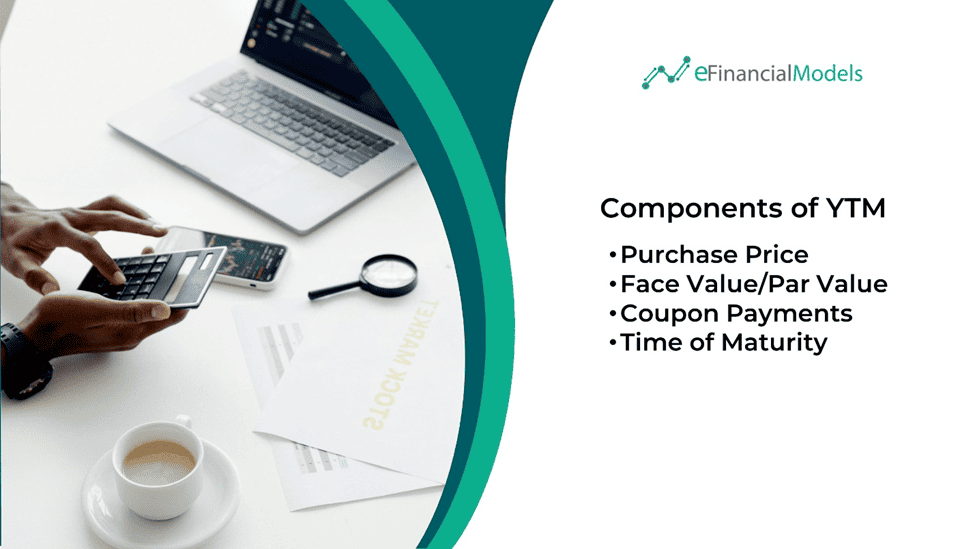
Components of YTM
YTM considers the bond’s purchase price, face value (par value), coupon payments, and the time remaining until maturity. It also considers periodic interest payments (coupons) and potential capital gain or loss when the bond matures.
- The purchase price at which you buy the bond in the secondary market differs from its face value.
- The face value or par value of the bond is the amount the bond will be worth at maturity.
- Bonds typically pay periodic interest payments, known as coupon payments, to bondholders. YTM considers these interest payments.
- The time of maturity, or the number of years until the bond matures, is a crucial factor in calculating YTM.
YTM & Other Aspects of Bonds
To better understand YTM, it is also important to note its relationship to various aspects of bonds and other investment instruments.
- Coupon Rate: A bond’s coupon rate is the fixed annual interest rate it pays to bondholders based on its face value or par value. Just like bonds, YTM has an inverse relationship with coupon rates. When a bond’s YTM equals its coupon rate, it trades at par value. If YTM is higher than the coupon rate, the bond trades at a discount or lower price, and if YTM is lower, it trades at a premium or higher price.
- Current Yield: Current yield is a simpler measure of a bond’s return and is calculated as the annual interest payment (coupon) divided by the bond’s current market price. While YTM considers the entire stream of future cash flows, current yield only looks at the bond’s current income. YTM provides a more comprehensive picture of the bond’s expected return.
- Yield to Call: Yield to Call (YTC) is similar to YTM, but it calculates the annualized return assuming the bond is called by the issuer (redeemed) at a specified call date and price before its maturity date. It considers the potential early redemption of the bond and is relevant for callable bonds.
- Yield to Put: Yield to Put (YTP) is analogous to Yield to Call (YTC) but considers the possibility of the bondholder exercising their right to sell the bond back to the issuer at a specified put price before maturity. It is relevant for bonds with put options.
- Yield to Worst: Yield to Worst (YTW) is the lowest potential yield an investor can receive from a bond. It accounts for the various scenarios, including holding the bond until maturity, being called, or being put, and calculates the worst-case yield for the investor. This metric helps investors assess the downside risk associated with a bond.
In summary, YTM is a comprehensive measure of a bond’s expected return, considering its price, coupon rate, and time to maturity. It forms the basis for evaluating other yield measures like current yield, yield to call, yield to put, and yield to worst, each focusing on specific scenarios or features of the bond.









































How is Yield to Maturity Calculated?
The Yield to Maturity formula can be mathematically expressed as:
YTM = [(C + (FV – PV) / n) / ((FV + PV) / 2)]
Where:
- YTM stands for Yield to Maturity, the annualized rate of return an investor can expect to receive if a bond is held until it matures.
- C represents the bond’s coupon rate, the annual interest rate paid on a bond relative to its face value.
- FV stands for the bond’s face value, which is the amount it will be worth when it matures.
- PV represents the bond’s present value, which is the current market price or the price an investor paid for the bond.
- n represents the number of years remaining until the bond matures.
Sample Calculation
Suppose an investor had a bond with the following characteristics:
- Face Value/Par Value = $100
- Coupon Rate = 2.5%
- Maturity Period = 5 years
We can now calculate the coupon payment and yield to maturity.

The spreadsheet above shows that the investor will receive an annual coupon payment of $2.50 from Year 1 to Year 5. The above cash flow streams correspond to a 5% yield to maturity (YTM).
The complex process of the yield-to-maturity formula means calculating a precise YTM value is often difficult. Instead, one can approximate YTM using a bond yield table, Excel financial models, financial calculator, spreadsheets, or online YTM calculator.
Pros & Cons of YTM
Yield to Maturity (YTM) is a widely used measure in bond investing that helps investors evaluate and compare bonds. Like any financial metric, it has pros and cons, which are important to consider when making investment decisions.
Pros of YTM
- Standardized Comparison: YTM provides a standardized way to compare bonds with different maturities, coupon rates, and prices. It enables investors to assess which bond offers the best return relative to its risk.
- Total Return Estimation: YTM considers both the coupon payments and the capital gain/loss upon maturity, giving investors a more comprehensive view of the potential total return on their bond investment.
- Useful for Pricing Bonds: YTM is essential for pricing bonds in the secondary market. It helps traders determine a fair market price for bonds when buying or selling them.
Cons of YTM
- Assumes Same Rate Reinvestment: YTM assumes that all coupon payments are reinvested at the same YTM rate, which may be unrealistic. In practice, interest rates fluctuate, and reinvestment opportunities may not always match the YTM rate.
- Doesn’t Account for Taxes: The yield-to-maturity formula does not consider the impact of taxes on bond income. It can be a significant omission for investors subject to tax liabilities, as it may overstate the expected return.
- Ignores Market Price Fluctuations: YTM focuses on the yield at the time of purchase and does not consider changes in the bond’s market price. Market prices can fluctuate due to changes in interest rates and creditworthiness, affecting the actual return if the bond is sold before maturity.
In summary, YTM is a useful metric for evaluating and comparing bond investments, but it has limitations. When making investment decisions, investors should be aware of their assumptions and consider other factors, such as taxes, market price fluctuations, and credit risk. YTM is just one tool in a broader toolkit for assessing bond investments.

Final Thoughts: Why Yield to Maturity Matters?
In conclusion, understanding and considering the yield to maturity (YTM) is paramount for individual and institutional investors. YTM helps investors decide whether to invest in a particular bond or fixed-income security. It provides a way to compare the potential return of the investment to other options, such as stocks or other bonds. It is a crucial tool for assessing bonds’ risks and rewards, helping investors make informed decisions about their investment portfolios.
Moreover, YTM enables investors to compare different bonds and financial instruments, allowing them to allocate their capital effectively and achieve their financial goals. By paying heed to YTM, investors can navigate the complex world of fixed-income securities with greater confidence, ultimately enhancing their ability to build and preserve wealth over time.
You might also like:
- Understanding the Debt Service Coverage Ratio: An Essential Metric for Financial Analysis
- Financial Modeling in Excel – Crash Course
- How to Calculate Net Present Value (NPV)?
- Top 5 Tips For a Good Financial Due Diligence
- 10 Tips to Develop a First Class Business Valuation Report
- 10 Main Elements of a Business Plan
- Financial Model Templates Easy to Use
- Financial Forecasting Models by eFinancialModels
- Cash Flow Analysis in Excel
- How to Effectively Read a Company’s Annual Report
- Achieve Financial Success By Knowing Your Business Plan Model
- Commercial Real Estate Valuation Methods: Helping Investors in Taking Informed Decisions
- Understanding What is Yield to Maturity and Why It Matters
- Loans & Lending Businesses
- Bonds
- Understanding the Levelized Cost of Energy Formula
- Investor Cash Flows
- 5 Steps to Create a Drop Down List Using Data Validation in Excel
- Top 10 Mistakes in DCF Valuation Models
- 5 Practical Tips to Help Raise Funds For Startups