
0 ITEMS

Estimate Your Solar Park’s Carbon Credit Output

Understanding how solar parks generate and sell carbon credits can add significant value to renewable energy projects.
- Carbon credits represent the right to emit one metric ton of CO₂, earned or bought through emission reduction projects.
- Calculating credits involves measuring solar energy output and comparing it to the emissions the grid would have produced.
- The process includes tracking solar generation, finding the local grid’s emission factor, and verifying credits with certified bodies.
- Proper calculation not only proves environmental impact but also enables monetizing emissions savings through trading or offsetting.
- Accurate estimates support attracting investors, achieving green certifications, and enhancing sustainability strategies.
Deepening your knowledge of carbon credit calculation helps optimize project revenue and environmental impact.

What Are Carbon Credits?
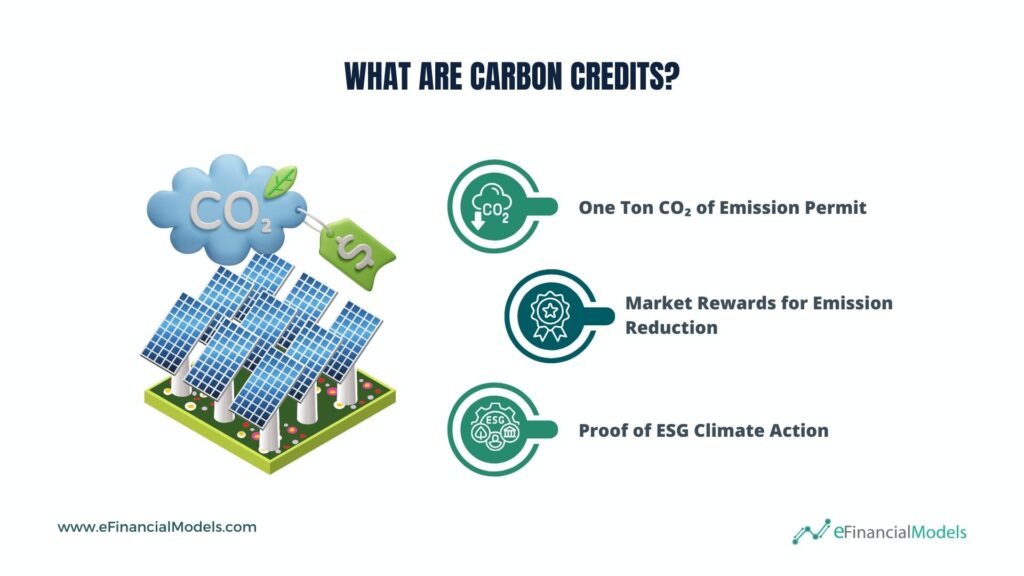
Carbon credits are a system designed to reduce global greenhouse gas emissions. What carbon credits represent the right to emit one metric ton of carbon dioxide (CO₂) or an equivalent amount of another greenhouse gas? These credits are either earned or purchased. Projects that actively reduce emissions—such as solar parks, wind farms, or reforestation efforts—can generate carbon credits by preventing pollution that would have occurred otherwise.
Once earned, these credits can be sold to companies or organizations that emit more than their allowed limit. By purchasing credits, these polluters can “offset” their excess emissions. What are carbon credits creates a financial incentive for clean and renewable energy projects and environmentally friendly practices. The goal is to encourage a market-driven approach to fighting climate change, where emissions have a cost and carbon-saving activities gain value. Carbon credits support sustainable development through this exchange while helping companies meet environmental goals.
Carbon credits support the “E” in ESG (Environmental, Social, and Governance (ESG) Funding) by helping companies cut their carbon footprint. Using or selling credits proves a company takes climate action seriously. It adds value to ESG reports and shows commitment to sustainability.
Types of Carbon Credits
Carbon credits began in the late 1990s as part of global efforts to tackle climate change, especially under the Kyoto Protocol. The idea was to create a market-based system where countries and companies could trade emission reductions. So, carbon credits aren’t all the same—and that’s on purpose. As the fight against climate change grows, industries and regions need tailored ways to cut emissions. That’s where the various types of carbon credits come in. Each is designed to fit a specific strategy, whether reducing, avoiding, or removing carbon dioxide from the atmosphere. Depending on how and where emissions are addressed, these categories help ensure transparency, accountability, and real impact.
Among the most common types of carbon credits are:
- Avoidance Carbon Credits: Avoidance credits prevent emissions from happening in the first place. They reward projects that stop carbon from being released, like protecting forests or switching to clean energy. These credits are based on the difference between expected and actual emissions after the project starts. Energy, forestry, and transport sectors often use them to show climate action without cutting their emissions.
- Nature-Based Voluntary Carbon Credits: Nature-based voluntary credits come from projects that use ecosystems to absorb or avoid carbon. Examples include reforestation, wetland restoration, or soil carbon improvements. These credits are calculated by measuring how much carbon the land captures or avoids emitting over time. Agriculture, forestry, and conservation groups use them to support sustainable land use and climate goals.
- Technology-Based Voluntary Carbon Credits: Technology-based voluntary credits rely on machines or systems that reduce emissions. This includes using carbon capture tech, switching to renewable energy, or improving energy efficiency. Credits are issued based on how much less carbon is released compared to old methods. Heavy industries like oil & gas and manufacturing often use them to offset part of their emissions.
- Removal Carbon Credits: Removal credits focus on taking carbon from the air. This can happen through natural means like planting trees or advanced tech like direct air capture. These credits are measured by tracking how much carbon is pulled from the atmosphere and stored long-term. They’re popular in tech, finance, and companies aiming for net-zero emissions.

Solar parks earn avoidance carbon credits and technology-based voluntary carbon credits by replacing fossil fuel power with clean energy. This prevents emissions that would have come from coal, oil, or gas. Credits are calculated by comparing solar output to what a traditional plant would emit. Since solar relies on renewable tech and avoids new emissions, it qualifies for both credit types. Energy firms and investors use these to meet climate goals and boost sustainability.













































Carbon Credit Calculation
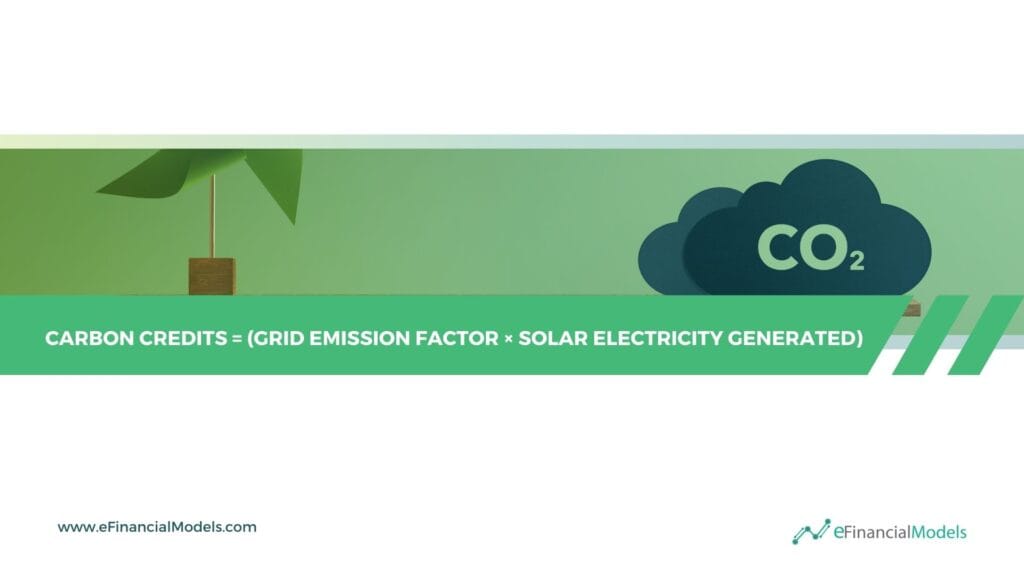
The carbon credit calculation for a solar park uses the formula:
Where:
- The grid emission factor shows how much CO₂ the local power grid releases for every kilowatt-hour (kWh) of electricity it produces. It depends on the mix of energy sources, like coal, gas, or renewables. In carbon credit calculations for a solar park, this factor helps estimate the emissions avoided using clean energy instead of grid electricity. A higher grid emission factor means more carbon savings from solar power.
- Solar electricity generated is the total clean energy a solar park produces over time, measured in kilowatt-hours (kWh). It shows how much power the system sends to the grid or uses on-site. This number helps measure how much fossil fuel energy the solar park replaces in carbon credit calculations. More solar electricity means more avoided emissions—and more carbon credits earned.
The carbon credit calculation results show how much CO₂ the solar park avoided by replacing fossil-fuel electricity. One carbon credit equals one metric ton of CO₂ avoided.
How Does Carbon Credit Calculation Work?
Carbon credit calculation shows how much pollution a solar park prevents by using clean energy instead of fossil fuels. It compares the solar electricity produced to the carbon emissions the grid would have released for the same power. The difference becomes measurable carbon savings. These savings turn into carbon credits, which the solar park can sell or use. This process helps prove the real impact of solar power in fighting climate change. Here’s how carbon credit calculation works in a solar park, step by step:
- Track Solar Output – Measure the solar park’s total electricity in kilowatt-hours (kWh) using energy meters connected to the solar inverters or monitoring systems.
- Find the Grid Emission Factor – Get the official CO₂ emission rate of the local power grid (in kg or tons per kWh). You can get a solar park’s official CO₂ emission rate by checking the local or national grid emission factor published by environmental agencies or carbon registries.
- Multiply Both Values – Multiply the solar electricity by the grid emission factor to avoid CO₂ emissions.
- Convert to Carbon Credits – Divide the total CO₂ avoided by 1,000 (if in kg) to get the number of carbon credits (1 credit = 1 ton CO₂).
- Verify the Data – Use a certified body to review and confirm the numbers. Certified bodies like Verra, Gold Standard, and Climate Action Reserve review and confirm the carbon credit numbers for a solar park.
- Register the Credits – Submit the verified credits to a recognized carbon registry. Recognized carbon registries where you can submit verified carbon credits include the Verra Registry, the Gold Standard Registry, and the American Carbon Registry.
- Sell or Use the Credits – Trade or apply the credits to offset your emissions. You can trade or apply the carbon credits of a solar park on carbon marketplaces like ClimateTrade and Xpansiv or through direct deals with buyers seeking carbon offsets.
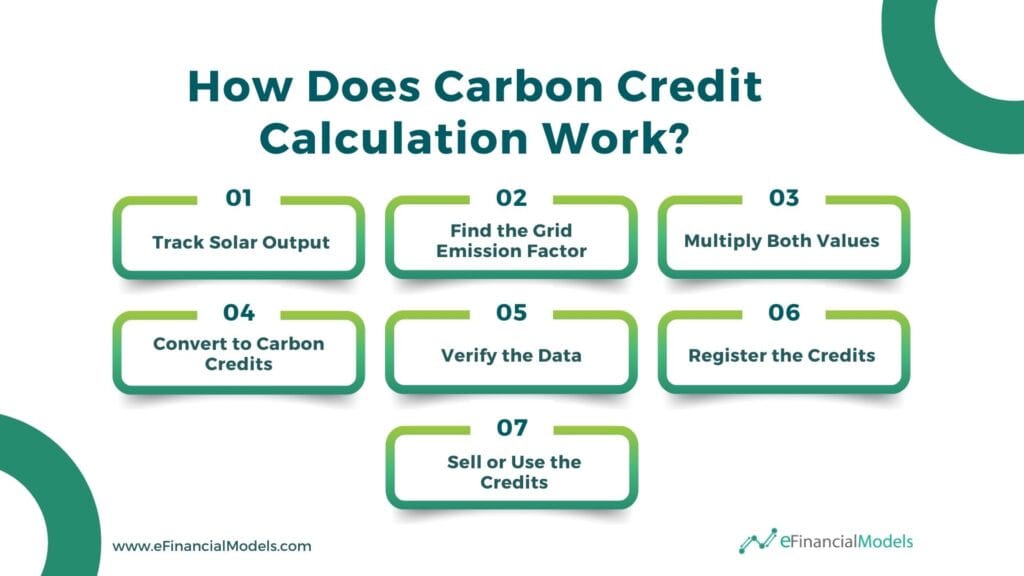
Carbon credit calculation is essential for solar parks because it proves their environmental impact. It shows how much carbon pollution the park prevents by replacing dirty energy with clean power. This data helps solar park owners earn carbon credits, which they can sell or use to offset emissions. It also attracts eco-conscious investors, supports green certifications, and strengthens the case for future renewable energy projects.
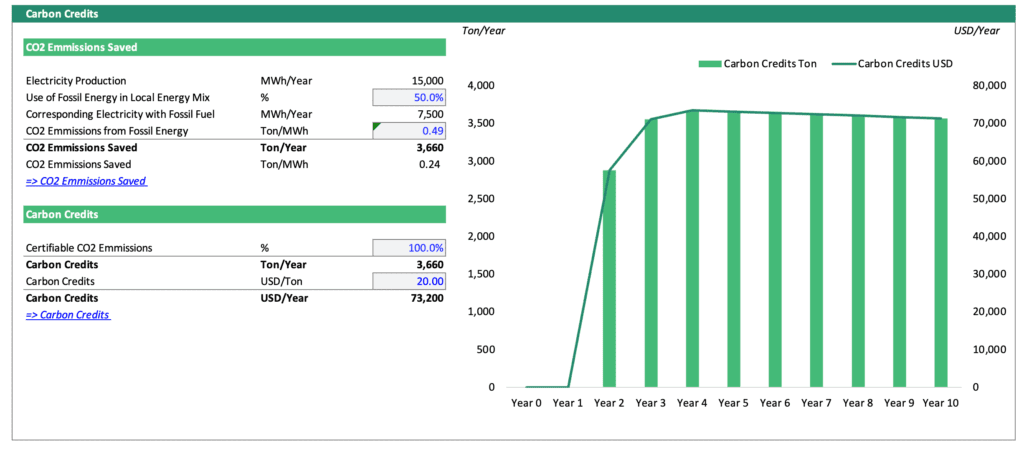
The carbon credit calculation above shows how a solar park can turn clean energy into extra income by calculating carbon credits. With 15,000 MWh of yearly output and a 50% fossil energy share in the local grid, the solar park avoids 3,660 tons of CO₂ annually. At $20 per ton, that’s $73,200 in potential revenue each year. This process transforms environmental savings into a secondary income stream—helping the project stay profitable while reducing emissions.
Estimate Carbon Credits with Data-Driven Precision
Knowing how much carbon your solar park saves is key to unlocking extra income and proving your environmental value. You can estimate your carbon credit potential by tracking clean energy output and comparing it to grid emissions. This simple step turns your solar energy into a powerful financial and climate-friendly asset.
While the concept is clear, accurate carbon credit calculation is more complex than it seems. You need reliable energy data, updated emission factors, and verified certification. Financial models help bring all these elements together, offering a precise and structured way to estimate your carbon credit value confidently.
Want to dive deeper into carbon credits and solar profits? Check out these financial model templates for real insights.
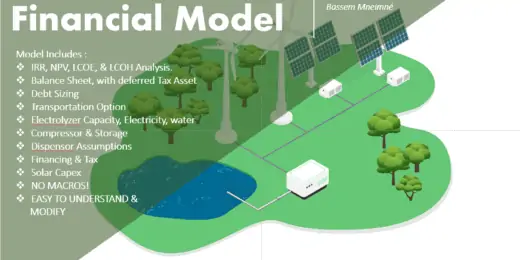
- Our Solar Energy Financial Model gives a clear view of solar projects’ revenues, costs, and carbon savings.
- For rooftop setups, our Rooftop Solar Power Plant Template helps you easily estimate returns, emissions avoided, and credit income.
You might also like:
- 10 Ideas to Increase Average Revenue Per User
- How to Profit from Carbon Capture Technology
- The Potential of Carbon Capture and Sequestration
- 10 Main Elements of a Business Plan
- Financial Modeling using Excel
- Cash Flow Analysis in Excel
- Financial Modeling for Startups and Small Businesses
- Are Wind Energy Farms Worth the High Initial Cost?
- Financial Forecasting Models by eFinancialModels
- How to Evaluate a New Solar Park for Investment?
- Renewable Energy
- Carbon Capture
- Funding Sources
- Scenario Analysis
- Fundraising
- Renewable Energy Financial Model Bundle
- How Do Startup Funding Rounds Work?
- Renewable Natural Gas (RNG) Financial Model Template
- Biogas Financial Model