
0 ITEMS

Swimming School Financial Model Excel Template
A comprehensive editable, 5-year 3 statement MS Excel spreadsheet for tracking Swimming School finances, including an MRR Subscription version, and summary tabs. Income Statements, Balance Sheets, & Cash Flow Statements, provide a comprehensive view of financial performance.


These financial models provide a detailed framework to assess the financial health and performance of your swimming school.
There are 3 Versions of this Excel Template: All are 5-Year 3 Statement.
Version 1: 5 Year, 3 Statement financial model. for tracking, and reporting of your swimming school financials.
Version 2: 5 Year, 3 Statement with MRR Revenue 6 Tier Subscription Tracking.
You would typically sell your services at tiered monthly agreements that increase in price as SLAs (Service Level Agreements) and monthly schooling scale upwards.
Version 3: 5 Year, 3 Statement with MRR Revenue 4 Tier Subscription Tracking.
1. Income Statement (Profit and Loss Statement)
The Income Statement summarizes the school’s revenues, expenses, and net profit over a specific period.
Revenue Streams:
- Tuition Fees: Primary source of revenue from swimming lessons.
- Inputs: Number of students, pricing per class/session, frequency of lessons, course durations.
- Membership Fees: Recurring income from members who pay monthly/annual access fees for pool usage.
- Private Lessons: Revenue from one-on-one or specialized training (e.g., competitive swimming, stroke refinement).
- Inputs: Number of sessions, price per session, coach availability.
- Group Classes: Revenue from group swimming sessions categorized by skill level or age group.
- Pool Rentals: Income from renting out the pool for events, school programs, or private use.
- Merchandise Sales: Selling swimming gear, branded items, or refreshments.
- Events and Camps: Seasonal programs like summer camps, swimming competitions, or water safety workshops.
Operating Expenses:
- Fixed Costs:
- Pool Maintenance and Utilities: Costs for heating, cleaning, and water filtration.
- Rent/Lease: Cost of facility rental or mortgage payments for owned premises.
- Salaries: Fixed salaries for administrative staff, receptionists, and facility managers.
- Insurance: Liability insurance, property insurance, and employee coverage.
- Variable Costs:
- Coach Payments: Hourly or per-session wages for swimming instructors.
- Lifeguard Costs: Salaries for lifeguards (mandatory in many jurisdictions).
- Marketing and Advertising: Online ads, social media campaigns, flyers, and referral discounts.
- Equipment Replacement: Costs for new equipment (e.g., lane ropes, poolside safety gear).
- Refreshments and Merchandise COGS: Cost of goods sold for items offered.
Depreciation and Interest:
- Depreciation: Spread over useful life for assets like pool facilities, furniture, and fixtures.
- Interest: Costs on loans for facility upgrades or initial capital.
Net Income:
- Revenue – Total Operating Expenses – Depreciation – Interest = Net Income Before Taxes.
2. Cash Flow Statement
This section outlines the inflow and outflow of cash, ensuring liquidity for day-to-day operations.
Operating Cash Flow:
- Cash Inflows:
- Payments from tuition, memberships, and rentals (recurring and one-time).
- Advance payments for lesson packages or seasonal programs.
- Cash Outflows:
- Salaries and wages for instructors, lifeguards, and staff.
- Pool maintenance (chemicals, heating, water replacement).
- Rent and utilities.
- Marketing and advertising costs.
- Purchases of inventory (swimming gear, refreshments).
Investing Cash Flow:
- Cash Inflows:
- Sale of old equipment or facility improvements that no longer add value.
- Cash Outflows:
- Pool construction, renovations, or expansions.
- New swimming equipment or technological upgrades (e.g., online booking software).
Financing Cash Flow:
- Cash Inflows:
- Loans or equity financing for capital-intensive improvements.
- Contributions from owners or investors.
- Cash Outflows:
- Loan repayments (principal and interest).
- Dividends to shareholders (if applicable).
Net Cash Flow:
- Operating Cash Flow + Investing Cash Flow + Financing Cash Flow = Net Change in Cash.
3. Balance Sheet
This section provides a snapshot of the financial position, detailing assets, liabilities, and equity.
Assets:
- Current Assets:
- Cash and Cash Equivalents: Available cash for immediate needs.
- Accounts Receivable: Outstanding tuition fees or memberships.
- Inventory: Swimming gear, refreshments, or uniforms available for sale.
- Non-Current Assets:
- Pool Facilities: Book value of pools, changing rooms, and other infrastructure.
- Equipment: Lane dividers, swim training tools, and lifeguard chairs.
- Technology Assets: Booking software, POS systems.
Liabilities:
- Current Liabilities:
- Accounts Payable: Unpaid bills for suppliers or maintenance services.
- Short-Term Loans: Loan portions are due within a year.
- Deferred Revenue: Advance payments for lessons not yet delivered.
- Long-Term Liabilities:
- Loans or mortgages for pool construction, major renovations, or facility purchases.
Equity:
- Owner’s Equity: Investments made by owners or shareholders.
- Retained Earnings: Accumulated profits reinvested into the school.
Balance Equation:
- Assets = Liabilities + Equity.
4. MRR and ARR Revenue Tracking
Focuses on tracking the recurring revenue that forms the backbone of a subscription-based business.
Monthly Recurring Revenue (MRR): Total monthly revenue generated from active subscriptions.
MRR = (Number of subscribers in each tier × Tier price).
Annual Recurring Revenue (ARR): Total expected revenue over a year from recurring subscriptions.
ARR = MRR × 12.
Metrics to Monitor
Subscriber Growth Rate:
(New Subscribers – Cancellations) / Starting Subscribers.
Churn Rate:
(Number of Cancellations / Starting Subscribers).
Lifetime Value (LTV):
Average Revenue Per User (ARPU) × Average Subscriber Lifetime.
Customer Acquisition Cost (CAC):
Total Sales & Marketing Costs / Number of New Subscribers.
LTV/CAC Ratio:
Indicates the ROI on customer acquisition.
Dashboard Components
MRR by Tier:
Breakdown of MRR across different subscription plans (e.g., Child Group, Adult Group).
MRR Growth:
Month-over-month MRR change percentage.
Churn Analysis:
Identify patterns or reasons for subscriber cancellations.
ARR Projections:
Forecast ARR based on historical MRR trends and growth rates.
Key Metrics and Ratios
To monitor the swimming school’s financial health, consider:
- Revenue per Student: Total Revenue / Average Number of Active Students.
- Gross Margin: (Revenue – Cost of Services) / Revenue.
- Operating Margin: Operating Income / Total Revenue.
- Break-Even Analysis: Fixed Costs / (Average Price per Lesson – Variable Cost per Lesson).
- Student Retention Rate: (Students Retained Over Period / Total Students at Start) x 100%.
- Facility Utilization Rate: (Actual Hours Used / Total Available Hours) x 100%.
This financial model offers a comprehensive structure to assess profitability, manage cash flow, and evaluate the financial sustainability of your swimming school.
Similar ProductsOther customers were also interested in...



 Giorgos
Scuba Diving Center – 5 Year Financial Model
Scuba diving affords an unparalleled experience with the underwater world. However, safe diving requ... Read more

Sky Diving Center – 5 Year Financial Model
Skydiving is the sport of jumping from an aircraft and performing acrobatic maneuvers in the air dur... Read more

Dance Studio Financial Model – 5 Year Financial ...
Provides an advanced 5-year financial plan for a startup or operating Dance Studio and is a flexible... Read more

Baby Swimming School – Dynamic 10 Year Financial...
Financial model providing a dynamic 10-Year Financial Plan for a Baby Swimming School for children u... Read more
 HenrySheykin
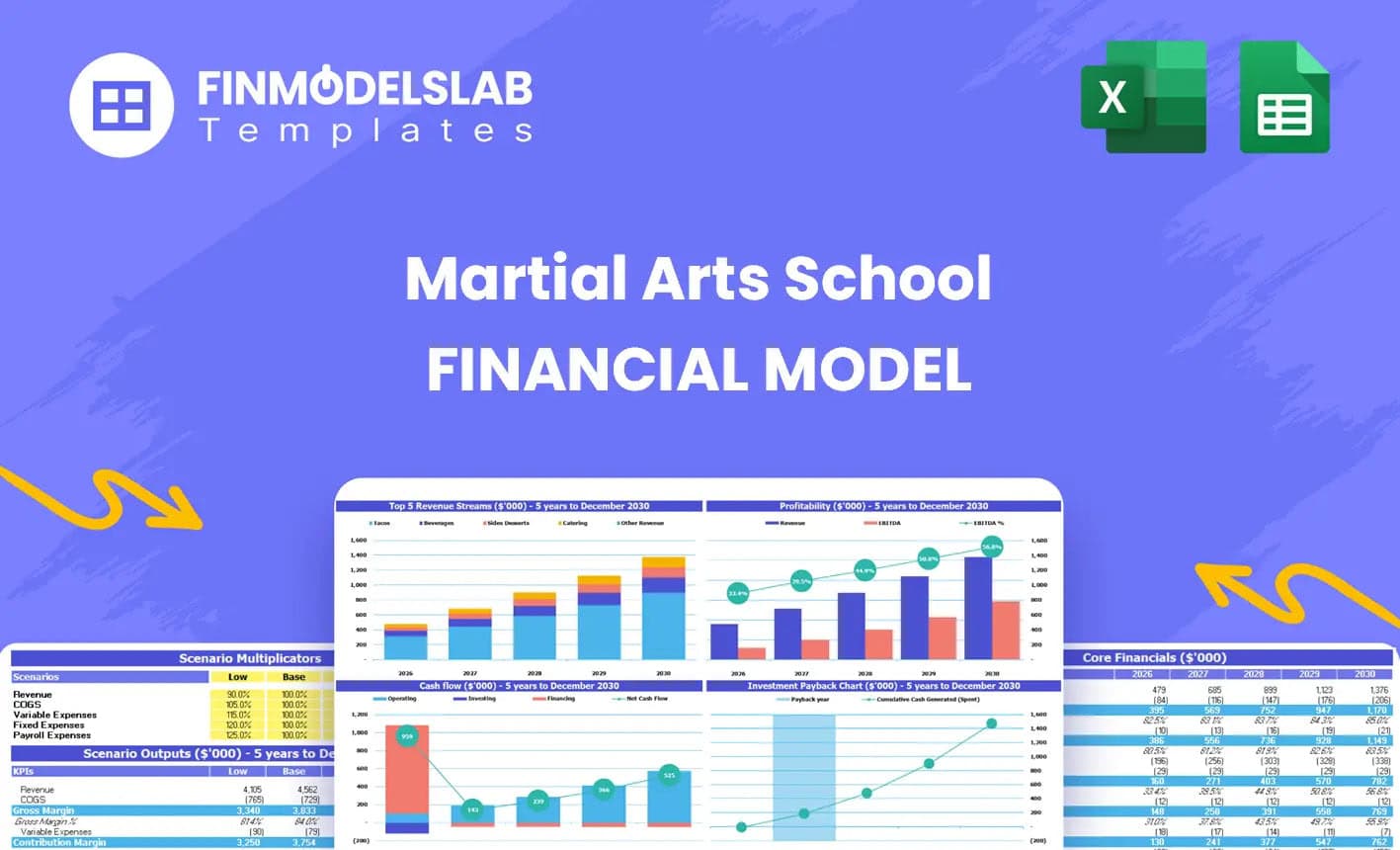
Martial Arts School Financial Model Excel Template
The Martial Arts School Financial Model helps founders, school owners, consultants, and business pla... Read more

Martial Arts School Financial Model Excel Template
The Martial Arts School Financial Model helps founders, school owners, consultants, and business pla... Read more

Dance School Financial Model Excel Template
The Dance School Financial Model helps users turn a studio concept into a structured financial forec... Read more

 City Finance
Indoor Golf Centre Finance Model
A comprehensive editable, MS Excel spreadsheet for tracking Indoor Golf Centre finances, integrates ... Read more

 eFinancialModels
Financial Plan for the Startup of a University and...
The University and School Financial Model aim to plan the operations, financial feasibility, and pro... Read more

Childcare Center Financial Plan
The Childcare Center business model template aims to forecast the financial feasibility and profitab... Read more
You must log in to submit a review.