
0 ITEMS

Physiotherapy Clinic Finance Model 5 Year 3 Statement Excel Template Bundle
A comprehensive editable, MS Excel spreadsheet for tracking Physiotherapy Clinic finances, integrates Income Statements, Balance Sheets, & Cash Flow Statements, providing a comprehensive view of financial performance.


This financial model for your physiotherapy clinic involves organizing revenue, costs, and financial projections into key sections: Income Statement, Cash Flow Statement, and Balance Sheet.
WHAT YOU GET? 3 VERSIONS IN 1 ZIP FILE. So you can decide which one is best for you.
There are 3 Versions of these Excel Templates: All are 5-Year 3 Statement.
Version 1: 5-Year, 3-Statement financial model, with 5 standard PAYG revenue streams
Version 2: 5-Year, 3-Statement with 6 Tier Subscription Tracking ‘Managed Service Agreements’. Build your MSA book as quickly as possible.
You would typically sell your services under tiered 12-month agreements that increase in price as SLAs (Service Level Agreements) and monthly physio/consulting hours increase.
Version 3: 5 Year, 3 Statement with 6 Tier Subscription Tracking, Plus 5 Inputs for PAYG Services,
All versions are completely editable and royalty-free; you buy them, you own them. The only restriction is no reselling.
1. Income Statement (Profit and Loss Statement)
Revenue Streams:
1. Subscription Services:
– Rehabilitation Programs: Revenue from clients subscribing to tailored rehabilitation services (post-injury recovery, chronic conditions).
– Inputs: Number of subscribers, subscription price, churn rate.
– Sports Injuries Treatment: Specialized plans for athletes recovering from injuries.
– Inputs: Subscriber volume, monthly pricing per program, retention rates.
– Shockwave Therapy: Subscription packages or per-session revenue from advanced therapies.
– Inputs: Number of clients, price per session or monthly package.
– Massage Therapy: Monthly membership or per-session bookings for relaxation or therapeutic massages.
– Inputs: Frequency of sessions, average price per session, membership volume.
2. Pay-As-You-Go Services: Revenue from clients paying on a per-session basis.
– Includes one-off visits for any of the above therapies.
3. Other Revenue Streams:
– Retail Sales: Physiotherapy-related equipment (e.g., foam rollers, resistance bands) or supplements.
– Workshops and Events: Revenue from hosting wellness or injury prevention workshops.
– Corporate Partnerships: Partnerships with companies offering physiotherapy benefits to employees.
Operating Expenses:
1. Fixed Costs:
– Rent/Lease: Cost of clinic space.
– Utilities: Electricity, water, internet, and heating/cooling systems.
– Insurance: Liability, property, and malpractice insurance.
– Staff Salaries: Regular wages for administrative staff and receptionists.
2. Variable Costs:
– Therapist Payments: Salaries, hourly rates, or commissions for physiotherapists and massage therapists.
– Equipment Maintenance: Costs for maintaining therapy machines (e.g., shockwave devices).
– Consumables: Costs for oils, lotions, disposable materials.
– Marketing and Advertising: Social media ads, referral discounts, or events promotions.
3. Depreciation and Amortization:
– Depreciation of equipment like therapy machines, massage tables, and clinic furniture.
– Amortization of software systems (e.g., booking platforms).
4. Interest and Financing:
– Loan interest for clinic setup or expansion.
Profitability:
– Gross Profit = Revenue – Cost of Services (therapist payments, consumables, etc.).
– Operating Profit (EBIT) = Gross Profit – Fixed Costs – Marketing Expenses – Depreciation.
– Net Income = EBIT – Interest – Taxes.
—
2. Cash Flow Statement
Operating Cash Flow:
1. Cash Inflows:
– Monthly subscription payments from clients (core income).
– Pay-as-you-go revenue from additional treatments.
– Revenue from workshops or corporate deals.
2. Cash Outflows:
– Salaries and therapist payments.
– Rent, utilities, and insurance.
– Consumables and equipment maintenance.
– Marketing expenses (online ads, referral commissions).
– Subscription software or technology costs.
Investing Cash Flow:
1. Cash Inflows:
– Sale of unused or outdated therapy equipment.
2. Cash Outflows:
– Purchase of new equipment (e.g., shockwave machines, therapy tools).
– Investment in software (appointment booking or customer management systems).
– Facility improvements or expansions.
Financing Cash Flow:
1. Cash Inflows:
– Loans or investments for new service offerings or expansion.
2. Cash Outflows:
– Loan repayments (principal and interest).
– Dividends or profit-sharing with owners/investors.
Net Cash Flow:
– Operating + Investing + Financing Cash Flows = Net Change in Cash.
—
3. Balance Sheet
Assets:
1. Current Assets:
– Cash and Cash Equivalents: Liquid funds available.
– Accounts Receivable: Outstanding subscription payments or corporate client payments.
– Inventory: Retail items like physiotherapy equipment or supplements.
2. Non-Current Assets:
– Equipment: Therapy machines, massage tables, and diagnostic tools.
– Leasehold Improvements: Renovations for therapy rooms or waiting areas.
– Technology Assets: Booking software, client management systems.
Liabilities:
1. Current Liabilities:
– Accounts Payable: Payments due to suppliers or service providers.
– Short-Term Debt: Loan portions due within a year.
– Deferred Revenue: Advance payments for subscription services not yet delivered.
2. Long-Term Liabilities:
– Loans or financing for equipment purchases or clinic setup.
Equity:
– Owner’s Equity: Initial capital or retained earnings reinvested into the clinic.
Balance Equation:
– Assets = Liabilities + Equity
4. MRR and ARR Revenue Tracking
Focuses on tracking the recurring revenue that forms the backbone of a subscription-based business.
- Monthly Recurring Revenue (MRR): Total monthly revenue generated from active subscriptions.
MRR = (Number of subscribers in each tier × Tier price). - Annual Recurring Revenue (ARR): Total expected revenue over a year from recurring subscriptions. ARR = MRR × 12.
Metrics to Monitor
- Subscriber Growth Rate:
(New Subscribers – Cancellations) / Starting Subscribers. - Churn Rate:
(Number of Cancellations / Starting Subscribers). - Lifetime Value (LTV):
Average Revenue Per User (ARPU) × Average Subscriber Lifetime. - Customer Acquisition Cost (CAC):
Total Sales & Marketing Costs / Number of New Subscribers. - LTV/CAC Ratio:
Indicates the ROI on customer acquisition.
Dashboard Components
- MRR by Tier:
Breakdown of MRR across different subscription plans (e.g., Rehabilitation, Sports Injury). - MRR Growth:
Month-over-month MRR change percentage. - Churn Analysis:
Identify patterns or reasons for subscriber cancellations. - ARR Projections:
Forecast ARR based on historical MRR trends and growth rates.
Key Metrics and Ratios
1. Revenue Per Client: Total Revenue / Average Number of Clients.
2. Gross Margin: (Revenue – Cost of Services) / Revenue.
3. EBITDA Margin: Operating Profit Before Depreciation, Interest, and Taxes / Revenue.
4. Client Retention Rate: (Clients Retained Over a Period / Total Clients at Start) x 100%.
5. Break-Even Analysis: Fixed Costs / (Average Revenue Per Client – Variable Cost Per Client).
This financial model provides a structured approach to assess the profitability and financial health of the physiotherapy clinic while highlighting the importance of balancing subscription services, pay-as-you-go treatments, and associated costs.
Similar ProductsOther customers were also interested in...


 City Finance
Medical Center (Centre) Clinic Financial Model 5 Y...
A comprehensive editable, MS Excel spreadsheet for tracking private Medical Center finances, includi... Read more

 strategyfinancialmod...
HOSPITAL Financial Model Template
A comprehensive and customizable financial template that captures all the key aspects of the hospita... Read more

 HenrySheykin
Medical Practice Financial Model Excel Template
The Medical Practice Financial Model helps users turn a clinic concept, expansion plan, or healthcar... Read more

Dental Practice Financial Model Excel Template
The Dental Clinic Financial Model helps users turn a dental practice concept, launch plan, or expans... Read more

Ophthalmology Financial Model Excel Template
The Ophthalmology Clinic Financial Model is a ready-to-use financial model template designed to help... Read more

Clinic Financial Model Excel Template
The Healthcare Clinic Financial Model helps founders, clinic owners, consultants, analysts, and busi... Read more
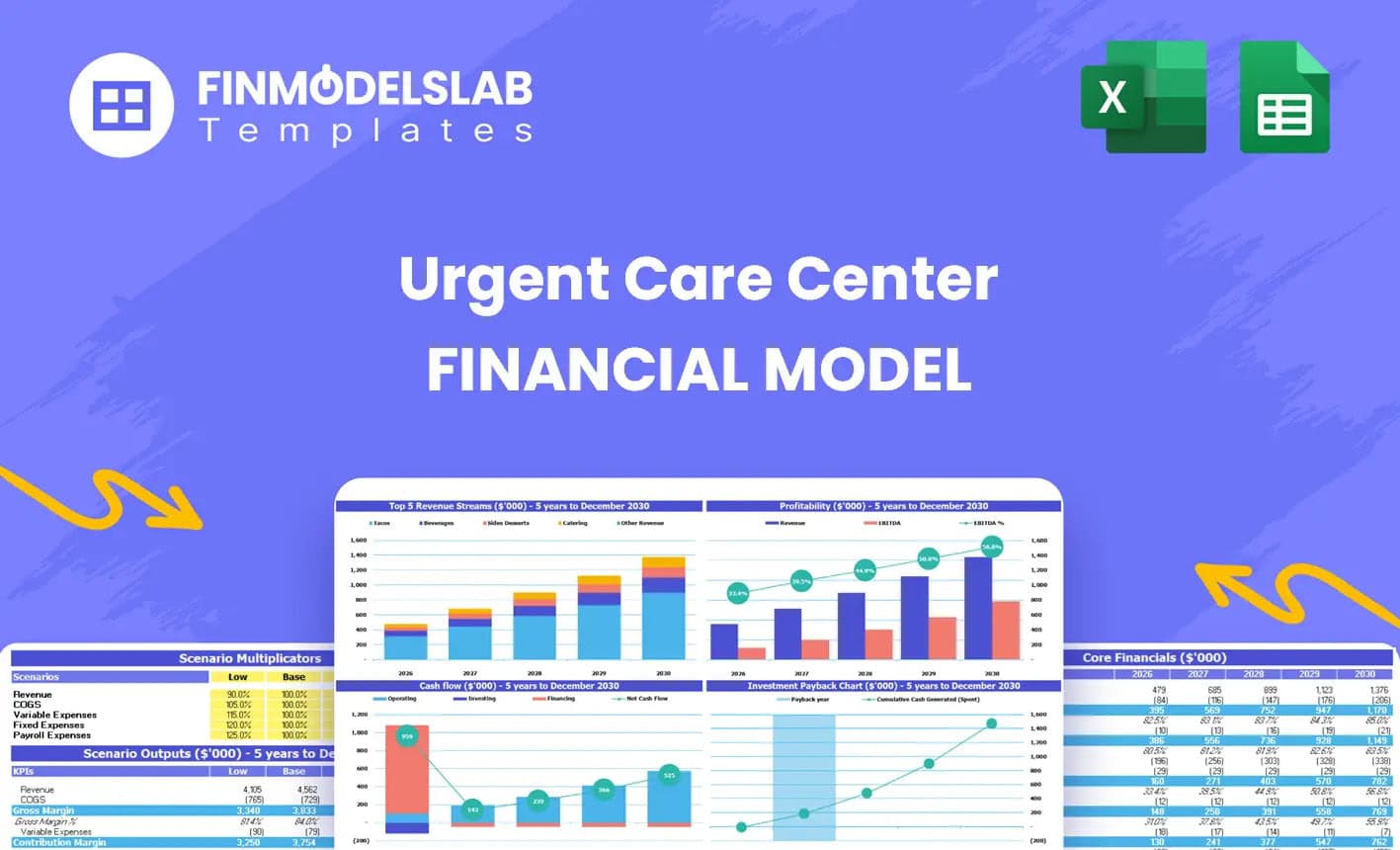
Urgent Care Center Financial Model Excel Template
The Urgent Care Center Financial Model helps users turn a walk-in clinic concept into a structured f... Read more

Veterinary Financial Model Excel Template
The Veterinary Clinic Financial Model Financial Model Template helps entrepreneurs, clinic owners, c... Read more

Outpatient Clinic Financial Model Excel Template
The Outpatient Clinic Financial Model helps users turn a clinic business concept into a structured, ... Read more

Nutritionist Financial Model Excel Template
The Nutritionist Financial Model Financial Model Template helps turn a nutrition practice, dietitian... Read more
You must log in to submit a review.