
0 ITEMS

Mobile App Financial Model Excel – 60-Month Forecast, Subscriptions, Cohorts, CAC/LTV & 3 Statements
Professional 60-month mobile app Excel model with subscriber cohorts, monthly and annual subscriptions, freemium conversion, in-app purchases, advertising, CAC/LTV, P&L, balance sheet, cash flow, three scenarios and 8 linked dashboard charts. Includes a 16-page PDF guide.

MOBILE APP FINANCIAL MODEL
60-Month SIGNATURE Edition | Subscriptions, Freemium, In-App Purchases & Three-Statement Forecasting
Plan user growth. Model monetization. Forecast profitability. Understand funding requirements.
Turn your mobile app business assumptions into a structured, transparent and fully editable five-year Excel financial forecast.
The Mobile App Financial Model – SIGNATURE Edition by SheetworksStudio is a professional financial planning system designed for app founders, startup CFOs, product teams, financial analysts, consultants and early-stage investors.
Rather than forecasting revenue from a single growth assumption, the workbook connects paid and organic acquisition, user activation, cohort retention, subscription conversion, in-app purchases and advertising monetization to operating expenses, financial statements and projected liquidity.
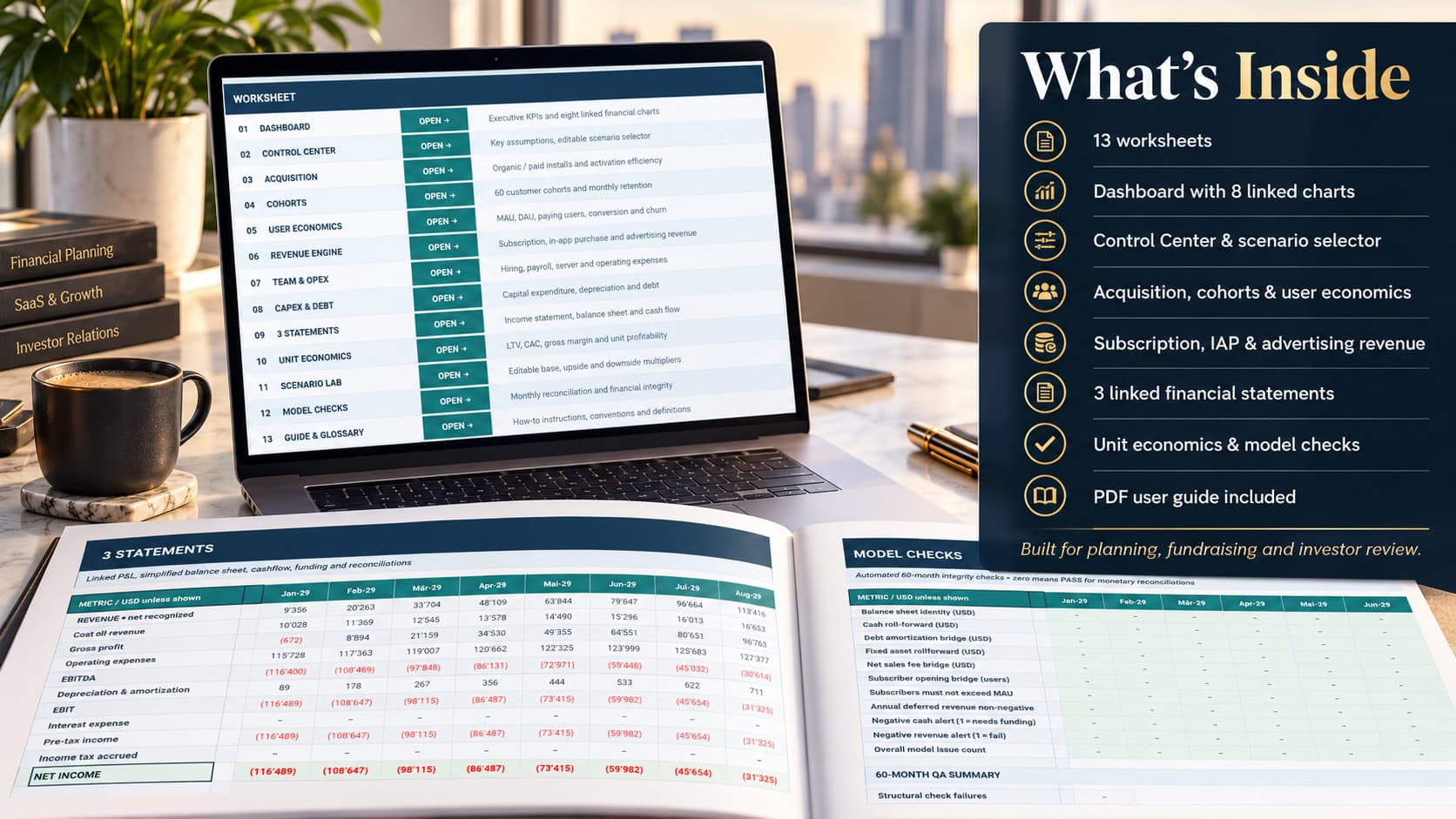
The integrated model contains 14 interconnected worksheets, 60 monthly forecast periods, three operating scenarios, eight dynamic dashboard charts and a separate 16-page PDF user guide.
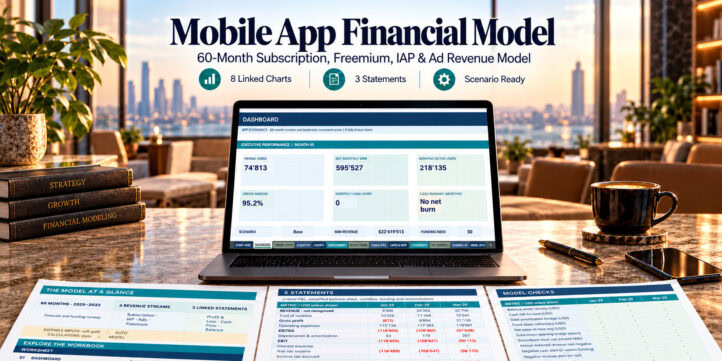
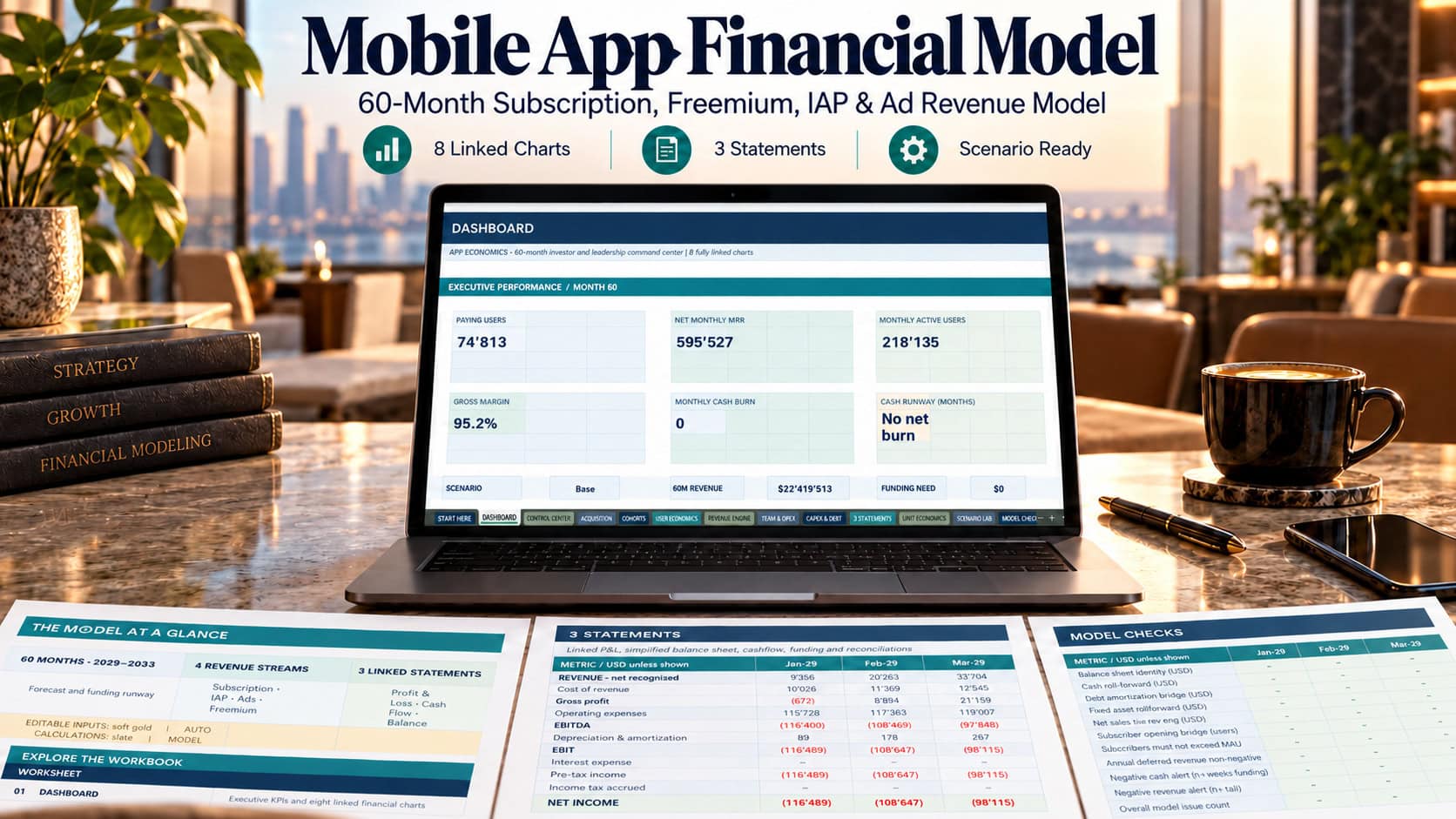
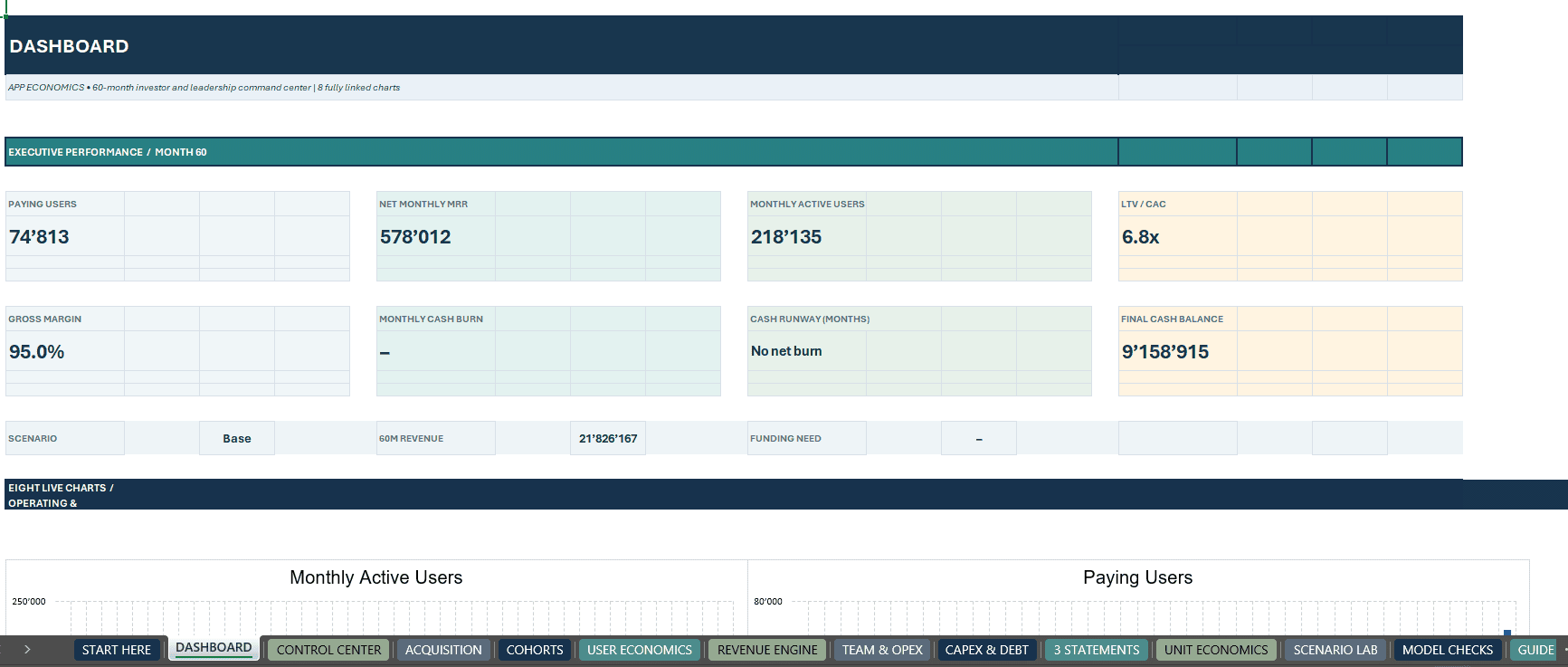
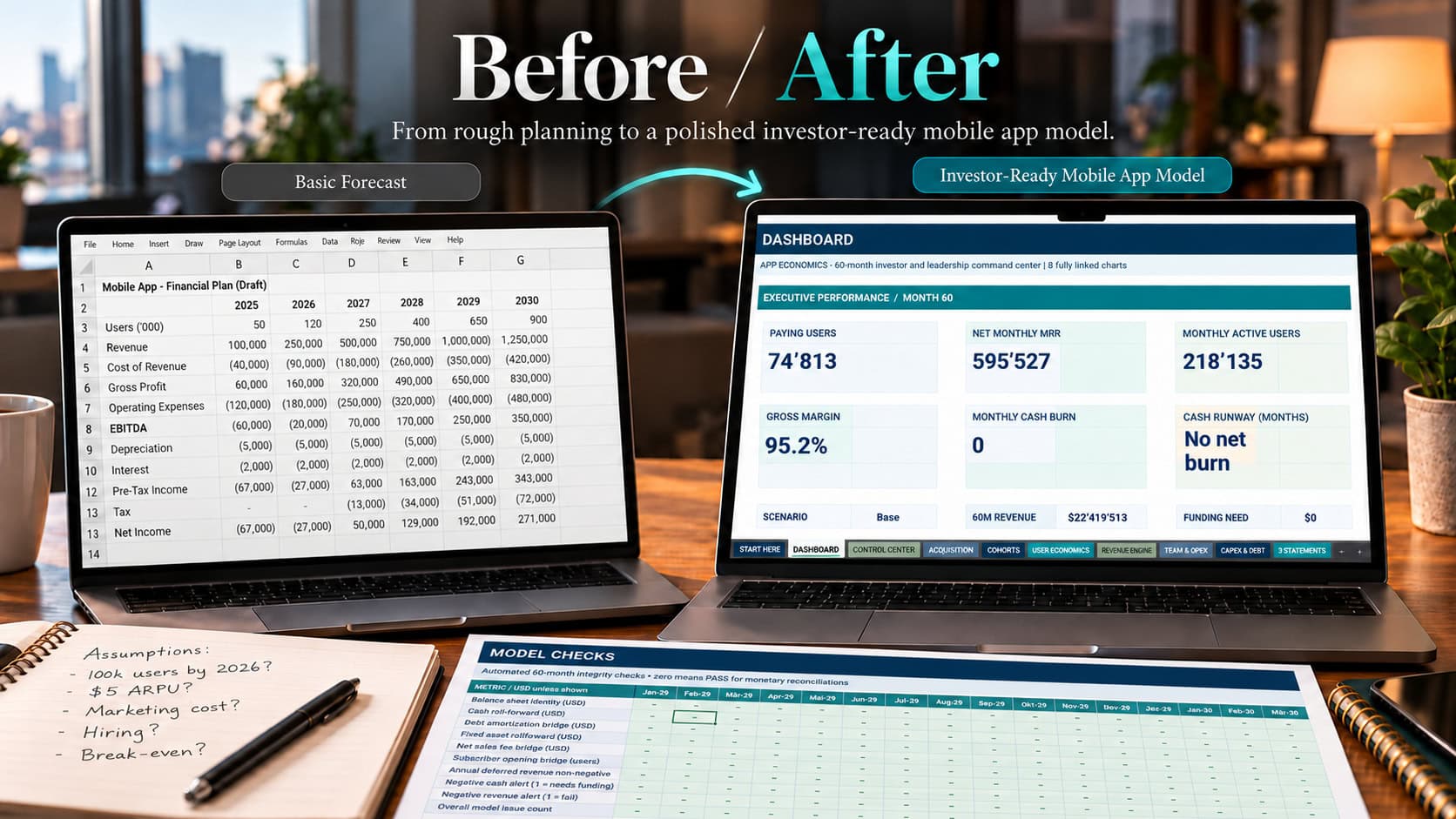
📊 EXECUTIVE DASHBOARD – EIGHT LINKED CHARTS
Monitor your mobile app’s operating and financial performance through a professional Executive Dashboard.
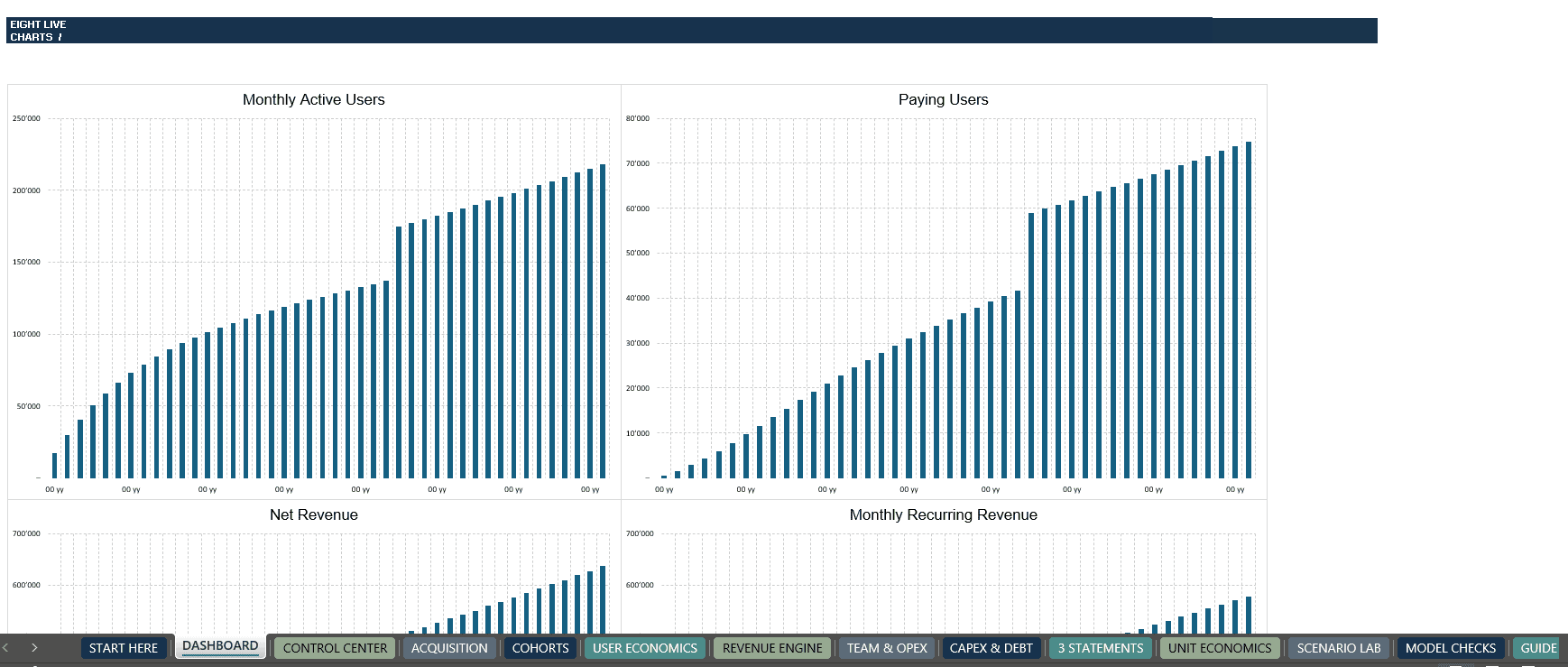
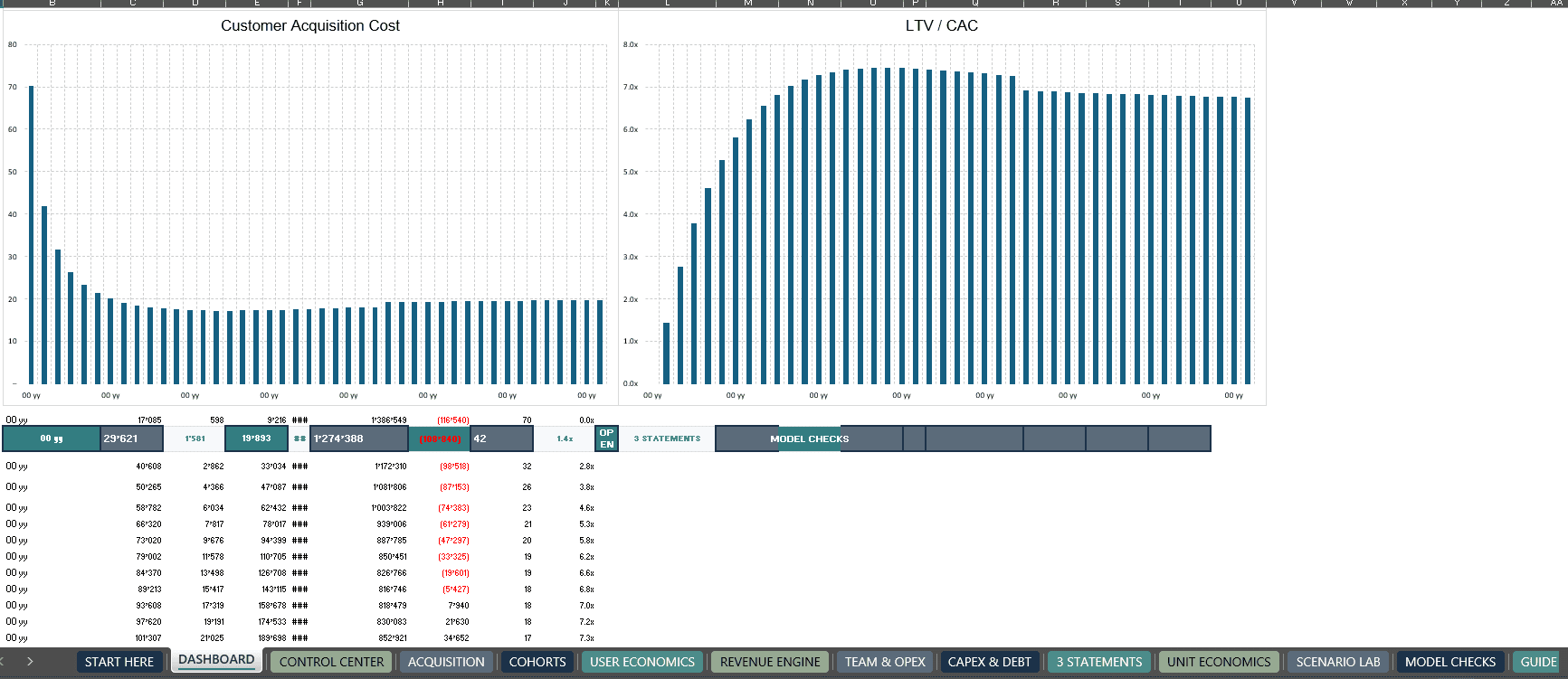
Eight native Excel charts visualize:
- Monthly Active Users (MAU)
- Paying Subscribers
- Net Revenue
- Monthly Recurring Revenue (MRR)
- Closing Cash Balance
- EBITDA Performance
- Customer Acquisition Cost (CAC)
- Lifetime Value to Acquisition Cost (LTV/CAC)
The dashboard also provides key performance indicators covering active users, paying subscribers, recurring revenue, gross margin, monthly cash burn, cash runway, cumulative revenue, liquidity and estimated funding requirements.
All dashboard indicators are linked to the underlying model calculations and update when assumptions or scenarios change.
📱 USER ACQUISITION, COHORTS & RETENTION
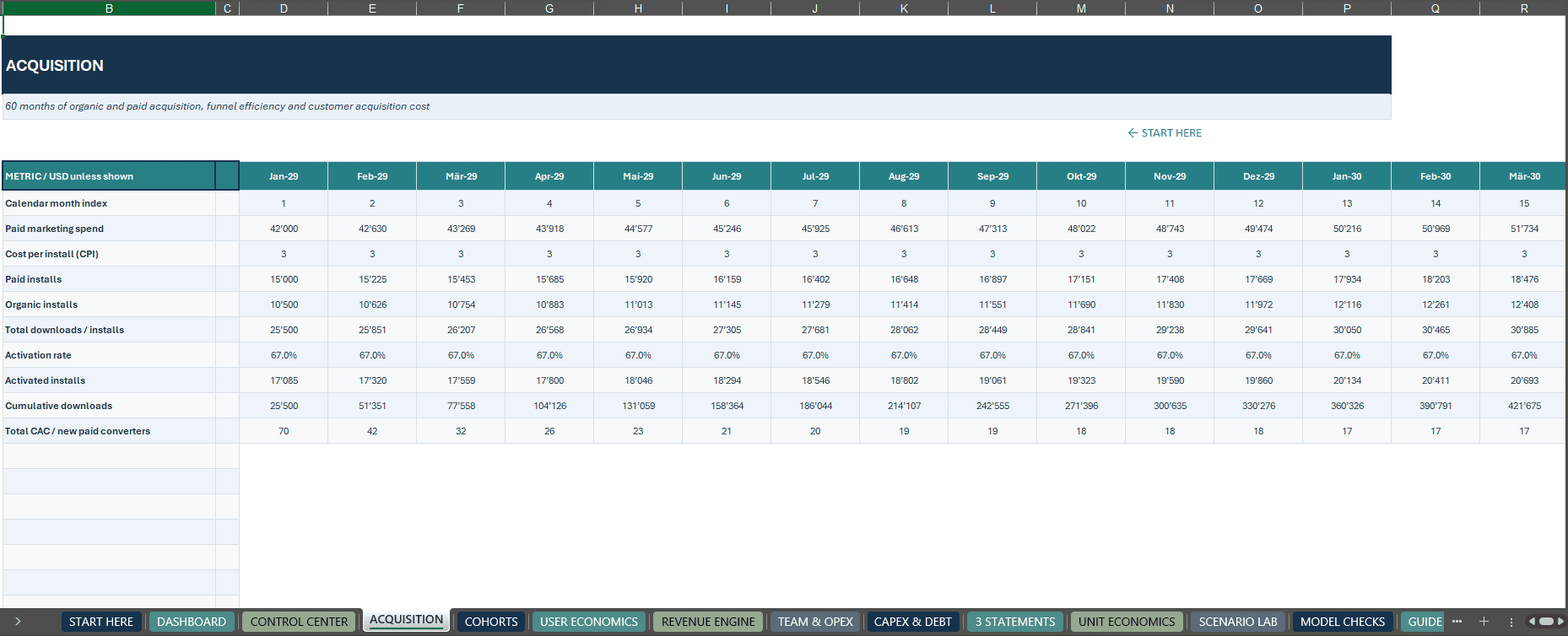
Model the relationship between marketing investment, app downloads, active users and paying subscribers.
Paid & Organic Acquisition
Forecast paid installs using marketing spend and Cost per Install (CPI), while separately modeling organic user acquisition and growth assumptions.
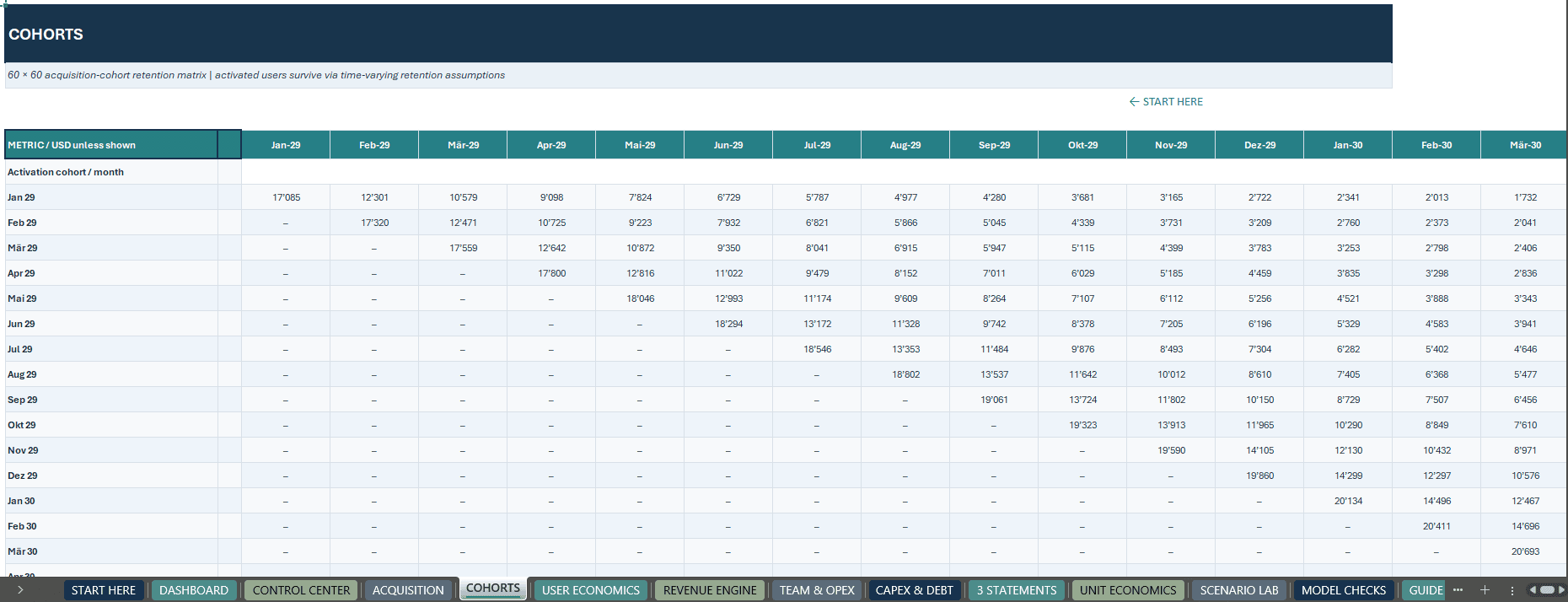
60-Cohort Retention Model
Analyze how new users enter the app ecosystem and contribute to future activity through a 60-cohort retention structure.
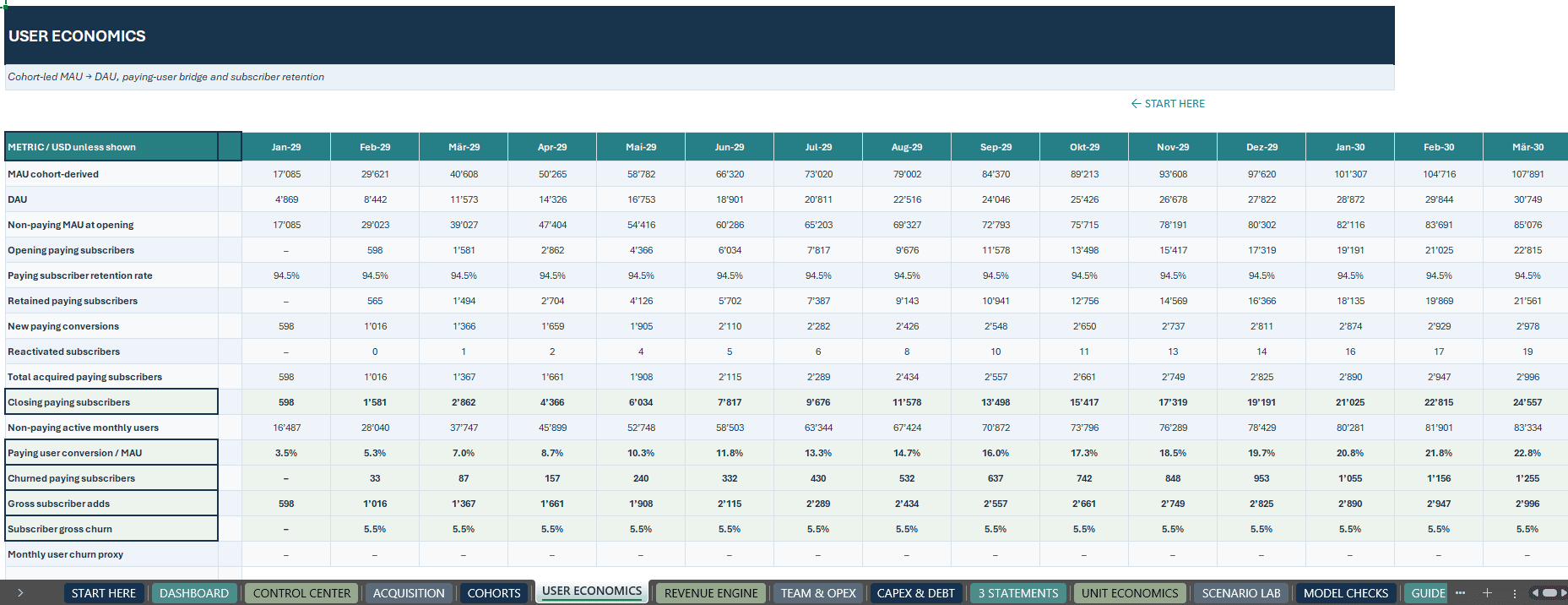
Active User Development
Connect activation, retention and user activity to Monthly Active Users (MAU), Daily Active Users (DAU) and engagement indicators.
Subscription Conversion & Churn
Model paying subscriber conversion, subscription cancellations and reactivation to understand recurring revenue development.
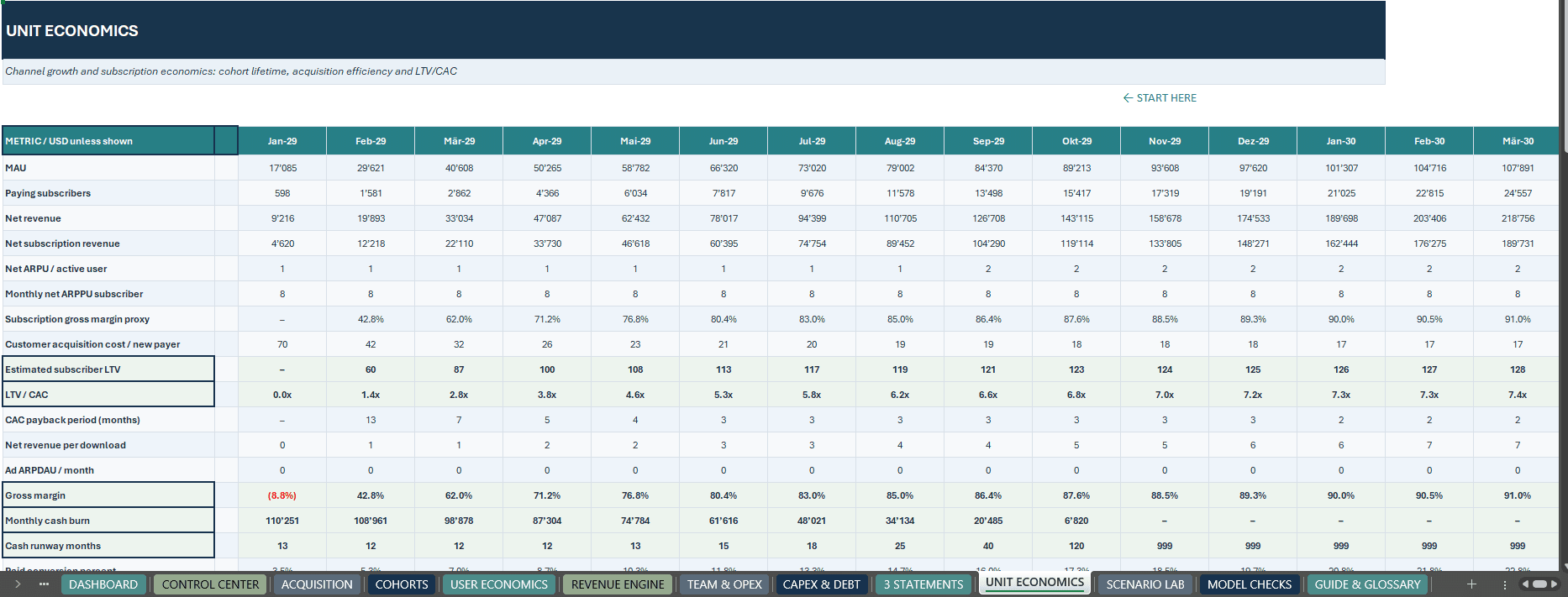
Customer Unit Economics
Evaluate customer acquisition cost, estimated subscriber lifetime value, LTV/CAC and CAC payback.
This approach helps founders understand how acquisition efficiency and customer retention influence long-term financial performance.
💰 MULTIPLE MONETIZATION STREAMS
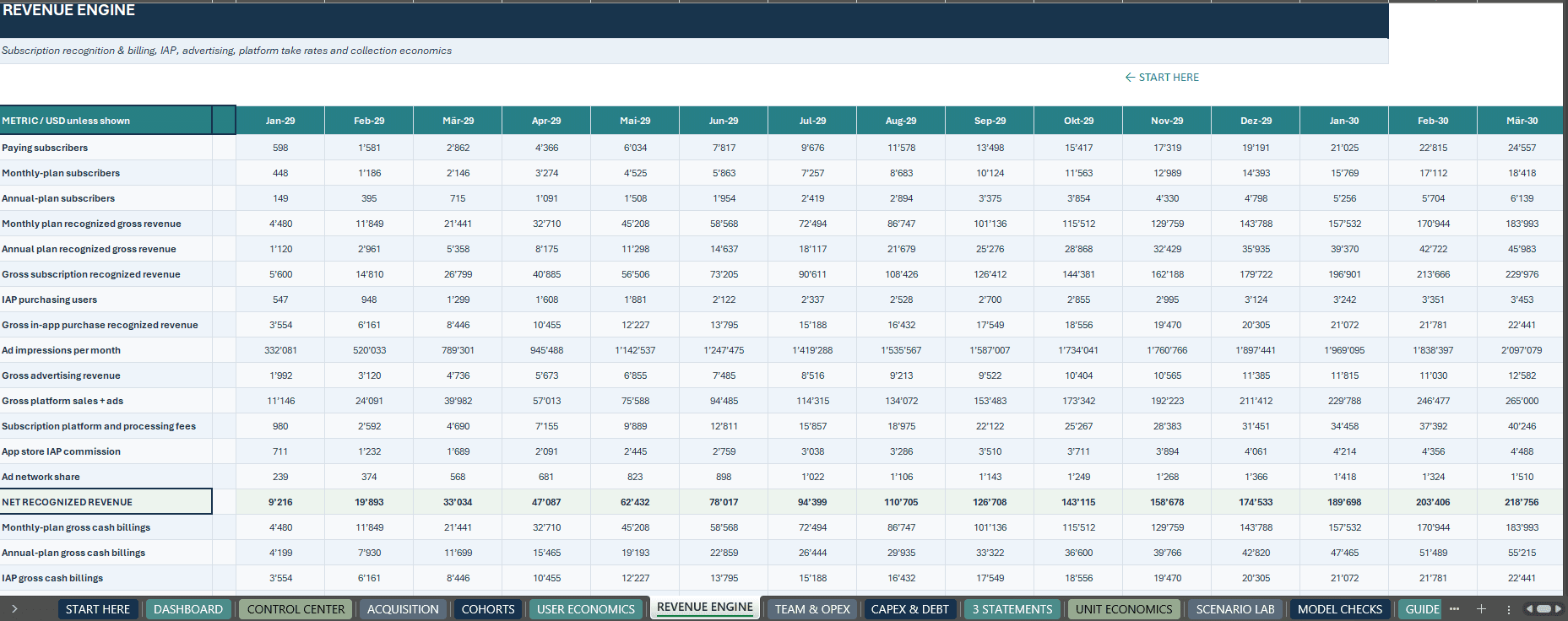
The Revenue Engine combines three paid monetization channels with a freemium acquisition and conversion model.
1. Subscription Revenue
Forecast monthly and annual subscription plans using configurable subscriber counts, prices, conversion assumptions and customer retention.
The workbook distinguishes recognized subscription revenue from estimated cash collections.
For annual subscriptions, the model includes simplified upfront billing assumptions, renewal behavior and related deferred revenue calculations.
Platform commissions and subscription payment-processing fees are incorporated into net revenue.
2. In-App Purchases
Estimate revenue generated by virtual goods, premium features, digital products or other in-app transactions.
Calculations use user activity, purchasing conversion, average transaction amounts and applicable platform commissions.
3. Advertising Revenue
Forecast advertising monetization based on active users, estimated impressions, advertising frequency and Revenue per Mille (RPM).
The model also considers advertising network fees when calculating net advertising revenue.
4. Freemium Conversion Economics
Analyze how free users contribute to active-user growth, subscription conversions, purchases and advertising opportunities.
Freemium is modeled as a user acquisition and monetization mechanism rather than a separate fourth cash revenue line.
The integrated Revenue Engine connects these calculations to financial performance and cash flow.
📈 60-MONTH FORECAST & THREE FINANCIAL STATEMENTS
The model provides 60 monthly forecast periods, with illustrative data covering January 2029 through December 2033.
A configurable starting date allows the forecast to be adapted to different planning periods.
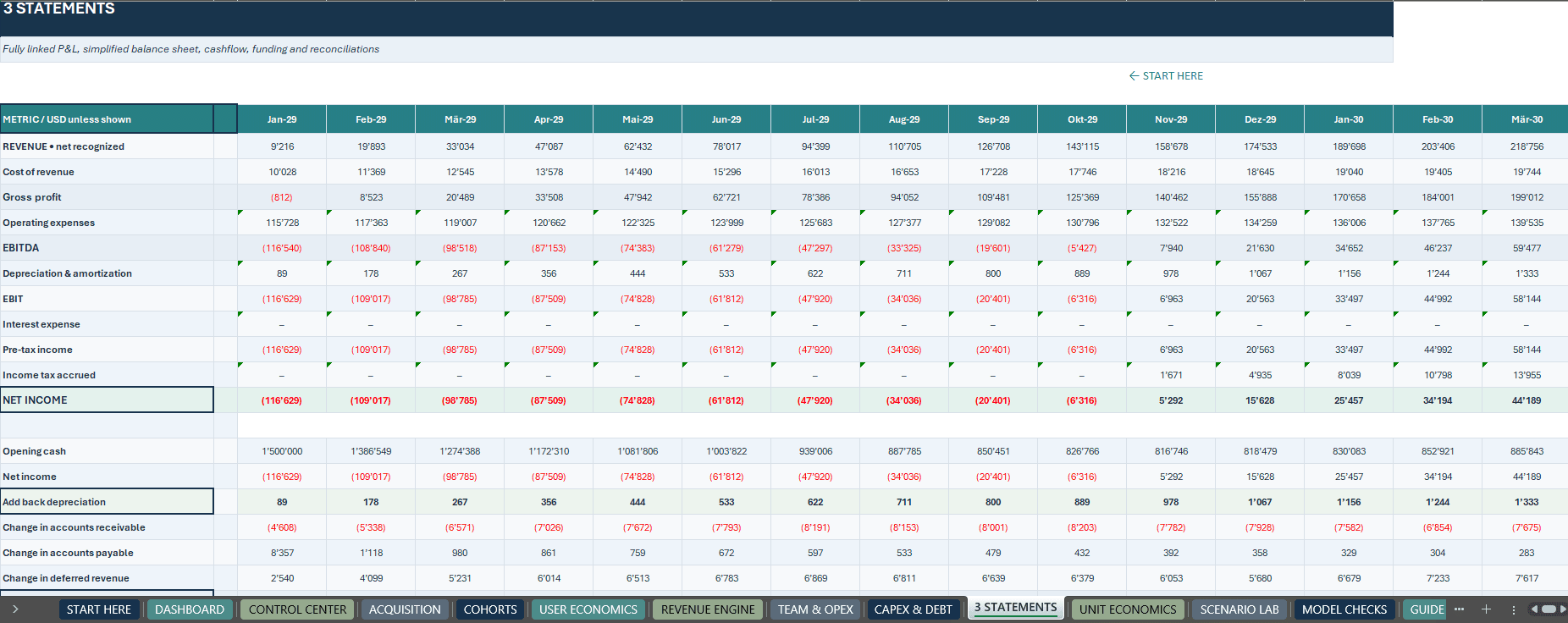
Income Statement – Profit & Loss
Analyze recognized revenue, direct operating costs, gross profit, payroll, marketing, operating expenses, EBITDA, depreciation, financing costs, simplified taxation and net income.
Balance Sheet
Review projected cash, accounts receivable, fixed assets, accounts payable, deferred subscription revenue, financing balances and shareholders’ equity.
Cash Flow Statement
Monitor cash movements from operating activities, capital investment, financing activity and resulting closing cash balances.
The financial statements are linked to the underlying acquisition, monetization, expense and financing calculations.
A dedicated MODEL CHECKS worksheet provides monthly reconciliation and warning indicators to help identify selected financial inconsistencies.
🧮 OPERATING COSTS, UNIT ECONOMICS & FUNDING
Understand how growth assumptions translate into financial requirements.
The workbook includes:
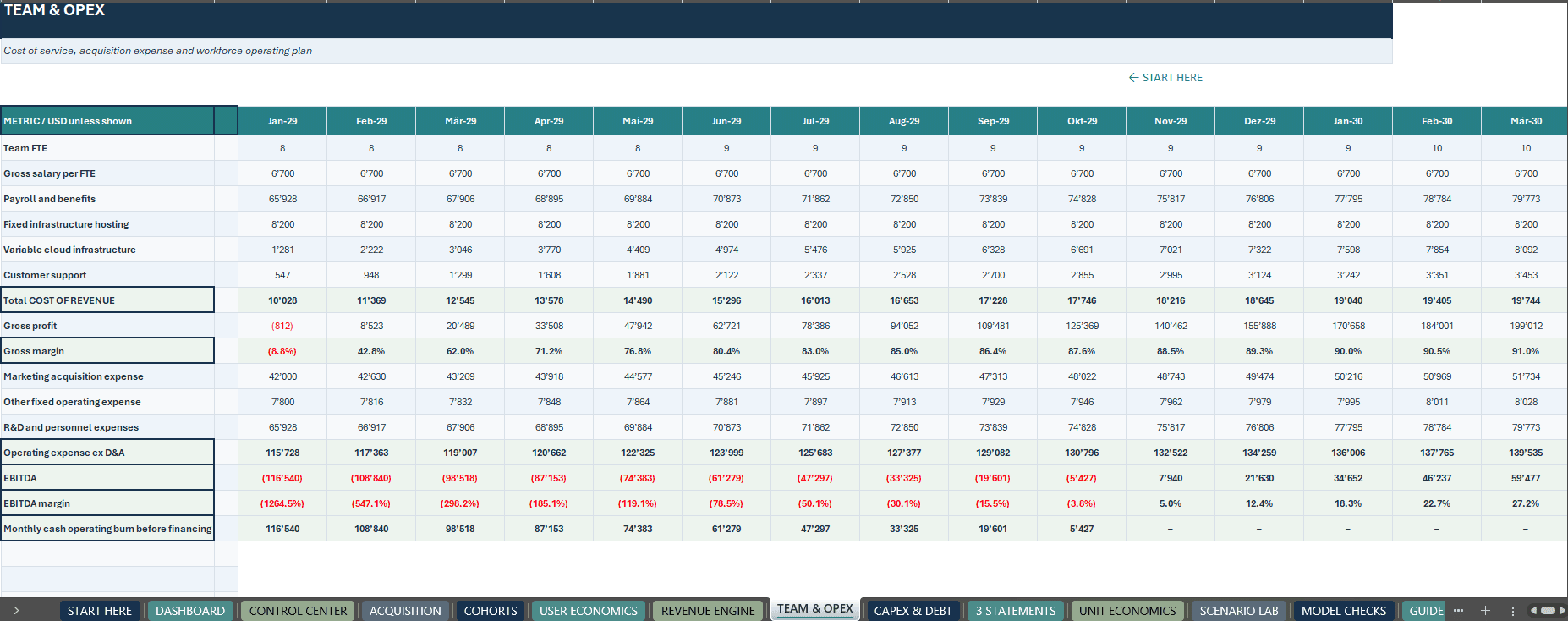
- Employee and Payroll Planning
- Marketing Expenditure
- Hosting and Server Costs
- Customer Support and Operating Expenses
- Capital Expenditure and Depreciation
- Simplified Debt and Equity Financing
- Monthly Cash Burn and Cash Runway
- Estimated Funding Requirements
- Customer Acquisition Cost (CAC)
- Estimated Customer Lifetime Value (LTV)
- LTV/CAC Ratio and CAC Payback
- Revenue and Profitability Analysis
These modules support financial planning, business-case development, fundraising discussions and management reporting.
🔄 THREE INTEGRATED FINANCIAL SCENARIOS
Explore alternative operating assumptions without rebuilding the workbook.
BASE CASE
A central financial forecast based on the selected acquisition, pricing, retention and expense assumptions.
UPSIDE CASE
A more favorable outlook incorporating improvements in customer acquisition efficiency, subscriber conversion, retention and advertising monetization.
DOWNSIDE CASE
A more conservative forecast reflecting weaker acquisition efficiency, retention, conversion and advertising economics.
Scenario selection flows into the operating calculations, financial statements, cash forecasts and Executive Dashboard.
This enables users to evaluate how changes in app performance affect revenue, profitability and funding requirements.
📦 WHAT YOU RECEIVE
1. Premium Mobile App Financial Model (.xlsx)
A professional, editable Excel workbook with 14 interconnected worksheets:
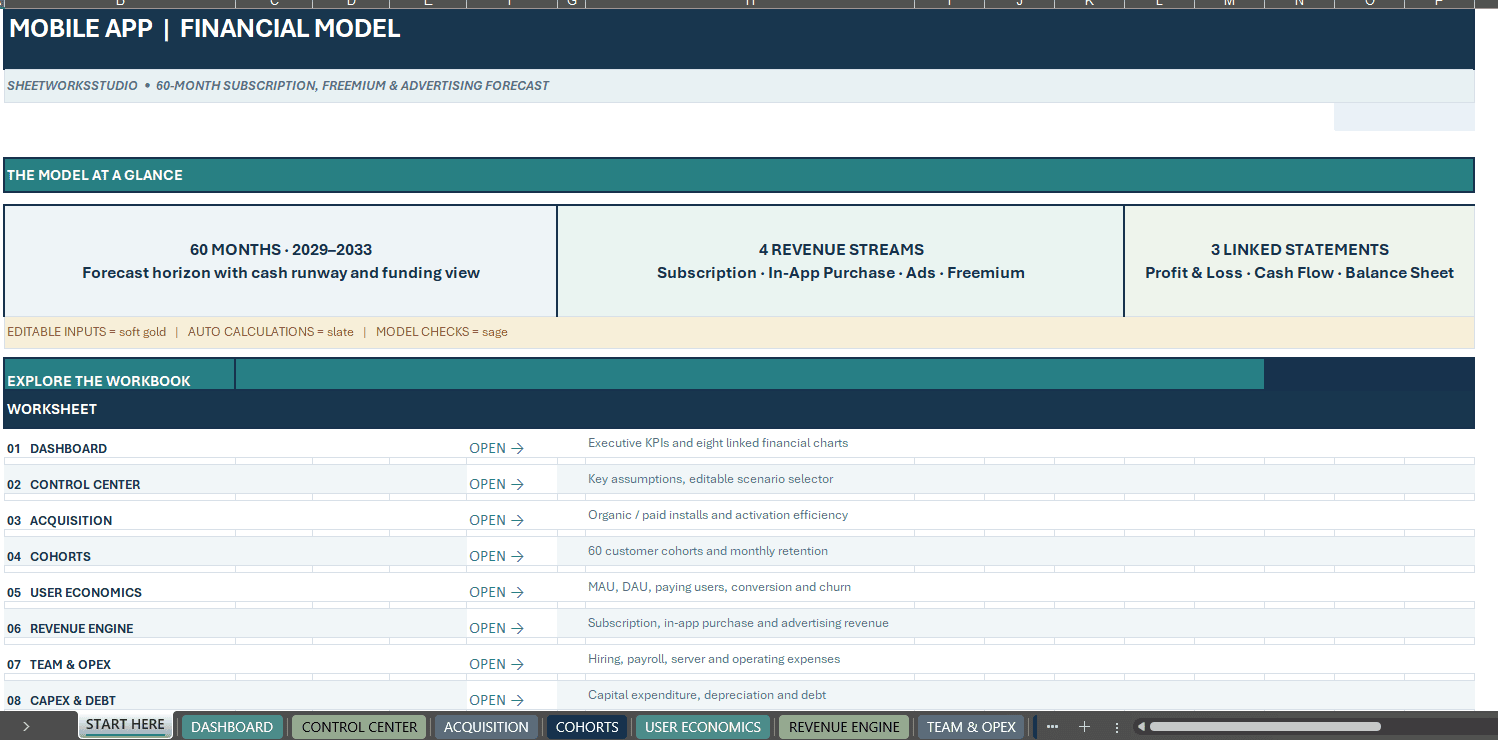
Worksheet Function START HERE Overview, instructions and navigation DASHBOARD Executive KPIs and eight dynamic charts CONTROL CENTER Central assumptions and scenario selection ACQUISITION Paid and organic app-user acquisition COHORTS Cohort-based customer retention USER ECONOMICS Active users, subscribers and churn REVENUE ENGINE Subscriptions, in-app purchases and advertising TEAM & OPEX Hiring, payroll and operating expenses CAPEX & DEBT Capital investment and financing 3 STATEMENTS Integrated P&L, balance sheet and cash flow UNIT ECONOMICS CAC, LTV, profitability and efficiency metrics SCENARIO LAB Scenario assumptions and adjustments MODEL CHECKS Monthly reconciliation and validation GUIDE & GLOSSARY Workbook instructions and terminology
2. Professional How-to-Use Guide – 16-Page PDF
A detailed English-language guide covering:
- Workbook Setup and Navigation
- Editable Assumptions
- User Acquisition and Retention
- Subscription Monetization
- In-App Purchases and Advertising
- Financial Statement Interpretation
- Customer Unit Economics
- Scenario Analysis
- Model Validation and Troubleshooting
- Financial Model Limitations
3. Illustrative Sample Data
The workbook includes fictional app business assumptions and calculated examples to demonstrate the complete modeling workflow.
All main financial formulas remain visible and editable.
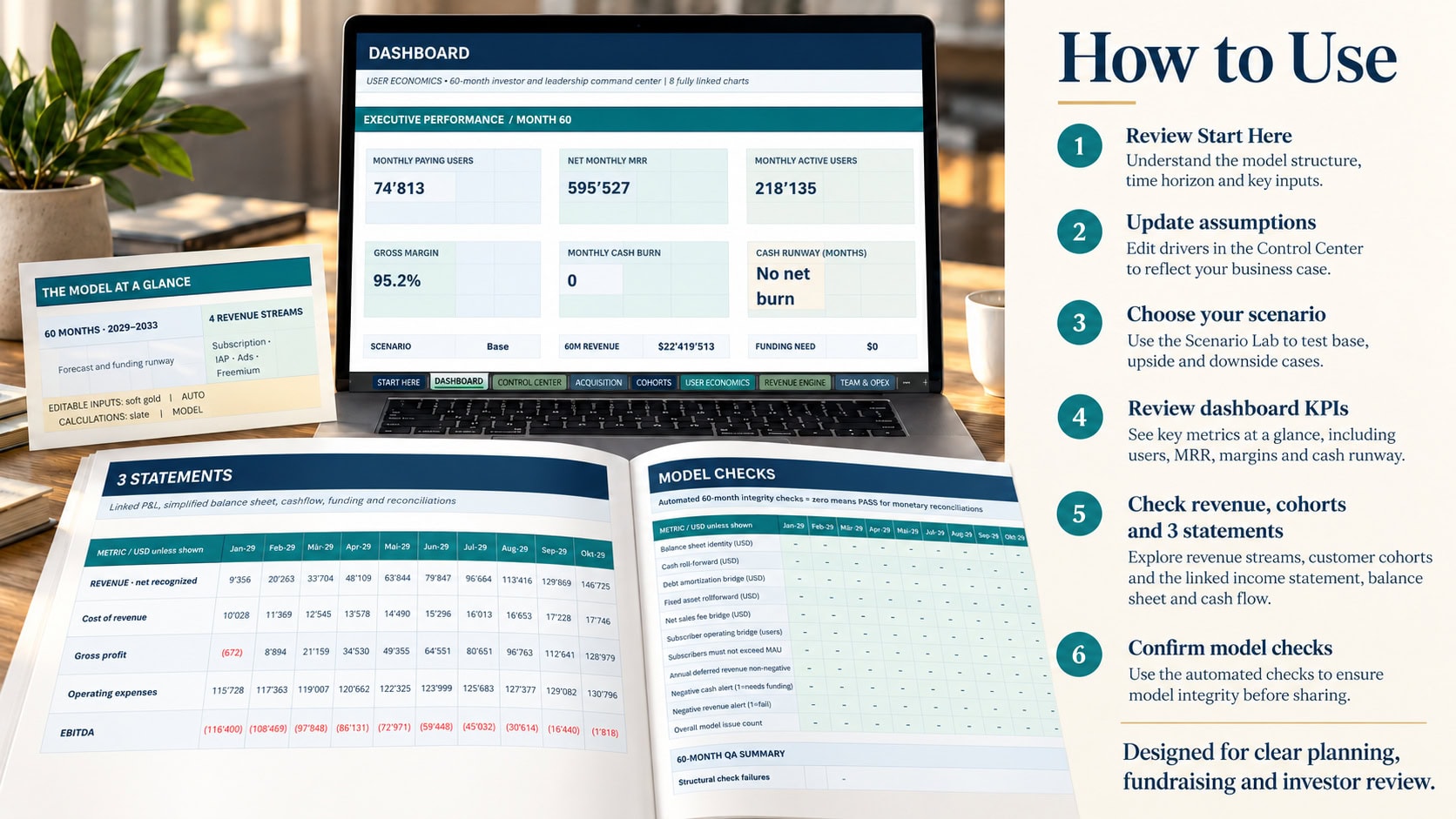
⚙️ HOW TO USE
Step 1 – Start with the Workbook Overview
Open START HERE and review the navigation, workflow and input conventions.
Step 2 – Configure Your Business
Use CONTROL CENTER to enter the forecast start date, customer acquisition assumptions, subscription prices, operating parameters and financial scenario.
Step 3 – Review User Growth
Analyze ACQUISITION, COHORTS and USER ECONOMICS to understand how acquisition and retention affect active users and paying subscribers.
Step 4 – Model Revenue
Review REVENUE ENGINE to analyze subscriptions, in-app purchases, advertising and related fees.
Step 5 – Evaluate Financial Performance
Use DASHBOARD, TEAM & OPEX, CAPEX & DEBT, 3 STATEMENTS and UNIT ECONOMICS to assess profitability, liquidity and funding needs.
Step 6 – Compare Scenarios
Switch between Base, Upside and Downside to investigate alternative outcomes.
Step 7 – Validate Your Forecast
Review MODEL CHECKS and investigate any warnings before relying on the results.
IDEAL FOR
- Mobile App Founders and Entrepreneurs
- Subscription-Based Mobile Businesses
- Freemium App Developers
- Consumer Mobile App Startups
- Product Managers and Growth Teams
- Startup CFOs and Finance Managers
- Financial Analysts and Consultants
- Early-Stage Investors
- Startup Accelerators and Incubators
- Business Plan and Fundraising Preparation
TECHNICAL SPECIFICATIONS
- File Format: Microsoft Excel (.xlsx)
- Forecast Horizon: 5 Years
- Forecast Frequency: Monthly
- Forecast Periods: 60
- Default Example: January 2029 – December 2033
- Worksheets: 14
- Dashboard Charts: 8
- Operating Scenarios: 3
- Customer Cohorts: 60
- Financial Statements: Income Statement, Balance Sheet and Cash Flow
- Formulas: Editable and Visible
- Macros: None
- External Data Connections: None
- PDF User Guide: 16 Pages
Microsoft Excel Desktop is recommended.
Google Sheets import and functional compatibility have not been independently verified. Equivalent formula calculations, dropdowns, charts, navigation and formatting are therefore not guaranteed.
IMPORTANT MODEL CONVENTIONS & DISCLAIMER
This is an illustrative mobile app financial planning and forecasting model, not a statutory accounting system, audited GAAP/IFRS model, subscription billing platform or certified investment valuation.
Annual subscription revenue recognition, advance collections, deferred revenue, renewals, working capital, taxation, financing and cash runway use simplified financial planning assumptions.
The cohort model uses deterministic retention assumptions rather than actual customer transaction records.
The model does not include a full discounted cash flow valuation, legal capitalization table or detailed ownership dilution calculations.
Results depend on user-provided assumptions and may differ materially from actual business performance.
Users are responsible for independently verifying all inputs, formulas, financial calculations and investment decisions.
The template does not constitute financial, investment, tax, legal, accounting or professional business advice.
All included sample figures and business assumptions are fictional and provided for educational and planning purposes.
No physical product will be shipped.
Developed by SheetworksStudio – Professional Financial Models & Business Planning Tools.
Similar ProductsOther customers were also interested in...



 eFinancialModels
Electric Vehicle (EV) Charging Station Financial M...
With this comprehensive 5- or 10-year monthly tool, investors can assess the viability of setting up... Read more

Financial Model for Mobile App | Mobile App Busine...
The Mobile App Financial Plan Template in Excel allows you to develop financial projections when lau... Read more

 HenrySheykin
Food Truck Financial Model Excel Template
The Food Truck Financial Model helps entrepreneurs, founders, business owners, consultants, and anal... Read more

Green Hydrogen Production from Wind Energy Financi...
The Green Hydrogen from Wind Financial Model aims to comprehensively forecast a horizon of 40 years ... Read more

Simple Mutual Non-Disclosure Agreement Template
Protect your business secrets with ease using our Simple Mutual Non-Disclosure Agreement Template. S... Read more

Solar Energy Financial Model
The Solar Energy Financial Model Spreadsheet Template in Excel assists you in preparing a sophistica... Read more

 Peter Graf
The Customer-Centric Financial Model for Restauran...
Starting a restaurant without a financial plan is like driving a car blindfolded. You wouldn´t do i... Read more
You must log in to submit a review.