
0 ITEMS

E-Commerce & DTC Financial Model Excel – 60-Month Forecast, Inventory, Cash Flow, 3 Statements & DCF
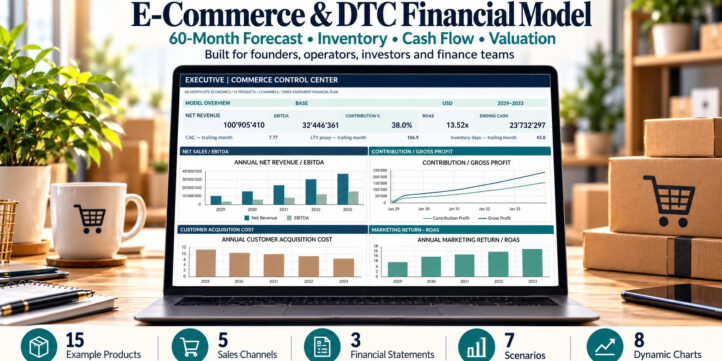
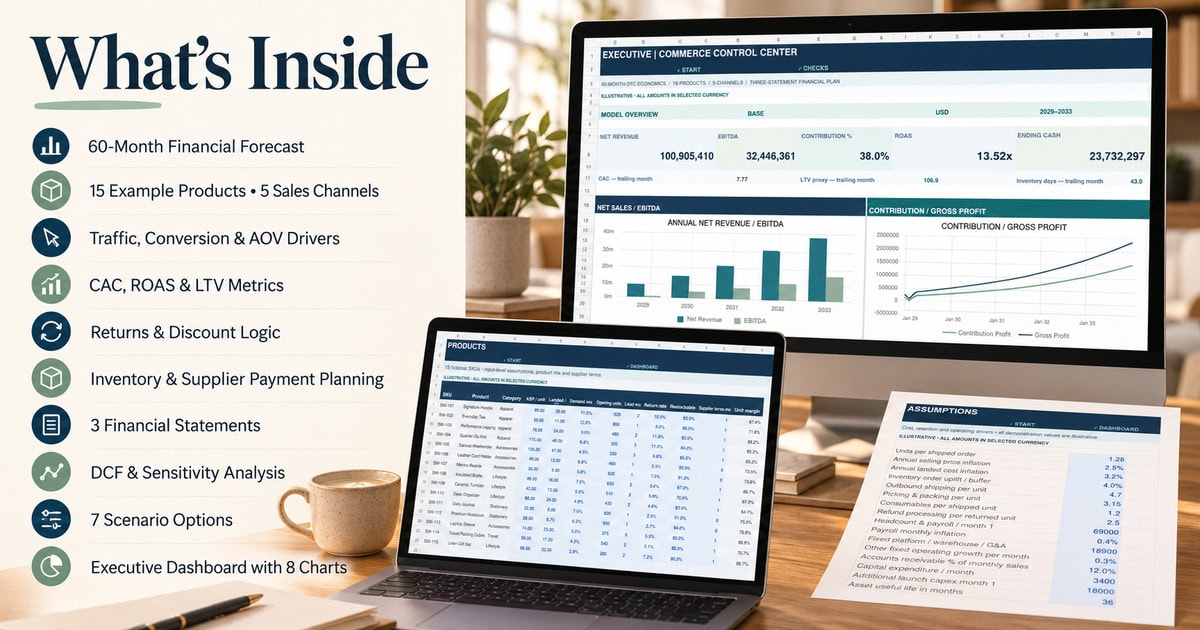
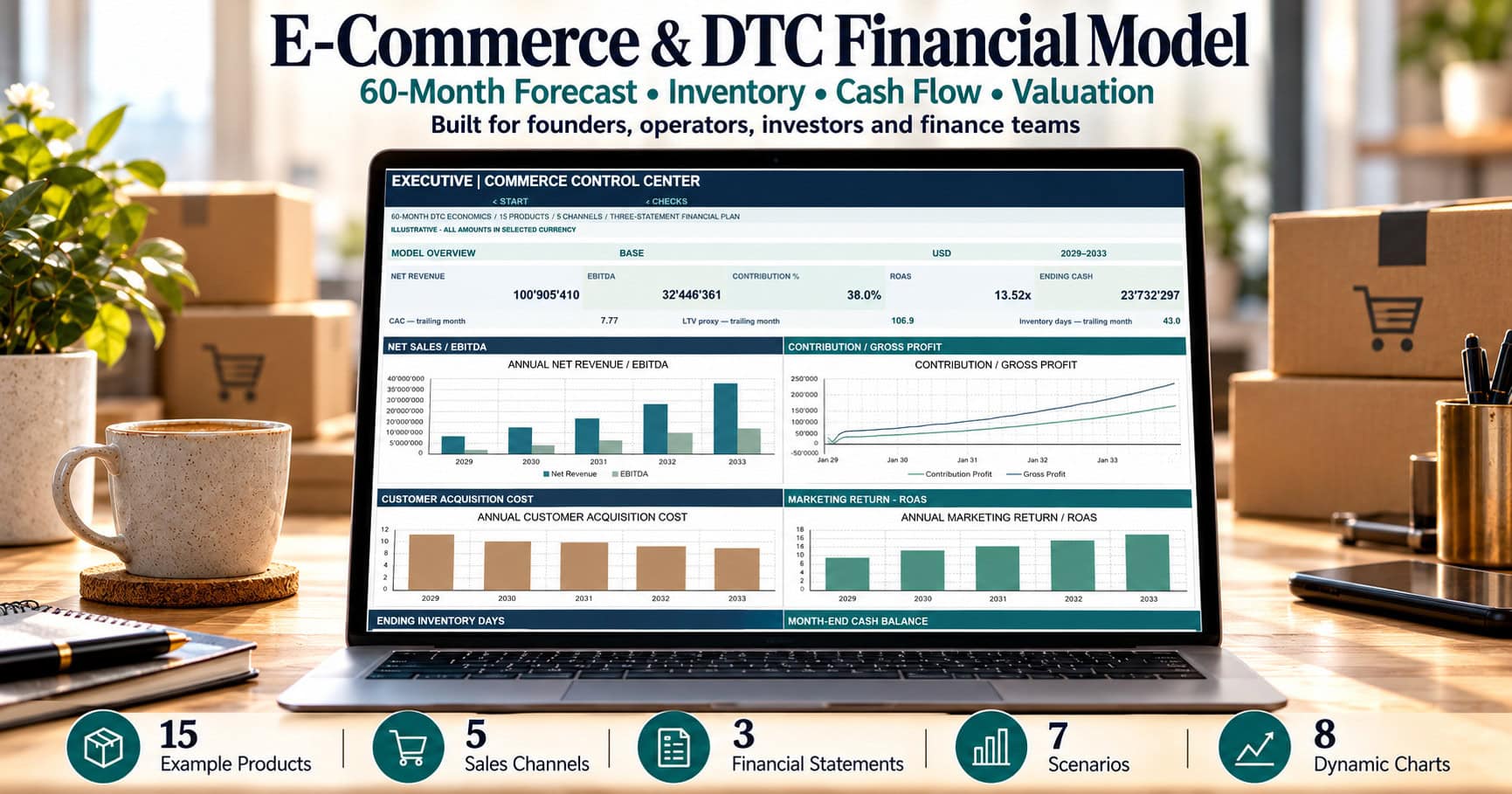
A premium, editable 60-month e-commerce and DTC financial model connecting 15 SKUs, five sales channels, purchase orders, inventory-constrained sales, customer returns, supplier payments, three integrated financial statements and DCF valuation. Includes 23 worksheets, eight native charts, seven operating scenarios, monthly model checks and a detailed 42-page English PDF guide.

E-COMMERCE & DTC FINANCIAL MODEL – 60-MONTH SIGNATURE EDITION
Plan Demand. Control Inventory. Forecast Cash. Understand Business Value.
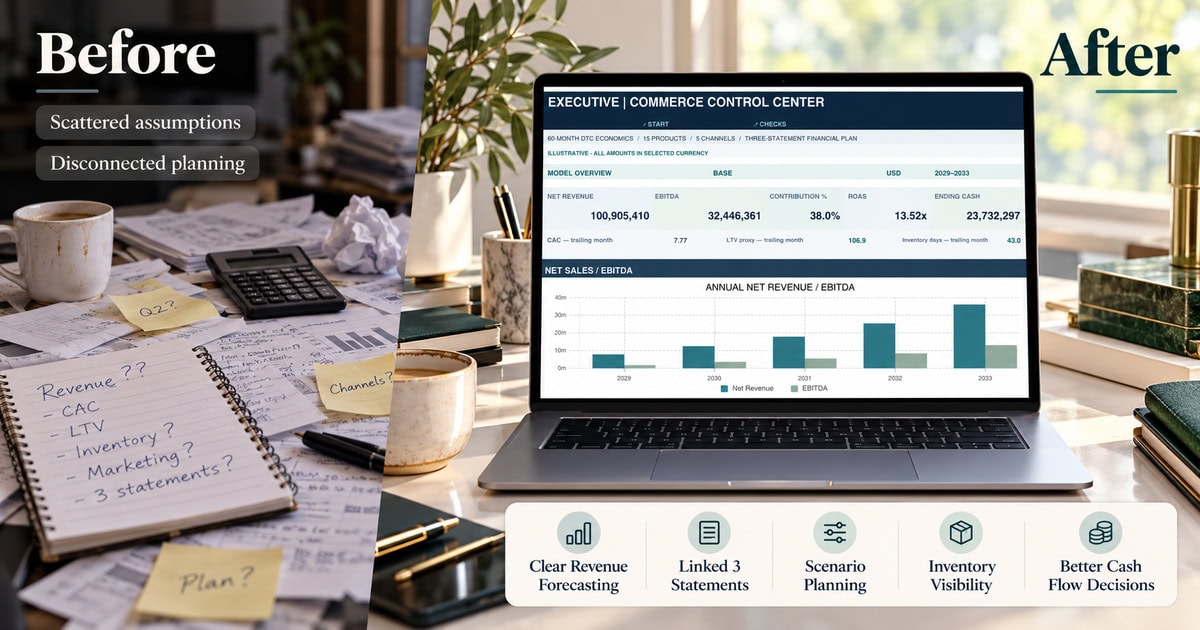
The E-Commerce & DTC Financial Model by SheetworksStudio is a comprehensive, fully editable Excel planning system connecting product economics, acquisition channels, inventory replenishment, supplier payments, financial statements and business valuation within one integrated 60-month forecast.
Designed for e-commerce founders, direct-to-consumer brand operators, CFOs, finance teams and financial advisors, the model helps users evaluate how selling prices, channel demand, marketing spend, customer returns, inventory availability and purchasing assumptions influence profitability and liquidity.
The complete package includes 23 integrated Excel worksheets, 15 illustrative products, five sales channels, seven operating scenarios, eight native dashboard charts and a detailed 42-page English PDF user guide.
The default illustrative forecast covers 2029–2033, with an editable start date.
📊 1. EXECUTIVE DASHBOARD & COMMERCIAL PERFORMANCE
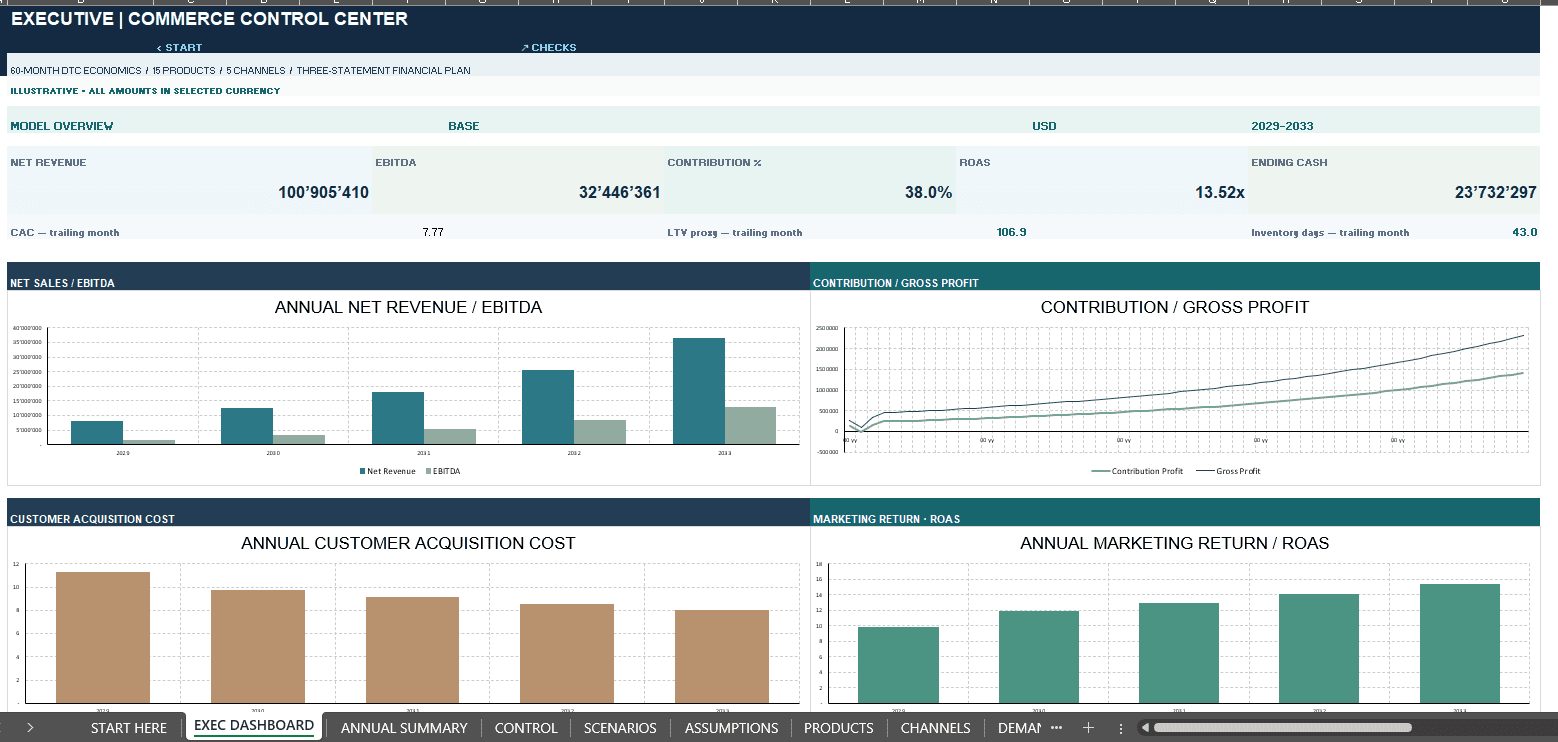
Turn interconnected operating assumptions into decision-relevant management indicators through a professionally designed Executive Dashboard.
Key Performance Indicators Include:
- Net Revenue
- EBITDA
- Contribution Margin
- Blended Return on Advertising Spend (ROAS)
- Customer Acquisition Cost (CAC)
- Directional Gross-Profit LTV Proxy
- Inventory Days
- Ending Cash Balance
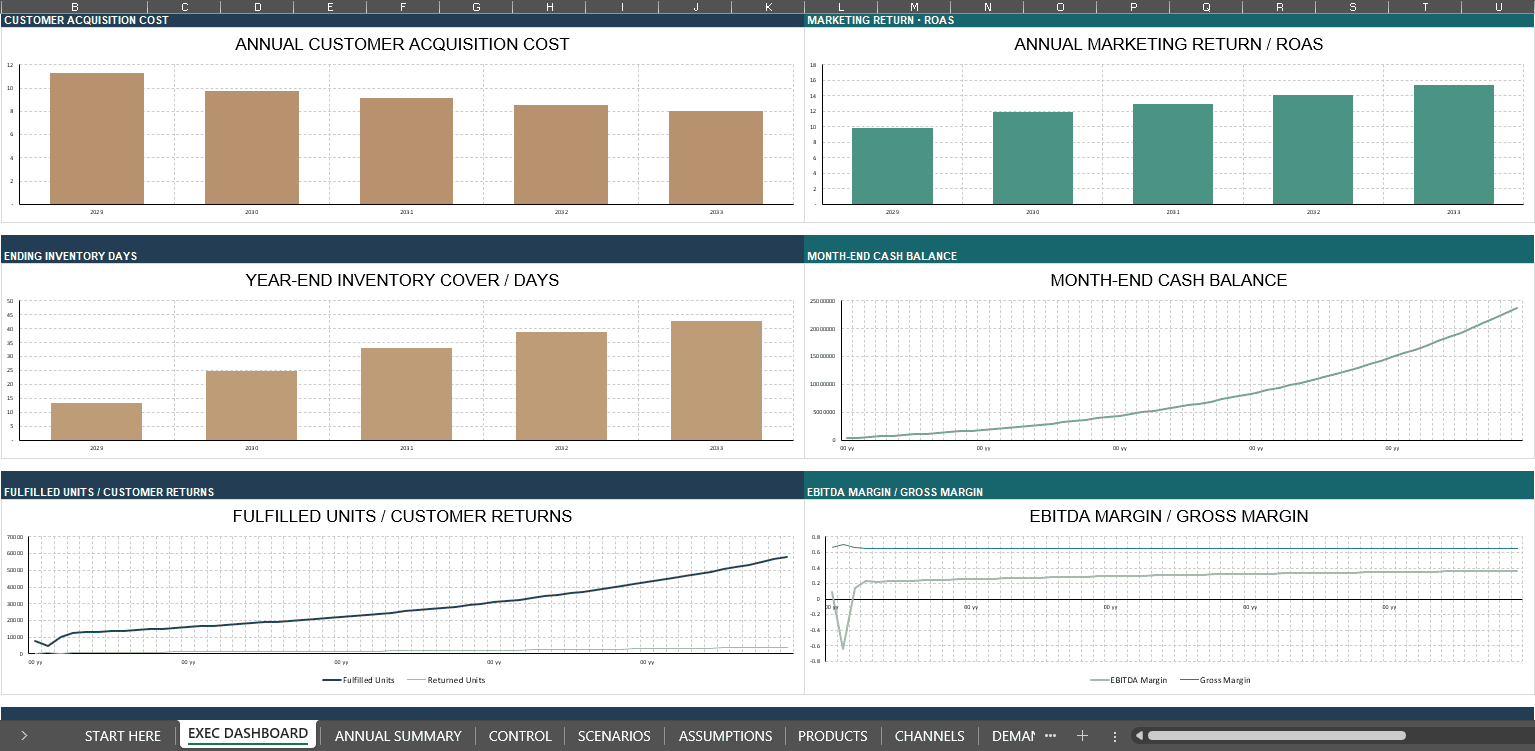
Eight native, data-linked Excel charts visualize:
- Annual Net Revenue and EBITDA
- Contribution Profit and Gross Profit
- Annual Customer Acquisition Cost
- Marketing Return / ROAS
- Year-End Inventory Coverage
- Monthly Closing Cash Balances
- Fulfilled Units and Customer Returns
- EBITDA Margin and Gross Margin
The dashboard connects directly to the operating and financial schedules, giving users a structured overview of business growth, margins, working capital and liquidity.
🛍️ 2. PRODUCT & CHANNEL UNIT ECONOMICS
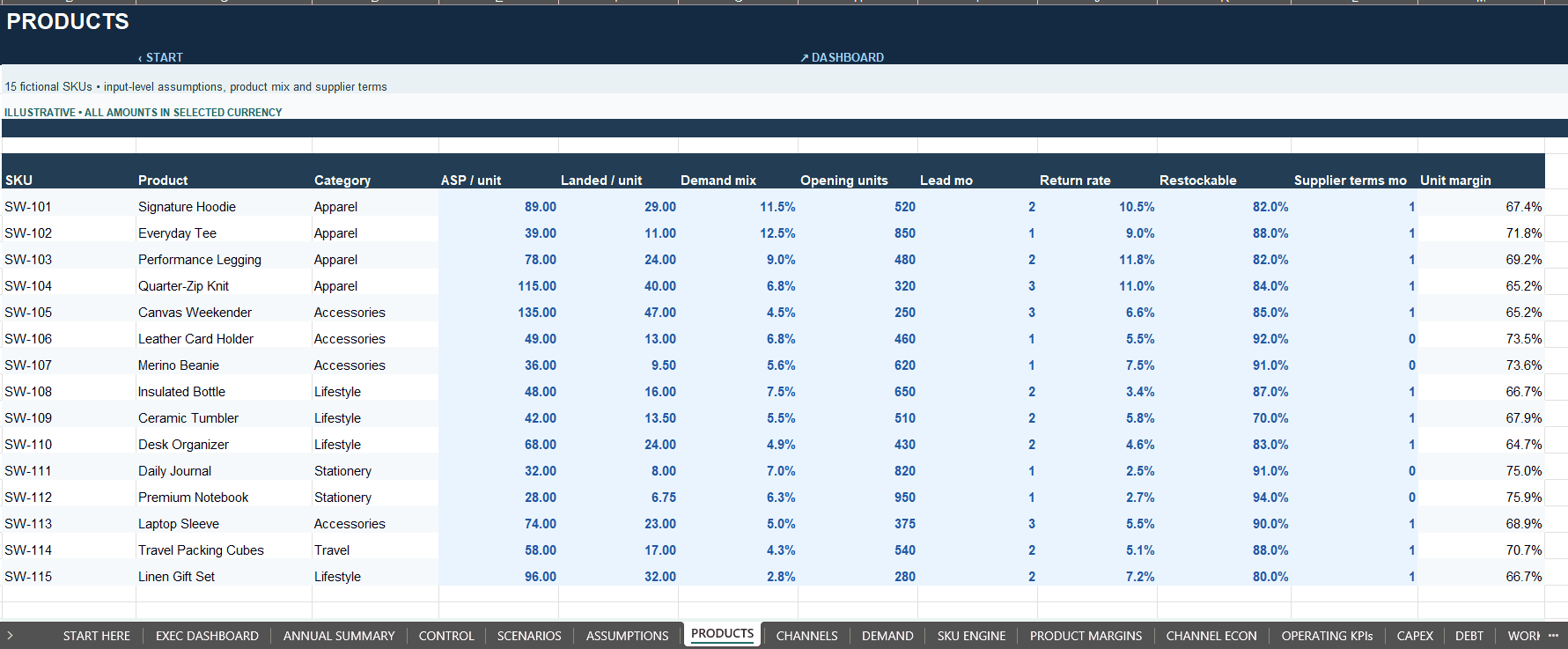
Build your financial forecast around 15 editable product records and five sales channels.
Product-Level Features:
- Selling Prices
- Landed Product Costs
- Product Demand Mix
- Opening Inventory
- Supplier Lead Times
- Product Return Rates
- Restockable Return Percentages
- Supplier Payment Terms
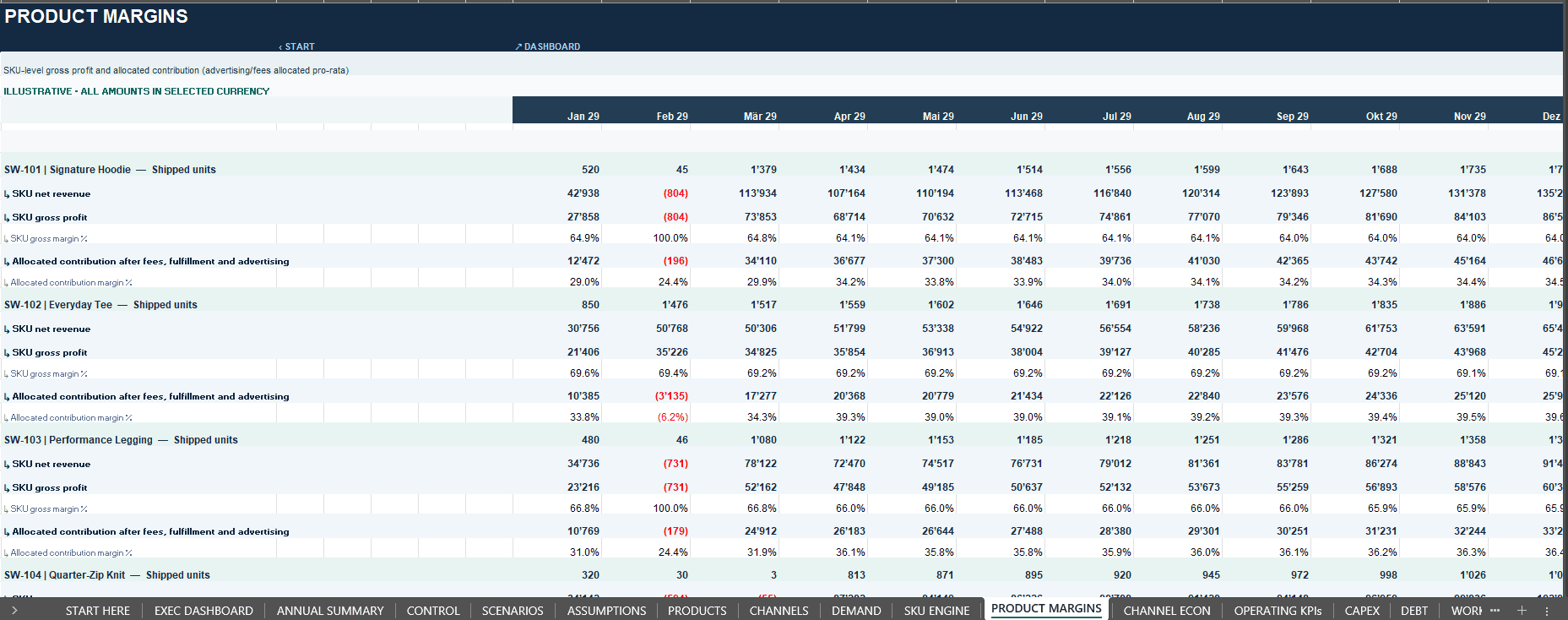
- Product Gross Profit
- Product Contribution Profit
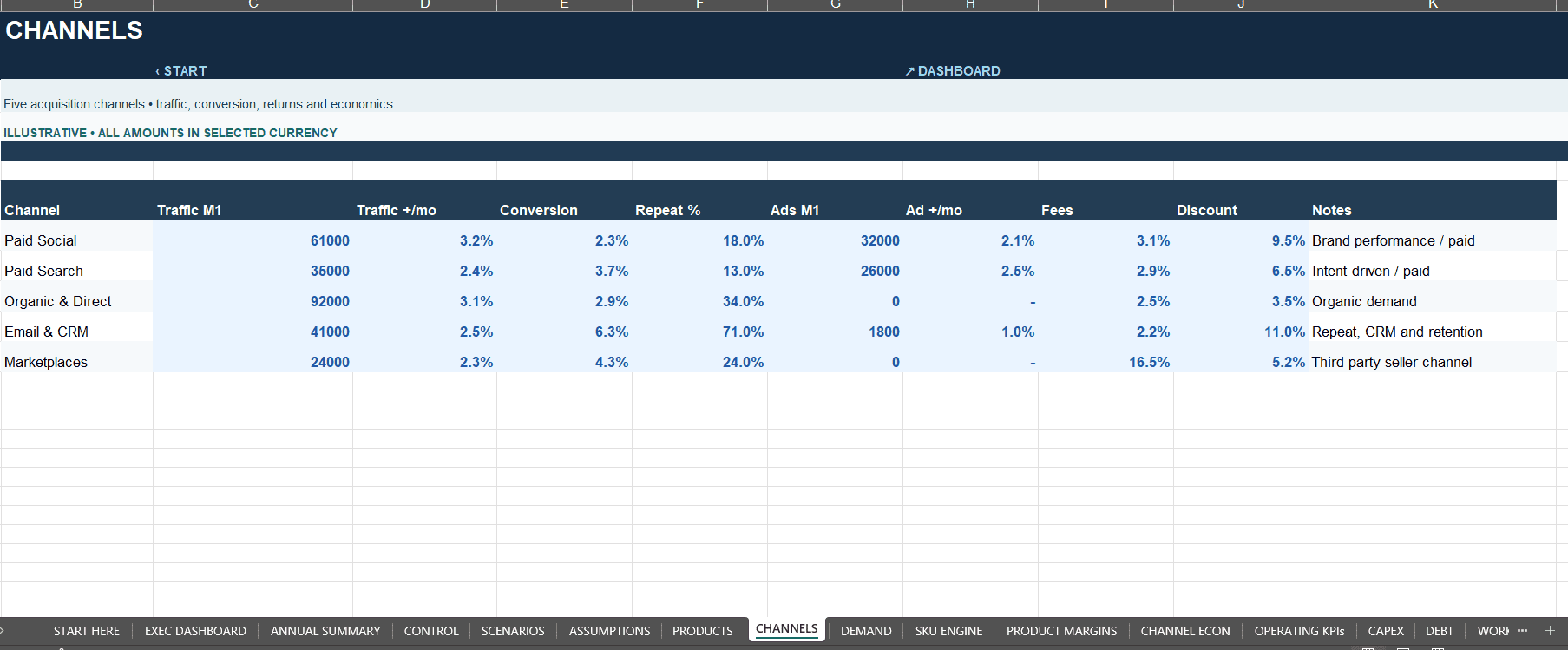
Channel-Level Features:
- Website Traffic
- Conversion Rates
- New and Returning Customer Mix
- Promotional Discounts
- Channel Fees
- Marketing Expenditure
- Customer Acquisition Metrics
- Blended Marketing Returns
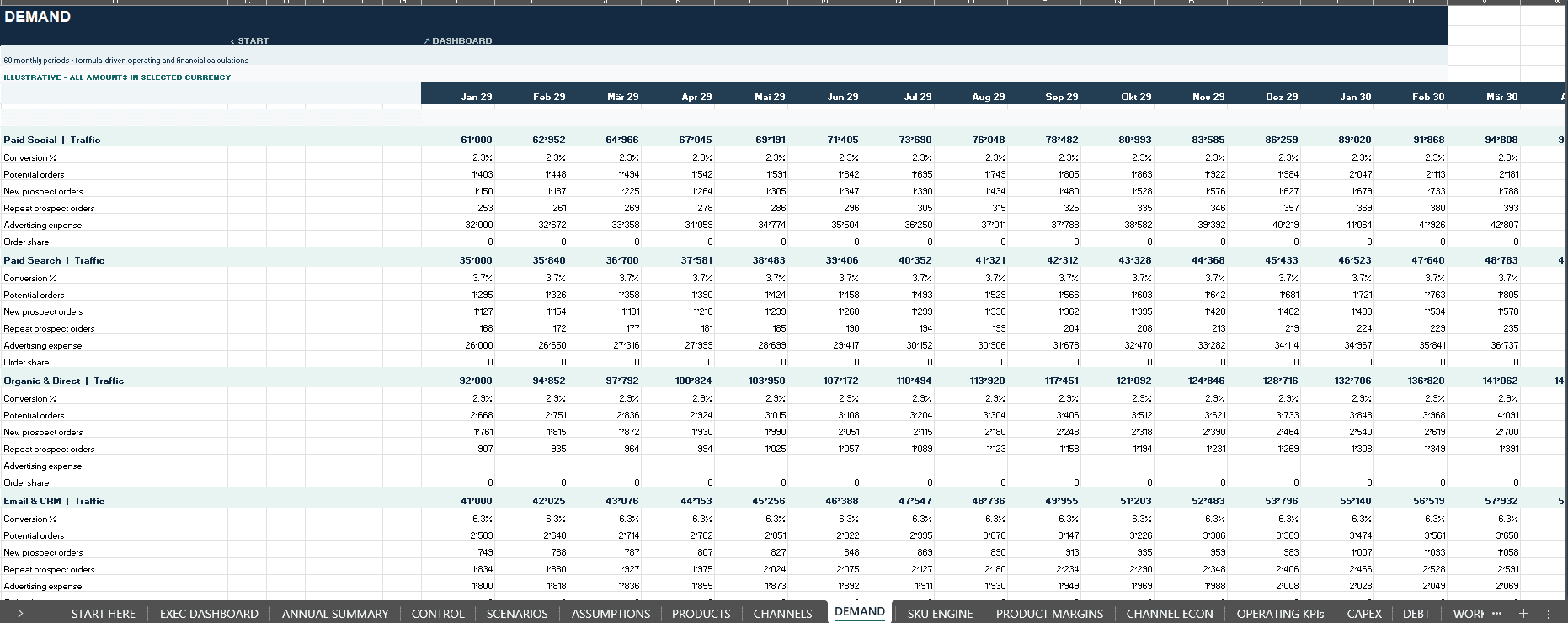
The operating model links demand to physical stock availability.
Forecast fulfilled sales therefore reflect available inventory rather than assuming that all potential demand can be satisfied.
This helps users assess how stock availability, channel economics and marketing assumptions affect realized revenue and contribution margins.
📦 3. INVENTORY, CUSTOMER RETURNS & SUPPLIER PAYMENTS
Understand how inventory purchasing decisions influence revenue, profitability, working capital and cash flow.
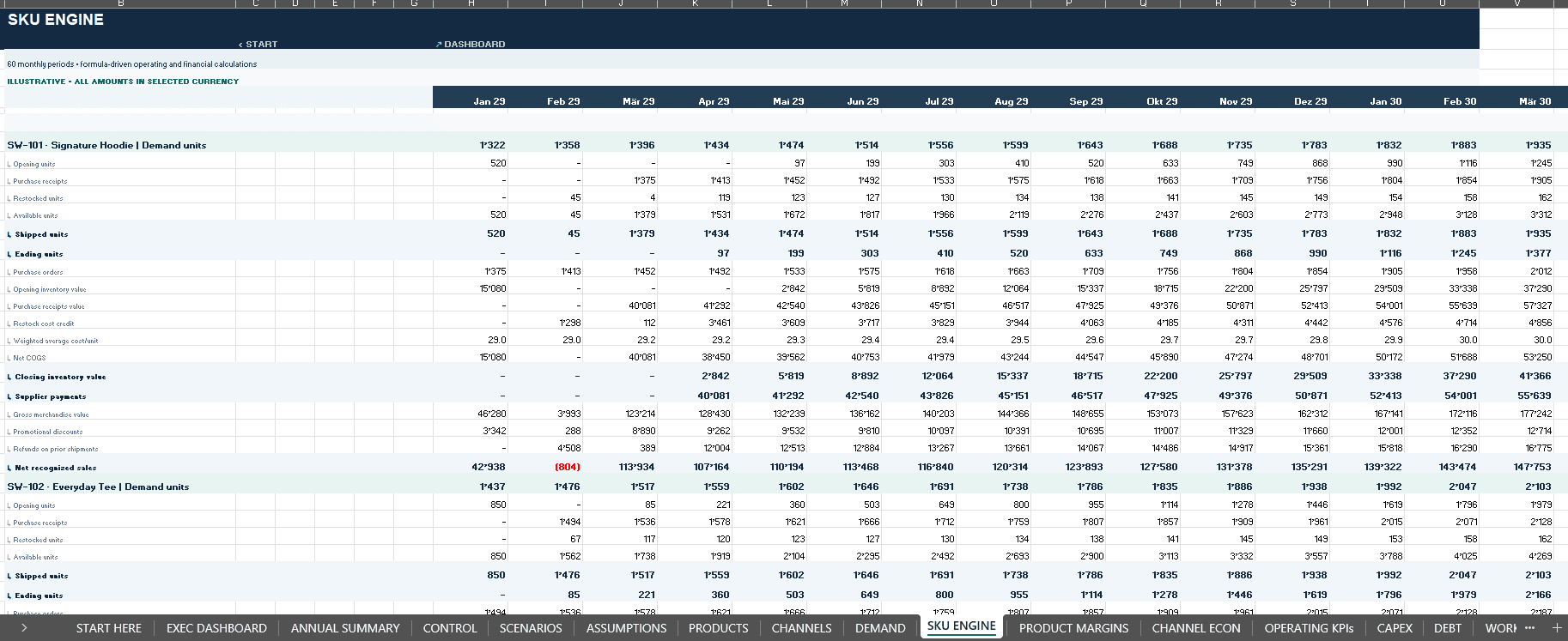
The integrated SKU Engine models:
- Product Demand and Purchase Orders
- Scenario-Adjusted Supplier Lead Times
- Inventory Receipts
- Opening and Closing Stock
- Available Inventory
- Fulfilled Customer Sales
- Weighted-Average Inventory Costing
- Customer Refunds
- Recoverable Product Returns
- Inventory Restocking
- Supplier Invoices
- Cash Payment Timing
- Accounts Payable
Customer refunds follow the model’s documented prior-month shipment convention.
Restockable returned units flow back into inventory through the model’s weighted-average costing methodology.
Purchasing and supplier-payment schedules connect to working capital and the monthly cash flow statement.
This provides a transparent relationship between commercial demand, inventory investment, supplier obligations and operating liquidity.
💼 4. THREE INTEGRATED FINANCIAL STATEMENTS
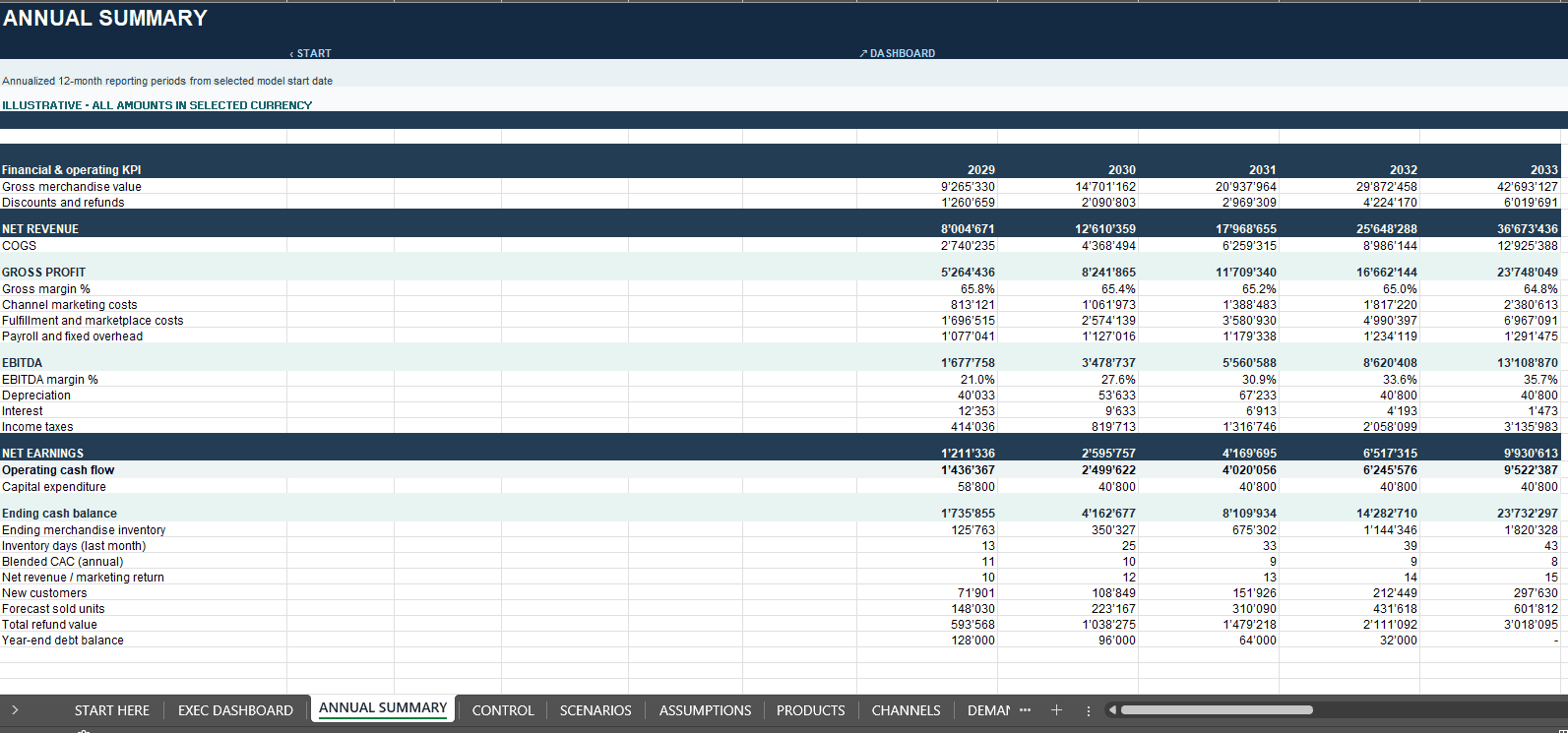
Review the financial performance of the business through 60 connected monthly calculation periods and five annual reporting summaries.
Integrated Financial Statements:
- Income Statement / Profit & Loss
- Cash Flow Statement
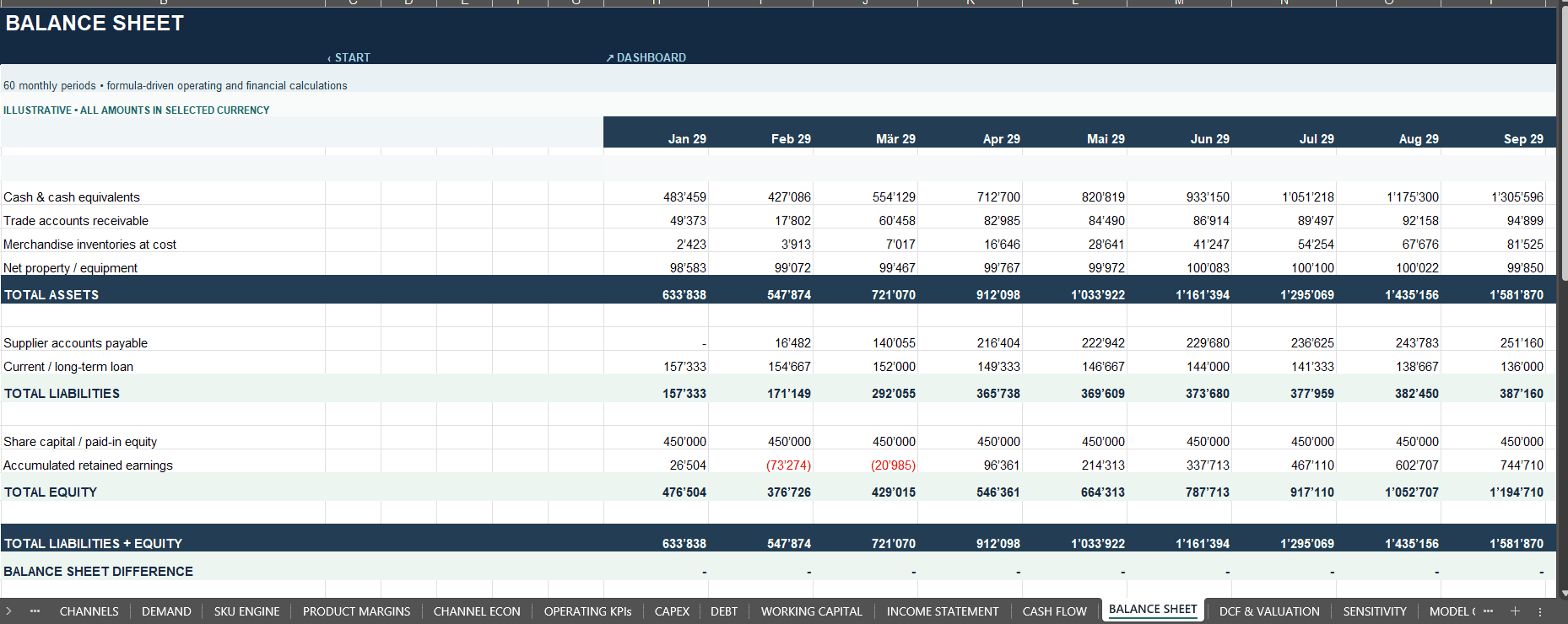
- Balance Sheet
Supporting Financial Calculations:
- Recognized Sales Revenue
- Cost of Goods Sold
- Gross Profit
- Marketing and Fulfillment Expenses
- Payroll and Fixed Operating Costs
- EBITDA and EBIT
- Capital Expenditure
- Depreciation
- Trade Receivables
- Merchandise Inventory
- Supplier Payables
- Opening Term Loan
- Principal Amortization
- Interest Expense
- Simplified Corporate Income Tax
- Shareholder Equity
- Closing Cash Balances
These schedules connect operating profitability with working capital requirements, capital expenditure, financing and cash movements.
Users can examine how inventory purchasing, customer receipts, operating expenses and loan repayments influence projected business liquidity.
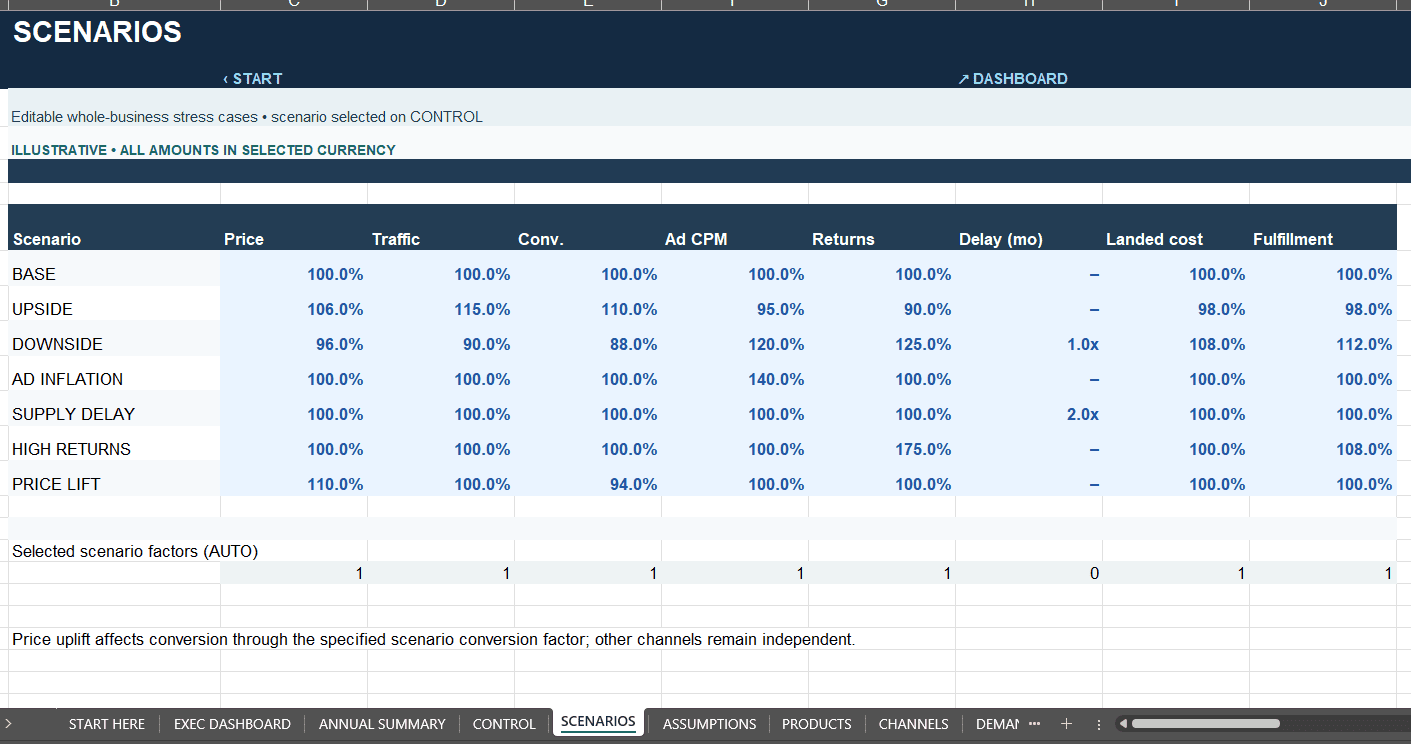
🔀 5. SEVEN EDITABLE OPERATING SCENARIOS
Evaluate alternative operating conditions using seven selectable scenarios.
Available Scenarios:
- BASE
- UPSIDE
- DOWNSIDE
- AD INFLATION
- SUPPLY DELAY
- HIGH RETURNS
- PRICE LIFT
Scenario assumptions adjust the relevant selling-price, traffic, conversion, advertising-cost, return-rate and supplier-delay drivers.
The selected assumptions flow through the connected operating schedules, financial statements and investment valuation.
This enables users to explore how different commercial conditions may affect revenue, inventory, contribution profit, EBITDA, working capital, cash balances and estimated business value.
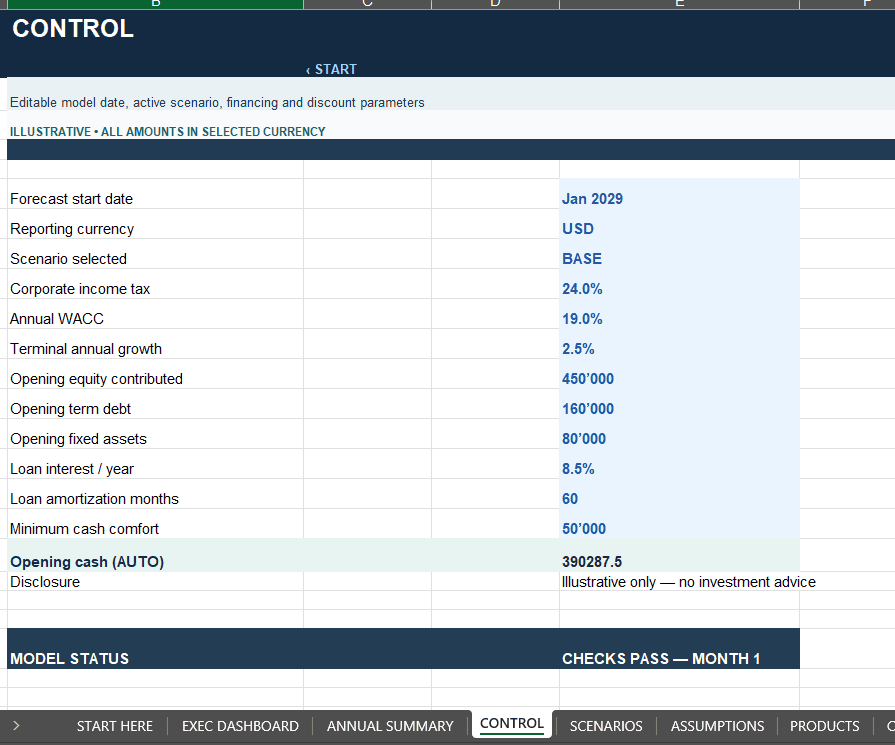
Scenarios are selected individually through the CONTROL worksheet. Results can be reviewed and manually preserved for comparison.
📈 6. DCF VALUATION & SENSITIVITY ANALYSIS
Evaluate the estimated value of the business through an integrated Discounted Cash Flow framework.
Valuation Features Include:
- Monthly Free Cash Flow to Firm
- Discounted Forecast Cash Flows
- Editable Annual Discount Rate / WACC
- Monthly Discount Factors
- Continuing-Growth Terminal Value
- Enterprise Value
- Opening Debt Adjustment
- Opening Cash Adjustment
- Implied Opening Equity Value
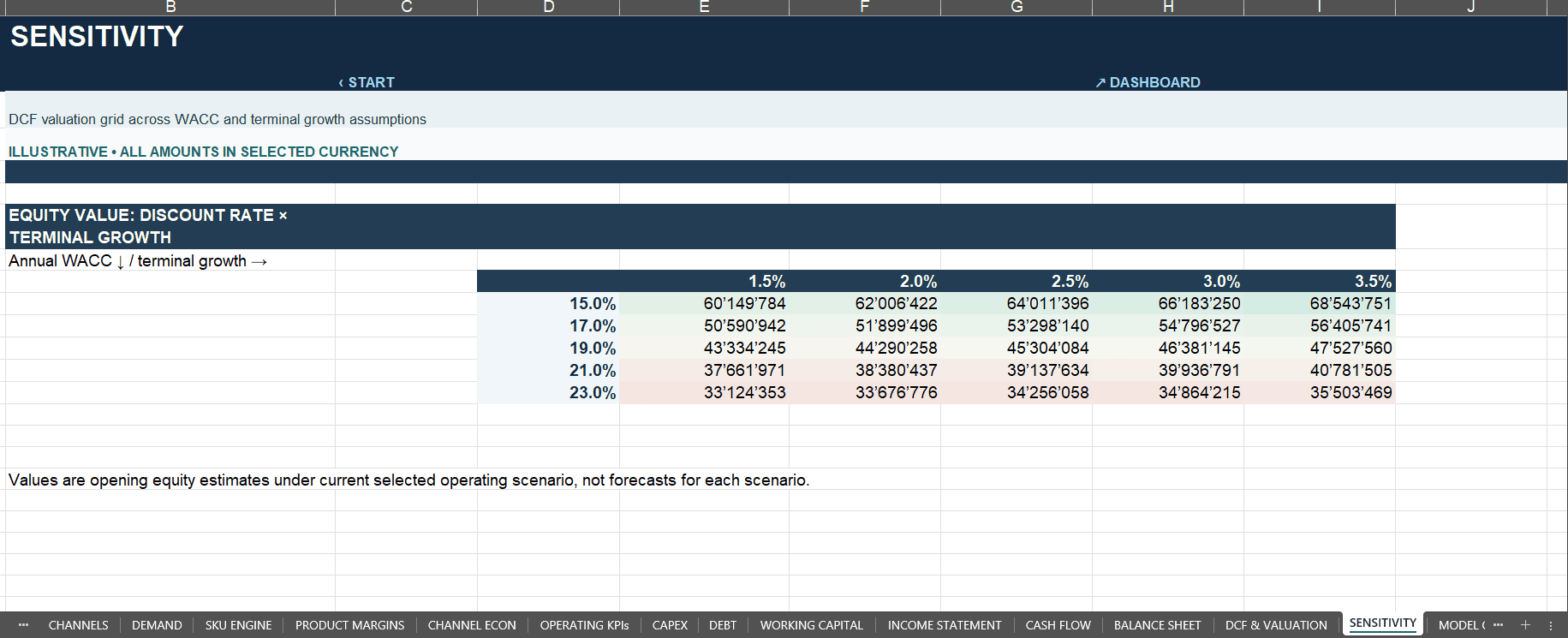
A dedicated sensitivity matrix shows how implied equity value changes under different WACC and terminal-growth assumptions.
The model connects financial forecasts and operating conditions with estimated business value, helping users examine the valuation implications of changes in demand, profitability, investment and working capital.
Important: The DCF is a scenario-based financial modeling estimate, not an independently certified valuation.
✅ 7. MODEL INTEGRITY & FINANCIAL CONTROLS
The workbook includes a dedicated MODEL CHECKS worksheet to support financial transparency and calculation review.
Control Areas Include:
- Balance Sheet Reconciliation
- Monthly Cash Flow Continuity
- SKU-Level Inventory Quantity Reconciliation
- SKU-Level Inventory Value Reconciliation
- Supplier Payables
- Channel Revenue Reconciliation
- Fulfilled Demand Constraints
- Non-Negative Inventory
- Debt Balance Continuity
- Sales Contribution Reconciliation
- Working Capital
- Gross Profit
- Revenue Bridges
- Product Demand Mix
- Opening Capital Sources and Uses
The inventory controls also test SKU-level continuity, helping detect offsetting product-level discrepancies that may be missed by aggregate checks alone.
A failed-check counter supports monthly review of exceptions.
A passing model control confirms the relevant programmed relationships, not overall business profitability or the suitability of financial assumptions.
📦 8. WHAT’S INCLUDED
FILE 1 — E-COMMERCE & DTC FINANCIAL MODEL (.XLSX)
One editable Excel financial workbook containing:
- 23 Integrated Worksheets
- 60 Monthly Forecast Periods
- Five Annual Financial Summaries
- 15 Illustrative Products
- Five Sales Channels
- Seven Operating Scenarios
- Eight Native Dashboard Charts
- Product Demand and SKU Calculations
- Inventory and Returns Modeling
- Supplier Payments and Working Capital
- Three Integrated Financial Statements
- DCF Enterprise and Equity Valuation
- WACC and Terminal-Growth Sensitivity
- Monthly Model Integrity Controls
- In-Workbook User Guidance
FILE 2 — COMPLETE HOW-TO-USE GUIDE (.PDF)
A detailed 42-page English operating manual covering:
- Initial Workbook Setup
- Worksheet Navigation
- Editable Input Cells
- Product and Channel Assumptions
- Demand and SKU Calculations
- Inventory Replenishment
- Customer Returns
- Supplier Payment Timing
- Working Capital
- Income Statement, Balance Sheet and Cash Flow
- Executive Dashboard and KPI Definitions
- Seven Operating Scenarios
- DCF Valuation
- Sensitivity Analysis
- Model Checks and Troubleshooting
- Financial Modeling Conventions and Limitations
Both purchased files are delivered together in one downloadable ZIP package.
The complete PDF guide may also be offered as a complimentary standalone reference download. The free guide does not include the paid Excel financial model.
9. WHO IS THIS MODEL FOR?
Designed for:
- E-Commerce Entrepreneurs
- DTC Brand Founders
- Online Retail Business Owners
- CFOs and Finance Managers
- FP&A Professionals
- Inventory and Operations Planners
- Financial Consultants
- Business Advisors
- Investment and Financial Analysts
The model is particularly suitable for businesses that can be represented within 15 product slots, five channels and a monthly financial planning framework.
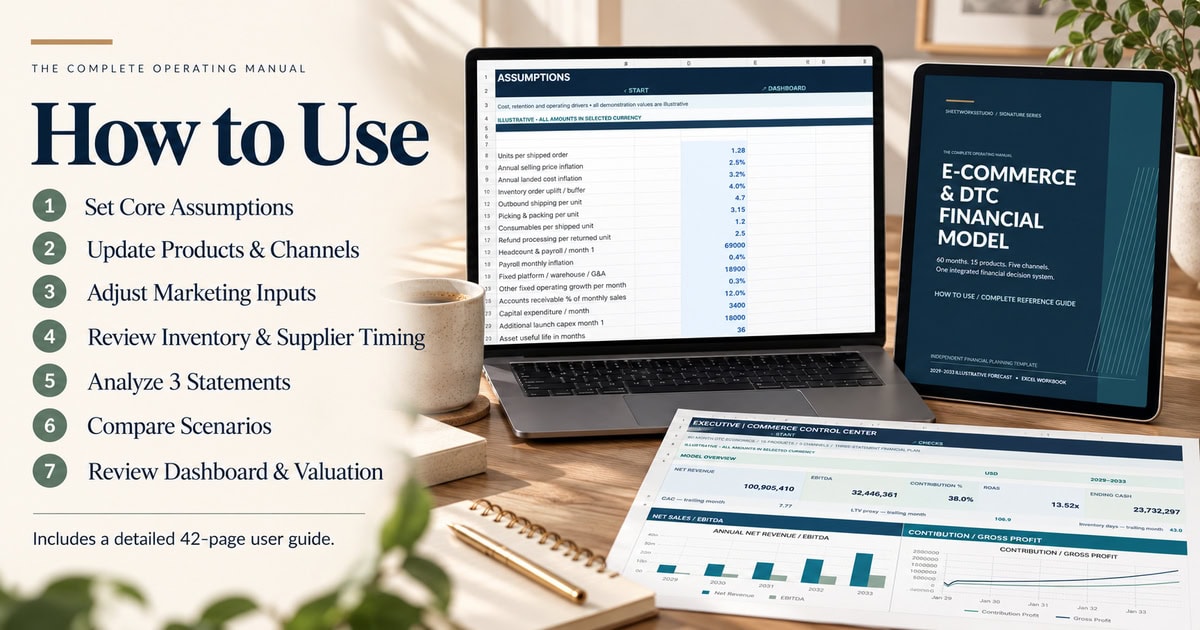
🧭 10. HOW TO USE
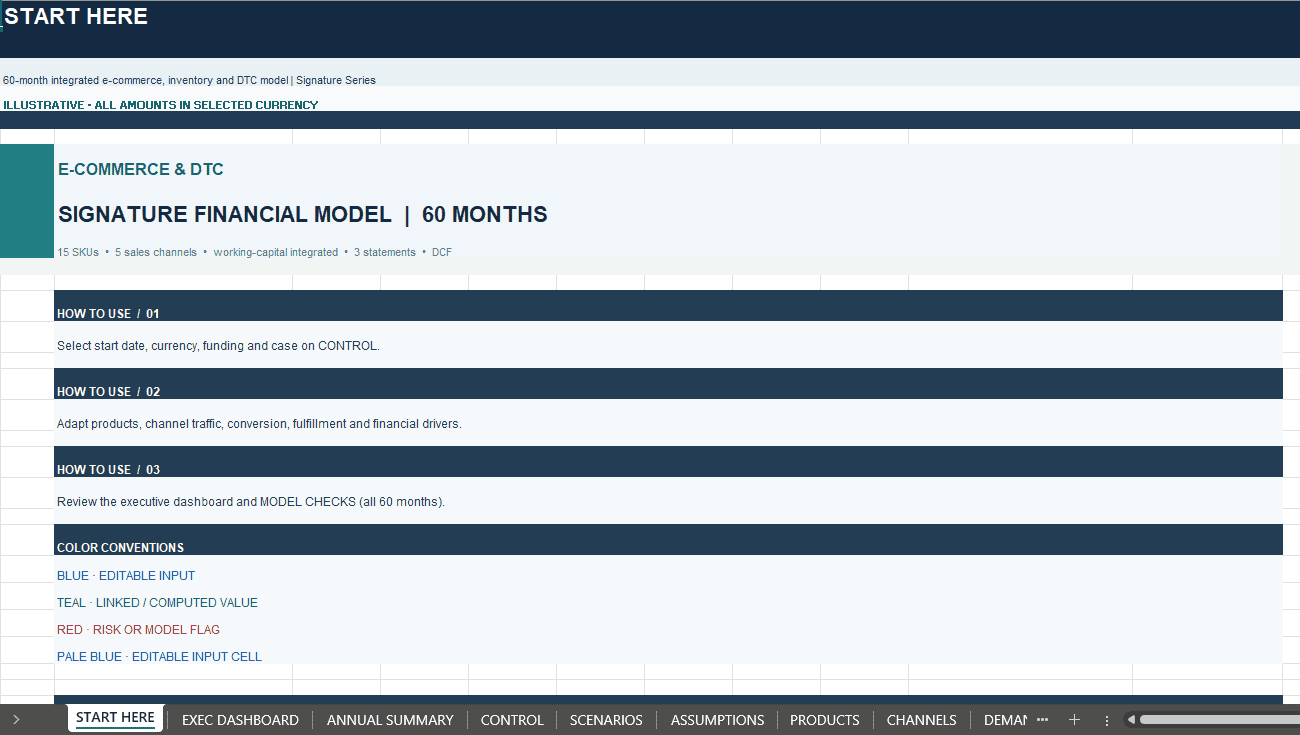
STEP 1 — CONFIGURE THE MODEL
Open START HERE and set the forecast date, reporting currency, scenario and opening financing in CONTROL.
STEP 2 — CUSTOMIZE OPERATING ASSUMPTIONS
Replace fictional product records, channel assumptions, inventory settings and operating cost inputs.
STEP 3 — REVIEW OPERATING ECONOMICS
Analyze demand, fulfilled units, inventory receipts, customer returns, product margins and supplier payment timing.
STEP 4 — REVIEW FINANCIAL PERFORMANCE
Examine the Executive Dashboard, annual summaries, monthly Income Statement, Cash Flow and Balance Sheet.
STEP 5 — ANALYZE SCENARIOS & VALUATION
Select alternative operating scenarios, review the DCF valuation and compare discount-rate and terminal-growth assumptions.
STEP 6 — VALIDATE THE MODEL
Review all monthly financial controls and investigate warnings before relying on projected results.
11. TECHNICAL SPECIFICATIONS
- Product: E-Commerce & DTC Financial Model
- Forecast Horizon: 60 Months / Five Years
- Illustrative Forecast: 2029–2033
- Worksheets: 23
- Product Slots: 15
- Sales Channels: 5
- Operating Scenarios: 7
- Native Dashboard Charts: 8
- Financial Statements: Income Statement, Balance Sheet and Cash Flow
- Valuation: Discounted Cash Flow
- Sensitivity: WACC and Terminal Growth
- Documentation: 42-Page English PDF Guide
- File Formats: XLSX + PDF
- Recommended Software: Microsoft Excel Desktop
- VBA / Macros: Not Required
- External Workbook Connections: Not Required
- Delivery: Digital ZIP Download
Software Compatibility: Microsoft Excel Desktop is recommended. Google Sheets import and functional compatibility have not been independently verified. Equivalent formulas, charts, navigation, dropdowns and formatting are therefore not guaranteed.
12. IMPORTANT MODEL LIMITATIONS & DISCLAIMER
All included product records, operating assumptions and financial results are fictional and intended for financial planning, educational use and scenario analysis.
The model uses simplified inventory, customer-return, supplier-payment, financing, tax and accounting conventions.
ROAS is a blended sales-to-marketing-spend measure rather than incremental advertising attribution.
LTV is a directional gross-profit proxy, not a fully calculated customer-cohort lifetime-value metric. Inventory days is a modeled coverage estimate.
VAT and sales-tax calculations, multi-currency conversion, revolving credit financing and jurisdiction-specific tax compliance are not included.
Adding products beyond the 15 prepared slots or expanding beyond five channels requires adjustments to formulas, allocation ranges and the calculation structure.
The workbook is an independent, unofficial SheetworksStudio template and is not affiliated with any commerce platform, advertising network or financial institution.
The product does not constitute investment, accounting, audit, legal, tax or financial advice.
Users should replace all demonstration assumptions with independently supported business information and validate the calculations before making financial decisions.
PLAN COMMERCE. CONTROL INVENTORY. FORECAST CASH. VALUE YOUR BUSINESS.
One Connected Excel Model for Professional E-Commerce and DTC Financial Planning.
SheetworksStudio | Professional Financial Modeling Templates
Similar ProductsOther customers were also interested in...



 eFinancialModels
Electric Vehicle (EV) Charging Station Financial M...
With this comprehensive 5- or 10-year monthly tool, investors can assess the viability of setting up... Read more

Financial Model for Mobile App | Mobile App Busine...
The Mobile App Financial Plan Template in Excel allows you to develop financial projections when lau... Read more

 HenrySheykin
Food Truck Financial Model Excel Template
The Food Truck Financial Model helps entrepreneurs, founders, business owners, consultants, and anal... Read more

Green Hydrogen Production from Wind Energy Financi...
The Green Hydrogen from Wind Financial Model aims to comprehensively forecast a horizon of 40 years ... Read more

Simple Mutual Non-Disclosure Agreement Template
Protect your business secrets with ease using our Simple Mutual Non-Disclosure Agreement Template. S... Read more

Solar Energy Financial Model
The Solar Energy Financial Model Spreadsheet Template in Excel assists you in preparing a sophistica... Read more

 Peter Graf
The Customer-Centric Financial Model for Restauran...
Starting a restaurant without a financial plan is like driving a car blindfolded. You wouldn´t do i... Read more
You must log in to submit a review.