
0 ITEMS

Mobile Massage Salon Financial Model Excel Template
The Mobile Massage Financial Model Template helps entrepreneurs, founders, consultants, analysts, and business owners turn a mobile therapy concept into a structured five-year financial forecast. Instead of starting with a blank spreadsheet, users can work from a ready-to-use model designed around the operating realities of an on-demand massage service, including daily visits, service pricing, therapist commissions, supplies, software, insurance, marketing, and capacity growth. It gives buyers a practical framework for estimating revenue potential, startup costs, operating expenses, payroll needs, cash flow, profitability, and the funding required to launch or scale with greater confidence. This template is especially useful for anyone preparing a mobile massage business plan, investor presentation, loan application, internal budget, or expansion case. Users can document their assumptions, adjust pricing and service mix, test low, base, and high scenarios, and understand how changes in bookings, therapist utilization, add-ons, and corporate sessions affect financial results. The model connects revenue assumptions with cost structure and staffing plans, making it easier to evaluate whether the business can support its operations, cover fixed costs, and move toward sustainable profitability. The template supports practical financial planning by showing how the business may perform month by month and year by year. It helps users review projected profit and loss, cash flow, balance sheet movement, and key performance indicators in one organized file. This is valuable for decision-making because a mobile massage business depends on managing appointment volume, therapist availability, travel efficiency, repeat customers, and direct service costs. With editable assumptions and automated calculations, the model helps users identify cash gaps, understand break-even timing, and evaluate whether growth plans are realistic before committing capital. Built for both early-stage startups and existing mobile wellness providers, the Mobile Massage Financial Model gives users a professional foundation for financial forecasting and stakeholder communication. It can be customized in Microsoft Excel or Google Sheets, reused for multiple planning updates, and shared with partners, lenders, investors, or internal teams. Whether the goal is to launch a solo mobile massage operation, build a multi-therapist service, expand into corporate wellness bookings, or improve budgeting discipline, this template provides a clear way to organize the numbers and make better business decisions.


Financial Model Overview
The Mobile Massage Financial Model Financial Model Template is a ready-to-use planning tool for building a structured financial forecast for an on-demand massage service. It is designed for entrepreneurs, founders, business owners, consultants, analysts, and anyone preparing a mobile massage business plan, investor pitch, lender package, or internal operating budget. A mobile massage business has a unique financial structure because revenue depends on appointment volume, service mix, therapist availability, travel efficiency, corporate bookings, add-on sales, and recurring customer demand, while costs include therapist commissions, supplies, booking software, insurance, marketing, equipment, and administration. This template brings those drivers into one organized model so users can estimate startup needs, forecast revenue, calculate expenses, review profitability, monitor cash flow, and present professional financial outputs without building a spreadsheet from scratch. The model is fully editable, works in Excel and Google Sheets, and is built to support up to five years of projections, making it suitable for launch planning, funding preparation, expansion analysis, and ongoing decision-making.
All-in-One Dashboard
The all-in-one dashboard gives users a central view of the Mobile Massage Financial Model by connecting the most important inputs and outputs in one practical planning area. Instead of moving between disconnected spreadsheets, users can review high-level assumptions, projected revenue, expense trends, profit margins, cash position, and major financial indicators from a single place. The dashboard may include inputs such as service volume, operating days, average pricing, therapist commissions, direct supply costs, software expenses, insurance, marketing spend, and other fixed operating costs, then convert those assumptions into summarized outputs that are easier to interpret. For a mobile massage business, this is useful because decisions often need to be made quickly, such as whether to add another therapist, raise pricing, invest in corporate outreach, or increase digital advertising. The dashboard helps users see how the business is performing against its plan and whether the forecast supports launch, growth, or funding goals. It is also helpful for stakeholder communication because investors, lenders, partners, and internal teams can review the main financial picture without digging through every calculation tab.
Low, Base, and High Scenario Analysis
The low, base, and high scenario analysis section helps users stress-test the mobile massage business under different operating conditions. A base case may represent the most realistic forecast, while a low case can show the impact of slower bookings, lower service pricing, weaker corporate demand, higher therapist costs, or delayed customer acquisition. A high case can show the potential upside from stronger daily visit volume, better retention, higher add-on sales, more corporate sessions, or improved therapist scheduling density. This component is valuable because a mobile massage business can be sensitive to small changes in appointment volume, average order value, and utilization rates. By comparing scenarios, users can see how revenue, margins, cash flow, EBITDA, and funding needs change when key assumptions move up or down. This is especially important for planning because it helps users avoid relying on a single optimistic forecast. It supports smarter decision-making by showing which assumptions create the greatest financial risk and which growth levers have the strongest effect on profitability. For investors and lenders, scenario analysis also demonstrates that the business has been evaluated under multiple market conditions.
Professional Charts
The professional charts section transforms forecast data into clear visual reports that can be used for presentations, planning meetings, investor discussions, or internal reviews. Financial models often contain detailed calculations, but charts make it easier to communicate the story behind the numbers. This component may visualize revenue growth, expense categories, EBITDA movement, cash balance trends, profitability improvement, service mix changes, monthly performance, and other key metrics. For a mobile massage business, charts can make patterns easier to understand, such as how higher-margin corporate sessions contribute to growth, how direct costs behave as appointment volume increases, or how fixed expenses become less burdensome as revenue scales. These visuals help users present a more polished financial case and reduce the time needed to explain complex projections. They are also useful for ongoing management because owners can quickly spot trends, compare actual results against forecasted expectations, and decide whether pricing, staffing, marketing, or operating assumptions need to be adjusted. Professional charts support funding and strategic planning by turning raw financial outputs into presentation-ready insights.
ROE Components and DuPont Analysis
The ROE components and DuPont analysis section helps users evaluate return on equity by breaking performance into the drivers that influence investor returns. Rather than only showing a single return figure, this component can separate profitability, asset efficiency, and financial leverage to show how the business creates or limits shareholder value. For a mobile massage company, this is useful because return performance may be affected by margins, therapist commission structure, equipment investment, working capital, marketing efficiency, and the amount of debt or equity used to fund the business. The model may use inputs such as net income, revenue, total assets, equity, liabilities, and profitability ratios to calculate return on equity and related performance indicators. This helps users understand whether growth is being supported by strong operating results or simply by adding more capital. It also gives investors a more detailed view of how the business is expected to generate value over time. For founders, DuPont-style analysis can support decision-making by identifying whether the priority should be improving margins, using assets more efficiently, controlling expenses, or adjusting the capital structure before raising additional funds.
Revenue Inputs
The revenue inputs section is where users define the commercial assumptions that drive the Mobile Massage Financial Model. For a mobile massage service, revenue may be based on daily visits, operating days per year, service mix, pricing by massage type, corporate wellness sessions, add-ons, retail product sales, customer growth, repeat bookings, and seasonal changes in demand. This section may include editable assumptions for Swedish massage, deep tissue massage, corporate sessions, wellness packages, and optional retail or service upgrades. By entering or adjusting these assumptions, users can build a forecast that reflects their specific market, pricing strategy, service capacity, and growth plan. This is one of the most important parts of the model because revenue is not just a top-line number. It is the result of pricing, appointment volume, therapist availability, booking efficiency, and customer demand. Accurate revenue inputs help users determine whether the business can generate enough sales to cover direct costs, fixed overhead, payroll, marketing, and startup investment. They also allow users to test strategies such as increasing corporate bookings, raising prices, adding premium services, or growing the number of therapists over time.
Bank-Ready Reports
The bank-ready reports section provides lender-friendly financial outputs that can support loan applications, funding requests, and formal business planning. Banks and financing partners typically want to see more than revenue projections. They often need clear income statements, cash flow forecasts, balance sheet projections, debt service visibility, startup funding requirements, and evidence that the business can maintain liquidity. This component organizes the financial outputs into a more professional format so users can communicate how the mobile massage business is expected to generate income, manage costs, repay obligations, and remain financially stable. Inputs such as startup investment, working capital, loan amounts, repayment terms, operating expenses, service revenue, and profitability assumptions flow through the model to produce structured reports. For a mobile massage founder, this can save significant time because the template already connects assumptions to lender-relevant outputs. It is useful for preparing funding documents because it shows not only the growth opportunity but also the operational discipline behind the plan. Clean, bank-ready reports help users present a credible financial case and answer common lender questions about cash flow, repayment capacity, and financial sustainability.
Revenue Breakdown
The revenue breakdown section gives users a detailed view of how total sales are generated across different services and revenue streams. A mobile massage business may earn income from individual massage appointments, deep tissue sessions, Swedish massage, corporate wellness visits, package sales, add-on services, retail products, membership-style arrangements, or premium booking options. This component helps users understand which revenue streams contribute the most to overall sales and which may offer the highest margin or growth potential. It may use assumptions such as service price, number of visits, percentage mix by service type, frequency of add-ons, and corporate session volume to calculate revenue by category. This is valuable because total revenue alone does not explain whether the business model is healthy. A company may grow sales but still underperform if too much revenue comes from low-margin or operationally inefficient services. By reviewing the revenue breakdown, users can refine the service menu, adjust pricing, target higher-value customer segments, and prioritize marketing toward the most attractive revenue streams. It also supports investor communication by showing how the business expects to scale beyond basic one-to-one appointments.
KPI Dashboard
The KPI dashboard section highlights the operational and financial metrics that matter most for managing a mobile massage business. Key performance indicators may include daily visits, average revenue per appointment, therapist utilization, gross margin, EBITDA margin, cash balance, customer acquisition efficiency, revenue per therapist, corporate session share, add-on conversion, break-even timing, payback period, and return metrics. This component helps users move beyond traditional financial statements and evaluate whether the business is performing efficiently at the operating level. For example, if revenue is below plan, the KPI dashboard can help determine whether the issue is lower pricing, fewer visits, poor utilization, weak add-on sales, or insufficient corporate bookings. If profitability is under pressure, users can examine direct cost ratios, commission assumptions, supply costs, and fixed overhead as a percentage of revenue. The KPI dashboard is useful for internal decision-making because it creates a simple framework for tracking progress and identifying corrective actions. It is also valuable for investors and stakeholders because it shows that management understands the drivers of performance and can monitor the business with measurable targets.
Startup Costs and Funding Requirements
The startup costs and funding requirements section helps users estimate the initial capital needed to launch or expand a mobile massage operation. This component may include massage tables, therapist kits, linens, oils and supplies, booking system setup, website development, branding, business registration, insurance deposits, initial marketing, training, software subscriptions, professional fees, working capital, and contingency reserves. For a mobile massage business, startup costs can be easy to underestimate because the company may not need a traditional storefront, but it still requires equipment, systems, compliance, scheduling tools, customer acquisition, and enough cash to operate before bookings become consistent. This section organizes those pre-opening and launch expenses so users can understand how much money is required before revenue begins and how that funding may be allocated. It can also help compare different launch strategies, such as starting with a smaller therapist network versus building capacity from day one. For funding preparation, this section is especially important because investors and lenders want to know exactly how capital will be used. A clear startup cost breakdown supports better budgeting, reduces surprise cash needs, and helps founders decide whether to fund the business through savings, loans, investor capital, or a combination of sources.
Break-Even Analysis
The break-even analysis section helps users identify when the mobile massage business is expected to cover its costs and begin generating sustainable profit. It can use assumptions such as service pricing, daily visits, operating days, direct costs, therapist commissions, supplies, marketing, software, insurance, payroll, rent if applicable, administrative overhead, and startup investment to calculate the revenue or appointment volume needed to reach break-even. This is valuable because a mobile massage business may grow gradually, and the timing of profitability depends on how quickly bookings increase relative to fixed and variable costs. Break-even analysis gives users a practical target for planning, such as the number of appointments needed per month, the required average ticket size, or the level of corporate bookings needed to cover overhead. It also helps users evaluate different strategies for reaching profitability sooner, including improving therapist scheduling density, increasing premium services, selling prepaid packages, reducing nonessential expenses, or focusing on higher-value corporate clients. For decision-making, break-even analysis provides a clear milestone that founders can use to monitor progress after launch. For investors and lenders, it helps demonstrate when the business is expected to become financially self-supporting and how sensitive that timing is to changes in revenue and cost assumptions.
File types:
Excel – Single-User: .xlsx
Excel – Multi-User: .xlsx
Similar ProductsOther customers were also interested in...

 HenrySheykin
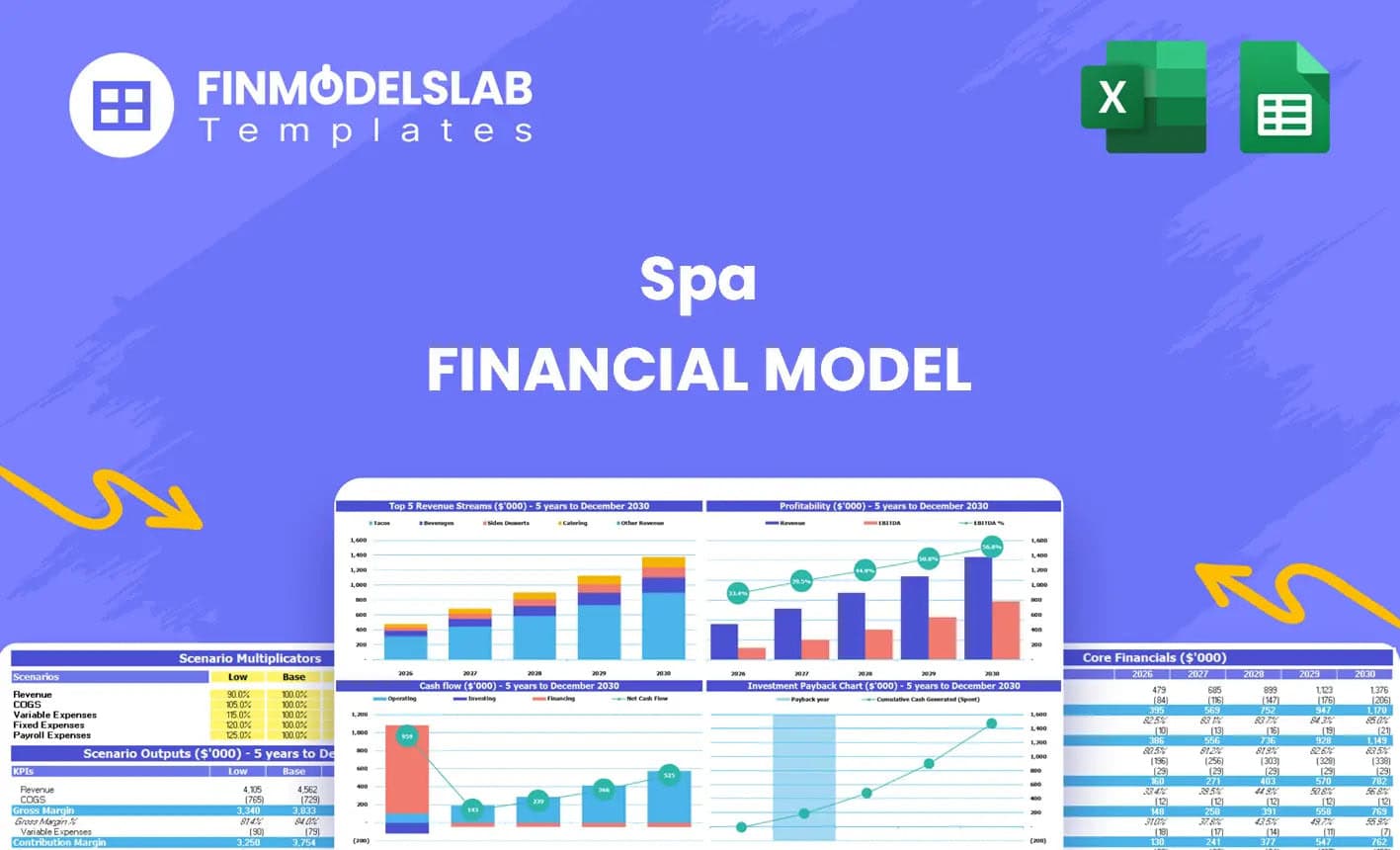
Spa Financial Model Excel Template
The Spa Financial Model helps entrepreneurs, spa owners, consultants, analysts, and business planner... Read more

Nail Salon Financial Model Excel Template
The Nail Salon Financial Model Financial Model Template helps entrepreneurs, salon owners, consultan... Read more

Beauty Salon Financial Model Excel Template
The Beauty Salon Financial Model helps entrepreneurs, salon owners, consultants, analysts, and found... Read more

Mobile Spa Salon Financial Model Excel Template
The Mobile Spa Financial Model Template helps users turn a mobile beauty and wellness business idea ... Read more

Hair Salon Financial Model Excel Template
The Hair Salon Financial Model helps salon owners, founders, consultants, and business planners turn... Read more

Tattoo Parlor Financial Model Excel Template
The Tattoo Studio Financial Model helps entrepreneurs, studio owners, consultants, analysts, and bus... Read more

Tanning Salon Financial Model Excel Template
The Tanning Salon Financial Model helps entrepreneurs, salon owners, consultants, analysts, and busi... Read more

Sauna Financial Model Excel Template
The Sauna Financial Model helps entrepreneurs, founders, consultants, analysts, and wellness busines... Read more

Massage Salon Financial Model Excel Template
The Massage Salon Financial Model helps entrepreneurs, salon owners, consultants, analysts, and busi... Read more

Makeup Salon Financial Model Excel Template
The Makeup Salon Financial Model helps entrepreneurs, salon founders, consultants, analysts, and bus... Read more
You must log in to submit a review.