
0 ITEMS

Tanning Salon Financial Model Excel Template
The Tanning Salon Financial Model helps entrepreneurs, salon owners, consultants, analysts, and business plan writers turn a tanning salon concept into a structured financial forecast. Instead of starting with a blank spreadsheet, users get a ready-to-use financial model template designed around the economics of a tanning business, including tanning sessions, memberships, packages, retail products, staffing, equipment, and operating expenses. It gives users a practical way to estimate revenue assumptions, startup costs, monthly expenses, cash flow, profitability, and funding needs before launch or expansion. This template is especially useful for people preparing business plans, loan applications, investor materials, internal budgets, or feasibility studies. It helps users understand how customer visits, service pricing, membership growth, retail sales, payroll, rent, utilities, marketing, and capital investment affect the financial performance of a tanning salon. By organizing the key assumptions in one editable model, it supports better decision-making and helps users evaluate whether the business can reach sustainable profitability under realistic conditions. The Tanning Salon Financial Model includes a five-year projection structure with automated calculations, professional reports, visual charts, KPI tracking, scenario analysis, revenue detail, and cash flow forecasting. Users can adjust the assumptions to reflect their own location, salon size, pricing strategy, service mix, staffing plan, and growth goals. The model also supports break-even analysis, allowing users to estimate when the business may cover its fixed and variable costs and begin generating profit. Built for both planning and presentation, the template works for startup founders opening a new salon as well as existing operators evaluating expansion, equipment upgrades, new services, or improved pricing. It can help identify capital requirements, test low, base, and high scenarios, review return metrics, and communicate the business case to lenders, investors, partners, or internal stakeholders. With editable inputs and pre-built outputs, the model saves time while giving users a clear financial framework for planning a tanning salon with more confidence.
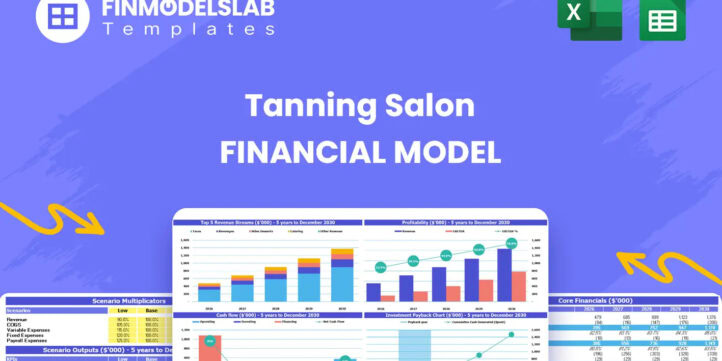


Financial Model Overview
The Tanning Salon Financial Model is a ready-to-use financial model template designed to help entrepreneurs, salon owners, consultants, analysts, and business plan writers evaluate the financial potential of a tanning salon before launching, expanding, or seeking funding. A tanning salon has a specific operating structure, with revenue coming from UV tanning sessions, spray tanning, memberships, prepaid packages, and retail product sales, while costs often include equipment, studio buildout, rent, utilities, payroll, marketing, maintenance, inventory, and working capital. This model brings those moving parts into one organized forecast so users can connect business assumptions to revenue, expenses, cash flow, profitability, funding needs, and decision-making. The template is editable, professionally formatted, and built to support five-year financial projections, making it useful for business plans, investor discussions, loan applications, internal budgeting, and strategic planning. Instead of guessing whether the salon can support its costs or when it may become profitable, users can test practical assumptions, review financial outputs, and understand the key drivers behind the business.
All-in-One Dashboard
The all-in-one dashboard gives users a centralized view of the most important inputs and outputs in the Tanning Salon Financial Model. It is designed to reduce the time spent searching through multiple tabs by bringing core planning assumptions and financial results into one place. Users can review or update major inputs such as customer visits, average pricing, service mix, membership assumptions, retail sales per visit, payroll levels, startup investment, and operating cost assumptions, then see how these choices affect revenue, profitability, cash flow, and other performance indicators. The dashboard helps translate detailed spreadsheet calculations into a more usable planning tool, especially for founders or business owners who want to understand the model without needing to inspect every formula. For funding preparation, it provides a practical summary of how the salon is expected to perform and supports conversations with investors, lenders, partners, or advisors. For internal decision-making, it helps users quickly compare planned performance against operating goals and identify which assumptions deserve closer attention.
Low, Base, and High Scenario Analysis
The low, base, and high scenario analysis component helps users test how different business conditions may affect the financial performance of a tanning salon. Rather than relying on a single forecast, the model allows users to evaluate conservative, expected, and optimistic outcomes by adjusting key drivers such as daily customer visits, membership adoption, service pricing, package sales, retail conversion, staffing levels, marketing effectiveness, and cost inflation. A low case may show the impact of slower customer acquisition, weaker repeat visits, or higher operating expenses, while a high case may show the upside of stronger local demand, better membership retention, or more successful promotional campaigns. This component is useful because tanning salons can be sensitive to seasonality, local competition, pricing strategy, and customer traffic, so a single projection may not capture the full range of possible outcomes. Scenario analysis helps users prepare a more credible business plan, understand downside risk, identify cash flow pressure points, and make better decisions about funding, hiring, marketing spend, and growth timing.
Professional Charts
The professional charts component turns the financial forecast into clear visual reports that are easier to interpret and present. Instead of showing only rows of numbers, the Tanning Salon Financial Model can display trends such as revenue growth, EBITDA progression, net profit, cash balance, expense structure, customer volume, margins, and other key performance indicators in presentation-ready graphs. These visuals are useful for business plan documents, investor updates, lender conversations, management reviews, and internal strategy sessions because they allow stakeholders to understand the direction of the business quickly. For example, a chart showing monthly revenue growth can help illustrate whether customer traffic is ramping as expected, while a cash flow chart can highlight months where working capital may be tight. Professional charts also make it easier to compare scenarios, review the effect of pricing changes, and explain why certain decisions may be needed. For users who are not finance specialists, the chart-based outputs help make complex projections more accessible, actionable, and persuasive.
ROE Components and DuPont Analysis
The ROE components and DuPont analysis section helps users understand what is driving return on equity in the tanning salon business. Return on equity is an important measure for owners and investors because it indicates how effectively the business is using invested capital to generate profit. DuPont analysis breaks this return into underlying drivers, often including profitability, asset efficiency, and leverage, so users can see whether returns are being influenced by margin performance, the productive use of salon assets, or the capital structure of the business. In a tanning salon, this can be especially helpful because major assets such as UV tanning beds, spray tan booths, HVAC upgrades, leasehold improvements, and other equipment require meaningful upfront investment. This component helps users evaluate whether the business is generating adequate returns from that investment as customer volume grows. It can also support decisions about equipment purchases, debt financing, expansion, and reinvestment by showing how changes in margins, revenue scale, and balance sheet structure can affect owner returns over time.
Revenue Inputs
The revenue inputs component is one of the most important parts of the Tanning Salon Financial Model because it defines how the business generates income. Users can work with assumptions tied to the core revenue drivers of a tanning salon, such as average daily customer visits, UV tanning session pricing, spray tanning session pricing, membership plans, prepaid packages, retail product sales, and potential changes in customer volume over time. These inputs help estimate how much revenue the salon may generate under different operating conditions and growth plans. For example, users can test the effect of increasing daily visits, adjusting the service mix, raising prices, adding membership packages, or improving retail sales per customer. The model connects these inputs to projected sales performance, allowing users to understand how commercial decisions affect total revenue and profitability. This component is useful for planning marketing strategy, setting pricing, defining sales targets, and building a business plan that is grounded in measurable operating assumptions rather than broad estimates.
Bank-Ready Reports
The bank-ready reports component provides structured financial outputs that are useful for lenders, investors, and other stakeholders who need to review the financial case behind the tanning salon. These reports may include projected profit and loss statements, cash flow forecasts, balance sheet summaries, revenue projections, expense summaries, funding needs, profitability metrics, and other lender-friendly outputs. The goal is to present the financial plan in a clean and professional format that supports loan applications, investor presentations, partner discussions, or internal approvals. Banks and financing partners often want to understand whether the business can generate enough revenue to cover operating expenses, service debt, maintain positive cash flow, and produce a reasonable return. This section helps users communicate those points clearly by organizing the forecast into familiar financial statement formats. For a tanning salon, bank-ready reporting is especially valuable because startup costs can be significant, and lenders may want to see how equipment, buildout, working capital, and early operating losses are funded before the business reaches stable performance.
Revenue Breakdown
The revenue breakdown component gives users a detailed view of how each income stream contributes to total salon revenue. Instead of treating sales as one single number, the model separates revenue into the categories that matter for a tanning salon, such as UV tanning sessions, spray tanning sessions, memberships, multi-session packages, and retail product sales. This structure helps users see which revenue streams are expected to drive growth, which services may carry higher margins, and how changes in customer behavior may affect the overall forecast. For example, membership revenue may provide recurring income and improve cash flow predictability, while retail product sales may increase average revenue per visit if staff are trained to promote add-on products effectively. This component is useful for pricing strategy, marketing planning, staff incentives, and service mix decisions. It also helps business owners identify whether the salon is too dependent on one source of income or whether a more balanced mix of sessions, memberships, packages, and retail sales can support stronger financial performance.
KPI Dashboard
The KPI dashboard focuses on the operating and financial metrics that help users track the health of the tanning salon over time. Key performance indicators may include customer visits, average revenue per visit, membership growth, retail sales per customer, revenue growth, gross margin, EBITDA margin, cash balance, payroll as a percentage of revenue, break-even progress, and other metrics relevant to salon performance. This component is useful because it turns the financial model into a management tool, not just a startup planning spreadsheet. Owners and managers can use the KPI dashboard to compare actual or expected performance against targets, identify early warning signs, and make adjustments before small issues become larger problems. For example, if customer visits are increasing but profit margins are not improving, the dashboard may point users toward pricing, labor scheduling, product costs, or utility expenses as areas to review. For investors and lenders, the KPI dashboard provides a concise way to understand whether the business is operating efficiently and progressing toward profitability.
Startup Costs
The startup costs component helps users estimate the initial capital required to open or prepare a tanning salon for operations. A tanning salon often requires meaningful upfront spending before revenue begins, including UV tanning beds, spray tan booths, studio buildout, ventilation or HVAC upgrades, electrical work, furniture, signage, reception equipment, point-of-sale systems, deposits, licenses, launch marketing, opening inventory, professional fees, and initial working capital. This section organizes those costs so users can understand the total investment required and avoid underfunding the business at launch. It can also help users separate one-time capital expenditures from recurring operating expenses, which is important for accurate cash flow forecasting and funding discussions. For entrepreneurs preparing a loan request or investor pitch, the startup cost section provides a clear explanation of how capital will be used. For existing salon owners planning expansion, it can be adapted to evaluate the cost of adding equipment, renovating a location, opening a second site, or introducing additional tanning services.
Break-Even Analysis
The break-even analysis component helps users estimate when the tanning salon may generate enough revenue to cover its fixed and variable costs. This is a critical planning tool because it shows the sales volume, customer traffic, or revenue level needed for the business to stop losing money and begin producing profit. The analysis may consider assumptions such as service pricing, customer visits, membership revenue, retail sales, rent, payroll, utilities, marketing, product costs, payment processing fees, and other ongoing expenses. By connecting revenue drivers to the cost structure, the model helps users understand how many daily visits or monthly sales may be required to reach break-even. This is useful for launch planning, cash reserve planning, pricing decisions, and funding preparation because it clarifies how long the business may need support before becoming self-sustaining. It also allows users to test strategies that could accelerate break-even, such as increasing membership sales, improving retail conversion, optimizing staffing, controlling utilities, or promoting higher-margin services.
File types:
Excel – Single-User: .xlsx
Excel – Multi-User: .xlsx
Similar ProductsOther customers were also interested in...


 HenrySheykin
Spa Financial Model Excel Template
The Spa Financial Model helps entrepreneurs, spa owners, consultants, analysts, and business planner... Read more
Nail Salon Financial Model Excel Template
The Nail Salon Financial Model Financial Model Template helps entrepreneurs, salon owners, consultan... Read more

Beauty Salon Financial Model Excel Template
The Beauty Salon Financial Model helps entrepreneurs, salon owners, consultants, analysts, and found... Read more

Mobile Spa Salon Financial Model Excel Template
The Mobile Spa Financial Model Template helps users turn a mobile beauty and wellness business idea ... Read more

Hair Salon Financial Model Excel Template
The Hair Salon Financial Model helps salon owners, founders, consultants, and business planners turn... Read more

Tattoo Parlor Financial Model Excel Template
The Tattoo Studio Financial Model helps entrepreneurs, studio owners, consultants, analysts, and bus... Read more

Sauna Financial Model Excel Template
The Sauna Financial Model helps entrepreneurs, founders, consultants, analysts, and wellness busines... Read more

Mobile Massage Salon Financial Model Excel Templat...
The Mobile Massage Financial Model Template helps entrepreneurs, founders, consultants, analysts, an... Read more

Massage Salon Financial Model Excel Template
The Massage Salon Financial Model helps entrepreneurs, salon owners, consultants, analysts, and busi... Read more

Makeup Salon Financial Model Excel Template
The Makeup Salon Financial Model helps entrepreneurs, salon founders, consultants, analysts, and bus... Read more
You must log in to submit a review.