
0 ITEMS

Massage Salon Financial Model Excel Template
The Massage Salon Financial Model helps entrepreneurs, salon owners, consultants, analysts, and business plan writers turn a massage therapy concept into a structured five-year financial forecast. Instead of relying on a rough spreadsheet or disconnected assumptions, this template brings together revenue assumptions, startup costs, operating expenses, payroll, cash flow, profitability, and investment metrics in one ready-to-use model. It is designed for massage salons, massage clinics, wellness studios, and spa-style businesses that need a practical way to understand whether the numbers support the plan before launching, expanding, or presenting to stakeholders. This financial model template is built around the main drivers of a massage salon business, including daily visits, service pricing, membership sessions, retail product sales, add-ons, staffing requirements, therapist utilization, rent, marketing, equipment, and other operating costs. Users can adjust the assumptions to reflect their own location, service mix, pricing strategy, team structure, and growth expectations. The model then helps translate those assumptions into projected revenue, gross profit, EBITDA, cash flow, and profitability over time, making it easier to evaluate business performance under realistic conditions. For funding preparation and decision-making, the Massage Salon Financial Model provides a cleaner and more professional alternative to building a forecast from scratch. It supports investor and lender discussions by organizing the key financial statements, revenue build-up, cost structure, break-even analysis, and return metrics that stakeholders often expect to review. The template is useful for preparing a business plan, estimating funding needs, testing low, base, and high scenarios, reviewing the timing of cash shortfalls, and identifying the operational targets needed to reach sustainable profitability. Because the template is fully editable and compatible with Excel and Google Sheets, it can be customized for a small independent massage studio, a larger wellness center, or an expanding massage salon concept. Users can update inputs, test different pricing or staffing decisions, review visual dashboards, and refine their plan as new information becomes available. The result is a practical financial planning tool that helps users make better decisions, communicate their strategy clearly, and understand the financial path from startup investment to break-even and long-term growth.


Financial Model Overview
The Massage Salon Financial Model is a ready-to-use financial model template designed to help entrepreneurs, business owners, consultants, analysts, and planning teams evaluate the financial potential of a massage salon, massage clinic, wellness studio, or spa-style service business. A massage salon has several moving parts that directly affect profitability, including daily appointment volume, service pricing, therapist capacity, membership sales, retail add-ons, staffing costs, rent, equipment, marketing, and working capital. This template brings those drivers into one structured planning tool so users can forecast revenue, costs, cash flow, profitability, and funding needs without building a complex spreadsheet from scratch. It is useful for preparing a business plan, reviewing the economics of a new location, presenting to lenders or investors, or making internal decisions before committing capital. With editable assumptions, five-year projections, financial statements, dashboards, and analysis sections, the model helps turn a massage salon idea into a more organized, measurable, and decision-ready financial plan.
All-in-One Dashboard
The all-in-one dashboard gives users a central view of the most important inputs and outputs in the Massage Salon Financial Model. Instead of moving through multiple tabs to understand the forecast, users can review the core assumptions, projected revenue, expenses, profit, cash position, and other key results in one place. For a massage salon, this may include assumptions such as average daily visits, operating days, service pricing, membership session rates, retail add-on revenue, startup investment, payroll, rent, marketing, and other operating costs. The dashboard is useful because it connects the operating plan with the financial outcome, allowing users to quickly see how the salon performs under the current set of assumptions. It supports faster review, cleaner decision-making, and more confident stakeholder conversations by presenting the model’s main conclusions in a practical and organized format. Business owners can use it to check whether the plan is financially realistic, while consultants and analysts can use it as a quick reference point when explaining the forecast to clients, investors, or lenders.
Low, Base, and High Scenario Analysis
The low, base, and high scenario analysis section helps users evaluate how the massage salon could perform under different business conditions. A single forecast can be misleading because appointment volume, pricing, staff availability, marketing results, and customer retention may not develop exactly as expected. This component allows users to compare a conservative case, a realistic base case, and an optimistic growth case by adjusting important drivers such as average daily visits, service prices, membership adoption, add-on sales, payroll assumptions, rent levels, and operating expenses. The output shows how each scenario affects revenue, margins, cash flow, profitability, and long-term financial performance. This is especially useful for funding preparation because investors and lenders often want to understand both downside risk and upside potential. For the owner, it supports practical planning by showing what happens if demand grows more slowly, if a marketing campaign performs better than expected, or if costs increase above the initial budget. The scenario structure turns the model into a planning and risk-management tool rather than a static forecast.
Professional Charts
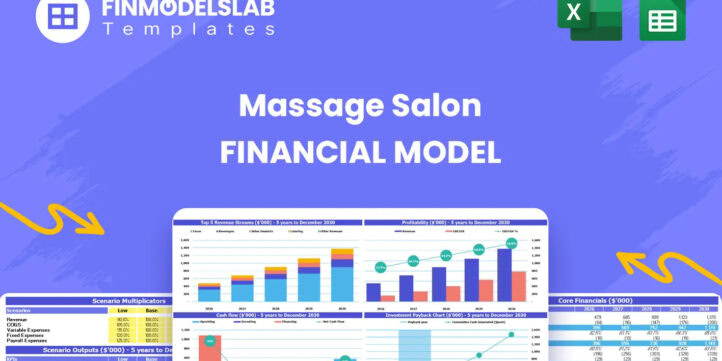
The professional charts component turns the financial projections into clear visuals that are easier to interpret and present. Massage salon financial planning often involves many connected figures, including revenue growth, EBITDA, cash balance, gross margin, startup investment, and profitability trends. Charts make these outputs easier to understand by showing movement over time and highlighting relationships between key financial metrics. Users can use the charts to communicate the salon’s growth path, show when the business begins generating positive earnings, compare revenue streams, or present cash flow trends in a more stakeholder-friendly format. This is valuable for business plans, pitch decks, bank meetings, internal planning sessions, and partner discussions because visual reporting can make a complex forecast more accessible. The component also helps users identify patterns that may be missed in row-by-row spreadsheets, such as periods of cash pressure, margin improvement, or rapid revenue growth. For non-financial users, the charts provide a practical way to understand the direction of the business and explain the plan with greater confidence.
ROE Components and DuPont Analysis
The ROE components and DuPont analysis section helps users understand the drivers behind return on equity instead of viewing return as a single isolated number. For a massage salon, return on equity can be influenced by profit margins, asset efficiency, and the way the business is financed. This component breaks performance into underlying factors so users can see whether returns are being driven by healthy operating profitability, better utilization of assets such as treatment rooms and equipment, or changes in the capital structure. Inputs may include projected net income, equity investment, assets, revenue, margins, and balance sheet figures. Outputs can help users interpret return on equity, operational efficiency, and the quality of the salon’s financial performance over the forecast period. This is especially useful when presenting to investors or evaluating whether the business is creating attractive returns relative to the capital invested. It also helps management identify where improvement is needed, such as increasing therapist utilization, improving margins through pricing and add-ons, or controlling the asset base required to support growth.
Revenue Inputs
The revenue inputs component provides the foundation for forecasting income in the Massage Salon Financial Model. A massage salon’s revenue depends on specific operating assumptions, so this section allows users to define the drivers that matter most, such as average daily visits, operating days per year, à la carte session pricing, membership session pricing, retail product sales, add-ons, and expected growth over time. These assumptions can be adjusted to match the user’s business model, whether the salon focuses on one-time appointments, recurring memberships, premium treatments, corporate wellness packages, or a mix of services and retail products. The model uses these inputs to calculate projected sales across the forecast period, helping users understand how changes in volume, pricing, and service mix affect total revenue. This section is useful because it makes the forecast transparent and easier to defend. Instead of entering revenue as one broad number, users can build it from operational logic, making the business plan more credible for lenders, investors, advisors, and internal decision-makers.
Bank-Ready Reports
The bank-ready reports component organizes the financial model outputs into a format that is suitable for lenders, investors, and other professional stakeholders. A massage salon seeking funding may need to show more than a simple revenue projection. Lenders often want to review profit and loss forecasts, cash flow projections, balance sheet estimates, startup capital requirements, debt service capacity, margins, and the assumptions behind the numbers. This section helps package the model’s results into financial outputs that are easier to review during loan applications, funding discussions, or business planning meetings. Inputs flow from the assumptions, revenue model, cost structure, payroll, startup budget, and financing plan, while outputs may include projected statements, profitability summaries, investment metrics, and liquidity indicators. The value of this component is that it helps users present a more complete and professional financial case. It reduces the risk of showing incomplete numbers and gives stakeholders a clearer view of how the massage salon expects to generate revenue, manage costs, repay obligations, and reach sustainable operations.
Revenue Breakdown
The revenue breakdown component gives users a detailed view of how total revenue is generated across different massage salon revenue streams. Rather than treating sales as one combined figure, this section separates the business into meaningful categories such as à la carte massage sessions, membership sessions, retail product sales, and add-on services. This structure helps users understand which streams contribute the most to revenue, which may carry higher margins, and where growth opportunities may exist. Inputs may include session pricing, visit volume, membership penetration, customer purchase behavior, retail sales assumptions, add-on adoption rates, and annual growth assumptions. Outputs can show revenue by category, total sales trends, contribution by stream, and changes in mix over time. This is useful for strategic decision-making because the owner can test whether a membership-focused model improves stability, whether premium add-ons increase profitability, or whether retail sales justify inventory investment. A detailed revenue breakdown also supports a stronger business plan by demonstrating that the forecast is based on specific commercial activities rather than a generic sales estimate.
KPI Dashboard
The KPI dashboard focuses on the performance metrics that help users monitor the health and direction of the massage salon. While the all-in-one dashboard provides a broad summary of inputs and outputs, the KPI dashboard is centered on measurable indicators that can be reviewed against targets and benchmarks. Relevant metrics may include revenue growth, average revenue per visit, gross margin, EBITDA margin, net profit margin, cash balance, customer volume, utilization, cost ratios, payroll as a percentage of revenue, marketing efficiency, and return metrics. These KPIs help users evaluate whether the salon’s forecast is balanced, whether operating costs are reasonable, and whether the business is moving toward profitability at a healthy pace. The dashboard can also support benchmark comparisons, allowing users to review how their projected performance aligns with broader wellness or service-business standards. For owners and managers, this component is useful for setting operational goals and tracking progress. For investors and lenders, it provides a concise view of the financial indicators that matter most when assessing business quality and risk.
Startup Costs and Operating Expense Planning
The startup costs and operating expense planning component helps users estimate both the initial investment required to open the massage salon and the recurring costs needed to keep it running. Startup expenses may include leasehold improvements, massage tables, treatment room equipment, initial retail inventory, deposits, licensing, technology, furniture, signage, launch marketing, and working capital. Operating expenses may include rent, utilities, payroll, therapist wages, reception staff, booking software, insurance, cleaning supplies, laundry, marketing, maintenance, professional fees, and administrative costs. By organizing these costs in a structured way, the model helps users avoid underestimating capital needs or overlooking expenses that can create cash pressure after launch. The outputs support funding calculations, monthly budgeting, cash flow forecasting, and profitability analysis. This section is particularly important for a massage salon because the business may require upfront build-out and equipment investment before it generates meaningful revenue. A clear cost plan helps owners decide how much capital to raise, when to hire staff, how much cash reserve to maintain, and whether the pricing and volume assumptions can support the planned cost base.
Break-Even Analysis
The break-even analysis component helps users identify when the massage salon is expected to cover its fixed and variable costs and begin generating profit. This section connects revenue assumptions, service pricing, customer volume, payroll, rent, marketing, cost of goods sold, and operating expenses to determine the level of activity required for the business to become financially sustainable. Outputs may include the projected break-even month, required revenue, required visit volume, margin contribution, and the relationship between fixed costs and sales performance. For a massage salon, this is especially useful because early months often involve ramp-up costs, customer acquisition spending, and lower initial appointment volume. Understanding the break-even point helps users set realistic sales targets, plan pre-launch marketing, evaluate staffing levels, and estimate how much working capital is needed before the salon becomes self-supporting. It is also a key metric for lender and investor discussions because it shows how long the business may need funding support and what operating milestones must be achieved to reduce financial risk.
File types:
Excel – Single-User: .xlsx
Excel – Multi-User: .xlsx
Similar ProductsOther customers were also interested in...


 HenrySheykin
Spa Financial Model Excel Template
The Spa Financial Model helps entrepreneurs, spa owners, consultants, analysts, and business planner... Read more

Nail Salon Financial Model Excel Template
The Nail Salon Financial Model Financial Model Template helps entrepreneurs, salon owners, consultan... Read more

Beauty Salon Financial Model Excel Template
The Beauty Salon Financial Model helps entrepreneurs, salon owners, consultants, analysts, and found... Read more

Mobile Spa Salon Financial Model Excel Template
The Mobile Spa Financial Model Template helps users turn a mobile beauty and wellness business idea ... Read more

Hair Salon Financial Model Excel Template
The Hair Salon Financial Model helps salon owners, founders, consultants, and business planners turn... Read more

Tattoo Parlor Financial Model Excel Template
The Tattoo Studio Financial Model helps entrepreneurs, studio owners, consultants, analysts, and bus... Read more

Tanning Salon Financial Model Excel Template
The Tanning Salon Financial Model helps entrepreneurs, salon owners, consultants, analysts, and busi... Read more

Sauna Financial Model Excel Template
The Sauna Financial Model helps entrepreneurs, founders, consultants, analysts, and wellness busines... Read more

Mobile Massage Salon Financial Model Excel Templat...
The Mobile Massage Financial Model Template helps entrepreneurs, founders, consultants, analysts, an... Read more

Makeup Salon Financial Model Excel Template
The Makeup Salon Financial Model helps entrepreneurs, salon founders, consultants, analysts, and bus... Read more
You must log in to submit a review.