
0 ITEMS

Makeup Salon Financial Model Excel Template
The Makeup Salon Financial Model helps entrepreneurs, salon founders, consultants, analysts, and business owners turn a makeup salon concept into a structured five-year financial forecast. Instead of starting from a blank spreadsheet, users can work from a ready-to-use model designed around the economics of a beauty service business, including bridal makeup, occasion makeup, instructional sessions, workshops, and retail product sales. The template helps organize revenue assumptions, startup costs, operating expenses, payroll, cash flow, profitability, and funding needs in one connected planning tool. This financial model template is useful for business planning, investor discussions, loan applications, internal budgeting, and decision-making before launch or expansion. Users can enter assumptions such as daily client visits, pricing, service mix, staffing levels, cosmetic supply costs, marketing spend, rent, equipment, inventory, and opening investment. The model then helps translate those assumptions into financial statements, dashboards, charts, scenario outputs, and key performance indicators that make the business plan easier to understand and present. For makeup salon owners and planners, the template provides a practical way to evaluate whether the salon can generate enough sales volume to cover fixed costs, recover the initial investment, and reach sustainable profitability. It supports planning around revenue growth, cost control, payroll management, cash flow timing, and break-even analysis, helping users identify potential funding gaps and test how different assumptions affect performance. This is especially valuable for founders preparing a salon launch, consultants building client models, or operators comparing pricing, staffing, and service mix options. The Makeup Salon Financial Model is fully editable and built for use in Microsoft Excel and Google Sheets, making it flexible for different markets, currencies, salon sizes, and growth strategies. Users can customize the assumptions, review low, base, and high scenarios, prepare bank-ready reports, and present financial results through professional charts and dashboards. By connecting operational details with financial outcomes, the model helps users make better decisions about launch capital, pricing, hiring, marketing, inventory, and long-term business growth.
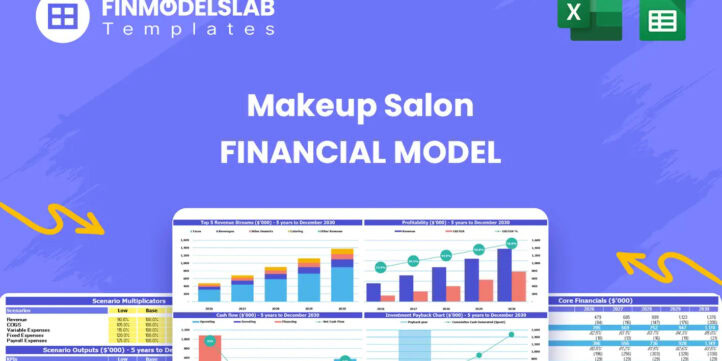


Financial Model Overview
The Makeup Salon Financial Model is a ready-to-use financial model template built to help entrepreneurs, salon founders, business owners, consultants, and analysts plan the financial performance of a makeup salon. It brings together the key assumptions behind a beauty service business, including client visits, service pricing, bridal bookings, occasion makeup, instructional sessions, retail sales, staffing, startup costs, operating expenses, cash flow, and profitability. The template is designed to support a five-year forecast and can be used for business planning, funding preparation, bank discussions, investor presentations, internal budgeting, and strategic decision-making. Because the model is editable, users can replace the pre-filled assumptions with their own market research, local pricing, expected salon capacity, payroll structure, rent, marketing budget, and growth plan. This gives users a practical way to move from a business idea to a structured financial forecast that shows how the salon may perform month by month and year by year.
All-in-One Dashboard
The all-in-one dashboard gives users a central view of the most important inputs and outputs in the Makeup Salon Financial Model. It is designed to make the model easier to navigate by bringing core assumptions, headline financial results, and key performance indicators into one summary area. Users can review inputs such as pricing, service volume, growth assumptions, cost drivers, staffing plans, and startup requirements, then see how those inputs affect revenue, profit, cash flow, break-even timing, and return metrics. This section is useful because it reduces the need to move between multiple tabs just to understand the overall financial picture. For founders and business owners, the dashboard supports faster decision-making by showing whether the business plan is financially realistic. For consultants, analysts, lenders, and investors, it provides a concise overview of the salon’s expected performance and helps communicate the financial story behind the makeup salon business plan.
Low, Base, and High Scenario Analysis
The low, base, and high scenario analysis section helps users test how the makeup salon may perform under different market conditions. A base scenario can reflect the most likely plan, while a low scenario may model slower client growth, lower booking volume, weaker retail sales, or higher costs. A high scenario can show the potential upside from stronger demand, better pricing, more bridal bookings, improved staff utilization, or more successful marketing campaigns. Users can adjust key assumptions such as average daily visits, service prices, customer mix, retail attachment rate, payroll costs, rent, and marketing spend to see the effect on revenue, profit margins, cash flow, and funding needs. This component is especially useful for planning because it shows that the business does not depend on one fixed set of assumptions. It helps users prepare for downside risk, justify funding requirements, set realistic performance targets, and understand which drivers have the strongest impact on profitability.
Professional Charts
The professional charts section turns the financial forecast into clear visual outputs that are easier to understand and present. Instead of relying only on rows of numbers, users can review charts for revenue growth, expense trends, cash balance, profitability, EBITDA, margins, and other important financial measures. These charts help show how the makeup salon is expected to develop over time, from launch through the later years of operation. They are useful for investor presentations, lender discussions, business plan documents, management meetings, and monthly performance reviews because they translate complex financial projections into a more accessible format. Users can quickly identify trends such as improving profitability, rising operating costs, seasonal cash pressure, or delayed payback. For a makeup salon, where success depends on balancing client volume, service mix, staffing, and inventory costs, visual reporting helps stakeholders understand whether the business is moving toward sustainable performance and where adjustments may be needed.
ROE Components and DuPont Analysis
The ROE components section uses DuPont analysis to help users understand what is driving return on equity in the makeup salon business. Rather than showing only a final return figure, this part of the model breaks performance into underlying components such as profitability, asset efficiency, and financial leverage. Users can review how net income, revenue, assets, and equity interact to influence the salon’s return profile over time. This is useful for investors and business owners because it helps explain whether returns are being created through healthy operating profit, efficient use of assets, or changes in the capital structure. For a makeup salon, this analysis can support decisions around equipment investment, inventory levels, expansion plans, retained earnings, and outside financing. It also gives users a more professional way to evaluate business performance beyond simple profit figures, making the financial model stronger for stakeholder review and long-term planning.
Revenue Inputs
The revenue inputs section is where users define the commercial assumptions that drive the salon’s forecast. This includes assumptions such as average daily client visits, service mix, pricing for bridal makeup, occasion makeup applications, instructional sessions, workshops, and retail product sales. Users can adjust these inputs to reflect their local market, target customer base, salon positioning, booking capacity, and expected growth over time. For example, a salon focused on premium bridal services may use higher average transaction values and lower volume, while a salon focused on frequent occasion makeup may rely on higher daily client traffic. The revenue inputs are important because small changes in pricing, visit volume, booking frequency, or product sales can significantly affect total revenue and profitability. By organizing these assumptions clearly, the model helps users build a more realistic forecast, test different service strategies, and understand the relationship between salon operations and financial outcomes.
Bank-Ready Reports
The bank-ready reports section provides lender-friendly financial outputs that can support loan applications, funding requests, and formal business planning. This component typically includes structured financial statements such as the profit and loss statement, cash flow forecast, and balance sheet, along with supporting schedules that explain how the projections were built. Users can review revenue, cost of goods sold, gross profit, operating expenses, EBITDA, net income, assets, liabilities, equity, and cash movement over the forecast period. For a makeup salon seeking startup financing or expansion capital, these reports help demonstrate the expected ability of the business to generate revenue, manage expenses, maintain liquidity, and repay financing. The reports are useful because they present the financial plan in a format that lenders, investors, advisors, and partners can review more easily. They also help founders identify weaknesses in the plan before submitting documents to external stakeholders.
Revenue Breakdown
The revenue breakdown section gives users a more detailed view of how the makeup salon generates sales across its different revenue streams. Instead of showing total revenue only, it separates income by categories such as bridal makeup services, occasion makeup applications, instructional sessions, workshops, and retail product sales. This allows users to see which services contribute the most to revenue and how changes in customer demand or pricing affect the overall business model. The section may use assumptions for client volume, service frequency, average price, growth rate, and retail conversion to calculate projected revenue by stream. This is valuable for planning because each revenue category can have different margins, capacity requirements, marketing needs, and growth potential. A bridal service may generate high revenue per booking but depend on seasonal demand, while retail product sales may improve profitability when attached to appointments. The breakdown helps users refine their sales strategy and prioritize the most attractive revenue opportunities.
KPI Dashboard and Performance Benchmarks
The KPI dashboard and performance benchmarks section helps users measure the salon’s financial performance using practical indicators that matter for a beauty service business. It may include metrics such as revenue per client, gross margin, EBITDA margin, net profit margin, cash balance, burn rate, revenue growth, payroll as a percentage of revenue, cost of goods sold, and return metrics. Benchmarking can help users compare projected performance against industry expectations or internal targets, making it easier to validate assumptions and identify unrealistic forecasts. For example, if payroll or cosmetic supply costs are too high relative to revenue, the model can highlight pressure on profitability before it becomes a real operating issue. This section is useful for founders, operators, and advisors because it turns the financial forecast into measurable performance targets. It also strengthens business plans and funding discussions by showing that the salon’s assumptions have been reviewed against relevant financial standards.
Startup Costs and Operating Expense Planning
The startup costs and operating expense planning section helps users estimate the capital required to open and run the makeup salon. Startup costs may include salon build-out, renovation, furniture, fixtures, makeup stations, lighting, mirrors, professional equipment, initial inventory, retail products, deposits, licenses, launch marketing, technology, insurance, and working capital. Operating expenses may include rent, payroll, contractor payments, utilities, booking software, accounting, marketing, cleaning, supplies, insurance, repairs, and general administration. This section is useful because it separates one-time launch investments from recurring monthly costs, giving users a clearer understanding of funding requirements and ongoing cash needs. For a makeup salon, upfront investment can be significant, especially if the business requires a polished client environment and professional-grade equipment. By mapping these costs in advance, users can avoid underestimating the cash required to open, prepare more accurate funding requests, and make better budgeting decisions before committing to leases, suppliers, or staffing plans.
Break-Even and Payback Analysis
The break-even and payback analysis section helps users understand when the makeup salon may become financially sustainable and when the initial investment may be recovered. Break-even analysis compares revenue with fixed costs, variable costs, startup investment, and operating expenses to estimate the point at which the business covers its costs. Payback analysis shows how long it may take for cumulative cash flow or profit to recover the original investment. Users can test how changes in client volume, pricing, service mix, cost of goods sold, rent, payroll, and marketing spend affect the timing of break-even and payback. This is especially important for a makeup salon because early months may include heavy launch costs, lower brand awareness, and slower client acquisition. The analysis helps users set realistic expectations, plan funding reserves, evaluate risk, and decide whether adjustments are needed to pricing, staffing, marketing, or cost structure. It also gives investors and lenders a clear view of the path toward profitability.
File types:
Excel – Single-User: .xlsx
Excel – Multi-User: .xlsx
Similar ProductsOther customers were also interested in...


 HenrySheykin
Spa Financial Model Excel Template
The Spa Financial Model helps entrepreneurs, spa owners, consultants, analysts, and business planner... Read more

Nail Salon Financial Model Excel Template
The Nail Salon Financial Model Financial Model Template helps entrepreneurs, salon owners, consultan... Read more

Beauty Salon Financial Model Excel Template
The Beauty Salon Financial Model helps entrepreneurs, salon owners, consultants, analysts, and found... Read more

Mobile Spa Salon Financial Model Excel Template
The Mobile Spa Financial Model Template helps users turn a mobile beauty and wellness business idea ... Read more

Hair Salon Financial Model Excel Template
The Hair Salon Financial Model helps salon owners, founders, consultants, and business planners turn... Read more

Tattoo Parlor Financial Model Excel Template
The Tattoo Studio Financial Model helps entrepreneurs, studio owners, consultants, analysts, and bus... Read more

Tanning Salon Financial Model Excel Template
The Tanning Salon Financial Model helps entrepreneurs, salon owners, consultants, analysts, and busi... Read more

Sauna Financial Model Excel Template
The Sauna Financial Model helps entrepreneurs, founders, consultants, analysts, and wellness busines... Read more

Mobile Massage Salon Financial Model Excel Templat...
The Mobile Massage Financial Model Template helps entrepreneurs, founders, consultants, analysts, an... Read more

Massage Salon Financial Model Excel Template
The Massage Salon Financial Model helps entrepreneurs, salon owners, consultants, analysts, and busi... Read more
You must log in to submit a review.