
0 ITEMS

Aromatherapy Salon Financial Model Excel Template
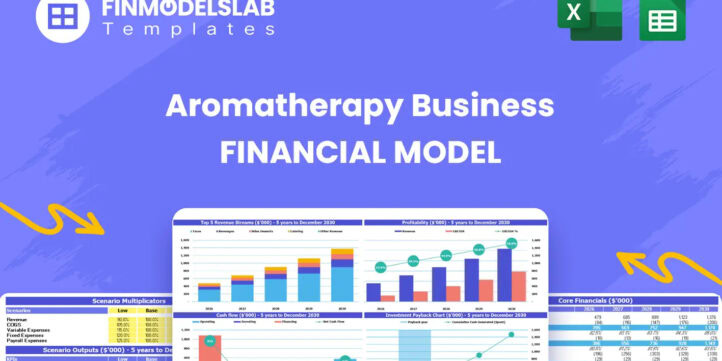
The Aromatherapy Business Financial Model helps entrepreneurs and planners turn an e-commerce aromatherapy concept into a structured financial forecast. Instead of estimating demand, costs, and profitability in separate files, this financial model template connects the main drivers of an aromatherapy product business in one editable workbook. Users can plan revenue from essential oils, diffusers, curated relaxation kits, and subscription boxes while also reviewing startup costs, operating expenses, payroll, inventory-related costs, cash flow, and profit potential over a five-year period. Built for founders, business owners, consultants, analysts, and people preparing business plans or funding documents, the template is designed to support practical financial planning and better decision-making. It gives users a clear framework for documenting revenue assumptions, testing customer acquisition costs, estimating repeat purchases, planning staffing needs, and understanding how product mix and margins affect overall profitability. The model is especially useful for aromatherapy brands, wellness product startups, natural product sellers, and online retailers that need a credible financial plan before launching, raising capital, or scaling operations. The template includes pre-built formulas, professional reports, dashboard views, scenario analysis, charts, KPI tracking, revenue breakdowns, and investor-oriented outputs so users can evaluate the business from multiple angles. It helps answer important questions such as how much funding may be needed, when the business may reach break-even analysis, how cash flow behaves during early growth, and which assumptions have the biggest impact on performance. Users can adjust pricing, sales volumes, marketing spend, payroll, fulfillment costs, and other inputs to reflect their own plan rather than relying on generic assumptions. Because the Aromatherapy Business Financial Model is fully customizable and compatible with Excel and Google Sheets, it can be used for startup planning, internal budgeting, investor presentations, lender discussions, and ongoing business reviews. It saves time compared with building a model from scratch while still giving users the flexibility to personalize assumptions, update forecasts, and compare outcomes. Whether you are preparing a funding request, validating a wellness product idea, or managing growth in an existing aromatherapy business, this template provides a practical financial planning tool for evaluating revenue, expenses, cash flow, profitability, and long-term sustainability.


![Spreadsheet titled Startup Costs (CAPEX) showing initial purchase items and dates in a yellow highlighted table in an Excel sheet screenshot, with accompanying headers and totals to the right.] ,](https://www.efinancialmodels.com/wp-content/uploads/edd/2026/06/aromatherapy-financial-model-capex-financialmodelslab_f82b29db-421c-4b8c-bc3b-39663456ea55-scaled.jpg "aromatherapy-financial-model-capex-financialmodelslab_f82b29db-421c-4b8c-bc3b-39663456ea55 | eFinancialModels")


Financial Model Overview
The Aromatherapy Business Financial Model is a ready-to-use financial model template built for entrepreneurs, founders, consultants, analysts, and business owners planning an aromatherapy product business. It is especially useful for an e-commerce or direct-to-consumer wellness brand selling essential oils, diffusers, relaxation kits, subscription boxes, and related natural wellness products. The template brings together the core assumptions investors, lenders, and internal decision-makers typically want to review, including revenue drivers, startup investment, operating expenses, payroll, profitability, cash flow, and break-even timing. Instead of building a financial model from a blank spreadsheet, users can begin with a structured framework that is already organized around the realities of an aromatherapy business. The model can be edited to reflect different pricing strategies, customer acquisition plans, product mixes, cost structures, and growth assumptions, making it suitable for both early-stage planning and expansion analysis.
All-in-One Dashboard
The all-in-one dashboard gives users a central view of the Aromatherapy Business Financial Model by combining core inputs and core outputs in one accessible section. This component helps users quickly understand how the business is projected to perform without searching through multiple worksheets or reports. Key assumptions such as revenue growth, pricing, customer activity, cost behavior, staffing, and investment needs can be reflected in the dashboard outputs, allowing users to see the connection between their planning inputs and the resulting financial forecast. The dashboard is useful for reviewing projected revenue, gross margin, EBITDA, net profit, cash balance, and other high-level indicators that summarize the health of the business. For an aromatherapy brand, this is particularly valuable because performance depends on several moving parts, including marketing efficiency, repeat customer behavior, product mix, fulfillment costs, and inventory planning. The dashboard gives founders and advisors a clear starting point for decision-making, helping them identify whether the plan is financially realistic, where assumptions may need to be adjusted, and what story the business numbers are telling before the model is shared with investors or lenders.
Low, Base, and High Scenario Analysis
The low, base, and high scenario analysis component allows users to compare how the aromatherapy business may perform under different market and operating conditions. This section is designed for practical planning because business results rarely follow one exact forecast. Users can test a conservative case, a realistic base case, and an optimistic growth case by adjusting assumptions such as marketing effectiveness, customer acquisition cost, conversion rates, repeat purchase behavior, average order value, subscription adoption, product margins, and operating costs. The output helps users see how changes in key assumptions affect revenue, cash flow, profitability, funding needs, and the timing of important milestones. For example, if customer acquisition becomes more expensive or repeat purchases are slower than expected, the low scenario can show how much additional cash may be required and whether the break-even timeline moves further out. If higher-value relaxation kits or subscription boxes gain traction faster than planned, the high scenario can show the potential upside. This component is useful for preparing investor discussions, building contingency plans, setting realistic performance targets, and understanding which assumptions create the greatest financial risk or opportunity.
Professional Charts
The professional charts component converts the financial forecast into presentation-ready visuals that make the Aromatherapy Business Financial Model easier to understand and communicate. Rather than relying only on rows of numbers, users can review charts that show revenue trends, expense behavior, profitability movement, cash flow direction, margin development, and other key financial patterns over time. These visuals are useful when presenting the business plan to investors, lenders, partners, internal teams, or advisors who need to grasp the financial story quickly. For an aromatherapy business, charts can help demonstrate how revenue grows as online marketing improves, how product mix shifts toward higher-value items, how operating leverage develops as order volume increases, and how profitability changes as fixed costs are absorbed. The charting component is also valuable for decision-making because it highlights trends that may not be obvious in detailed spreadsheet tabs. A founder can quickly identify whether revenue growth is strong enough to support payroll, whether cash flow is improving after a difficult startup period, or whether expenses are scaling too quickly. By creating cleaner and more visual financial outputs, this section helps users turn the model into a more credible and useful business planning document.
ROE Components and DuPont Analysis
The ROE components and DuPont analysis section helps users understand the drivers behind return on equity instead of viewing investor return as a single isolated number. This component breaks performance into the financial elements that influence ROE, such as profitability, asset efficiency, and leverage. In an aromatherapy business, these drivers can be affected by product margins, marketing efficiency, inventory turnover, working capital needs, debt usage, and the amount of equity invested into the company. By separating ROE into its underlying components, the model helps users see whether returns are being improved by stronger operating profit, better use of assets, more efficient cost management, or changes in the capital structure. This is useful for investor preparation because stakeholders often want to know not only what return may be achieved, but why that return is possible and how sustainable it is. The section can also guide management decisions by showing whether the business should focus on improving gross margins, increasing sales volume, reducing operating expenses, managing inventory more tightly, or reconsidering the funding mix. For founders who want to communicate a disciplined financial strategy, this component adds a deeper layer of financial analysis to the overall forecast.
Revenue Inputs
The revenue inputs section is one of the most important parts of the Aromatherapy Business Financial Model because it defines how the business generates sales. This component allows users to build the revenue forecast from researched and editable assumptions rather than using broad estimates. Inputs may include product prices, sales mix, customer acquisition cost, marketing spend, conversion rates, new customer volume, repeat customer rates, subscription uptake, average order value, and sales growth by month or year. For an aromatherapy business, this makes it possible to forecast revenue from essential oil sales, diffuser sales, curated relaxation kits, monthly subscription boxes, and other wellness product lines. The model can reflect how the business evolves over time, such as starting with lower-priced essential oils and later increasing the share of higher-value kits or recurring subscription products. This section helps users test whether their pricing and customer acquisition assumptions can support the broader cost structure. It is also useful for evaluating marketing strategy, because it connects promotional spending with orders, customer growth, and revenue output. By organizing revenue assumptions in a clear and editable format, the template gives users a practical foundation for business planning, funding preparation, and ongoing financial decision-making.
Bank-Ready Reports
The bank-ready reports component provides structured financial outputs that can be shared with lenders, investors, advisors, and other stakeholders. These reports are designed to present the results of the Aromatherapy Business Financial Model in a clear and professional format, helping users move from internal planning to external communication. The reports may include forecasted profit and loss statements, cash flow summaries, balance sheet outputs, funding needs, debt service considerations, profitability measures, and other key financial data that lenders commonly review. For an aromatherapy product company, this is useful because financing may be needed for initial inventory, website development, branding, packaging, marketing campaigns, working capital, or growth inventory as demand increases. Bank-ready outputs help show whether the business can generate enough revenue and cash flow to support operations and repay financing obligations. They also help users communicate the assumptions behind the plan in a more organized way, reducing the risk that a lender or investor sees the forecast as incomplete or unstructured. By creating lender-friendly reports from the model, this section saves time, improves presentation quality, and supports more confident conversations around funding, repayment capacity, and long-term financial sustainability.
Revenue Breakdown
The revenue breakdown component gives users a detailed view of how different revenue streams contribute to total sales. This section is especially important for an aromatherapy business because revenue may come from several product categories with different pricing, margins, demand patterns, and repeat purchase potential. Users can review the contribution of essential oils, diffusers, relaxation kits, subscription boxes, and any other added revenue streams to understand which products are driving growth and which may require adjustment. Inputs may include unit pricing, expected order volume, sales mix percentages, product-specific growth rates, subscription retention, and repeat customer purchasing behavior. The output helps users evaluate the balance between lower-priced repeatable products and higher-value bundles or recurring offers. This is useful for planning inventory, marketing campaigns, gross margin strategy, and customer lifetime value. For example, if subscription boxes generate stronger recurring revenue but require higher fulfillment costs, the model can help assess whether the margin and cash flow impact is attractive. If relaxation kits increase average order value, the revenue breakdown can show how much they improve total revenue and profitability. This component helps users move beyond a single total sales figure and make more informed decisions about product strategy, pricing, promotion, and growth priorities.
KPI Dashboard
The KPI dashboard tracks key performance indicators that help users monitor the aromatherapy business against financial and operating benchmarks. This component is useful because a business can show revenue growth while still facing problems with customer acquisition cost, margins, cash flow, or operating efficiency. The KPI dashboard may include metrics such as revenue growth, gross margin, EBITDA margin, customer acquisition cost, average order value, repeat purchase rate, payback period, cash balance, return measures, and other performance indicators relevant to an e-commerce wellness brand. Users can compare projected results with targets or market benchmarks to evaluate whether their assumptions are realistic and whether the business is moving toward sustainable profitability. For founders, this dashboard helps translate the financial model into a management tool that can be reviewed regularly rather than a one-time planning document. For consultants and analysts, it provides a concise way to evaluate the strengths and weaknesses of the forecast. For investors and lenders, it highlights the metrics that matter most when assessing growth quality and financial discipline. By organizing performance data into a clear dashboard, this component supports faster decision-making, better internal reviews, and more credible stakeholder communication.
Startup Costs and Funding Requirements
The startup costs and funding requirements component helps users estimate the investment needed before the aromatherapy business can begin operating and generating meaningful revenue. This section organizes one-time and pre-launch costs such as initial inventory, e-commerce website development, branding, packaging design, initial marketing assets, business formation costs, software setup, equipment, deposits, and working capital reserves. For an aromatherapy business, startup cost planning is especially important because inventory quality, packaging, compliance, brand presentation, and digital sales infrastructure can all require upfront spending. The model allows users to adjust each cost assumption and evaluate how the total launch budget changes based on their strategy. It also helps identify how much capital may need to come from founder investment, loans, outside investors, or other funding sources. The outputs are useful for business plans and funding documents because they provide a clear explanation of where money will be used and why it is required. This section also supports better decision-making by helping users separate essential launch expenses from optional spending that can be delayed. By clarifying the initial capital requirement and linking it to the broader financial forecast, this component helps users avoid underfunding the business and prepares them for more realistic launch planning.
Break-Even Analysis
The break-even analysis component helps users identify when the aromatherapy business may become financially sustainable by comparing revenue generation with the costs required to operate the company. This section can evaluate when monthly revenue covers monthly operating expenses, when cumulative revenue offsets startup and operating losses, and how changes in pricing, margin, customer acquisition, payroll, fulfillment, or fixed costs affect the break-even timeline. For an aromatherapy brand, the path to break-even can be influenced by product mix, repeat customer behavior, subscription revenue, marketing efficiency, shipping costs, supplier pricing, and the speed at which order volume grows. The model helps users understand whether the business needs more revenue, better margins, lower expenses, or additional funding to reach profitability within a reasonable period. This is valuable for investors and lenders because break-even timing is a practical indicator of business risk and capital efficiency. It is also valuable for founders because it turns broad profitability goals into specific operational levers. Users can test how increasing average order value, reducing customer acquisition cost, improving repeat purchase rates, or optimizing fulfillment costs may accelerate the break-even point.
File types:
Excel – Single-User: .xlsx
Excel – Multi-User: .xlsx
Similar ProductsOther customers were also interested in...


 HenrySheykin
Spa Financial Model Excel Template
The Spa Financial Model helps entrepreneurs, spa owners, consultants, analysts, and business planner... Read more

Nail Salon Financial Model Excel Template
The Nail Salon Financial Model Financial Model Template helps entrepreneurs, salon owners, consultan... Read more

Beauty Salon Financial Model Excel Template
The Beauty Salon Financial Model helps entrepreneurs, salon owners, consultants, analysts, and found... Read more

Mobile Spa Salon Financial Model Excel Template
The Mobile Spa Financial Model Template helps users turn a mobile beauty and wellness business idea ... Read more

Hair Salon Financial Model Excel Template
The Hair Salon Financial Model helps salon owners, founders, consultants, and business planners turn... Read more

Tattoo Parlor Financial Model Excel Template
The Tattoo Studio Financial Model helps entrepreneurs, studio owners, consultants, analysts, and bus... Read more

Tanning Salon Financial Model Excel Template
The Tanning Salon Financial Model helps entrepreneurs, salon owners, consultants, analysts, and busi... Read more

Sauna Financial Model Excel Template
The Sauna Financial Model helps entrepreneurs, founders, consultants, analysts, and wellness busines... Read more

Mobile Massage Salon Financial Model Excel Templat...
The Mobile Massage Financial Model Template helps entrepreneurs, founders, consultants, analysts, an... Read more

Massage Salon Financial Model Excel Template
The Massage Salon Financial Model helps entrepreneurs, salon owners, consultants, analysts, and busi... Read more
You must log in to submit a review.