
0 ITEMS

What Is the Debt Service Coverage Ratio?
Understanding the debt service coverage ratio (DSCR) is key for assessing a business’s ability to manage debt payments reliably.
- The DSCR equation compares unlevered free cash flow to total debt payments to show how easily a business can meet its obligations.
- A DSCR above 1 indicates sufficient cash flow to cover debt, while below 1 signals potential financial stress.
- Lenders use the DSCR to evaluate loan risk, and a ratio of 1.25 or higher is generally considered safe.
- Businesses can use a DSCR worksheet to monitor cash flow, plan borrowing, and avoid overleveraging.
- Understanding and controlling your DSCR helps you make smarter financial decisions and maintain lender confidence.
Keep reading to apply this key metric to boost your financial health.
Breaking Down the Debt Service Coverage Ratio Equation
The debt service coverage ratio (DSCR) measures how well your business can pay its debts using its operating income. It indicates whether you earn enough to cover loan payments, including both principal and interest. A debt service coverage ratio equation indicates whether your business generates sufficient funds to cover its debts. It compares your net operating income to your debt payments. A higher ratio means you’re in a stronger position to pay what you owe. Lenders use this to decide if your business is a safe bet and that your business is on solid ground. The debt service coverage ratio equation is a simple tool to check your business’s financial health. It shows how many times your income can cover your outstanding debt. Use it to spot risks, plan, and stay loan-ready.
The debt service coverage ratio equation is:

Where:
- Unleverd Free Cash Flows is the starting point in the debt service coverage ratio (DSCR) equation. It shows how much cash the business generates from its core operations before paying interest or debt. By comparing this cash flow to required debt payments, the DSCR indicates to lenders whether the company generates sufficient earnings to cover its financial obligations. A higher unlevered free cash flow means the business has a stronger cushion to meet debt service without relying on outside funding.
- Total Debt Service refers to the total amount your business must pay to cover its outstanding loans. It includes both principal and interest payments due within a set period, usually a year. In the debt service coverage ratio equation, this number indicates the amount of cash required to maintain current debt payments. If your income falls short of this amount, your business may face financial stress. The total debt service is calculated directly from a debt schedule using the principal repayments and interest payments. Make sure the interest expense is cash-based, not accrued-only. If you include non-cash (accrued) interest in the denominator, you’re overstating debt service and potentially understating DSCR, leading to a misleadingly negative picture.
The debt service coverage ratio equation covers paying back the loan principal and covering interest payments. But not all interest gets treated the same. We usually focus only on the actual cash interest paid. If any interest is accrued but not paid in cash, we exclude it. Why? Our primary concern is whether the business can meet its debt obligations with the cash on hand—nothing more.
Example Calculation:
For instance, ABC Corp has the following annual financials:
- Unlevered Free Cash Flows = $500,000
- Total Debt Service = $250,000

The DSCR calculation above shows that the company generates twice as much unlevered free cash flow as it needs to cover its debt payments. With $500,000 in cash flow and $250,000 in total debt service, the Debt Service Coverage Ratio (DSCR) is 2.0x. That means the business has a strong cushion to meet its debt obligations using cash. It signals good financial health and lowers risk for lenders or investors.
No Downloads found
What Is a Good DSCR?
A good Debt Service Coverage Ratio (DSCR) is typically 1.25x or higher. This means a company earns 25% more than it needs to cover its debt payments, providing a financial buffer. This cushion is vital because it protects the company during slow seasons, economic downturns, or surprise expenses. With this margin, the company can continue to meet its loan payments without delay, even when profits temporarily dip. For lenders, this signals lower risk and more confidence in the borrower’s ability to repay. It also gives the business more borrowing power and better loan terms.
A DSCR of exactly 1.0x means the company breaks even on debt, with no room for error. While this may seem acceptable, it leaves zero margin for error. Any drop in revenue, unexpected expense, or delay in payment collection could make the business unable to meet its debt obligations. This tight financial position raises red flags for lenders, who prefer to see a safety buffer.
Anything below a DSCR of 1.0x is a major warning sign, indicating the company does not generate enough income to cover its debt payments fully. For example, a DSCR of 0.9x means the business only earns 90% of what it owes, falling short by 10 percentage points. This shortfall puts pressure on the company’s cash flow and often forces it to dip into reserves, delay expenses, or seek additional funding to stay afloat. Lenders view this as a high-risk situation, as it indicates a significant likelihood of late payments or even default.
How Does Debt Service Coverage Ratio Affect Your Business?
The Debt Service Coverage Ratio (DSCR) indicates whether a business generates sufficient funds to cover its debt payments. A high DSCR indicates that the company can easily meet its payments, providing lenders with greater confidence. A low DSCR signals trouble and raises risk. This ratio affects loan approval, interest rates, and investment decisions. It can also shape how a company manages its cash flow and plans future growth. Simply put, DSCR has a direct influence on financial stability and access to credit.
- Shows debt repayment ability buffer: The Debt Service Coverage Ratio (DSCR) shows lenders whether your business can cover its loan payments, including both interest and principal. A strong DSCR means you generate enough income to pay your debts with a safety cushion comfortably. This gives banks confidence that lending to you is low-risk and your cash flow won’t be stretched thin.
- Guides how much debt is feasible: Business owners use DSCR to determine if they can afford additional loans. It reveals whether the company’s income is sufficient to handle new debt in addition to its current obligations. If the ratio is too low, taking on more debt could hurt the business. A healthy DSCR means room to borrow without putting financial health at risk. Even when a bank waives DSCR requirements for a year, they still check if you can repay over the long term. They want to feel confident that your business model is viable and that your income can support future payments. The waiver is temporary—what matters is proving that, in principle, you can handle the debt responsibly.
- Reveals debt service strength to investors clearly: Investors use the DSCR to determine whether a business can meet its debt obligations. A high DSCR indicates solid earnings and prudent debt utilization. It shows the company can grow without falling into financial trouble. Low DSCR, on the other hand, raises red flags. It’s a key number that reveals how safely a company handles its loans.

Why Every Business Needs a Debt Service Coverage Ratio Worksheet?
The Debt Service Coverage Ratio (DSCR) is a simple yet powerful tool. It indicates whether your business generates sufficient revenue to cover its debt. A DSCR above 1 means you’re on solid ground—your income exceeds your debt payments. This ratio helps you determine whether taking on more debt is a sensible decision. It also demonstrates to lenders and investors that your business can effectively manage its financial obligations. In short, DSCR gives a clear snapshot of your debt health and guides smarter financial choices.
A debt service coverage ratio worksheet is a measure of a company’s cash flow before taking into account its financial obligations, such as interest payments and debt. It reflects the cash available to all investors—both equity and debt holders—after the company has paid its operating expenses and capital expenditures (CAPEX) but before interest and debt repayments. Unlevered free cash flow provides a clear view of operating performance, free from the impact of capital structure. It provides a flexible way to measure a firm’s ability to meet its debt obligations. Using unlevered free cash flows provides a clearer picture of the cash available to pay off debt, as it includes capital expenses and working capital needs — unlike net operating income, which doesn’t cover these.
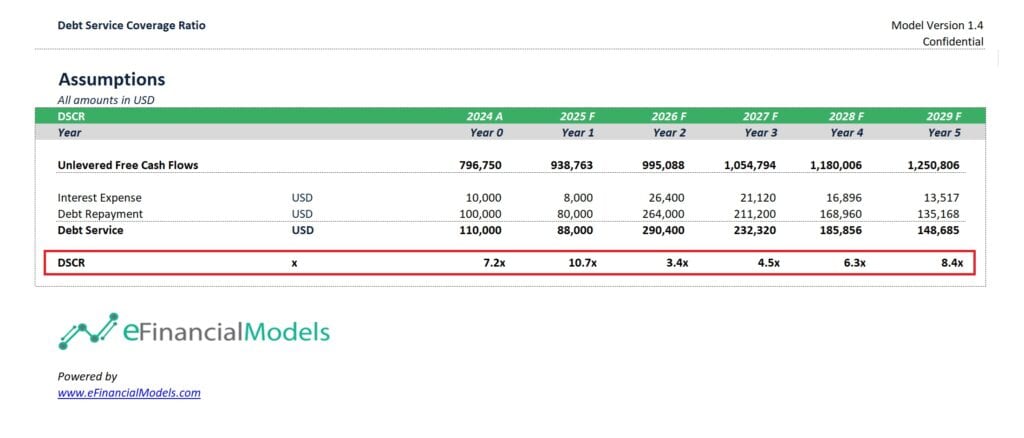
The debt service coverage ratio worksheet above provides clear insights into how well a business can meet its annual debt payments. It shows rising unlevered free cash flows and compares them to annual debt service, producing the DSCR for each period. These figures reveal strong financial health, with most years showing a DSCR well above 1—indicating reliable debt coverage. Using unlevered free cash flows in the worksheet provides a clearer view of operating performance, free from the effects of financing. This makes the debt service coverage ratio worksheet especially useful for evaluating a company’s true ability to handle debt.
Every business needs a debt service coverage ratio worksheet to maintain control over its debt. It shows if your cash flow can handle loan payments without stress. With just a few numbers, you can spot problems early and avoid overborrowing. The worksheet helps you plan smart, borrow wisely, and build lender trust. It’s a simple tool that brings powerful clarity to your finances.























































You might also like:
- Understanding the Debt Service Coverage Ratio: An Essential Metric for Financial Analysis
- 10 Main Elements of a Business Plan
- 10 Tips to Develop a First Class Business Valuation Report
- Balancing Balance Sheet and Income Statement: A Comprehensive Guide
- Calculating Revenue Growth Rate: A Key Metric for Business Success
- 5 Steps to Create a Drop Down List Using Data Validation in Excel
- 12 Funding Sources for Businesses and Startups
- Startup Financial Models
- Business Valuation
- Cash Flow Analysis in Excel
- Budgeting
- How to Calculate Net Present Value (NPV)?
- Financial Planning for Small Business Owners – Taking an SBA Loan
- Financial Ratios Analysis and Its Importance
- How to Prepare a Financial Plan for a Chicken Egg Farm?
- Project Finance
- Debt Amortization Table
- Understanding Debt Sizing & Project Finance Ratios
- Transform Your Restaurant with Strategic Pricing Tactics
- Loans and Debt