0 ITEMS

How Much Funding Should You Raise? A Step-by-Step Guide

A founder should raise enough to cover net burn over the target runway, plus one-time capital spending and a contingency buffer, and no more than the next milestones justify. This guide walks through the five-step calculation, a worked software-startup example built in Excel, and the funding sources that fit each round size.
Key Takeaways
- The funding ask equals (summed monthly net burn + capital expenditures) × (1 + contingency percentage), the same formula used in every step below.
- Net burn counts cash collected from customers, not booked revenue, so the revenue growth assumption can swing the ask sharply, as the worked example shows.
- The worked example needs $92,806 at 20 percent monthly growth, $138,720 at 10 percent and $345,000 at zero, so growth drives the answer.
- Round size decides the source: angels write small checks, seed rounds run to seven figures, and lenders underwrite cash flow.
- Build the ask from milestones, show a use-of-funds table, and revisit the model every quarter or after any missed milestone.
Why Getting Your Funding Amount Right Matters
The right amount is the one that funds a defined set of milestones with a buffer: too little ends the company before proof arrives, and too much gives away ownership without need.
Business formation is active. The U.S. Census Bureau’s Business Formation Statistics release of November 12, 2026 put business applications for October 2026, adjusted for seasonal variation, at 501,609.
Small firms dominate the economy that these founders enter. The U.S. Small Business Administration (SBA) Office of Advocacy counts 36,207,130 small businesses in the United States in its 2026 FAQ and states that 99.9 percent of businesses are small.
Running out of cash before the business finds its footing is a common way early companies stall, so sizing the raise carefully protects the runway.
The 5-Step Method to Calculate Your Funding Needs
The method adds three pieces: net burn summed over the months of the target runway in which cash runs short, one-time capital expenditures, and a contingency buffer. Written as a formula, the funding ask equals (summed monthly net burn + capital expenditures) × (1 + contingency percentage). Months with negative net burn are left out of the sum by convention, a conservative choice because a later surplus cannot pay for an earlier shortfall.
Step 1: Estimate Your Runway and Monthly Burn Rate
Burn rate is the cash a company spends each month. Gross burn is total monthly cash out, and net burn is gross burn minus cash collected from customers in the same month, so net burn is negative (a surplus) in any month when collections exceed spending. Runway is the number of months that cash on hand can cover net burn: cash on hand divided by monthly net burn. Founders can derive these from bank statements or, for a new company, from a payroll and vendor budget. Before revenue, net burn equals gross burn. Once customers pay, net burn falls, which is why Step 2 matters.
Step 2: Project Your Revenue Growth
Forecast cash collected for 12 to 18 months. A bottom-up forecast multiplies customers by price and conversion rates, while a top-down forecast takes a share of a market size. Add seasonality where it exists and use a conservative growth rate. A sensitivity analysis, which tests how the answer changes when one input moves, shows how much the ask depends on the growth assumption.
Step 3: Factor in One-Time Capital Expenditures
Capital expenditures (CapEx) are one-time purchases that last beyond a year: equipment, office build-out, perpetual software licences and capitalized intellectual property. Subscriptions and routine legal fees are operating expenses, not CapEx. Accounting spreads an asset’s cost over its useful life (depreciation for equipment, amortization for software), but the cash leaves on the purchase date. The funding ask therefore includes the full payment up front.
Step 4: Account for a Contingency Buffer
A buffer of 10 to 20 percent on burn plus CapEx is an editorial rule of thumb, not a sourced benchmark. Regulatory approvals, supplier delays, hiring delays and a longer fundraising process all consume cash the base plan never showed.
Step 5: Add Up Your Total Funding Ask
Add the pieces using the formula above, then present the number as a round size with a use-of-funds table and the milestones it reaches inside the runway. Revisit the model every quarter and after any missed milestone. This guide covers equity and debt rounds in general terms and does not cover convertible instruments, tax or legal terms, which a startup lawyer and an accountant should review.
Worked Example: Funding Calculation for a SaaS Startup
The example below uses illustrative inputs for a business-to-business (B2B) startup selling Software as a Service (SaaS), which means software rented by subscription.
Assumptions and Inputs
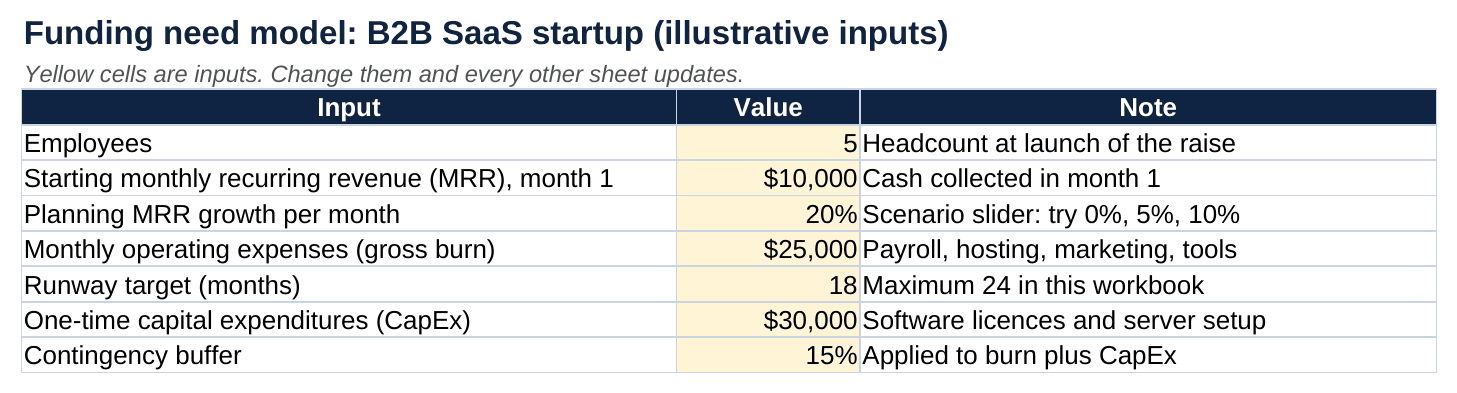
The startup has 5 employees and starts with $10,000 of monthly recurring revenue (MRR), the recurring subscription revenue billed each month; the example treats all of it as cash collected in the month it is billed, so MRR stands in for cash collected. The example assumes MRR grows 20 percent per month, operating expenses stay at $25,000 per month, the runway target is 18 months, CapEx is $30,000 for server hardware and perpetual software licences, and the buffer is 15 percent.
Building the Model in Excel
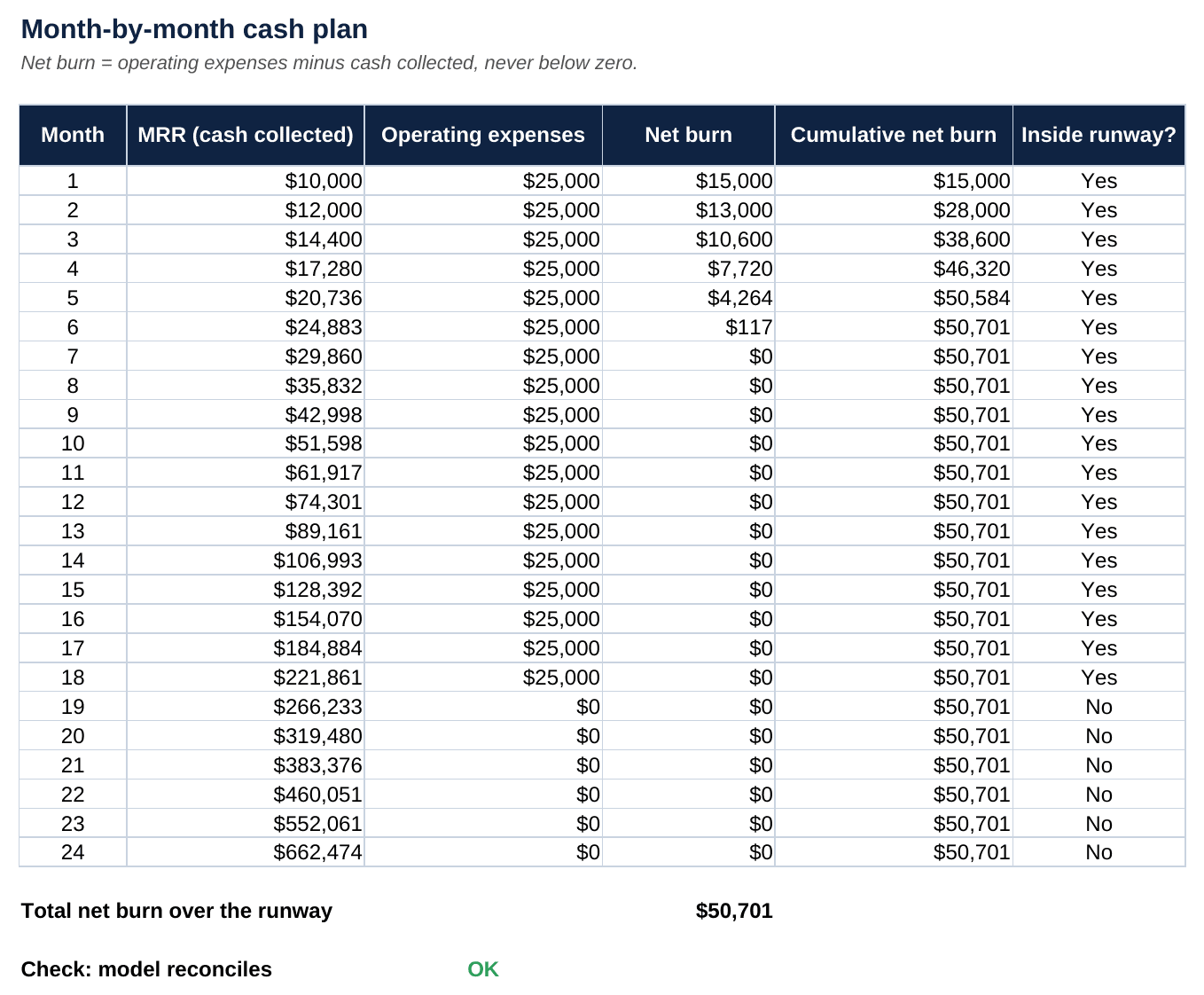
The workbook has three sheets. The Inputs sheet holds the yellow input cells, including a growth-rate cell that acts as the scenario slider; the Calculation sheet projects MRR, expenses, net burn and cumulative burn month by month using live formulas, with the Net burn column showing each month’s shortfall floored at zero; and the Results sheet adds CapEx and the buffer. A check cell on the Calculation sheet reads OK only when the monthly schedule reconciles with an independent formula and the ask equals (net burn + CapEx) × (1 + buffer).
Interpreting the Results
Net burn is $15,000, $13,000, $10,600, $7,720, $4,264 and $117 in months 1 to 6, which sum to $50,701. From month 7, MRR of $29,860 exceeds the $25,000 of expenses, so net burn is negative ($25,000 − $29,860 = −$4,860 in month 7); that surplus is left out by the convention above, so the summed shortfall over all 18 months stays $50,701. Adding $30,000 of CapEx gives $80,701, the 15 percent buffer adds $12,105, and the total funding ask is $92,806. These totals assume customers pay in the same month and exclude taxes, fundraising costs and any hiring beyond the five employees. The 20 percent case is the optimistic plan, because MRR would reach about $222,000 by month 18. The sensitivity table shows the risk: at 10 percent monthly growth the ask is $138,720, and in the stress case of zero growth it is $345,000. A company with no revenue at all would burn $25,000 × 18 = $450,000, add $30,000 of CapEx to reach $480,000, and with the 15 percent buffer need $480,000 × 1.15 = $552,000.
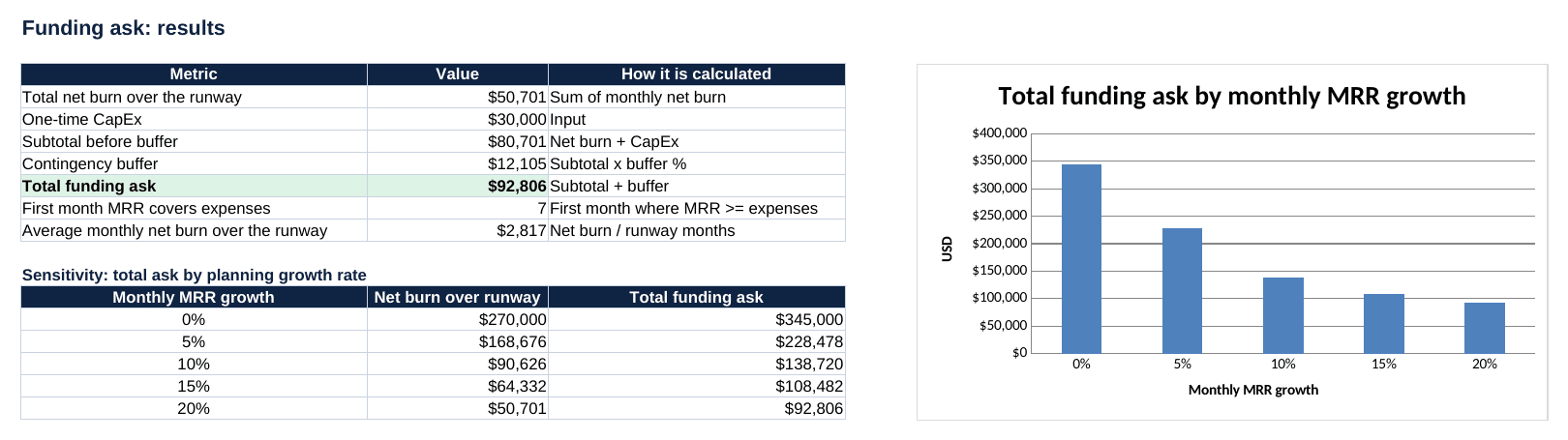
This lean five-person plan sits far below the seed round sizes quoted in the next section. If the output feels too low, a founder should test whether hiring, marketing or a longer runway belongs in the plan. If it feels too high, the plan should drop non-essential spending or split the raise into milestone-based stages, and a prudent founder sizes the raise against a conservative case, such as the 10 percent row, while keeping the zero-growth stress case in view.
Comparison of Funding Sources and Their Typical Round Sizes
The calculated number decides which source is feasible: small asks suit savings, friends and family, or angels, while seven-figure asks suit seed rounds. Only seed rounds have a sourced size benchmark here; the other rows describe how each source behaves.
Crunchbase News reported in May 2026 that the median U.S. seed round in the prior year was around $3 million, with a lowest quartile of $1 million and an upper quartile median of about $5.6 million, and that median seed sizes have been climbing since 2023.
| Source | Typical check size | Pros | Cons | Best for |
|---|---|---|---|---|
| Bootstrapping | Founder savings and customer revenue | Full ownership, forced discipline | Slow growth, personal risk | Asks the founder can fund from savings and early revenue |
| Friends and family | No reliable benchmark; set by the relationship | Fast, flexible terms | Strains relationships, informal terms | Small bridges before an institutional round |
| Angel investors | Small checks from individuals or angel groups; size varies by group | Mentors and introductions | Small checks, several investors to manage | Pre-seed asks |
| Venture capital (VC) | Median total seed round around $3 million, often split across several investors | Large checks, follow-on capital | High dilution and growth pressure | Seven-figure asks with fast growth |
| Debt | Set by lender underwriting | No ownership given up | Repayments from cash flow, covenants | Companies with steady revenue |
Founders who plan a staged raise can model the sources side by side using the Fundraising tag page.
5 Common Mistakes Founders Make When Raising Funds
- Asking for too little. A raise that ignores buffer and a slow fundraising process forces a second raise within months, often from a weaker position.
- Asking for too much. Oversized rounds dilute ownership without need.
- Ignoring dilution. Ownership sold equals the investment divided by post-money valuation, so every round should be checked against the ownership target.
- Misaligning round size and milestones. The raise should reach a milestone that unlocks the next round, such as a revenue level or a product launch.
- Skipping the use-of-funds breakdown. Investors expect hiring, product, marketing and CapEx lines that add up to the ask.
Tools and Templates to Simplify Your Calculations
Add a tab comparing actual cash spent with plan and a flag for runway below six months, in Excel or Google Sheets, so burn tracking starts before cash gets tight. Ready-made structures for software companies are collected in the SaaS financial model category, and broader options sit in the Financial Model category.
Conclusion
The funding ask is a calculation: summed net burn, plus CapEx, plus a buffer, tested against a zero-growth stress case and matched to a source of the right size. Founders who want a ready structure for the round-size step can use the Simple Fundraising Model from eFinancialModels, an Excel template that calculates the required funding amount, includes a Uses and Sources of Funds table and calculates pre- and post-money valuation.
Frequently Asked Questions
How much funding should a pre-revenue startup raise?
A pre-revenue startup has no cash coming in, so every monthly dollar of spending is net burn. Multiply the planned monthly spend by the months needed to reach the next proof point, add the equipment and licence purchases, then apply the buffer. Choose the milestone first, such as a working product with paying pilots, and let that milestone set the number of months rather than picking a round size and working backwards.
What is the difference between pre-money and post-money valuation?
Pre-money valuation is what the company is worth before new cash arrives, and post-money valuation is pre-money plus the new investment. Ownership sold equals the investment divided by the post-money figure. For example, $1,000,000 invested at a $4,000,000 pre-money valuation creates a $5,000,000 post-money valuation, so the investor owns 20 percent and existing holders keep 80 percent. Confusing the two figures is a common error that quietly changes the percentage given away.
How should a founder adjust the funding ask when revenue already exists?
Replace gross burn with net burn by subtracting cash actually collected each month, and use trailing collections as the base for forecasting the next months. Lower the ask only by revenue that a conservative scenario supports, because investors compare the plan with bank-statement actuals and will challenge any gap between the two. Founders should also keep the forecast of collections separate from the forecast of bookings.
Can a startup raise in multiple tranches?
Yes. A tranche is a portion of a round released when the company hits a defined milestone, which lets investors limit risk and lets founders sell less ownership early. The cost is complexity: the term sheet must define exactly what counts as the milestone, who verifies it, and what happens if the date is missed. Many founders instead raise one round sized for the stress case.
What if the calculated need exceeds typical seed-round sizes?
First separate must-have spending from nice-to-have spending, because plans often bundle both into one ask. Then compare the remainder with the quartile range for seed rounds in the comparison section. If the need still exceeds it, stage the plan into two rounds, look at lenders for CapEx that equipment can secure, or reduce scope so that one raise reaches a single fundable milestone, which is easier to defend than a broad plan.