0 ITEMS

Startup Funding Calculator: How Much Should You Raise?

A startup should raise enough to cover 12 to 18 months of net burn, the general rule that seed founders often stretch to 24, plus planned milestone costs and a buffer, then check that the dilution is acceptable. In the illustrative example below, that method gives a USD 1.7 million raise for 18 months of runway, which sells 22.08% of the company at an assumed USD 6 million pre-money valuation.
Key Takeaways
- Raise amount equals cumulative net burn over the target runway, plus milestone costs, minus cash on hand, plus a contingency buffer.
- Net burn is cash spent minus cash collected from customers, so booked revenue that has not been paid does not reduce it.
- Sources give 12 to 18 months as a general runway rule and 18 to 24 for seed; closing a round takes months, so raising starts early.
- Dilution equals the raise divided by post-money valuation, pre-money plus the raise, in a priced round with no pool top-up or note conversion.
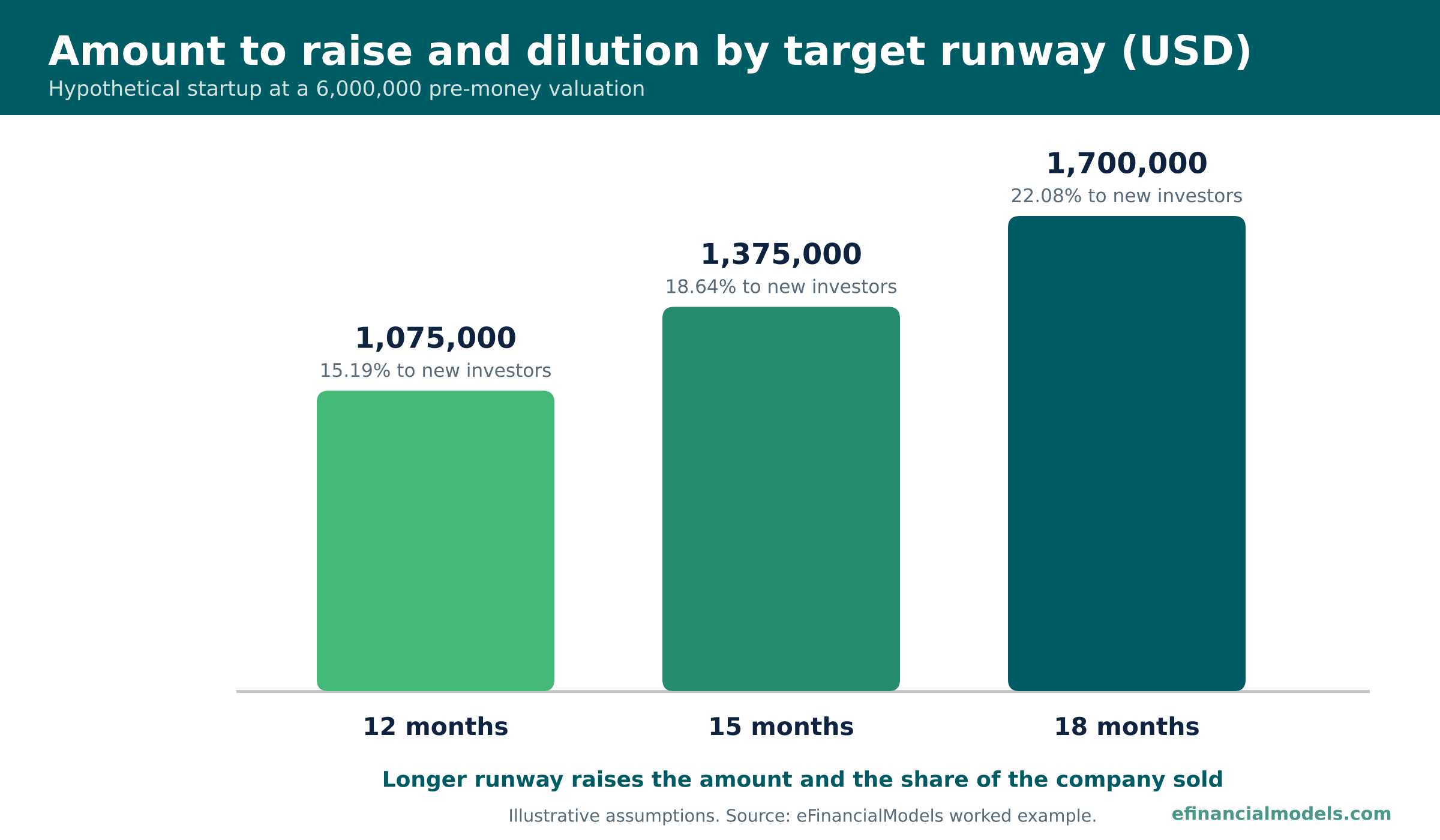
- In the illustrative example, 12, 15 and 18 months of runway need USD 1,075,000, 1,375,000 and 1,700,000 and dilute 15.19%, 18.64% and 22.08%.
The Funding Formula: Net Burn Over the Runway, Milestones and a Buffer
The amount to raise is the cash the company will consume before its next funding event, less the cash it already holds, plus a safety margin. A funding calculator turns that sentence into three lines:
Gross need = cumulative net burn over the runway + milestone costs
Net need = gross need - cash on hand
Amount to raise = net need x (1 + buffer %), rounded up
Burn rate is the cash a company spends each month. Net burn is cash operating outflows minus cash collected from customers, not booked revenue, because an unpaid invoice funds nothing. Runway is the number of months the cash on hand lasts at the current net burn. When burn grows every month, runway comes from a month-by-month schedule instead of a single division.
How Many Months of Runway Should a Startup Raise For?
A common rule of thumb is 12 to 18 months of cash runway, with many recommending 24 to 36 months in tighter fundraising markets (First Round Review glossary, 2025). CRV, a venture capital firm, reports that most founders target 18 to 24 months of runway at seed (CRV, 2026).
The same CRV page says raising seed funding takes three to six months from first pitch to closed round (CRV, 2026). Fundraising therefore has to start while enough cash remains to survive the process. The calculator offers 12, 15 and 18 months, which cover the general rule and the bottom of the seed range.
Runway planning protects the time the milestones need, but it does not fix weak demand, so the plan should show what the raise is expected to prove.
Milestone Costs: Fund the Next Proof Point, Not the Whole Company
A milestone is a one-off event that raises the odds of the next round, such as launching a minimum viable product (MVP), passing a security review, onboarding the first sales hire or obtaining a certification.
Each milestone has a name, a month and a cost. The cost joins that month’s cash outflow, so a milestone inside the runway raises the amount to raise, and one beyond it does not.
Equity Dilution: Pre-Money, Post-Money and What the Founders Keep
Pre-money valuation is the value of the company before the new cash arrives, and post-money valuation is pre-money plus the amount raised. New investors own the raise divided by the post-money valuation, and every existing holder is diluted pro rata by the same factor.
Post-money = pre-money + raise
New investor % = raise / post-money
Founder % after = founder % before x pre-money / post-money
CRV states that most founders give up 20 to 25 percent of their company to raise seed capital, with 20 percent being the median (CRV, 2026). Cooley GO, the startup guidance arm of the law firm Cooley, notes that Series A investors often end up with roughly 15 to 25% ownership post-financing (Cooley GO, 2026). Cooley GO’s figure is a later-round reference point for the ownership investors hold after a priced round. The last benchmark is a US median across seed deals: the Venture Monitor from PitchBook and the National Venture Capital Association (NVCA) reports a median seed pre-money valuation of USD 18.4 million in the first quarter of 2026 (PitchBook-NVCA Venture Monitor, 2026). A single company can sit far from that median, so the example uses a smaller assumed valuation.
At a fixed valuation, raising more money raises dilution, and a higher pre-money valuation lowers it.
Worked Example: Sizing a Raise for a Hypothetical Seed-Stage Startup
This worked example assumes a hypothetical seed-stage software company with USD 150,000 in the bank. All figures are illustrative assumptions from the calculator workbook, which is shown as screenshots only; readers can rebuild it from the three formulas above. The method leaves out capital spending, inventory, debt and grants, which hardware and other capital-heavy businesses must add, and term sheets belong with a startup lawyer.
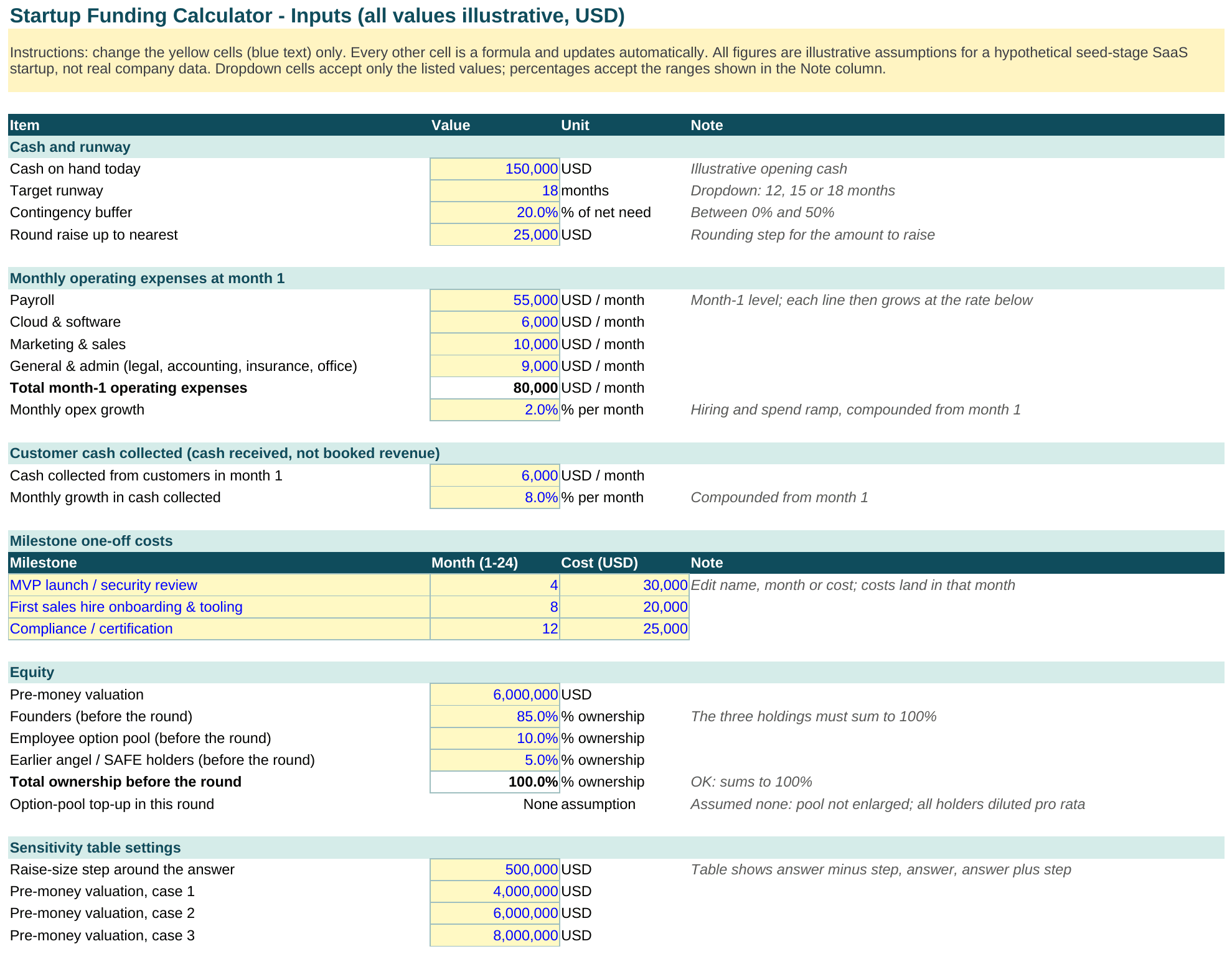
Month-1 operating expenses are USD 80,000 (payroll 55,000, cloud and software 6,000, marketing and sales 10,000, general and administrative 9,000) and grow 2% a month. Customers pay USD 6,000 in cash in month 1, growing 8% a month. Net burn in month 1 is therefore 80,000 – 6,000 = USD 74,000, and in month 2 it is 81,600 – 6,480 = USD 75,120. Milestones cost USD 30,000 in month 4, USD 20,000 in month 8 and USD 25,000 in month 12. The buffer is 20% and the pre-money valuation is USD 6,000,000. Before the round, the founders hold 85%, the option pool 10% and earlier angel holders 5%, and the example assumes no option-pool top-up.
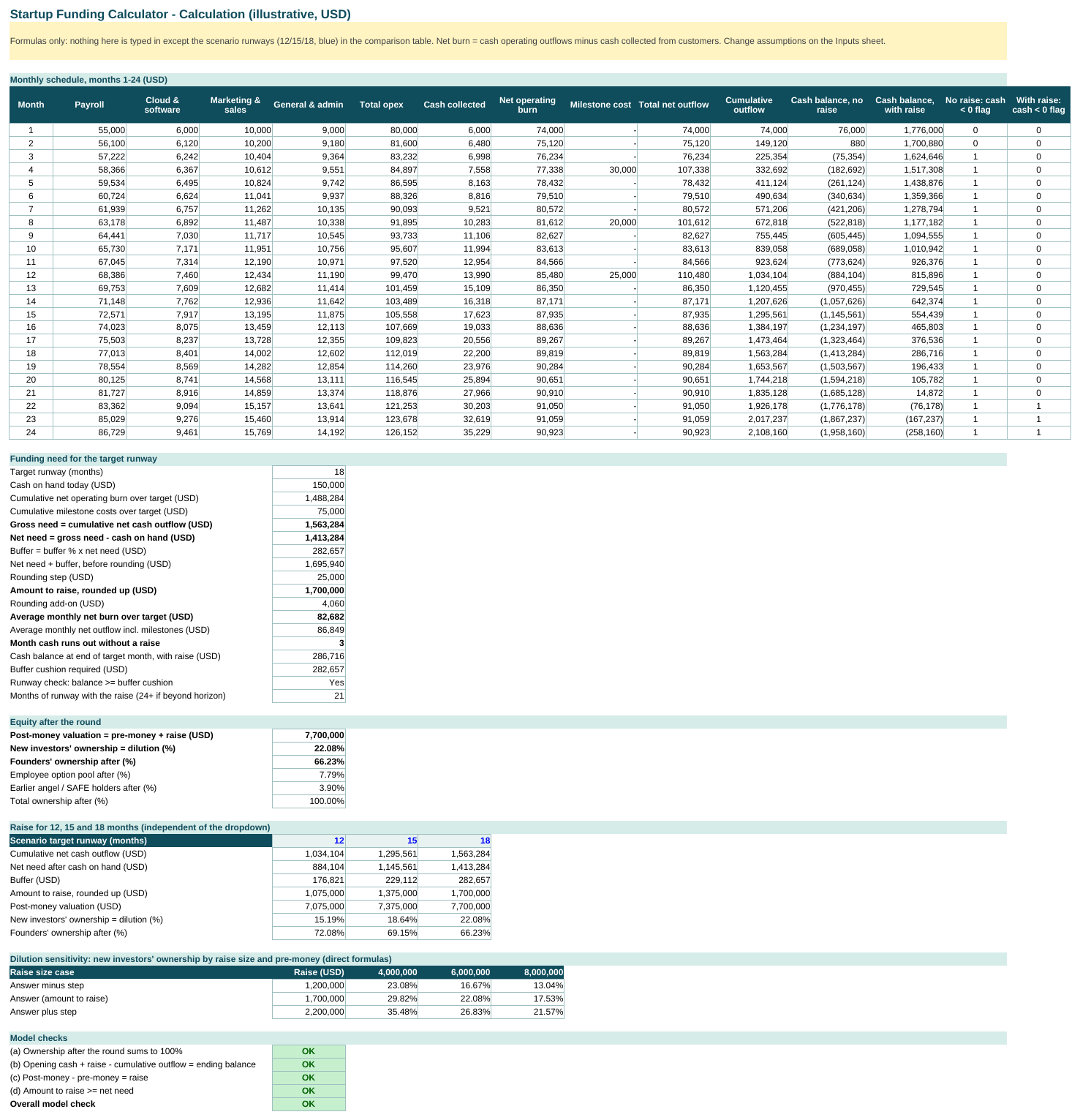
Without a raise, the cash balance is USD 880 at the end of month 2, so cash runs out in month 3. The example assumes the round closes at the start of month 1; a real process takes the months noted above, so a company in this position would need a bridge from existing holders or a much earlier start. For 18 months, the calculation runs as follows.
| Step | Calculation | USD |
|---|---|---|
| Net operating burn, months 1 to 18 | Sum of monthly net burn | 1,488,284 |
| Milestone costs | 30,000 + 20,000 + 25,000 | 75,000 |
| Gross need | 1,488,284 + 75,000 | 1,563,284 |
| Net need | 1,563,284 – 150,000 | 1,413,284 |
| Buffer | 20% x 1,413,284 | 282,657 |
| Net need plus buffer | 1,413,284 x 1.20 | 1,695,941 |
| Amount to raise | Rounded up to the next 25,000 | 1,700,000 |
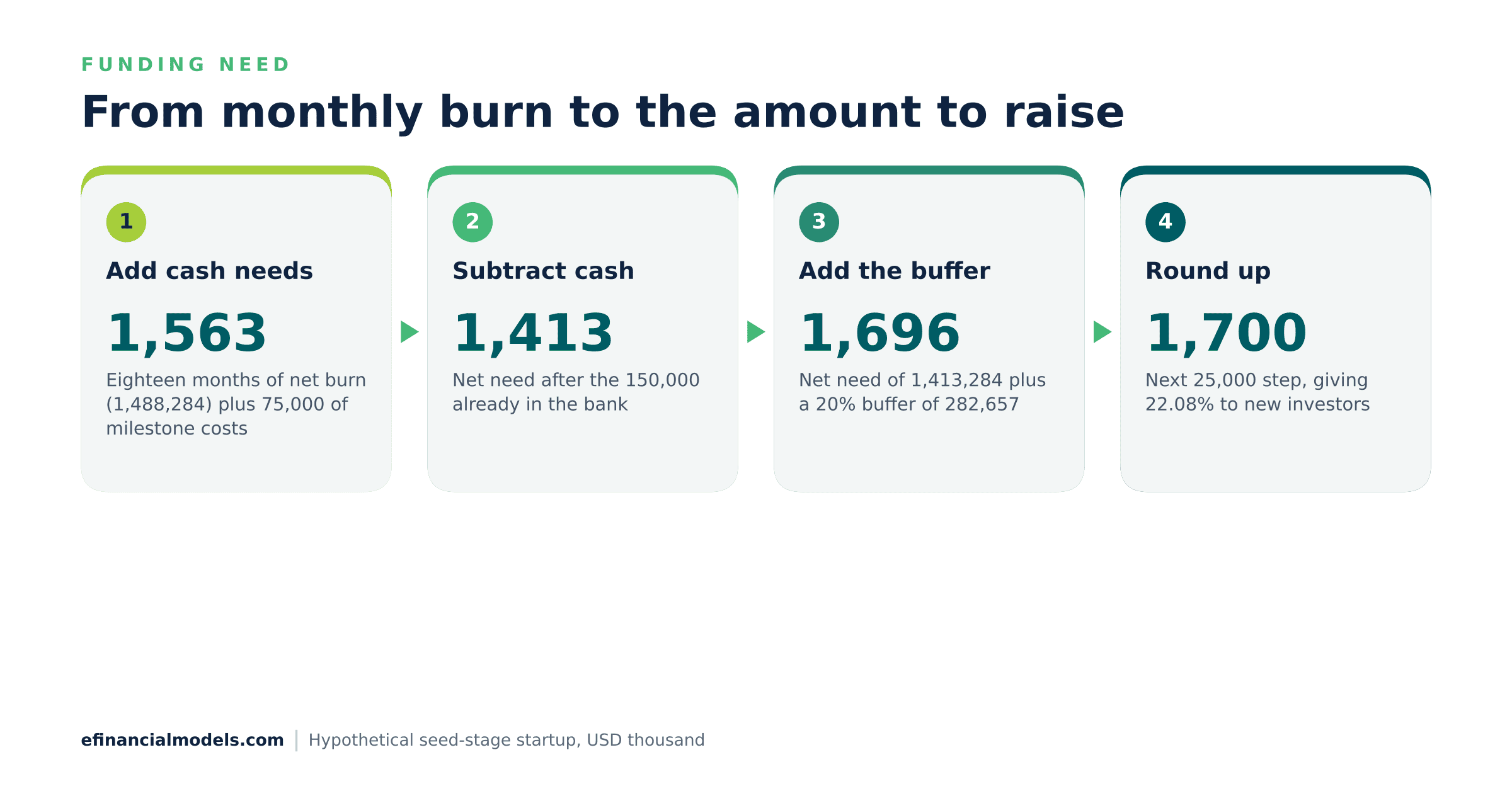
The post-money valuation is 6,000,000 + 1,700,000 = USD 7,700,000, so new investors own 1,700,000 / 7,700,000 = 22.08%. Founders keep 85% x 6,000,000 / 7,700,000 = 66.23%, the option pool keeps 7.79% and earlier angels keep 3.90%, which sum with the new investors to 100%. At month 18 the company holds 150,000 + 1,700,000 – 1,563,284 = USD 286,716, and the raise lasts 21 months before cash turns negative.
| Target runway | Amount to raise (USD) | New investors | Founders after |
|---|---|---|---|
| 12 months | 1,075,000 | 15.19% | 72.08% |
| 15 months | 1,375,000 | 18.64% | 69.15% |
| 18 months | 1,700,000 | 22.08% | 66.23% |
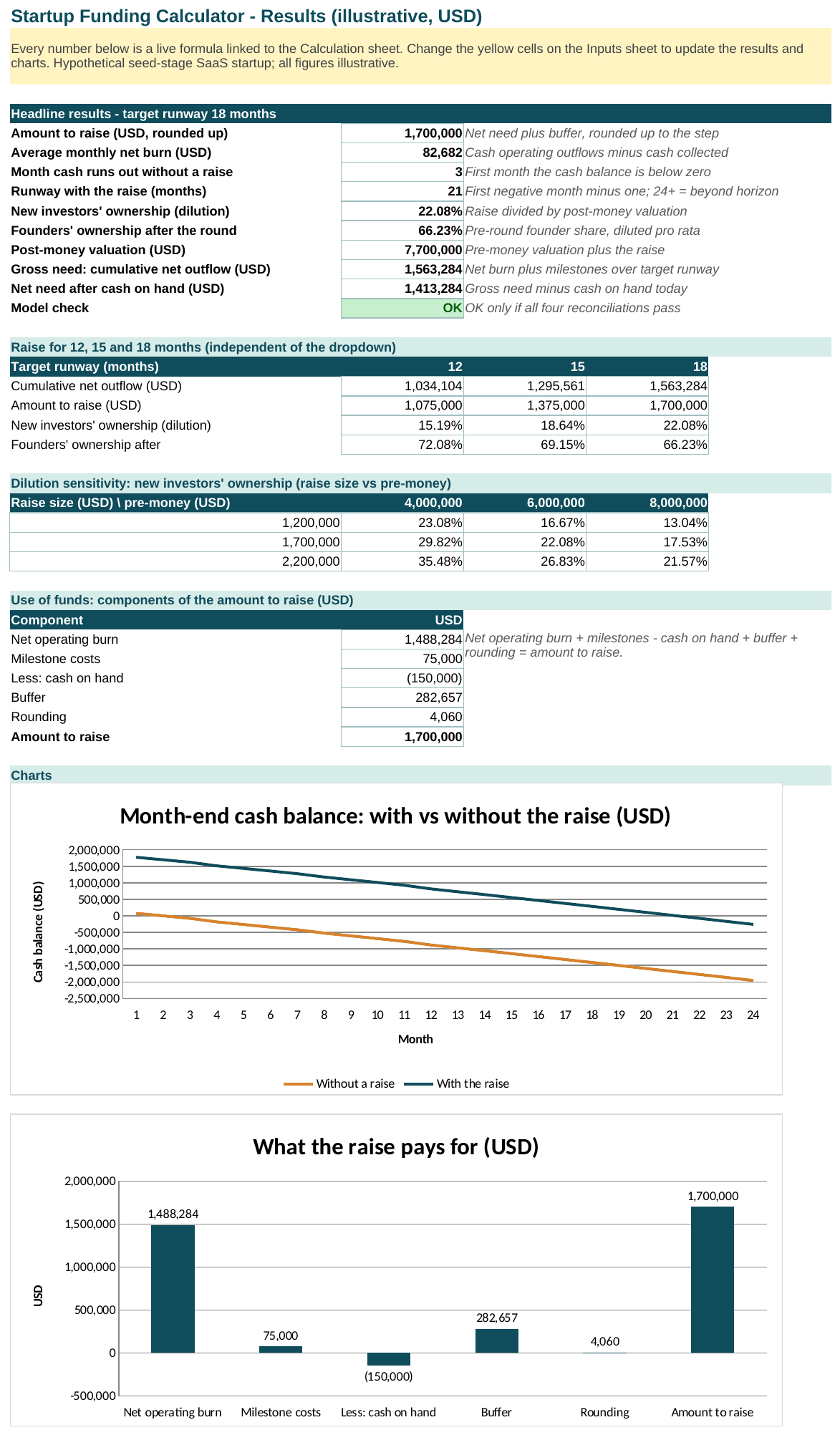
The sensitivity grid shows a USD 1,700,000 raise selling 29.82% of the company at a USD 4,000,000 pre-money valuation, 22.08% at USD 6,000,000 and 17.53% at USD 8,000,000.
Frequently Asked Questions
When should a founder start raising money?
Start while cash still covers the round’s own duration plus a margin, because a company with only a few months of cash left negotiates from weakness and may have to accept whatever terms are offered. The cash-out month, month 3 without a raise in the example, is the deadline for having the money in the bank. The latest start is that month minus the expected closing time, so a founder normally begins the process much earlier.
Is it better to raise more than 18 months of runway?
More runway buys time and costs ownership. At a fixed valuation, each extra month of runway raises the amount and the share of the company sold, as the three-row table shows. Longer targets suit tight fundraising markets or products with long approval cycles, and the 24-month schedule supports one with a small change to the runway list. The calculator stops at 18 months, which already sells 22.08% in the example, inside the typical seed range.
What if investors offer less than the calculated amount?
A smaller raise either shortens the runway or removes milestones. Founders can push the least valuable milestone beyond the runway, slow hiring, or negotiate a second tranche released when a defined result is reached. Each change goes into the schedule again, and the new cash-out month shows at once whether the remaining plan still reaches the next funding event with a safety margin of cash.
How does revenue change the amount a startup needs to raise?
Cash collected from customers reduces net burn, so faster collections lower the raise by about 1.2 times the extra cash, because the 20% buffer applies to net need. The example assumes collections grow 8% a month, which is an assumption and not a forecast. Late payment shows up as extra burn. Founders therefore test a slower collection case before presenting a number to investors.
Do convertible notes, SAFEs or an option-pool top-up change the dilution maths?
Yes. The example assumes a priced round and no pool top-up. A convertible note, which is debt that converts into shares, and a simple agreement for future equity (SAFE) both convert at the next priced round, at a valuation cap or discount, so their dilution depends on that round. An investor request to enlarge the option pool before closing lowers the effective pre-money valuation, because the new shares are counted before the new money. Both effects need their own rows in the ownership table.
Conclusion
Size a raise from the runway and the milestones first, then test the dilution it creates, and move the months or the valuation until both numbers are acceptable. Founders who want to build the ownership table and funding schedule can start from the eFinancialModels Simple Cap Table Template, which models dilution across seed to Series A rounds with an option pool and pre-money and post-money valuations, and the Simple Fundraising Model, which covers sources and uses of funds and an equity financing schedule. The fundraising collection lists further templates.