0 ITEMS

Acquisition Modeling Playbook: Templates for Buying a Business

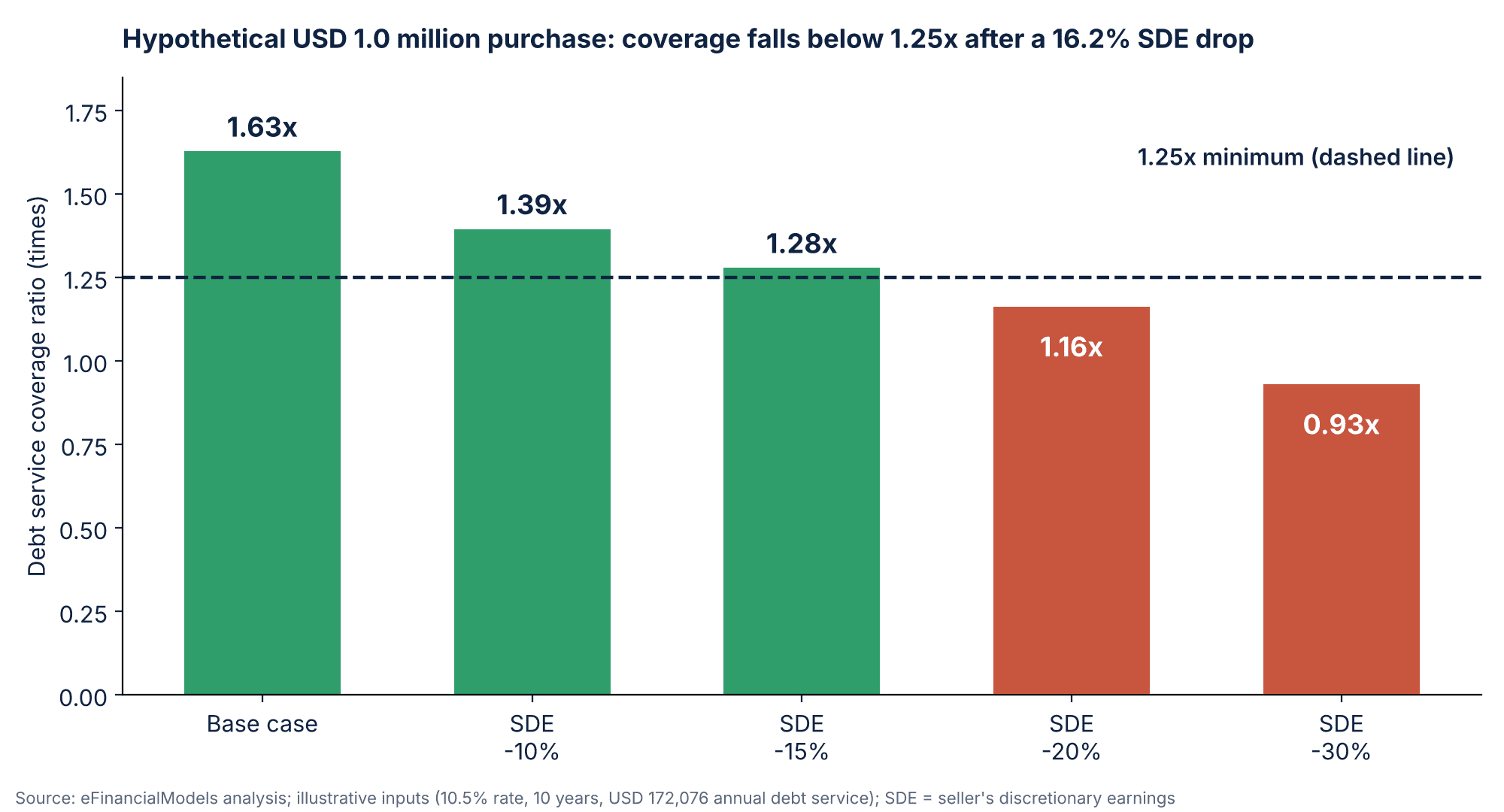
Yes, templates exist for buying an existing business, and a practical playbook combines an offer letter, a funding structure and a lender stress test. The case study below applies that playbook to a hypothetical USD 1.0 million purchase, where the deal passes a 1.25x lender test, measured before income taxes and capital spending, and breaks only if seller’s discretionary earnings (SDE) fall 16.2%.
Key Takeaways
- Templates cover the offer letter and funding stages, and a lender stress test built from historical cash flow completes the playbook.
- Businesses on BizBuySell sold at 94% of asking price in 2025, about a 6% discount, so the model should treat asking price as the upper case.
- US Small Business Administration (SBA) lenders reviewing a change of ownership use historical cash flow; projections cannot meet the coverage test.
- In the hypothetical case study, coverage before taxes and capital spending is 1.63x against a 1.25x minimum, and a 16.2% SDE drop erases the cushion.
- If SDE falls 20% to USD 320,000, the case study clears 1.25x again at about USD 919,000, roughly 8% below the USD 1.0 million base price.
Yes, Templates Exist for the Offer and Funding Stages of a Purchase
A buyer needs several tools rather than one: a valuation, a letter of intent (LOI, the non-binding offer that sets price and main terms), a funding structure, a due diligence checklist and a stress test. The two products in the table cover the offer and funding stages, and buyers can browse the mergers and acquisitions model and financial due diligence collections for valuation and due diligence tools.
| Stage | What the template covers | eFinancialModels resource |
|---|---|---|
| Offer | A non-binding share deal offer with purchase details, financing, time plan, exclusivity and closing conditions | Letter of Intent for Business Acquisition Template (Share Deal) |
| Funding and returns | A one-page deal layout with a Uses and Sources of Funds table, investor cash flows and deal metrics | Simple Private Equity Deal Template |
| Lender test | A loan coverage check and a cash flow stress test | Built step by step in the case study below |
Asking price is the upper case, not the expected price. BizBuySell reported that small business median sale prices rose 2% to $350,000 in 2025 and that businesses sold at 94% of asking price, about a 6% discount, across 9,586 transactions on its marketplace, with the average cash flow multiple up 1% to 2.61x (BizBuySell, 2025 year in review).
The financing rules in the next section are specific to the United States. Buyers elsewhere should ask their lender for its minimum coverage ratio and use it in place of the 1.25x used here.
SBA Lenders Test the Deal on Historical Cash Flow
The US Small Business Administration (SBA) 7(a) loan program has a maximum loan amount of $5 million, and it lists changes of ownership, complete or partial, among allowed uses of proceeds (SBA, 7(a) loans).
A law firm summary of the change-of-ownership rules under Standard Operating Procedure (SOP) 50 10 8.1 lists an equity injection requirement of 10% of total project costs that cannot be reduced or eliminated, a debt service coverage ratio (DSCR, the annual cash flow available divided by the annual loan payments) of 1.25:1 for several change-of-ownership categories, and a ban on using projections to meet that requirement (Starfield & Smith, September 2026).
A second firm reports that the new procedure raises the coverage requirement for most change of ownership transactions from 1.15x to 1.25x (PilieroMazza, August 2026).
These rules shape the model. Cash flow comes from the seller’s historical records and is adjusted for the buyer’s own pay, while forecasts serve only as a second view. Total project cost also includes working capital, which is the cash a business needs to carry its inventory and receivables after payables, because the new owner must fund that cash on day one.
Worked Example: A USD 1.0 Million Purchase Tested Against 1.25x
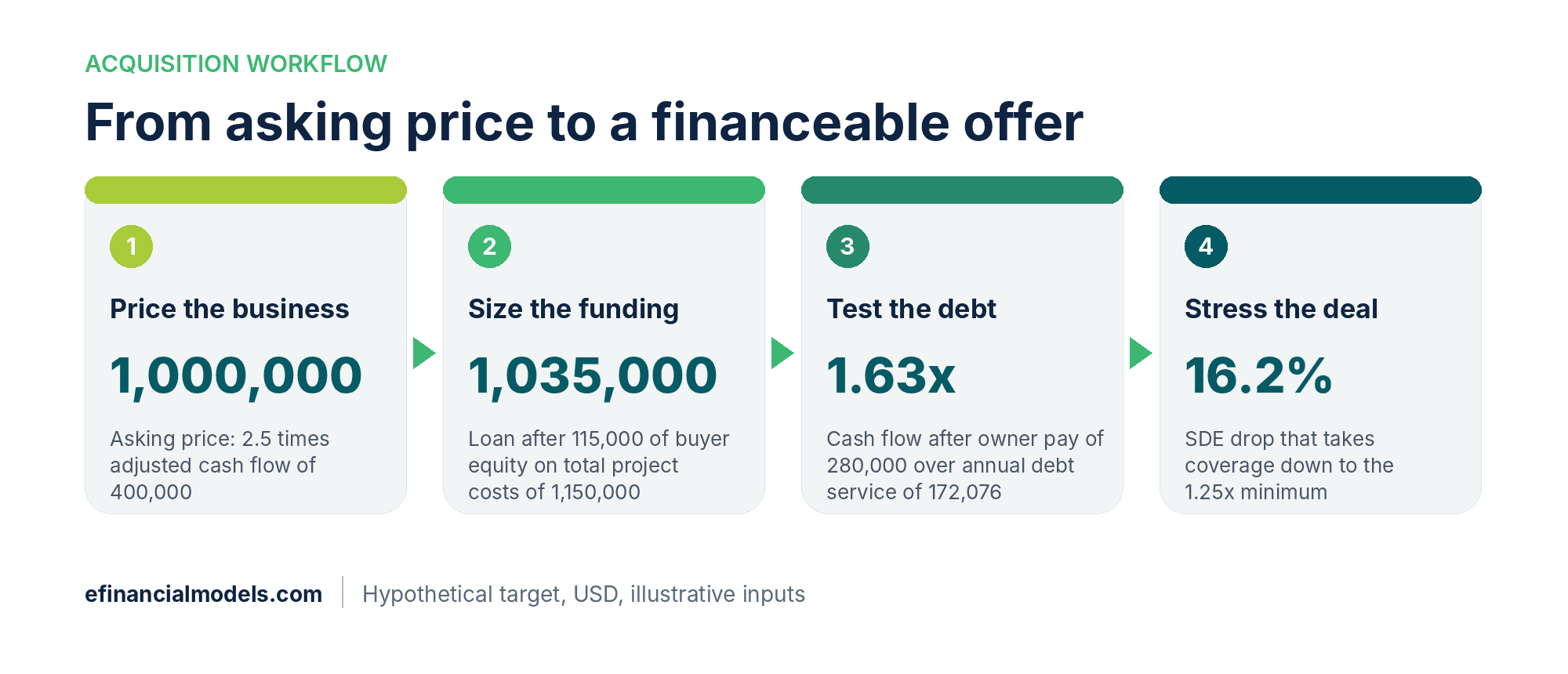
The hypothetical buyer passes the test with a DSCR of 1.63x, and the deal fails only after a 16.2% drop in seller’s discretionary earnings (SDE), which are the profit of the business plus the owner’s pay and one-off costs, and serve as the cash flow base. The example is illustrative and applies the 10% equity requirement to total project cost. The 1.63x is measured before income taxes, capital spending and any other debt service.
| Input (illustrative) | Value |
|---|---|
| Seller’s discretionary earnings | USD 400,000 |
| Purchase multiple of earnings | 2.5x |
| Purchase price (400,000 x 2.5) | USD 1,000,000 |
| Closing costs | USD 50,000 |
| Working capital funded by the buyer at closing | USD 100,000 |
| Total project cost | USD 1,150,000 |
| Buyer equity (10% of 1,150,000) | USD 115,000 |
| Loan (1,150,000 less 115,000) | USD 1,035,000 |
| Interest rate and term | 10.5% a year, 10 years |
| Replacement salary for the buyer | USD 120,000 |
The annual loan payment follows the standard level-payment formula, loan x rate / (1 – (1 + rate)^-years), which first gives the payment factor 0.105 / (1 – 1.105^-10) = 0.105 / 0.631551 = 0.166257. The payment is then 1,035,000 x 0.166257 = USD 172,076. Cash flow available for debt service is 400,000 less the 120,000 salary, or USD 280,000. The coverage is therefore 280,000 / 172,076 = 1.63x, above the 1.25x minimum.
The stress test lowers SDE and keeps the salary and the loan payment fixed.
| Scenario | SDE | Cash flow after salary | DSCR |
|---|---|---|---|
| Base case | USD 400,000 | USD 280,000 | 1.63x |
| SDE down 10% | USD 360,000 | USD 240,000 | 1.39x |
| SDE down 15% | USD 340,000 | USD 220,000 | 1.28x |
| SDE down 20% | USD 320,000 | USD 200,000 | 1.16x |
| SDE down 30% | USD 280,000 | USD 160,000 | 0.93x |
The break-even follows from the same inputs: 1.25 x 172,076 = USD 215,095 of cash flow, which needs SDE of 215,095 + 120,000 = USD 335,095, a drop of 16.2% from 400,000.
Run the Playbook in Five Steps
- Adjust the seller’s reported earnings for owner pay, one-off items and related-party terms, and check them against tax returns during due diligence.
- Set the price as a multiple of that adjusted cash flow and record it in the offer letter.
- Add closing costs and working capital to reach total project cost, then split it between buyer equity and the loan.
- Calculate the annual loan payment and the coverage ratio from historical cash flow only.
- Lower cash flow in steps until coverage reaches the minimum, and walk away or renegotiate when the cushion is thinner than the buyer can absorb.
The model does not cover tax treatment, the legal form of the deal or lender approval. A tax adviser, a lawyer and an SBA-approved lender should confirm those points before an offer is signed.
Frequently Asked Questions
Is there a free template for buying an existing business?
Yes, the Simple Private Equity Deal Template in the table above is free, but it focuses on investor returns and deal metrics rather than a lender coverage test. A useful template should show sources and uses of funds, a loan schedule, coverage against a stated minimum and a scenario table that lowers earnings. Hard-coded results are a warning sign, because the buyer must be able to change the price, the rate and the equity share and watch every output update.
What can a buyer do when coverage falls short of the minimum?
The fastest lever is price. If SDE fell 20% to USD 320,000, which is beyond the 16.2% break-even drop, cash flow after the salary would be USD 200,000, so the loan payment must fall to USD 160,000. With closing costs, working capital and the 10% equity share unchanged, the loan shrinks to about USD 962,000 and the price to about USD 919,000. Other levers, all subject to the lender’s rules, include a longer term or more equity.
Do the same rules apply outside SBA lending?
No. Conventional banks, seller financing and private investors each set their own tests, so the minimum coverage should be an input cell rather than a fixed number. Larger deals usually add layers such as subordinated debt or investor equity, which call for a full leveraged buyout structure with returns analysis. The case study keeps one loan so that the coverage logic stays visible.
How should a growth-stage owner model buying a competitor?
An add-on acquisition needs the target’s stand-alone cash flow first, then integration costs and any savings as separate lines. Lenders following the SBA approach above do not count projected savings toward the coverage test, so the base case should pass without them. Savings then act as a cushion, and the combined business should also be checked for a drop in the buyer’s own cash flow during integration.
Conclusion
The playbook answers the buyer’s question with an offer letter template, a funding structure and one rule: price the deal on historical cash flow and prove that it survives a stress test. Buyers who want to extend the case study into a leveraged structure with seller financing and equity injection options can start from the eFinancialModels Private Equity – Leveraged Buyout Model, which includes ten-year projections and a detailed debt financing schedule.