0 ITEMS

What Makes a Financial Model Template Professional-Grade?

A professional-grade financial model template is one that a stranger can audit: its inputs, calculations and outputs sit apart, its formulas stay consistent, and its built-in checks flag mistakes. A first-time founder can test most of this in a single sitting once the working file is in hand.
Key Takeaways
- A professional-grade template separates inputs, calculations and outputs, so any reviewer can trace each result back to a stated assumption.
- Spreadsheet errors are common, so a founder should test a template before buying instead of trusting how polished it looks.
- Built-in checks, consistent formulas and written instructions matter more than extra sheets, charts or colour.
- Investors want confidence in a return, so a template should produce income, balance sheet and cash flow statements that update together.
- Reviews can shortlist templates, but a founder’s own change-one-input test is stronger evidence than any star rating.
A Professional-Grade Template Is One Others Can Audit
Professional modelling standards describe quality in terms of auditability, not feature count. The FAST (Flexible, Appropriate, Structured and Transparent) Standard, a public rulebook for spreadsheet design, takes its name from those four qualities. ICAEW (Institute of Chartered Accountants in England and Wales), the professional body for accountants in England and Wales, published its 2024 Financial Modelling Code with principles such as “Structure workbooks with a clear flow of inputs, processes, and outputs”, “Refer to existing calculated results instead of reperforming the calculation” and “Build in checks, controls, and alerts from the outset”.
Each principle answers a practical buyer question: can a reviewer see which cells are assumptions, does one calculation live in one place, and will the workbook warn when something breaks? A cheap or generic template often fails the first test, because inputs sit inside formulas.
Spreadsheet Errors Are Common, So Testing Beats Trusting
Raymond Panko’s 2015 review of spreadsheet research for the European Spreadsheet Risks Interest Group reported that the average cell error rate across laboratory studies was 3.9%, and that inspection studies of spreadsheets found errors in 94% of those examined. A 2026 European Spreadsheet Risks Interest Group paper that analysed 121 public spreadsheet failure cases from 1995 to 2026 classed 71 of them as formula errors, data-entry slips or data-handling mistakes, which is about 59% (71 divided by 121). That collection is a public record, not a representative sample. None of these studies rates a particular template. Together they show why appearance is a weak signal and why a short test is worth the time.
Three Real Spreadsheet Failures and What Went Wrong
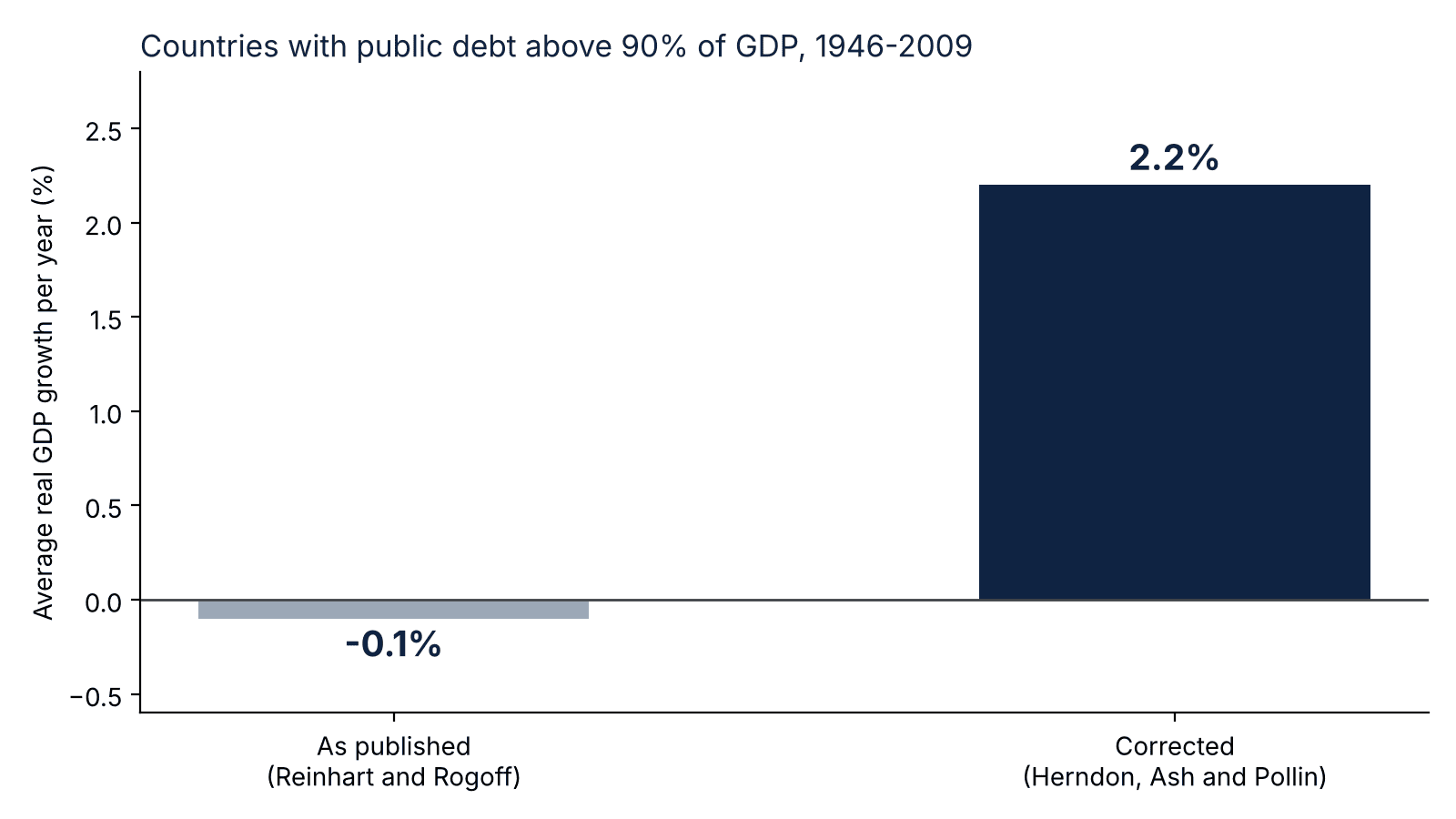
The first case is academic. In 2013, researchers at the Political Economy Research Institute at the University of Massachusetts Amherst re-examined a widely cited growth study by Reinhart and Rogoff. They found that countries with public debt above 90% of gross domestic product (GDP), the total value of a country’s output, averaged 2.2% real annual growth, not the published -0.1%. That corrected figure combines the coding fix with other changes the authors made, so the gap is not the spreadsheet error alone. Their journal version, which covers 1946 to 2009, also reported that a coding error in the working spreadsheet excluded five countries entirely.
The second case is a data-handling failure rather than a faulty model. In October 2020, Public Health England reported 15,841 coronavirus cases missing between 25 September and 2 October because the data sat in an older Excel file format that limited each sheet to 65,536 rows. The same report said as many as 48,000 people were not told they had been in close contact with an infected person.
The third case is financial. A 2013 US Senate subcommittee report said JPMorgan Chase later determined that a new risk model it used required “error-prone manual data entry” and contained formula and calculation errors.pdf). The same report says the model immediately lowered the trading portfolio’s value at risk (VaR), the loss it is not expected to exceed over a set period at a set confidence level, by 50%, which understated the risk being run. The first and third show how unreviewed manual steps and untested formulas produce confident, wrong numbers, and the second shows how a hidden capacity limit can silently drop data, a risk a founder can test by loading a full-size data set.
Six Checks a First-Time Founder Can Run Before Buying
A founder can run these checks on any template from the Financial Model category, or any other source, in a single sitting and without modelling experience, using only what Excel already shows. The checks need the working file, so a founder should first ask the seller for a sample copy, a demo or a refund policy, and treat a seller who offers none as a risk.

| Check | What to look for | What a weak template shows |
|---|---|---|
| Layout | Inputs, calculations and outputs on clearly labelled areas or sheets | Assumptions scattered through calculation sheets |
| Formula consistency | The same formula across each row, with no pasted values in between | Hard-typed numbers inside a row of formulas |
| Hard-coded values | Rates and prices entered once, then referenced | Constants typed into formulas |
| Built-in checks | A visible check that the balance sheet balances and that cash on it matches closing cash in the cash flow statement | No checks, or checks that are never shown |
| Change test | Raise one input, such as a price, and watch every statement update | Outputs that do not move, or move incorrectly |
| Documentation | Written instructions and a list of assumptions | No guidance on how to use or adapt it |
Investors expect the output to reach statements. The US Small Business Administration (SBA), a federal agency that supports small businesses, says in its business plan guidance that investors want to feel confident they will see a return on their investment. A template that cannot turn assumptions into income, balance sheet and cash flow statements gives a reviewer nothing to test that confidence against, and the requirement that those statements update together comes from the modelling principles above, not from the SBA. Financing is common: the Federal Reserve Banks’ 2026 Report on Employer Firms, based on a survey fielded from September to November 2025, found, in a non-random survey, that 60% of the small employer firms surveyed had applied for financing in the prior 12 months.
Reviews Help, but Only as a Second Opinion
Buyer reviews show how a template feels to use. On the product page for eFinancialModels’ Simple Fundraising Model, which lists a three-statement model (income statement, balance sheet and cash flow statement linked together) with five-year projections, a sources and uses of funds table (where the money comes from and where it goes) and a pre- and post-money valuation calculation (the company’s value before and after new investment), one reviewer wrote:
“the model is easy to use, simply and meaningful, straight to the point and provide very attentive dashboard to the audience”
The page shows no reviewer names or dates, so this is one anonymous impression, not an audit. A testimonial can shortlist a template, while the six checks above decide whether to buy it.
Worked Example: The Return on a Reviewed Template
The return on investment (ROI), meaning net gain divided by the total cost of the investment, of a reviewed template depends mostly on hours saved. In this example, assume a founder values time at $50 per hour. Building a three-statement model from scratch is assumed to take 40 hours, while adapting a reviewed template, for example one from the Startup Financial Models collection, is assumed to take 8 hours plus a $200 template price.
| Item | Build from scratch | Adapt a reviewed template |
|---|---|---|
| Hours spent | 40 | 8 |
| Value of time at $50 per hour | $2,000 | $400 |
| Template price (assumed) | $0 | $200 |
| Total cost | $2,000 | $600 |
The net gain is the $2,000 avoided minus the $600 spent, or $1,400. Dividing that gain by the $600 cost gives an ROI of about 2.33, or 233%, which is $2.33 of net saving for every $1 spent on price and time. The figures are illustrative and ignore the cost of an undetected error, which the cases above show can be serious. A founder should substitute their own hours and rate.
Conclusion
A professional-grade template earns trust through structure and checks, and a founder can verify both before paying. A first-time founder can start by running the six checks on eFinancialModels’ Simple Fundraising Model, whose page lists a three-statement model with five-year projections, so the balance, cash and change tests can all be tried on it.
Frequently Asked Questions
Does a higher price mean a better financial model template?
Price says little about quality. A template can cost nothing and still separate inputs from calculations, show its checks and explain its assumptions, while an expensive one can hide hard-typed numbers inside formulas. A founder should compare templates by running the same tests on each, then weigh the price against the hours the template saves and the confidence it gives when an investor asks where a number comes from.
How can a founder test a template without modelling experience?
Excel itself provides enough tools. Click a result cell and use Trace Precedents on the Formulas tab to see which cells feed it. Change one assumption and confirm the totals move in the expected direction. Scan a row for a number that looks pasted over a formula. If a check cell exists, deliberately break an input and see whether it reacts. Any template that resists these simple probes deserves suspicion.
What should a founder do after buying a template?
Treat the purchased file as a starting point, not a finished forecast. Replace every sample figure with local prices, wages, tax rates and timing, then keep a short change log noting what was edited and why. Re-run the balance and cash checks after each round of edits, and save dated versions so an earlier set of numbers can be recovered when an investor asks how the plan evolved.
Is a template with more sheets and features always better?
No. Extra sheets add places for errors to hide and make the model harder for a reviewer to follow. A smaller template with clear structure, visible checks and documented assumptions usually serves an early-stage founder better than a sprawling workbook with dozens of tabs. A useful rule is to keep only the complexity the business actually needs today, and add detail as the company grows.
When is a custom model worth paying for instead of a template?
A custom build starts to make sense when the business has unusual revenue mechanics, regulated reporting, or several legal entities that no standard layout can represent. For a first-time founder with a conventional product, a reviewed template adapted carefully is usually enough for early fundraising conversations. The deciding question is whether the template can express how the company actually earns and spends money without awkward workarounds.