0 ITEMS

How to Build a Year-1 Budget: Business vs Personal Steps

A year-1 budget is built in six steps: set a goal and a cash baseline, forecast revenue month by month, add costs, convert profit into cash, size a reserve, and compare actuals against the plan every month. Business and personal budgets share that sequence, but a business budget also forecasts when customers pay, while a personal budget starts from a fixed income.
Key Takeaways
- Build the year-1 budget in six steps, from a cash baseline to a monthly actual-versus-plan review.
- Keep business and personal money in separate accounts, because the United States Small Business Administration ties separation to liability protection.
- Forecast monthly or quarterly in year 1; profit does not equal cash when customers pay 30 days late.
- In the hypothetical example, a 78,000 annual operating profit still leaves cash 49,000 below the 66,000 reserve target at the end of month 1.
- Personal budgets use the same method with income as the fixed driver, and a three-month cushion is an illustrative target.
Set the Goal, the Baseline and Separate Accounts First
A year-1 budget starts with one written goal, an opening cash figure and separate accounts for business and personal money. The goal can be a profit target, a cash minimum or a funding milestone, and every later line in the budget serves it.
The United States Small Business Administration (SBA) explains that business banking “offers limited personal liability protection by keeping your business funds separate from your personal funds” (SBA, open a business bank account). A clean split also makes the opening cash balance a number that can be checked against a bank statement rather than estimated.
Business and Personal Budgets: What Changes
This article is written for business owners, so tax, headcount planning and scenario analysis are out of scope. Business and personal budgets differ in the driver of the plan, the planning horizon and the timing gap between a transaction and its cash. The table summarises the differences that matter in year 1.
| Item | Business budget | Personal budget |
|---|---|---|
| Main driver | Forecast revenue, which can move | Income, which is usually fixed |
| Cost behaviour | Delivery costs vary with sales; fixed costs stay | Mostly fixed bills plus flexible spending |
| Cash timing | Customers pay days or weeks late | Salary arrives on a known date |
| Output | Profit, cash balance and funding need | Savings rate and cash balance |
| Review | Monthly variance against plan | Monthly check of spending categories |
The SBA business plan guidance says to “include forecasted income statements, balance sheets, cash flow statements, and capital expenditure budgets” and, for the first year, to be “even more specific” with quarterly or monthly projections (SBA, write your business plan). This article covers the operating profit and cash parts of that standard and leaves the balance sheet and capital expenditure budget out of scope.
Step by Step: How to Build the Year-1 Budget
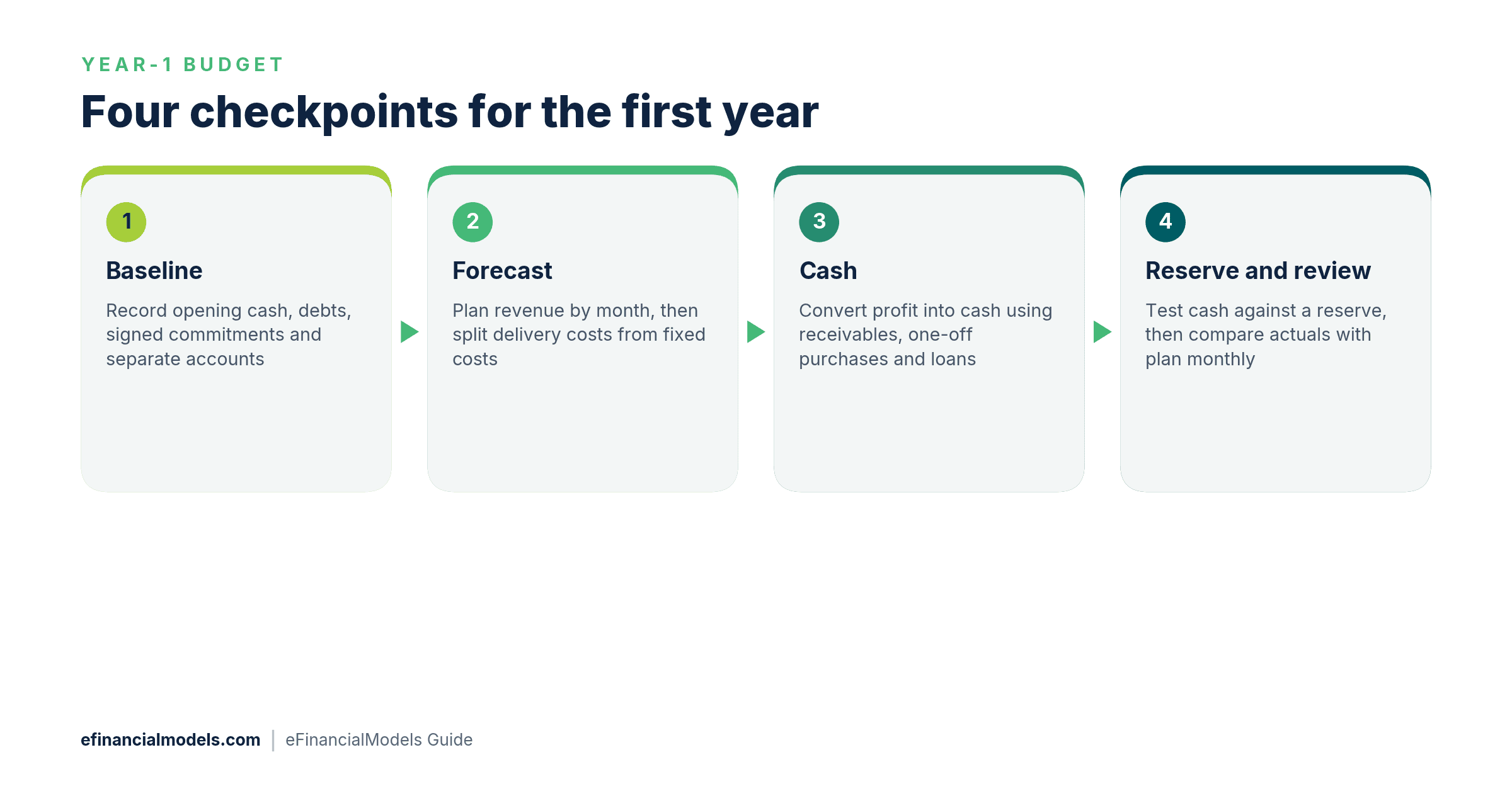
The six steps below turn the goal into a monthly plan that can be tracked.
- Fix the baseline. Record opening cash, debts, and commitments already signed, such as leases and payroll.
- Forecast revenue by month. Base each month on contracts, pipeline and the price list, and state the growth assumption in one input cell.
- Split costs into delivery and fixed. Delivery costs, such as materials or contractor time, move with revenue. Fixed costs, such as rent and salaries, do not.
- Convert profit into cash. Adjust operating profit for the cash timing of receivables (money customers owe), one-off purchases and loan payments.
- Size the reserve. Choose a minimum cash balance, for example three months of fixed costs, and compare every period-end balance with it.
- Review monthly. Compare actuals with the plan, explain each gap above a set threshold, and reforecast the remaining months.
Cash pressure is a widely reported challenge that this process addresses. In the 2024 Small Business Credit Survey of the Federal Reserve Banks, a convenience sample of US employer firms with 1 to 499 employees, 56% of firms cited paying operating expenses and 51% cited uneven cash flows as financial challenges (Federal Reserve Banks, 2025 Report on Employer Firms).
Worked Example: A 12-Month Budget for a Service Business
In this hypothetical example, a service business with 80,000 of opening cash earns an annual operating profit of 78,000 with no depreciation modelled, yet its cash balance falls 45,000 short of a three-month reserve after the first quarter. All amounts are in USD and every input is assumed.
The assumptions are quarterly revenue of 120,000, 135,000, 150,000 and 165,000; delivery costs of 40% of revenue; fixed costs of 22,000 per month, or 66,000 per quarter; a one-off setup purchase of 25,000 in the first quarter; no receivables outstanding at the start of the year, no loans, and delivery costs paid in the month they are incurred. Revenue is spread evenly across each quarter and customers pay on 30-day terms, so one third of each quarter’s revenue is still unpaid at the quarter end. The reserve target is three months of fixed costs, so 3 × 22,000 = 66,000.
Operating profit equals revenue minus delivery costs minus fixed costs. In the first quarter, delivery costs are 40% of 120,000, which is 48,000, so operating profit is 120,000 − 48,000 − 66,000 = 6,000. The net cash change equals operating profit minus the increase in receivables minus the one-off purchase, so Q1 is 6,000 − 40,000 − 25,000 = −59,000, and closing cash is 80,000 − 59,000 = 21,000.
| Quarter | Revenue | Operating profit | Increase in receivables | One-off purchase | Net cash change | Closing cash |
|---|---|---|---|---|---|---|
| Q1 | 120,000 | 6,000 | 40,000 | 25,000 | -59,000 | 21,000 |
| Q2 | 135,000 | 15,000 | 5,000 | 0 | 10,000 | 31,000 |
| Q3 | 150,000 | 24,000 | 5,000 | 0 | 19,000 | 50,000 |
| Q4 | 165,000 | 33,000 | 5,000 | 0 | 28,000 | 78,000 |
Adding the four quarters gives annual revenue of 570,000 and annual operating profit of 78,000, so the margin is 78,000 ÷ 570,000 = 13.7%. The receivables balance at the end of Q1 is one third of 120,000, which is 40,000, and because the opening balance is zero the increase is also 40,000. The balance then reaches 45,000, 50,000 and 55,000 at the ends of Q2, Q3 and Q4, so each later quarter adds only 5,000.
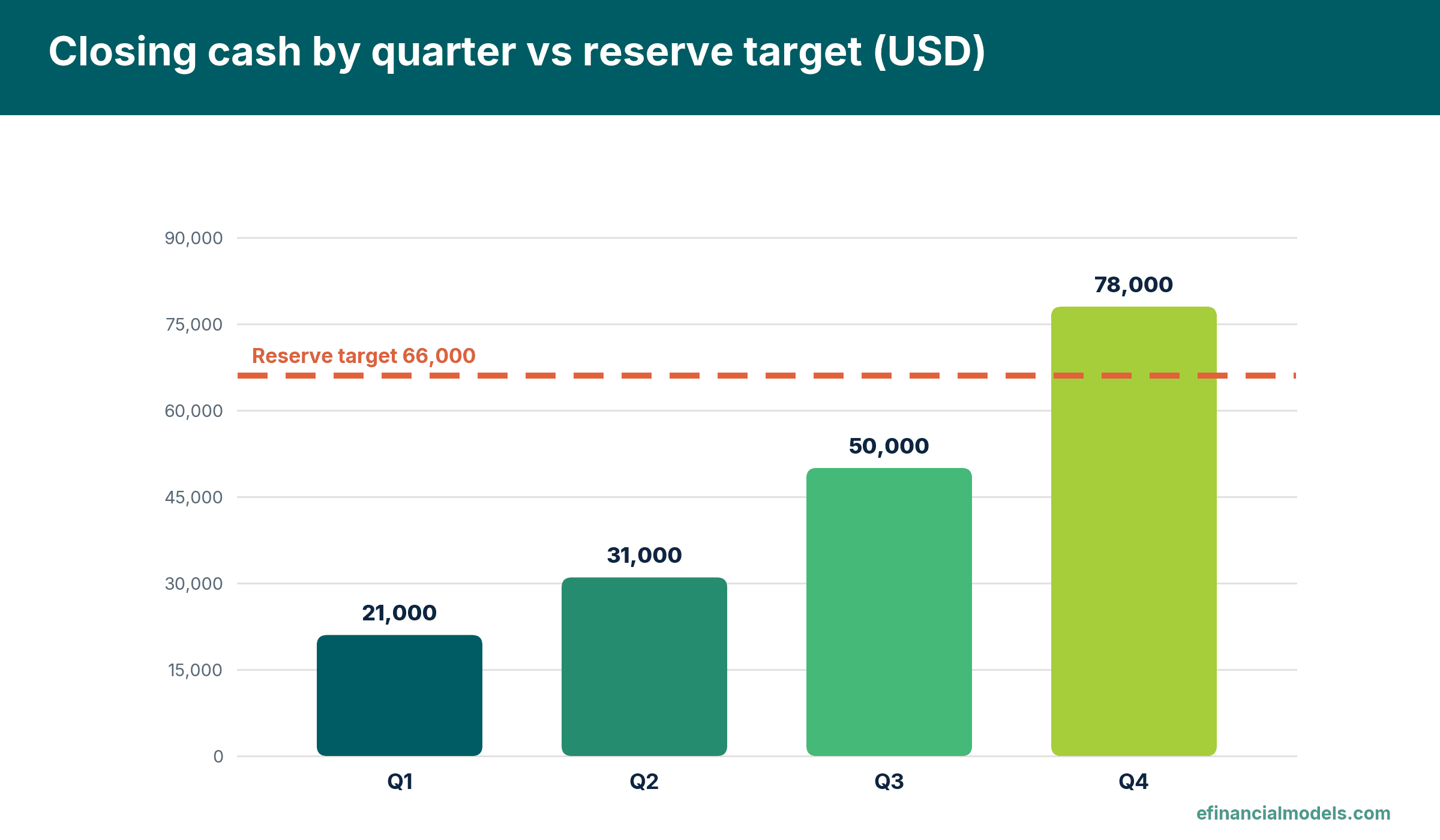
The gap to the reserve is 45,000 in Q1, 35,000 in Q2 and 16,000 in Q3, and the fourth quarter clears it by 12,000. Quarter-end figures hide the intra-quarter low. With revenue spread evenly, month 1 pays 38,000 of costs and the 25,000 purchase while collecting nothing, so cash falls to 17,000 at the end of month 1, which is 49,000 below the reserve target. Months 2 and 3 each add 2,000, which returns cash to 21,000 at the end of Q1. The budget therefore signals a funding need of 49,000 at its lowest month-end that a credit line, upfront billing terms or a later setup purchase can cover. Moving the 25,000 setup purchase to the fourth quarter lifts the first-quarter closing cash to 46,000, which still leaves a 20,000 gap at the quarter end, and the month 1 low becomes 42,000, which is 24,000 below the target.
How a Personal Budget Uses the Same Method
A personal year-1 budget follows the same six steps with income as the fixed driver and a savings rate in place of profit. The baseline is take-home pay and current savings, the costs are fixed bills and flexible spending, and the reserve is an emergency fund. A target of three months of essential spending is an illustrative starting point.
The Federal Reserve survey of household well-being found that 63% of adults in the United States would cover a hypothetical USD 400 expense using cash or its equivalent in 2024 (Federal Reserve Board, Economic Well-Being of US Households in 2024). This self-reported share describes US adults, not businesses, so it applies to the personal budget only. Households can build that budget from the eFinancialModels personal budgets collection.
Owners who pay themselves from the business need a bridge between the two budgets: the owner’s salary is a fixed cost in the business budget and the income line of the personal budget. Keeping that single transfer visible stops personal spending from draining business cash.
Templates and Review Routine
A template saves the structure work, but the assumptions still have to be the owner’s, and the eFinancialModels budgeting collection lists many such planners. A good template holds inputs in one place, calculates cash as well as profit, and shows a variance column for actual against plan. Quarterly figures suit the first planning pass, and monthly figures suit the review once the year starts. For a deeper forecast, the cash flow projections collection from eFinancialModels shows how monthly cash models are laid out.
A monthly review takes three questions: which line missed the plan by more than a set percentage, why, and what changes in the remaining months. Updating the reserve test after each review keeps the funding conversation ahead of the bank balance.
Conclusion
A year-1 budget works when it is built in a fixed order, tested for cash rather than profit alone, and reviewed monthly. The eFinancialModels Free Budget Planner Template in Excel for Services Businesses offers a simple framework to prepare a yearly budget, with an inputs and assumptions section and a side-by-side comparison report that helps identify major deviations between budget and actual figures.
Frequently Asked Questions
How do I build a budget from scratch?
Begin with a baseline: list the cash on hand, the debts and the commitments that are already signed. Then estimate income or revenue for each month, list every cost as either fixed or delivery (variable), and subtract to find the monthly surplus or gap. Finally set a minimum cash level and mark any month that falls under it. Writing every assumption in a labelled cell lets later changes flow through the whole plan without rebuilding it.
How is a business budget different from a personal budget?
A business budget forecasts revenue that can rise or fall, so its inputs need regular updating, and it tracks the delay between a sale and the cash arriving. Scenario analysis, which tests the budget under alternative assumptions, is outside the scope of this guide. A personal budget usually starts from a steady paycheque and concentrates on categories of spending and on savings. The business plan also feeds into decisions about hiring, pricing and borrowing, while the personal plan feeds into decisions about housing, debt repayment and long-term saving.
How many months of expenses should the reserve cover?
There is no single legal or regulatory figure, so the target is a judgment based on how predictable income is. Three months of fixed costs is one reasonable starting point, and owners with lumpy or seasonal revenue often choose more. The right test is to check the weakest month of the plan and confirm that cash stays above zero with room for one surprise bill. Revisit the target every quarter as the business grows.
Should a growing business budget monthly or quarterly?
Quarterly planning is enough for the first draft of a full year, because it keeps the number of assumptions small. Monthly planning becomes important for cash, since payroll, rent and tax dates fall on specific days. A practical approach is a quarterly plan for the revenue story and a monthly cash view for the first two quarters, which are usually the tightest. After that, a monthly rolling forecast replaces the original plan.
What should be reviewed when actual results miss the budget?
Start with the largest gap in money terms, not in percentage terms, and decide whether it is a timing difference or a permanent change. A late customer payment shifts cash but not profit, while a price cut changes profit for every later month. Update the forecast for the remaining months only after the cause is clear, and record the reason so the next budget cycle starts with a better assumption.