
0 ITEMS

Hair Extensions Financial Model Excel Template
The Hair Extension Salon Financial Model helps entrepreneurs, salon owners, consultants, analysts, and founders turn a specialized beauty business concept into a structured financial forecast. Instead of building projections from a blank spreadsheet, users can start with a ready-to-use model designed around the economics of a hair extension salon, including service pricing, client visits, maintenance appointments, retail product sales, staffing, direct costs, startup costs, operating expenses, cash flow, profitability, and funding needs. The template gives users a practical way to plan the launch or expansion of a salon while connecting revenue assumptions to the financial outcomes that matter most. This financial model template is useful for business planning, investor discussions, loan applications, internal budgeting, and decision-making. It helps users understand how daily client volume, average ticket size, service mix, recurring maintenance demand, product sales, payroll, rent, inventory, marketing, and other expenses may affect performance over time. By organizing the assumptions behind the business, the model makes it easier to test whether the salon can cover its cost structure, generate sustainable profit, maintain adequate cash flow, and reach break-even within a realistic timeline. It also supports planning for growth by showing how changes in pricing, capacity, staffing, and demand can influence revenue and profitability. The template is fully editable, so users can customize assumptions to match their own location, service offering, salon size, hiring plan, and investment strategy. It includes professional outputs that can be reviewed with investors, lenders, partners, advisors, or internal teams. Users can evaluate low, base, and high scenarios, review financial statements, assess return expectations, track key performance indicators, and prepare a more credible funding narrative. For anyone preparing a hair extension salon business plan or financial forecast, this model saves time, reduces guesswork, and provides a clear framework for financial planning. By combining detailed revenue modeling, expense planning, startup investment estimates, cash flow forecasting, profitability analysis, break-even analysis, dashboards, charts, and investor-ready reports, the Hair Extension Salon Financial Model helps users make better decisions before committing capital. Whether you are opening your first salon, expanding an existing beauty business, building a client presentation, or preparing documents for funding, the template provides a structured and adaptable way to evaluate the business opportunity.


Financial Model Overview
The Hair Extension Salon Financial Model is a ready-to-use financial model template built to help users plan, forecast, and evaluate the economics of a specialized hair extension salon. It brings together the key assumptions that drive this type of business, including initial application services, recurring maintenance visits, retail product sales, add-on styling services, staffing, supplier costs, salon build-out, operating expenses, cash flow, profitability, and investor returns.
For entrepreneurs, salon owners, consultants, analysts, and founders preparing a business plan or funding package, the model provides a structured framework for replacing guesswork with organized financial planning. It is designed to be editable, presentation-ready, and practical for both startup planning and expansion analysis, allowing users to adjust assumptions and see how their decisions affect financial outcomes over a multi-year forecast period.
All-in-One Dashboard
The all-in-one dashboard gives users a central place to review the most important inputs and outputs of the Hair Extension Salon Financial Model. This component connects the core assumptions of the business, such as service pricing, average daily visits, service mix, revenue ramp-up, direct costs, operating expenses, payroll, startup investment, and financing assumptions, with the model’s main financial outputs. Users can quickly see how their assumptions flow into revenue, gross profit, EBITDA, net income, cash balance, break-even timing, and investment metrics.
This is especially useful for owners and founders who want a fast summary of whether the salon plan is financially viable before reviewing the detailed schedules. A well-built dashboard also makes the model easier to use for non-financial users because it places the key decision points in one accessible view. Instead of navigating through every worksheet to understand performance, users can monitor the main business drivers, identify areas that need adjustment, and prepare a clear summary for partners, investors, lenders, or internal planning meetings.
Low, Base, and High Scenario Analysis
The low, base, and high scenario analysis component helps users test how the hair extension salon may perform under different market and operating conditions. A base case may reflect the expected plan, while a low case can model slower client acquisition, lower average visits, reduced pricing power, higher supplier costs, or delays in reaching full capacity. A high case can reflect stronger demand, a higher percentage of premium initial applications, better client retention, improved retail sales, or more efficient staffing. By comparing these scenarios side by side, users can understand the range of possible outcomes instead of relying on a single forecast.
This is valuable for risk management, funding preparation, and decision-making because it shows how sensitive cash flow, profitability, break-even timing, and return metrics are to changes in key assumptions. For a hair extension salon, where high-ticket services and recurring maintenance visits both influence the revenue profile, scenario planning helps users evaluate whether the business remains resilient if client ramp-up is slower than expected or if costs rise after launch.
Professional Charts
The professional charts component translates the salon’s financial projections into visual reports that are easier to understand and present. This section may include charts for revenue growth, expense trends, EBITDA, cash balance, net income, break-even progress, service revenue mix, and other important financial outputs. Visual reporting is useful because it helps users identify patterns, trends, and changes more quickly than reviewing rows of numbers alone.
For example, a chart can make it easier to see when revenue begins to accelerate, when profitability improves, or when cash flow becomes more stable. These charts are particularly helpful for investor presentations, lender discussions, partner meetings, and strategic reviews because they communicate the financial story of the salon in a clear and professional format. A hair extension salon business plan often needs to explain how initial high-value appointments, maintenance services, and retail sales combine over time, and chart-based reporting helps make that story more credible and easier to follow.
ROE Components and DuPont Analysis
The ROE components section uses a DuPont-style analysis to break down return on equity into the underlying drivers that influence investor performance. Instead of looking only at a final return percentage, users can review how profitability, asset efficiency, and financial structure contribute to overall return.
For a hair extension salon, this can help users understand whether returns are being driven mainly by strong margins, efficient use of salon assets, revenue growth, capital structure, or a combination of factors. Inputs may include net profit, revenue, total assets, equity investment, debt assumptions, and projected financial statement balances. Outputs can help users evaluate whether the business is using invested capital efficiently and whether the expected return is attractive for owners or investors.
This component is useful for funding discussions because it provides a more detailed explanation of investment performance. It also helps users identify where improvements may be possible, such as increasing service margins, improving space utilization, managing inventory more efficiently, or optimizing the balance between owner equity and borrowed capital.
Revenue Inputs
The revenue inputs component is where users define the main commercial assumptions that drive the salon’s sales forecast. For a hair extension salon, this may include the number of client visits per day, the ramp-up in bookings over time, pricing for initial hair extension applications, pricing for maintenance visits, retail product sales per client, add-on styling revenue, service mix, client retention, and growth assumptions.
Because hair extension services often include both high-ticket first appointments and recurring maintenance appointments, this section is essential for modeling the business accurately. Users can adjust assumptions to reflect their own pricing strategy, local market, stylist capacity, salon positioning, and expected demand. The revenue inputs then feed into monthly and annual forecasts, helping users estimate total sales, revenue by stream, average revenue per visit, and growth trajectory.
This component is useful for planning because it forces users to define how the salon will actually generate income, not just what the final revenue number should be. It also helps support pricing decisions, staffing plans, marketing budgets, and funding requests with a clear operational logic.
Bank-Ready Reports
The bank-ready reports component provides lender-friendly financial outputs that can support loan applications, funding requests, and stakeholder reviews. These reports typically organize the financial model’s outputs into clear statements and summaries, such as projected profit and loss, cash flow, balance sheet, debt service capacity, funding needs, and key financial metrics. For a hair extension salon seeking financing, banks and lenders often want to see whether the business can generate enough cash to cover operating costs, repay debt, maintain working capital, and remain stable during the early ramp-up period.
This component helps users present those answers in a structured and professional way. Inputs may include loan amount, repayment terms, interest rate, startup investment, operating assumptions, revenue forecast, expense forecast, and working capital requirements. Outputs can show profitability, cash available for debt service, closing cash balance, and overall financial health. This section is useful because it improves the credibility of the financial plan and makes it easier for external reviewers to understand the business case behind the salon.
Revenue Breakdown
The revenue breakdown component gives users a detailed view of how total salon revenue is generated across different services and income streams. For a hair extension salon, this can include initial hair extension applications, recurring maintenance visits, retail product sales, add-on styling services, and any other customized offerings the user wants to include.
This section helps users understand not only the total projected revenue, but also the composition of that revenue over time. That distinction matters because each stream may have different pricing, margins, frequency, staffing requirements, inventory needs, and growth potential. Initial applications may generate a high ticket value, while maintenance services can create recurring income and improve client lifetime value.
Retail products may add incremental margin when paired with service appointments. By reviewing revenue by stream, users can identify which services drive the largest share of sales, where pricing changes may have the greatest impact, and how the business mix evolves as the client base matures. This component is valuable for budgeting, marketing strategy, capacity planning, and profitability analysis.
KPI Dashboard
The KPI dashboard focuses on the key performance indicators that help users monitor the health and progress of the hair extension salon. This component may track metrics such as total revenue, revenue growth, average ticket size, daily client visits, gross margin, EBITDA margin, net profit margin, cash balance, break-even timing, return on equity, payback period, and expense ratios. It may also support performance benchmarking by comparing projected metrics against target levels or industry expectations.
For salon owners and managers, KPIs are useful because they translate detailed financial statements into practical operating signals. If revenue is growing but margins are declining, the user may need to review supplier costs, discounts, payroll efficiency, or service mix. If client visits are increasing but cash flow remains tight, the user may need to examine inventory purchases, payment timing, debt service, or working capital. The KPI dashboard is also useful for ongoing management after launch because it gives owners a concise way to compare actual performance against the financial plan and make timely decisions.
Startup Costs and Launch Budget
The startup costs and launch budget component organizes the initial investment required to open or expand a hair extension salon. This section may include salon build-out and renovation, furniture and fixtures, styling chairs, wash stations, mirrors, lighting, reception setup, point-of-sale systems, booking software, licenses, deposits, signage, initial inventory of hair extensions and products, pre-launch marketing, professional fees, insurance, and opening working capital.
By separating one-time launch costs from ongoing operating expenses, the model helps users understand how much funding is needed before the salon begins generating consistent revenue. The outputs may include total startup investment, funding gap, use of funds, and the amount of cash required to maintain a safe buffer during the early ramp-up period. This component is especially useful for business plans and funding presentations because investors and lenders want to know how the requested capital will be used. It also helps founders avoid underestimating the real cost of opening a salon, which can lead to cash shortages before the business reaches break-even.
Break-Even Analysis
The break-even analysis component helps users estimate when the hair extension salon can cover its costs and begin generating sustainable profit. This section connects revenue assumptions, gross margins, direct costs, fixed operating expenses, payroll, rent, marketing, utilities, software, insurance, and other overhead costs to determine the sales level or timeline required to break even. For a salon with high-value initial services and recurring maintenance visits, break-even analysis is particularly useful because it shows how pricing, client volume, service mix, and cost control work together.
Users can test whether increasing daily visits, improving maintenance retention, upselling retail products, reducing supplier costs, or adjusting staffing levels accelerates profitability. Outputs may include break-even month, cumulative profit or loss, required monthly revenue, and the gap between projected performance and break-even performance. This component is important for planning and decision-making because it gives founders a concrete target to manage toward. It also helps investors and lenders understand how quickly the business may move from launch investment to operating stability.
File types:
Excel – Single-User: .xlsx
Excel – Multi-User: .xlsx
Similar ProductsOther customers were also interested in...


 HenrySheykin
Spa Financial Model Excel Template
The Spa Financial Model helps entrepreneurs, spa owners, consultants, analysts, and business planner... Read more
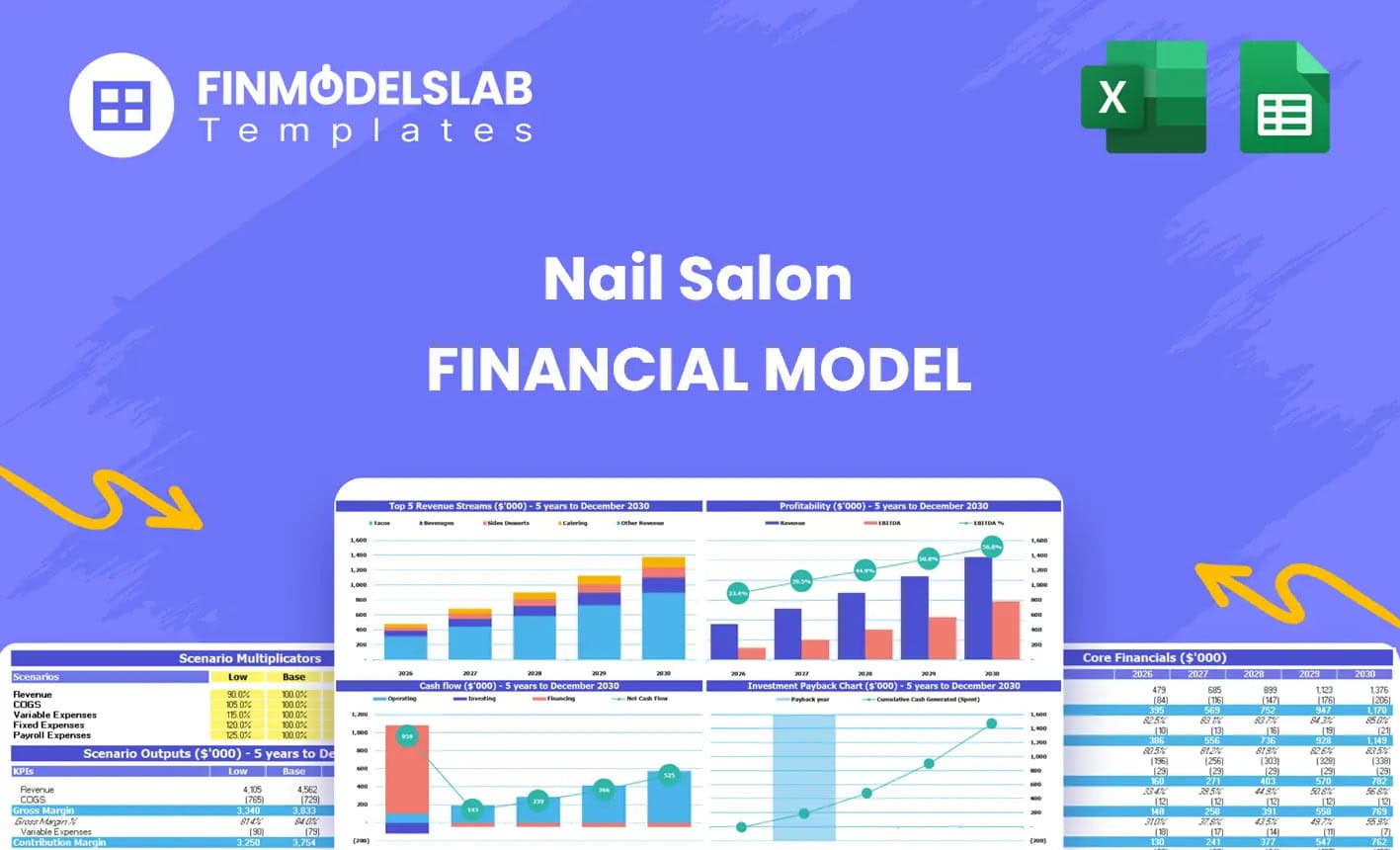
Nail Salon Financial Model Excel Template
The Nail Salon Financial Model Financial Model Template helps entrepreneurs, salon owners, consultan... Read more

Beauty Salon Financial Model Excel Template
The Beauty Salon Financial Model helps entrepreneurs, salon owners, consultants, analysts, and found... Read more

Mobile Spa Salon Financial Model Excel Template
The Mobile Spa Financial Model Template helps users turn a mobile beauty and wellness business idea ... Read more

Hair Salon Financial Model Excel Template
The Hair Salon Financial Model helps salon owners, founders, consultants, and business planners turn... Read more

Reiki Center Financial Model Excel Template
The Reiki Center Financial Model helps entrepreneurs, wellness business owners, consultants, and ana... Read more

Tattoo Parlor Financial Model Excel Template
The Tattoo Studio Financial Model helps entrepreneurs, studio owners, consultants, analysts, and bus... Read more

Tanning Salon Financial Model Excel Template
The Tanning Salon Financial Model helps entrepreneurs, salon owners, consultants, analysts, and busi... Read more

Sauna Financial Model Excel Template
The Sauna Financial Model helps entrepreneurs, founders, consultants, analysts, and wellness busines... Read more

Mobile Massage Salon Financial Model Excel Templat...
The Mobile Massage Financial Model Template helps entrepreneurs, founders, consultants, analysts, an... Read more
You must log in to submit a review.