
0 ITEMS

Eco Hotel Financial Model Excel Template
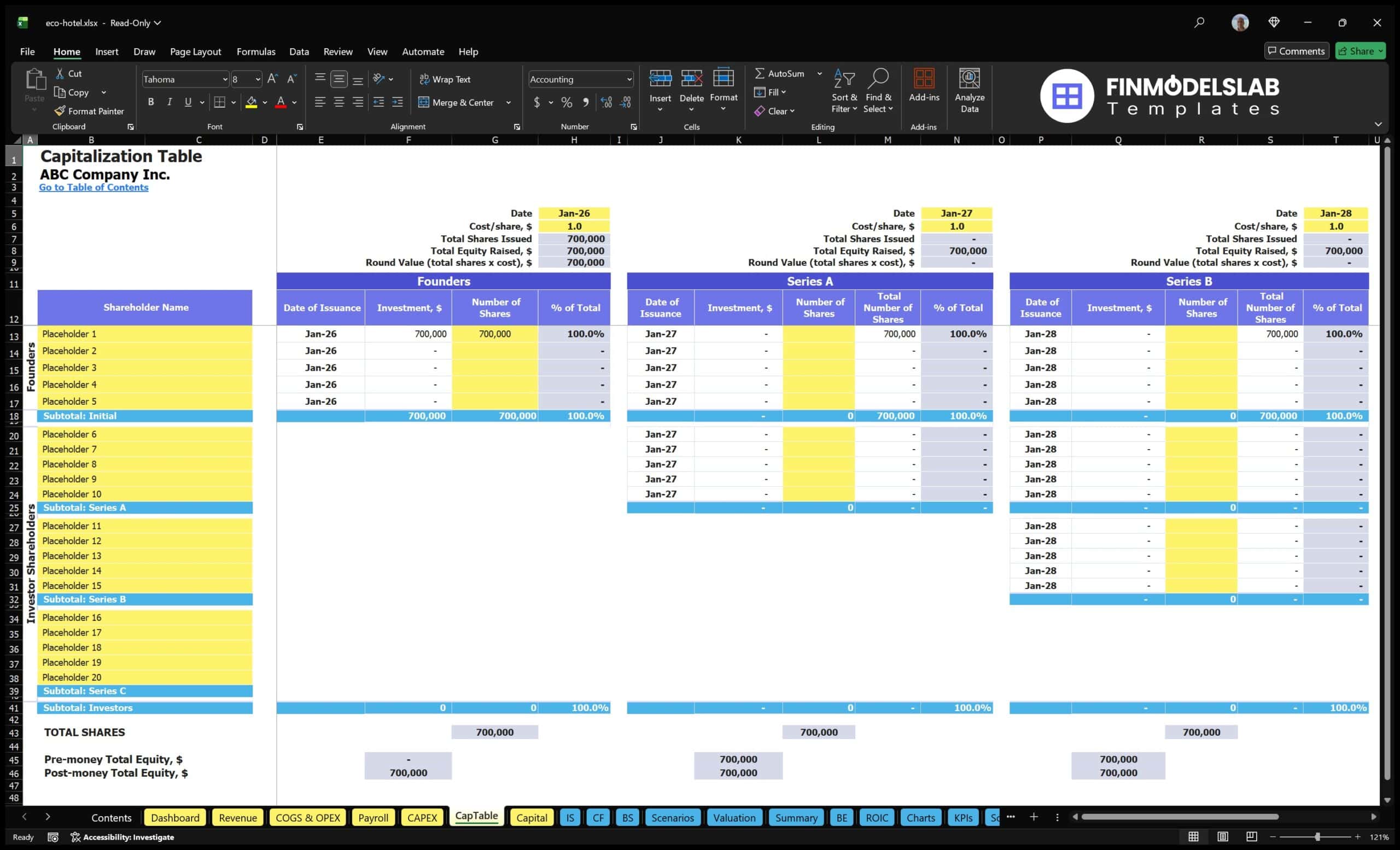
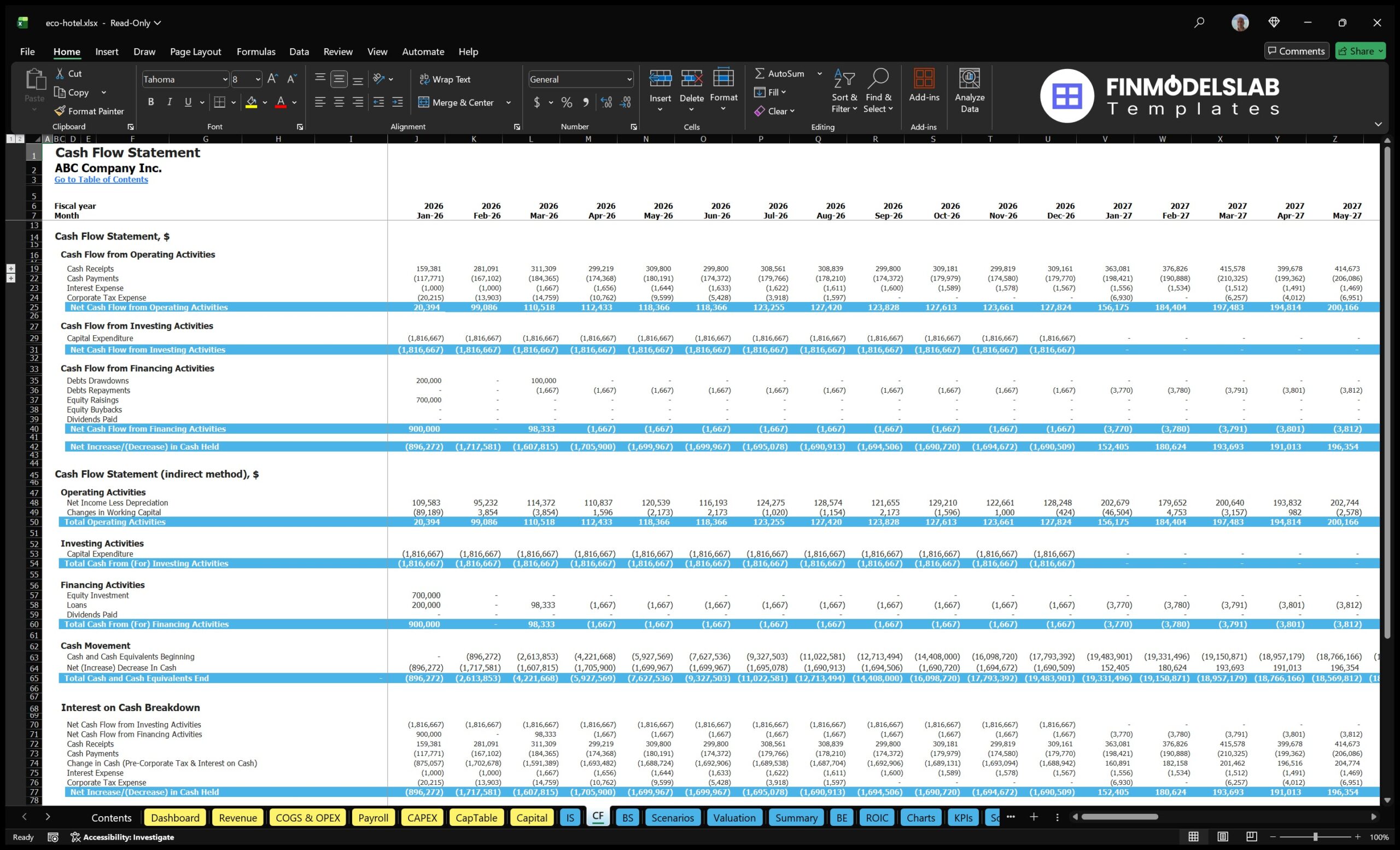
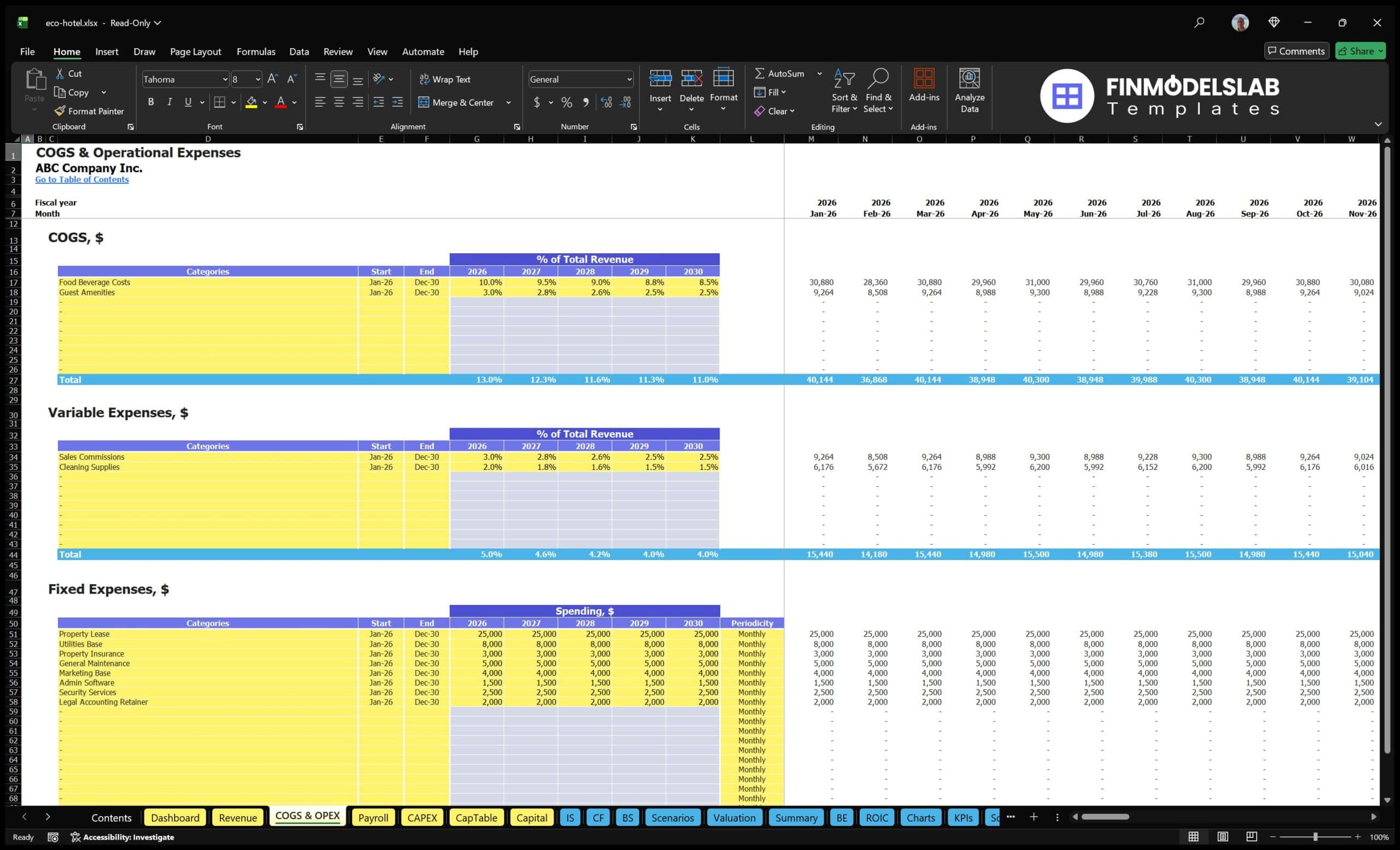
The Eco-Friendly Hotel Financial Model helps turn a sustainable hospitality concept into a structured five-year financial forecast. Instead of starting with a blank spreadsheet, users get a ready-to-use planning tool designed around the operating realities of a green hotel, including room revenue, occupancy, average daily rates, ancillary income, startup investment, operating expenses, payroll, cash flow, profitability, and investor-focused outputs. It gives founders and planners a practical way to understand whether the business can support its development costs, monthly operations, financing needs, and long-term return expectations. This financial model template is built for entrepreneurs, hotel developers, business owners, consultants, analysts, and anyone preparing a business plan, funding proposal, lender package, or internal feasibility review. It is especially useful for eco-hotel projects that need to communicate both commercial performance and sustainability-related investment needs, such as renewable energy systems, water reclamation, efficient construction, and eco-friendly furnishings. Users can adjust assumptions for room count, room types, occupancy growth, pricing, restaurant and bar sales, event space rentals, spa and wellness services, staffing, utilities, supplier costs, and other operating drivers. The model connects assumptions with financial outputs so users can review projected revenue, expenses, profit and loss, cash flow, balance sheet movement, returns, KPIs, and break-even performance. It supports decision-making by showing how changes in occupancy, ADR, service mix, cost structure, or funding strategy may affect liquidity and profitability. This makes it easier to test a base plan, assess downside risk, compare upside potential, and prepare more credible conversations with investors, lenders, partners, and management teams. Because the template is editable and designed for Excel and Google Sheets, users can personalize it to match a new build, redevelopment, boutique eco-resort, wellness-focused hotel, or established property planning an expansion. The pre-built structure saves time while still allowing detailed customization. Whether the goal is to raise capital, validate the project economics, plan staffing, estimate startup costs, monitor cash flow, or present a polished financial forecast, the Eco-Friendly Hotel Financial Model provides a clear framework for turning assumptions into actionable financial planning.
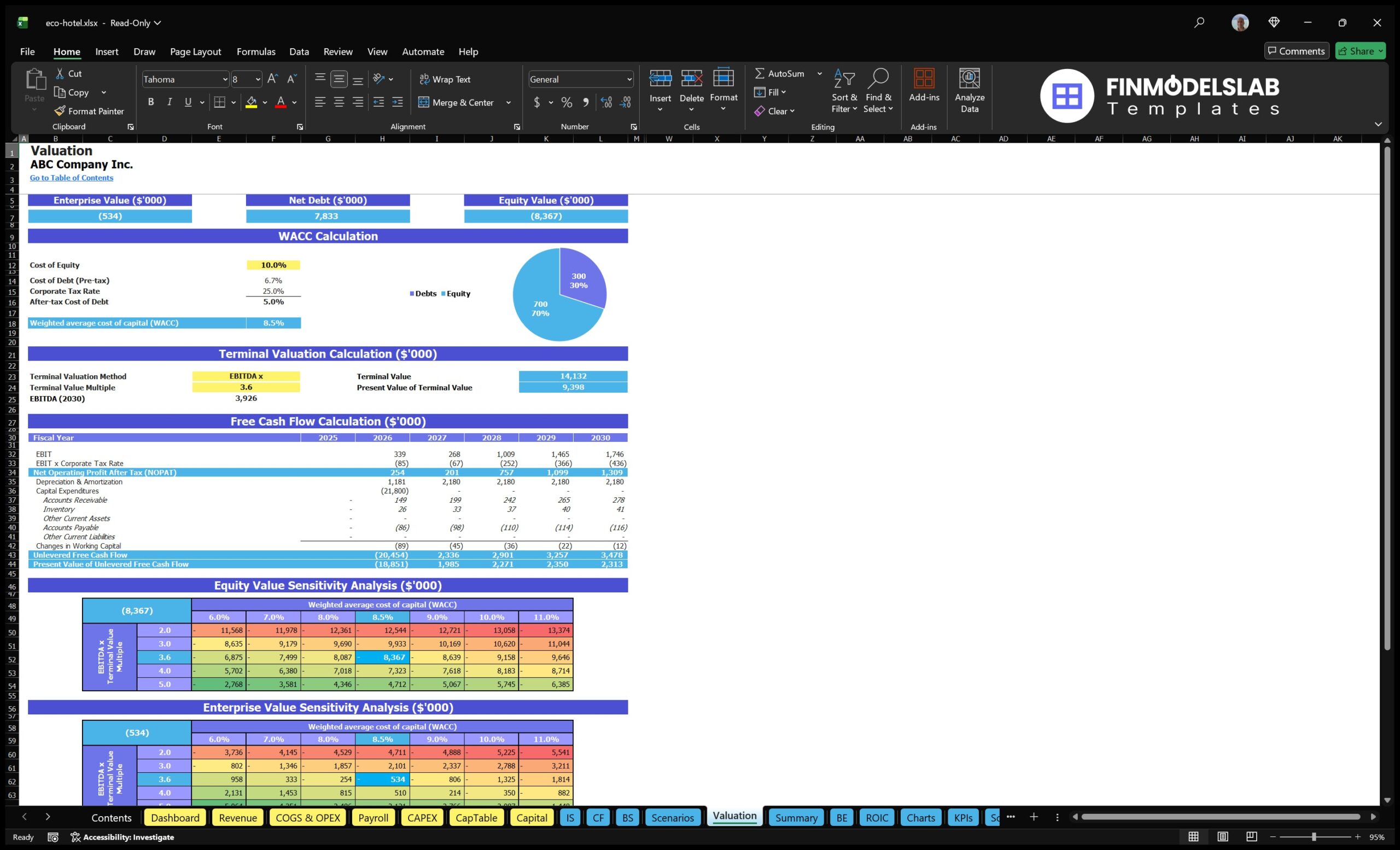
Financial Model Overview
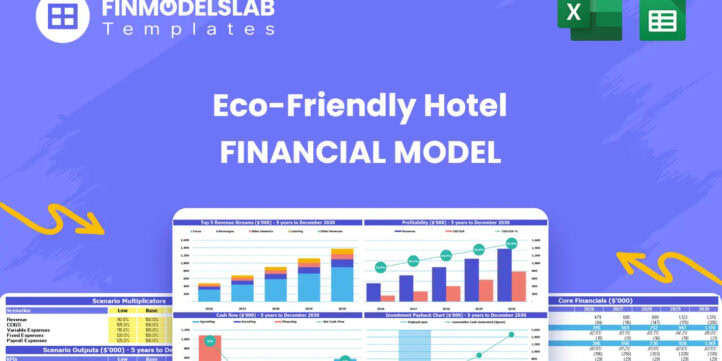
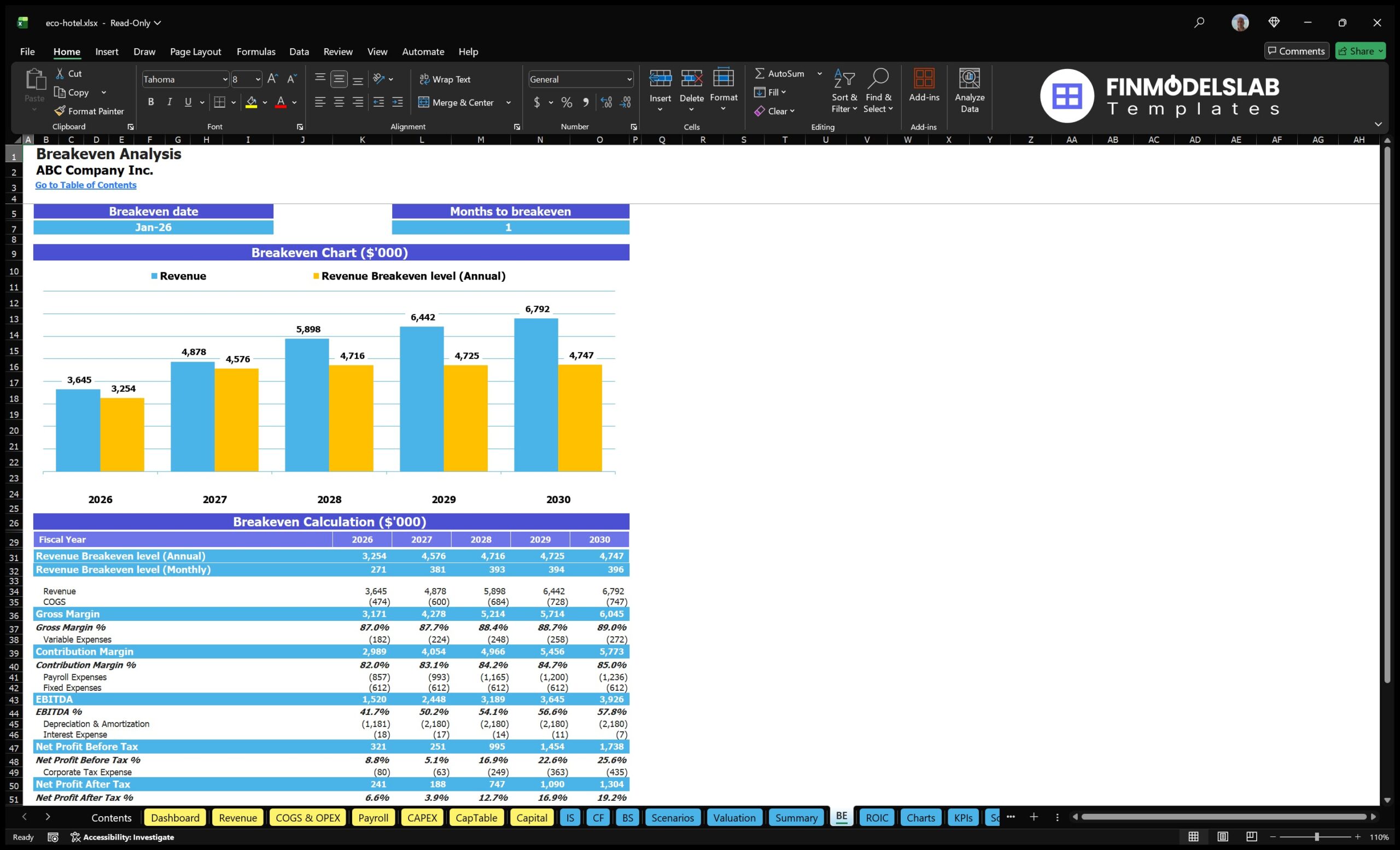
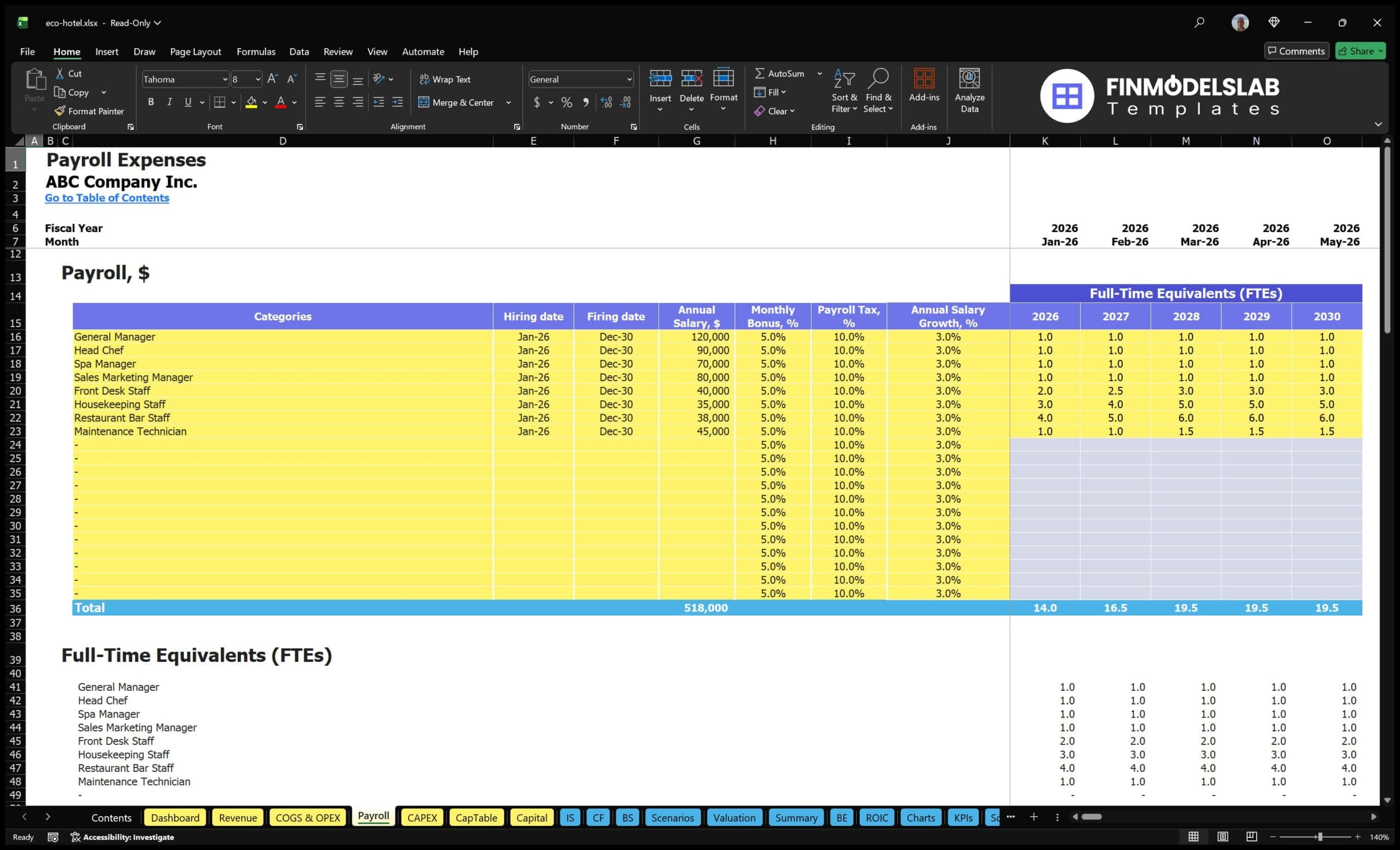
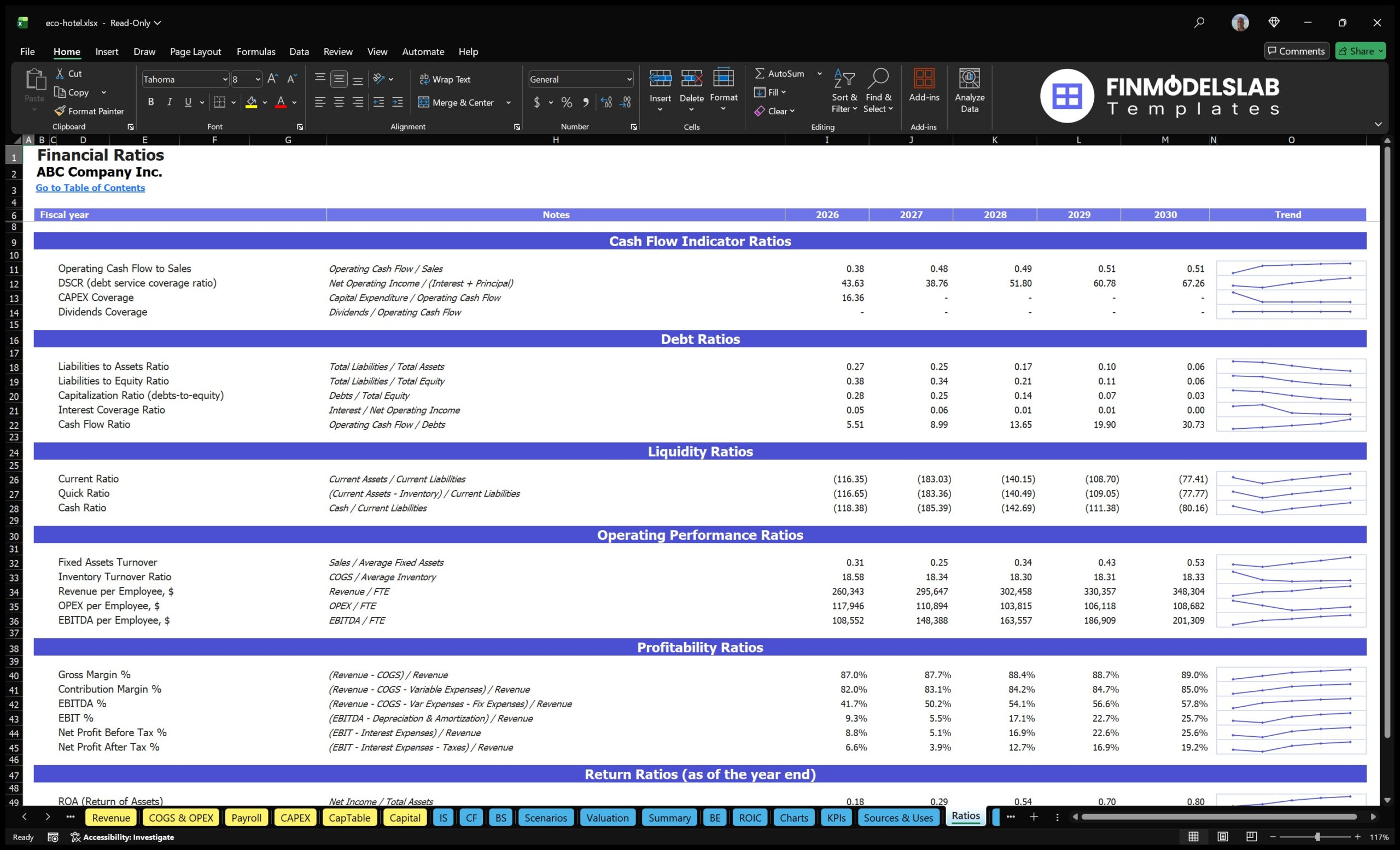
The Eco-Friendly Hotel Financial Model is a ready-to-use financial model template built for planning, evaluating, and presenting the financial performance of a sustainable hotel project. It gives entrepreneurs, hotel developers, consultants, analysts, and business owners a structured way to forecast revenue, startup costs, operating expenses, payroll, cash flow, profitability, balance sheet movement, returns, and key performance metrics over a multi-year planning period. The model is especially useful for an eco-friendly hotel because sustainable hospitality projects often include higher upfront capital requirements, specialized green technologies, renewable energy investments, water efficiency systems, eco-conscious furnishings, and operating assumptions that differ from a conventional hotel. By linking editable inputs to investor-ready outputs, the template helps users replace guesswork with a clear financial planning process. It can be used for business plans, funding applications, lender discussions, investor presentations, feasibility studies, internal budgeting, and scenario analysis. Users can customize assumptions for room types, occupancy, average daily rate, ancillary revenue, staffing, expenses, financing, and capital expenditures, then review how those assumptions affect profit, cash flow, break-even timing, and investment returns.
All-in-One Dashboard
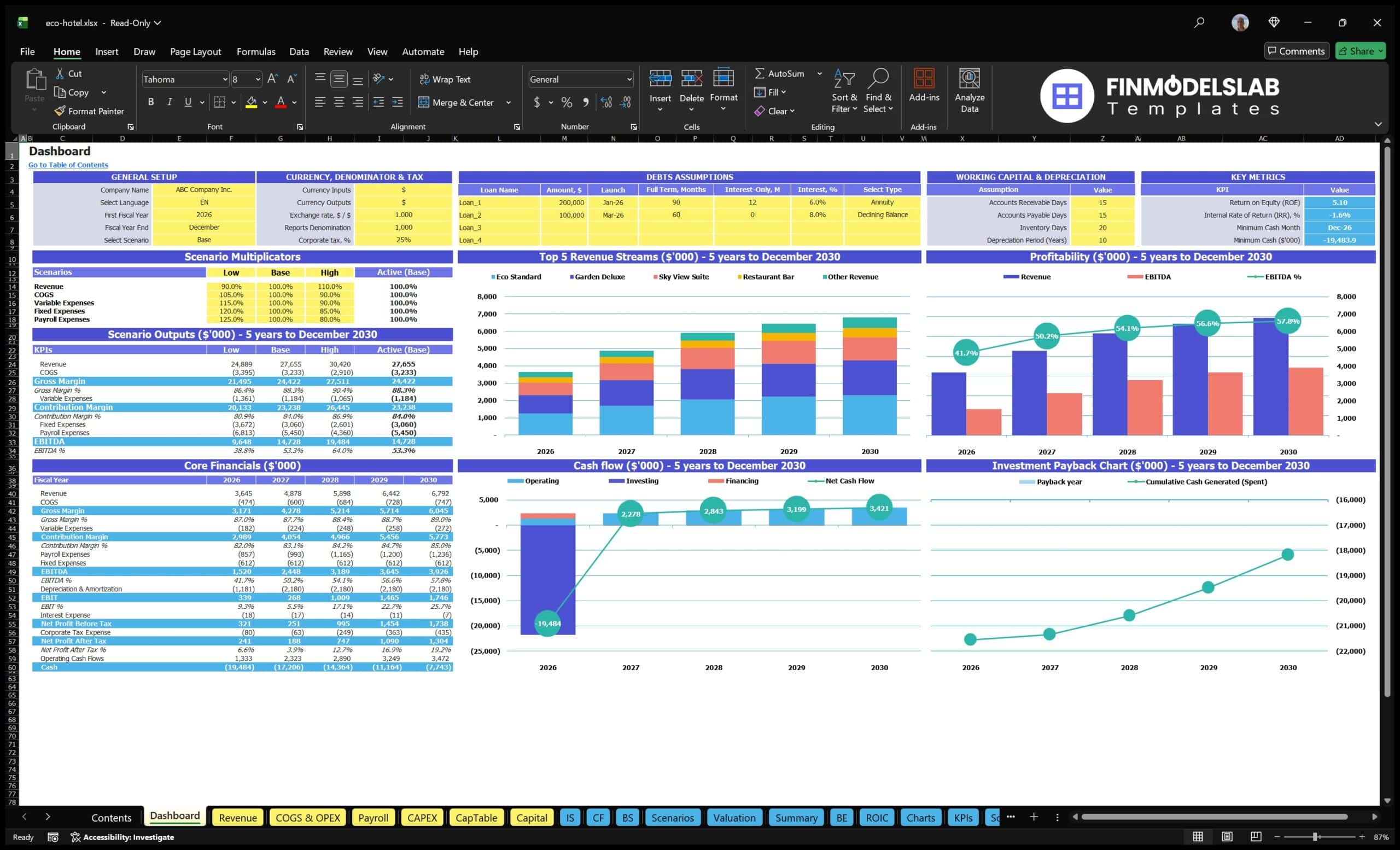
The all-in-one dashboard brings the core inputs and core outputs of the Eco-Friendly Hotel Financial Model into a centralized view so users can quickly understand the financial position of the project without navigating through disconnected spreadsheets. This section is designed to summarize the most important assumptions, such as room count, occupancy ramp-up, average daily rate, revenue streams, cost drivers, financing needs, and growth expectations, while also displaying outputs such as revenue, EBITDA, net income, cash balance, margins, return metrics, and funding requirements. For an eco-friendly hotel, the dashboard is particularly valuable because it allows users to see how major sustainable development choices, such as green construction, renewable energy systems, water reclamation, and premium eco-positioning, influence the overall business case. It gives founders and advisors a fast way to review whether the model is producing realistic results, whether the hotel can support its operating expense structure, and whether the financial story is ready for stakeholder review. The dashboard also supports decision-making by turning complex calculations into a practical summary that can be used in planning meetings, investor updates, and lender conversations. Instead of reviewing every schedule individually, users can use this section as a control center for monitoring forecast performance and identifying which assumptions need further refinement.
Low, Base, and High Scenario Analysis
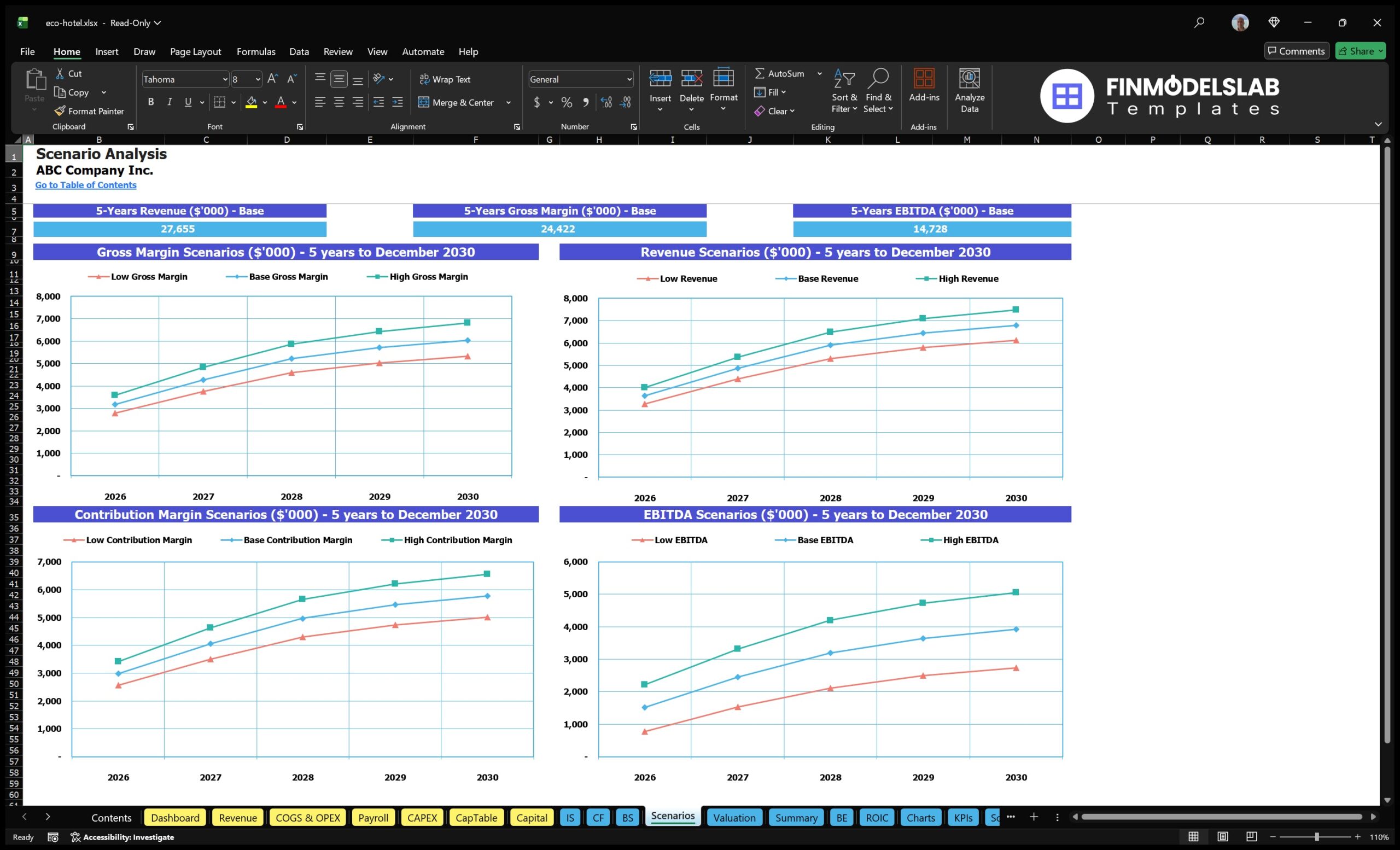
The low, base, and high scenario analysis section helps users evaluate how the eco-friendly hotel may perform under different market conditions and strategic outcomes. This component is important because hotel performance can vary significantly depending on occupancy, average daily rate, seasonality, booking pace, corporate demand, tourism trends, event activity, labor costs, utility costs, and the market response to sustainability positioning. The low scenario can be used to model a slower ramp-up, weaker demand, higher operating costs, delayed stabilization, or a more conservative pricing strategy. The base scenario can represent the most realistic operating plan based on the user’s expected assumptions. The high scenario can show upside potential from stronger occupancy, premium pricing, successful wellness and event packages, better cost efficiency, or stronger ancillary revenue. By comparing these scenarios side by side, users can understand the financial guardrails of the business and prepare more credible answers for investors and lenders. The section may show the impact on revenue, gross profit, EBITDA, net income, cash flow, ending cash balance, debt service coverage, and return metrics. This makes the template useful not only for presenting a single forecast but also for stress-testing the business plan and identifying how much capital may be needed if performance comes in below expectations.
Professional Charts
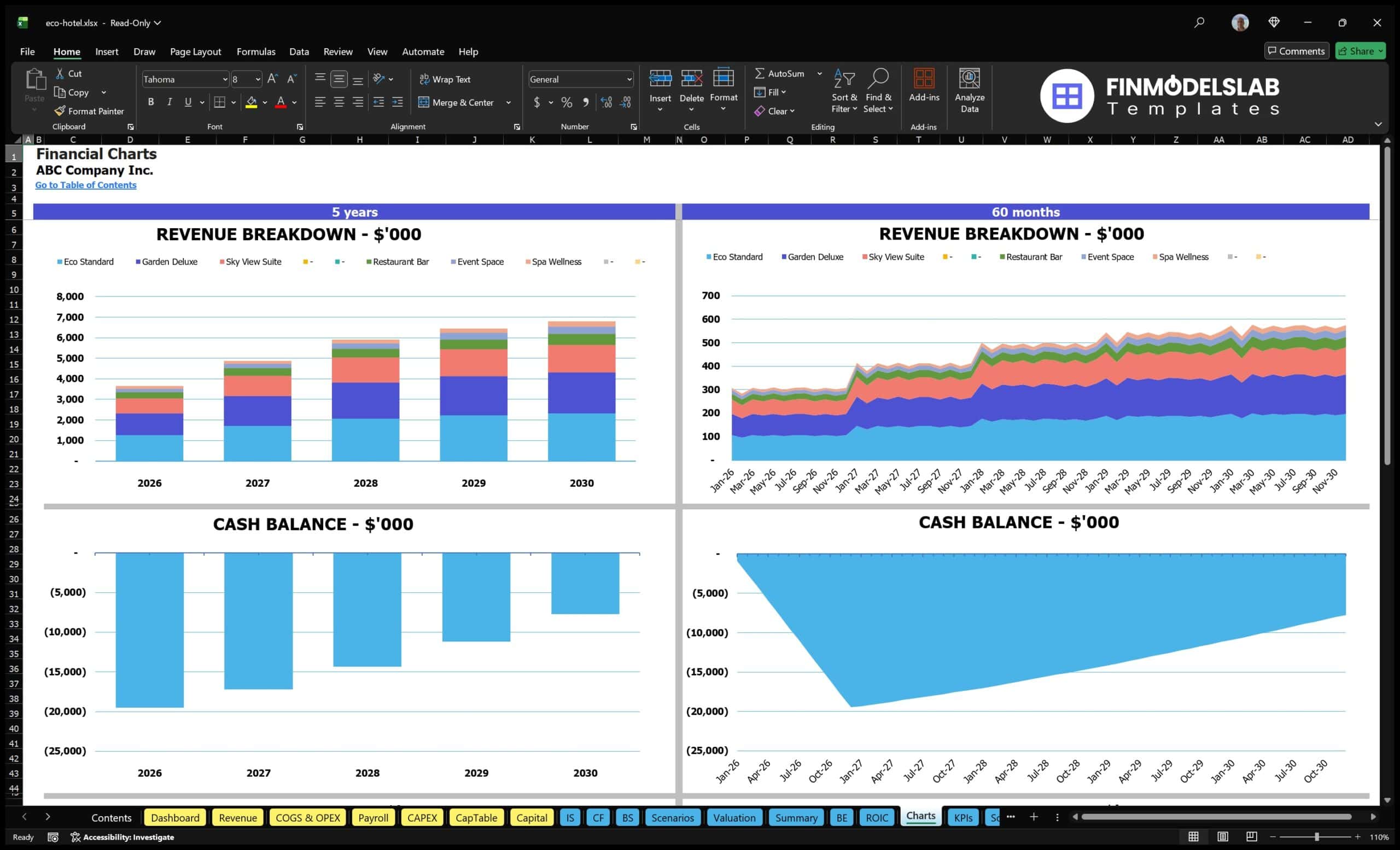
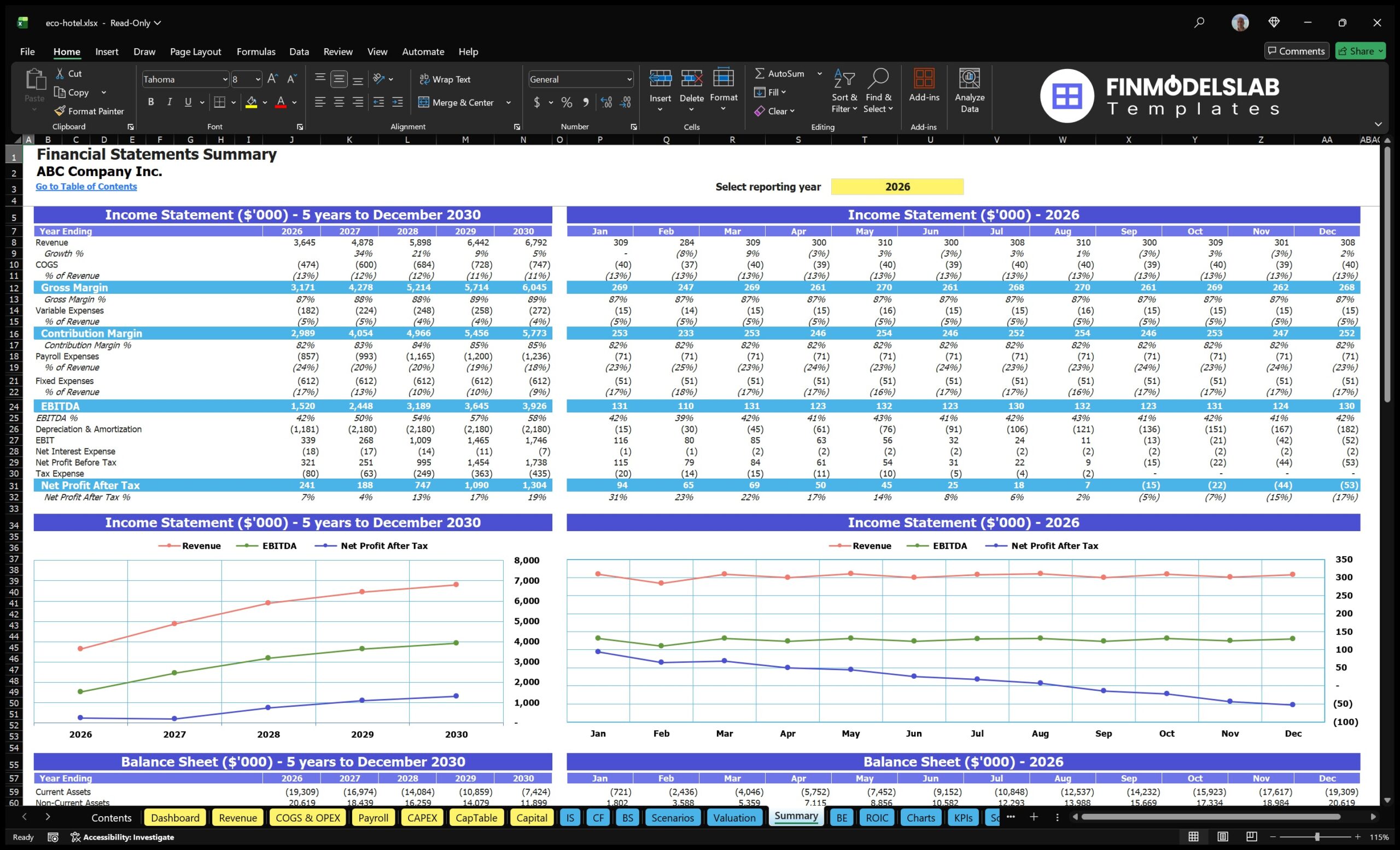
The professional charts section transforms the forecast into clean visual outputs that make financial results easier to understand and communicate. Rather than relying only on rows of numbers, users can review visual trends for revenue growth, operating expenses, profitability, cash flow, cash balance, margins, funding needs, and other key metrics. This is especially helpful when presenting an eco-friendly hotel concept to investors, lenders, partners, board members, or internal decision-makers who need to quickly grasp the financial story behind the project. Charts can make it easier to show how occupancy improves over time, how average daily rate increases as the hotel gains market traction, how ancillary revenue from restaurant, bar, events, spa, and wellness services contributes to total income, and how profitability scales as fixed costs are absorbed across higher revenue. For sustainable hotel projects, the charts can also support conversations around the timing of heavy upfront capital expenditures and the path toward stable operating cash flow. Professional visual outputs help users identify trends, spot potential concerns, and explain forecast assumptions in a more polished and accessible way. This section is useful for pitch decks, feasibility discussions, internal presentations, and ongoing financial planning because it converts detailed model calculations into presentation-ready insights.
ROE Components and DuPont Analysis
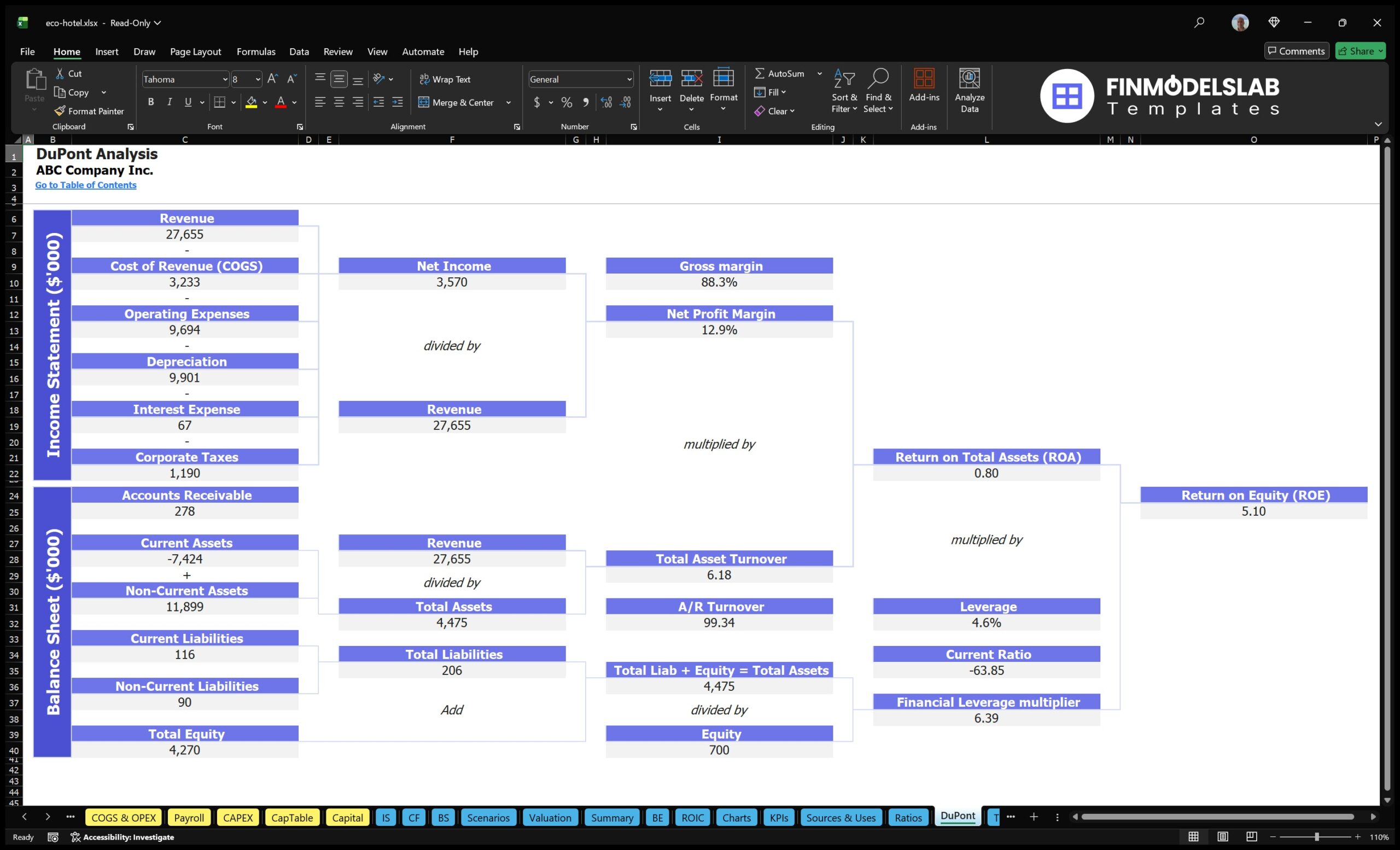
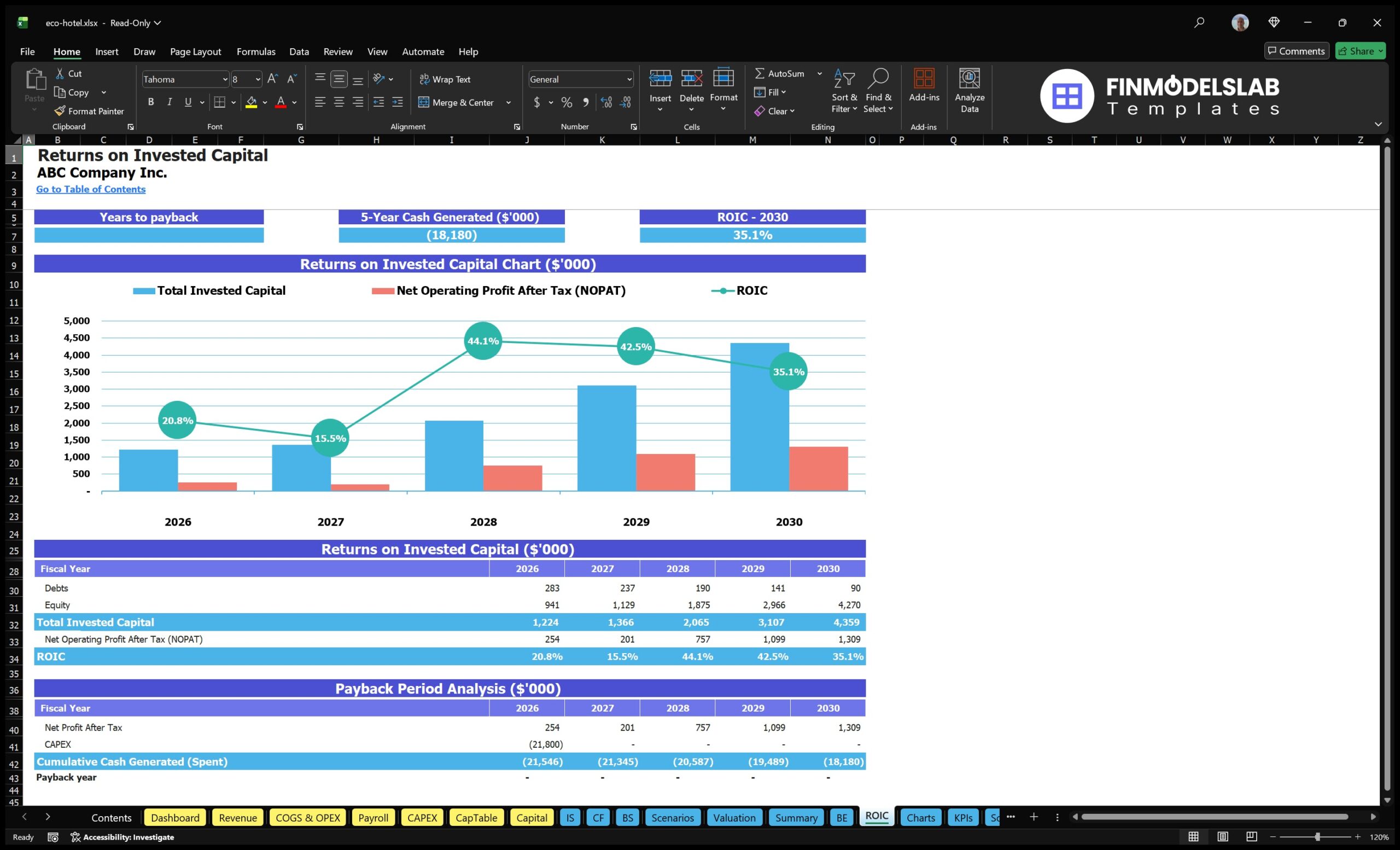
The ROE components and DuPont analysis section helps users evaluate return on equity by breaking performance into the drivers that influence shareholder returns. Instead of viewing return on equity as a single result, this component can decompose it into profitability, asset efficiency, and leverage-related factors, giving users a more detailed understanding of why returns improve or weaken over time. For an eco-friendly hotel, this is useful because the project may involve substantial initial investment in land, construction, renewable energy systems, sustainable materials, efficient building systems, furnishings, technology, and pre-opening costs. These investments can affect asset intensity and near-term return metrics, even when the hotel becomes operationally profitable. By reviewing ROE components, users can better understand whether returns are being driven by operating margin improvement, higher utilization of hotel assets, revenue growth, debt financing, or changes in equity structure. This section supports investor discussions because it provides a more sophisticated view of financial performance than a basic profit forecast. It can help users explain why a project with strong EBITDA growth may still require a longer investment horizon to produce attractive equity returns. It also helps analysts evaluate whether pricing, cost control, occupancy growth, financing mix, or capital efficiency should be adjusted to improve the overall return profile.
Revenue Inputs
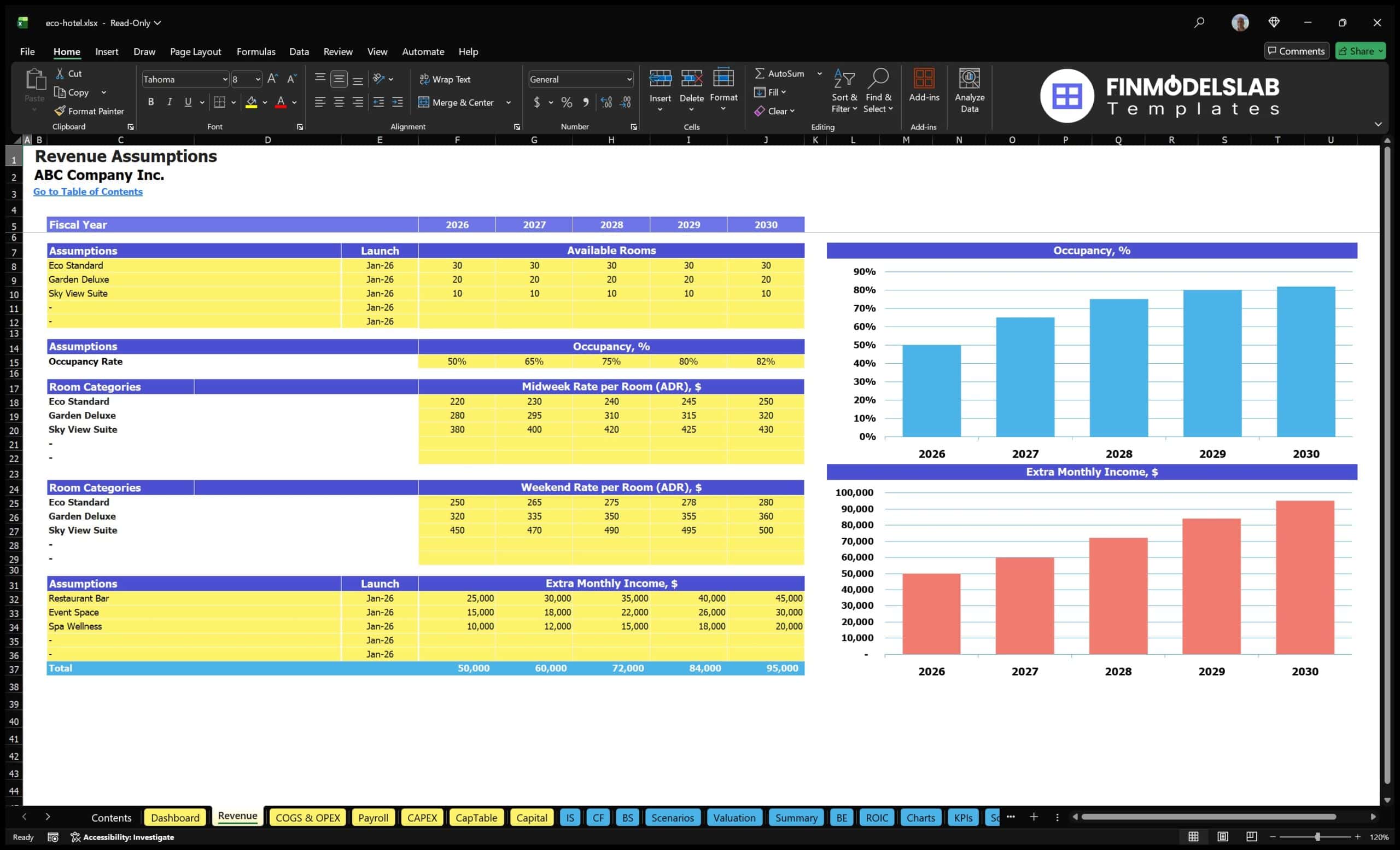
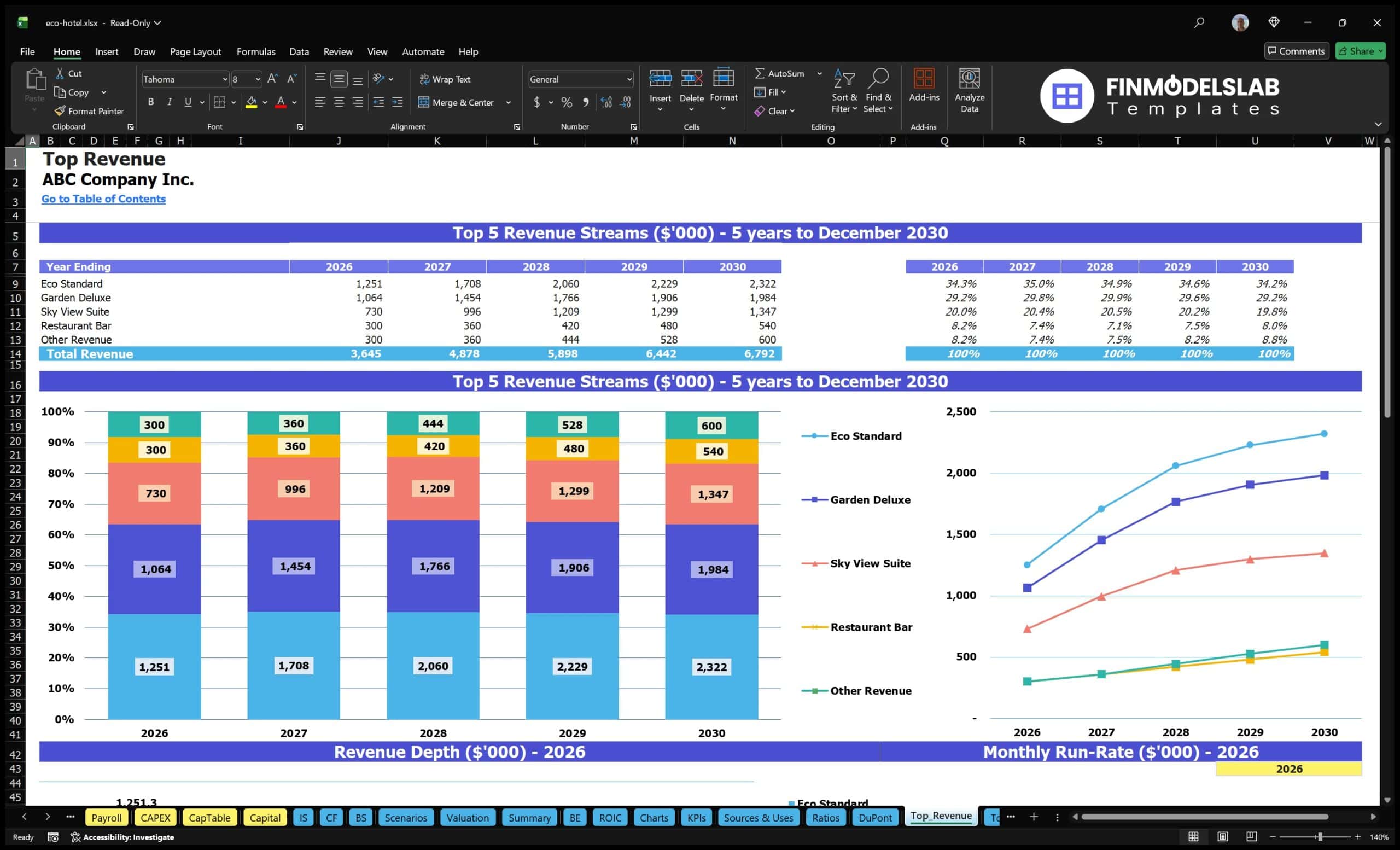
The revenue inputs section is where users define the assumptions that drive the hotel’s top-line forecast. For an eco-friendly hotel, this may include room categories such as eco standard rooms, garden deluxe rooms, and sky view suites, along with the number of available rooms, occupancy rates, average daily rates, annual pricing growth, seasonality assumptions, and ramp-up timing. The section may also include inputs for non-room revenue such as restaurant and bar sales, event space rentals, spa and wellness services, sustainability-focused packages, retreats, corporate bookings, and other guest amenities. These inputs are essential because hotel revenue is highly sensitive to occupancy and pricing, and a small change in ADR or occupancy can materially affect profitability and cash flow. By organizing the revenue drivers in one editable area, the template allows users to build a forecast that reflects their specific property positioning, target customer segments, geographic market, and service mix. It also helps users test whether the hotel can generate enough income to support payroll, utilities, supplies, marketing, maintenance, debt service, and required reserves. For business planning and funding documents, the revenue inputs provide a clear foundation for explaining how the hotel will make money and which assumptions support the growth trajectory.
Bank-Ready Reports
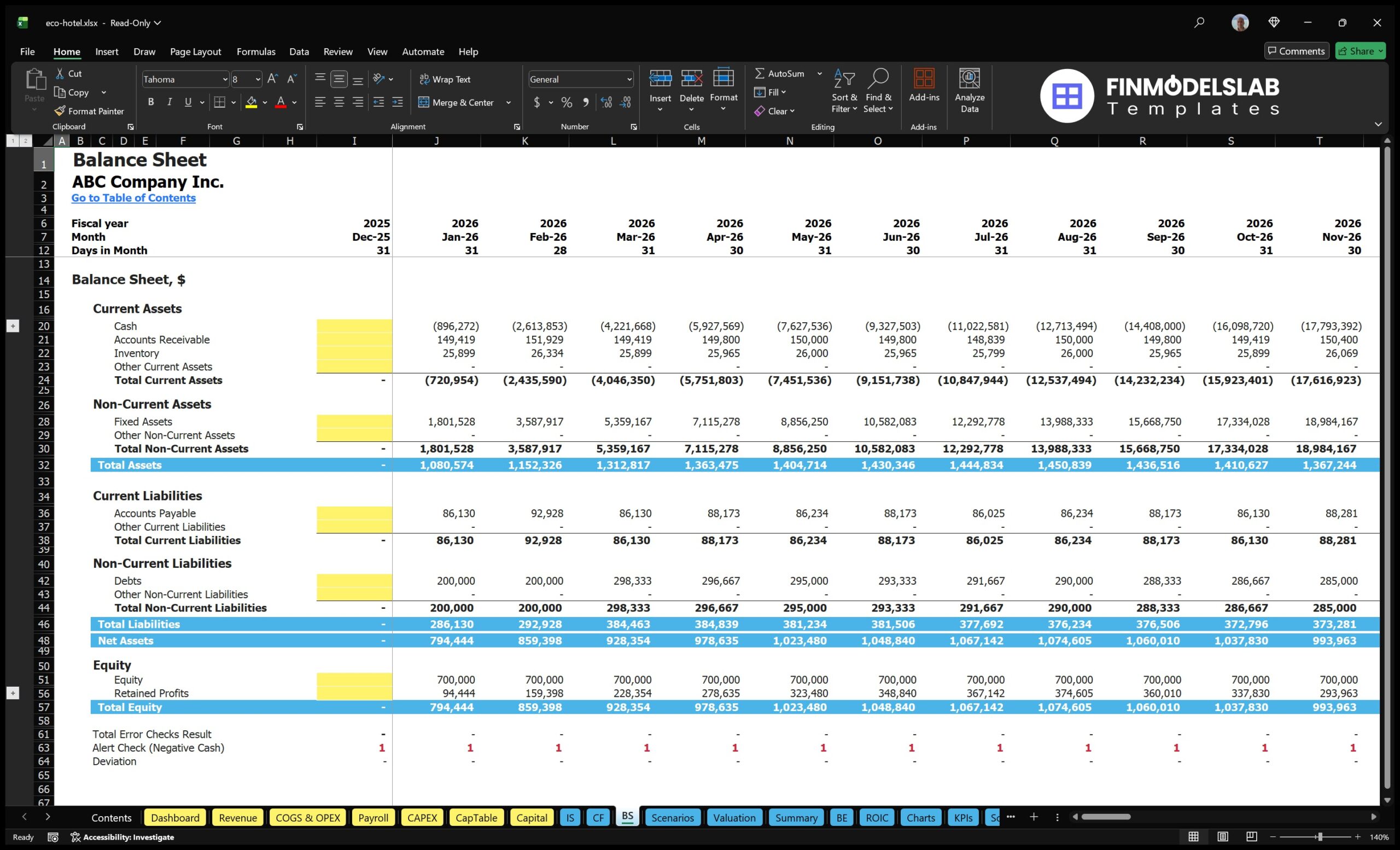
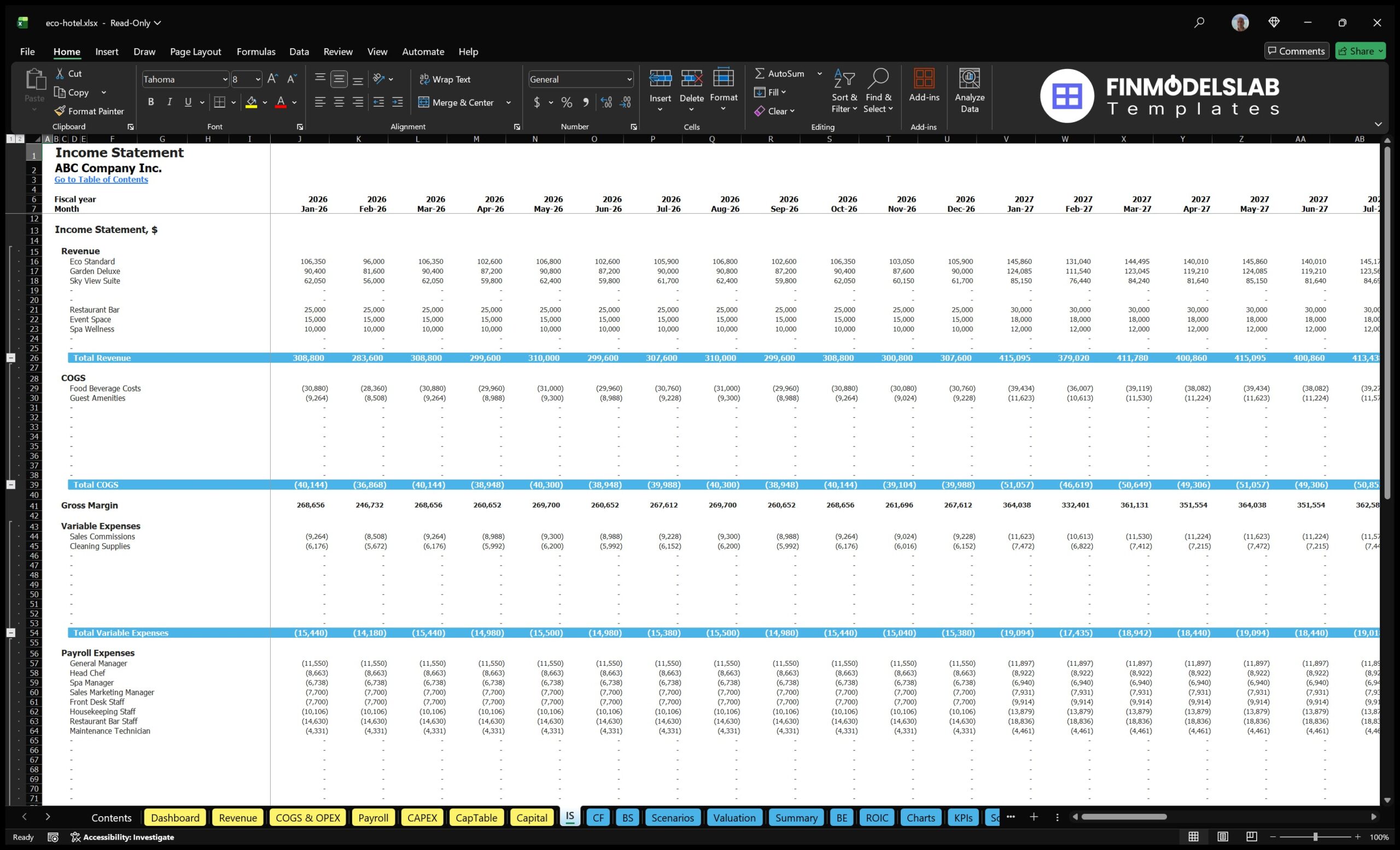
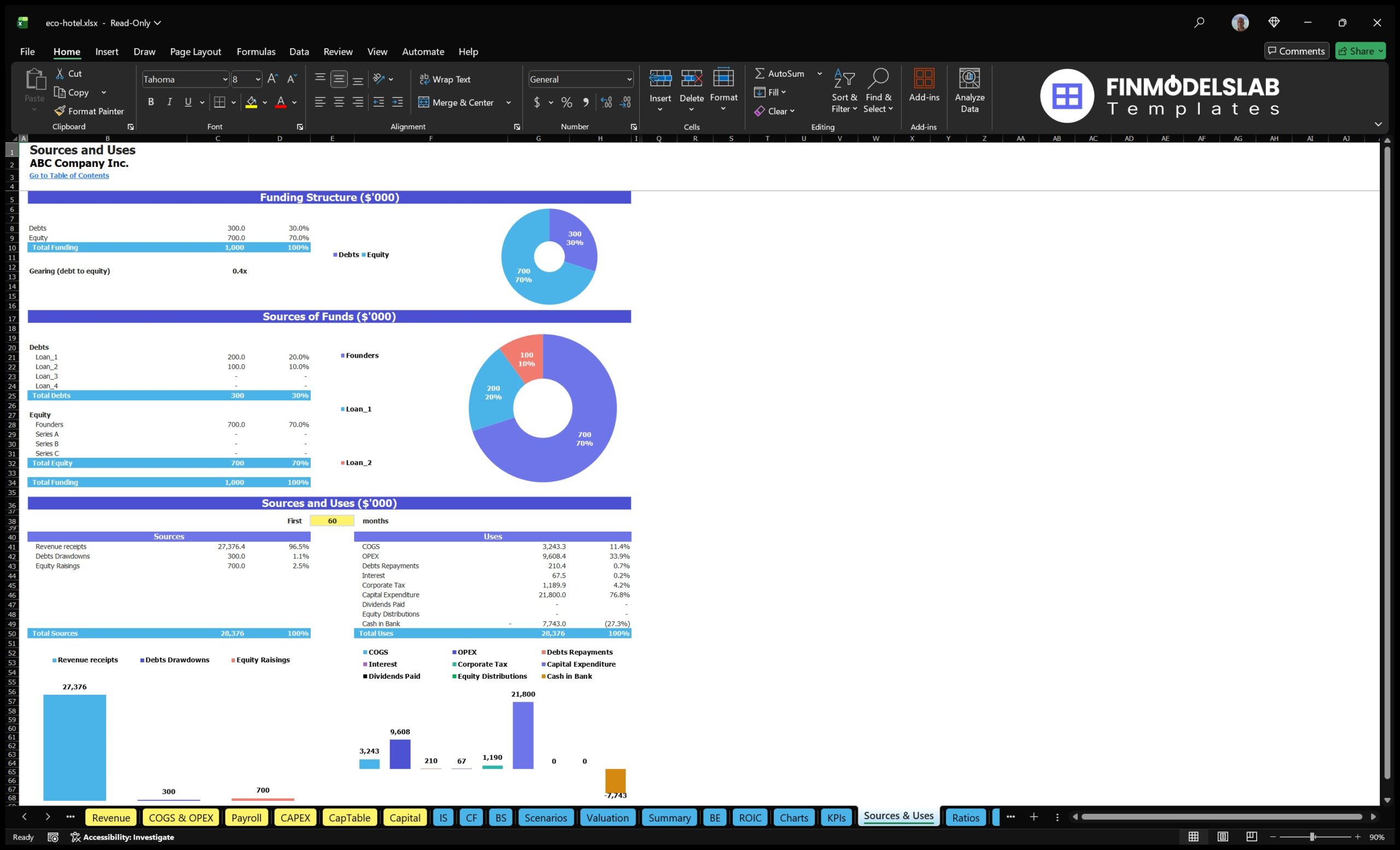
The bank-ready reports section provides lender-friendly financial outputs that help users present the eco-friendly hotel project in a format suitable for financing conversations. Lenders typically need to understand projected profit and loss, cash flow, balance sheet position, debt service capacity, funding requirements, operating performance, and the assumptions behind the forecast. This component helps organize those outputs into a professional format that can support loan applications, credit reviews, refinancing discussions, construction financing, or working capital planning. For a sustainable hotel development, bank-ready reporting is especially important because the project may require significant upfront funding before stable operating cash flow begins. The section can help users show how capital will be used, when revenue is expected to start, how quickly occupancy ramps up, whether the business can cover ongoing expenses, and whether projected cash flow is sufficient to support debt repayment. It also helps improve credibility by presenting the forecast in a structured, consistent, and polished way. Instead of sending a collection of unconnected calculations, users can provide a coherent set of financial statements and summaries that make it easier for lenders and stakeholders to assess project viability, risk, and repayment potential.
Revenue Breakdown
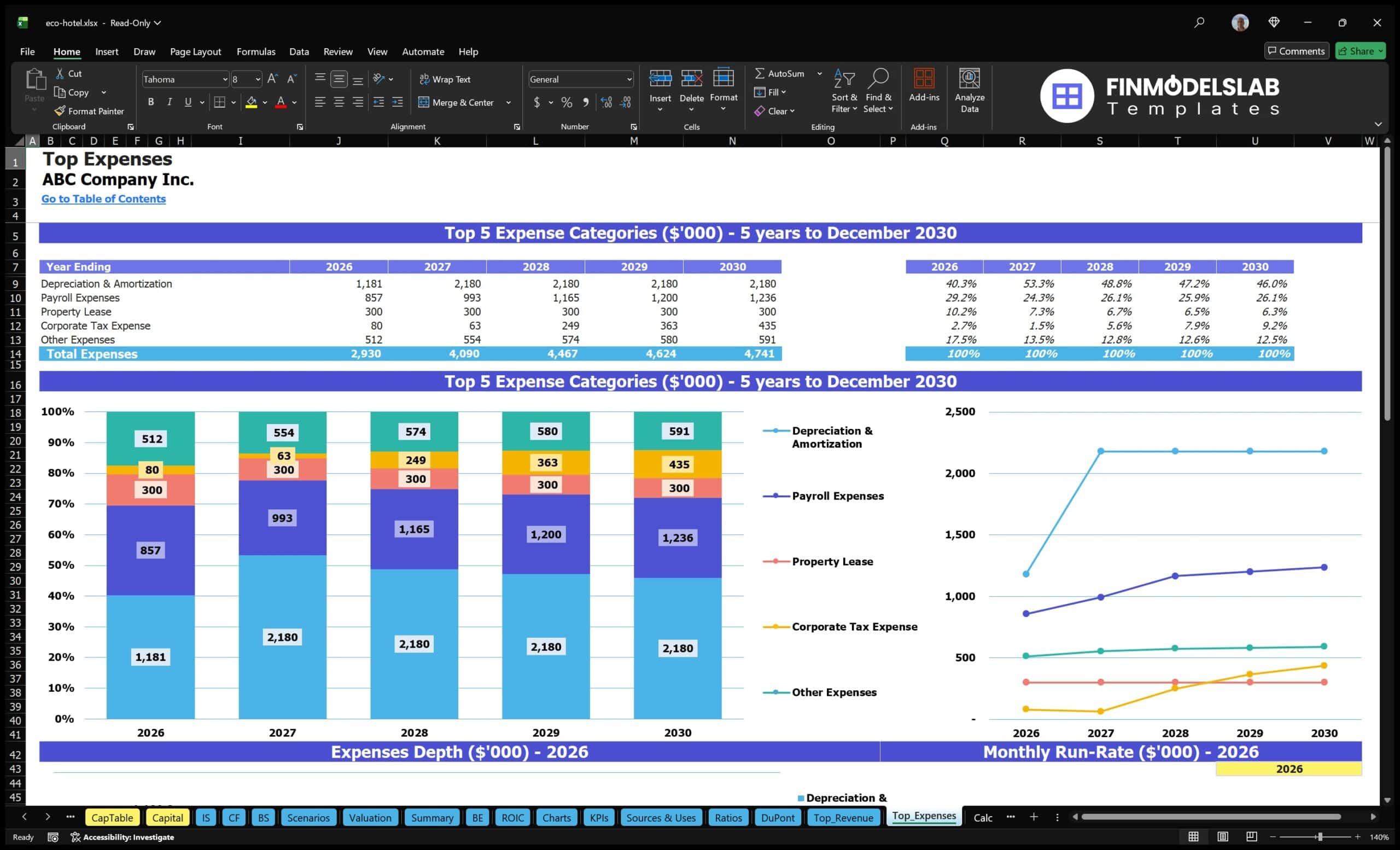
The revenue breakdown section gives users a detailed view of the income streams that make up the eco-friendly hotel’s total revenue. This component helps separate room revenue from ancillary income, making it easier to understand which parts of the business are contributing most to growth and profitability. Room revenue may be analyzed by room type, occupancy rate, available nights, average daily rate, and annual rate escalation. Ancillary revenue may include restaurant and bar sales, event space rentals, spa and wellness services, wellness retreats, meeting packages, eco-tourism experiences, or other on-site amenities. This detailed view is useful because hotels often rely on more than room sales to improve margins and create a stronger guest experience. For an eco-friendly hotel, non-room revenue can also reinforce the brand positioning through wellness offerings, sustainable dining, corporate ESG retreats, and events for environmentally conscious travelers. By reviewing revenue by stream, users can identify which areas deserve more investment, which services may need pricing adjustments, and how changes in guest behavior could affect total sales. The section also supports more accurate budgeting because different revenue streams may have different cost structures, staffing needs, gross margins, and seasonal patterns. This makes the model more useful for operational planning, investor presentations, and management decision-making.
KPI Dashboard
The KPI dashboard section focuses on performance metrics and benchmarks that help users evaluate the health of the eco-friendly hotel beyond basic revenue and profit figures. Important hotel KPIs may include occupancy rate, average daily rate, revenue per available room, total revenue, gross margin, EBITDA margin, payroll as a percentage of revenue, operating expense ratio, cash balance, return on equity, internal rate of return, payback period, and other investor or management metrics. This component is useful because it gives users a fast way to compare projected performance against internal targets, market expectations, or hospitality industry benchmarks. For an eco-friendly hotel, KPIs can also help demonstrate whether the project’s premium positioning and sustainability investments are translating into stronger pricing power, improved guest spending, or more efficient operations. The dashboard can support monthly reviews, annual planning, investor updates, and lender reporting by showing where performance is improving and where corrective action may be needed. It can also help non-financial users understand the model because KPIs provide concise signals about occupancy, pricing, efficiency, profitability, liquidity, and return potential. By keeping these metrics visible, the template helps users make better decisions about pricing strategy, staffing levels, marketing campaigns, cost control, service mix, and capital planning.
Startup Cost and Capital Expenditure Planning
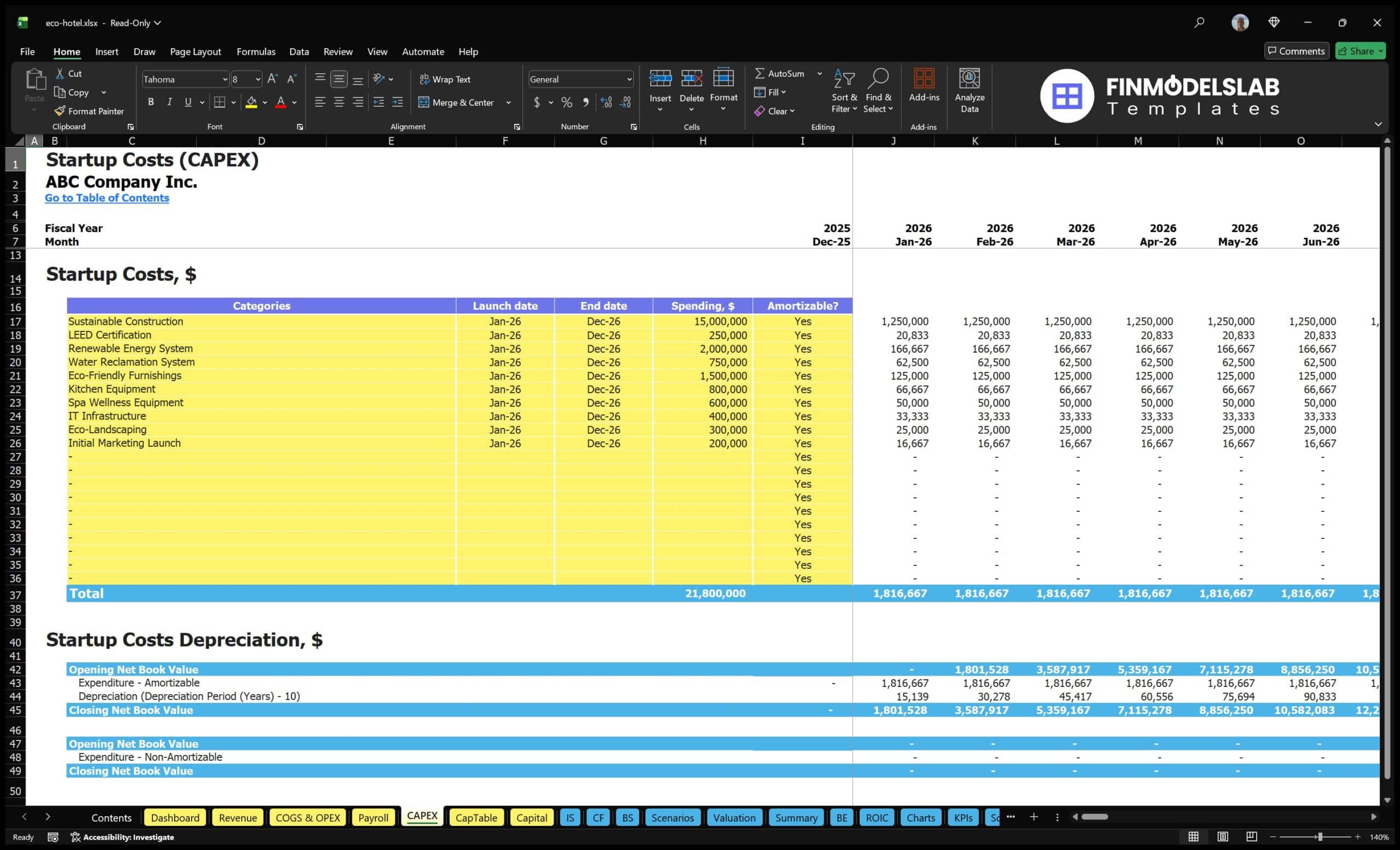
The startup cost and capital expenditure planning section helps users estimate the initial investment required to develop, furnish, equip, and launch the eco-friendly hotel. Sustainable hotel projects often require a detailed capital plan because the upfront cost may include land preparation, construction, architecture, engineering, permits, interior design, furniture, fixtures, equipment, renewable energy systems, water reclamation systems, energy-efficient building materials, technology, pre-opening payroll, branding, launch marketing, deposits, professional fees, contingency, and working capital reserves. This component organizes those costs so users can understand how much funding may be needed before the hotel begins generating steady operating income. It also supports fundraising because investors and lenders want to see exactly how capital will be used and whether the proposed budget is realistic. The section can help users distinguish between one-time startup costs, long-term capital assets, and recurring operating expenses, which is important for both financial statements and financing strategy. By modeling capital expenditures clearly, users can assess the impact of upfront investment on cash flow, balance sheet structure, depreciation, financing needs, and return metrics. This is particularly valuable for an eco-friendly hotel because green infrastructure may increase the initial budget but can also support brand differentiation, utility savings, premium positioning, and long-term operational resilience.
File types:
Excel – Single-User: .xlsx
Excel – Multi-User: .xlsx
Similar ProductsOther customers were also interested in...

 HenrySheykin
Boutique Hotel Financial Model Excel Template
The Boutique Hotel Financial Model Financial Model Template helps entrepreneurs, hotel owners, consu... Read more
Hotel Financial Model Excel Template
The Hotel Financial Model helps users build a structured financial forecast for a hotel business usi... Read more
Resort Financial Model Excel Template
The Resort Financial Model Financial Model Template helps resort developers, hospitality entrepreneu... Read more
Casino Hotel Financial Model Excel Template
The Casino Hotel Financial Model helps users build a structured five-year forecast for an integrated... Read more
Floating hotel Financial Model Excel Template
The Hotel Financial Model helps users build a structured financial forecast for a hotel business usi... Read more
Private Island Financial Model Excel Template
The Luxury Private Island Financial Model helps users turn an exclusive resort, island rental, or hi... Read more
Beach Hotel Financial Model Excel Template
The Beach Resort Financial Model template helps entrepreneurs, resort owners, consultants, analysts,... Read more
Bed And Breakfast Financial Model Excel Template
The Bed and Breakfast Financial Model is a ready-to-use financial model template built to help entre... Read more
Vacation Rentals Hotel Financial Model Excel Templ...
The Vacation Rental Financial Model helps users turn a short-term rental concept, property managemen... Read more
Condo Hotel Financial Model Excel Template
The Condo Hotel Financial Model helps users turn a condo hotel concept, launch plan, or investment o... Read more
You must log in to submit a review.