
0 ITEMS

Construction and Demolition Waste Recycling Plant Financial Model: C&D MRF, Recycled Concrete Aggregate, Tipping Fees, Project Finance, USA and Canada
Annual Excel model for a construction and demolition (C&D) waste recycling plant. Compare three plant designs, model gate fees, a 10-material balance, recycled aggregate, wood and metal sales and residue disposal, and test returns, DSCR debt and three statements for US and Canada markets.
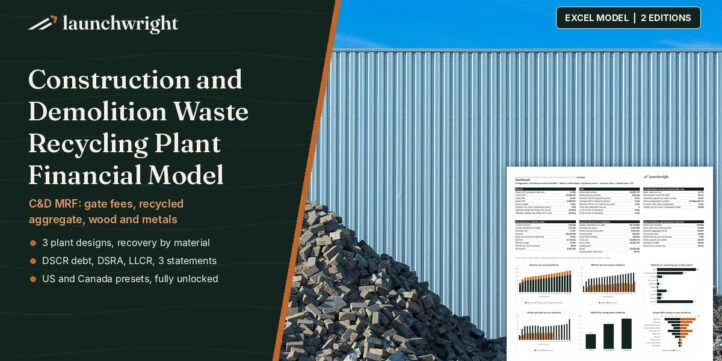
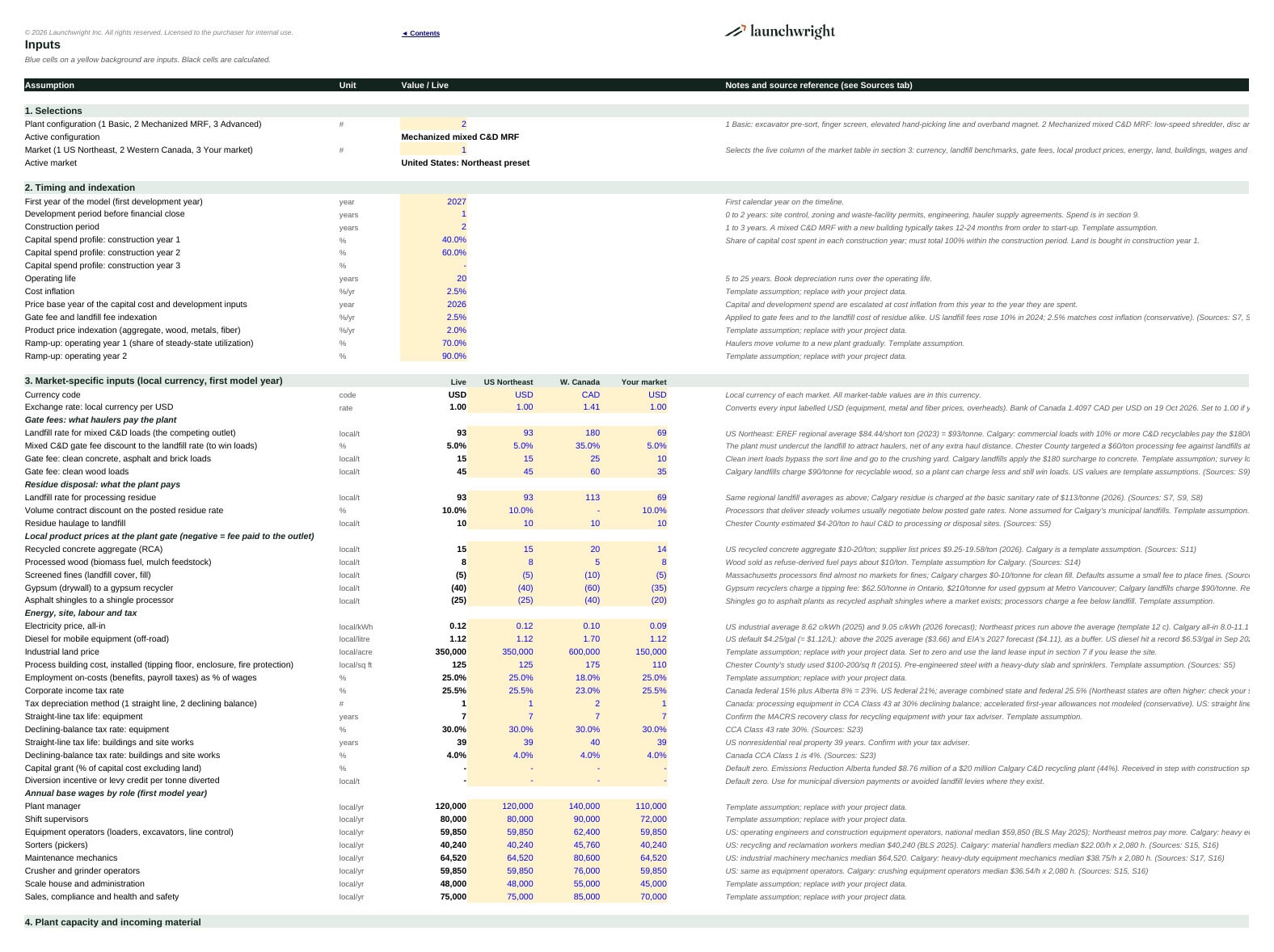
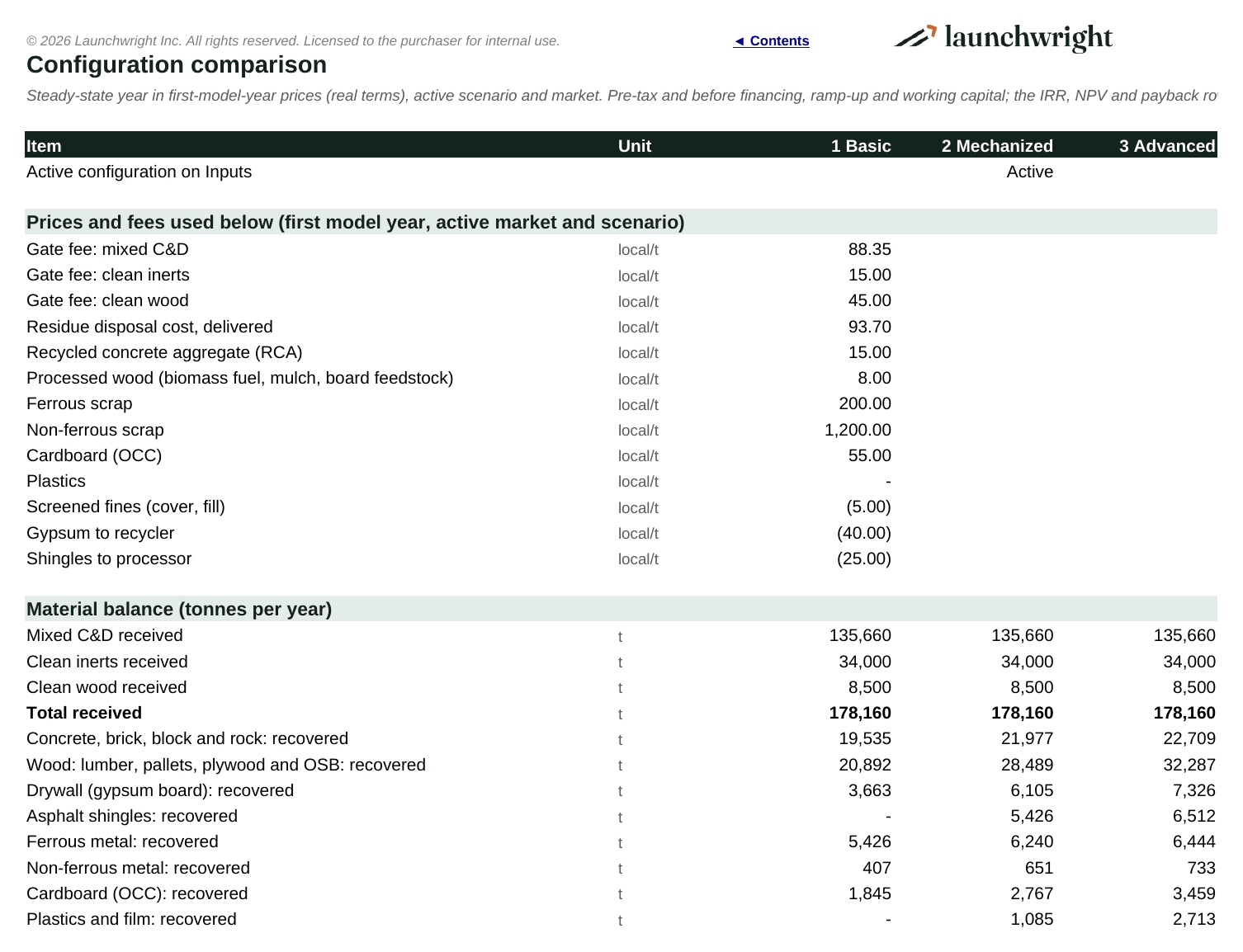
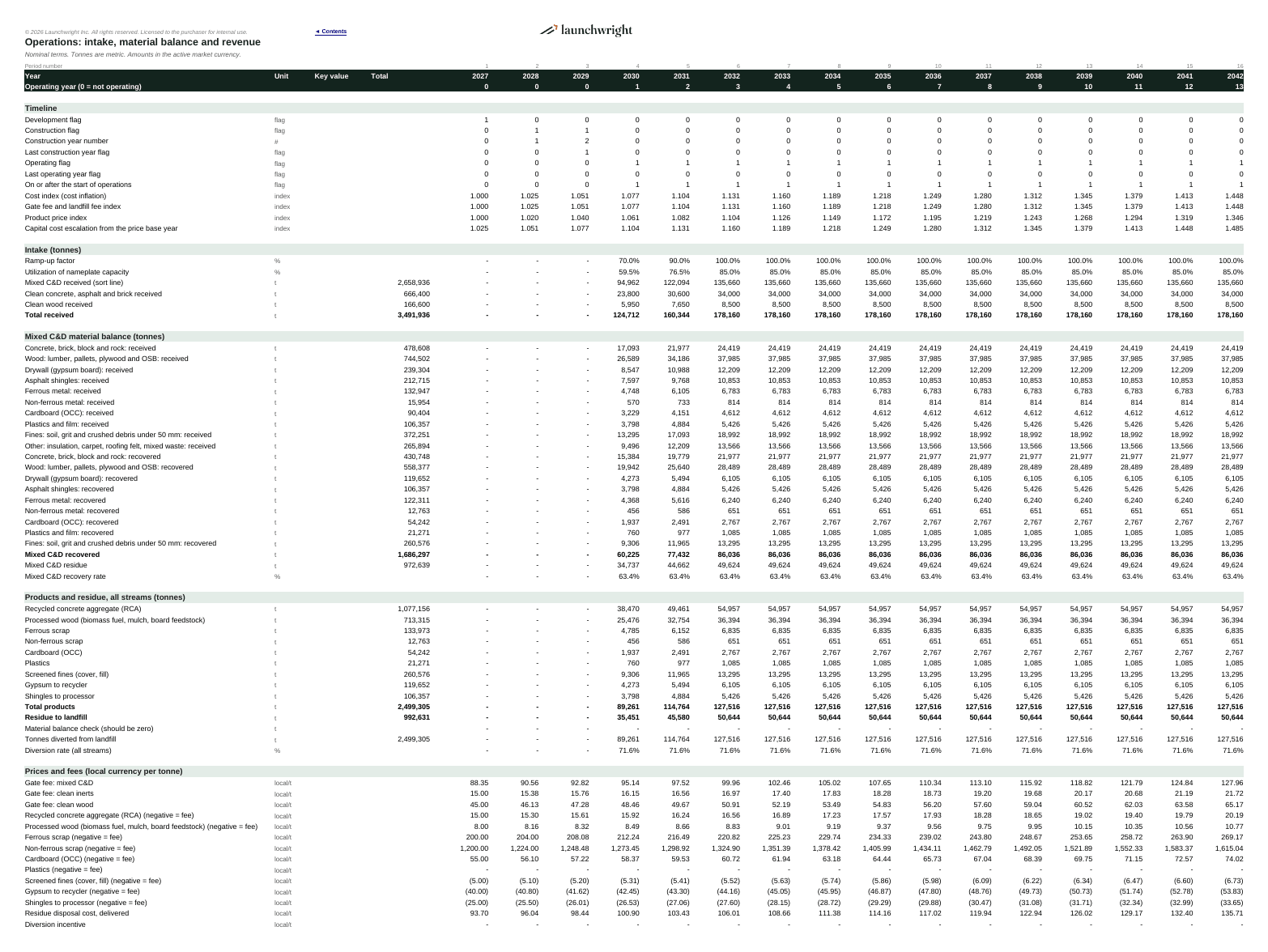
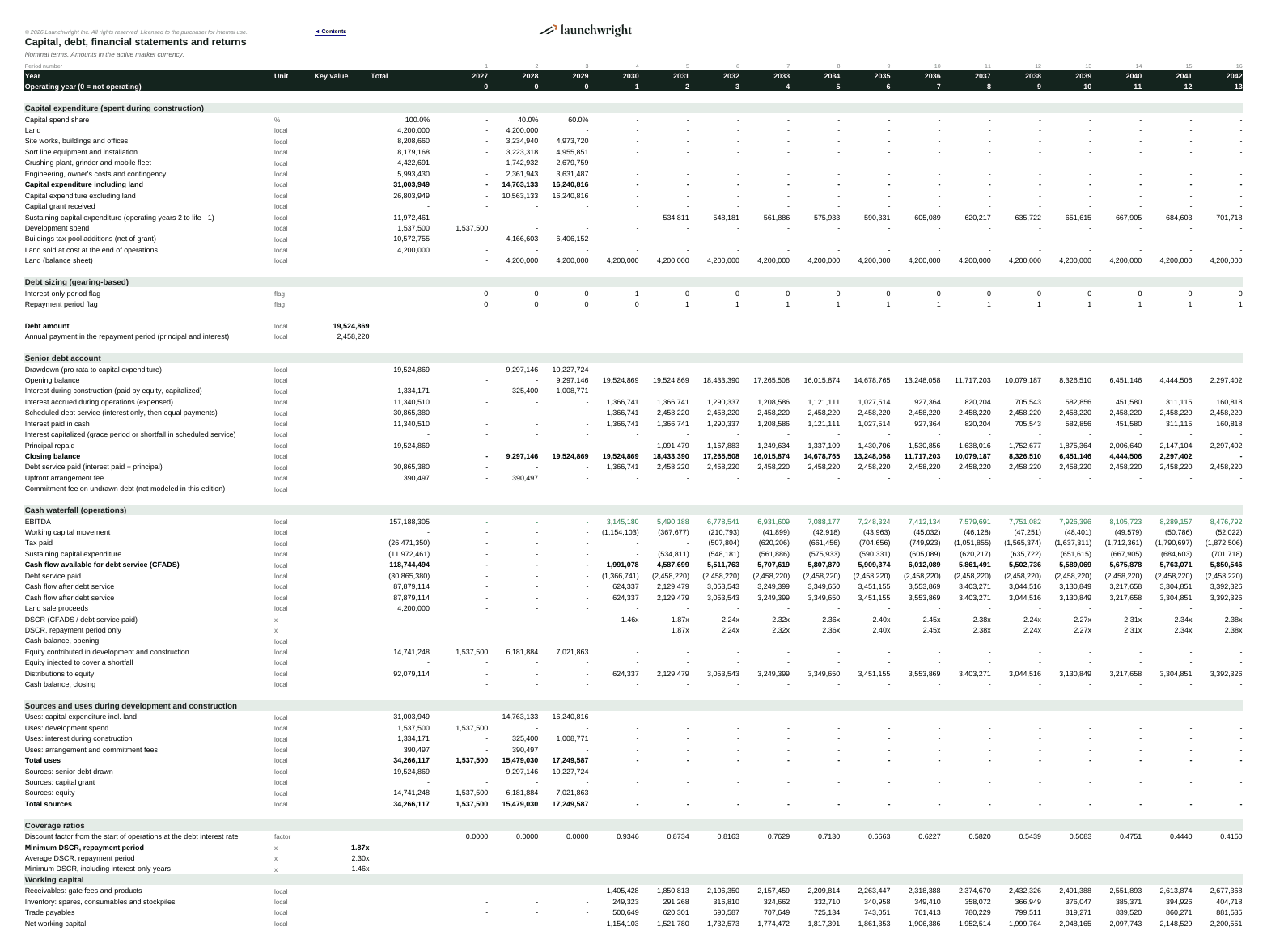
Planning a construction and demolition (C&D) waste recycling plant, or assessing one for investors or lenders? This Excel model turns your plant assumptions into a full financial case, and it is the only C&D-specific model on eFinancialModels.
Why this model
A C&D recycler earns money in two ways: haulers pay a gate fee to tip at the plant, and the plant sells what it recovers. It pays to landfill everything it cannot sell. The project works when the gate fee, less the cost of landfilling residue, covers sorting, staff and capital. This model is built around that spread.
It takes three intake streams: mixed C&D loads sorted on the line, clean concrete, asphalt and brick crushed into recycled aggregate, and clean wood ground into biomass fuel or mulch feedstock. Mixed loads are split into ten materials (concrete and rubble, wood, drywall, shingles, ferrous and non-ferrous metal, cardboard, plastics, fines and other), each recovered at its own rate, and a material balance closes every year.
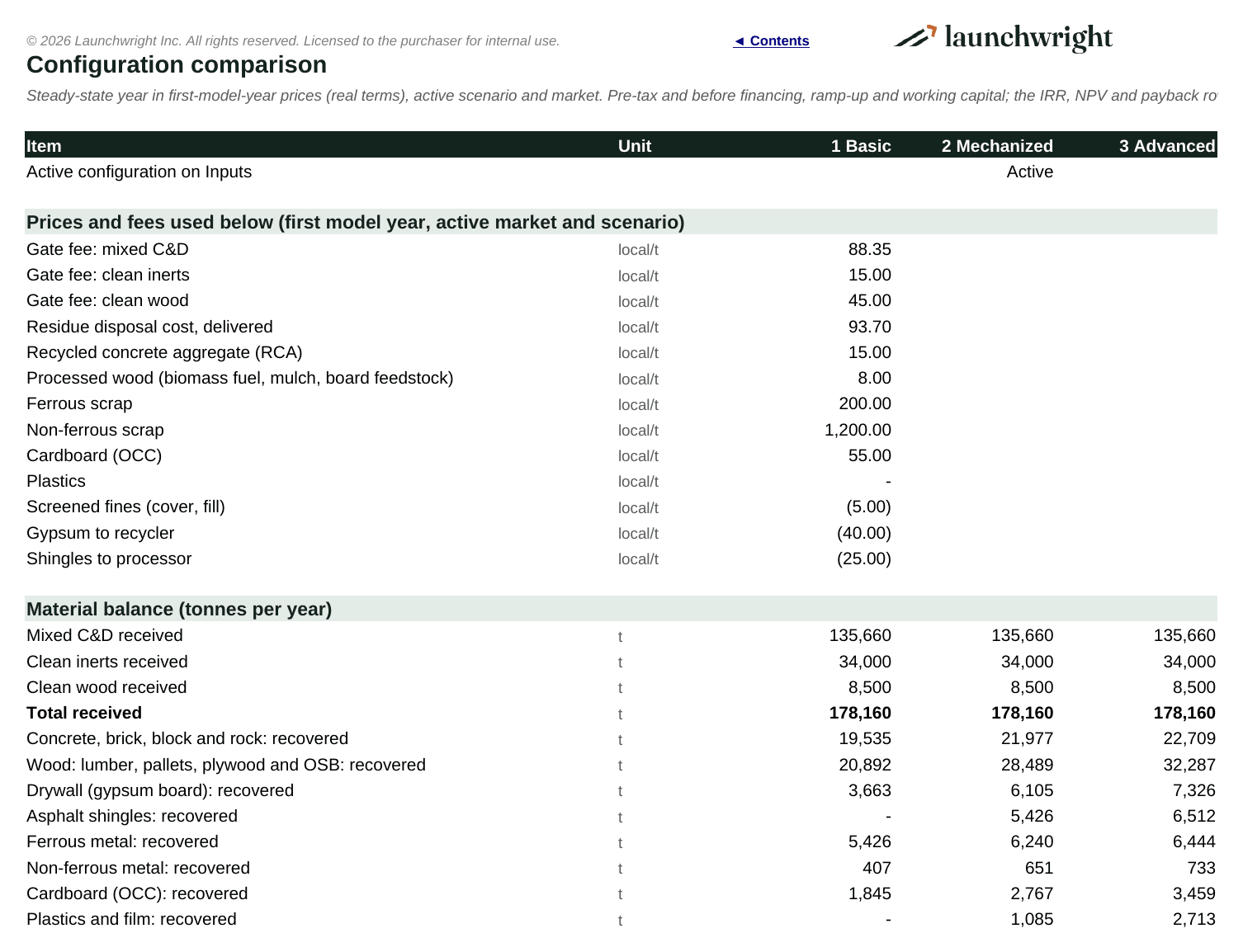
Three plant configurations are compared at the same throughput, each with its own recovery rates, crew, power use, wear parts and itemized capital cost:
- Basic: excavator pre-sort, finger screen, hand-picking line and magnet
- Mechanized mixed C&D MRF: shredder, disc and star screens, air separation, magnets and eddy current separator
- Advanced: the mechanized line plus optical (NIR) sorters and robotic pickers
Three market columns let you switch between a US Northeast preset, a Western Canada preset built on Calgary’s 2026 landfill rates (including the $180 per tonne disposal surcharge on loads with recyclables) and your own market.
How it compares with other listings
- Other waste models on the marketplace cover municipal solid waste concessions, hauling fleets or a generic recycling centre. None models C&D materials, recovery by plant design or residue disposal.
- Gate fees are set as a discount to the competing landfill rate, so you can see how far below the landfill you can price and still earn your return.
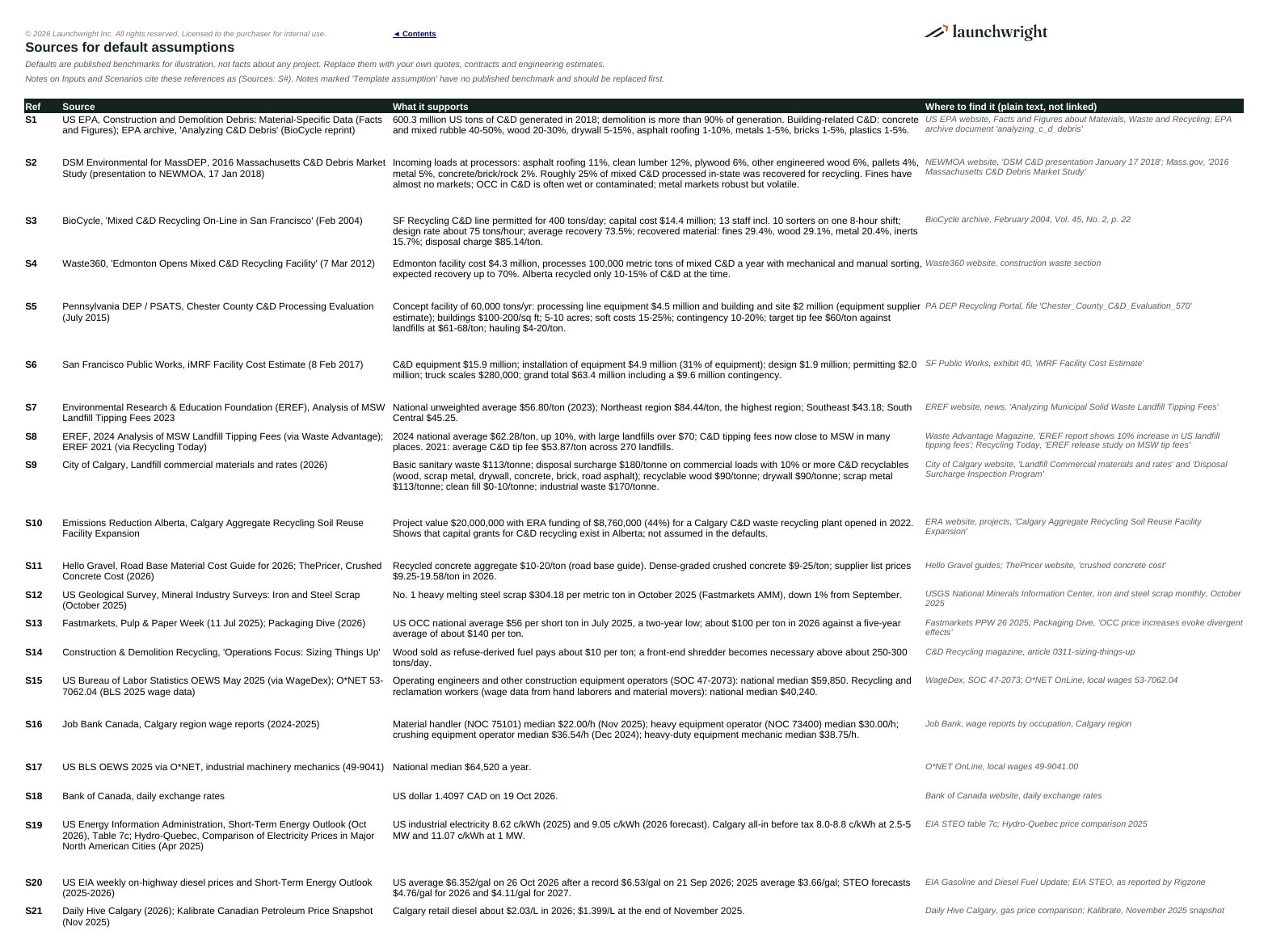
- Defaults are cited to 27 public sources, including EPA C&D composition data, EREF landfill tipping fee surveys, City of Calgary 2026 rates, published C&D plant costs and BLS and Job Bank wages. Unsourced inputs are labelled as template assumptions.
- Fully unlocked .xlsx with no macros, unlike macro-based .xlsb models.
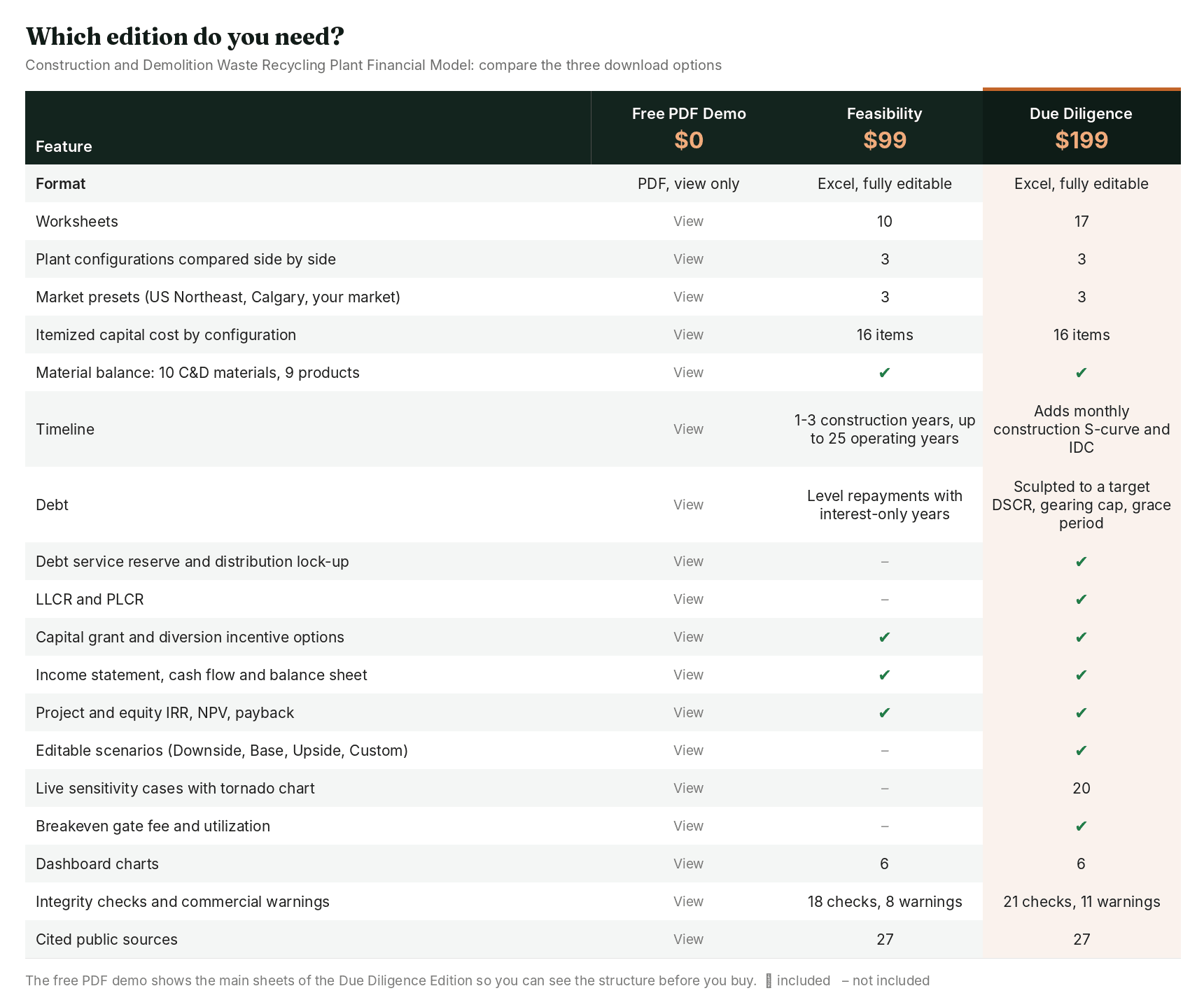
Two editions
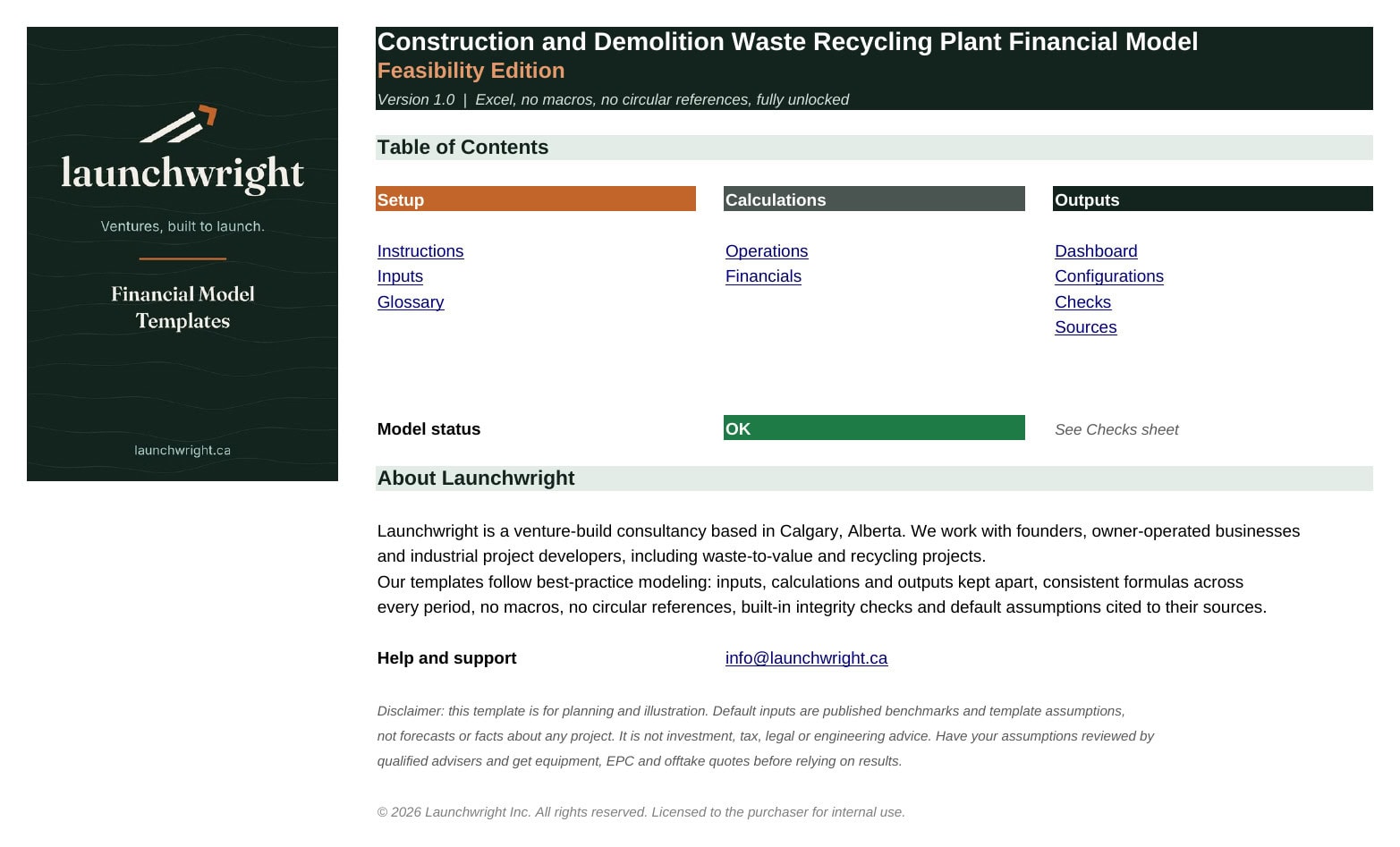
- Feasibility Edition: a fast annual model for early screening. Three configurations, three market columns, three intake streams, the 10-material balance, a 16-line itemized capital cost, a capital grant option, level debt repayments with interest-only years, three integrated statements, project and equity returns, a dashboard with six charts and 18 integrity checks.
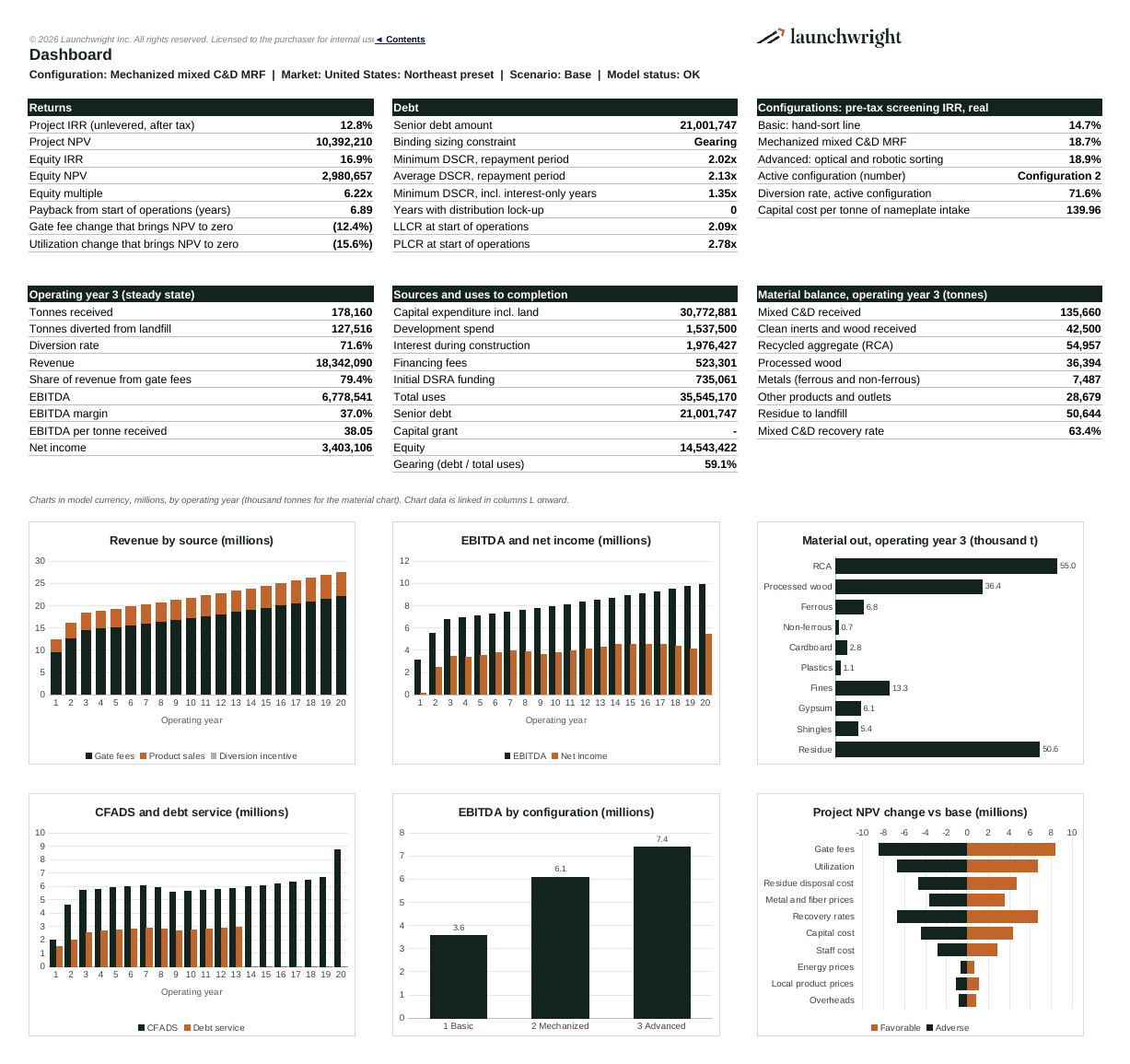
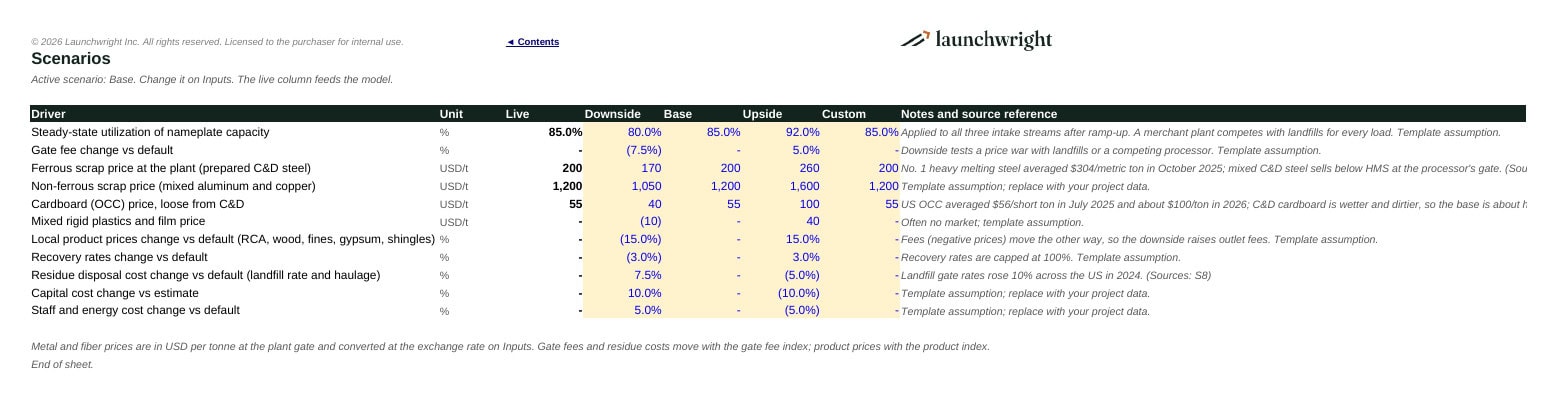
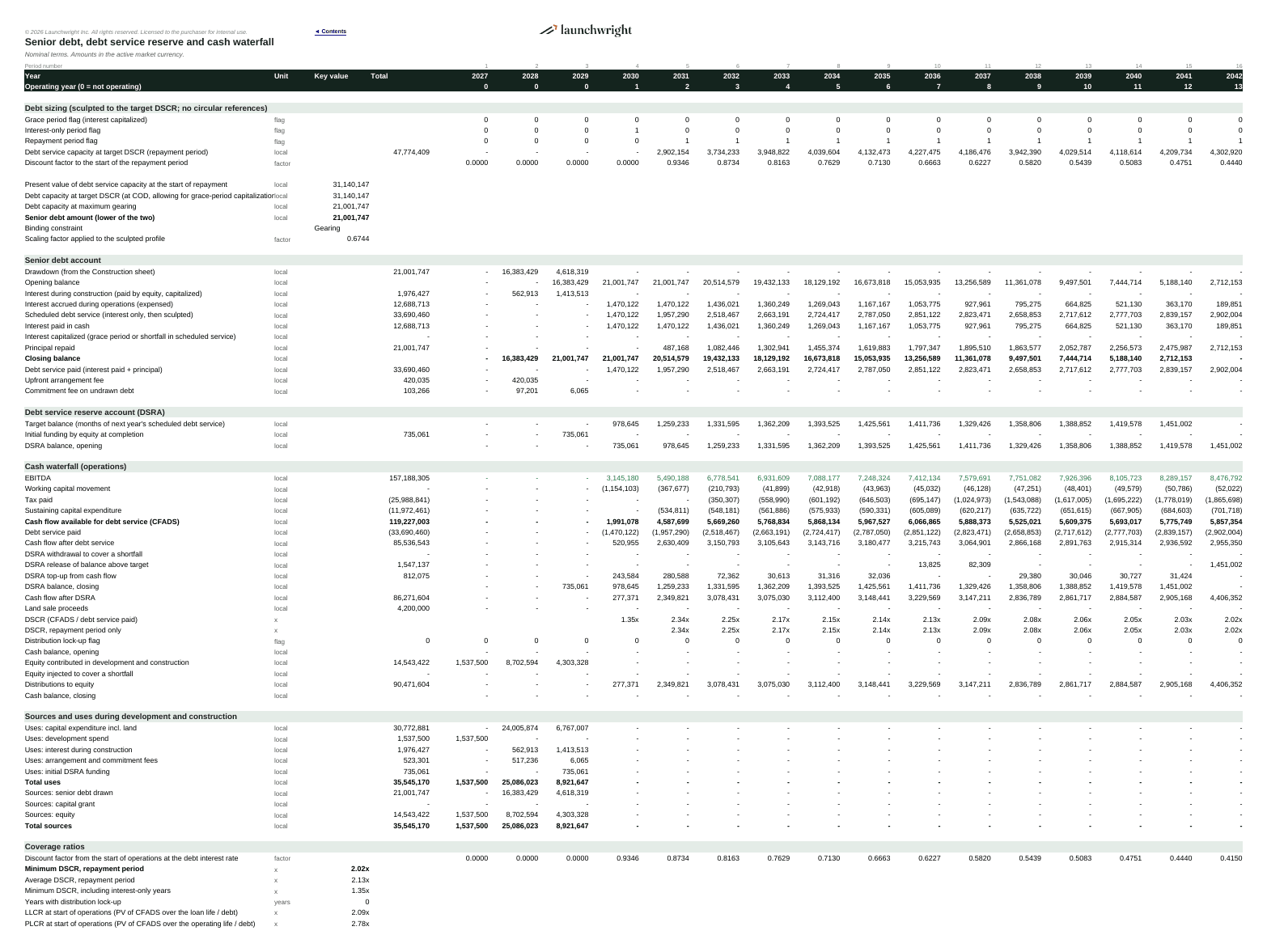
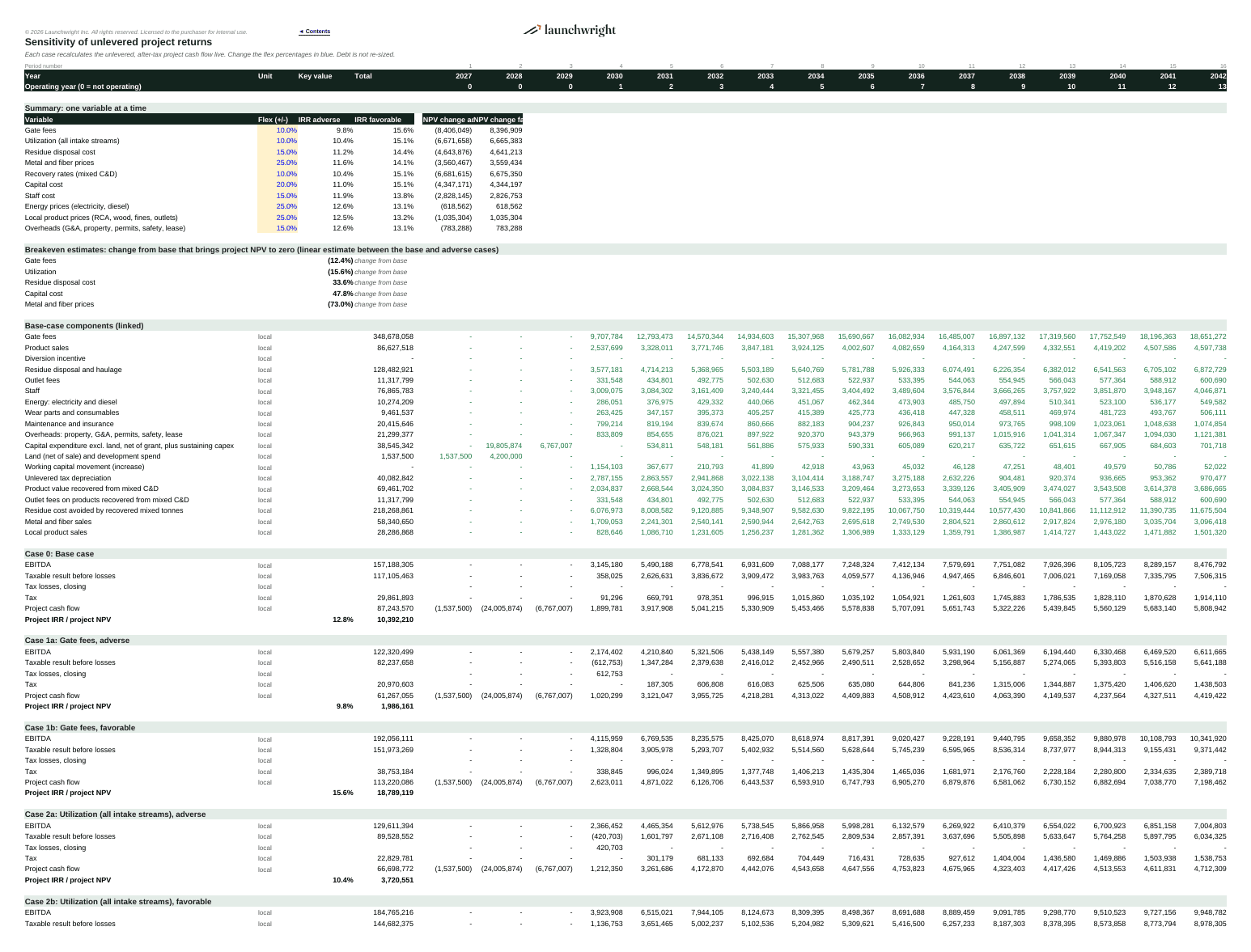
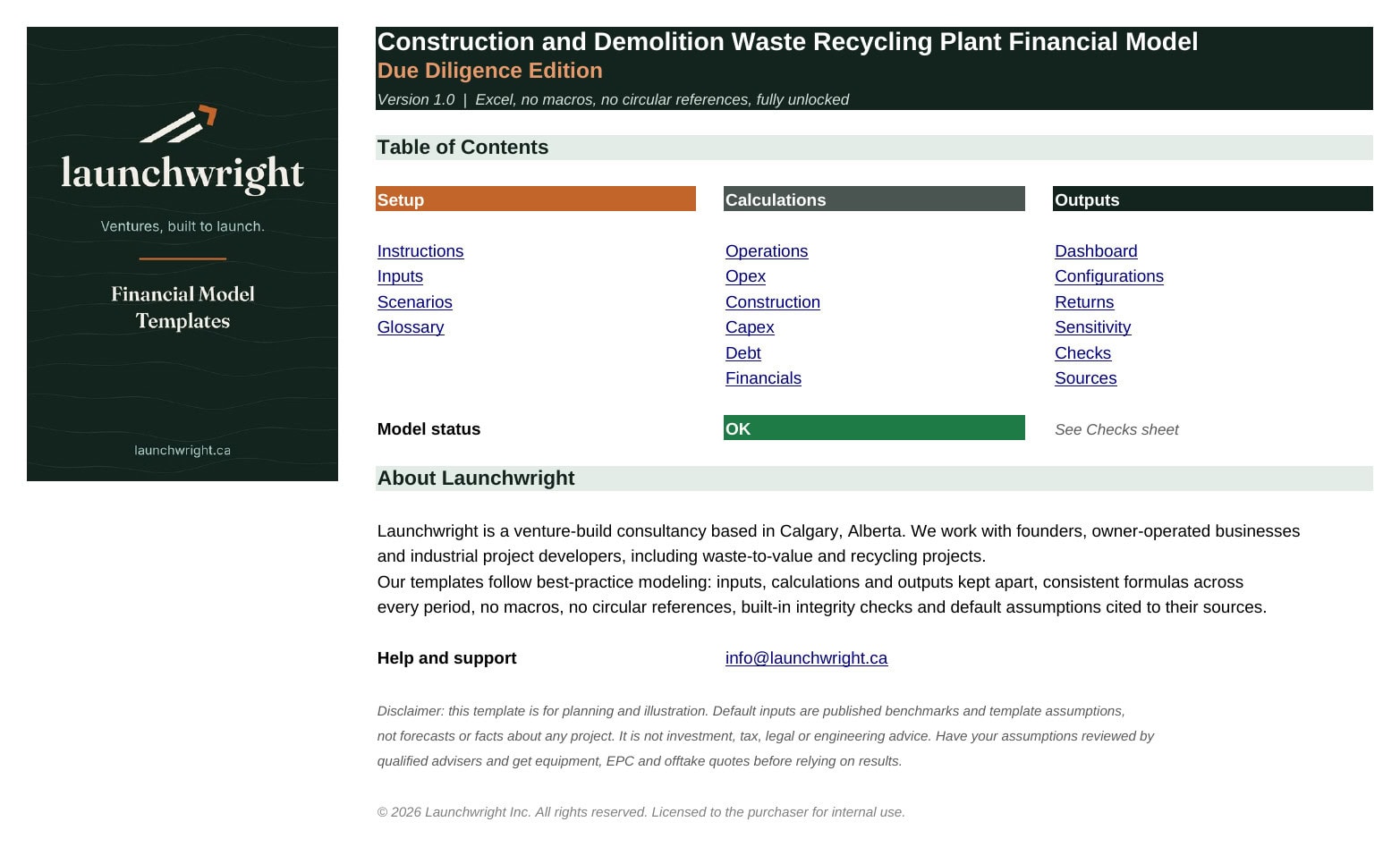
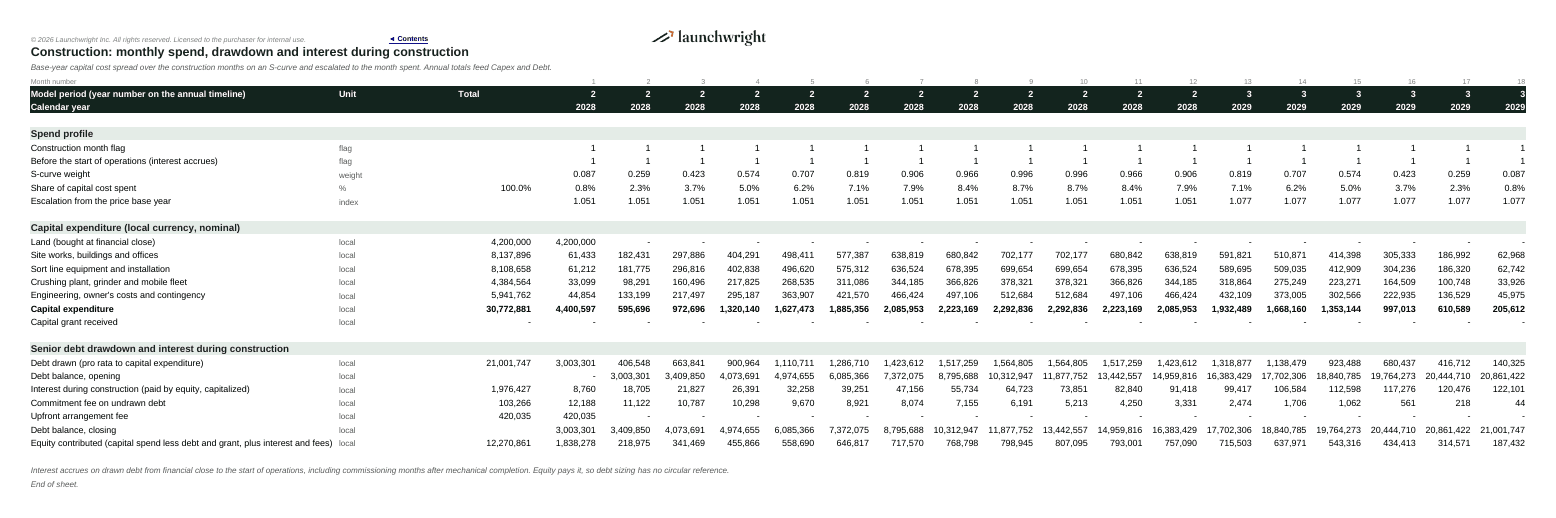
- Due Diligence Edition: everything in the Feasibility Edition, plus monthly construction with an S-curve spend profile, interest during construction and commitment fees; senior debt sized and sculpted to a target DSCR with a gearing cap, grace and interest-only periods; a debt service reserve account; a distribution lock-up test; LLCR and PLCR; four editable scenarios (Downside, Base, Upside, Custom); 20 live sensitivity cases with a tornado chart; breakeven gate fee and utilization; and 21 integrity checks.
Key outputs
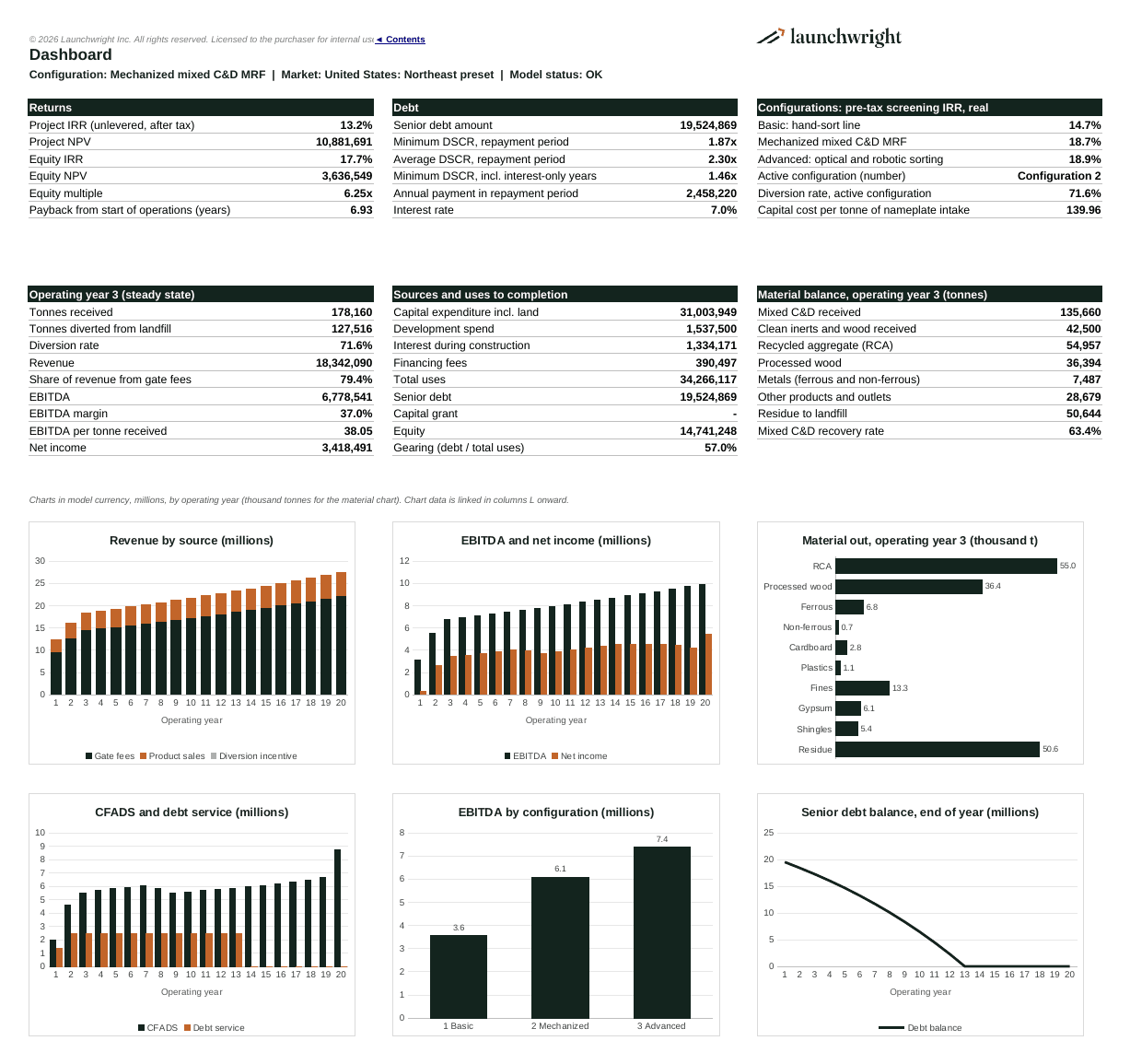
- Project IRR (unlevered, after tax), equity IRR, NPV, equity multiple and payback
- Senior debt amount, minimum and average DSCR; binding sizing constraint, LLCR and PLCR in the Due Diligence Edition
- Tonnes received, diverted and landfilled, diversion rate and recovery rate by material
- Revenue split between gate fees and product sales, EBITDA and operating cost per tonne
- Steady-state comparison of the three configurations: revenue, costs, EBITDA, capital cost per tonne and a pre-tax screening IRR after sustaining capital
- Income statement, cash flow statement and balance sheet for every year, with a balance check
Built to modeling best practice
- Inputs, calculations and outputs on separate sheets; inputs in blue on yellow, formulas in black
- Consistent formulas across every year; start year, inflation and capital cost base year are inputs
- Capital cost itemized by configuration (site, building, scale house, line equipment, crusher, grinder, mobile fleet) and scaled to plant size, plus installation, engineering, owner’s costs and contingency
- Tax depreciation in two pools, straight line or declining balance, losses carried forward, capital grant reduces the depreciable cost
- No macros, no circular references, no hidden or protected sheets, no external links
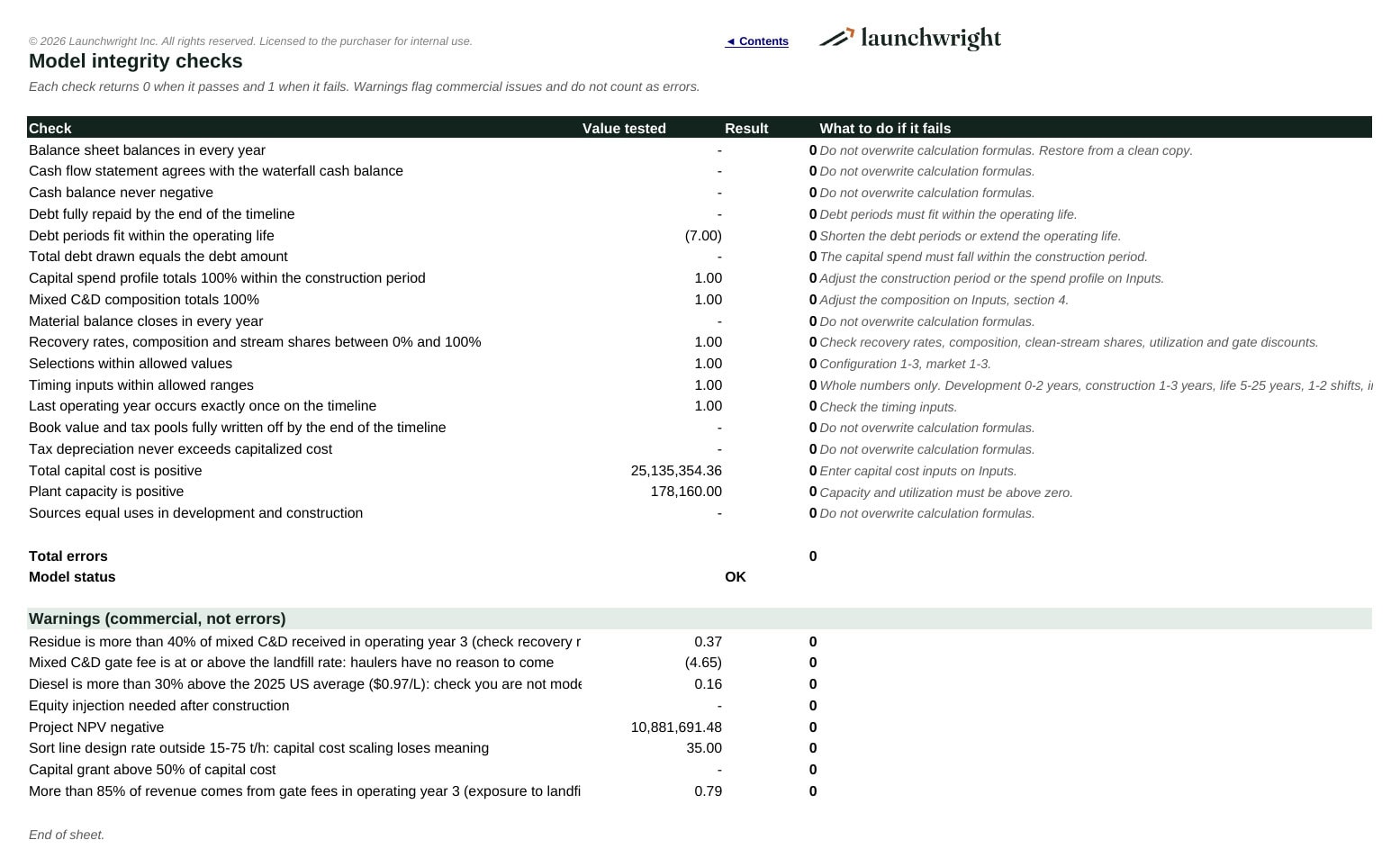
- Checks sheet confirms the balance sheet balances, cash never goes negative, debt is repaid and the material balance closes; warnings flag commercial risks such as a gate fee above the landfill rate
Timeline
Annual periods with up to 2 development years and up to 25 operating years, with a two-year ramp-up. Construction is 1 to 3 years in the Feasibility Edition and 6 to 36 months, modeled monthly, in the Due Diligence Edition.
Default assumptions
Defaults describe a mechanized mixed C&D MRF with a 35 t/h sort line on two shifts (about 160,000 tonnes a year of mixed C&D) plus 40,000 tonnes of clean concrete and 10,000 tonnes of clean wood, in the US Northeast at 85% utilization. At these defaults the Due Diligence Edition shows a project IRR of 12.8% and an equity IRR of 16.9%; gate fees are about four-fifths of revenue. The same plant at US national-average landfill fees falls below a 9% discount rate, which is why the competing landfill rate is the first input to replace. Defaults are benchmarks for illustration, not facts about any project.
What you get
- One Excel workbook (.xlsx) for the edition purchased, built only with functions available since Excel 2010
- A free PDF demo showing the main sheets of the Due Diligence Edition
- Built for Microsoft Excel on Windows or Mac
Download options: compare the editions
Frequently asked questions
Can I use my own landfill rates and gate fees?
Yes. Every market input is editable, and the third market column is for your own market. Enter the landfill rate haulers pay today and the discount you plan to offer.
Does it work outside the US and Canada?
Yes. Enter your own currency, exchange rate, landfill rates, product prices, wages and tax in the third market column.
Can I model a plant that only crushes concrete or only sorts mixed loads?
Yes. Set the capacity of any intake stream to zero and its equipment cost scales to zero. If you drop the sort line, also set its crew per shift to zero on Inputs.
Does it include collection trucks?
No. It models a processing plant that charges haulers a gate fee. Hauling is outside the model.
Can I add a capital grant?
Yes. Enter the grant as a share of capital cost; it is received during construction and reduces the depreciable cost.
Is it unlocked?
Yes. No passwords, no macros, no hidden sheets, every formula visible.
Support
Questions about how the template works are answered by email us via the Contact Author button or through customer support chat.
Similar ProductsOther customers were also interested in...


 eFinancialModels
Electric Vehicle (EV) Charging Station Financial M...
With this comprehensive 5- or 10-year monthly tool, investors can assess the viability of setting up... Read more

Financial Model for Mobile App | Mobile App Busine...
The Mobile App Financial Plan Template in Excel allows you to develop financial projections when lau... Read more

 HenrySheykin
Food Truck Financial Model Excel Template
The Food Truck Financial Model helps entrepreneurs, founders, business owners, consultants, and anal... Read more

Green Hydrogen Production from Wind Energy Financi...
The Green Hydrogen from Wind Financial Model aims to comprehensively forecast a horizon of 40 years ... Read more

Simple Mutual Non-Disclosure Agreement Template
Protect your business secrets with ease using our Simple Mutual Non-Disclosure Agreement Template. S... Read more

Solar Energy Financial Model
The Solar Energy Financial Model Spreadsheet Template in Excel assists you in preparing a sophistica... Read more

 Peter Graf
The Customer-Centric Financial Model for Restauran...
Starting a restaurant without a financial plan is like driving a car blindfolded. You wouldn´t do i... Read more
You must log in to submit a review.