
0 ITEMS

How Do I Write a Startup Business Plan?
A solid business plan is essential for turning a startup idea into a successful company, especially when seeking funding or partners.
- It provides a clear roadmap outlining how your business will grow, make money, and manage risks.
- Key components include market research, financial projections, operational strategy, and an investor value proposition.
- A concise plan typically covers 3 to 5 years with detailed estimates for the first year.
- Good examples show how strong goals, realistic numbers, and steps to execution attract investor confidence.
- Having a well-structured business plan helps founders stay focused, make informed decisions, and communicate their vision effectively.
Keep reading for practical tips on building a startup business plan that delivers results.
What is a Business Plan for a Startup?
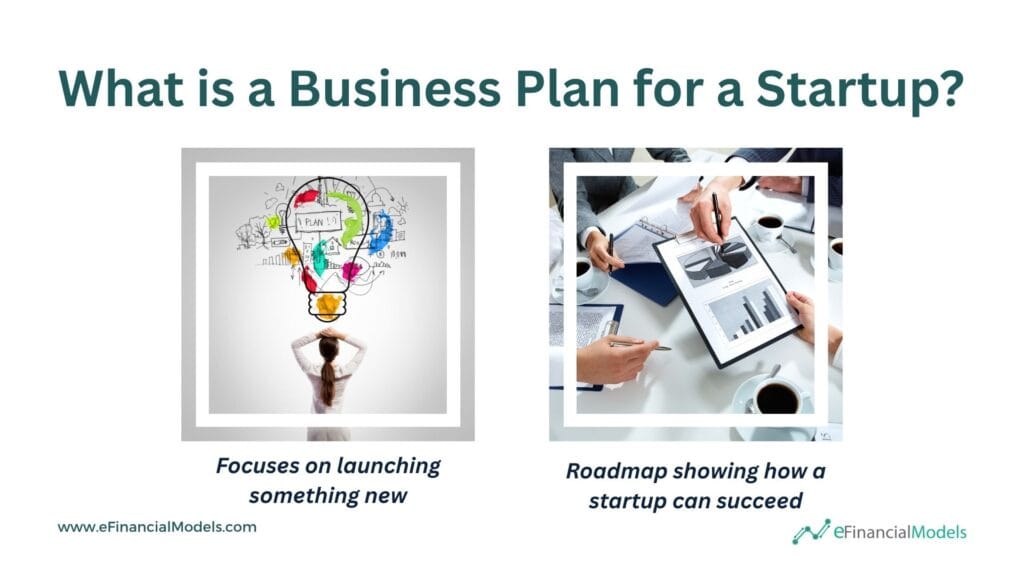
A business plan for a startup is a clear, written roadmap that shows how a new company will succeed. It outlines the business idea, products or services, sales strategy, target market, and expected profits. This plan helps founders attract investors, manage risks, and stay focused on their goals. It also breaks down goals into simple steps, making it easier to measure progress and adjust when needed. A business plan for a startup is unique because it focuses on launching something new from scratch. It highlights early-stage risks, fresh ideas, and untested markets. Unlike plans for existing businesses, it must convince others the concept can work. Every section leans heavily on vision, potential, and flexibility.
How Long Should a Startup Business Plan Be?
A business plan for a startup should be concise enough to cover the essentials but not too brief to lose attention. The startup business plan format typically covers a 3- to 5-year financial projection period. This timeframe provides sufficient room to demonstrate growth potential, milestones, and financial forecasts without straying too far into uncertain territory. The first year should be detailed with monthly or quarterly breakdowns, while years 2 through 5 can be more broad. This range strikes a balance between short-term execution and long-term vision in a solid startup business plan format. Aim for 15 to 25 pages, plus useful appendices. Focus on what matters—problem, solution, market, team, and financials. Investors want clear, direct answers. Don’t overload with fluff or filler. A sharp, simple startup business plan format demonstrates that you respect time and understand your business.
Do I Really Need a Business Plan to Start a Business?
Many new founders wonder if they really need a business plan. The truth is that a clear plan saves time, cuts mistakes, and helps you stay focused. It shows investors you’re serious and gives your ideas structure. Even a simple version helps you think ahead. If you’re unsure where to begin, consider looking at startup business plan examples to guide you.
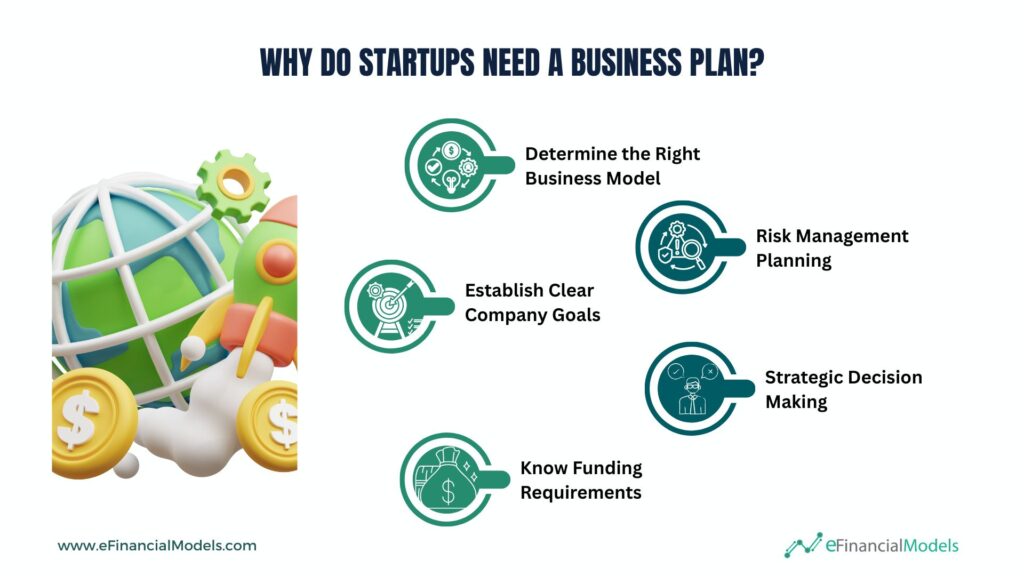
- Determine the Right Business Model: A business plan helps you determine how your company will generate revenue. It forces you to think through your options and choose the best way to serve customers while staying profitable. With a clear business model, you avoid guesswork and start with confidence.
- Establish Clear Company Goals: Without goals, it’s easy to drift. A business plan sets specific targets, so you know what success looks like. It helps you stay focused, track your progress, and adjust as needed to hit each milestone.
- Know the Funding Requirements: You need to determine the amount of money your startup requires to operate. A business plan breaks down costs and shows when you might need extra funds. This helps you talk to investors or banks with clarity and confidence.
- Risk Management Planning: Starting a business involves risk. A risk management plan helps you spot threats early and prepare backup strategies. This lowers the chance of failure and demonstrates to others that you’re serious about protecting your business.
- Strategic Decision Making: The startup business plan format guides smart choices. It organizes your ideas and priorities so you can act quickly but thoughtfully. With a strategy in place, you avoid random decisions and stay on track for growth.
What to Include in a Startup Business Plan Format?
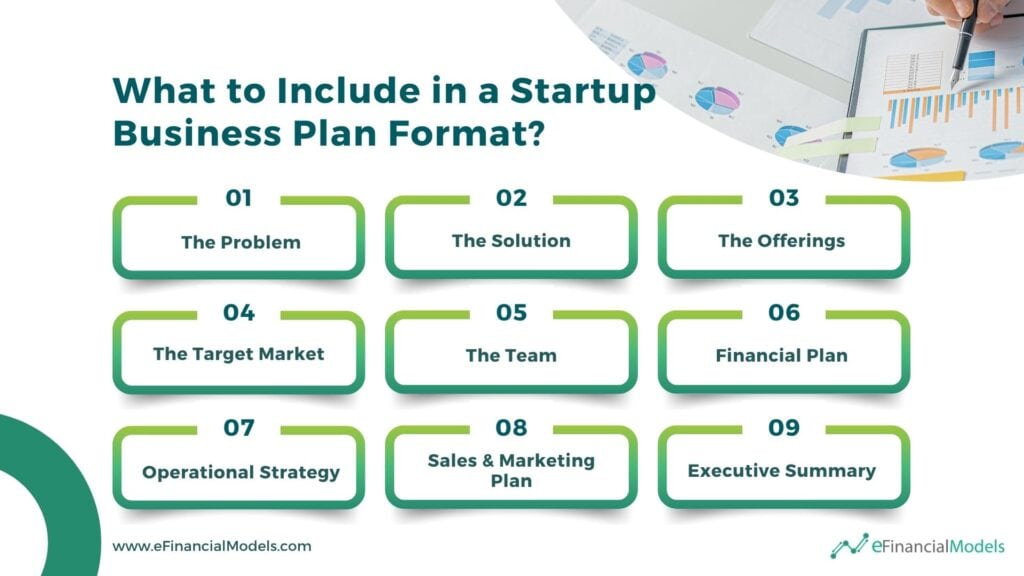
A clear startup business plan format sets the tone for your company’s growth. It explains what your business does, how it makes money, and why it will succeed. Investors and partners rely on it to judge your potential. Without it, your ideas may seem scattered or uncertain. A solid plan shows you’ve thought things through and are ready to act.
- The Problem: Start by explaining the core issue your business solves. Focus on real pain points your target customers face. Make it clear and relatable. A strong problem sets the stage for everything else in the startup business plan format.
- The Solution: Demonstrate how your business addresses the issue. Keep it simple and focused. Describe how your product or service works and why it’s better than others. This part should prove your idea is worth pursuing.
- The Offerings: Detail what you sell. Whether it’s a product, service, or both, explain how it works and what makes it unique. Use plain language so anyone can understand your value. Make the benefit clear.
- The Target Market: Identify who will buy from you. Explain their needs, behaviors, and why they care about your solution. Keep the focus tight—don’t try to serve everyone. This helps sharpen your message and guide decisions.
- The Team: Highlight the people behind your business. Focus on skills and experience that demonstrate your ability to deliver. A great team instills confidence in investors and partners. Even a small team can make a strong impression if its talent is exceptional.
- Financial Plan: Break down how you’ll make money. Show expected revenue, costs, and profits. Use realistic numbers based on research. A simple financial plan demonstrates that your business can be both sustainable and profitable.
- Operational Strategy: Explain how you’ll run the business day to day. Cover suppliers, production, staffing, or tech tools. Keep it practical. This shows you’re ready to operate, not just dream.
- Sales & Marketing Plan: Describe how you’ll reach your target market and increase sales. Cover channels like social media, email, or direct sales. Demonstrate your ability to attract customers and retain them.
- Executive Summary: Summarize your full plan in a few short sentences. Include your idea, market, solution, and business goals. It’s the first thing people read, so make it strong, clear, and compelling.
Steps to Write a Startup Business Plan
Writing a business plan for a startup means turning an idea into a real, structured path forward. It demonstrates how your business will grow, generate revenue, and address a customer’s problem. You’ll define your goals, explain your solution, and prove your concept makes financial sense. This process brings clarity, keeps you focused, and helps others believe in your vision. With the right plan, you move from concept to company with purpose and direction.
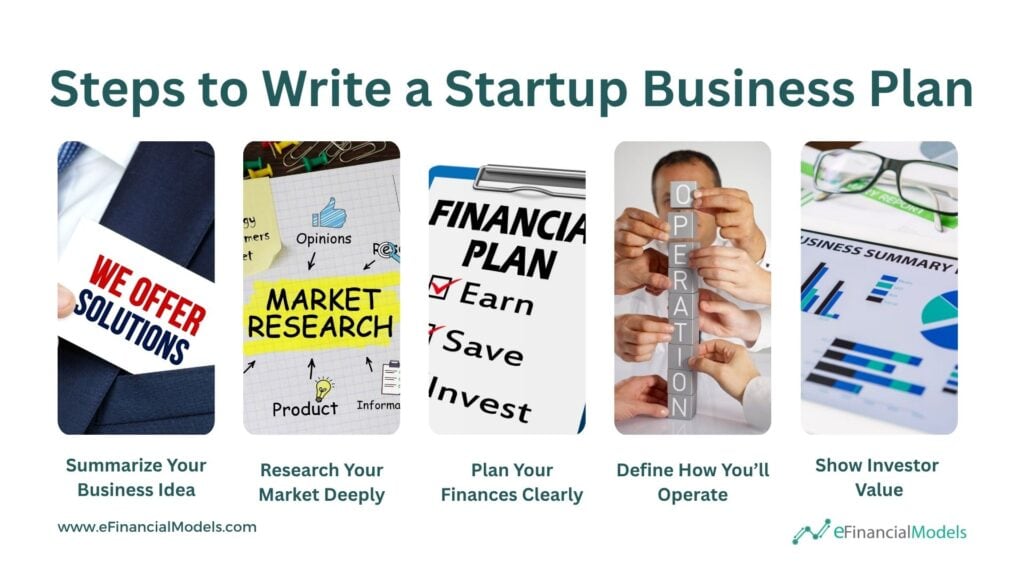
Step 1: Summarize Your Business Idea
Begin with a concise, clear summary of what your startup does, who it helps, and how it achieves this. Stick to the core purpose. This is the first thing people see, so make it clear and exciting. Use simple language to describe your product, service, or innovation. A compelling company description grabs attention by clearly stating the problem your target customers face. It then highlights how your offerings (products or services) effectively solve that problem. This focused message shows the value your company brings, builds trust, and sparks interest. Use simple, direct language to explain what you do, how you help, and why it matters—making it easy for anyone to understand your mission and offerings at a glance.
Step 2: Research Your Market Deeply
Know your audience. Study competitors, trends, and customer needs. Use data to back your claims. A strong business plan for a startup always rests on solid market research. This demonstrates that you understand your space and can identify genuine opportunities. A thorough market analysis pinpoints who your ideal customers are and what they need. It examines market size, trends, and buying habits to inform informed decisions. By understanding your audience, you can tailor your products, pricing, and messaging to meet their needs and wants. This focus helps you stand out, reduce risk, and spot new growth opportunities.
Step 3: Plan Your Finances Clearly
List your costs, prices, sales goals, and funding needs. Make your numbers easy to follow. This builds trust and demonstrates your seriousness. Many successful startup business plan examples have a simple, logical structure with clear financial forecasts. A comprehensive financial plan gives a clear view of your business’s financial health. It sets a time frame for goals (plan horizon), tracks key financial metrics, and shows where money comes from (revenue sources). It also outlines major costs (cost structure), spending on assets (CAPEX plan), and short-term cash needs (net working capital). Together, these elements help guide smart decisions, prepare for growth, and attract investors. The plan should clearly outline the amount of funding the business requires and where it may be sourced. It breaks down the exact amount required for operations, growth, or emergencies. It also lists funding options, such as loans, investors, or internal cash. This helps leaders choose the best path and stay prepared. Furthermore, it should map out future earnings and costs through a clear financial forecast. It helps predict cash flow, profits, and funding needs. It should also outline an exit plan, showing how owners or investors can leave the business with a return. This keeps the business goal-driven and ready for change.
Step 4: Define How You’ll Operate
Explain your day-to-day setup. Who’s on your team? What tools or locations do you need? Demonstrate how your operations align with your goals. A well-structured startup business plan should clearly demonstrate how your systems facilitate smooth growth. In your startup business plan format, the operational plan should outline how you will run the business on a day-to-day basis. Summarize key tasks, team roles, and tools needed to deliver your product or service. Briefly explain how you’ll handle risks like supply issues or staffing gaps. Show how you’ll adapt to problems and stay on track. Finally, mention a clear exit strategy, such as selling the business or merging, to give investors a view of the long-term plan.
Step 5: Show Investor Value
Share what makes your startup unique and scalable. Point to the problem you solve and how fast you can grow. This section should excite backers and make them want in. Focus on results and a strong return on investment. In your startup business plan format, the operational plan should outline how you will run the business on a day-to-day basis. Summarize key tasks, team roles, and tools needed to deliver your product or service. Briefly explain how you’ll handle risks like supply issues or staffing gaps. Show how you’ll adapt to problems and stay on track. Finally, mention a clear exit strategy, such as selling the business or merging, to give investors a view of the long-term plan.




































Some Winning Startup Business Plan Examples
Explore some of our winning startup business plan examples that show how clear goals, smart strategies, and solid numbers come together. Each plan reflects real-world success, offering insight into what works and why. These examples demonstrate how to establish a solid foundation and attract the right investors.
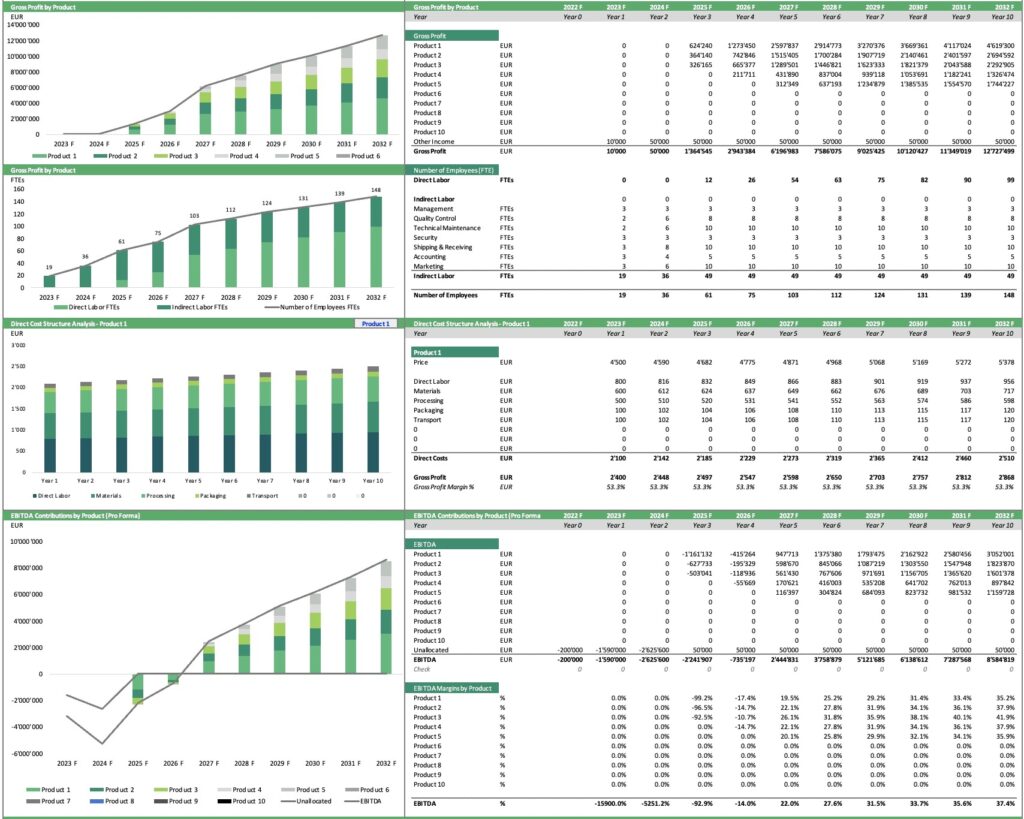
The table above in our Manufacturing Startup Feasibility Model highlights the problem, solution, and offering all in one visual. The problem is visible in the early years—gross profit starts low or negative, signaling high startup costs and inefficient scale. The solution comes into play as the employee count rises and cost structures improve, as evidenced by increasing gross profits across all products. This growth proves our offering—ten distinct products—scales well, becomes profitable, and supports long-term viability. It’s a perfect real-world snapshot to use in startup business plan examples, showcasing how initial losses evolve into solid financial gains through smart planning and execution.
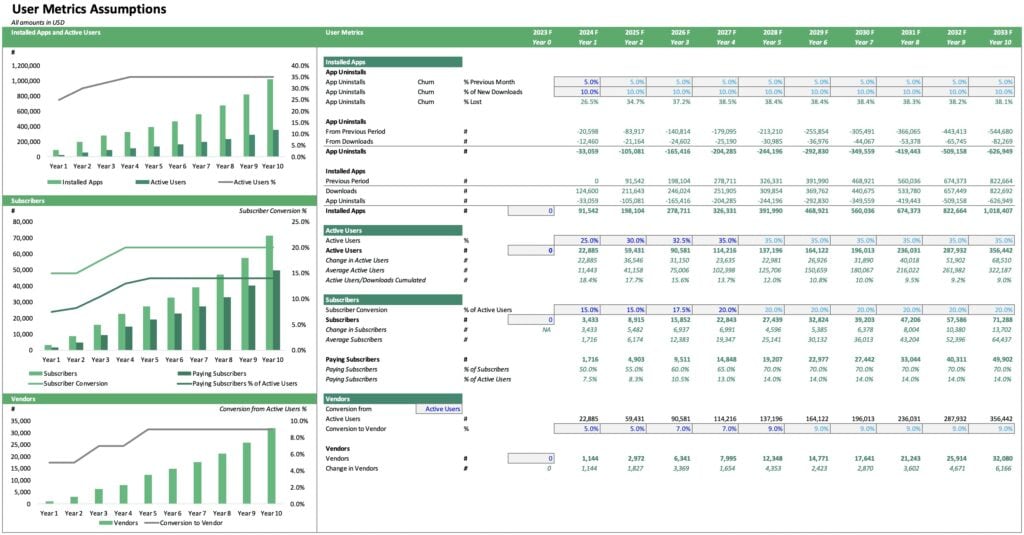
The target market section of our Mobile App Business Plan breaks down real user behavior into installed apps, active users, subscribers, and vendors, offering a comprehensive picture of who uses the app and how. It illustrates how users evolve, convert into paying customers, and even become vendors over 10 years. Charts and churn data pinpoint what drives growth and retention. With subscriber and vendor conversion rates tracked, this model helps define and size the addressable market with precision—ideal for showcasing start-up business plan examples that aim to impress investors with data-driven insights.
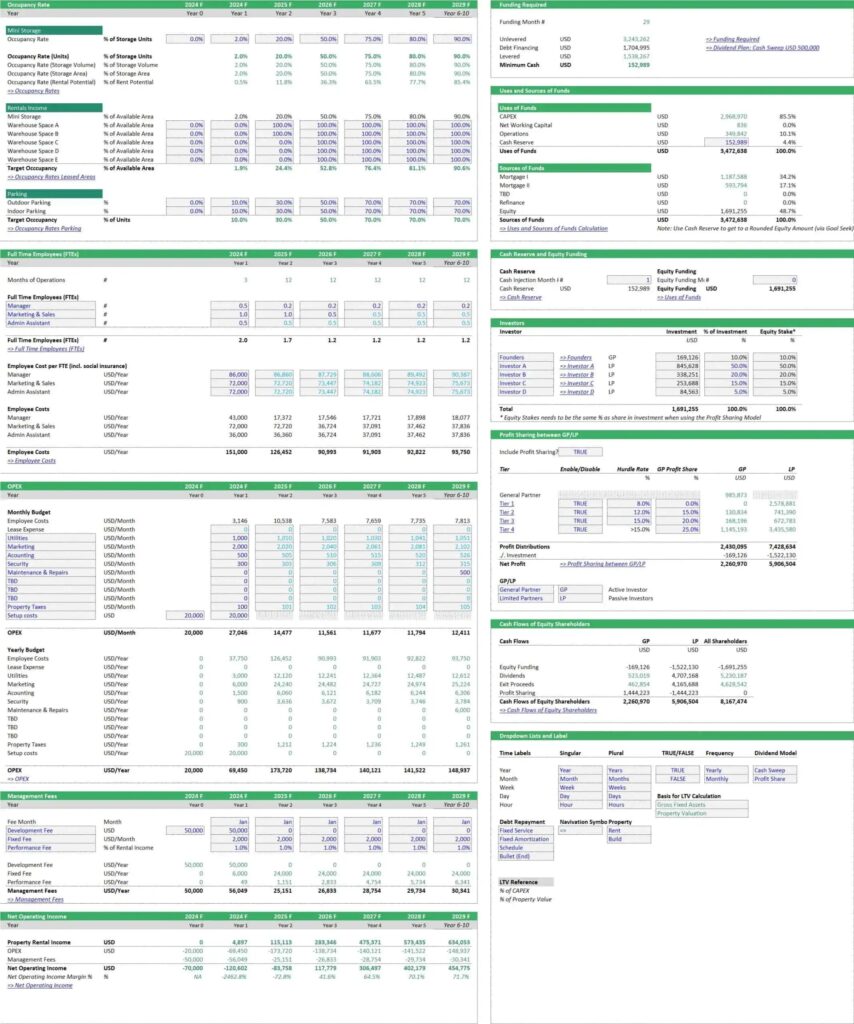
The above financial plan, outlined in our Mini Storage Financial Model Template, presents a 10-year plan horizon, illustrating how the business grows year by year. It tracks key financial metrics, such as occupancy rates, rent potential, and profit margins, providing a clear view of performance. It covers revenue from rental income, operational costs, staff expenses, capital expenditure (CAPEX) for warehouses, and working capital needs, such as fit-outs and repairs. Funding options include equity, debt, and owner investment, with detailed cash flow distributions to investors. This setup provides a strong blueprint, as seen in many well-built startup business plan examples, proving the model’s practical value.
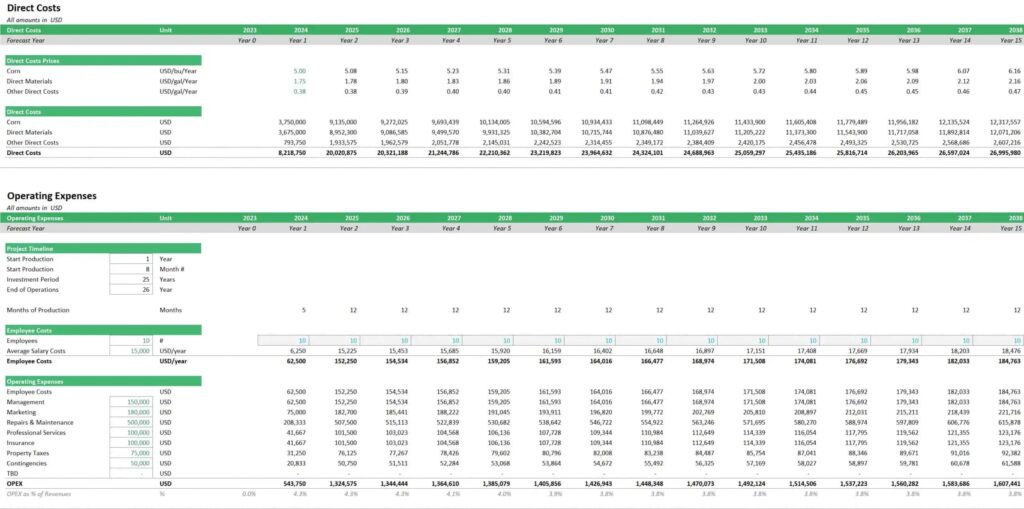
The direct cost section of our Business Plan for Ethanol Manufacturing Plant outlines a clear operational strategy—from raw materials such as corn and direct inputs to fixed employee costs and annual production timelines. The detailed tracking of production start, investment horizon, and monthly run rates reflects a strong, structured approach to scaling operations. The team structure, with ten core employees and rising salary levels, highlights our lean yet capable workforce. This setup ensures control over costs while expanding capacity—ideal for demonstrating how execution aligns with cost efficiency in solid startup business plan examples focused on sustainable growth.
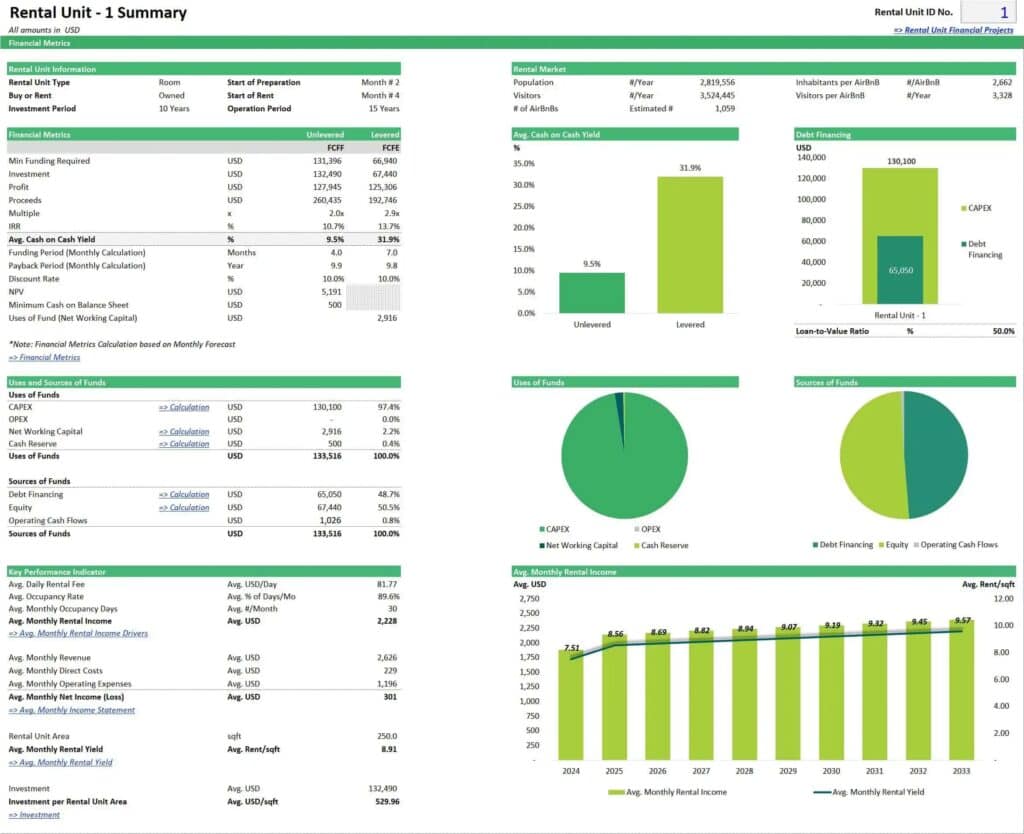
The rental unit summary of our Airbnb Rental Units Business Plan highlights a sharp sales and marketing strategy through key data points, including average daily rental rate, occupancy rate, and monthly rental yield. It proves how strong market positioning and pricing drive consistent income. Metrics such as visitors per Airbnb and rental market population reveal our clear target focus, while stable growth in average monthly rental income shows effective promotions and demand capture. The lean capital setup and high ROI underscore smart management decisions, making this one of the most practical startup business plan examples for short-term rental ventures.
Secure Startup Success with a Solid Financial Model
To write a business plan for a startup, begin by clearly stating the problem your business solves and identifying your target customers. Dive deep into market research to understand trends, customer needs, and competitors. Lay out your financial goals with realistic forecasts on revenue, costs, and funding needs. Describe your operational structure, outlining how your team will deliver the product or service efficiently. Finally, highlight the value your startup offers to investors—this includes growth potential, return on investment, and your unique edge. Follow these steps to craft a plan that inspires action and builds confidence.
Secure your startup’s future with a clear, smart financial model. It shows how you plan to generate revenue, manage expenses, and expand. Investors want proof that your idea can work—financials provide that proof. A solid model helps you set targets, track progress, and adjust quickly. It’s not just numbers—it’s your roadmap to success. Build it right, and your business stands strong from day one.
Start building your financial model today and lay the foundation for your startup’s success!



















































You might also like:
- 10 Main Elements of a Business Plan
- 5 Practical Tips to Help Raise Funds For Startups
- How to Make a Startup Financial Plan for Fundraising?
- Understanding the Levelized Cost of Energy Formula
- Financial Projections Templates – The Easy Way
- How to Write a Business Plan Step-by-Step
- Business Plan Models – Using Business Models as Examples
- Startup Model Templates in Excel that can help your Business Grow
- 10 Ideas to Increase Average Revenue Per User
- Calculating Revenue Growth Rate: A Key Metric for Business Success
- Commercial Real Estate Valuation Methods: Helping Investors in Taking Informed Decisions
- Steps to Securing Series C Financing
- Financial Model Templates Easy to Use
- How to Build a Capitalization Table
- How Contribution Margin Analysis Can Drive Your Business to Financial Success
- Monthly Budget Template (with Financial Statements)
- Financial Planning for Small Business Owners – Taking an SBA Loan
- Top 10 Mistakes in DCF Valuation Models
- Understanding the Debt Service Coverage Ratio: An Essential Metric for Financial Analysis