
0 ITEMS

Which Revenue Type Has the Highest Quality?

One critical metric that stands out when evaluating the financial strength of the world’s largest tech companies—Apple, Amazon, Google (Alphabet), Meta (Facebook), and Microsoft—is the quality of earnings. While all five generate billions in revenue, the composition and predictability of their income streams vary significantly. Apple relies heavily on hardware sales, Amazon balances e-commerce with cloud services, Google and Meta thrive on advertising, and Microsoft enjoys a diversified mix of software, cloud, and enterprise services. Microsoft has the highest revenue quality due to its dominance in subscription-based models like Microsoft 365 and Azure. Unlike cyclical hardware sales or ad-driven income fluctuating with market conditions, Microsoft’s revenue benefits from long-term contracts and high customer retention.
But what defines high-quality revenue, and which type consistently offers the most financial stability? Let’s dive into the different revenue types and determine the highest quality.
How to Identify a Strong Type of Revenue
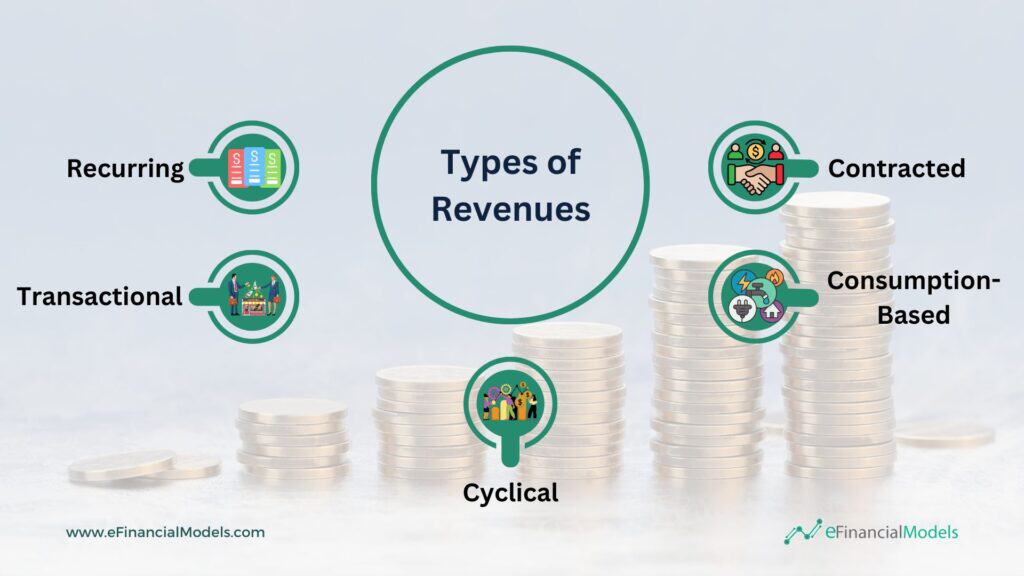
Businesses generate revenue through various models, each with its characteristics and risk profile. The main types include:
- Recurring Revenue: A business earns recurring revenue by charging customers regularly, ensuring a steady income stream. Some examples are subscription-based income, such as SaaS (Software-as-a-Service) models, membership programs, and insurance policies.
- Transactional Revenue: A company generates transactional revenue by selling products or services in one-time purchases. These include one-time sales of products or services, such as retail and consulting fees.
- Contracted Revenue: A business secures contracted revenue through binding agreements guaranteeing future payments—revenue generated through long-term agreements, such as government contracts or B2B service retainers.
- Consumption-Based Revenue: A company earns consumption-based revenue by charging customers based on actual usage. A good example is usage-based pricing, where customers pay for their consumption (e.g., cloud computing or utilities).
- Cyclical Revenue: A business experiences cyclical revenue when sales fluctuate based on seasonal or economic patterns, such as tourism, construction, and retail holiday sales.
Each revenue type has advantages and drawbacks, making it essential to analyze them through financial modeling.
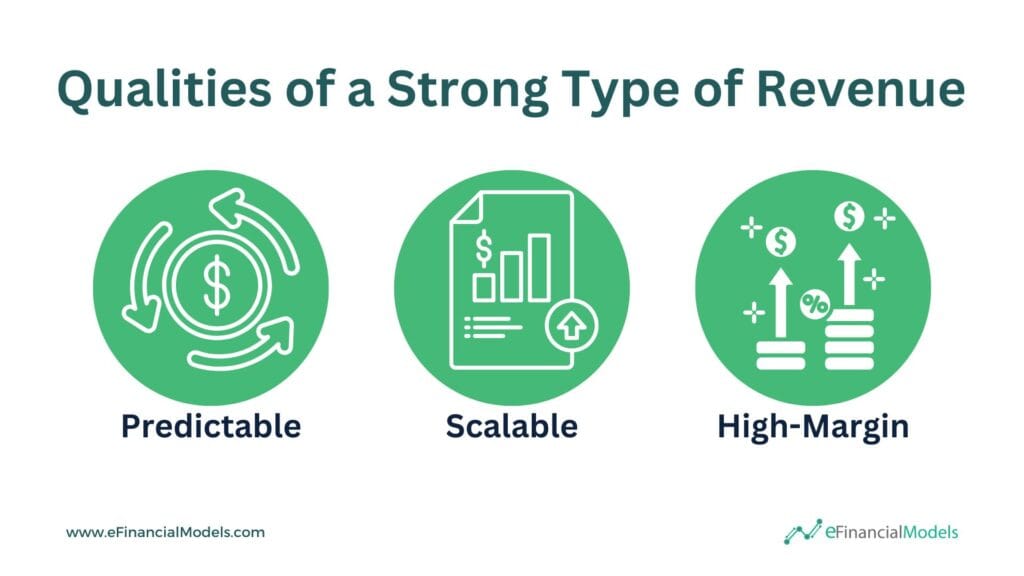
But what exactly is a high-quality revenue type? A high-quality revenue type is predictable, scalable, and high-margin.
- Predictable revenue ensures steady cash flow. Customers make regular payments, reducing uncertainty. Businesses can plan expenses and growth with confidence. The key is keeping customers engaged and reducing churn. Predictable revenue is seen in streaming services like Netflix. Subscribers pay a fixed fee every month, ensuring steady cash flow. The company knows how much revenue to expect, making budgeting easier. As long as customers stay engaged, income remains reliable.
- Scalable revenue grows without major cost increases. It expands income without relying on constant new customer acquisition. Scalable revenue is clear in Amazon Prime. A subscriber customer may also buy more products, use additional services, or renew yearly. The business can grow revenue without spending much to acquire new users. Each customer has multiple chances to generate more income.
- High-margin revenue maximizes profit per sale. The price far exceeds the cost to deliver. Strong pricing power and low expenses make this type of revenue more valuable. High-margin revenue is common in software companies like Microsoft 365. The cost to provide a digital subscription is low, but customers pay a premium. Since software requires no inventory and minimal delivery costs, most revenue turns into profit.




































Unveiling the Quality of Earnings by Comparing Revenue Types
Understanding a company’s true financial health requires more than just looking at revenue figures. The quality of earnings depends on how that revenue is generated. A business with a high quality of earnings maintains consistent cash flow and long-term value. Investors and decision-makers can assess financial strength, sustainability, and risk by comparing revenue types.
Recurring Revenue
Recurring revenue is a business’s steady income at regular intervals, such as monthly or annually. It comes from subscriptions, service contracts, or repeat purchases. Unlike one-time sales, it provides financial stability and predictability. Businesses with strong recurring revenue models often grow faster and sustain long-term success because of high quality of earnings.
Recurring revenue is highly predictable because customers commit to ongoing payments. Subscription models, memberships, and service contracts create a steady income stream. The quality of earnings from this type of revenue is scalable because businesses can grow without significantly increasing costs. Unlike traditional sales, there’s no need for constant customer acquisition. This leads to high margins or strong profitability over time.

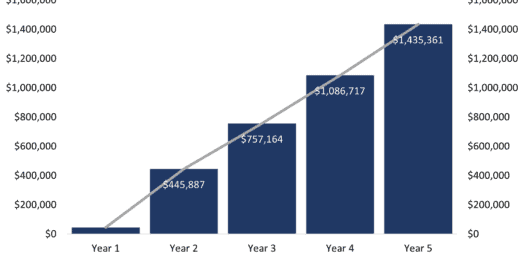
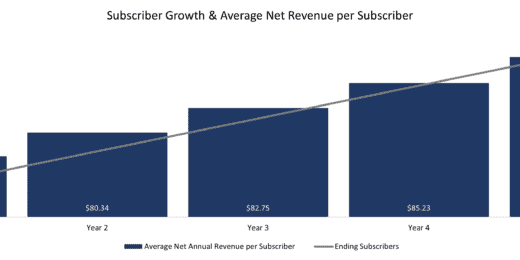
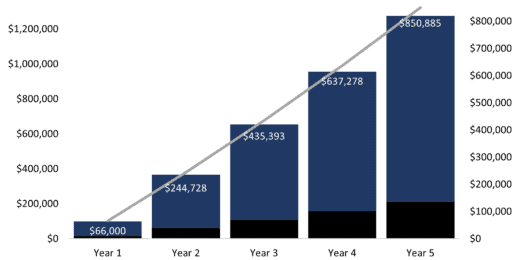
The example recurring revenue table above is from a SaaS B2C Financial Model. It highlights strong predictability, scalability, and high margins. Predictability comes from the clear month-over-month growth, ensuring stable revenue streams. Scalability is evident as new subscribers consistently increase, driving higher Annual Recurring Revenue (ARR) without proportional cost jumps. The high-margin nature is reinforced by SaaS models, where additional subscribers add revenue with minimal extra expenses, maximizing profitability.
Recurring revenue increases business valuation by providing stable, predictable cash flow. Investors value consistency, as it reduces risk and ensures long-term profitability. Businesses with high recurring revenue often trade higher valuation multiples because future earnings are more certain.
Transactional Revenue
Transactional revenue comes from one-time sales of goods or services. Each purchase is a separate event, with no ongoing commitment from the customer. Businesses earn revenue per transaction, making income dependent on sales volume. Examples include retail purchases, consulting fees, and single-use software licenses.
Transactional revenue is less predictable because it depends on customer demand and market trends. Unlike subscriptions, sales can fluctuate based on seasonality, competition, and economic conditions. It is scalable if businesses can sell more without increasing costs at the same rate. Furthermore, they can be of high-margin if costs stay low.
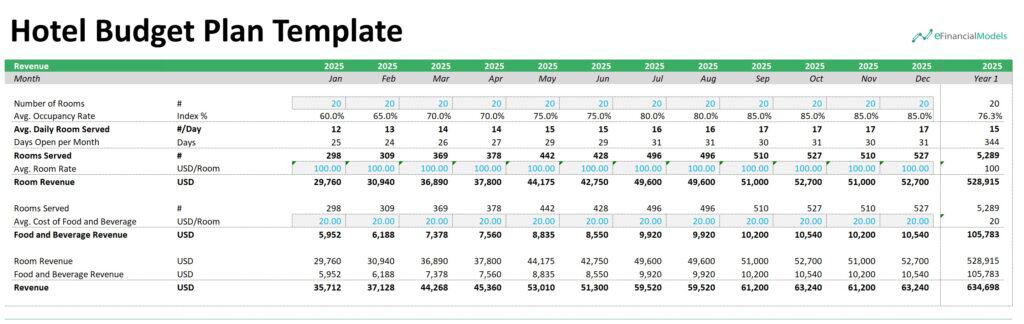
The transactional revenue shown above is from a Hotel Budget Plan Template. It is less predictable due to fluctuating occupancy rates and seasonal demand. It is scalable because adding more rooms or optimizing pricing can boost revenue. However, margins remain moderate since food and beverage costs eat into profits, and room rates stay fixed. This model relies on steady bookings and efficient cost management to maximize returns.
Transactional revenue can lower business valuation due to its unpredictability. Without steady income, future earnings become harder to forecast. Investors see higher risk, which can reduce valuation multiples.
Contracted Revenue
Contracted revenue is the income a business is guaranteed to receive based on signed agreements with customers. These contracts outline pricing, terms, and duration, ensuring future cash flow. Unlike one-time sales, this revenue is locked in for a set period, reducing uncertainty.
Contracted revenue is has a highly predictable quality of earnings because it is based on legally binding agreements. Businesses can confidently forecast future earnings since customers commit to payments over time. It is scalable if the business can acquire new contracts without significantly increasing costs. Growth depends on acquiring new customers while retaining existing ones. Contracted revenue can be high-margin, especially in businesses with low operational costs. However, margin levels depend on pricing, customer acquisition, and service expenses.
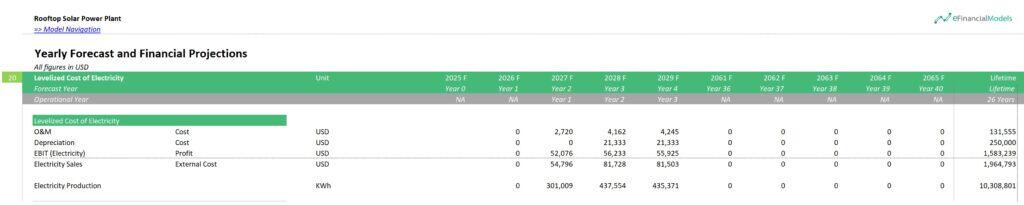
Electricity sales in the table above represent revenue from contracted Power Purchase Agreements (PPA) from a Rooftop Solar Power Plant Template. It suggests predictable revenue due to fixed electricity sales figures across the years, making cash flow easier to forecast. However, scalability is limited since electricity production and sales do not show strong year-over-year growth, indicating constraints in expansion. The high EBIT figures suggest a high-margin business, as operating costs remain low while revenue stays stable.
Contracted revenue boosts business valuation by ensuring future income. Investors favor predictable cash flow, reducing risk and increasing confidence. Long-term contracts create stability, making earnings easier to forecast. This reliability often leads to higher valuation multiples.
Consumption-Based Revenue
Consumption-based revenue comes from charging customers based on their actual product or service usage. Instead of fixed fees, businesses earn revenue when customers consume more. This model is common in cloud computing, utilities, and pay-per-use services. It aligns costs with demand, making it flexible for both businesses and customers.
Consumption-based revenue has less predictable quality of earnings than fixed subscription models. Demand can fluctuate due to seasonality, customer behavior, or economic shifts. As more customers use the service, revenue naturally grows. Businesses can expand globally without needing to raise prices or add fixed costs. The profit margin depends on the business model.
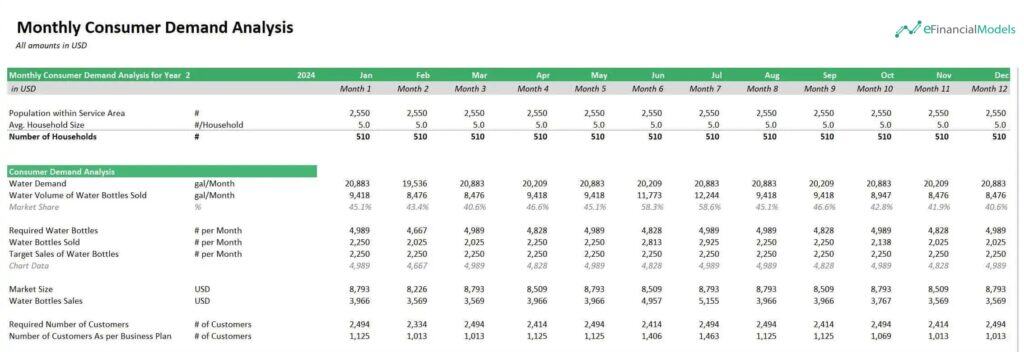
Above is an example of consumption-based revenue from a Water Refilling Station Business Financial Model. It shows low predictability because water demand fluctuates monthly, making revenue uncertain. However, it is highly scalable since serving more households requires minimal extra costs. The profit margin is likely low because water refilling stations operate on thin margins, with pricing pressure and fixed costs like rent and utilities limiting profitability.
Consumption-based revenue adds flexibility but can create valuation uncertainty. Earnings depend on customer usage, making cash flow less predictable. Investors may see higher risk if demand fluctuates. However, scalable models with strong retention can drive growth and increase valuation.
Cyclical Revenue
Cyclical revenue comes from products or services that see demand rise and fall with economic cycles or seasonal trends. Tourism, real estate, and luxury goods businesses often experience these shifts—revenue surges in strong economies but declines during downturns. Companies must plan for fluctuations to stay profitable.
Cyclical revenue follows economic patterns, making it somewhat predictable. Businesses analyze past cycles to forecast trends, but external factors like recessions or market shifts add uncertainty. While timing exact peaks and downturns is hard, companies can anticipate general patterns and adjust strategies. Cyclical revenue is scalable, but growth depends on market conditions. During strong economic periods, companies can expand quickly by increasing production or services. However, scaling is risky because demand may drop when the cycle turns. It can be high-margin in peak periods but inconsistent over time.
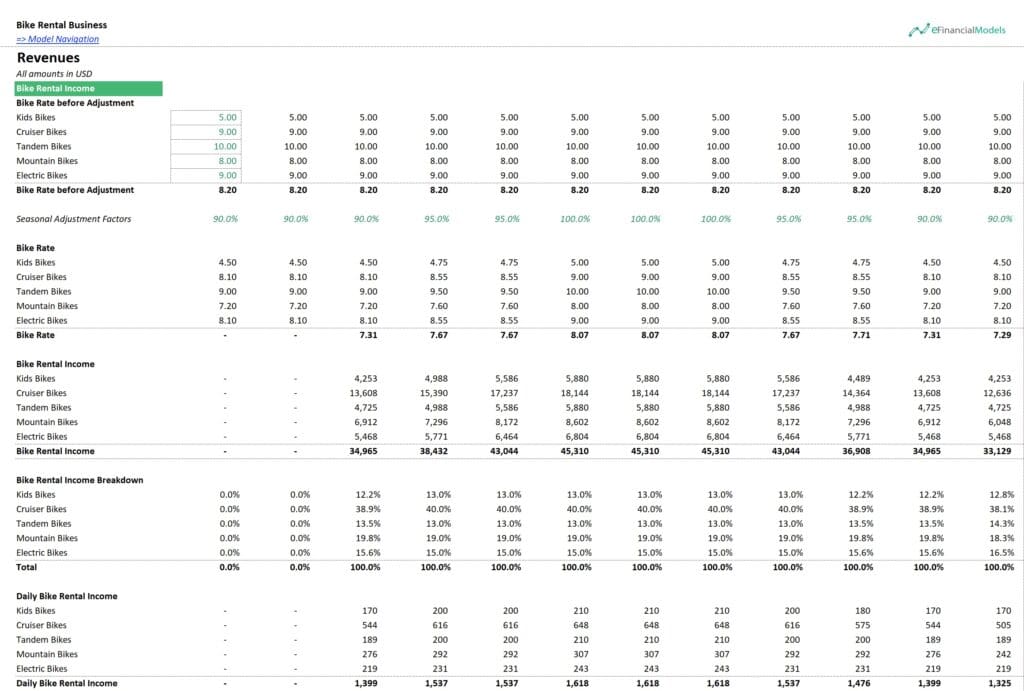
Above is a cyclical revenue table from our Bike Rental Business Financial Model. It shows high predictability because rental income follows seasonal patterns with stable bike rates and demand fluctuations. However, scalability is uncertain since expanding inventory or locations depends on market demand, seasonal peaks, and operational capacity. The profit margin is also uncertain due to fluctuating costs, such as maintenance, staffing, and off-season expenses, which impact overall profitability despite steady revenue trends.
Cyclical revenue lowers business valuation due to its unpredictability. Earnings rise and fall with market trends, making cash flow unstable. Investors see higher risk, leading to lower valuation multiples.
Quality of Revenue Analysis: Identifying the Most Reliable Revenue Streams
Recurring revenue stands out as the type of revenue with the highest quality because it offers high predictability, strong scalability, and high-profit margins. Unlike transactional or consumption-based models, recurring revenue ensures steady cash flow and reduces uncertainty. While contracted revenue also provides stability, its scalability is moderate. Cyclical and consumption-based revenue models face unpredictability, making them riskier. Businesses seeking long-term growth and financial stability should prioritize recurring revenue streams for the best balance of reliability and profitability.
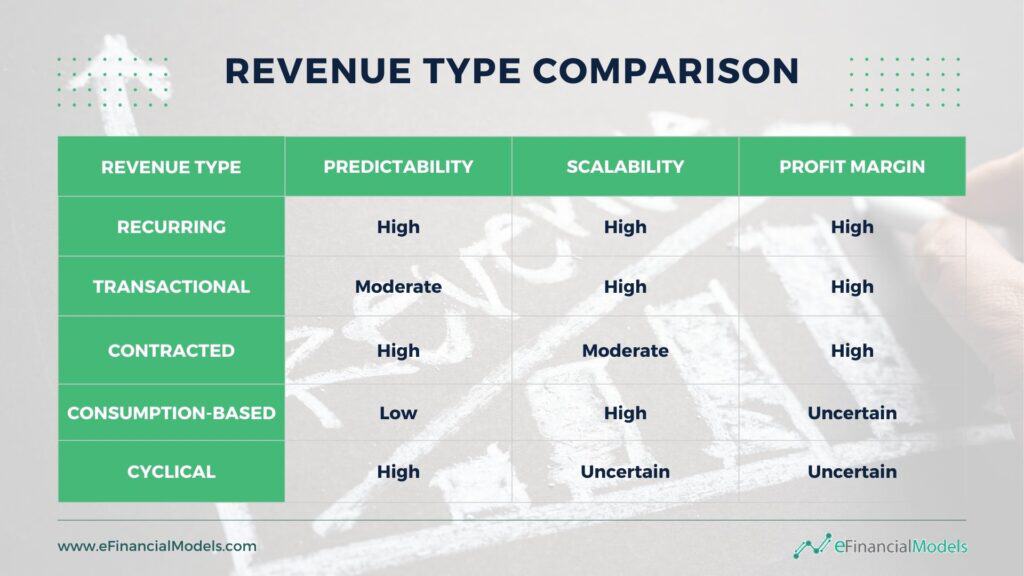
The quality of earnings directly impacts business valuation. Recurring and contracted revenue increase value by ensuring stable cash flow. Transactional revenue lowers valuation due to its unpredictability. Consumption-based revenue creates uncertainty, as earnings depend on customer usage. Cyclical revenue reduces valuation because of market fluctuations. Investors favor businesses with reliable, predictable income streams, leading to higher valuation multiples.
Understanding earnings quality helps businesses make smarter financial decisions and attract investors. A Quality of revenue analysis helps businesses spot the most reliable revenue streams by focusing on predictability, scalability, and profit margins. A strong financial model highlights these differences, guiding better decisions when performing a quality of revenue analysis. Ready to improve your revenue forecasting? Get expert financial model templates at eFinancialModels.com and strengthen your strategy today!















































You might also like:
- 10 Tips to Develop a First Class Business Valuation Report
- 12 Funding Sources for Businesses and Startups
- How to Value a Business Using a Discounted Cash Flow Model
- How to Make Smart Decisions with 6 Key Financial Metrics?
- What Are the Main Drivers of Business Valuations?
- Understanding the Debt Service Coverage Ratio: An Essential Metric for Financial Analysis
- Financial Ratios Analysis and Its Importance
- Business Plan Models – Using Business Models as Examples
- How to Write a Business Plan Step-by-Step
- Growth Rate Calculator: Exploring the Benefits
- How to Prepare a Financial Feasibility Study?
- Top 5 Tips For a Good Financial Due Diligence
- Factors Impacting the Valuation of Your Business
- Calculating Revenue Growth Rate: A Key Metric for Business Success
- Financial Planning for Small Business Owners – Taking an SBA Loan
- How to Build a Capitalization Table
- Startup Model Templates in Excel that can help your Business Grow
- Business Valuation Service
- Financial Model – Valuation of Tax Loss Carryforwards
- Real Estate Valuation Model Template