
0 ITEMS

10 Best Practices for Your Next Financial Due Diligence Report

The most effective way to prepare a financial due diligence report is through a structured and thorough approach that identifies risks, validates financial health, and supports informed decision-making. Whether evaluating an investment, acquisition, or partnership, a thoroughly executed due diligence report provides the clarity necessary to mitigate risks and maximize opportunities.
Financial due diligence is essential for understanding a company’s true financial health before high-stakes deals like mergers, acquisitions, or investments.
- It goes beyond a regular audit by uncovering hidden liabilities, verifying financial estimates, and ensuring transparency.
- Key areas include analyzing financial statements, assessing revenue sources, and reviewing tax and regulatory compliance.
- Understanding market position and operational risks helps gauge long-term viability and growth potential.
- Using advanced tools and a multidisciplinary team increases accuracy and efficiency in the evaluation process.
- Proper due diligence supports informed negotiations, accurate valuation, and risk mitigation, reducing surprises after the deal.
Mastering financial due diligence is crucial for making informed investment decisions and mitigating risks. This guide breaks down the key steps, best practices, and expert insights to help you create a thorough and accurate financial due diligence report. Discover how to streamline evaluations, identify potential risks, and make data-driven decisions. Whether you’re assessing an acquisition, conducting an internal audit, or preparing for investor scrutiny, a well-executed due diligence process provides clarity and confidence. Let’s explore the essential strategies to craft a high-impact financial due diligence report.

What is Financial Due Diligence?
Financial due diligence is a structured, investigative procedure applied by companies, investors, and financial institutions to assess a target firm’s financial health, solidity, and risk prior to high-risk deals such as mergers, acquisitions, alliances, or investments.
Unlike a regular financial audit, due diligence is a thorough, multi-level review designed to uncover hidden liabilities, substantiate financial estimates, and ensure that published financial information accurately reflects reality.
It entails an intensive review of:
- Financial Statements: A thorough examination of income statements, balance sheets, and cash flow statements enables an assessment of profitability, liquidity, and overall financial stability. Analyzing historical and projected cash flow trends ensures that the business can sustain operations, manage debt obligations effectively, and meet future financial commitments. Identifying red flags such as irregular revenue patterns, excessive liabilities, or inconsistencies in reported earnings is crucial to mitigating risk.
- Sources of Revenue: Understanding the sources of revenue, their sustainability, and growth potential is vital for long-term success. This includes evaluating customer concentration risks, distinguishing between recurring and one-time income, assessing pricing strategies, and analyzing market demand. A diversified revenue base with stable, predictable earnings is a strong indicator of financial resilience, while reliance on a few key customers or volatile income streams can pose significant risks.
- Tax and Regulatory Compliance: Ensuring compliance with tax laws and industry regulations minimizes legal risks and potential financial penalties. This involves reviewing tax filings, outstanding liabilities, potential disputes, and adherence to local and international regulations. A company facing frequent tax audits, pending litigation, or non-compliance with key industry laws may indicate hidden financial burdens that could impact future performance.
- Market Position & Drivers of Profitability: Assessing a company’s competitive standing within its industry helps determine long-term viability and potential for growth. This includes analyzing market share, pricing power, brand strength, competitive advantages, and industry trends. Additionally, understanding what drives profitability, such as cost efficiencies, economies of scale, or proprietary technology, allows investors and stakeholders to evaluate whether the business can maintain or improve its market position over time.
- Operational Efficiency & Exposure to Risk: Reviewing operational processes, cost structures, and risk exposure ensures a comprehensive understanding of the company’s ability to sustain profitability. This includes evaluating supply chain dependencies, workforce productivity, cost management strategies, and external risks such as economic downturns, cybersecurity threats, or geopolitical factors. A well-structured, agile operation with strong risk mitigation strategies is better positioned for long-term success.
Through thorough financial due diligence, companies achieve clarity, enabling them to negotiate more favorable terms, recalculate valuations, and avoid expensive surprises. This protects decision-makers from surprise financial risk and fortifies the strategic underpinnings of any deal.

Why is Having High-quality Financial Due Diligence Important?
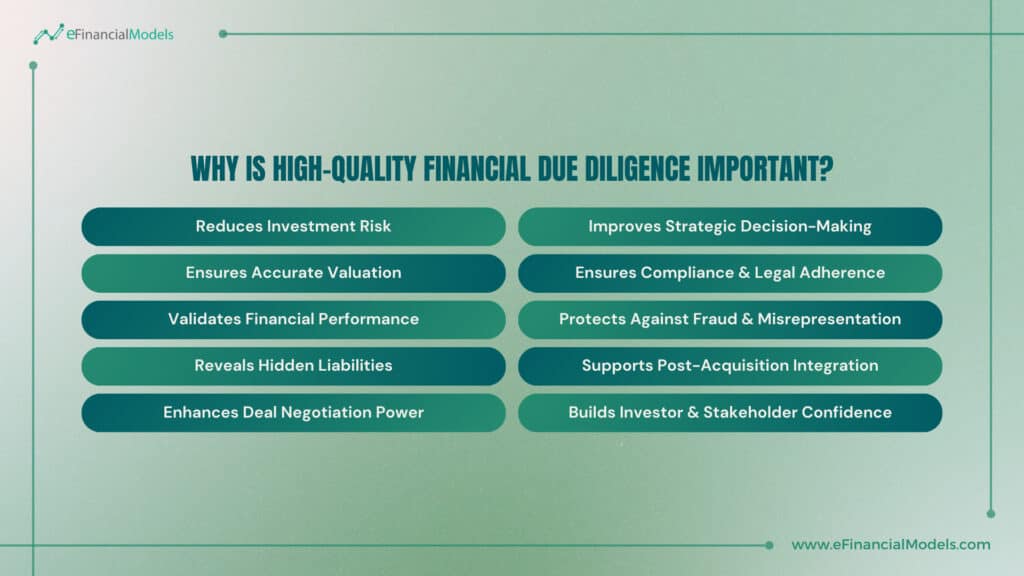
Effective financial due diligence ensures that companies thoroughly evaluate a target company’s financial stability, risks, and long-term viability. This process helps uncover critical insights by addressing key questions, such as whether the financial information is accurate and truly reflects business performance or if there are hidden red flags. It also assesses the sustainability of earnings, determining whether historical revenue growth is repeatable or merely driven by temporary factors. Additionally, due diligence identifies any concealed liabilities, such as off-balance-sheet obligations, unresolved tax issues, or pending lawsuits, which could pose future risks. Moreover, it evaluates upcoming financial commitments, including long-term liabilities and contractual obligations that may impact the company’s financial health. By systematically addressing these concerns, financial due diligence provides a clear and data-driven foundation for informed decision-making, mitigates potential risks, and ensures sound investment choices.
Through conducting high-quality financial due diligence, businesses can establish a reasonable purchase price, forecast risks, and facilitate a smooth transaction.
10 Best Practices for Your Next Financial Due Diligence Report

Implementing best practices can significantly optimize the due diligence process:
A well-executed financial due diligence process goes beyond routine financial assessments it is a meticulous investigation that validates financial health, uncovers hidden risks, and strengthens decision-making. Without a structured approach, critical red flags may be overlooked, leading to costly mistakes, inflated valuations, or unforeseen liabilities post-transaction.
By implementing best practices, companies can optimize the due diligence process, ensuring it is both thorough and efficient. From setting clear objectives to leveraging advanced AI tools, these best practices provide a systematic framework that minimizes uncertainty and enhances financial transparency. Whether you’re evaluating an acquisition, investment, or strategic partnership, the following 10 best practices will help you conduct due diligence with precision and confidence.
- Thorough Planning & Scope Definition: Clearly define the scope, objectives, and key focus areas of the due diligence process. This includes determining the specific goals (e.g., evaluating profitability, uncovering financial risks, ensuring regulatory compliance) and establishing priorities to align with strategic objectives.
- Systematic Data Collection & Organization: Gather all necessary documents, including financial statements (income statements, balance sheets, cash flow statements) for the past five years, tax filings (10-K, 10-Q), audit reports, contracts, and organizational charts. Organize these documents in a comprehensive and well-organized repository to ensure the due diligence team can access accurate and up-to-date information.
- Cross-Functional Expertise & Team Formation: Assemble a team with diverse skills in finance, legal, tax, human resources, and operational areas. This cross-functional team ensures a comprehensive evaluation from various perspectives.
- Comprehensive Financial Statement Analysis: Review and analyze financial statements to assess the accuracy and sustainability of earnings. Evaluate working capital, debts, and hidden liabilities to ensure the company can meet its obligations.
- Financial Ratio Analysis & Health Dashboard: Calculate key financial ratios over the last five years to create a comprehensive view of the company’s financial health. Benchmark these ratios against industry standards to identify potential issues.
- Legal & Regulatory Compliance Review: Ensure the target company complies with all relevant laws and regulations. Review tax filings and compliance to uncover any potential liabilities.
- Risk Assessment & Mitigation: Identify financial, operational, legal, and market risks associated with the target company. Use tools like SWOT analysis or risk heat maps to prioritize and visualize risks effectively.
- Leverage Technology & AI: Utilize AI-powered tools to enhance accuracy, improve efficiency, and process large volumes of data. AI tools can quickly sift through financial records, contracts, and other documents, identifying patterns and anomalies that human reviewers may miss.
- Comprehensive Reporting & Documentation: Summarize findings in a clear, structured reportthat highlights key risks, opportunities, and actionable recommendations. Ensure the report includes discrepancies in financial statements, hidden liabilities, and regulatory concerns that need immediate attention.
- Ongoing Monitoring & Post-Transaction Review: Implement regular monitoring post-transaction to identify emerging risks early.
Each of these best practices plays a crucial role in creating a due diligence process that is not only comprehensive but also strategic and value-driven. A well-defined scope ensures the focus remains on critical financial factors, while structured data collection prevents oversight. Cross-functional expertise adds depth to financial assessments, and advanced financial analysis techniques reveal patterns that may otherwise go unnoticed. Technology and AI further enhance accuracy and efficiency, reducing the risk of human error. Finally, post-transaction monitoring ensures that financial stability and risk mitigation extend beyond the initial evaluation.
By following these best practices, companies can transform financial due diligence from a routine check into a powerful decision-making tool one that protects investments, strengthens negotiations, and paves the way for long-term financial success.
Key Takeaways
- A structured financial due diligence process minimizes risks and enhances decision-making capabilities for mergers, acquisitions, and investments. Key components include:
- Assembling a competent multidisciplinary team.
- Defining clear objectives to ensure an efficient process.
- Conducting detailed analyses across financial, legal, operational, and market domains.
- Leveraging advanced analytical tools for improved accuracy.
- Maintaining transparent communication with stakeholders.
Conclusion
Due diligence is not merely a regulatory gateway it is a strategic necessity that makes or breaks high-stakes business deals. A properly articulated due diligence report does not just examine financials it reveals hidden risks, validates projections, and provides a playbook for making confident, data-driven decisions.
By applying best practices such as assembling a multidisciplinary team, leveraging advanced analytics, and conducting deep financial and risk analysis, companies can navigate uncertainty and negotiate from a position of strength. Identifying red flags, assessing financial viability, and remaining agile in response to market changes provide businesses with a competitive edge in mergers, acquisitions, and investments.
Moreover, financial due diligence is not a one-time event it is an ongoing process. Post-transaction monitoring is crucial to ensuring financial stability, regulatory compliance, and long-term value creation. Companies that integrate due diligence into their strategic framework, rather than treating it as a mere checklist, position themselves for sustainable growth in an ever-evolving financial landscape.
In today’s fast-paced business world, success belongs to those who make informed, risk-aware decisions. Mastering financial due diligence enables businesses to transform potential risks into strategic opportunities, ensuring that every transaction is not just a deal, but a step toward achieving long-term financial success. For access to high-quality financial models that streamline due diligence and investment analysis, view our templates and gain expert tools to support your financial decision-making.
You might also like:
- 10 Main Elements of a Business Plan
- 10 Tips to Develop a First Class Business Valuation Report
- 14 Best Practices in Financial Modeling
- How to Write a Business Plan Step-by-Step
- Financial Due Diligence
- Top 5 Tips For a Good Financial Due Diligence
- Understanding the Levelized Cost of Energy Formula
- Valuation
- Financial Modeling for Startups and Small Businesses
- 5 Ways COVID-19 Impacts Financial Plans For Retirement & What To Do About It
- Financial Analysis
- How to Prepare a Financial Feasibility Study?
- Financial Ratios Analysis and Its Importance
- Scenario Analysis
- Business Valuation
- Business Plans
- Financial Modeling for Project Finance
- Financial Statements – Definition, Uses, Contents and Templates
- Financial Model Templates Easy to Use
- A Step-By-Step Guide to the Merger and Acquisition Process
- How to Prepare a Financial Plan for a Chicken Egg Farm?
