
0 ITEMS

Understanding the Levelized Cost of Energy Formula
Table of Content

The levelized cost of energy (LCOE) helps compare the economic feasibility of different power sources by calculating the average cost to produce one unit of electricity over a plant’s lifetime.
- Tesla used LCOE to evaluate the competitiveness of its solar panels and battery storage, reducing costs to challenge fossil fuels.
- Understanding LCOE is essential for investors, policymakers, and energy producers to assess cost-efficiency and sustainability of energy options.
- The formula includes components like capital, operation, maintenance costs, and energy output, focusing on buyer’s perspective for decision-making.
- Analyzing the lifecycle costs and lifetime energy production helps determine whether renewable projects are financially viable.
- Comparing LCOE across sources reveals the most cost-effective options in transitioning to cleaner energy systems.
This article provides a clear overview of how LCOE impacts energy investment and policy choices.
What is the Levelized Cost of Energy Meaning?
The global pursuit of renewable energy sources has prompted the development of various financial metrics and tools to evaluate energy projects. Among these, the levelized cost of energy formula is among the most significant. It represents the per-unit cost (usually in dollars per megawatt-hour or cents per kilowatt-hour) of building and operating a generating plant over an assumed financial lifetime. When people commonly calculate LCOE, they focus on electricity because it is the most widely used energy form that needs generation, transmission, and distribution infrastructure. It makes the levelized cost of energy meaning synonymous with electricity generation in many energy studies and discussions.
The levelized cost of energy meaning refers to the average total cost of building and operating a power-generating asset over its lifetime, divided by the total energy output it is expected to produce. This metric is crucial for comparing the cost-effectiveness of energy generation technologies such as solar, wind, or natural gas. Essentially, the levelized cost of energy meaning provides a common financial benchmark that allows investors, utilities, and policymakers to assess and compare different energy sources on a per-unit basis, taking into account installation, operation, maintenance, and fuel costs over time.
Components of the Levelized Cost of Energy Formula
The levelized cost of energy (LCOE) is a metric used to assess the average cost per unit of electricity a project generates over its entire lifespan. It is calculated by dividing the total lifecycle cost of a project by its total energy production over the project’s lifetime. Here’s the levelized cost of energy formula:

The levelized cost of energy formula represents the cost of generating one unit of electricity, accounting for all costs incurred during the entire operational period. Using it makes it easier to compare the economic efficiency of different energy sources on a common basis. The LCOE approach allows investors and project planners to evaluate and compare projects, ensuring cost-effectiveness and long-term viability in energy generation. Now. Let’s break down the components of the levelized cost of energy formula.
Please explain here that in the most cases – unless we define our perspective differently – we should consider the costs from a buyer’s perspective, from the perspective someone purchasing the electricity. This means this corresponds to the revenues from a seller’s perspective which includes all his costs and even a profit – because the electricity will only be produced when the seller can produce a profit.
Lifecycle Cost of a Project
The lifecycle cost of a project represents the total cost associated with owning, operating, and maintaining the project over its entire lifespan. These costs include:
- Operations & Maintenance Costs (O&M): The ongoing expenses are required to operate and maintain the project. O&M costs are incurred regularly throughout the project’s life, including equipment maintenance, labor, and administrative expenses. It ensures the project remains functional and efficient.
- Depreciation: Depreciation is an accounting method that spreads the cost of the project’s assets over their useful life. Depreciation represents the decline in value of the assets due to wear and tear, obsolescence, or age, and it can also have tax benefits as it reduces the taxable income over time.
- Earnings Before Interest and Taxes (EBIT): EBIT refers to the profit generated from the project’s electricity production, without considering loan interest payments or income taxes. It represents the operating profitability of the project before financial and tax expenses.
- Electricity Sales: The revenue generated by selling electricity to external customers or the grid. It acts as a cost recovery, offsetting other project lifecycle costs and potentially providing profit if the revenue exceeds total operating expenses.
- Loan Payments: Loan payments are the scheduled repayments of principal and interest for any debt taken to finance the project. These payments impact the project’s cash flow throughout its lifecycle and are an important consideration for evaluating project affordability and viability.
- Investment Tax Credit (ITC): The Investment Tax Credit is a government incentive that reduces tax liability based on a percentage of the initial investment. ITC helps lower the project’s initial cost, thereby improving its overall lifecycle economics by reducing the upfront financial burden.
- Present Value of Performance-Based Incentive: This is the present value of any incentives that are provided based on the performance of the project. PVPBI reflects the discounted value of expected future performance-based incentives, which can help reduce overall lifecycle costs and improve project economics.
- Profits: The project’s profit needs to be taken into account, as such projects will only be built if the developer and operators can produce a profit; otherwise, such projects would not even be built.
It is essential to note that the Loan Payments, Investment Tax Credit (ITC), and Present Value of Performance-Based Incentive (PVPBI) are not always included in the lifecycle cost calculation of a project. The lifecycle cost of a project is typically focused on direct costs related to designing, building, operating, maintaining, and decommissioning the project over its useful life. It aims to provide a comprehensive view of the costs required to sustain the project from inception to disposal, excluding financing mechanisms and incentives. Loan payments, tax credits, and incentives are usually considered financial elements and do not represent the project’s direct costs.

Lifetime Energy Production
Lifetime Energy Production refers to the total energy generated by an energy system (like a solar panel or wind turbine) over its expected lifespan. It can be calculated both in undiscounted and discounted terms, where each approach gives a different perspective on the energy output over time.
- The undiscounted lifetime energy production is calculated by summing the total energy output expected over the system’s operational lifespan, typically measured in kilowatt-hours (kWh) or megawatt-hours (MWh). It involves projecting the annual energy production for each year and simply adding these values without considering any adjustments for time value.
- In contrast, discounted lifetime energy production incorporates the concept of discounting to account for the time value of energy production, reflecting that energy produced sooner is often more valuable due to factors like inflation, technological changes, or cost of capital. It involves applying a discount rate to each year’s energy production and summing these discounted values to estimate the present value of total energy output. Both metrics are useful: the undiscounted value gives a straightforward total, while the discounted value provides a more realistic evaluation of energy benefits considering financial and economic factors.
Sample Levelized Cost of Energy Calculation in Excel
A levelized cost of energy calculation is essential for evaluating the financial feasibility of energy projects, providing a standardized metric to compare the cost-effectiveness of energy generation. LCOE represents the average total cost of building and operating an energy system over its lifetime, divided by the total energy produced. It captures all expenses—such as capital, operational, and maintenance costs—providing a comprehensive picture of how much it costs to generate each unit of electricity. In our Solar Energy Financial Model, the levelized cost of energy calculation helps stakeholders determine the project’s competitiveness against traditional energy sources and make informed decisions on potential investments.

The above levelized cost of energy calculation calculates the average cost per unit of electricity generated, taking into consideration all expenses throughout the lifespan of the solar project.
- Operations and Maintenance (O& M)) represents the costs of operating and maintaining the solar plant over time. It includes expenses for regular servicing, repairs, and monitoring. The price is calculated annually and then divided by the total energy production to determine the cost per megawatt-hour (USD/MWh). The discounted value reflects the present value of these costs, considering the selected discount rate.
- Depreciation accounts for the reduced value of solar energy equipment and assets over time. It is calculated based on the capital cost of the equipment and provides an annual expense amount, which helps determine the LCOE by dividing it by the electricity produced. The discounted depreciation values are adjusted based on the chosen discount rate to reflect their present value.
- Earnings Before Interest and Taxes (EBIT) calculates the profit from electricity generation after subtracting O&M and depreciation. It helps assess the profitability of the project. Similar to other components, EBIT is also divided by the energy production (in MWh) to get a per-unit cost in the LCOE calculation.
- Electricity Production indicates the total energy generated by the solar plant annually, measured in megawatt-hours (MWh). The discount factor applied each year takes into account the time value of money, helping to adjust electricity production costs to their present value.
- The Discounted Levelized Cost of Electricity section shows how the annual costs and production are discounted to their present value using a discount rate (in this case, 10%). Discounting is crucial for understanding the true economic value of future cash flows, reflecting that money today is more valuable than the same amount in the future.
The final levelized cost of energy calculation divides the sum of discounted costs (O&M, depreciation, and EBIT) by the discounted electricity production. This gives the “Levelized Cost of Electricity” value in USD/MWh, which provides a benchmark for comparing the project’s energy cost against other sources. The LCOE value is calculated to be around 63.08 USD/MWh. This metric is valuable for assessing whether the solar project is financially viable compared to other energy sources and helps in pricing decisions or evaluating project competitiveness.
A levelized cost of energy calculation of 68.348 USD/MWh for a solar project is potentially financially viable in the US, depending on regional electricity prices, incentives, and project-specific variables. For comparison, the average LCOE for new utility-scale solar in the US has ranged between 30 to 60 USD/MWh in recent years. If local electricity prices are higher, this levelized cost of energy calculation could indicate a competitive project. However, further analysis of market conditions and specific project costs is necessary for a definitive assessment.















































Levelized Cost of Energy by Source: Which is Most Cost-Effective?
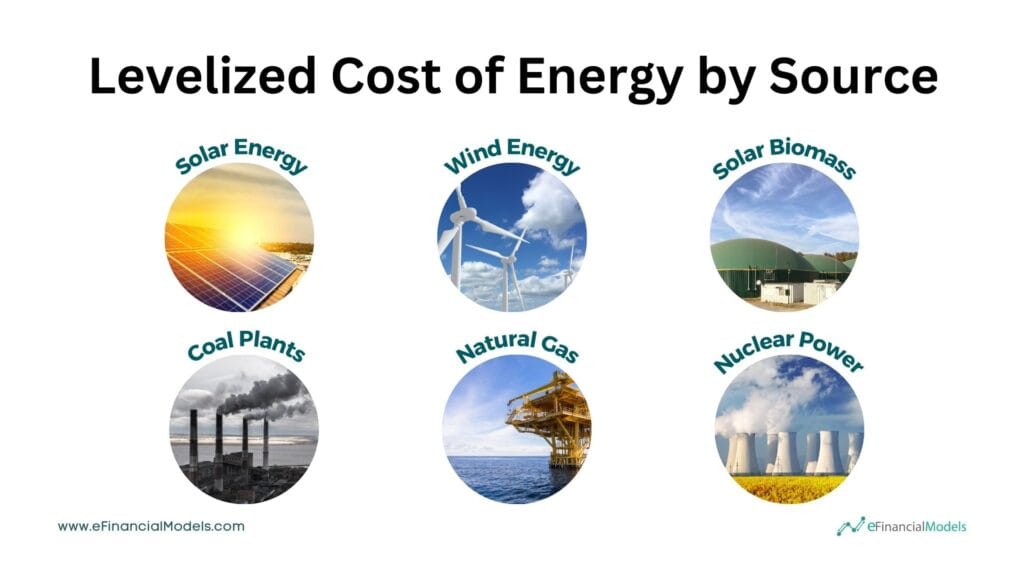
The levelized cost of energy (LCOE) varies significantly by energy source. Each levelized cost of energy by source has unique factors that contribute to its overall cost-effectiveness. Understanding the LCOE for different energy sources is essential for evaluating their economic viability, especially in transitioning towards more sustainable and renewable energy systems.
Solar Energy
The LCOE for solar energy has significantly dropped over the past decade due to technological advancements, government subsidies, and falling production costs. Solar projects usually have high capital costs but minimal O&M and zero fuel costs, which makes them attractive for reducing the dependency on fossil fuels. The cost-effectiveness of solar energy, from an LCOE perspective, stems from its low ongoing costs after installation. Solar projects in regions with abundant sunlight can achieve one of the lowest LCOEs compared to other energy sources, making it a very competitive option. Moreover, economies of scale and continued improvements in photovoltaic efficiency have further reduced costs, making solar one of the most promising energy solutions in many areas. Solar energy represents different deployment scales and applications that impact the cost-effectiveness and efficiency of energy production. They may include small-scale PV rooftop systems, small-scale PV rooftop systems with battery storage, large-scale photovoltaic rooftop systems, large solar photovoltaic utility grid installations, or agricultural photovoltaic systems.
Wind Energy
Wind energy LCOE has also decreased, largely driven by technological improvements and economies of scale. Wind power is highly cost-competitive with other sources, particularly in areas with consistently strong winds. Onshore wind projects have relatively lower installation costs and minimal ongoing operational expenses, which makes their LCOE favorable. Offshore wind projects, while initially more expensive due to infrastructure and installation requirements, have seen falling LCOE as technology advances and larger turbines are deployed to capture more energy. The cost-effectiveness of wind energy, particularly onshore, lies in its ability to generate substantial amounts of power with low O&M costs and no fuel expenses. When located in regions with consistent wind patterns, wind energy can have an LCOE that rivals or even undercuts fossil fuel-based sources.
Solar Biomass
When assessed through Levelized Cost of Energy (LCOE), solar-biomass hybrid systems represent an innovative approach to renewable energy generation by combining two complementary energy sources—solar and biomass. This integration takes advantage of the strengths of each source, which can provide a stable energy supply at any time, including when solar energy isn’t available, such as at night or during cloudy conditions. Solar panels or solar thermal collectors capture energy from the sun, which can be used directly for electricity or heating, while biomass systems use organic materials like agricultural residues, wood, or organic waste to generate energy through combustion, gasification, or other methods. By pairing these technologies, solar biomass systems can provide a more reliable and efficient energy solution, addressing the intermittency issues associated with solar power and improving biomass sustainability. This synergy can also help reduce the carbon footprint, as the system can optimize energy use and decrease dependency on fossil fuels, making solar biomass a promising option for sustainable, decentralized energy production, particularly in rural or off-grid areas.
Coal Plants
Historically, coal was a dominant source of electricity due to its availability and low fuel cost. However, the environmental costs associated with coal have led to the imposition of carbon taxes and regulatory requirements, increasing its LCOE. These additional costs and growing societal pressure to decarbonize have made coal less competitive than renewable energy sources. While coal plants may have relatively low operational costs, the high emissions and the resulting regulatory expenses significantly increase the LCOE, making it less cost-effective in the current energy landscape. As renewable energy sources continue to see falling costs and increased efficiency, the cost-effectiveness of coal is further diminished, especially when factoring in environmental and health-related externalities. Lignite and hard coal are popular energy sources due to their relatively low Levelized Cost of Electricity (LCOE), making them economically attractive for power generation in many regions.
Natural Gas
The LCOE for natural gas is affected significantly by fuel prices and market volatility. Despite high operational and fuel costs, natural gas plants can still offer competitive LCOE due to lower capital costs and the ability to provide stable, on-demand electricity. Natural gas is often used as a bridging fuel because it can be brought online quickly to meet peak demands, offering flexibility that intermittent renewable sources may not provide. The cost-effectiveness of natural gas, in terms of LCOE, is largely due to its relatively low upfront capital costs compared to renewable projects. However, the long-term LCOE of natural gas may be vulnerable to rising fuel prices and potential carbon pricing, making it less competitive than renewable energy sources. Combined Cycle Gas Turbine (CCGT-CH4), Gas Turbine (GT-CH4), and Gas Turbine Conversion (GT-Conversion) are popular natural gas energy sources with competitive Levelized Cost of Electricity (LCOE), widely used for efficient and flexible power generation.
Nuclear Power
Nuclear power has a relatively high LCOE, primarily due to large upfront capital costs and stringent safety measures. However, once operational, nuclear power provides consistent and large-scale energy with very low O&M and fuel costs. The cost-effectiveness of nuclear energy is realized over the long term, as the low operational expenses and high capacity factors help spread the initial capital costs across decades of electricity production. Nuclear plants are typically favored for providing a stable energy supply, which is crucial for base-load power requirements. Despite the high LCOE, nuclear remains a competitive option in countries prioritizing energy security and seeking to reduce carbon emissions without relying on intermittent renewable sources. However, the public perception of safety risks and the challenge of managing radioactive waste can limit the widespread adoption of nuclear energy.
Levelized Cost of Electricity By Source
The levelized cost of electricity by source represents the average cost of producing one unit of electricity, considering the entire life cycle of different energy sources. It is a crucial metric for comparing the economic efficiency of renewable energy sources like solar and wind with more traditional options like coal, natural gas, and nuclear. As such, the levelized cost of electricity by source provides a comprehensive measure of how cost-effective various power generation methods are. Here’s a graph from Fraunhofer ISE showing the levelized cost of electricity by source for 2024 in €cents/kWh:
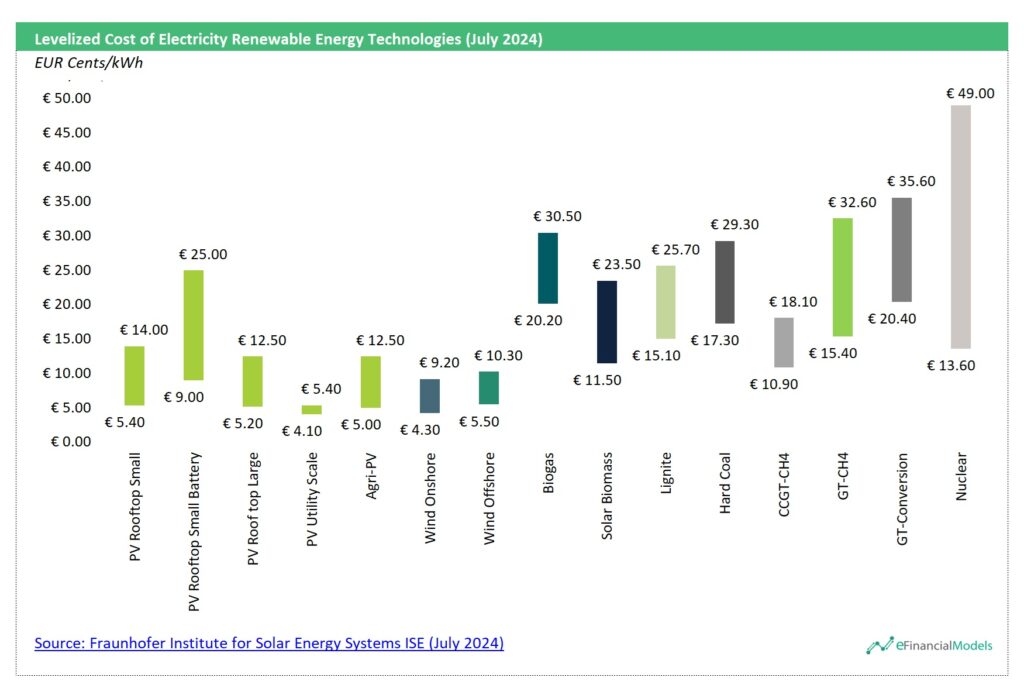
The chart above illustrates various energy sources’ Levelized Cost of Electricity (LCOE). The graph shows that the minimum LCOE across all energy sources is approximately €1.30/kWh, while the maximum reaches around €35.40/kWh. The data indicates that renewable energy sources like utility-scale solar photovoltaic (PV), onshore wind, and agri-photovoltaics (Agri-PV) offer the lowest LCOE, making them among the most cost-effective options for electricity generation. In contrast, conventional sources such as nuclear, gas turbine conversion (GT-conversion), and hard coal exhibit higher LCOE values, indicating they are the most expensive options for electricity production. This trend highlights the growing competitiveness of renewable energy compared to traditional energy sources, driven largely by their declining costs and environmental benefits.
In conclusion, solar and wind energy often offer the lowest levelized cost of energy by source, especially in resource-rich areas. Solar’s falling costs and low ongoing expenses make it highly competitive in sunny regions, while onshore wind is cost-effective in areas with steady wind. Technological advancements continue to reduce levelized cost of energy by source for both, enhancing their attractiveness. Natural gas can also be cost-effective due to lower capital costs and flexibility, but its competitiveness is affected by fuel price volatility and carbon costs. Solar and wind are generally the most cost-effective energy sources, especially as technology and economies of scale improve.
Why Does Levelized Cost of Energy Matter?
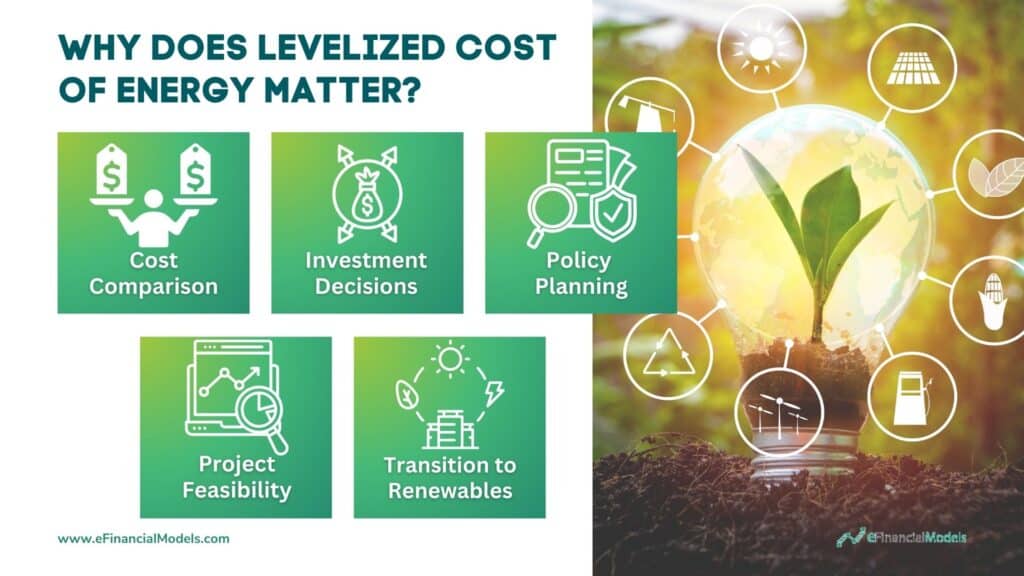
The Levelized Cost of Energy (LCOE) is a vital tool for understanding the economics of power generation, allowing us to determine the true cost-effectiveness of different energy sources. This metric matters because it cuts through the complexities of various energy technologies, providing a clear, apples-to-apples comparison that guides where to allocate resources most efficiently. As the world aims to transition to a sustainable energy future, LCOE has become essential in driving both public and private sector choices towards cleaner and more cost-effective solutions.
Cost Comparison
The Levelized Cost of Energy (LCOE) allows for an apples-to-apples comparison of different energy generation technologies. Unlike more straightforward cost metrics, LCOE considers the full spectrum of expenses, including upfront capital, ongoing operational costs, and fuel expenses across the entire lifespan of an energy project. By standardizing these costs into a single figure, LCOE enables stakeholders to objectively assess the financial efficiency of solar, wind, nuclear, fossil fuels, and other energy sources. This comprehensive approach to cost comparison provides a clear picture of which energy sources are most economical, helping decision-makers prioritize projects that promise the greatest value for electricity generation.
For instance, when deciding between solar, wind, and natural gas power plants, LCOE provides a standardized cost per unit of electricity over each project’s lifecycle, accounting for upfront capital expenses, ongoing operations, maintenance, and fuel costs. By using LCOE, stakeholders can assess which energy source offers the lowest cost and aligns with sustainability goals. For a municipality considering renewable investments, comparing LCOE values enables informed decision-making, helping to balance cost efficiency with environmental impact to meet budgetary and sustainability targets.
Investment Decisions
For investors, understanding the Levelized Cost of Energy is key to making sound financial decisions in the energy sector. LCOE provides insight into the lifetime costs of different energy generation options. It allows investors to evaluate potential returns, risks, and the long-term viability of projects. It serves as a benchmark that can be compared across technologies to determine which investments have the greatest potential for cost competitiveness and growth. Given that energy infrastructure projects require significant capital expenditures and often involve long payback periods, LCOE is invaluable in de-risking investments by helping investors choose projects that offer both economic sustainability and predictable returns.
Investors can also use the Levelized Cost of Energy (LCOE) to evaluate the long-term economic viability of a single energy project. When considering an investment in a new solar power plant, for example, the levelized cost of energy calculation helps determine whether the revenue from electricity sales will cover the project’s lifecycle costs, including capital expenditure, maintenance, and financing. By estimating LCOE early in the planning stage, investors can assess whether the project will reach profitability under various market conditions and pricing scenarios. This analysis helps understand the project’s break-even point and identify potential financial risks, ultimately informing decisions about the timing, scale, and financing structure of the energy investment.
Policy Planning
Policymakers rely on the levelized cost of energy formula to develop informed energy strategies and craft policies that encourage a balanced energy mix. By using LCOE to gauge the competitiveness of various energy technologies, governments can determine where subsidies or incentives would be most effective in promoting cleaner energy without imposing unnecessary costs on taxpayers. Moreover, LCOE allows for the assessment of whether renewable sources can compete economically with traditional fossil fuels, influencing policy frameworks that shape energy transitions and infrastructure investments. It helps ensure that public resources are directed toward initiatives that offer environmental benefits and economic value for society.
By calculating the LCOE for different energy sources—such as solar, wind, nuclear, or natural gas—policymakers can determine which technologies are the most cost-efficient and where financial support is most needed to achieve energy goals. For example, suppose LCOE analysis shows that solar power still costs more than fossil fuels. In that case, policymakers may introduce subsidies or tax incentives to encourage solar investments and drive down costs over time. LCOE also helps in setting realistic energy transition targets by providing a clear picture of the economic feasibility of renewable technologies, allowing for well-informed decisions that balance economic, environmental, and social objectives in energy planning.
Project Feasibility
For energy project developers, the levelized cost of energy formula plays an essential role in assessing the financial feasibility of potential projects. By providing a metric that captures all costs, from capital expenditures to operational and maintenance expenses, LCOE helps developers evaluate whether an energy project can be economically sustainable over its operational lifetime. A favorable LCOE suggests that the project can generate electricity at a competitive cost, which is crucial for securing funding and obtaining regulatory approvals. Understanding the LCOE of a project also helps developers refine designs, optimize resources, and improve cost structures to enhance overall economic performance, ultimately determining whether a project moves from concept to execution.
For instance, in the feasibility study of a new wind farm, the LCOE helps determine whether the energy produced will be competitive with other available sources and whether it meets market price expectations. If the calculated LCOE is lower or comparable to current market rates, the project is deemed economically feasible, supporting further development. This insight into cost efficiency aids developers in securing financing, optimizing the project’s financial structure, and mitigating risks before proceeding with full-scale implementation.
Transition to Renewables
The levelized energy cost is a crucial driver in the transition to renewable energy, and it provides transparent data that highlights the declining costs of renewables compared to fossil fuels. Over the past decade, the LCOE for renewable technologies like wind and solar has dropped significantly, making them increasingly competitive with, or even cheaper than, conventional energy sources. This trend has not only caught the attention of investors and developers but also reinforced the case for governments to support the transition to cleaner energy through policy measures and incentives. By quantifying the cost advantages of renewables, LCOE helps accelerate the shift towards a low-carbon economy, providing the financial justification needed to replace fossil fuel plants with more sustainable alternatives.
Levelized cost of energy calculation of renewable projects is particularly useful when planning energy transitions on a national or regional scale, as LCOE helps to identify which renewable sources can deliver power at a competitive rate and attract investment. For instance, if the LCOE of solar energy in a region falls below the cost of electricity from coal plants, it strengthens the economic argument for expanding solar capacity. This economic insight supports strategic decisions around investments, subsidies, and infrastructure development, ultimately accelerating the shift toward a cleaner, more sustainable energy grid.
Comparing LCOE with Other Metrics
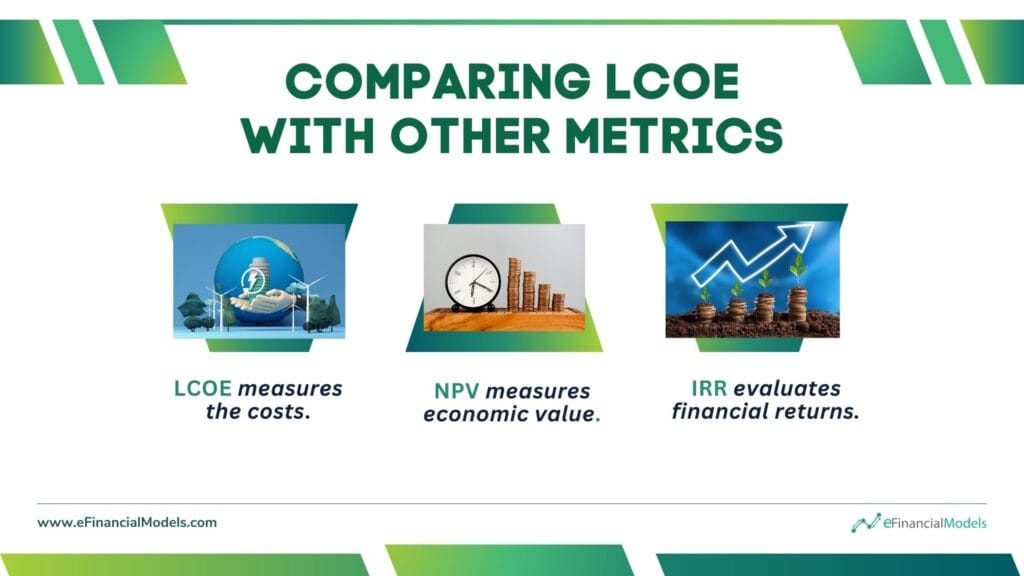
The Levelized Cost of Energy (LCOE) represents the average cost per unit of electricity generated over the lifetime of a power plant, essentially reflecting how much it costs for the buyer of the produced electricity. Typically, this buyer is an electricity distribution company, which pays the LCOE price for the energy generated by a plant, such as a solar or wind farm. The LCOE includes all relevant costs, such as capital, operation, and maintenance, balanced against the total energy output. The distribution company can resell the purchased electricity to end consumers at a premium, adding a markup to account for the value provided by delivering the electricity through the grid infrastructure, covering expenses related to transmission, distribution, and customer service, thereby achieving profitability. That is why when evaluating energy projects, comparing the Levelized Cost of Energy (LCOE) with other financial metrics like the Net Present Value (NPV) and Internal Rate of Return (IRR) can provide a more comprehensive view of a project’s viability.
Net Present Value (NPV)
Net Present Value (NPV) clearly shows a project’s profitability by discounting future cash flows to their present value. It reflects the economic value by indicating how much value will be added (or lost) by undertaking the project after considering costs, revenues, and the cost of capital. A positive NPV signifies that the project is expected to generate more economic value than it costs, making it a useful decision-making tool for comparing various energy investment opportunities and selecting economically viable ones.
In comparison, the Levelized Cost of Energy (LCOE) calculates the average cost of producing energy over the lifetime of a project. While LCOE is useful for comparing energy projects based on cost-effectiveness, it doesn’t directly assess profitability. NPV, on the other hand, incorporates both costs and revenues, providing a more comprehensive view of financial performance. When used together, LCOE and NPV give insight into energy projects’ cost structure and overall profitability, helping stakeholders make well-rounded investment decisions.
Internal Rate of Return (IRR)
The Internal Rate of Return (IRR) is a crucial metric for evaluating the financial returns of energy projects. IRR represents the discount rate that makes an energy project’s cash flows’ net present value (NPV) equal to zero. Essentially, it shows the expected annualized rate of return that the project will generate. By comparing the IRR to a project’s hurdle rate (the minimum acceptable return), investors can assess whether the energy project is likely to meet their financial objectives. For energy projects, such as solar farms or wind power installations, IRR takes into account the initial investment, operational costs, and the expected revenues from selling energy. A higher IRR indicates that the project is more financially attractive, as it implies a better return on the invested capital.
LCOE, on the other hand, measures the cost-efficiency of producing energy over the project’s lifetime. It calculates the average total cost of building and operating the energy project per unit of electricity generated, expressed in cost per kilowatt-hour (kWh). LCOE includes capital expenditures, operating expenses, fuel costs (if applicable), and decommissioning costs, divided by the total electricity generated over the project’s lifespan. Regardless of scale, it is a valuable metric for comparing the costs of different energy technologies—such as solar, wind, or natural gas. A lower LCOE indicates that energy can be produced at a lower cost, which is attractive from an economic competitiveness and policy standpoint.
Financial Modeling: Calculate and Compare LCOE Effectively
Understanding the Levelized Cost of Energy formula is crucial for evaluating the economic feasibility of energy projects. By considering all relevant costs—including capital, operating, and maintenance expenses—LCOE provides a standardized way to compare different energy technologies. It is a valuable tool for investors, policymakers, and developers looking to make informed decisions about energy investments and project development. However, it’s important to consider capital costs and tax implications for a truly holistic view, as these impact profitability and the overall financial landscape of energy projects.
Financial modeling brings crucial clarity to energy economics, especially using the levelized cost of energy formula. LCOE is a powerful tool that allows stakeholders to assess the long-term financial viability of energy projects by accounting for all the costs involved in generating electricity—from initial capital investments to ongoing operational and maintenance expenses. In an industry where economics and sustainability must go hand in hand, understanding the full scope of costs ensures that projects are technically feasible and financially sustainable.
Are you ready to gain deeper insights into your energy projects and ensure they are optimized for profitability and long-term success? Start leveraging financial modeling tools to unlock the full economic potential of your energy investments today.
You might also like:
- Understanding the Levelized Cost of Energy Formula
- 10 Main Elements of a Business Plan
- 10 Tips to Develop a First Class Business Valuation Report
- Renewable Energy
- Energy Efficiency
- Business Valuation
- How to Calculate Net Present Value (NPV)?
- How to Prepare a Financial Feasibility Study?
- Calculating Revenue Growth Rate: A Key Metric for Business Success
- Cash Flow Statement: Streamline Financial Success
- Sensitivity Analysis
- Discount Rate
- 5 Steps to Create a Drop Down List Using Data Validation in Excel
- Top 5 Tips For a Good Financial Due Diligence
- Top 5 Principles of Corporate Finance
- Financial Model Templates Easy to Use
- Funding Sources
- Financial Planning for Small Business Owners – Taking an SBA Loan
Tags: Investment Analysis