
0 ITEMS

Solar Panel Recycling Centre Financial Model
A comprehensive editable, MS Excel spreadsheet for tracking Solar Panel Recycling Centre finances, including development Opportunities, and summary tabs, integrates Income Statements, Balance Sheets, & Cash Flow Statements, providing a comprehensive view of financial performance.
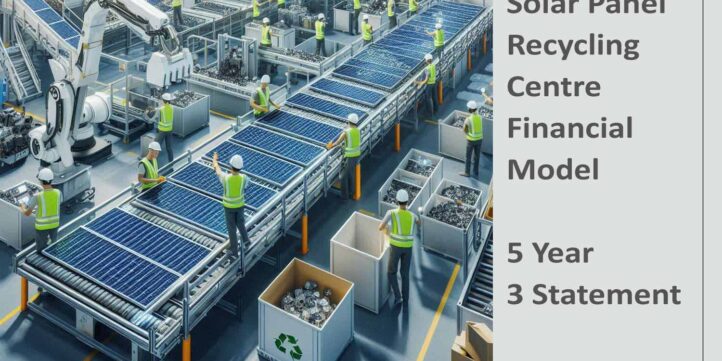


This detailed financial model for a solar panel recycling company pays careful attention to each aspect of operations, given the complexity of solar panel materials and recycling processes. Below is an outline for a comprehensive financial model, with specific attention to the *Income Statement*, *Cash Flow Statement*, and *Balance Sheet*, as well as dedicated sections for the key materials recovered from solar panels: *Glass, Plastic, Aluminium / Aluminum, Silicon, and Metals*.
—
### 1. **Income Statement**
The income statement for a solar panel recycling company would track revenues generated from the sale of recycled materials, along with costs associated with collection, processing, and distribution. Key categories include:
#### **Revenues**
– **Revenue from Material Sales**: Revenue is generated from selling recovered materials such as glass, plastic, aluminum/aluminium, silicon, and metals. Each material type has a different market price per unit (ton, kilogram, etc.) based on current commodity prices.
– *Glass Revenue*: Typically the largest component by volume. Priced per ton.
– *Plastic Revenue*: Sold per kilogram or ton.
– *Aluminum Revenue*: Often high-value, sold per kilogram or ton.
– *Silicon Revenue*: Premium pricing for purified silicon, sold per kilogram.
– *Metals Revenue*: Includes silver, copper, and other rare metals, priced per kilogram.
– **Government Incentives/Grants**: Revenue from local, state, or federal programs promoting recycling and sustainability, potentially through tax credits or direct subsidies.
– **Service Fees**: Revenue from collection services, if the company provides pickup from solar panel manufacturers or users.
#### **Cost of Goods Sold (COGS)**
– **Material Collection Costs**: Costs related to collecting end-of-life solar panels, including transportation and labor.
– **Processing Costs**: The costs of disassembly, shredding, and sorting solar panels into components (glass, plastic, etc.).
– *Glass Processing Costs*: Includes cleaning, crushing, and melting.
– *Plastic Processing Costs*: Sorting and cleaning plastics.
– *Aluminum Processing Costs*: Separation, shredding, and melting costs.
– *Silicon Processing Costs*: Complex extraction and purification costs.
– *Metal Processing Costs*: Extraction costs, especially for precious metals like silver.
– **Labor Costs**: Staff salaries for operations, processing, and administration.
– **Utilities and Overheads**: Expenses for energy, water, and facility maintenance.
#### **Gross Profit**: Calculated as Total Revenue – COGS.
#### **Operating Expenses**
– **Research & Development (R&D)**: Costs for improving recycling efficiency, technology development, and process innovation.
– **Sales & Marketing**: Costs associated with marketing recycled materials and establishing partnerships.
– **General & Administrative (G&A)**: General expenses such as office rent, salaries of executives, and professional fees.
#### **EBITDA (Earnings Before Interest, Taxes, Depreciation, and Amortization)**
#### **Depreciation & Amortization**: Mainly associated with machinery, equipment, and facilities.
#### **Operating Profit (EBIT)**
#### **Interest Expense**: For any outstanding loans or debt financing.
#### **Income Taxes**
#### **Net Income**
—
### 2. **Cash Flow Statement**
The cash flow statement will track cash flows from operations, investing, and financing to provide a full view of liquidity and operational efficiency.
#### **Cash Flow from Operating Activities**
– **Net Income**: Brought from the income statement.
– **Adjustments for Non-Cash Expenses**: Includes depreciation and amortization.
– **Changes in Working Capital**: Adjustments for changes in inventory (recycled materials), accounts receivable (pending payments from buyers of recycled materials), and accounts payable.
– **Cash Collections from Customers**: Cash inflows from selling recycled materials (glass, plastic, aluminum, etc.) and from service fees.
– **Payments to Suppliers and Employees**: Cash outflows for raw materials, labor, and other operating expenses.
#### **Cash Flow from Investing Activities**
– **Capital Expenditures**: Cash used for purchasing or upgrading recycling equipment, facilities, and vehicles for material collection.
– **Proceeds from Disposal of Assets**: Cash inflow from selling outdated or non-usable equipment.
#### **Cash Flow from Financing Activities**
– **Debt Financing**: Proceeds from loans or bond issuance for expansion.
– **Equity Financing**: Capital raised from issuing shares, if privately funded or publicly listed.
– **Repayment of Loans or Dividends**: Cash outflows for repaying debt and paying dividends.
#### **Net Change in Cash**: Summing up cash flows from operations, investing, and financing.
#### **Beginning and Ending Cash Balance**
—
### 3. **Balance Sheet**
The balance sheet provides a snapshot of the company’s financial position, including assets, liabilities, and equity.
#### **Assets**
– **Current Assets**
– *Cash and Cash Equivalents*: Cash from operations and financing.
– *Accounts Receivable*: Unpaid invoices for sales of recycled materials.
– *Inventory*: Value of processed materials (glass, plastic, aluminum, etc.) awaiting sale.
– **Non-Current Assets**
– *Property, Plant, and Equipment (PP&E)*: Long-term assets like recycling facilities, machinery, vehicles, etc., net of depreciation.
– *Intangible Assets*: Patents or proprietary recycling technologies, if applicable.
Similar ProductsOther customers were also interested in...


 eFinancialModels
Electric Vehicle (EV) Charging Station Financial M...
With this comprehensive 5- or 10-year monthly tool, investors can assess the viability of setting up... Read more

Financial Model for Mobile App | Mobile App Busine...
The Mobile App Financial Plan Template in Excel allows you to develop financial projections when lau... Read more

 HenrySheykin
Food Truck Financial Model Excel Template
The Food Truck Financial Model helps entrepreneurs, founders, business owners, consultants, and anal... Read more

Green Hydrogen Production from Wind Energy Financi...
The Green Hydrogen from Wind Financial Model aims to comprehensively forecast a horizon of 40 years ... Read more

Simple Mutual Non-Disclosure Agreement Template
Protect your business secrets with ease using our Simple Mutual Non-Disclosure Agreement Template. S... Read more

Solar Energy Financial Model
The Solar Energy Financial Model Spreadsheet Template in Excel assists you in preparing a sophistica... Read more

 Peter Graf
The Customer-Centric Financial Model for Restauran...
Starting a restaurant without a financial plan is like driving a car blindfolded. You wouldn´t do i... Read more
You must log in to submit a review.