
0 ITEMS

Interior Design Financial Model Excel Template
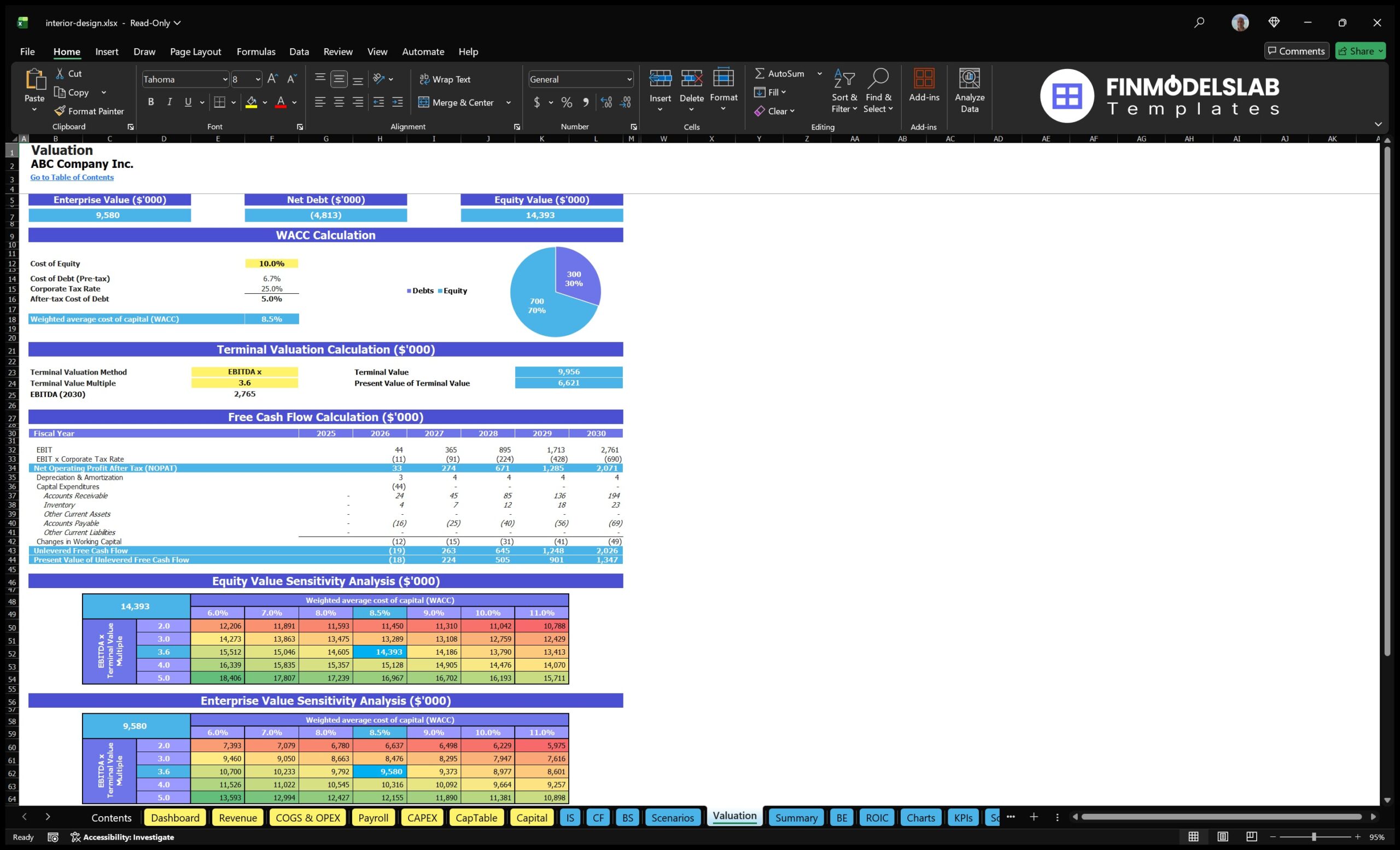
The Interior Design Financial Model helps users turn an interior design studio, consultancy, or project-based design service into a structured financial forecast. Instead of relying on a generic spreadsheet, this template is built around the way interior design businesses actually operate, including project fees, hourly consulting, billable design time, retainers, project management revenue, staffing costs, subcontractor costs, startup investment, and recurring overhead. It gives entrepreneurs, business owners, consultants, analysts, and founders a practical framework for estimating revenue potential, understanding cost behavior, and planning the financial path from launch to growth. This financial model template is designed for business planning, funding preparation, budgeting, and internal decision-making. Users can customize revenue assumptions, pricing, client volume, service mix, marketing spend, customer acquisition cost, payroll, operating expenses, and capital needs to reflect their own business strategy. The model helps connect commercial decisions with financial outcomes, so users can see how changes in hourly rates, project volume, staffing plans, or fixed expenses may affect cash flow, profitability, and long-term sustainability. For a new interior design firm, the template helps organize startup costs, launch expenses, working capital needs, and early revenue expectations before committing major resources. For an existing business, it can support expansion planning, hiring decisions, pricing reviews, investor discussions, bank applications, and performance tracking. The built-in structure helps users review projected income statements, cash flow forecasts, profitability trends, and financial metrics without building a complete model from scratch. The Interior Design Financial Model is especially useful for people preparing business plans, pitch decks, loan documents, or investor-ready financial projections. It supports five-year planning, scenario testing, break-even analysis, and profitability review, helping users evaluate whether the business can cover operating expenses, manage payroll, maintain liquidity, and generate attractive returns. By bringing key assumptions and outputs into one editable planning tool, the template makes it easier to compare options, identify financial risks, and make more confident decisions before launching or scaling an interior design business.
Financial Model Overview
The Interior Design Financial Model is a ready-to-use financial model template built for interior designers, studio founders, project-based design firms, consultants, and business planners who need a practical way to forecast revenue, costs, cash flow, and profitability. Interior design businesses often combine several revenue drivers, including hourly design consultations, fixed-fee packages, project management work, retainers, sourcing fees, and client project volume. This template brings those drivers into one structured model so users can understand how client acquisition, pricing, billable hours, staffing, subcontractor expenses, software costs, office setup, and marketing investment translate into financial performance. It is useful for launching a new design studio, preparing an interior design business plan, applying for funding, reviewing pricing, planning hiring, or testing whether a growth strategy can produce sustainable profit. The model is editable, organized, and designed for users who want a professional financial planning tool without building formulas, schedules, and reports from the ground up.
All-in-One Dashboard
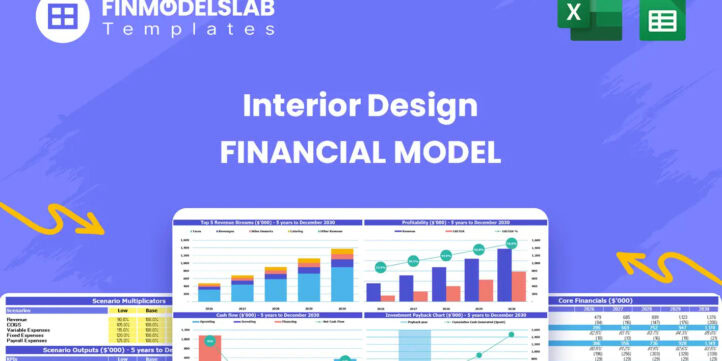
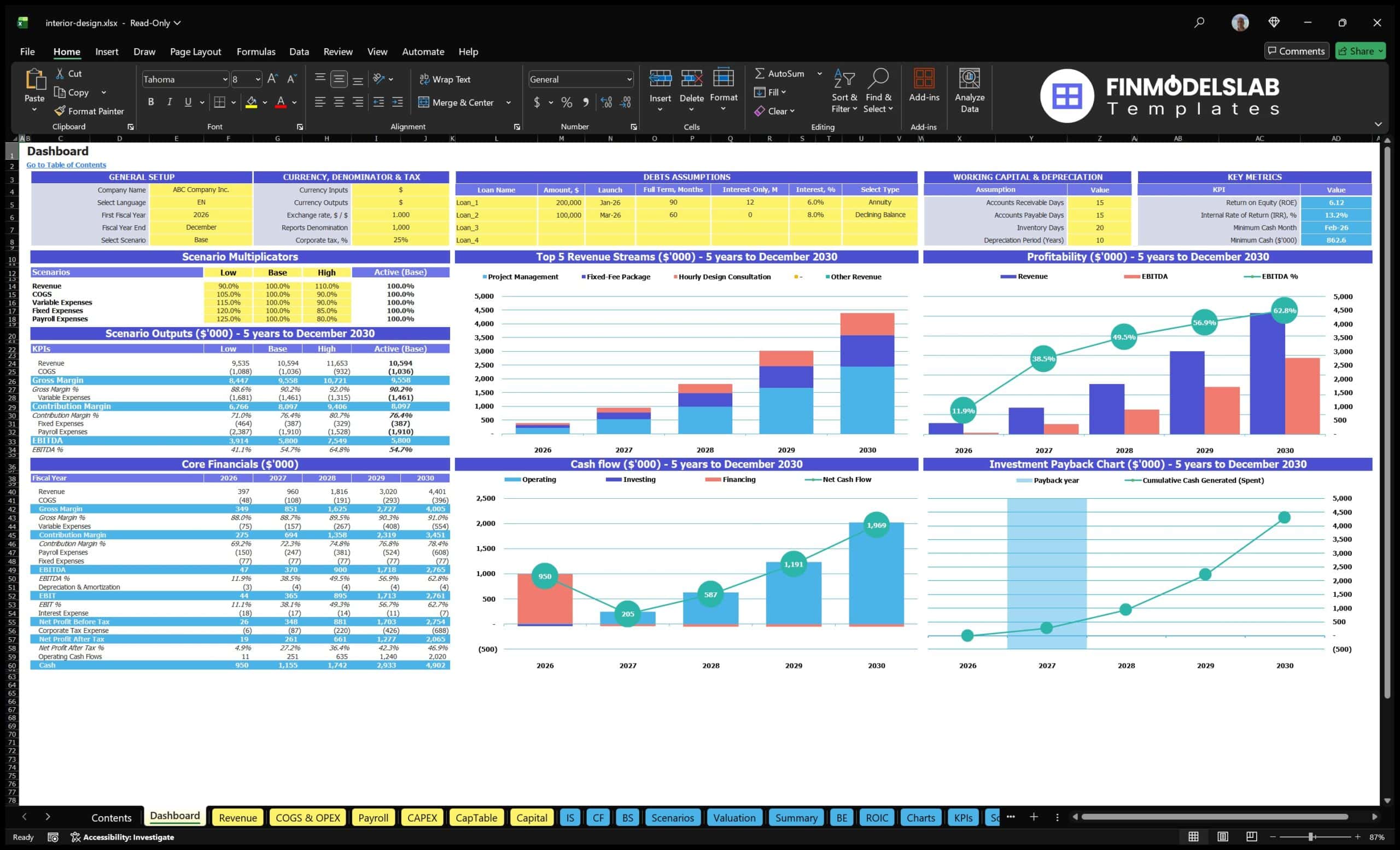
The all-in-one dashboard provides a central view of the most important inputs and outputs in the Interior Design Financial Model. This component helps users see the financial story of the business without searching through multiple tabs or calculations. It may include key assumptions such as client volume, service pricing, average billable hours, marketing budget, customer acquisition cost, payroll, direct costs, startup investment, and operating expenses, alongside outputs such as projected revenue, gross profit, EBITDA, cash balance, margins, payback period, and break-even timing. For an interior design firm, this is especially useful because the owner or analyst can quickly connect operational decisions with financial outcomes. If hourly rates increase, the number of active clients changes, or staffing is added earlier than expected, the dashboard helps show how those changes affect cash flow and profitability. This section is valuable for founders, consultants, and investors because it turns a detailed spreadsheet into a clear management view that supports faster review, better budgeting, and more confident decision-making.
Low Base High Scenario Analysis
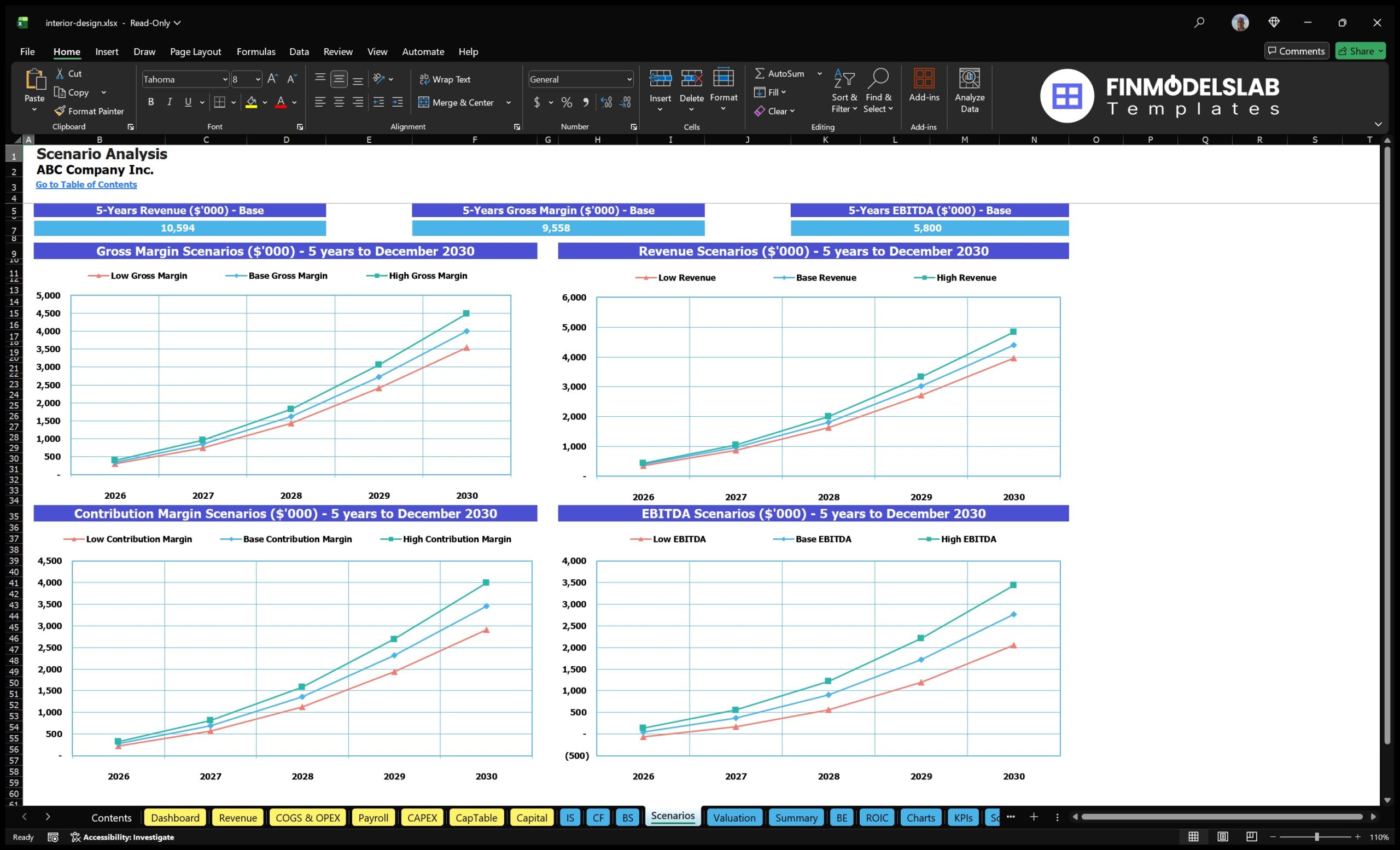
The Low, Base, and High scenario analysis component helps users evaluate how the interior design business may perform under different levels of growth, pricing, cost pressure, and demand. Rather than relying on a single forecast, this section allows users to compare conservative, expected, and optimistic cases using assumptions such as new client acquisition, marketing efficiency, customer acquisition cost, average project size, billable design hours, hourly rates, direct costs, and operating expenses. In the Low case, users can stress-test slower client growth, higher costs, reduced project volume, or lower pricing power. In the Base case, users can model the expected operating plan. In the High case, users can estimate the impact of stronger demand, better conversion rates, larger projects, or improved margins. This component is useful for planning because interior design revenue can vary based on seasonality, referral volume, real estate activity, economic conditions, and project timing. Scenario analysis helps users understand risk and upside before committing to hiring, marketing spend, studio space, or major investments. It is also valuable for lenders and investors because it shows that the business has been reviewed under more than one possible outcome.
Professional Charts and Visual Reports
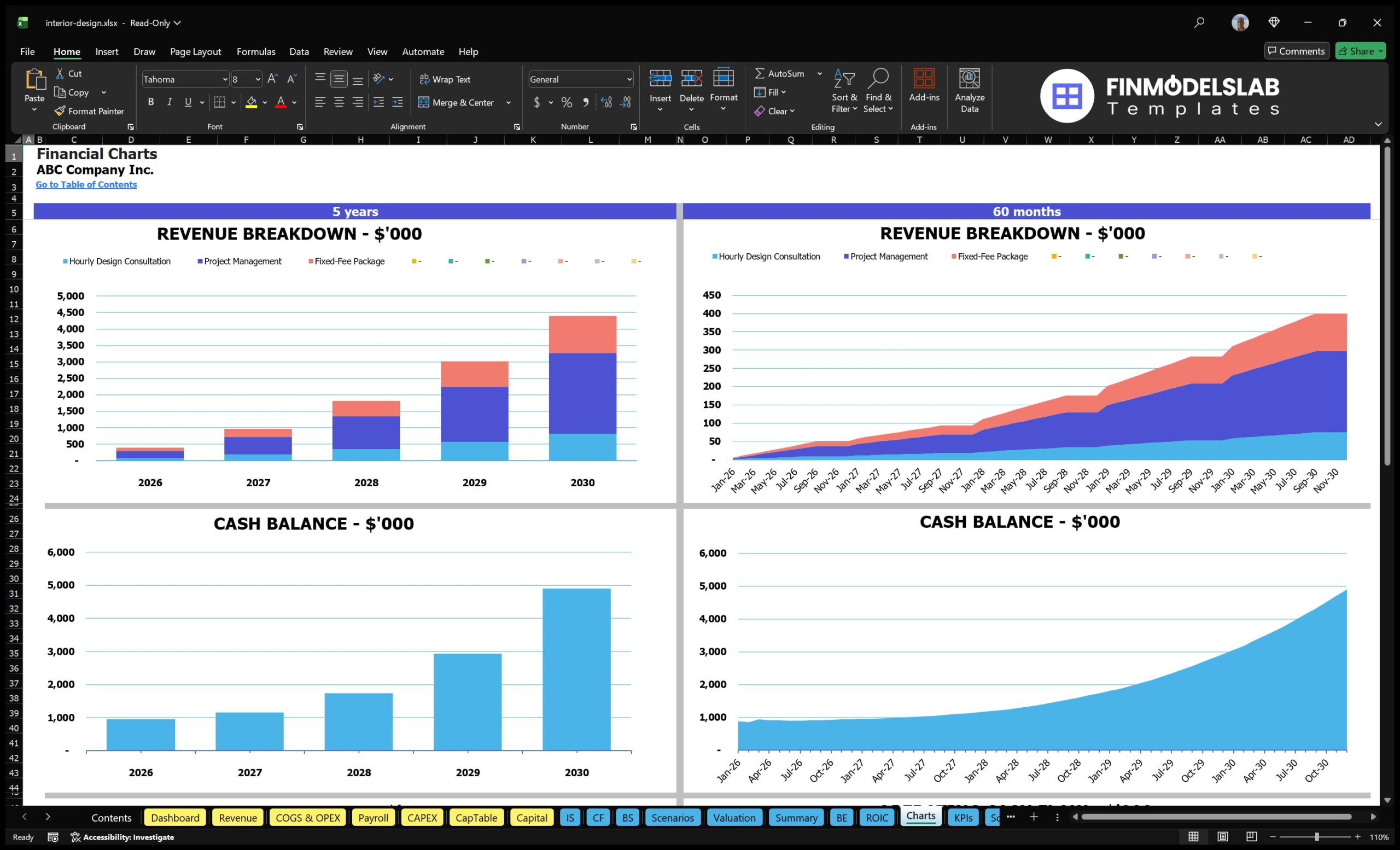
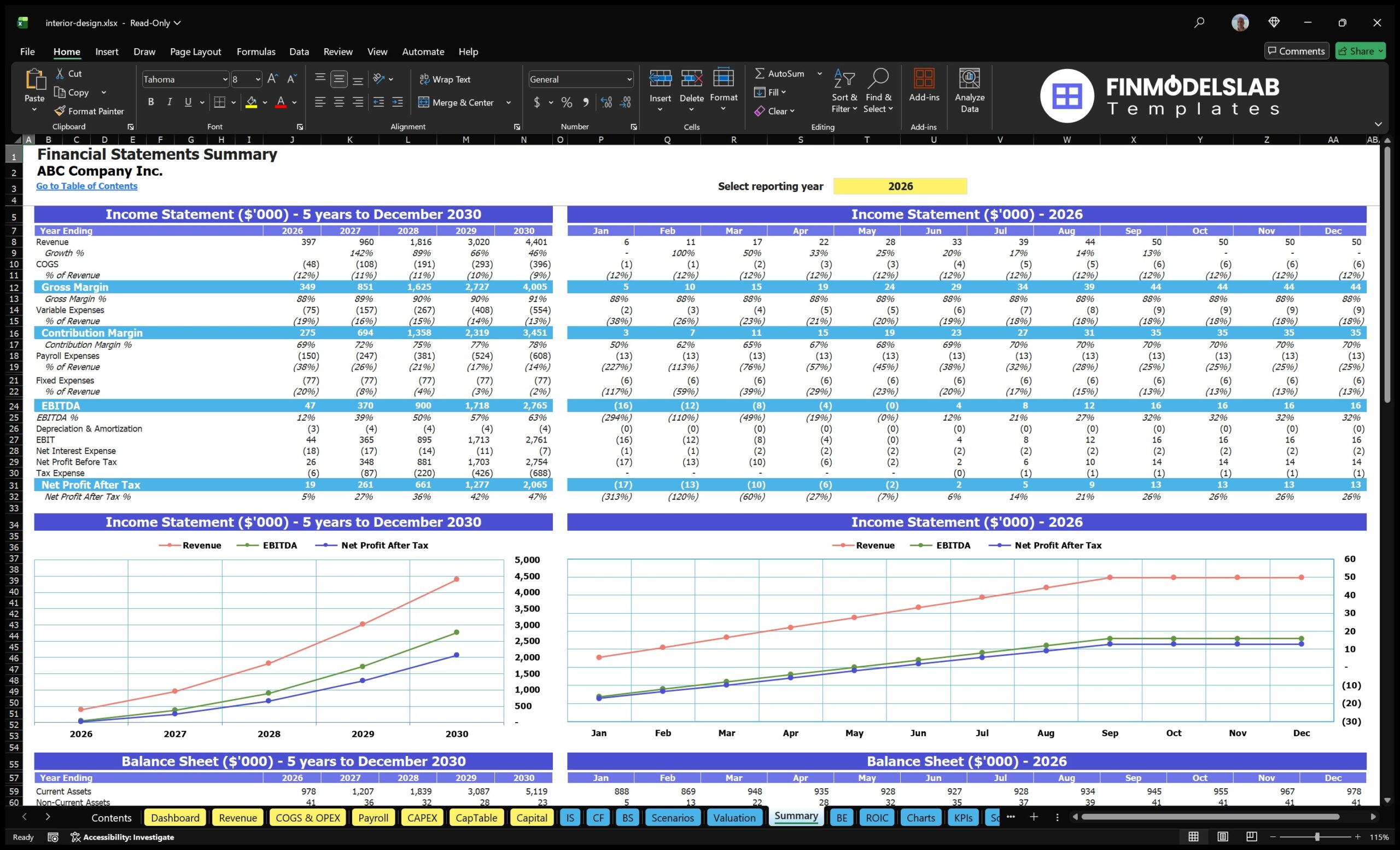
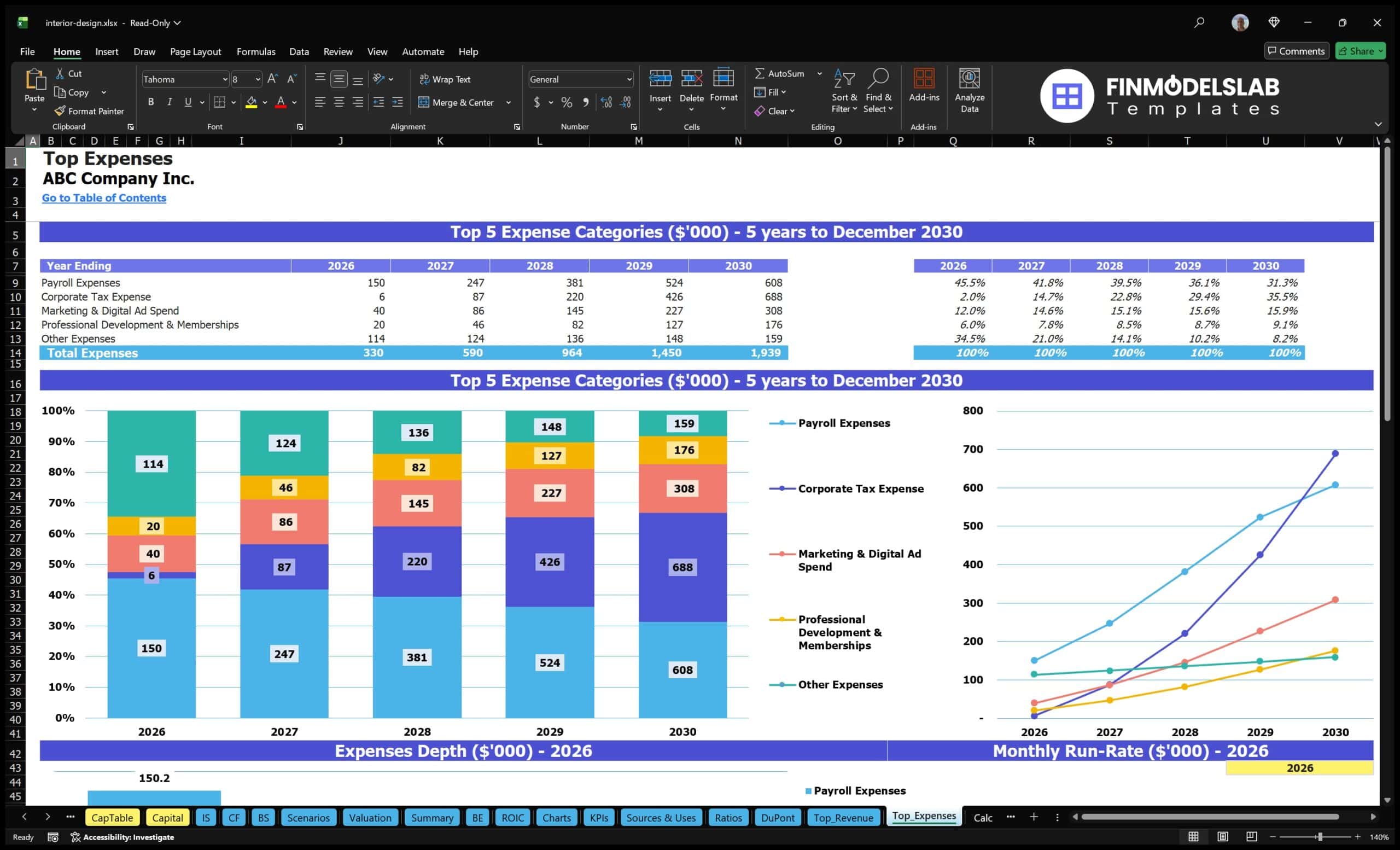
The professional charts and visual reports component converts financial data into clear visuals that can be used for internal planning, investor meetings, lender discussions, and business plan presentations. Interior design financial projections often include many moving parts, such as revenue by service, direct cost ratios, payroll expansion, operating expenses, cash flow, profitability, and cumulative returns. Charts make these outputs easier to understand by showing trends over time, comparisons between categories, and changes in financial performance across the forecast period. Users may be able to review revenue growth, EBITDA development, cash balance movement, margin trends, cost structure, and forecasted performance through presentation-ready visuals. This is useful because stakeholders may not want to inspect every formula or monthly schedule, but they do need a clear view of whether the studio can grow, remain liquid, and become profitable. For a founder preparing a pitch deck or loan package, the visual reporting section can help communicate the financial plan in a polished and accessible way. For an operating design firm, these charts can also support management reviews, budget discussions, and progress tracking against strategic goals.
ROE Components and DuPont Analysis
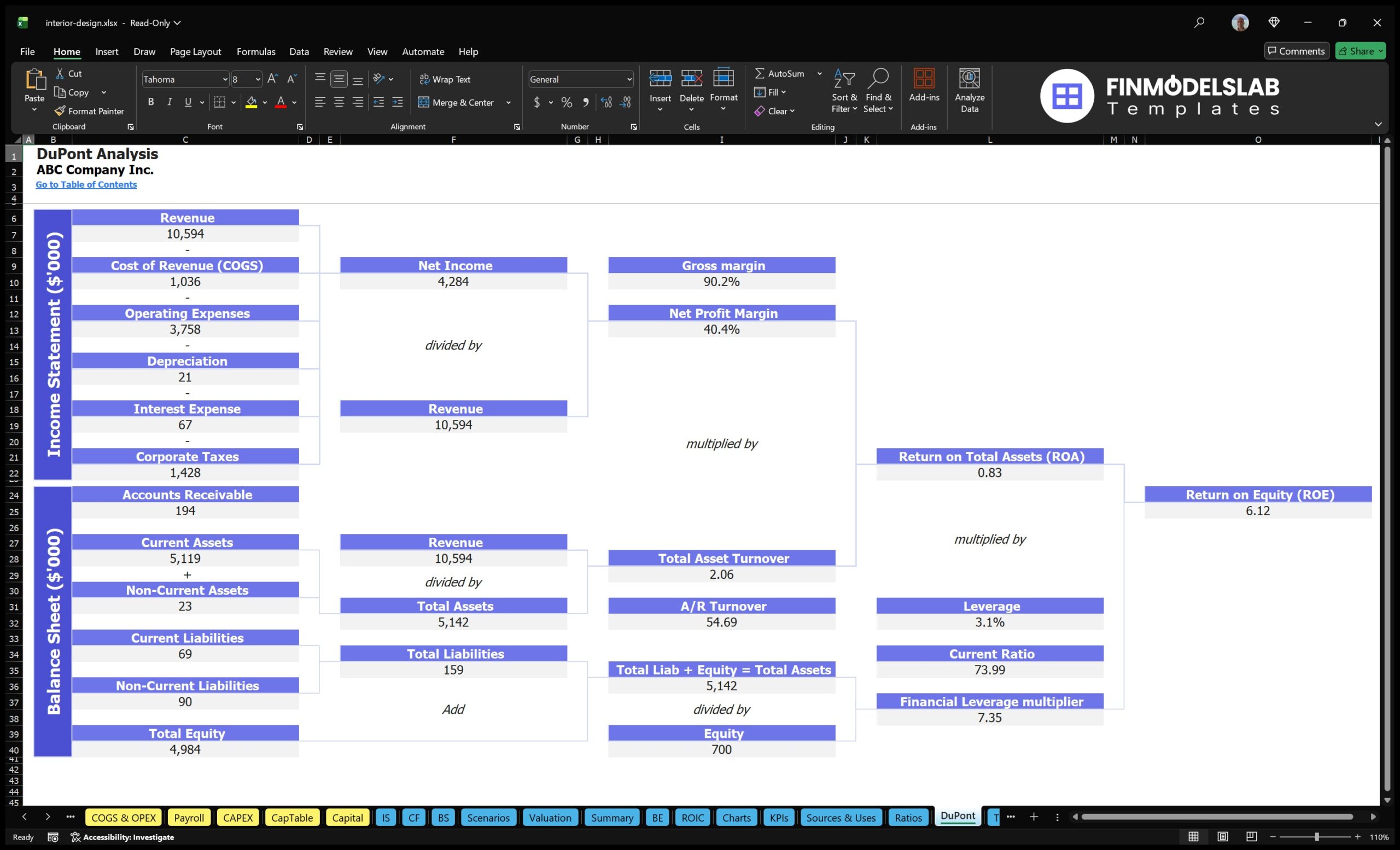
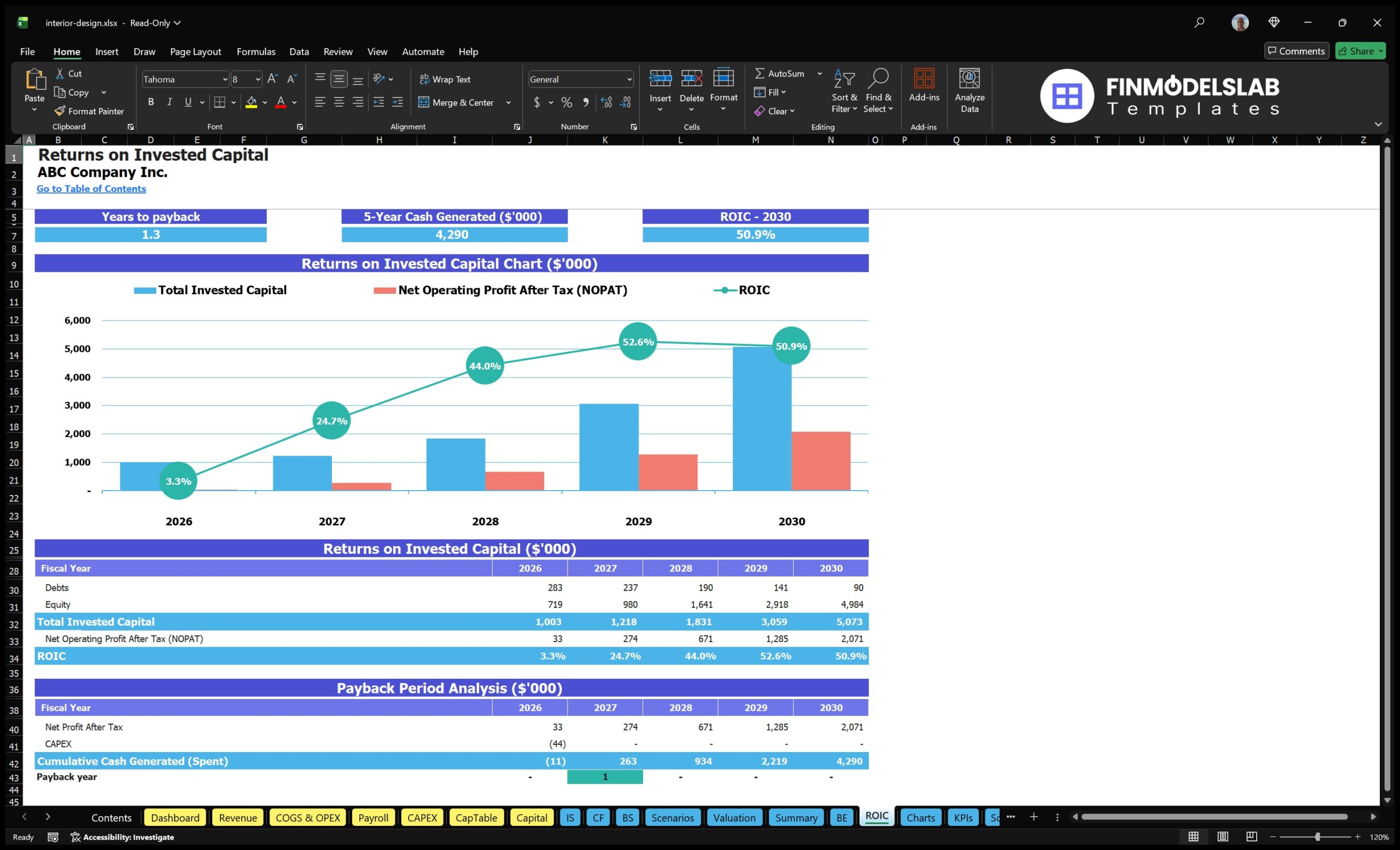
The ROE components and DuPont analysis section helps users understand what drives return on equity in the interior design business. Instead of showing return as a single output, this component breaks performance into the underlying factors that influence profitability and capital efficiency. DuPont-style analysis typically examines relationships between profit margin, asset efficiency, and financial leverage, helping users see whether returns are being driven by strong margins, efficient use of assets, or capital structure. For an interior design studio, this can be especially useful because the business may not require heavy manufacturing assets, but it can still involve meaningful investment in office setup, design software, workstations, sample libraries, marketing, staffing, and working capital. The section may use inputs from the income statement, balance sheet, equity investment, operating profit, revenue, and asset base to calculate how effectively the business is generating returns for owners or investors. This component supports funding discussions because it helps explain not only whether the business is profitable, but how efficiently it converts invested capital into financial returns. It also supports strategic decisions such as whether to scale with more staff, increase prices, reduce overhead, or improve project delivery efficiency.
Revenue Inputs
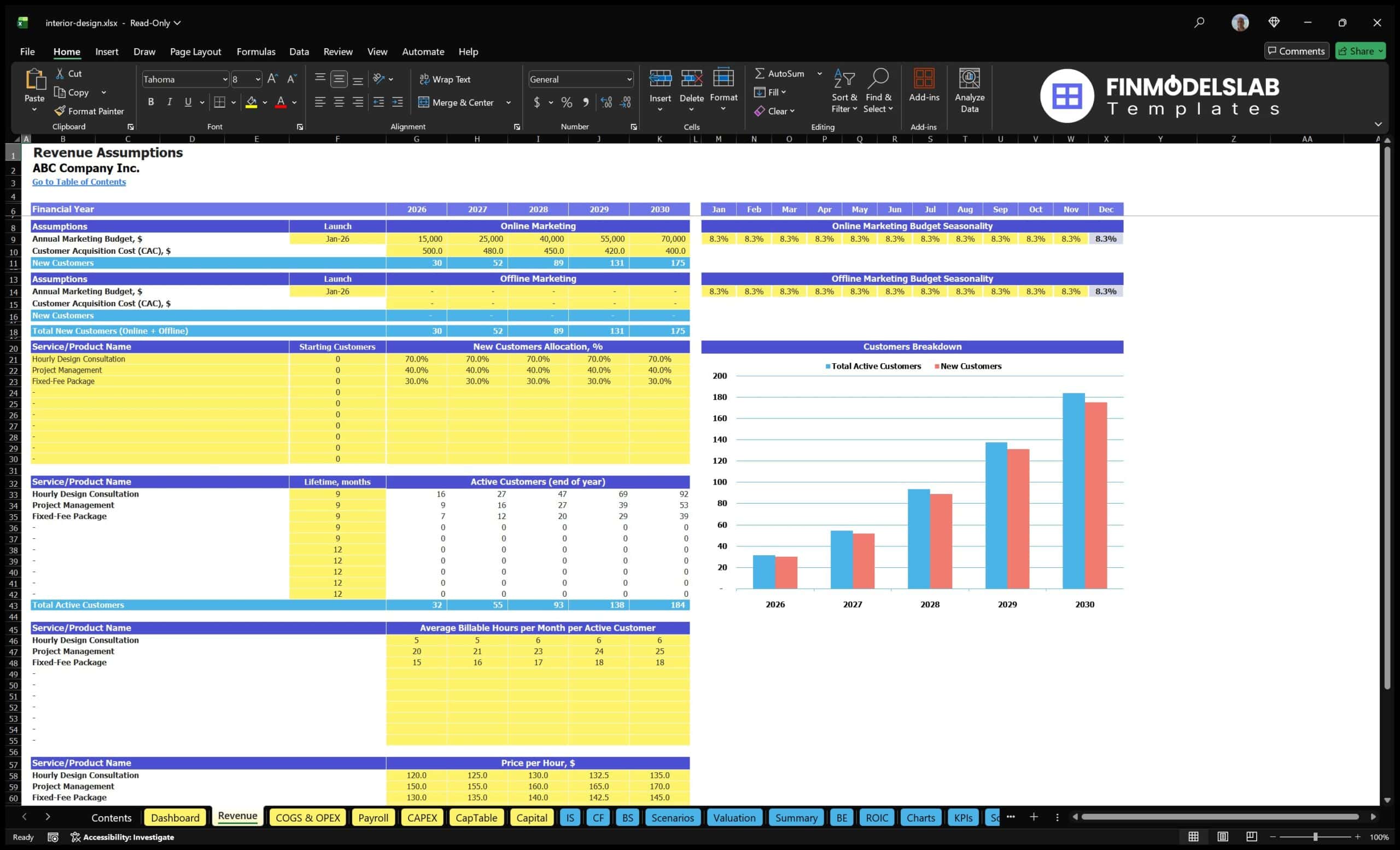
The revenue inputs component is one of the most important parts of the Interior Design Financial Model because it defines how the business generates income. It helps users build revenue assumptions around the actual mechanics of an interior design firm, including active clients, new customer acquisition, service mix, hourly consulting rates, project management fees, fixed-fee packages, average billable hours, retainers, and marketing-driven client growth. The model can use assumptions such as annual marketing spend, customer acquisition cost, conversion rates, pricing by service, and average project workload to estimate how many clients the firm may serve and how much revenue each service line may produce. This is more useful than a simple top-down sales estimate because it connects revenue to measurable business drivers. A user can test whether a planned marketing budget can produce enough new clients, whether pricing is high enough to support staffing, and whether project capacity is realistic based on billable hours. For founders and business planners, this component helps create a defensible sales forecast. For existing interior designers, it can support pricing strategy, service packaging, client acquisition planning, and revenue target setting.
Bank-Ready Reports
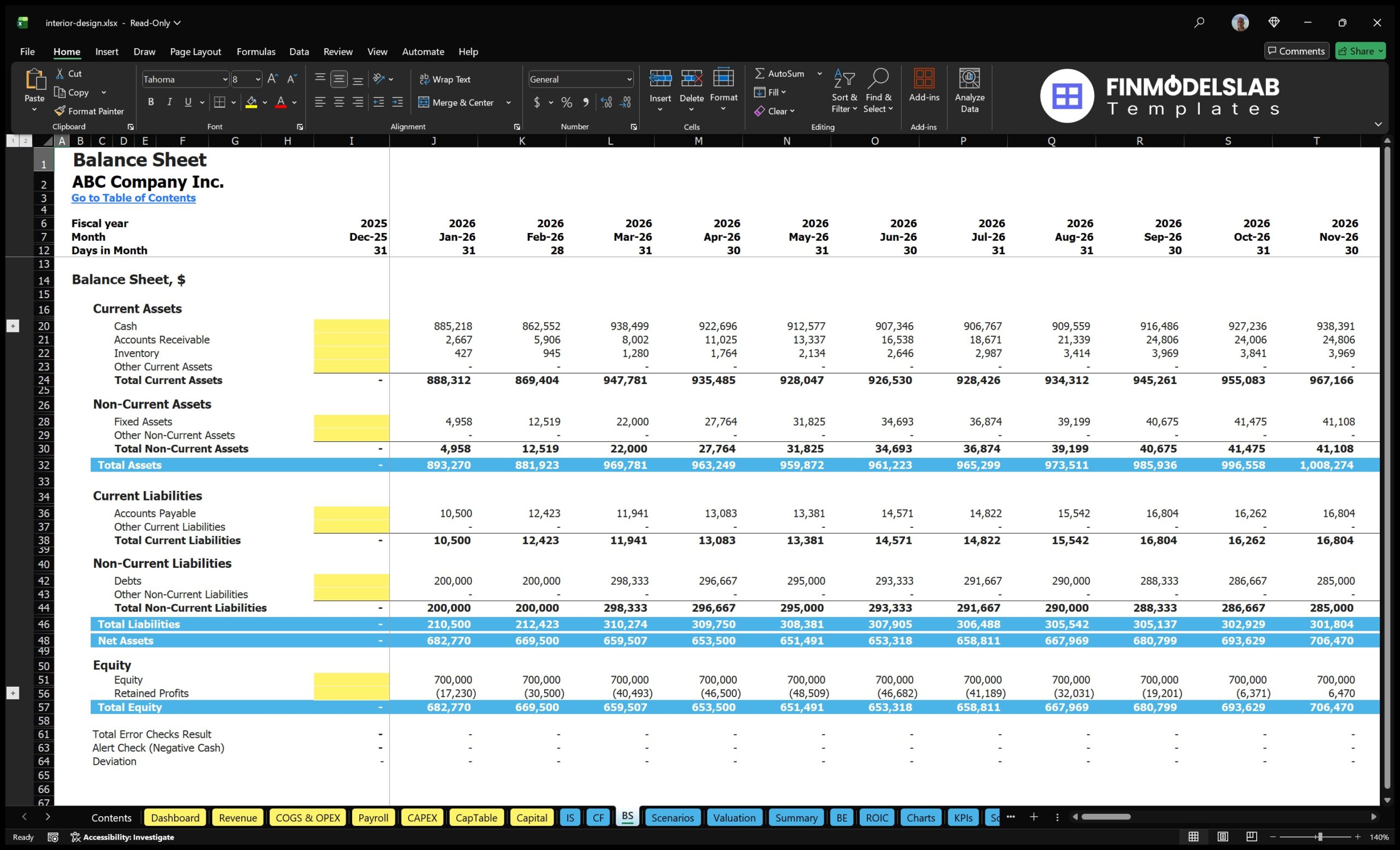
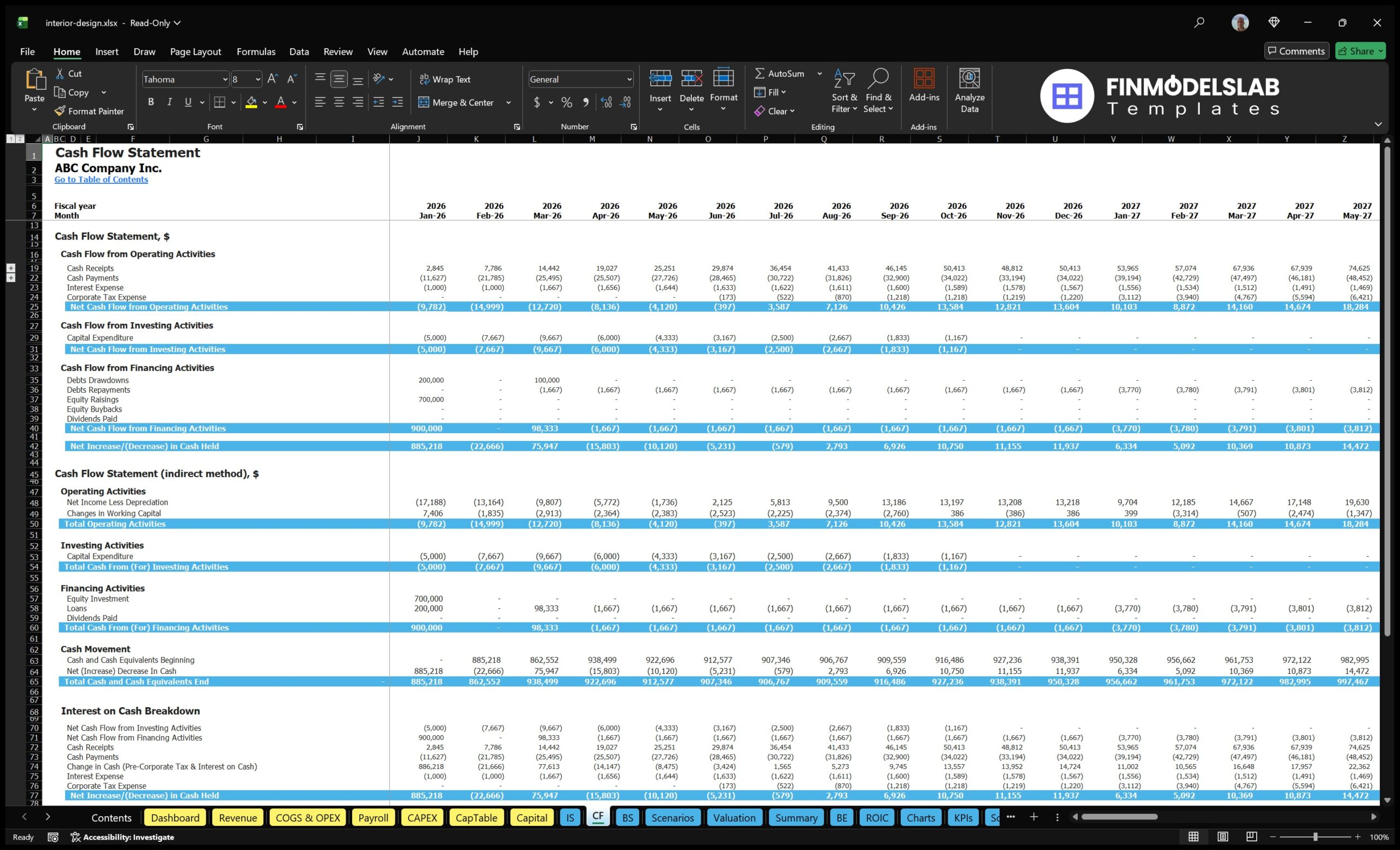
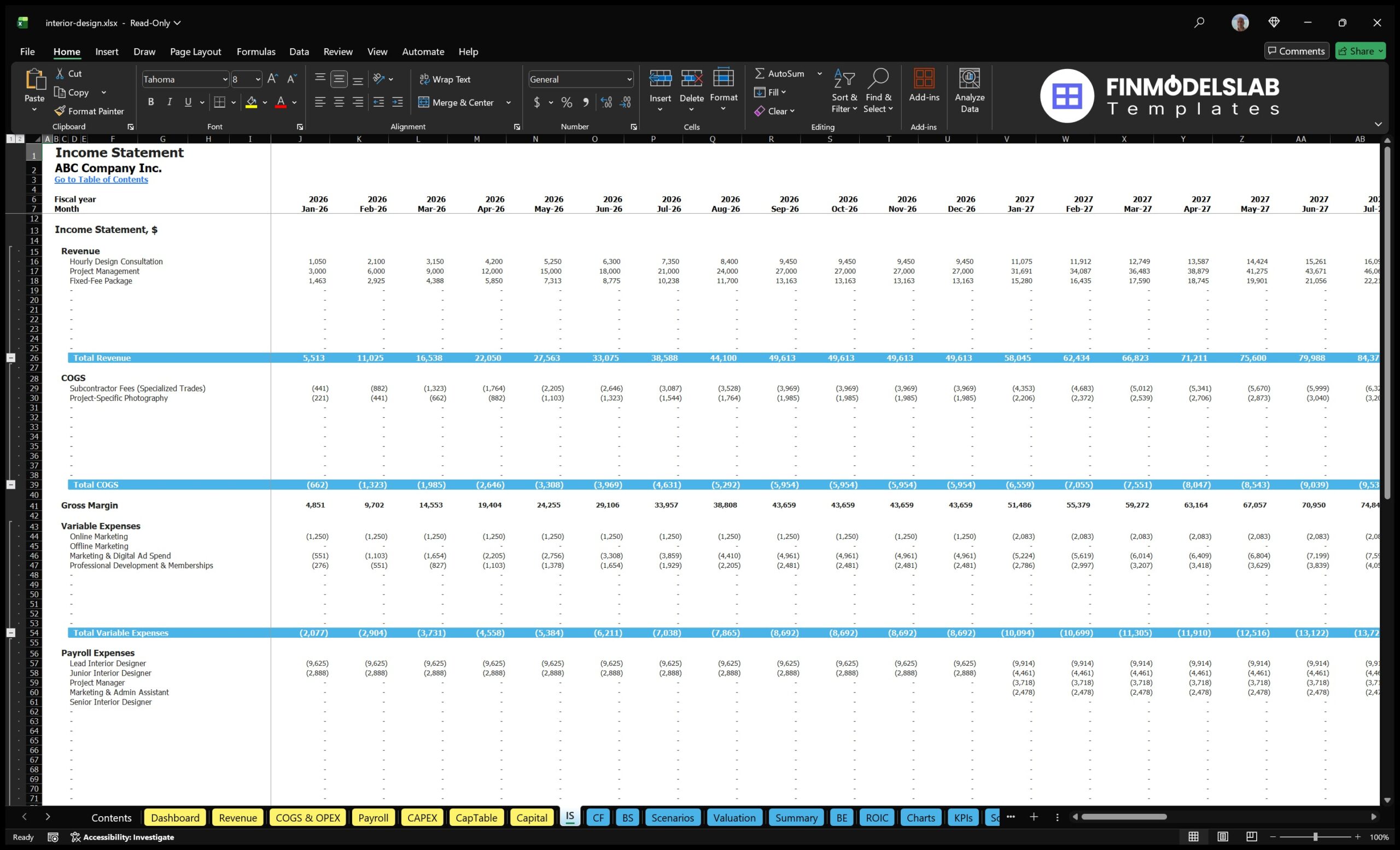
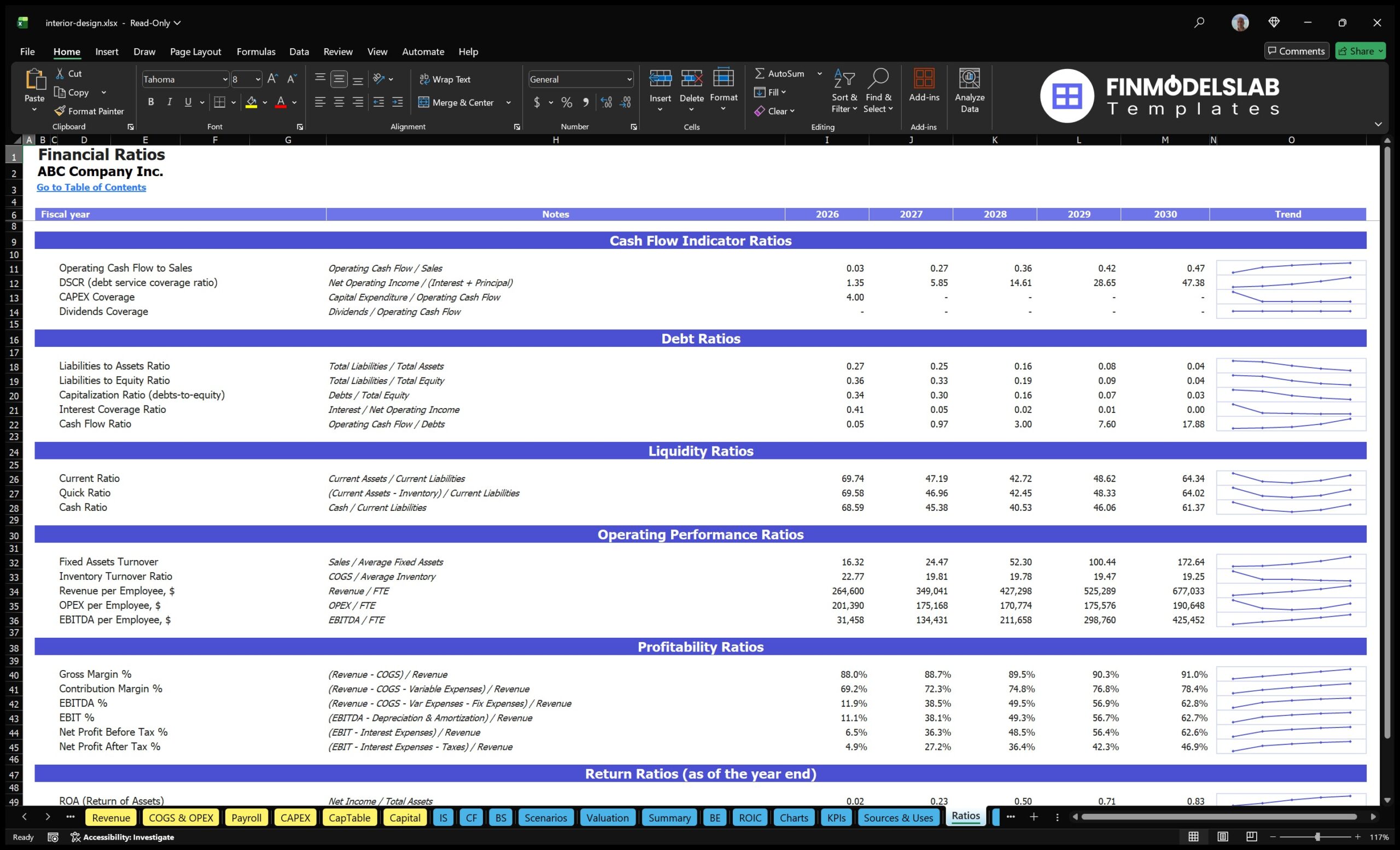
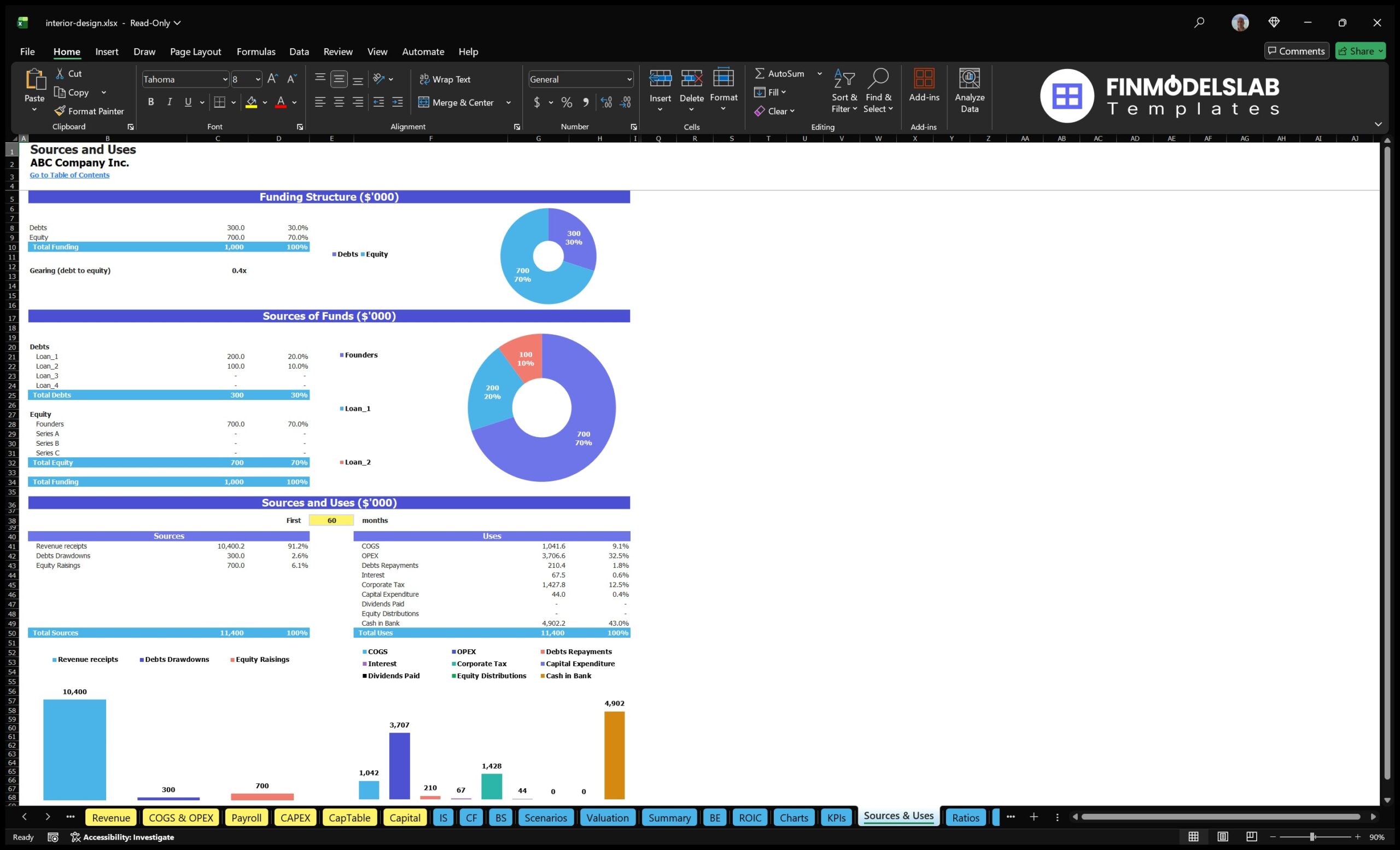
The bank-ready reports component organizes the financial outputs of the model into a clear format suitable for lenders, investors, accountants, and other professional stakeholders. When applying for a business loan, line of credit, or startup funding, an interior design firm typically needs more than a rough estimate of sales. Stakeholders often expect structured income statements, cash flow forecasts, balance sheet projections, profitability metrics, funding needs, payback expectations, and assumptions that support the numbers. This section helps present those outputs in a lender-friendly format so users can explain how the business will generate revenue, manage expenses, cover debt obligations, and maintain sufficient cash. The reports may draw from revenue inputs, payroll schedules, startup costs, operating expenses, direct costs, capital expenditures, and financing assumptions to produce a coherent financial package. For a new studio, this can help define the capital required to launch and survive the early months. For an established business, it can support expansion financing, equipment purchases, new office planning, or working capital requests. The value of this component is that it turns detailed model calculations into financial statements and outputs that are easier for decision-makers to review and trust.
Revenue Breakdown
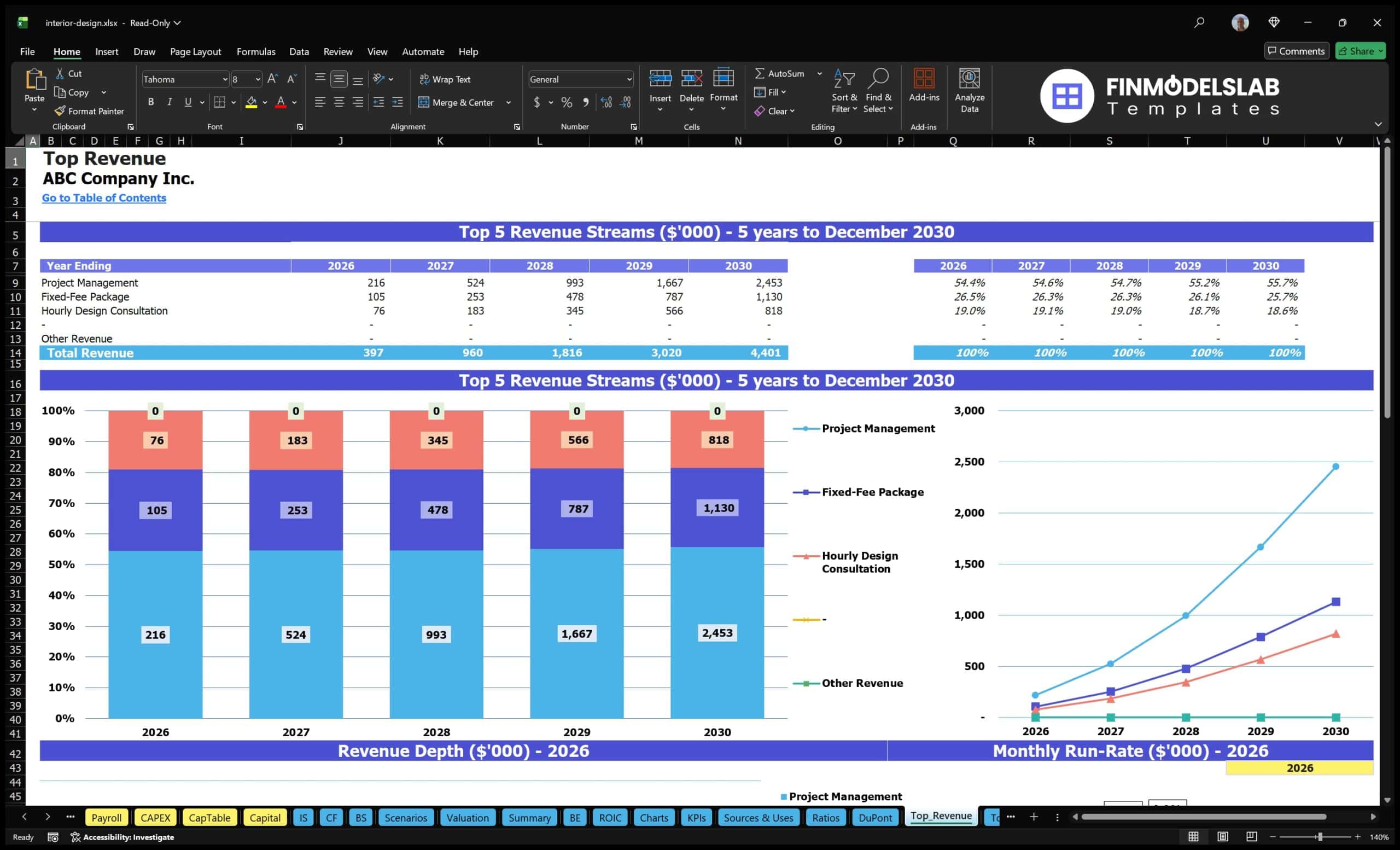
The revenue breakdown component provides a detailed view of how total revenue is built across the interior design firm’s different service lines and income sources. Rather than showing only one total sales figure, this section separates revenue streams such as hourly design consultation, project management, fixed-fee design packages, retainers, sourcing support, or other service categories included in the user’s business model. It may use inputs such as number of clients, average hours per project, hourly rates, package pricing, percentage allocation by service, project frequency, and annual growth assumptions. This detailed view helps users identify which services contribute most to the top line, which offerings may have higher revenue potential, and where pricing or capacity adjustments could improve performance. For example, if project management work has a higher billing rate but requires more coordination time, the model can help users examine whether that service should be prioritized. If fixed-fee packages are easier to sell but create margin pressure, the breakdown can highlight the need to refine scope or pricing. This component supports better commercial strategy because it helps users move beyond total revenue and understand the mix of work that drives the business.
KPI Dashboard
The KPI dashboard component tracks performance metrics that help users evaluate the health, efficiency, and scalability of the interior design business. Financial statements are important, but key performance indicators give users a faster way to understand what is happening inside the model. This section may include metrics such as revenue growth, gross margin, EBITDA margin, cash runway, average revenue per client, customer acquisition cost, payback period, break-even timing, payroll as a percentage of revenue, direct cost ratio, operating expense ratio, and return metrics. For an interior design firm, KPIs are useful because success depends on both creative delivery and disciplined business management. A studio may appear to be growing revenue while still struggling with high acquisition costs, weak margins, slow collections, excessive payroll, or low utilization of billable hours. The KPI dashboard helps identify these issues earlier by summarizing performance in a management-friendly format. It can also include benchmark-style comparisons to help users assess whether assumptions are conservative, aggressive, or aligned with industry expectations. This component is useful for regular internal reviews, investor updates, lender discussions, and strategic planning because it gives users measurable indicators for tracking progress and improving decisions over time.
Startup Cost Planning
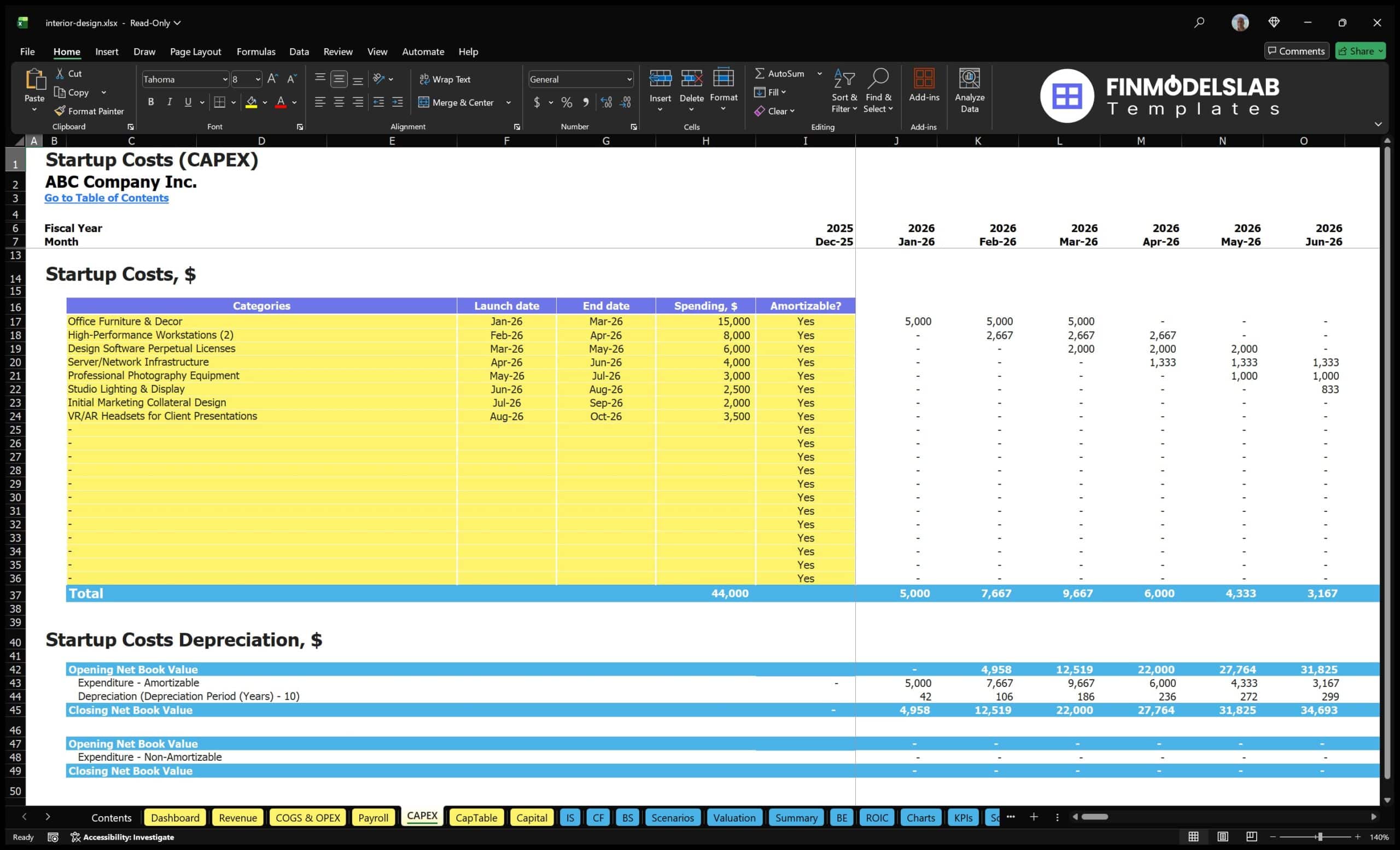
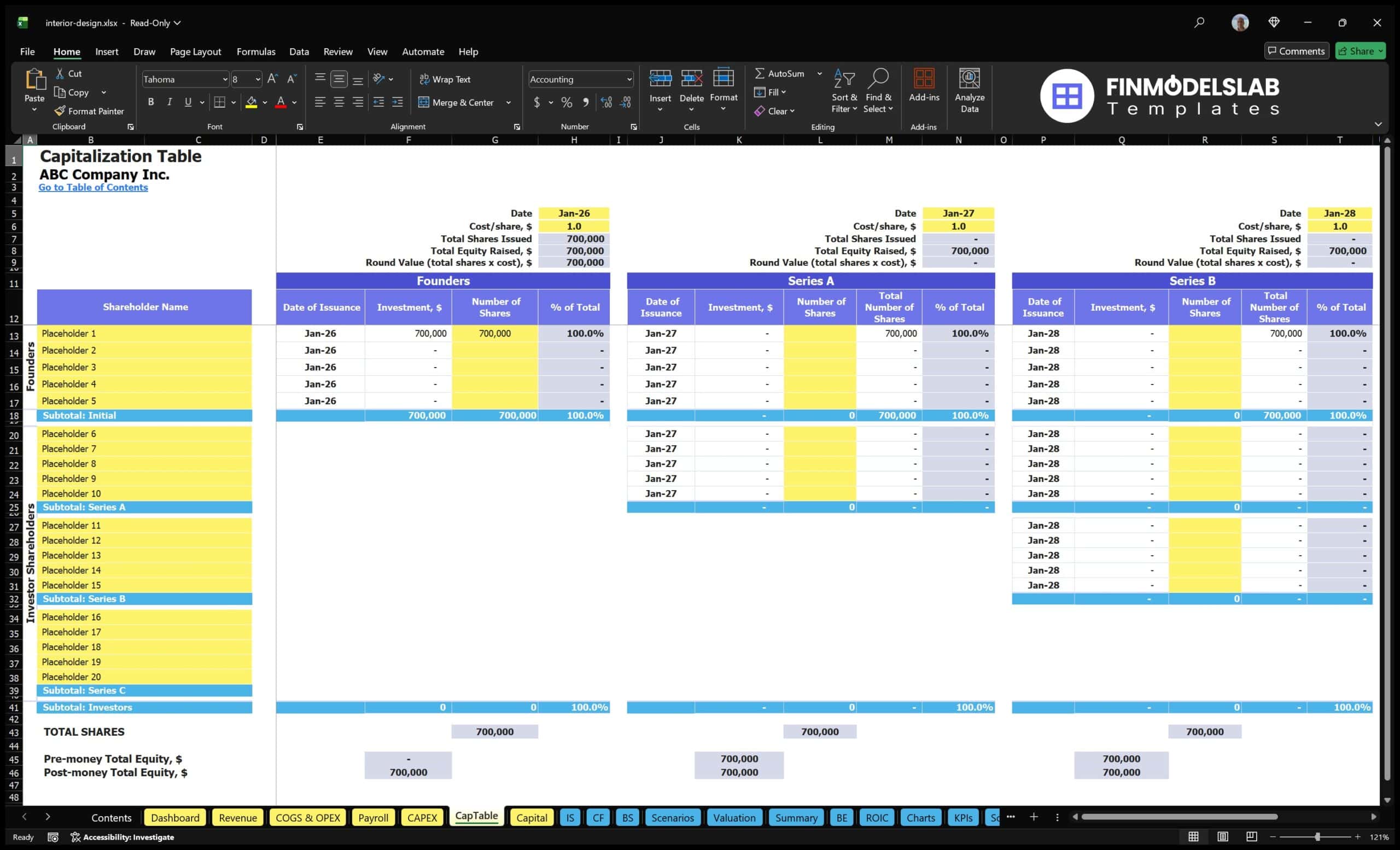
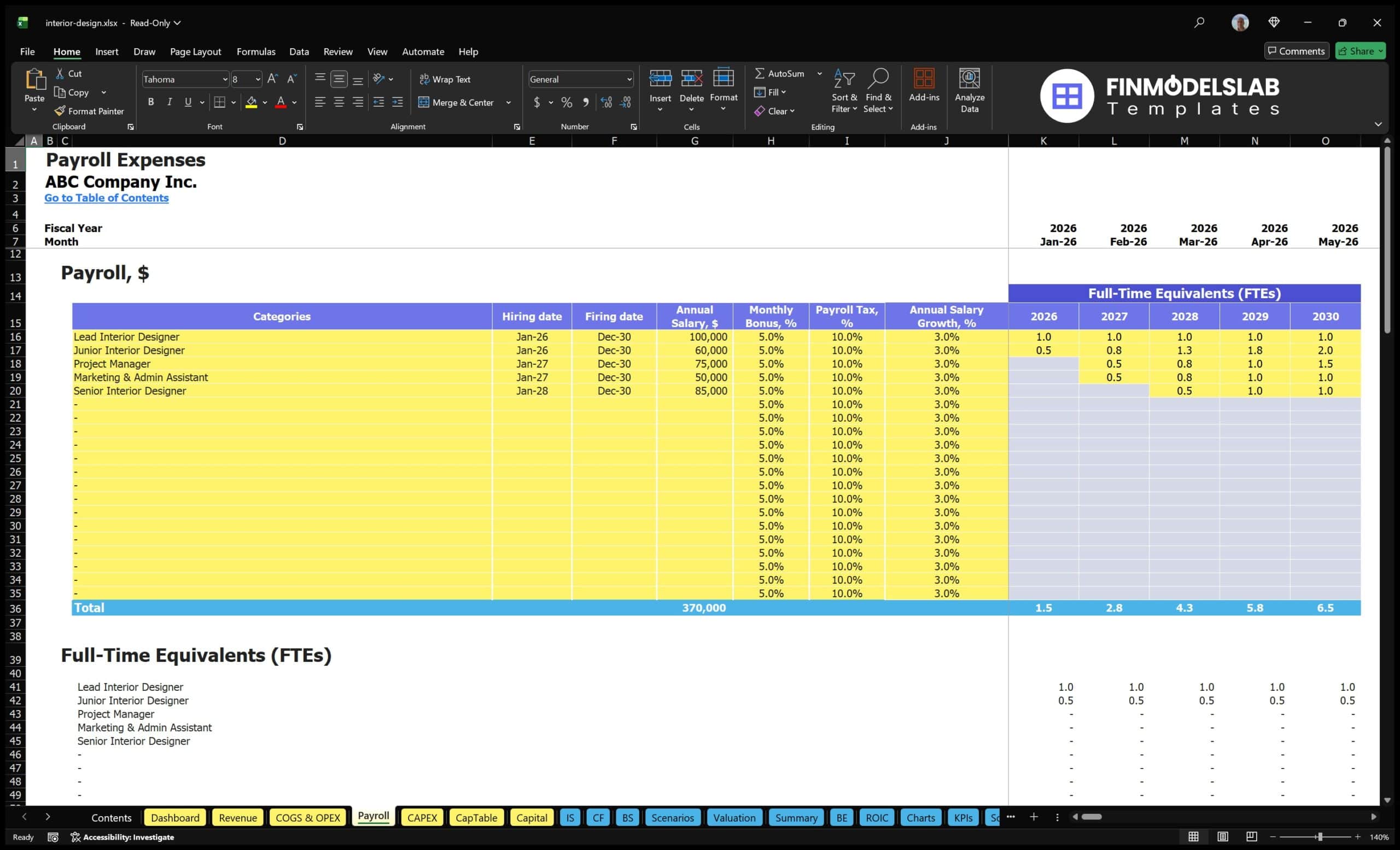
The startup cost planning component helps users estimate the initial investment required to launch or prepare an interior design studio for operations. Interior design businesses can have a wide range of startup needs depending on whether the firm is home-based, operates from a professional studio, hires a team immediately, or invests heavily in client-facing presentation tools. This section may include office furniture, studio decor, computers and workstations, design software licenses, sample materials, website development, branding, legal setup, insurance, deposits, initial marketing, professional photography, consulting support, and opening working capital. It can also include capital expenditures and one-time setup expenses that should not be confused with monthly operating costs. The output helps users calculate how much funding is required before the business can begin generating reliable revenue. This is especially useful for founders preparing a business plan or funding request because underestimating startup costs can create cash pressure early in the launch period. By organizing startup investment in a dedicated section, the model helps users set a realistic fundraising target, compare lean and fully equipped launch plans, and determine how much owner equity, debt, or outside investment may be needed to start the business with sufficient resources.
Break-Even Analysis
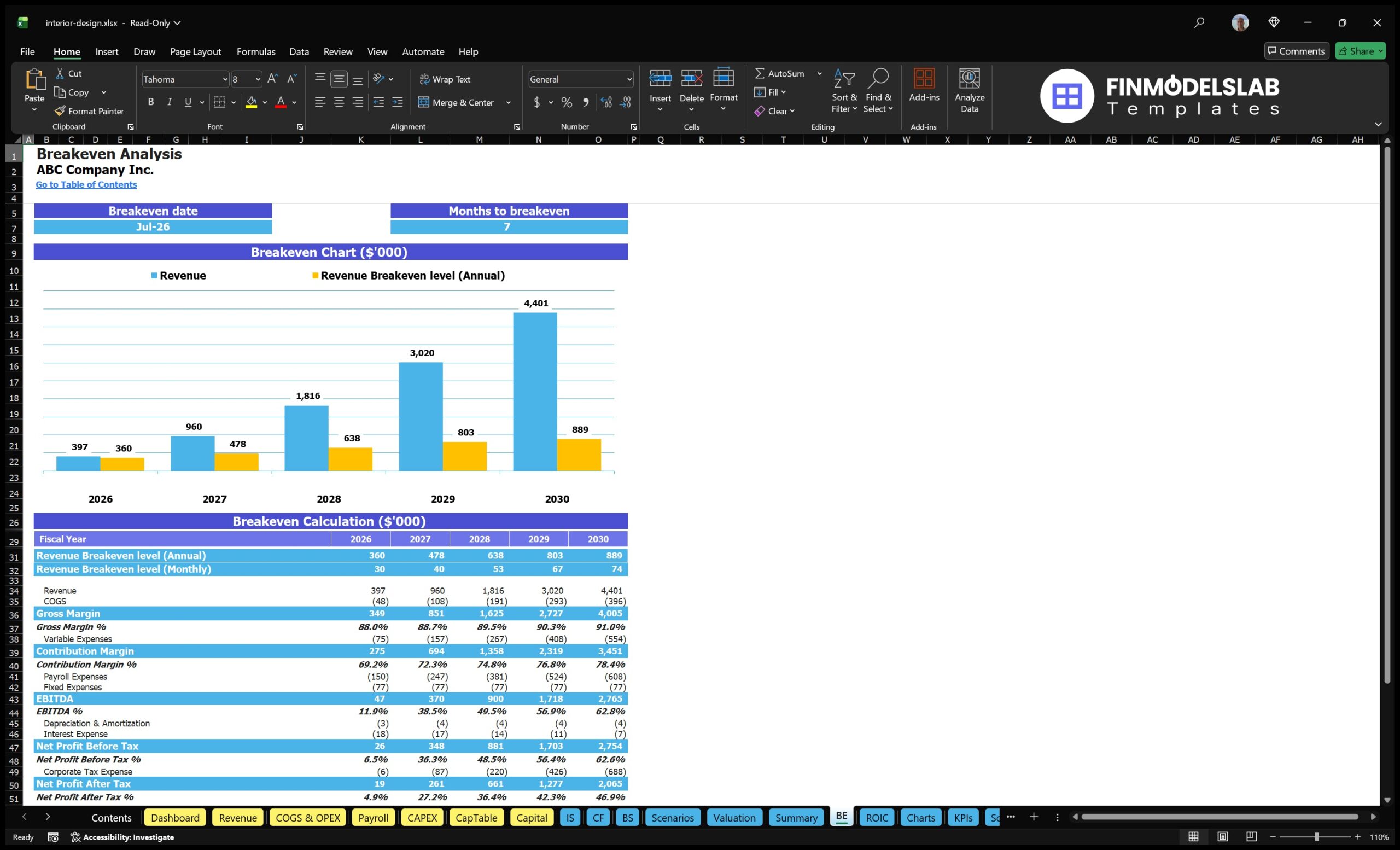
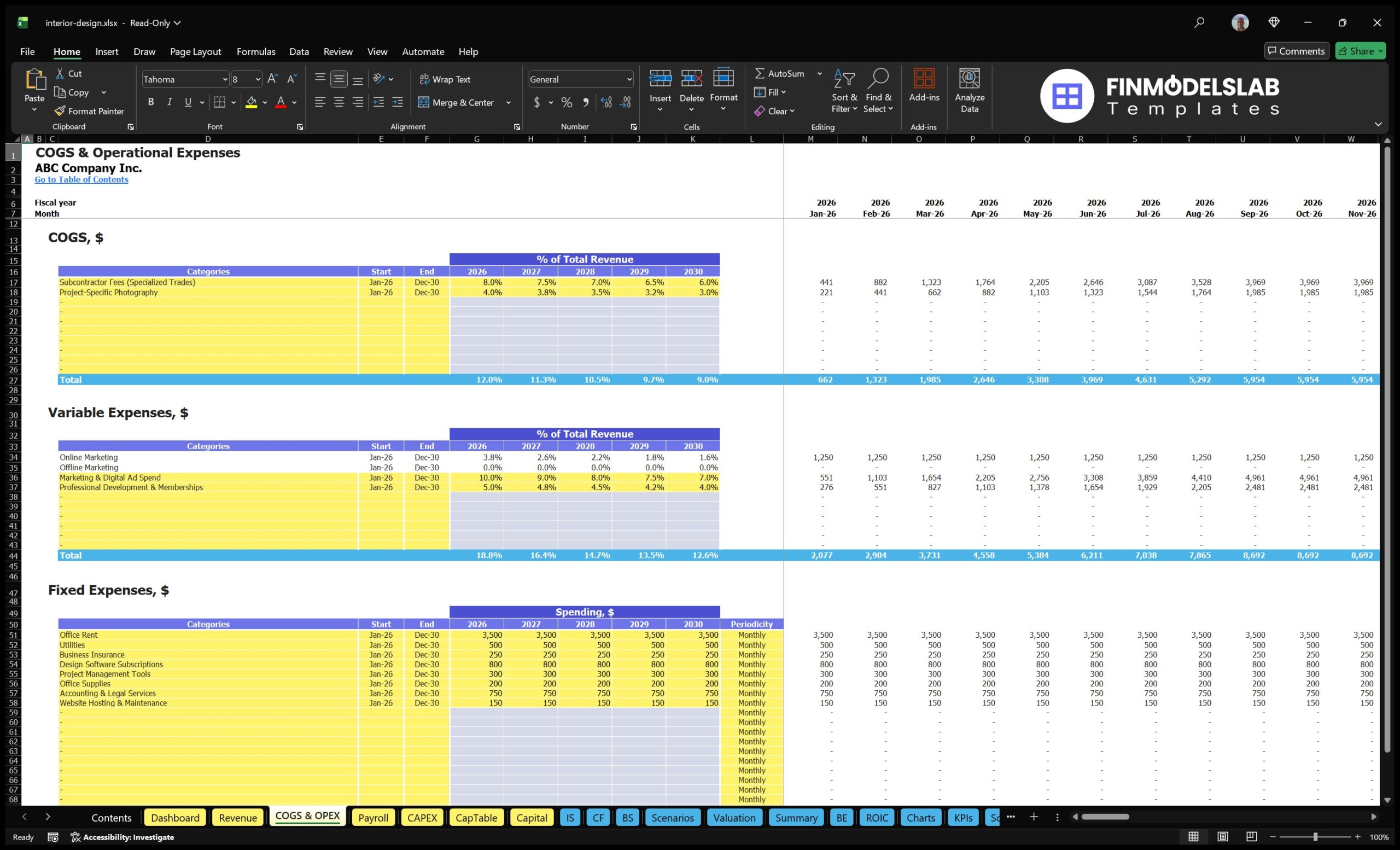
The break-even analysis component helps users identify when the interior design business is expected to cover its total costs and begin generating profit. This section is valuable because many design firms have a mix of fixed overhead, variable direct costs, marketing spend, payroll, subcontractor expenses, and project-related costs that can make profitability difficult to judge from revenue alone. The analysis may use assumptions from the revenue forecast, gross margin, direct cost structure, operating expenses, staffing plan, and pricing model to estimate the monthly or annual revenue required to break even. It can also show the expected timing of break-even based on the five-year forecast, helping users understand how long the business may need external funding or cash reserves before becoming self-sustaining. For an interior design firm, break-even insights can guide pricing, service mix, hiring timing, marketing spend, and overhead decisions. If the break-even point is too far away, the user can test ways to improve the plan, such as increasing hourly rates, requiring retainers, reducing fixed expenses, securing anchor clients, or shifting toward higher-margin services. For investors and lenders, this section provides a clear milestone that demonstrates when the business can move from startup mode toward sustainable profitability.
File types:
Excel – Single-User: .xlsx
Excel – Multi-User: .xlsx
Similar ProductsOther customers were also interested in...


 HenrySheykin
Spa Financial Model Excel Template
The Spa Financial Model helps entrepreneurs, spa owners, consultants, analysts, and business planner... Read more
Cafe Financial Model Excel Template
The Cafe Financial Model is a ready-to-use financial model template designed to help entrepreneurs, ... Read more

Car Wash Service Financial Model Excel Template
The Car Wash Financial Model is a ready-to-use financial model template designed to help entrepreneu... Read more
Nail Salon Financial Model Excel Template
The Nail Salon Financial Model Financial Model Template helps entrepreneurs, salon owners, consultan... Read more
Outpatient Clinic Financial Model Excel Template
The Outpatient Clinic Financial Model helps users turn a clinic business concept into a structured, ... Read more

Skin Care Financial Model Excel Template
The Skin Care Clinic Financial Model helps entrepreneurs, clinic owners, consultants, analysts, and ... Read more

Freight Brokerage Financial Model Excel Template
The Freight Brokerage Financial Model Financial Model Template helps entrepreneurs, founders, busine... Read more

Gift Shop Financial Model Excel Template
The Gift Shop Financial Model helps users build a structured financial forecast for a retail gift st... Read more

Car Rental Financial Model Excel Template
The Car Rental Financial Model helps entrepreneurs, founders, business owners, consultants, and anal... Read more

Home Health Care Financial Model Excel Template
The Home Health Care Agency Financial Model helps users turn a care services business plan into a st... Read more
You must log in to submit a review.