
0 ITEMS

Fashion Marketplace Financial Model Excel Template
The Fashion Retail Financial Model helps entrepreneurs, founders, business owners, consultants, and analysts turn a fashion retail concept into a structured financial forecast. Instead of relying on a generic retail spreadsheet, this template is built around the operating drivers that matter for apparel and accessories businesses, including customer traffic, conversion rates, average order value, product mix, inventory requirements, gross margin, repeat purchases, payroll, rent, marketing, and opening costs. It gives users a practical framework for estimating revenue potential, startup investment, operating expenses, cash flow, profitability, and funding needs before launching or expanding. This Fashion Retail Financial Model Financial Model Template is useful for clothing boutiques, apparel stores, online fashion retailers, accessories shops, showroom concepts, and hybrid retail models that combine ecommerce with physical selling locations. Users can customize assumptions to reflect their own pricing, sales channels, staffing plan, supplier costs, marketing strategy, inventory purchasing, and growth expectations. The model supports business planning, investor discussions, bank loan preparation, internal budgeting, and strategic decision-making by connecting commercial assumptions with monthly and annual financial projections. The template is designed to help users understand whether the business can generate enough revenue and margin to cover its cost structure. It supports revenue assumptions, startup costs, operating expenses, payroll planning, cost of goods sold, cash flow forecasting, profitability analysis, and break-even analysis in one connected model. By adjusting assumptions, users can evaluate how changes in traffic, conversion rate, repeat customer behavior, average order value, inventory costs, or marketing spend affect cash runway, profit margins, return on investment, and long-term growth. Built for practical use, the model includes editable inputs, automated calculations, presentation-ready outputs, and dashboard-style views that make the forecast easier to review and explain. It is suitable for non-financial users who need a ready-to-use structure, as well as experienced analysts who want a customizable starting point. Whether preparing a business plan, comparing launch scenarios, seeking funding, or managing an existing fashion retail operation, this template helps organize the financial planning process and turn assumptions into clearer, more confident decisions.
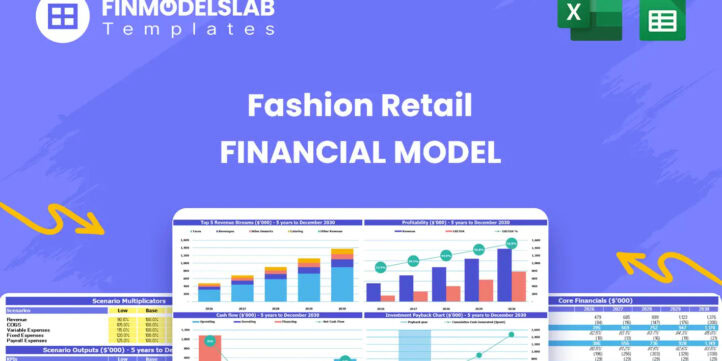


Financial Model Overview
The Fashion Retail Financial Model is a ready-to-use financial model template built specifically for apparel stores, clothing boutiques, fashion accessories shops, online fashion retailers, and hybrid fashion businesses that sell through both physical and digital channels. Fashion retail has unique financial planning requirements because performance depends on product mix, inventory purchasing, gross margins, customer traffic, conversion rates, average order value, repeat customer behavior, seasonality, staffing, rent, marketing, and upfront launch costs. This template brings those drivers into one structured planning tool so entrepreneurs, business owners, founders, consultants, and analysts can forecast revenue, expenses, cash flow, profitability, funding needs, and returns with greater clarity. Instead of starting from a blank spreadsheet, users can work from an editable model designed to support business planning, investor presentations, bank discussions, budgeting, and internal decision-making. The model helps users test whether the business can reach sustainable profitability, understand how much initial capital may be required, and identify the assumptions that have the greatest impact on financial performance.
All-in-One Dashboard
The all-in-one dashboard gives users a central view of the most important inputs and outputs in the Fashion Retail Financial Model. It is designed to make the model easier to navigate by bringing key assumptions, financial results, and business indicators into one organized area. Users can review core drivers such as visitor traffic, conversion rates, average order value, revenue growth, cost of goods sold, operating expenses, payroll, capital requirements, EBITDA, net income, and cash balance without having to search through multiple tabs. The dashboard helps translate detailed calculations into an executive-level view that is useful for founders, investors, lenders, and management teams. For a fashion retail business, this is especially valuable because many decisions are connected, such as how inventory buying affects cash, how marketing affects customer acquisition, and how pricing affects gross margin. The dashboard supports faster decision-making by showing whether the business plan is financially balanced, whether projected revenue can support the cost structure, and whether the company has enough liquidity to operate through its launch and growth stages.
Low, Base, and High Scenario Analysis
The low, base, and high scenario analysis section helps users evaluate how different assumptions can change the financial outlook of the fashion retail business. Instead of relying on one fixed forecast, users can compare a conservative case, an expected case, and an upside case to understand risk and opportunity. Inputs may include changes in store visitors, website traffic, conversion rate, average order value, repeat purchase behavior, gross margin, marketing spend, inventory efficiency, payroll needs, rent, and other operating expenses. The outputs help show how revenue, EBITDA, profit, cash runway, return on investment, and funding requirements may shift under different market conditions. For a clothing store or fashion accessories business, scenario planning is especially important because sales can be affected by seasonality, trends, foot traffic, ecommerce conversion, supplier pricing, markdowns, and customer demand. This component is useful for funding preparation because investors and lenders often want to see that the business has considered downside risk, realistic expectations, and upside potential. It also helps business owners set minimum performance targets, define stretch goals, and prepare contingency plans before cash flow pressure becomes a problem.
Professional Charts
The professional charts section turns the model’s financial outputs into clear visual reports that can be used for presentations, business plans, stakeholder updates, and internal reviews. It may include visual summaries of revenue growth, gross profit, EBITDA, net income, operating expenses, cash balance, customer growth, revenue mix, and other key metrics. Instead of reading only rows of spreadsheet data, users can quickly see financial trends over time and identify whether the business is moving toward stronger profitability, better cash flow, and healthier margins. For fashion retail planning, charts are useful because they help communicate the relationship between sales volume, product margins, inventory investment, and operating costs in a more accessible way. A founder can use them to explain the growth story to investors, while a consultant or analyst can use them to support recommendations in a client presentation. These charts also make the financial model easier to review with non-financial stakeholders, such as partners, store managers, lenders, or suppliers, because the visuals highlight the important takeaways from the underlying calculations.
ROE Components and DuPont Analysis
The ROE components section uses DuPont-style analysis to help users understand what is driving return on equity in the fashion retail business. Rather than viewing return on equity as a single percentage, this component breaks performance into underlying drivers such as profitability, asset efficiency, and financial leverage. Inputs and outputs may reflect net profit margin, revenue, total assets, equity, working capital, inventory investment, and financing structure. For a fashion retail business, this analysis is useful because strong sales alone do not always mean strong returns. A store may generate high revenue but tie up too much cash in inventory, carry excessive operating expenses, or rely on financing that changes the risk profile of the business. DuPont analysis helps users see whether projected returns are coming from healthy margins, efficient use of assets, or leverage. This is valuable for investors, founders, and financial analysts because it provides a deeper view of capital efficiency. It also helps management evaluate whether improvements should come from better pricing, lower cost of goods sold, faster inventory turnover, leaner operating expenses, or a more balanced funding structure.
Revenue Inputs
The revenue inputs section is where users build the foundation of the fashion retail forecast by entering the assumptions that drive sales. For a fashion retail business, revenue is often shaped by store visitors, website traffic, conversion rates, average order value, product category mix, customer retention, repeat purchases, and sales channel strategy. This section allows users to adjust assumptions for new customers and returning customers, as well as revenue across categories such as dresses, handbags, accessories, footwear, seasonal collections, or other apparel lines. It may also support assumptions for physical store sales, online sales, pop-up events, wholesale opportunities, or other retail channels depending on the user’s business model. The outputs from this section flow into revenue forecasts, gross profit calculations, cash flow projections, and profitability analysis. This component is useful because it encourages a bottom-up planning approach rather than a simple top-down sales estimate. Users can test whether their expected traffic and conversion assumptions are realistic, whether average order value is high enough to support margins, and whether repeat customers can become a meaningful growth driver over time.
Bank-Ready Reports
The bank-ready reports section organizes the financial forecast into lender-friendly outputs that can support loan applications, credit discussions, funding requests, and formal business planning. These reports typically summarize revenue, operating expenses, cost of goods sold, gross profit, EBITDA, net income, cash flow, funding needs, and repayment capacity in a structured format. For fashion retail businesses, lenders often want to understand how much capital is needed for buildout, initial inventory, technology, staffing, rent deposits, marketing, and working capital, as well as how the business will generate enough cash to cover ongoing obligations. This section helps users present the financial plan in a clear and professional way, with assumptions connected to outputs rather than isolated estimates. It can also support conversations with investors, landlords, suppliers, or partners who need confidence in the business model. The value of this component is that it turns a detailed operating forecast into organized financial statements and summaries that are easier for external stakeholders to review, compare, and evaluate.
Revenue Breakdown
The revenue breakdown section provides a more detailed view of how total revenue is generated across customer groups, product categories, and sales streams. Instead of showing only one total sales figure, this component helps users separate revenue from new customers, repeat customers, specific apparel categories, accessories, online orders, in-store purchases, or other channels relevant to the business. Inputs may include pricing, units sold, average order value, category share, purchase frequency, conversion rate, and customer growth assumptions. The outputs help users see which revenue streams contribute most to sales, gross margin, and long-term growth. This is important in fashion retail because not all products perform the same way. Some categories may generate high sales volume but lower margins, while others may have lower unit volume but stronger profitability. By understanding revenue mix, users can make better decisions about merchandising, buying, promotions, inventory allocation, marketing focus, and pricing strategy. This section also helps users explain the business model more clearly in a business plan by showing exactly where sales are expected to come from.
KPI Dashboard and Performance Benchmarks
The KPI dashboard and performance benchmarks section helps users track the operating and financial metrics that matter most for a fashion retail business. Key performance indicators may include revenue growth, gross margin, EBITDA margin, cash balance, average order value, conversion rate, repeat purchase rate, customer acquisition cost, payroll as a percentage of revenue, inventory efficiency, payback period, return on equity, and other relevant benchmarks. This section can also help users compare projected performance against industry expectations or internal targets. For founders and managers, the KPI dashboard is useful because it turns the forecast into a management tool rather than just a funding document. Users can identify whether the business is depending too heavily on aggressive conversion assumptions, whether margins are strong enough after cost of goods sold, or whether operating expenses are growing faster than sales. For consultants and analysts, KPI tracking supports more precise recommendations and performance reviews. For investors and lenders, it provides a quick way to assess whether the business model appears realistic, scalable, and financially disciplined.
Startup Costs and Opening Investment
The startup costs and opening investment section helps users estimate the capital required before the fashion retail business begins operating or before a new location, channel, or expansion plan is launched. Inputs may include initial inventory purchases, website development, store buildout, point-of-sale systems, office or warehouse equipment, fixtures, branding, photography, packaging, licenses, deposits, professional fees, pre-launch marketing, insurance, technology setup, and working capital reserves. The model organizes these one-time and pre-opening costs so users can understand how much funding may be needed before meaningful revenue begins. For fashion retail, this component is especially important because underestimating launch costs can create immediate cash pressure, particularly when inventory must be purchased before sales are collected. The outputs help users calculate total funding requirements, starting cash needs, capital allocation, and the relationship between initial investment and projected payback. This section is useful for entrepreneurs preparing a startup budget, investors evaluating capital efficiency, and lenders assessing whether the business has enough resources to open successfully and operate through the early months.
Break-Even Analysis
The break-even analysis section helps users identify when the fashion retail business is expected to become profitable and what level of sales is needed to cover its costs. Inputs may include gross margin, fixed operating expenses, payroll, rent, marketing, cost of goods sold, average order value, product mix, variable costs, and customer volume assumptions. The outputs may show the monthly break-even point, cumulative break-even timing, required revenue, required transactions, and the relationship between sales growth and profitability. This component is valuable because it gives users a clear milestone for business viability. A fashion retail business may have strong revenue potential, but it still needs enough gross profit after inventory costs and markdowns to cover rent, salaries, marketing, technology, and other overhead. Break-even analysis helps users test whether pricing, margins, conversion rates, and operating expenses are aligned. It also supports funding discussions by showing when losses may turn into profit and how long the business may need outside capital or cash reserves. For decision-making, it helps owners evaluate whether to adjust product mix, reduce fixed costs, improve margins, increase average order value, or accelerate customer acquisition to reach profitability sooner.
File types:
Excel – Single-User: .xlsx
Excel – Multi-User: .xlsx
Similar ProductsOther customers were also interested in...


 HenrySheykin
Online Clothing Store Financial Model Excel Templa...
The Online Clothing Store Financial Model helps founders, entrepreneurs, business owners, consultant... Read more
Etsy & Ebay Store Financial Model Excel Templa...
The Etsy and eBay Store Financial Model helps marketplace sellers, founders, consultants, and busine... Read more

Toys Marketplace Financial Model Excel Template
The Toy Marketplace Financial Model Template helps founders, entrepreneurs, consultants, analysts, a... Read more

Electronics Marketplace Financial Model Excel Temp...
The Online Marketplace Financial Model Template helps entrepreneurs, founders, consultants, analysts... Read more
Collectibles And Antiques Marketplace Financial Mo...
The Antique Store Financial Model helps entrepreneurs, business owners, consultants, founders, and a... Read more

Arts, Crafts And Gifts Marketplace Financial Model...
The Handmade Goods Marketplace Financial Model helps founders, entrepreneurs, consultants, and analy... Read more

 Giorgos
Online Clothing Wholesaler – 5 Year Financia...
Advanced Financial Model presenting a 5 Year Business Plan for an Online Clothing Wholesale company.... Read more

 Pushkar
Online Car Rental – 3 Statement Financial Mo...
Online Car Rental Platform Business Plan Model is a perfect tool for a feasibility study on launchin... Read more

 JILL LIU
Ultra Fashion Revenue and DCF Valuation Model
In this model, we presented a completed revenue and DCF valuation model for an Ultra-Fashion project... Read more
 anthony
Bundle – Business Financial Forecasting Mode...
The purpose of this Bundle of Business Forecasting and Financial Models is to assist Business Owners... Read more
You must log in to submit a review.