
0 ITEMS

Family Service Financial Model Excel Template
The Family Mediation Service Financial Model helps users turn a mediation practice concept into a structured, investor-ready financial plan. It is designed for founders, mediators, consultants, analysts, and business owners who need to forecast how a family mediation service may perform over time. Instead of relying on disconnected spreadsheets, the template organizes the core financial logic of the business, including revenue assumptions, client acquisition, billable hours, hourly rates, operating expenses, payroll, startup costs, cash flow, and profitability. This financial model template is especially useful for people preparing business plans, funding documents, lender presentations, or internal strategy reviews. It gives users a practical framework to estimate revenue from services such as divorce and separation mediation, child custody and co-parenting agreements, and estate or elder care disputes. By connecting client volume, service mix, pricing, staffing, marketing spend, and overhead costs, the model helps users understand what must happen for the business to become financially sustainable. The template is fully editable, allowing users to replace pre-filled assumptions with their own numbers and tailor the forecast to a specific location, pricing strategy, team structure, or growth plan. It supports financial planning by showing how changes in acquisition costs, billable hours, hourly rates, salaries, rent, technology, professional fees, and other operating expenses can affect profit margins and cash flow. This makes it useful not only for launch planning, but also for evaluating expansion, hiring decisions, marketing budgets, and service line adjustments. For decision-making, the Family Mediation Service Financial Model provides a clear way to review profitability, break-even analysis, projected financial statements, cash flow needs, and key performance indicators. Users can test low, base, and high scenarios, review charts and dashboards, prepare bank-ready financial outputs, and communicate financial expectations to partners, lenders, investors, or advisors. It saves time compared with building a model from scratch while still giving users the flexibility to adapt the forecast to their own mediation business strategy.
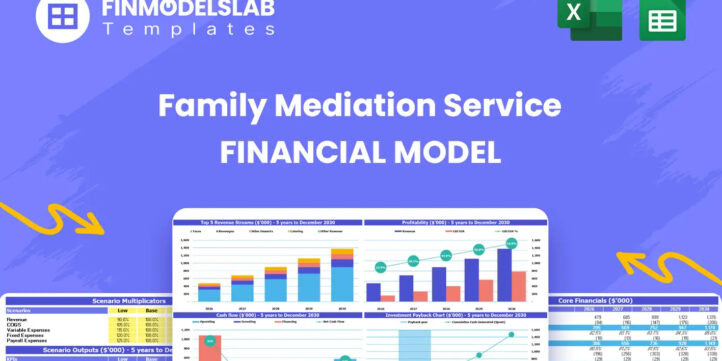


Financial Model Overview
The Family Mediation Service Financial Model is a ready-to-use financial model template built to help entrepreneurs, mediators, consultants, analysts, and business owners evaluate the financial potential of a family mediation practice. It brings together the main assumptions needed to plan revenue, pricing, client acquisition, service delivery, payroll, operating expenses, startup investment, cash flow, profitability, and funding requirements. A family mediation service depends on a clear balance between professional capacity, billable hours, hourly rates, client volume, referral activity, marketing efficiency, and administrative overhead. This model gives users a structured way to test that balance before launch, during growth planning, or when preparing a business plan for lenders and investors. Instead of building a spreadsheet from the ground up, users can work from an organized framework with editable inputs, automated calculations, financial outputs, charts, and decision-focused dashboards. The model is designed to support practical planning, helping users understand what drives performance, how long it may take to reach profitability, and how different assumptions affect the long-term financial outlook of the mediation service.
All-in-One Dashboard
The all-in-one dashboard brings the most important inputs and outputs into one central view, giving users a quick way to understand the overall financial position of the family mediation service. This component is useful because a mediation practice has several connected moving parts, including client acquisition costs, service mix, average billable hours per case, hourly rates, staffing levels, payroll, fixed overhead, and cash reserves. The dashboard helps users see how these assumptions flow into revenue, gross profit, EBITDA, net income, cash flow, and other key results. Instead of searching through multiple schedules, users can review the core forecast logic and the headline outputs in one place. This supports faster decision-making when testing pricing changes, adjusting marketing spend, planning hiring needs, or evaluating whether the business has enough financial runway. For business plans and funding discussions, the dashboard also helps communicate the financial story clearly by summarizing performance in a format that is easier for stakeholders to understand.
Low Base High Scenario Analysis
The low, base, and high scenario analysis section helps users evaluate how the family mediation service may perform under different business conditions. In a professional services business, actual results can vary depending on referral volume, marketing conversion rates, client demand, case complexity, hourly rates, mediator utilization, and operating cost discipline. This component allows users to create separate forecasts for conservative, expected, and optimistic outcomes, making it easier to understand potential upside and downside risk. Inputs may include different assumptions for customer acquisition, active client count, average billable hours, pricing, payroll expansion, marketing spend, and operating expenses. The outputs help users compare revenue, profit margins, cash flow, and funding needs across scenarios. This is especially valuable for decision-making because it shows whether the business can remain stable if client growth is slower than expected, or how quickly it can scale if demand is stronger. For lenders, investors, and internal planning teams, scenario analysis adds credibility by showing that the business plan has been stress-tested rather than built around a single fixed forecast.
Professional Charts
The professional charts component turns the financial model’s calculations into clear visual summaries that can be used for presentations, business planning, investor discussions, and internal performance reviews. Financial statements and assumption schedules are important, but charts make it easier to communicate trends such as revenue growth, EBITDA development, profit margin improvement, cash flow movement, and changes in cost structure over time. For a family mediation service, visual reporting can help show how early investment in marketing, staffing, office setup, technology, and brand development leads to future client growth and profitability. This section may draw from revenue forecasts, expense schedules, cash flow statements, profitability metrics, and KPI outputs to generate presentation-ready visuals. The benefit is that users can quickly identify trends and explain them to non-financial stakeholders without requiring them to interpret detailed spreadsheet tabs. Professional charts also support funding conversations by making the plan appear more organized, transparent, and decision-ready. They help users present the business model with clarity while still relying on the underlying financial calculations.
ROE Components and DuPont Analysis
The ROE components and DuPont analysis section helps users understand the drivers behind return on equity and overall financial performance. Rather than showing return metrics as a single number, this component breaks performance into underlying factors such as profitability, asset efficiency, and leverage. For a family mediation service, this is useful because returns are influenced not only by revenue growth, but also by how efficiently the business converts client work into profit, how much investment is tied up in startup assets and working capital, and how funding is structured. Inputs may include net income, equity investment, total assets, revenue, expenses, and balance sheet assumptions. Outputs can show how profit margin, asset turnover, and equity multiplier contribute to return on equity over the forecast period. This helps founders and investors evaluate whether the business is creating value in a sustainable way. It also supports strategic decisions about reinvesting profits, using debt, raising equity, controlling overhead, and improving margins. By showing the mechanics behind returns, this section gives users a more sophisticated view of the financial model than a basic profit forecast alone.
Revenue Inputs
The revenue inputs section is where users define the assumptions that drive sales for the family mediation service. Revenue in this type of business is typically built around billable hours, hourly rates, active client volume, service categories, and the average number of hours required per case. The model can reflect core services such as divorce and separation mediation, child custody and co-parenting agreements, and estate or elder care disputes, while allowing users to adjust pricing and demand assumptions for their own business plan. Inputs may include customer acquisition cost, new client volume, conversion rates, service mix percentages, average billable hours per case, hourly rates, and growth rates over time. These assumptions then feed the revenue forecast automatically, helping users understand how operational decisions translate into projected income. This component is especially important because small changes in billable hours, client mix, or pricing can have a meaningful impact on total revenue and profitability. By organizing revenue assumptions in one place, the model helps users build a forecast that is transparent, editable, and easier to defend in front of lenders, investors, or advisors.
Bank-Ready Financial Reports
The bank-ready financial reports section provides structured outputs that can support loan applications, funding discussions, and formal business planning. Lenders and financial stakeholders usually expect more than a simple revenue estimate; they want to review complete financial statements, clear assumptions, profitability expectations, cash flow forecasts, and the ability of the business to manage obligations over time. This component helps users generate organized financial reports that may include projected profit and loss statements, cash flow statements, balance sheets, EBITDA, net income, debt capacity indicators, and key summary metrics. For a family mediation service, these reports can demonstrate how the business expects to grow its client base, cover payroll and overhead, manage cash, and move toward sustainable profitability. The reports are useful because they translate operating assumptions into formal financial outputs that are easier for banks, lenders, and stakeholders to evaluate. They also help founders identify weaknesses before presenting the plan, such as insufficient cash reserves, high fixed costs, or a delayed path to profitability. With professional formatting and automated links, this section saves time while improving the credibility of the financial plan.
Revenue Breakdown
The revenue breakdown section gives users a detailed view of how total revenue is generated across different mediation services. Instead of treating the business as one general income stream, this component separates revenue by service category so users can evaluate the contribution of each offering. A family mediation service may earn income from divorce and separation mediation, child custody and co-parenting agreements, estate and elder care disputes, workshops, consultations, or related dispute resolution services. Inputs can include the percentage of clients using each service, average case duration, hourly rate, billable hours per case, and expected growth by service line. Outputs help users see which services contribute the most revenue, which have the strongest margins, and where pricing or marketing adjustments may be needed. This is useful for budgeting and strategic planning because different service types may require different expertise, scheduling capacity, administrative support, or marketing channels. A detailed revenue breakdown also helps users identify opportunities to expand higher-value services, refine their client acquisition strategy, and communicate the business model more clearly in funding documents or management discussions.
KPI Dashboard
The KPI dashboard focuses on the key performance indicators that matter most for managing a family mediation service. While financial statements show the outcome of the plan, KPIs help users understand the operating drivers behind those results. This section may track metrics such as client acquisition cost, active clients, conversion rates, average billable hours per case, revenue per client, utilization, EBITDA margin, net profit margin, cash runway, payback period, return on equity, and revenue growth. For founders and operators, these metrics make it easier to monitor whether the business is moving in the right direction and whether assumptions remain realistic as conditions change. The KPI dashboard is also useful for comparing performance against industry benchmarks or internal targets. If customer acquisition costs rise, utilization falls, or average billable hours decline, users can quickly identify the issue and adjust strategy. For investors and lenders, KPI tracking shows that the business is being managed with discipline and that performance can be measured beyond basic top-line revenue. This component supports ongoing decision-making after the initial plan is created.
Startup Costs and Capital Investment Planning
The startup costs and capital investment planning section helps users estimate the amount of funding required to launch or prepare the family mediation service for operation. A mediation practice may require spending on office furniture, decor, IT equipment, computers, secure communication tools, client management software, website development, branding, professional licenses, legal setup, insurance, deposits, initial marketing, and working capital reserves. This component organizes those one-time costs separately from recurring operating expenses, giving users a clearer picture of the initial investment needed before revenue becomes consistent. Inputs may include the cost of physical assets, technology setup, professional services, pre-opening expenses, and contingency amounts. Outputs help users calculate total startup funding needs, allocate capital by category, and determine whether the business will require founder investment, a bank loan, outside funding, or another financing source. This section is useful because many service businesses underestimate upfront costs and then face cash pressure during the early months. By planning capital requirements in advance, users can launch with a more realistic budget and avoid unexpected shortfalls.
Break-Even and Cash Flow Planning
The break-even and cash flow planning section helps users understand when the family mediation service may become financially self-sustaining and whether the business has enough liquidity to reach that point. Break-even analysis compares projected revenue with fixed and variable costs to show when total income is expected to cover total expenses. For a mediation practice, this depends on client volume, billable hours, hourly rates, payroll, rent, marketing, insurance, software, professional fees, and other operating costs. Cash flow planning goes further by showing the timing of money coming in and going out, which is essential because a business can be profitable on paper but still experience cash pressure. Inputs may include payment timing, retainers, accounts receivable assumptions, monthly expenses, startup capital, loan proceeds, debt payments, and working capital requirements. Outputs can show monthly cash balances, lowest cash point, cash runway, break-even timing, and funding gaps. This component is valuable for founders, lenders, and advisors because it helps answer one of the most important planning questions: how much cash is needed to survive the early stages and reach sustainable operations.
File types:
Excel – Single-User: .xlsx
Excel – Multi-User: .xlsx
Similar ProductsOther customers were also interested in...


 HenrySheykin
Infant Care Financial Model Excel Template
The Daycare Center Financial Model helps entrepreneurs, childcare founders, consultants, analysts, a... Read more
Pre-School Care Financial Model Excel Template
The Preschool Financial Model helps entrepreneurs, childcare founders, preschool owners, consultants... Read more

Child Care Financial Model Excel Template
The Daycare Center Financial Model helps entrepreneurs, childcare founders, consultants, analysts, a... Read more

In-Home Daycare Financial Model Excel Template
The In-Home Daycare Financial Model helps users turn a home-based childcare concept into a structure... Read more

Baby Minding Financial Model Excel Template
The Babysitting Service Financial Model helps entrepreneurs, founders, business owners, consultants,... Read more
Babysitting Financial Model Excel Template
The Babysitting Service Financial Model helps entrepreneurs, founders, business owners, consultants,... Read more

 Andreas
Online Tutoring Services Financial Model (10+ Yrs ...
The Online Tutoring Services Financial Model is a comprehensive tool designed to analyze the financi... Read more

Start Up Nursery School Financial Model
Start Up Nursery School Financial Model presents the case of an investment in a nursery school and i... Read more

 Giorgos
Foreign Languages School – 5 Year Financial Mode...
Financial Model providing an advanced 5-year financial plan for a startup or operating Foreign Langu... Read more

Driving School – 5 Year Financial Model
Financial Model providing an advanced 5-year financial plan for a startup or operating Driving Schoo... Read more
You must log in to submit a review.