
0 ITEMS

IFRS Financial Statements Template – Trial Balance to 5 Statements (SOFP, P&L & OCI, Equity, Cash Flow, Notes) with Ratios & Dashboard (Excel)
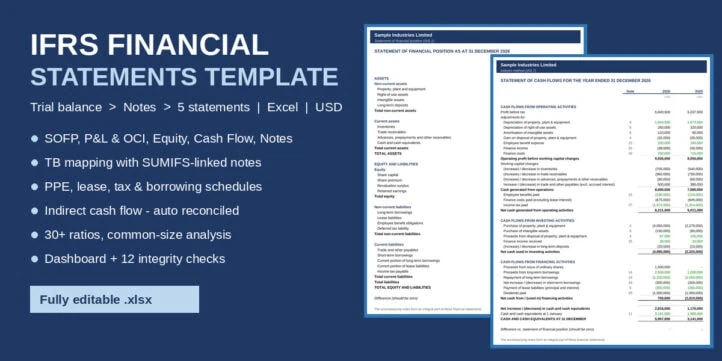
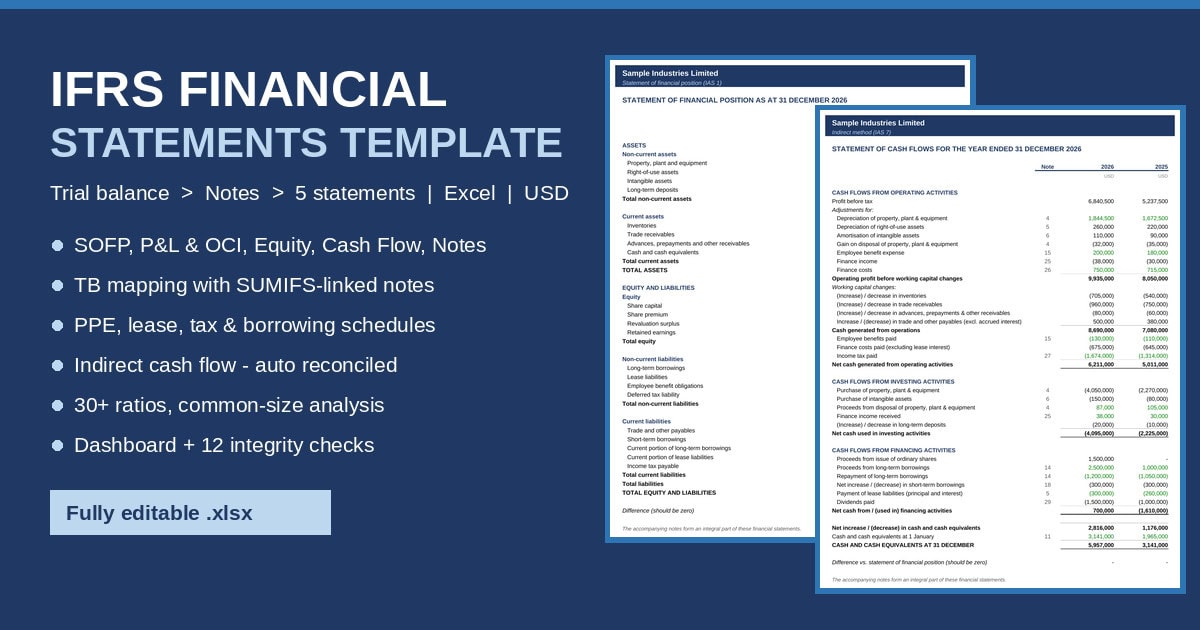
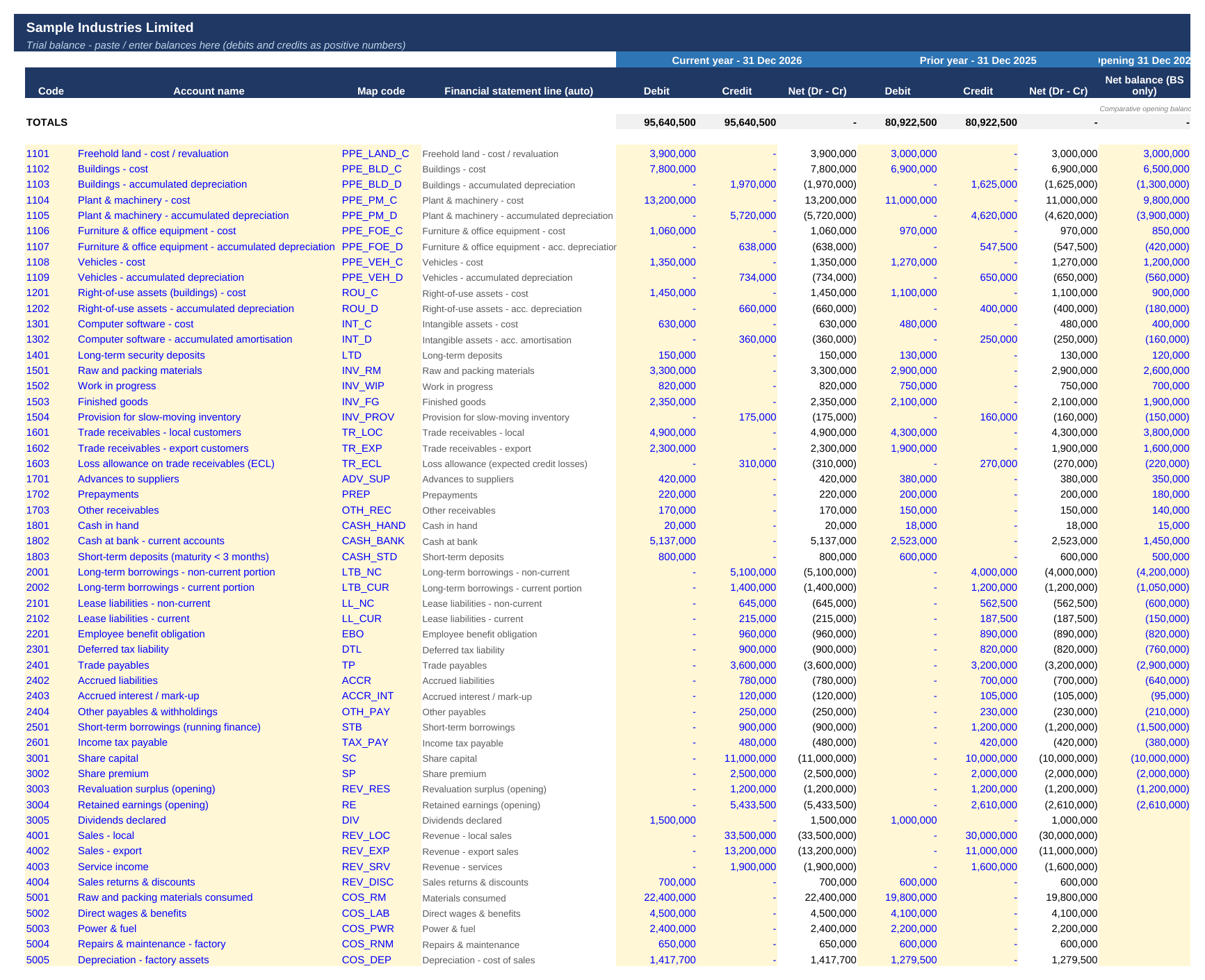
An Excel template that turns a trial balance into a complete set of IFRS financial statements, fully linked. You paste your trial balance and map each account to a line item from a drop-down. Every note is then calculated from the trial balance, and every statement line links to its note. The template produces all five components required by IAS 1: statement of financial position statement of profit or loss and other comprehensive income statement of changes in equity statement of cash flows (indirect method) notes, including accounting policies, PPE, lease, intangible, borrowing, employee benefit, deferred tax and income tax movement schedules. The cash flow statement is built automatically and reconciles to closing cash. The package also includes 30+ ratios with trend flags, horizontal and vertical analysis, a dashboard with 8 KPI tiles and 7 charts, and 12 integrity checks. Presented in USD with current and comparative years. No macros.

What is this IFRS Financial Statements Template used for?
This template is for accountants, auditors, CFOs, finance teams, consultants and students who need to prepare annual financial statements under IFRS Accounting Standards. Typical uses are year-end reporting, audit packs, bank submissions and investor reporting. Instead of retyping figures into statements and checking that everything ties, you paste a trial balance once and the whole set of statements and notes is produced with formulas. Change any balance and all statements, notes, ratios and charts update.
Key features and highlights
- Complete five-statement set (IAS 1):
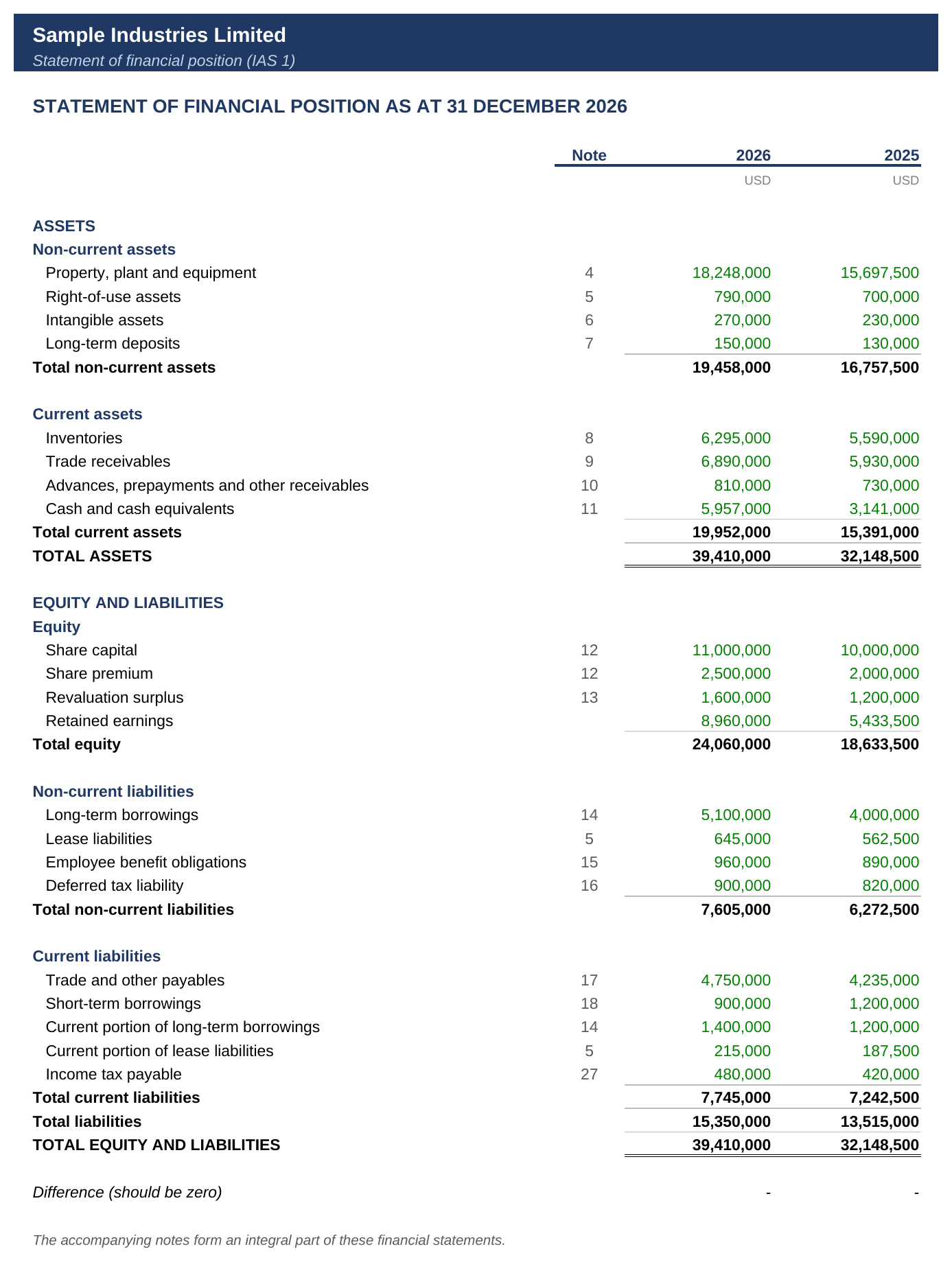
- statement of financial position (current/non-current split)
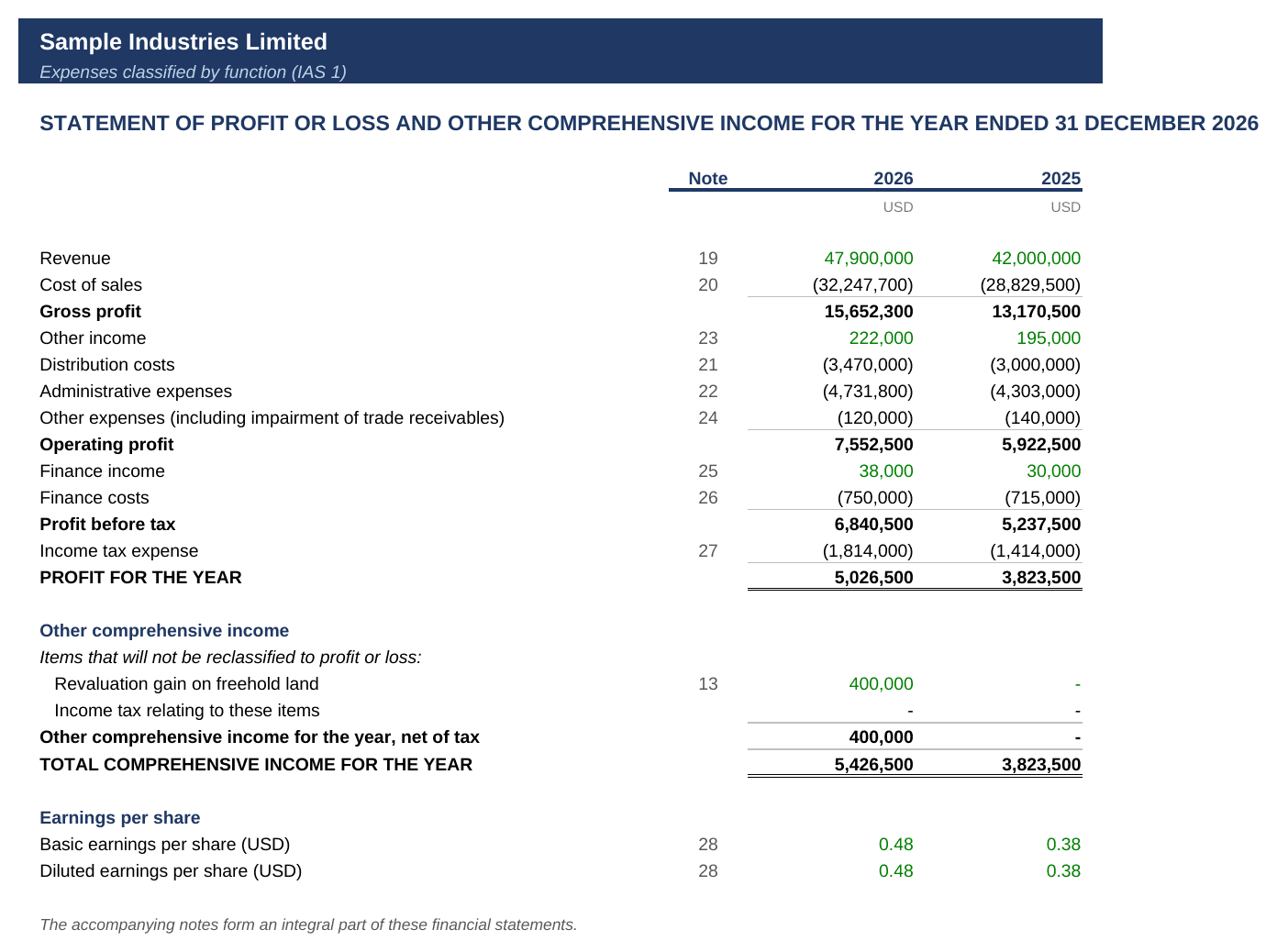
- statement of profit or loss and other comprehensive income, with expenses by function and EPS
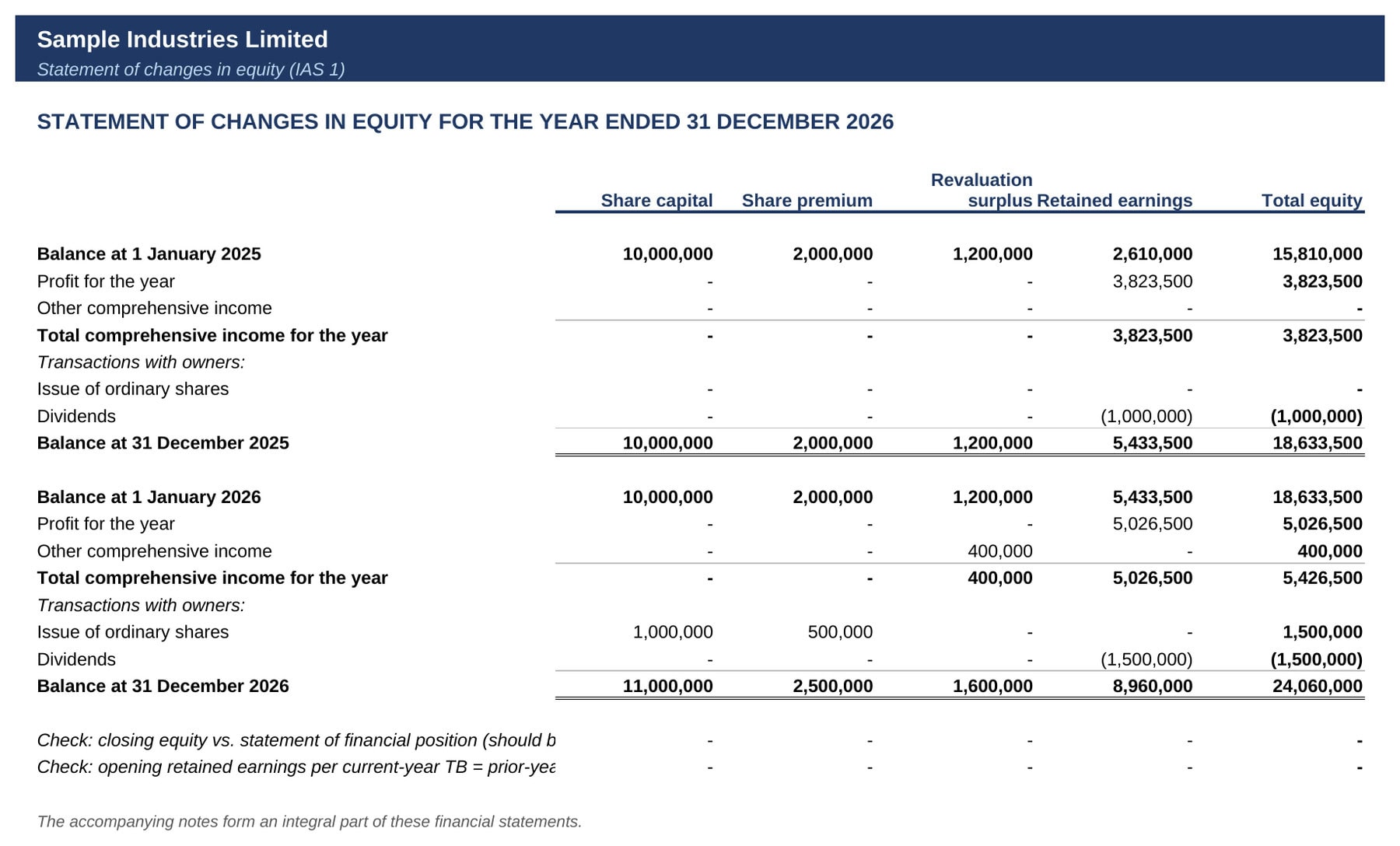
- statement of changes in equity
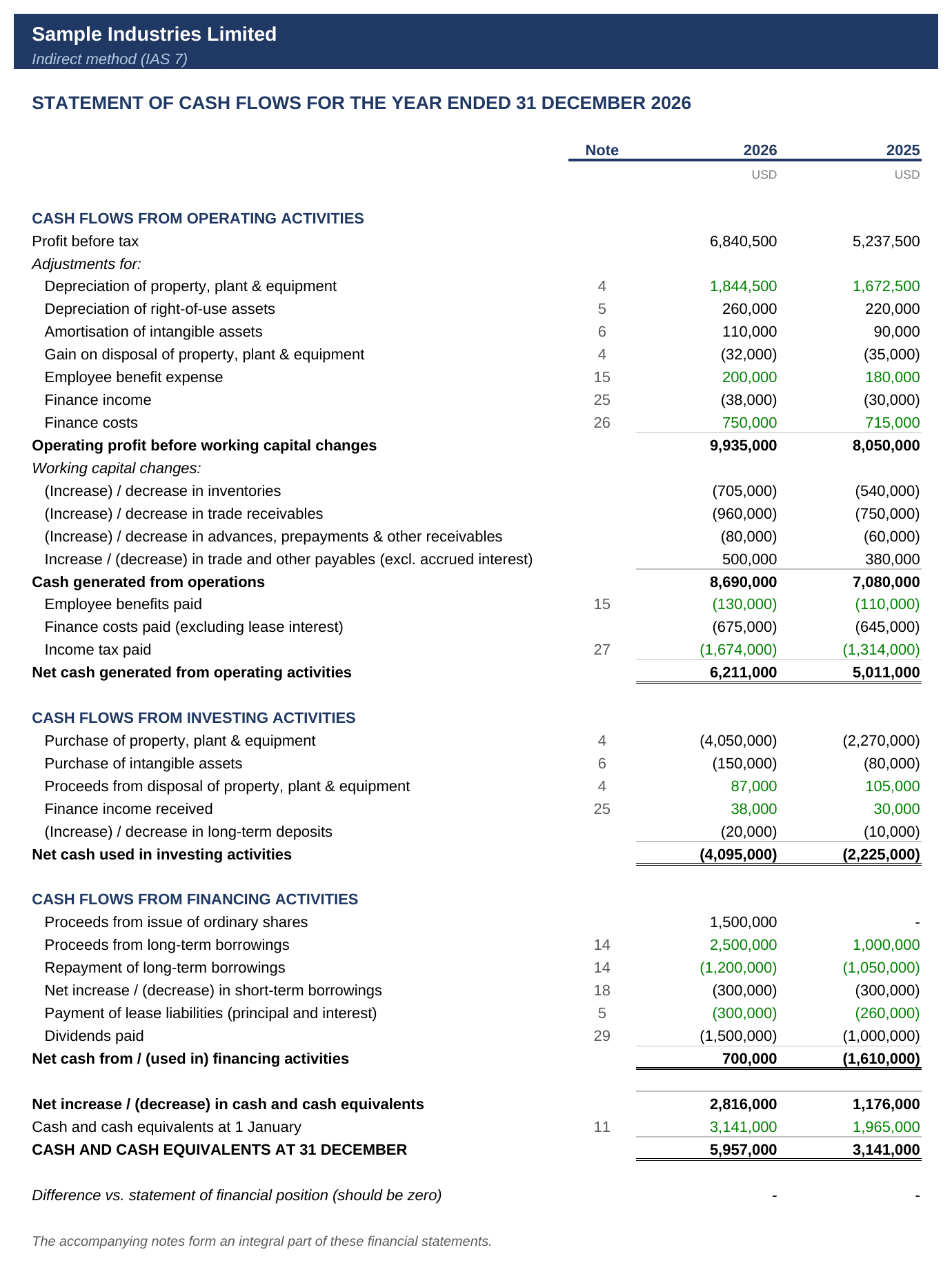
- statement of cash flows using the indirect method (IAS 7)
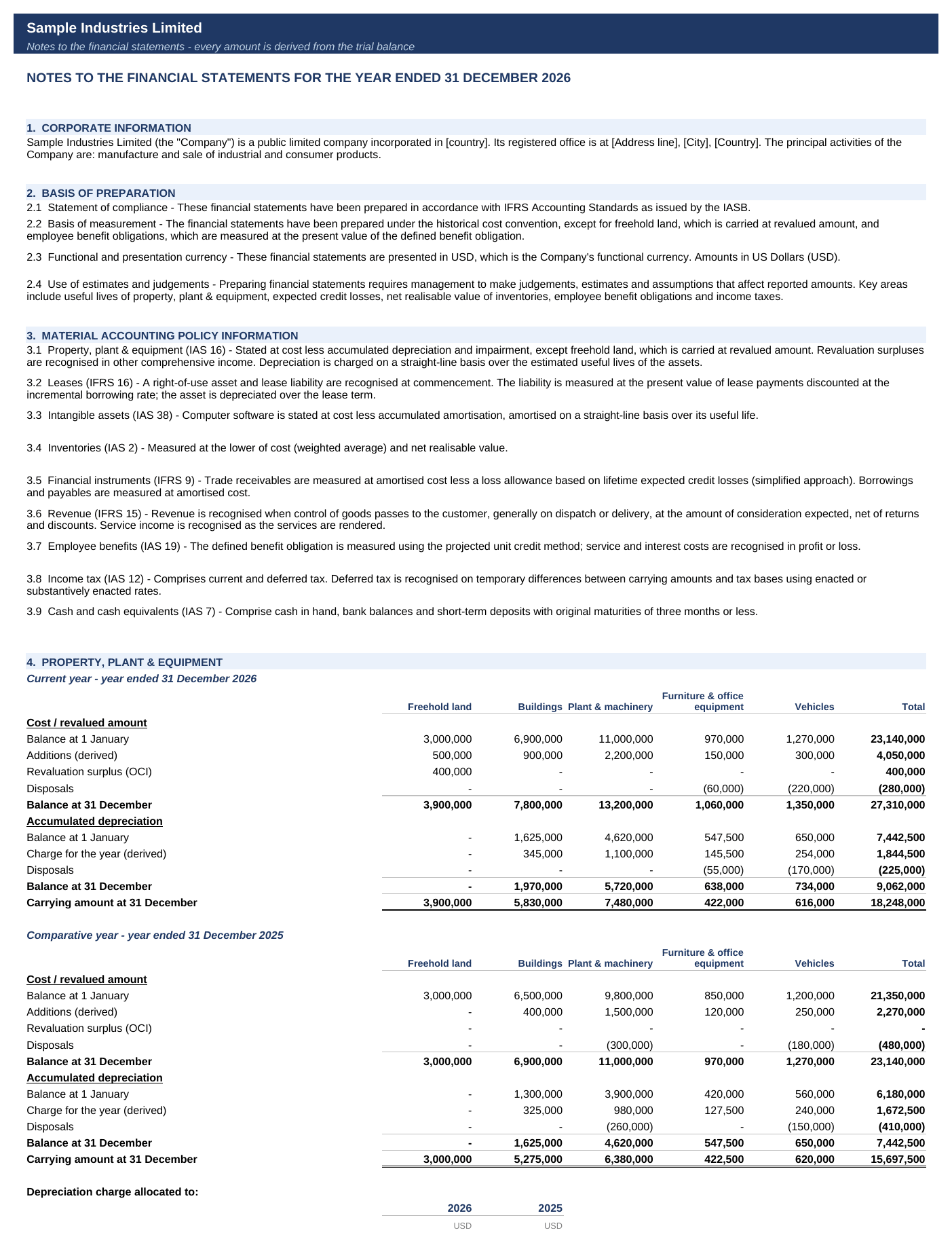
- notes
- Trial balance driven: the TB sheet holds current-year and prior-year debits and credits, plus the comparative-year opening balances. The opening balances allow full comparative cash flows and equity movements. Each account has a map code chosen from a drop-down.
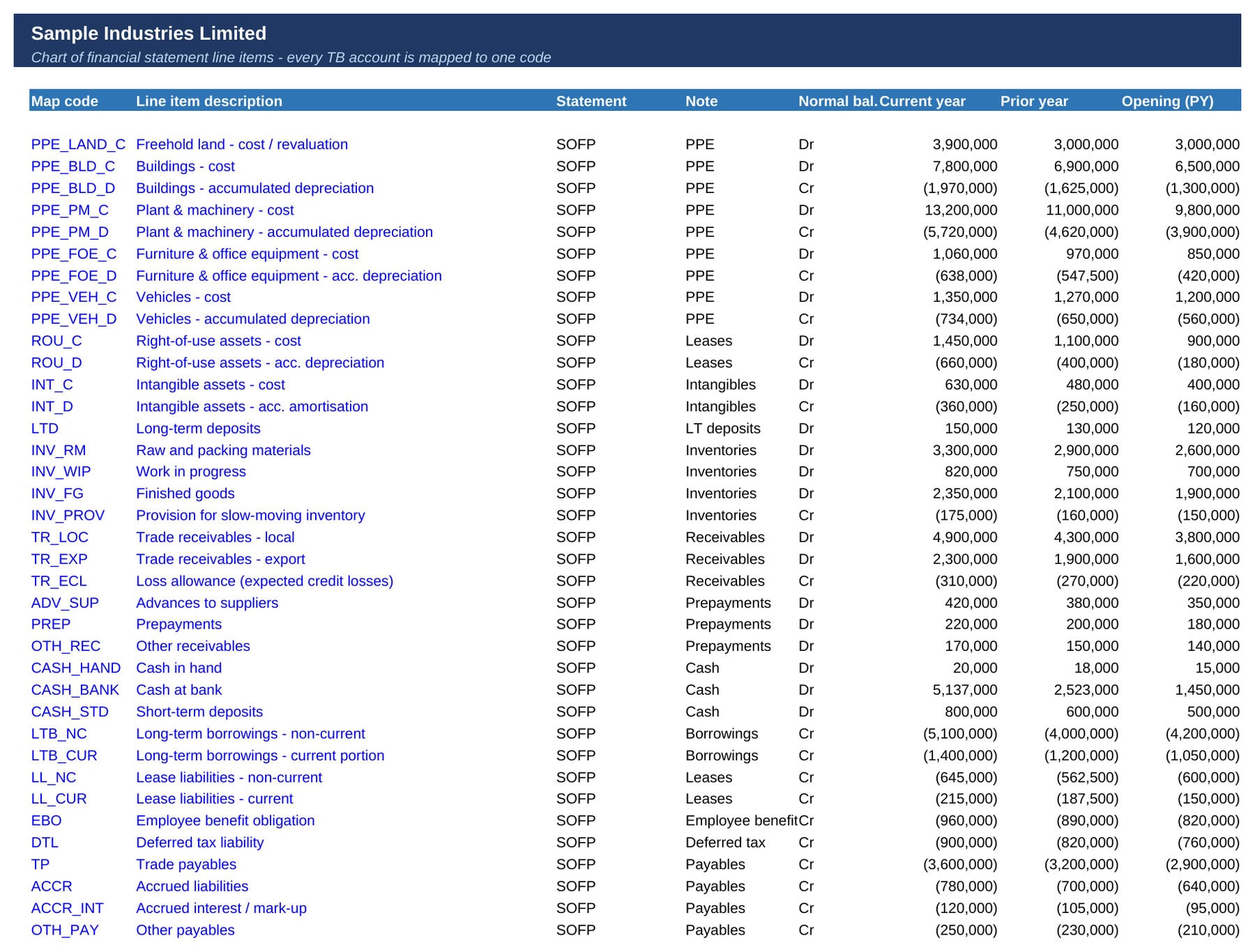
- Mapping sheet: a chart of financial-statement line items with live totals. Add your own codes and they appear in the drop-down. Unmapped accounts are highlighted and counted.
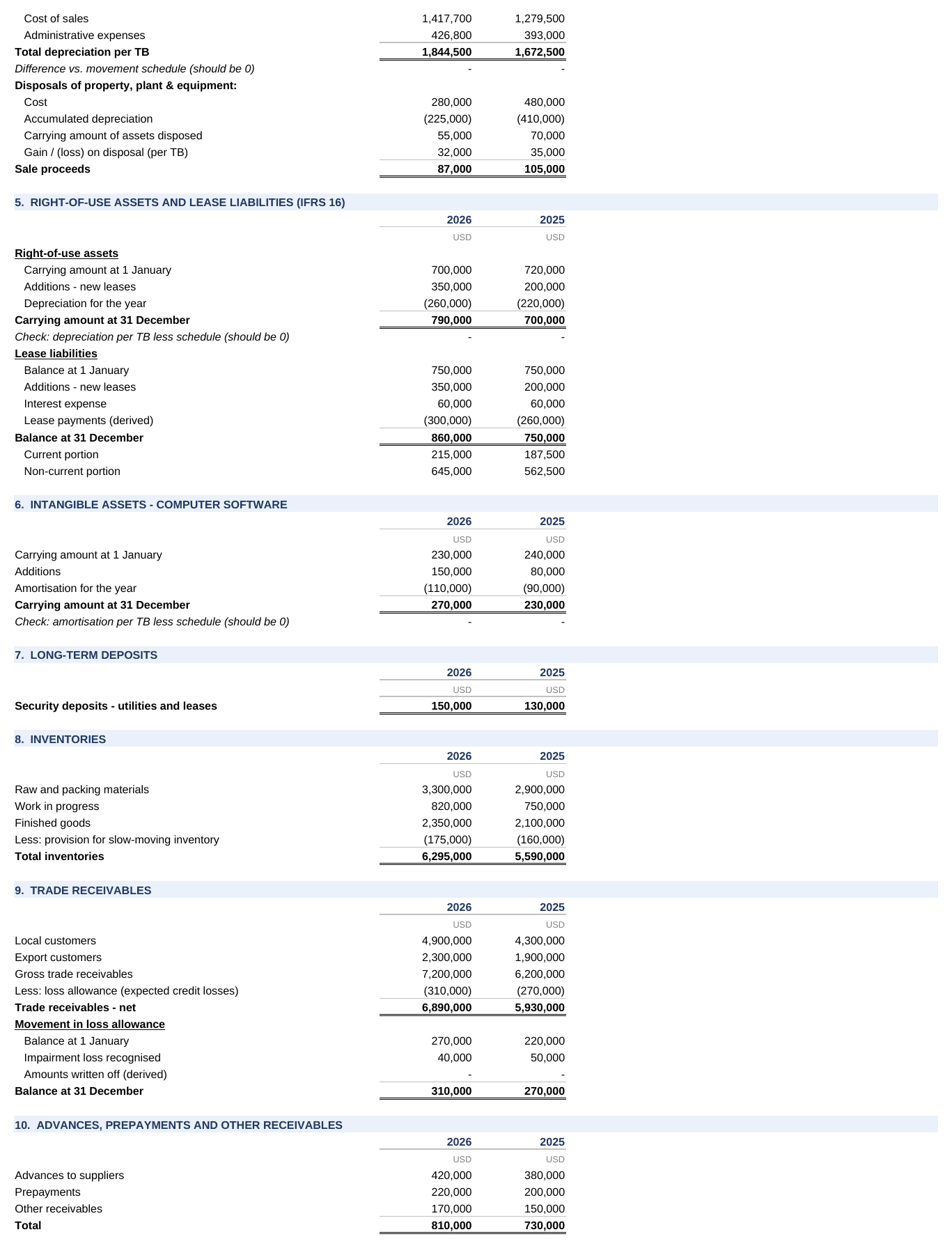
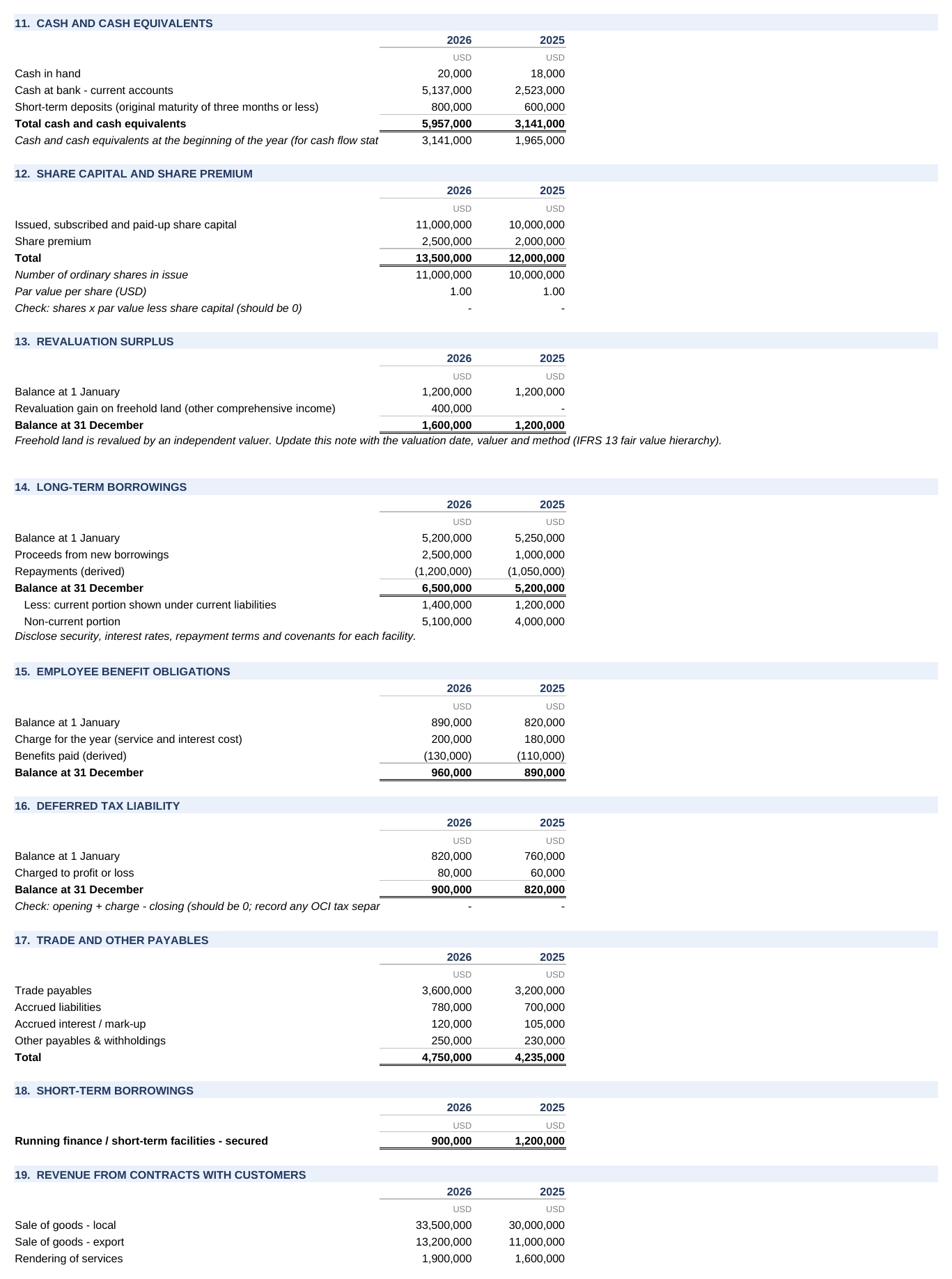
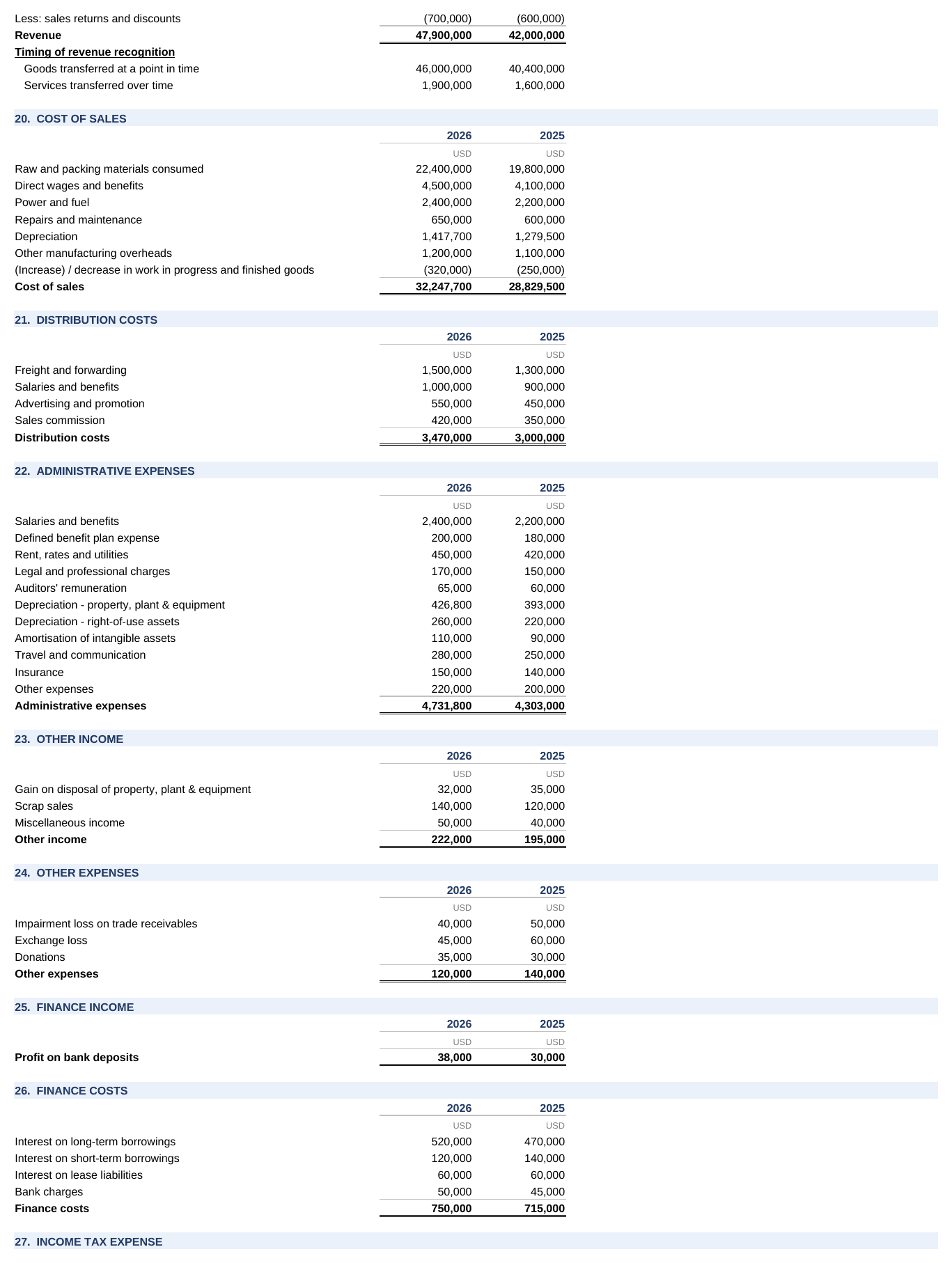
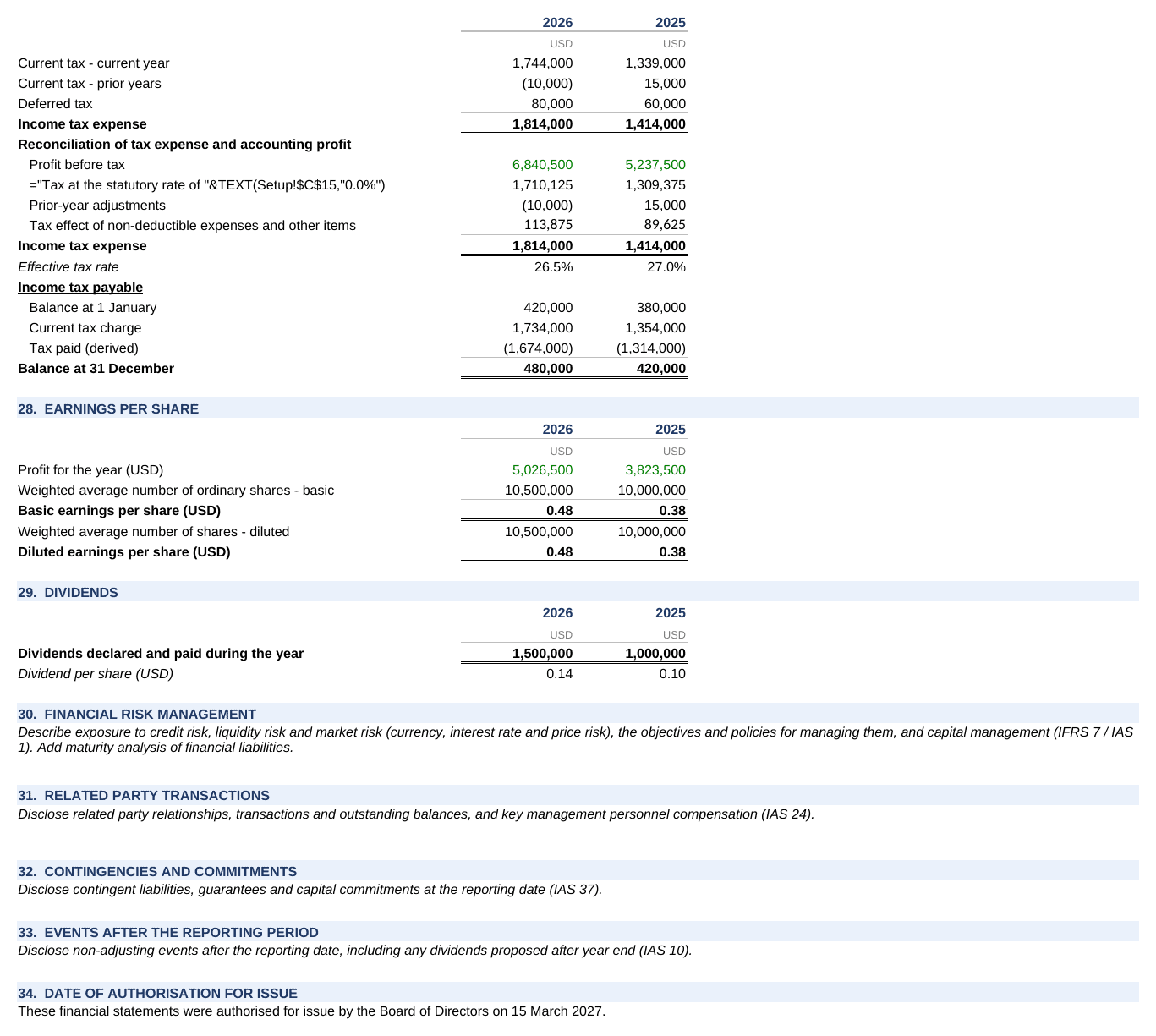
- Notes linked to the TB: 30+ notes, every amount a SUMIFS of the trial balance. They include:
- corporate information, basis of preparation and material accounting policies (IAS 16, IFRS 16, IAS 38, IAS 2, IFRS 9, IFRS 15, IAS 19, IAS 12, IAS 7)
- full PPE movement schedules for both years
- right-of-use assets and lease liabilities
- intangibles, inventories, trade receivables with the expected credit loss movement, borrowings, employee benefits and deferred tax
- revenue disaggregation, expense notes, finance costs, and income tax with a tax-rate reconciliation
- EPS, dividends, and placeholders for risk, related parties, contingencies and events after the reporting period
- Automatic movement schedules: additions, depreciation charges, lease payments, loan repayments, benefits paid and tax paid are derived from the trial balance. Only PPE disposals, new borrowings and share data go on a small Supplementary sheet.
- Self-reconciling cash flow: the cash flow statement is built from the notes and balance sheet movements, and its closing cash is checked against the statement of financial position.
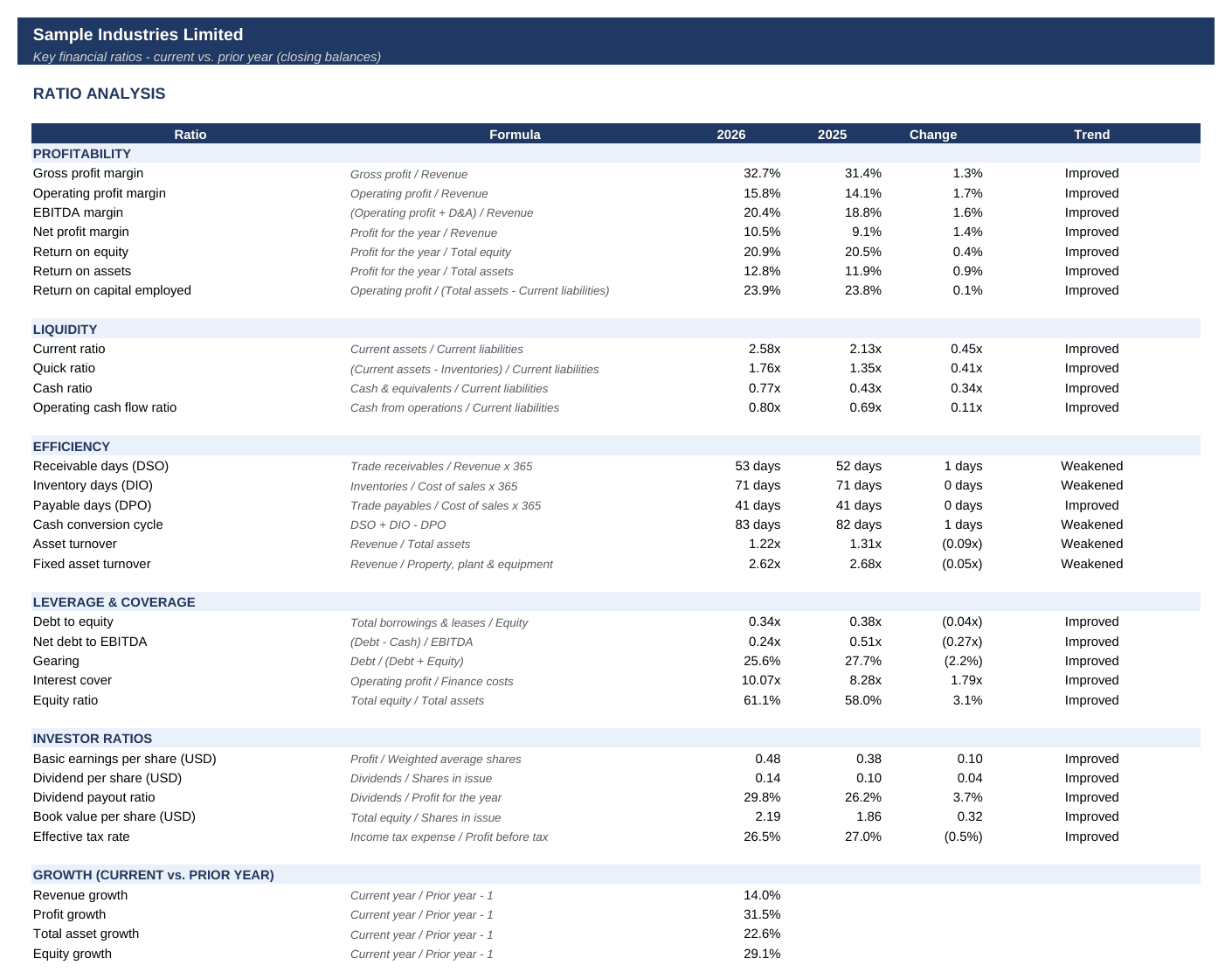
- Ratio Analysis: 30+ ratios covering profitability, liquidity, efficiency (DSO, DIO, DPO, cash conversion cycle), leverage and coverage, investor ratios and growth, each with an “Improved / Weakened” trend flag.
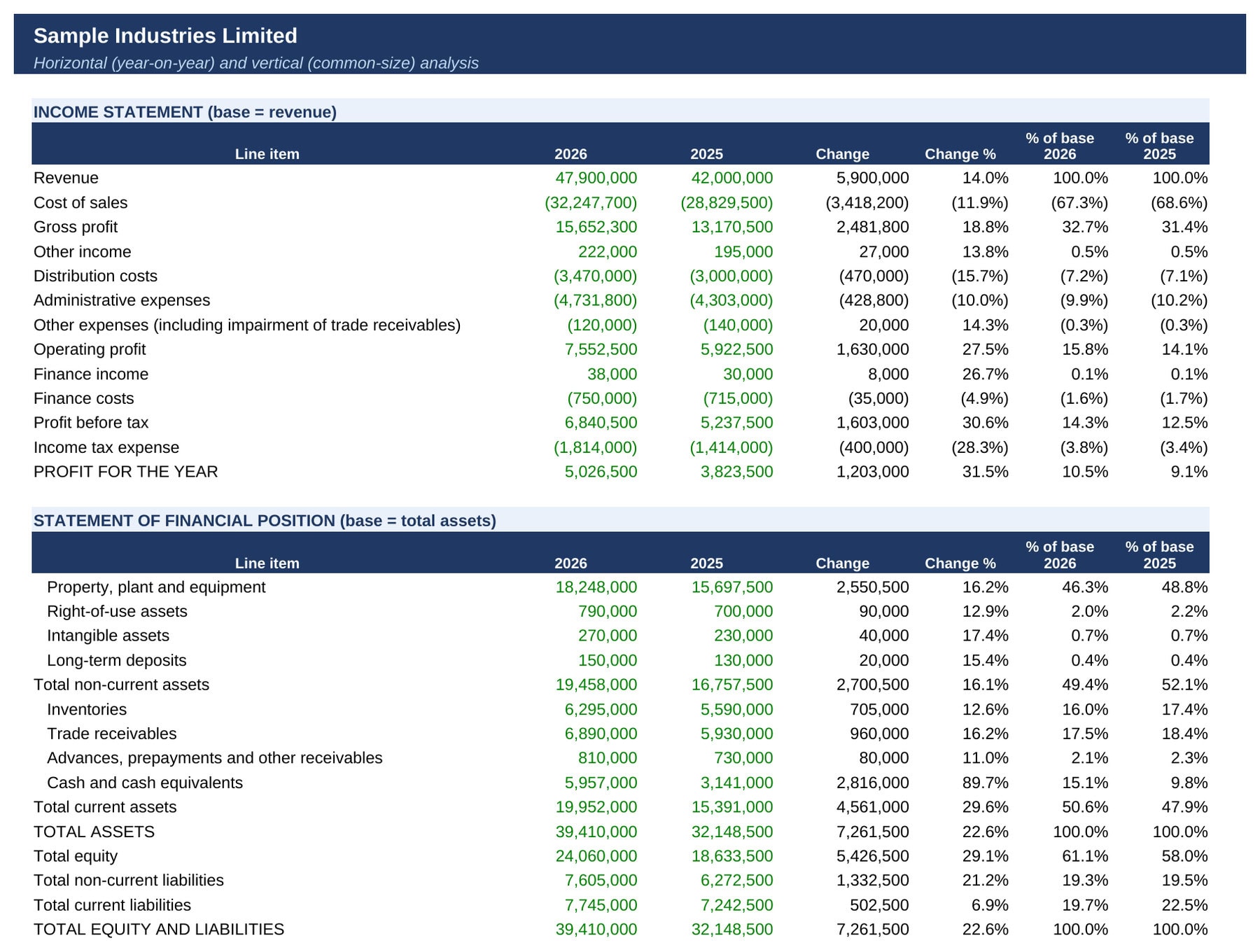
- Horizontal & vertical analysis: year-on-year changes and common-size percentages for the P&L and balance sheet.
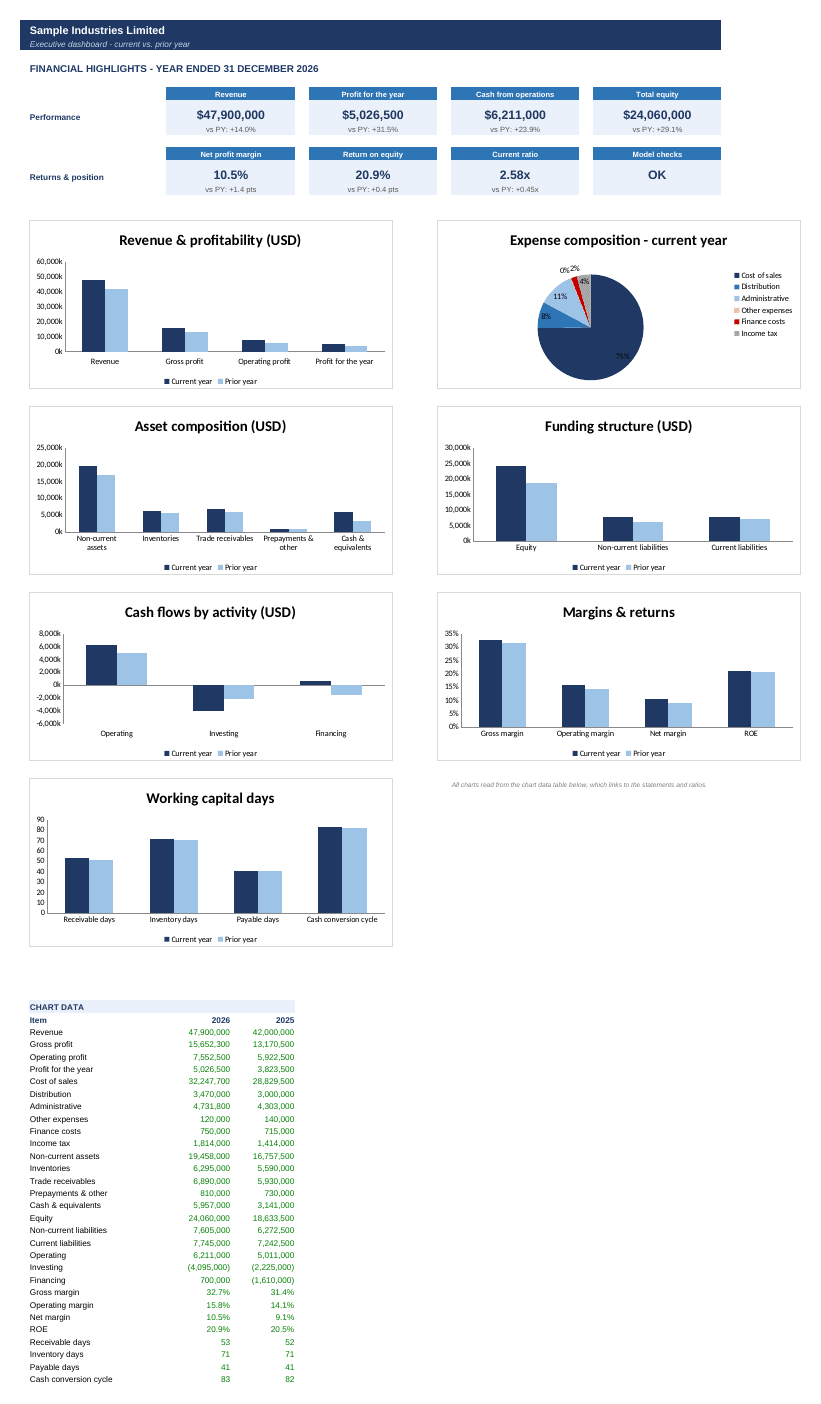
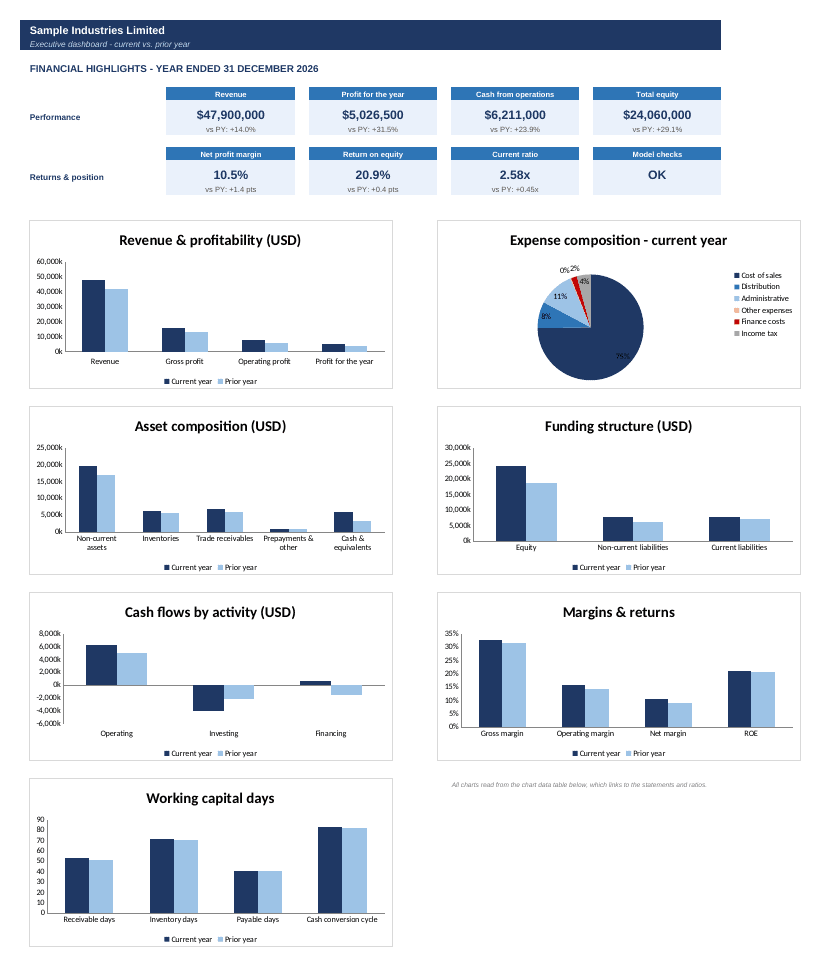
- Dashboard: 8 KPI tiles with change vs. prior year, plus 7 charts:
- revenue and profit
- expense mix
- asset composition
- funding structure
- cash flows by activity
- margins and returns
- working capital days
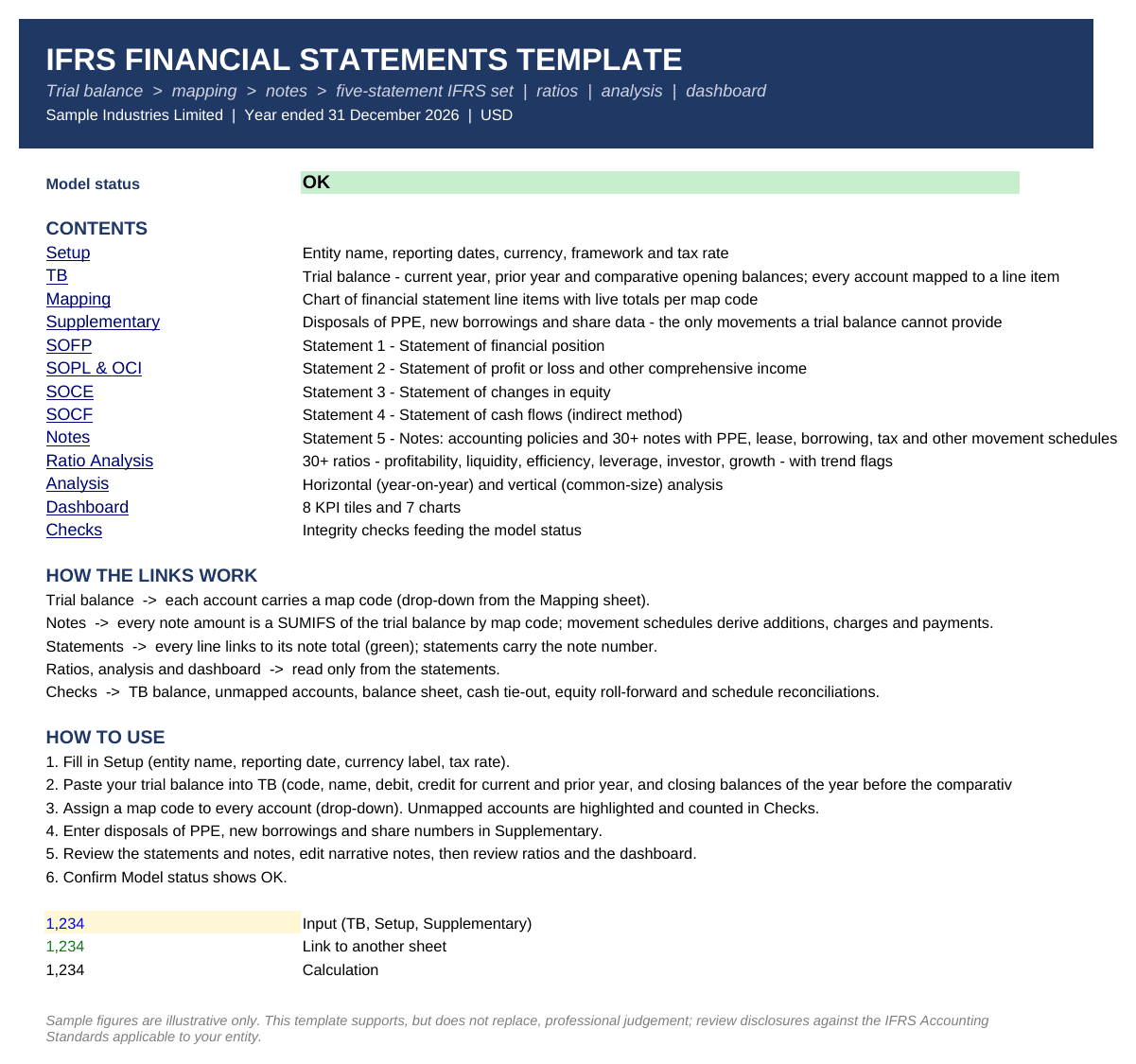
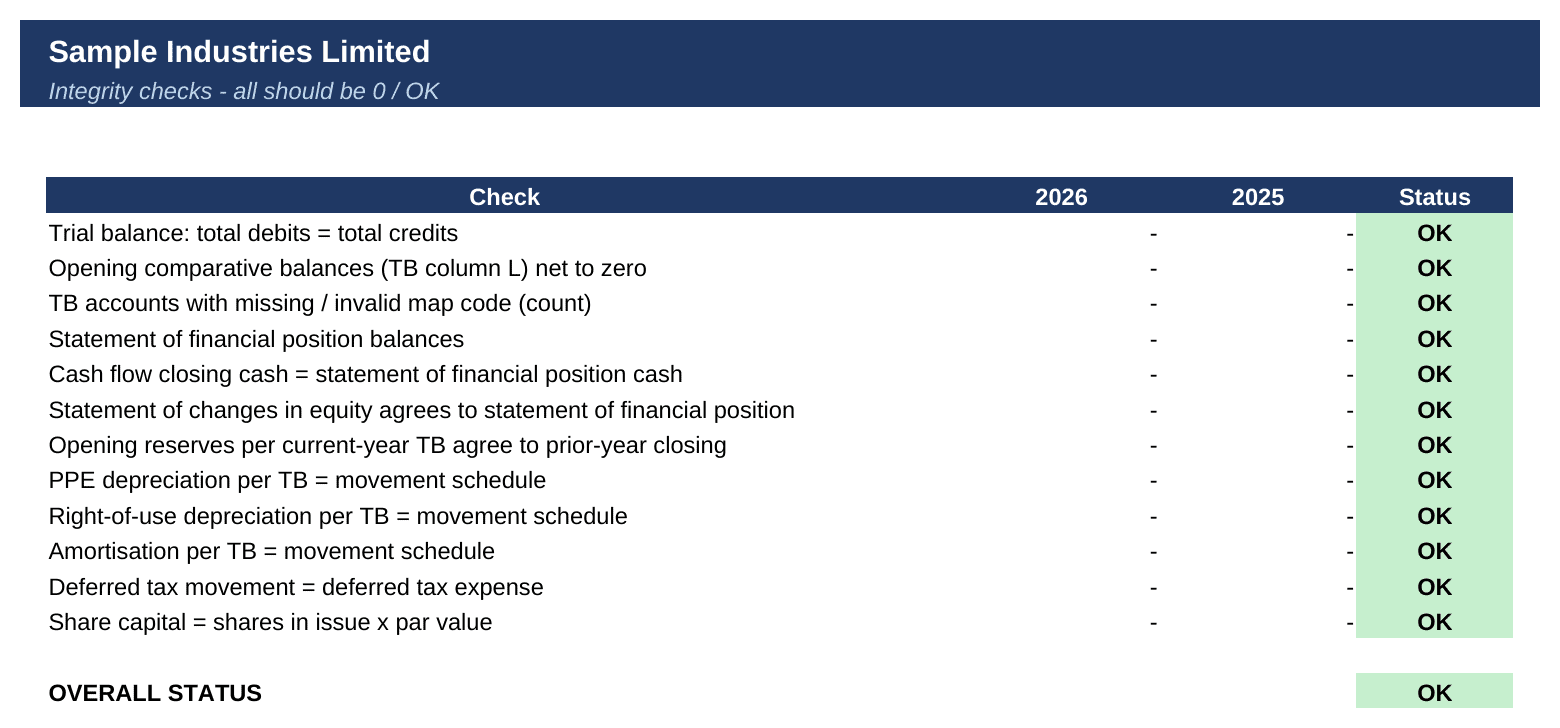
- 12 integrity checks: TB balances, opening balances, unmapped accounts, balance sheet, cash tie-out, equity roll-forward, opening reserves vs. prior-year closing, and depreciation, amortisation, deferred tax and share capital reconciliations. All feed one OK / ERROR status on the cover.
How to work with this template
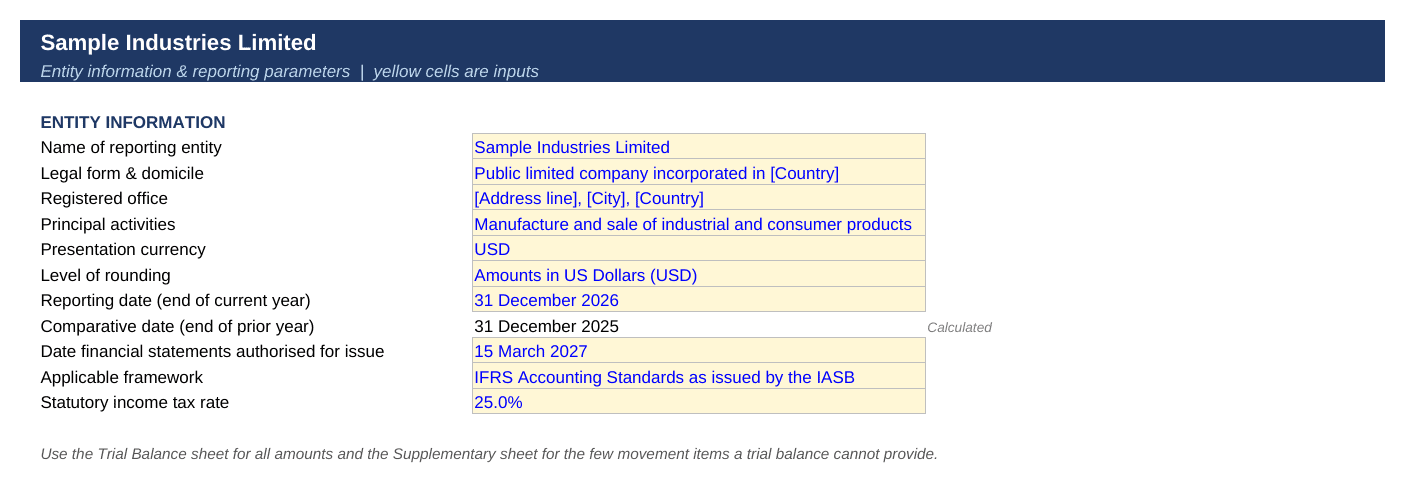
- Enter the entity details, reporting date and tax rate in Setup.
- Paste your trial balance into TB and select a map code for each account.
- Enter PPE disposals, new borrowings and share numbers in Supplementary.
- Review the five statements and edit the narrative notes.
- Use Ratio Analysis, Analysis and Dashboard for review and management commentary.
- Confirm the cover shows Model status: OK.
The model has no macros and 2,300+ live formulas. It uses a consistent colour code (blue inputs, green links, black calculations) and print-ready statement layouts. It works in Excel, Google Sheets and LibreOffice.
Why you need this template
Preparing financial statements by hand is slow, and every late adjustment means re-checking dozens of links. With this template, a corrected trial balance flows straight through to the notes, statements, cash flow, ratios and dashboard. The integrity checks show immediately if anything does not tie, so you can spend your time on judgement and disclosure rather than on arithmetic.
Sample figures are illustrative. Disclosures should be reviewed against the IFRS requirements that apply to your entity.
Similar ProductsOther customers were also interested in...



 eFinancialModels
Electric Vehicle (EV) Charging Station Financial M...
With this comprehensive 5- or 10-year monthly tool, investors can assess the viability of setting up... Read more

Financial Model for Mobile App | Mobile App Busine...
The Mobile App Financial Plan Template in Excel allows you to develop financial projections when lau... Read more

 HenrySheykin
Food Truck Financial Model Excel Template
The Food Truck Financial Model helps entrepreneurs, founders, business owners, consultants, and anal... Read more

Green Hydrogen Production from Wind Energy Financi...
The Green Hydrogen from Wind Financial Model aims to comprehensively forecast a horizon of 40 years ... Read more

Simple Mutual Non-Disclosure Agreement Template
Protect your business secrets with ease using our Simple Mutual Non-Disclosure Agreement Template. S... Read more

Solar Energy Financial Model
The Solar Energy Financial Model Spreadsheet Template in Excel assists you in preparing a sophistica... Read more

 Peter Graf
The Customer-Centric Financial Model for Restauran...
Starting a restaurant without a financial plan is like driving a car blindfolded. You wouldn´t do i... Read more
You must log in to submit a review.