
0 ITEMS

Baby Clothes Store Financial Model Excel Template
The Baby Clothing Store Financial Model helps entrepreneurs, boutique owners, consultants, analysts, and business plan writers turn a retail baby apparel concept into a structured financial forecast. Instead of relying on a generic retail spreadsheet, this template is designed around the way a baby clothing store operates, including product mix, customer traffic, conversion rates, repeat buyers, inventory costs, gross margins, payroll, store setup costs, and multi-year profitability. It gives users a practical framework for estimating revenue assumptions, startup costs, operating expenses, cash flow, and funding needs before launching or expanding the business. Built for financial planning, investor discussions, lender submissions, and internal decision-making, the model helps users understand how the store may perform under realistic assumptions. You can adjust visitor traffic, sales conversion, product pricing, units per order, repeat customer behavior, staffing levels, rent, marketing, inventory, and cost of goods sold to reflect your local market and strategy. The template connects these assumptions to revenue forecasts, profit and loss projections, cash flow planning, and balance sheet outputs, making it easier to see how operational decisions affect profitability and liquidity over time. This financial model template is useful for founders preparing a baby boutique business plan, existing store owners evaluating expansion, consultants building client forecasts, and analysts comparing different retail scenarios. It supports up to five years of projections and is compatible with Microsoft Excel and Google Sheets, allowing users to edit inputs, collaborate with teams, and present results to stakeholders. The structure is designed to save time while still giving users control over the assumptions that matter most. The Baby Clothing Store Financial Model also supports better decision-making by showing the relationship between startup investment, monthly expenses, payroll, revenue growth, inventory planning, cash flow, profitability, and break-even analysis. Users can test different outcomes, review key performance indicators, evaluate funding requirements, and prepare more credible financial documents. Whether you are seeking a loan, preparing for investor conversations, or simply trying to understand whether your baby clothing store can reach sustainable profit, this ready-to-use template provides an organized and editable foundation.
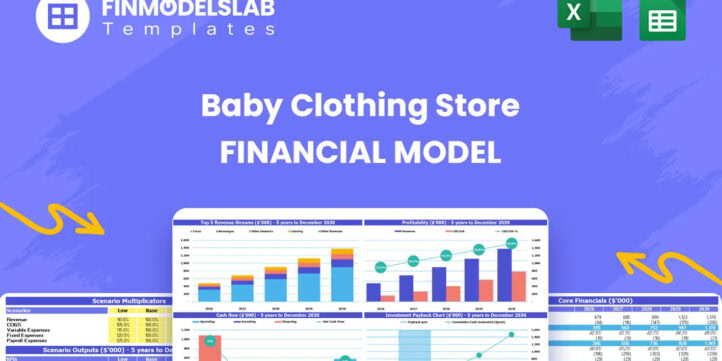


Financial Model Overview
The Baby Clothing Store Financial Model is a ready-to-use financial model template created for entrepreneurs, boutique owners, consultants, analysts, and business planners who need to evaluate the financial potential of a baby apparel retail business. A baby clothing store has specific planning requirements that go beyond a generic retail forecast, including product mix, seasonal demand, customer conversion, repeat purchases, inventory investment, cost of goods sold, staffing, rent, store setup, and long-term working capital needs.
This template brings those assumptions into one structured model so users can estimate revenue, expenses, cash flow, profitability, startup capital, and investor-ready outputs over a five-year forecast period. It is designed to help users replace guesswork with a clear planning process, whether they are opening a new store, expanding an existing children’s boutique, preparing a business plan, applying for financing, or testing whether their concept can reach sustainable profitability.
All-in-One Dashboard
The all-in-one dashboard brings the most important inputs and outputs of the Baby Clothing Store Financial Model into one centralized view. Instead of jumping between disconnected spreadsheets, users can review the core assumptions that drive the business, such as store traffic, conversion rates, average order size, product pricing, inventory costs, staffing levels, rent, marketing spend, and other operating expenses. The dashboard also summarizes key results such as revenue, gross profit, EBITDA, cash balance, funding needs, profitability trends, and return metrics.
This component is useful because it gives founders and stakeholders a fast way to understand the overall financial position of the store without needing to inspect every calculation line. For planning and budgeting, the dashboard helps users quickly identify whether assumptions are realistic, whether costs are aligned with revenue potential, and whether the store is moving toward a profitable and cash-positive position. For investor or lender conversations, it provides a concise overview of the business model and highlights the key numbers decision-makers usually want to see first.
Low, Base, and High Scenario Analysis
The low, base, and high scenario analysis component allows users to test how the baby clothing store performs under different market conditions. Retail results can change significantly depending on foot traffic, online demand, conversion rates, repeat customer behavior, average order value, inventory costs, and marketing effectiveness. This section lets users compare a conservative case, a realistic base case, and an upside case using adjustable assumptions that flow through the rest of the model.
For example, a low scenario may assume slower customer acquisition, lower buyer conversion, or higher inventory costs, while a high scenario may assume stronger weekend traffic, better repeat purchasing, improved product margins, or more successful promotional campaigns. The output helps users see the impact on revenue, cash flow, profitability, and funding requirements. This is especially valuable for decision-making because it shows which assumptions carry the most risk and which levers create the biggest improvement. It also helps founders prepare contingency plans, set more realistic targets, and communicate a balanced financial outlook to investors, lenders, partners, and internal teams.
Professional Charts
The professional charts component turns the financial forecast into presentation-ready visuals that make the model easier to interpret and communicate. A baby clothing store forecast can include many moving parts, including monthly sales, seasonal changes, product category performance, gross margin, operating expenses, cash flow, debt service, and profitability. Charts help users turn these detailed calculations into clear visual trends. This component may display revenue growth, profit development, cost structure, cash balance movement, EBITDA progression, break-even timing, and other financial metrics that are useful in business plans and funding presentations.
The benefit is that users can quickly understand the direction of the business rather than reading every row in a spreadsheet. Professional charts are also useful when presenting to investors, lenders, advisors, co-founders, or management teams because they make the story behind the numbers easier to explain. A clear chart showing how customer traffic grows, how margins improve, or when cash flow stabilizes can support a more credible discussion than a table of raw figures alone. This component helps convert the Baby Clothing Store Financial Model from an internal forecasting tool into a polished planning and communication resource.
ROE Components and DuPont Analysis
The ROE components and DuPont analysis section helps users understand the drivers behind return on equity rather than looking only at a single profitability percentage. In a baby clothing store, return on equity can be affected by profit margins, asset efficiency, inventory investment, fixed asset requirements, debt structure, and the amount of owner or investor capital used to fund the business. DuPont analysis breaks return on equity into meaningful parts so users can see whether returns are being driven by operating profitability, asset turnover, or financial leverage.
This component may use inputs and outputs such as net income, revenue, total assets, equity, debt, margins, and turnover ratios. It helps users assess whether the store is using capital efficiently and whether improvements should come from pricing, gross margin management, inventory turnover, expense control, or capital structure. For founders and investors, this is useful because a baby clothing store may require meaningful upfront investment in fixtures, leasehold improvements, inventory, and working capital before returns are generated. The analysis provides a deeper view of financial performance and helps decision-makers evaluate whether the projected return justifies the capital committed to the business.
Revenue Inputs
The revenue inputs section is one of the most important components of the Baby Clothing Store Financial Model because it defines the assumptions that drive sales. A baby apparel store typically earns revenue through a combination of customer traffic, buyer conversion, average units per order, pricing, repeat customer activity, and product category mix. This section allows users to adjust assumptions for key revenue drivers, such as daily store visitors, weekday and weekend traffic patterns, conversion rates, repeat customer percentages, purchase frequency, and average selling prices.
It can also reflect the store’s product mix across categories such as infant onesies, toddler dresses, baby blankets, gift sets, or other apparel and accessory lines. These assumptions then flow into revenue projections and help estimate monthly and annual sales over the forecast period. The value of this component is that it makes the sales forecast more operational and defensible. Rather than entering a single revenue number without explanation, users can build revenue from the actual behaviors and transactions that create sales. This makes the forecast easier to review, easier to improve, and more credible for funding documents, business plans, and internal planning.
Bank-Ready Reports
The bank-ready reports component provides structured financial outputs that can support loan applications, investor reviews, business plan submissions, and stakeholder presentations. Lenders and financial partners typically want to see more than a revenue estimate. They want to understand whether the store can cover operating expenses, manage cash flow, service debt, maintain adequate working capital, and reach profitability within a reasonable timeframe.
This section organizes the key reports needed for those discussions, including projected profit and loss, cash flow statement, balance sheet, funding requirements, profitability indicators, and supporting assumptions. The reports are designed to present the financial model in a professional format with consistent structure and clear outputs. For a baby clothing store, this can help demonstrate how startup costs are funded, how inventory investment is managed, how payroll and rent affect margins, and how cash flow evolves during the early years. This component is useful because it turns the model into a lender-friendly planning document rather than just an internal worksheet. It can help users prepare more confidently for bank meetings, investor conversations, grant applications, or formal business plan reviews.
Revenue Breakdown
The revenue breakdown component gives users a more detailed view of where sales are expected to come from across the baby clothing store’s product lines and revenue streams. Instead of treating all sales as one blended total, this section can separate revenue by product category, such as infant clothing, toddler apparel, blankets, gift sets, accessories, seasonal items, or other store-specific lines. It may use assumptions for sales mix, unit prices, units sold, average order composition, repeat purchasing, and category growth over time. The outputs help users see which categories contribute the most to revenue, which products may have the strongest margin potential, and how changes in product mix affect overall performance.
This is important for a baby clothing store because different products can have different price points, gross margins, reorder cycles, and inventory risks. Gift sets may perform strongly during holidays or baby shower seasons, while basics such as onesies may create recurring demand. By reviewing the revenue breakdown, users can make better decisions about buying inventory, setting prices, planning promotions, allocating shelf space, and developing merchandising strategies. It also gives investors and lenders more confidence that the revenue forecast is built from specific, understandable assumptions.
KPI Dashboard
The KPI dashboard focuses on the operating and financial metrics that help users monitor performance throughout the forecast period. A baby clothing store depends on more than total sales to succeed. Important performance indicators may include customer traffic, conversion rate, repeat customer rate, average order value, units per transaction, gross margin, cost of goods sold percentage, payroll as a percentage of revenue, rent burden, marketing efficiency, EBITDA margin, cash balance, and inventory-related measures. This dashboard collects key metrics in one place so users can compare projected performance against targets, benchmarks, or actual results once the business is operating.
It helps founders see whether the business is improving in the right areas and whether growth is being achieved profitably. For example, increasing revenue may not be enough if gross margins decline or inventory purchases consume too much cash. The KPI dashboard helps users identify these issues quickly and take corrective action. For advisors, consultants, and stakeholders, it provides a concise way to review business health and assess whether the store’s assumptions are aligned with industry expectations and operational reality.
Startup Cost and Operating Expense Planning
The startup cost and operating expense planning component helps users estimate how much capital is needed before and after opening the baby clothing store. Startup costs may include leasehold improvements, store fixtures, display units, signage, point-of-sale systems, initial inventory, licenses, deposits, website setup, launch marketing, professional fees, and opening working capital. Operating expenses may include rent, utilities, payroll, payroll taxes, marketing, insurance, software, supplies, shipping, accounting, repairs, and other recurring costs.
This section allows users to customize cost assumptions based on store size, location, staffing model, product selection, and launch strategy. The outputs help calculate the initial funding requirement, monthly expense base, and the level of revenue needed to support ongoing operations. This is especially important for baby clothing stores because inventory and retail setup costs can require cash before sales are generated. Underestimating these costs can create early financial pressure even if customer demand is strong. By organizing both one-time and recurring expenses, this component supports budgeting, funding preparation, vendor planning, and internal cost control. It also helps users evaluate whether the proposed business model is affordable and whether additional financing or a cash reserve is needed.
Break-Even and Cash Flow Analysis
The break-even and cash flow analysis component helps users understand when the baby clothing store may move from startup losses to sustainable profitability and whether the business has enough cash to survive the ramp-up period. Break-even analysis can compare revenue, gross profit, fixed expenses, variable costs, payroll, and inventory-related costs to determine the point at which the store covers its cost structure. Cash flow analysis goes further by showing when money enters and leaves the business, including startup investment, operating losses, inventory purchases, payroll, rent, taxes, debt payments, and owner or investor funding. The outputs may include monthly cash balances, minimum cash position, cash shortfalls, break-even timing, cumulative profit, and funding needs.
This component is useful because retail businesses can be profitable on paper while still facing cash pressure due to inventory purchases, seasonal demand, delayed sales growth, or upfront setup costs. By reviewing break-even and cash flow together, users can plan working capital more effectively, decide whether to secure a line of credit, adjust expenses, improve margins, or revise growth assumptions. It supports practical decision-making and helps users understand not only whether the store can become profitable, but also whether it can remain liquid until it gets there.
File types:
Excel – Single-User: .xlsx
Excel – Multi-User: .xlsx
Free Demo – .xlsx
Similar ProductsOther customers were also interested in...


 HenrySheykin
Online Clothing Store Financial Model Excel Templa...
The Online Clothing Store Financial Model helps founders, entrepreneurs, business owners, consultant... Read more
Clothing Store Financial Model Excel Template
The Clothing Store Financial Model helps turn a retail apparel concept into a structured financial f... Read more
Clothing Line Business Financial Model Excel Templ...
The Clothing Line Financial Model helps founders, apparel entrepreneurs, consultants, analysts, and ... Read more
Fashion Marketplace Financial Model Excel Template
The Fashion Retail Financial Model helps entrepreneurs, founders, business owners, consultants, and ... Read more
Bridal Shop Financial Model Excel Template
The Bridal Shop Financial Model helps users turn a wedding dress boutique concept into a structured,... Read more
Tailor Financial Model Excel Template
The Tailor Shop Financial Model helps entrepreneurs, business owners, consultants, and analysts turn... Read more

 Giorgos
Online Clothing Wholesaler – 5 Year Financia...
Advanced Financial Model presenting a 5 Year Business Plan for an Online Clothing Wholesale company.... Read more

Fashion Designer (Independent) – 5 Year Financia...
Financial Model providing a highly sophisticated 5-year financial plan for a startup Independent Fas... Read more

Clothing Boutique Financial Model – Dynamic 10 Y...
Financial Model providing a dynamic up to 10-year financial forecast for a startup or existing Cloth... Read more
You must log in to submit a review.