0 ITEMS

How to Calculate the Net Asset Value?
Table of Content
- What is Net Asset Value?
- THE NET ASSET VALUE FORMULA
- Going-Concern vs. Liquidation Scenario when Calculating NAV
- Adjusting Assets & Liabilities to their Fair Market Value
- An Example of Net Asset Value Calculation under a Going-Concern Scenario
- An Example of Net Asset Value Calculation under Liquidation Scenario
- An Example of Net Asset Value Calculation for a Holding Company
- Calculating Net Asset Value is an Effective Valuation Method
There are three main approaches used in business valuation: asset, income, and market. There are also several valuation methods from each approach that the valuation experts use to arrive at the conclusive value. This section will emphasize the net asset value calculation under an asset-based approach.
An asset-based approach is a form of business valuation used in determining the value of a closely held business, ownership interest, or security. The principal purpose of this practice is to bring the fair market value of the company’s assets after deducting its liabilities.
This approach is most appropriate for valuing investment holding companies, or capital-intensive companies, when the business generates continued losses or when income-based valuation indicates a lower value than net asset value.

What is Net Asset Value?
The Net Asset Value (NAV) is a business valuation technique under the asset approach experts use to determine the company’s fair market value (FMV). The asset and liabilities are restated to their realizable values, including off-balance-sheet assets and unrecorded liabilities. Thus, the equity is recalculated to reflect the business’s fair market value.
This method is also known as the asset accumulation method, which allows the valuation experts to establish a floor value of the business based on the realizable value of the underlying assets and liabilities at the valuation date. It can be used in going-concern principle or liquidation scenarios.

THE NET ASSET VALUE FORMULA
The net asset value formula is simple, we list all the assets and deduct all the liabilities.
NET ASSET VALUE (NAV) = ASSETS – LIABILITIES
The way to start this calculation is to start with the book value company balance sheet and list all assets and liabilities. However, it should be noted that each asset should be adjusted depending on the valuation scenario. Furthermore, there might also be off-balance sheet items or contingent liabilities that need to be considered in this calculation.
Going-Concern vs. Liquidation Scenario when Calculating NAV
How is net asset value calculated depends on the business circumstances. When calculating net asset value for a going-concern scenario, we seek to provide the shareholders and investors a perspective crucial to their next action plan. Meanwhile, the NAV calculation is important for creditors and stakeholders to determine whether all liabilities will be paid out from liquidating the assets in a liquidation scenario.
Going-Concern Scenario
Assumes that the business will continue to operate business as usual. This means, that the business is not under pressure to sell its assets at discounted prices and can take its time to obtain fair market prices.
Liquidation Scenario
There could be plenty of reasons why the business is liquidating. It could be bankruptcy, going out of business, suffering continued losses, not having enough money to pay for expenses, or force liquidation. For these reasons, the business lowers the company valuation at a significant discount to sell all its assets immediately.

Adjusting Assets & Liabilities to their Fair Market Value
Having a conclusive asset-based valuation can be a challenge because of the need to adjust the net asset. The adjusted asset-based business valuation aims at bringing the fair market value of the company’s assets after deducting its liabilities. Several factors need to be considered in adjusting net assets, including tangible assets, intangibles, inventories, receivables, and liabilities, which may directly affect the market value of the company’s net assets. Now that we know net asset value let’s drill down some common scenarios affecting the net asset value calculation.
- Tangible Properties – represent a significant part of every business’s net worth captured on the balance sheet. These are fixed operating resources used by the business over a long period, such as machinery, land, building premises, and property and equipment, and are depreciated over their useful life. In essence, the property’s value decreases as they age. The depreciation allows businesses to distribute the cost of these tangible assets over their expected useful life and eventually leads to tax savings. The higher the depreciation expense, the lower the net income subject to tax, making it an effective tax shield for businesses. Listed are scenarios applicable to tangible assets.

- Intangible Assets – are assets that do not have a physical substance and are identifiable (either separable or emerging from contractual or other legal rights). Intangible assets may include brands, industry reputation, human capital, goodwill, and intellectual property (patents, trademarks, copyright, etc.). However, it should be noted that goodwill cannot be sold separately from the business. If the business is sold higher than its market value, the premium is treated as goodwill.
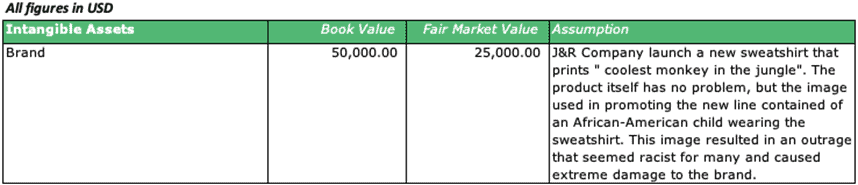
- Inventories – In general, inventory is quite costly to hold. The less inventory the business has is often more profitable. For instance, a business that owns a clothing brand may require an additional warehouse or storage facility to accommodate high inventory levels. For valuation purposes, the expert may assess the inventory as obsolete. Here are a few examples of inventory adjustments.

- Receivables – represent a legally enforceable claim for payment held by the business for services rendered or goods supplied to customers but not yet paid.

- Liabilities – are obligations that the business needs to pay or transfer to other entities due to previous transactions, including interest, bonds payable, accounts payable, accrued expenses, and other liabilities. More often than not, liabilities are fairly valued at the valuation date. However, it is imperative to adjust liabilities as a consequence of a valuation scenario. This could also include off-balance sheets or contingent liabilities, which are often unrecorded and could negatively impact the firm’s equity value.
Such contingent liabilities may include the following claims against the subject company.
- Tax audit or taxation-related disputes and assessments
- Employee-related disputes
- Environmental claims and other clean-up issues
- Infringement and litigation claims
- Breach of contract litigation suits
Unlike liabilities recorded on the company’s financial position, it may be a challenge to identify off-balance-sheet contingent liabilities. The valuation experts may opt to use other methods, such as an interview with the management and legal counsel of the company.
Moreover, a review of board resolutions, minutes of the meeting, supplementary documents, and company financial plans and forecasts may help the expert identify possible contingent liabilities.

If we observe, there are different ways of determining the market value of a particular asset depending on the availability and relevance of information. How is net asset value calculated? Once the market values are obtained, these assets will be summed up accordingly and reduced by the adjusted liabilities to get the net asset value. Let’s also emphasize that intangibles assets and goodwill are not considered in net asset value calculation under the liquidation scenarios since no cash inflows are expected from these assets.
An Example of Net Asset Value Calculation under a Going-Concern Scenario
Assume that the company will continue operating business as usual. The valuation expert should obtain the latest available financial position as of the valuation date and determine the market values of each asset class. Then, the next question would be what is net asset value of the subject business?
Assume further, that Ayala Land Holdings is a family-owned real estate company. The unadjusted balance sheet information is made available for the valuation expert to assess the amounts to be adjusted for net asset valuation purposes.
- Cash and cash equivalent market value is the same as its market value
- $30,000 of its accounts receivable is deemed uncollectible
- A portion of its inventory costing $20,000 was found damaged.
- Prepayments and other currents have zero market value.
- The depreciated replacement cost used to value the property, plant, and equipment results to be $100,000 lower than the historical cost less depreciation.
- The market value of its intangible assets (trained and assembled workforce & customer contracts) at the valuation date is $250,000
- Investment in Filinvest, Inc., a publicly listed entity, shows a $400,000 gain based on the latest market value for its 10,000 shareholdings.
- Contingent liabilities arise due to pending litigation; upon assessment of company lawyers, the probable loss from these claims is $250,000
- Capital gains tax is assumed to be 15%, and the company opts to take half the tax rate for provision since it does not expect to sell the assets immediately.

Note that the increase in the market value of its investment in Filinvest Inc triggers a taxable event. The resulting gain of $400,000 is subject to capital gains tax at 15% for a total of $60,000. However, since the company does not expect to sell these assets right after valuation, the expert considered a present value of 0.50 or $30,000 for its tax provision. At the valuation date, the total net asset value calculated for Ayala Land Holdings is $2,050,000.
An Example of Net Asset Value Calculation under Liquidation Scenario
Assume that the company is insolvent and intends to liquidate all its assets immediately. In this case, the book value company may have intangible assets and goodwill. However, these should be ignored for liquidation scenarios since the objective is to sell all its assets in a short span and quickly repay all its outstanding liabilities.
Assuming that Eisenmann, an automotive supplier filed for bankruptcy. Let’s assume the following liquidation ratios related to Eisenmann’s assets and liabilities as of the valuation date. What is the net asset value of Eisenmann at the valuation date?
- Cash and cash equivalent and marketable securities are the company’s most liquid assets; hence recovery ratio is 100%.
- Accounts receivable are estimated to be recovered at 70%.
- Inventories are assigned to have a 50% recovery ratio due to technical obsolescence.
- Prepayments and other currents are assigned a 0% recovery ratio since no cash inflows are expected from these assets.
- Property, Plant, and Equipment are estimated to be disposed of at 25% of their net book value.
- Intangible Assets and Goodwill are assigned a 0% recovery ratio.
- Assume all liabilities will be paid out in full, and therefore each type of liability is assigned a 100% recovery ratio.

This approach aims to determine the company’s value after selling all its assets and repaying all liabilities in a short period. The net amount calculated of $45,000 is the net asset value available to shareholders. In some instances, this value may turn negative, which means there are not enough assets to repay its lenders. Thus, the lenders will be paid in priority claims they hold on the company’s assets.
An Example of Net Asset Value Calculation for a Holding Company
How is net asset value calculated for holding companies is beyond a simple math exercise. A holding company is a parent company designed to hold an ownership interest in different entities, mostly publicly listed. It does not necessarily trade itself but focuses on investing in assets rather than business operations. A typical holding company may own marketable securities or other equity interests, real estate, or equipment. These assets represent a holding company’s primary value.
The valuation of a holding company relies on the asset approach, which adjusts the book value of company assets and liabilities to their respective fair values. Once adjusted, the value of the liabilities is deducted from the value of assets to arrive at the company’s net asset value (NAV) — the value of its equity.
Assume that the Holding Company holds equity participation in different publicly listed entities.
- 10% equity participation of Company 1, a business that is engaged in consumer electronics, software, and online services;
- 5% equity participation of Company 2, an online social media and social network service, and,
- 8% equity participation of Company 3, is a company that concentrates on artificial intelligence, search engine, cloud computing, online advertising, and e-commerce.
Calculate NAV and capital gains, if any.
At the valuation date, the expert considered the fair market value of its equity participation resulting in capital gains of $670 that are subjected to an assumed capital gains tax of 20% or $134. The capital gains tax calculated is also considered in the NAV calculation. The net asset value formula is the same; Hence, the total net asset value calculated at the valuation date is $2,686.


Calculating Net Asset Value is an Effective Valuation Method
Net asset valuation using going-concern and liquidation scenarios is an effective way to determine the company’s net worth in the present market. This valuation method would provide the owner, investor, creditor, and stakeholders with conclusive and reliable evidence to support their business decision. However, it is best to perform additional due diligence valuation exercises of the subject business being valued using other valuation methods.
If you’re looking for industry-specific financial model templates that include the calculation of the NPV, then please feel free to check out our selection below:






















































Feel free to also browse our huge collection of industry-specific financial model templates that include Valuation Analysis below: