
0 ITEMS

Mopeds Rental Financial Model Excel Template
The Scooter Rental Financial Model helps users turn a shared mobility or electric scooter rental concept into a structured financial forecast. Instead of starting with a blank spreadsheet, entrepreneurs, founders, consultants, analysts, and business owners can work from a ready-to-use model designed around the key economics of a scooter rental service. The template helps estimate revenue assumptions, startup costs, operating expenses, payroll, cash flow, profitability, and funding needs over a multi-year planning period, giving users a clearer view of what it may take to launch, manage, and scale the business. Built for business planning, lender conversations, investor preparation, and internal decision-making, this financial model connects the commercial drivers of the business with the financial outcomes stakeholders care about. Users can adjust assumptions related to rider demand, average order value, commission revenue, subscription income, owner services, staffing, marketing spend, technology costs, and ongoing operating expenses. As those assumptions change, the model helps show how revenue, margins, cash balances, EBITDA, and profitability may respond, making it easier to test whether the business plan is realistic before committing major capital. The template is especially useful for people preparing a scooter rental business plan, evaluating a micromobility marketplace, building financial projections for a funding application, or comparing different growth strategies. It gives users a practical way to review the relationship between customer acquisition, ride volume, pricing, payroll, platform costs, and cash flow timing. By including structured projections and investor-focused outputs, it supports more informed conversations with lenders, partners, investors, and internal teams. Because scooter rental businesses often face upfront development costs, early cash burn, operational complexity, and a need to reach scale before sustainable profitability, a clear financial model is essential. This template helps users identify funding gaps, understand break-even analysis, review profitability timelines, and make better decisions about launch timing, hiring, marketing, and expansion. Fully editable in Excel and Google Sheets, it is designed to save time while giving users control over the assumptions that matter most for their own market, city, fleet strategy, and growth plan.


Financial Model Overview
The Scooter Rental Financial Model is a ready-to-use financial model template built for entrepreneurs, founders, business owners, consultants, and analysts planning a scooter rental service, micromobility marketplace, or shared mobility platform. It brings together the assumptions and financial outputs needed to understand whether the business can attract users, generate recurring revenue, manage operating costs, fund early losses, and eventually reach sustainable profitability. Scooter rental businesses often require careful planning because revenue depends on rider behavior, utilization, pricing, commission rates, subscription adoption, local market demand, platform investment, staffing, insurance, payment processing, marketing, and cash flow timing. This template gives users a structured way to evaluate those drivers in one connected file, helping replace rough estimates with a clearer financial planning process. It is designed to support startup planning, funding preparation, internal budgeting, lender review, investor conversations, and ongoing decision-making. Users can edit assumptions, update revenue streams, adjust cost structures, forecast payroll, review cash flow, and present professional financial outputs without building the model from scratch.
All-in-One Dashboard
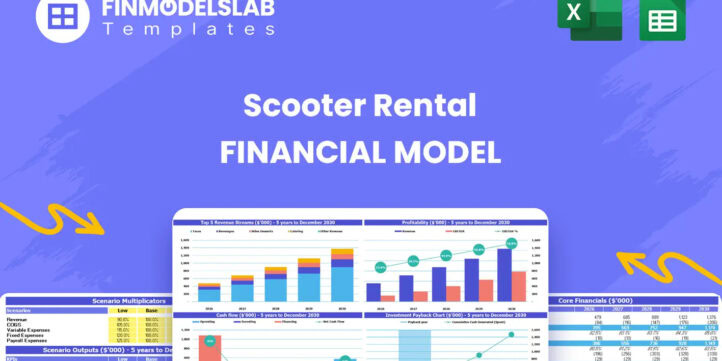
The all-in-one dashboard provides a central view of the most important inputs and outputs in the Scooter Rental Financial Model, allowing users to review the business at a high level before diving into the detailed tabs. This component is useful because scooter rental planning involves many moving parts, including rider growth, average order value, take rates, subscription income, seller extras, payroll, startup capital, operating expenses, EBITDA, cash balance, and profitability milestones. The dashboard helps bring those variables together in one organized summary so users can quickly understand the impact of their assumptions. It may include inputs for growth rates, pricing, commission structures, staffing levels, cost assumptions, funding needs, and timing of major expenses, while outputs may summarize revenue, gross profit, net income, cash flow, runway, and key return metrics. For founders and consultants, this makes the model easier to navigate and easier to explain to stakeholders. For lenders and investors, it provides a clean first impression by showing that the business has been evaluated through a structured, numbers-driven lens. Instead of searching through separate worksheets to understand the plan, users can use the dashboard as the starting point for business review, management discussions, funding presentations, and strategic decision-making.
Low, Base, and High Scenario Analysis
The low, base, and high scenario analysis section helps users evaluate how the scooter rental business may perform under different market conditions. A scooter rental venture can be highly sensitive to assumptions such as customer acquisition cost, ride frequency, tourist demand, commuter adoption, subscription conversion, average order value, seller participation, and marketing efficiency. This component gives users a practical way to compare a conservative case, a realistic planning case, and an upside case without creating separate models. Inputs may include different rider growth rates, usage levels, pricing assumptions, commission rates, subscription penetration, operating expense growth, staffing plans, and capital requirements. Outputs may show how each scenario affects revenue, EBITDA, net profit, cash flow, break-even timing, funding gaps, payback period, and investor returns. This is especially valuable for decision-making because it helps users see whether the business only works in an optimistic scenario or whether it remains viable under more cautious assumptions. It also supports fundraising and lender conversations by showing that the user has considered downside risk, not just the best-case outcome. For a scooter rental startup, scenario planning can help determine whether to launch in one city first, delay hiring, increase marketing spend, raise more capital, or focus on higher-value user segments before scaling.
Professional Charts
The professional charts component turns the financial model’s key outputs into visual reports that are easier to review, explain, and present. Scooter rental financial projections can include many detailed assumptions and calculations, but stakeholders often need a clear visual summary of what the numbers mean. This section may include charts for revenue growth, expense trends, EBITDA progression, cash balance, profitability, cost structure, user growth, revenue stream mix, and financial performance over time. The inputs come from the underlying model assumptions and linked financial statements, while the outputs are presentation-ready visuals that help users communicate the business story more effectively. For example, a chart showing the movement from early EBITDA losses to future profitability can help explain why upfront funding is needed and when the business is expected to become self-sustaining. A revenue mix chart can show the balance between ride commissions, subscription fees, and seller extras, while a cash flow chart can highlight the timing of maximum funding pressure. This component is useful for pitch decks, business plan appendices, lender meetings, internal reviews, and management updates. It helps users avoid overwhelming stakeholders with raw spreadsheet data and instead present the financial plan in a format that supports faster understanding and better decision-making.
ROE Components and DuPont Analysis
The ROE components and DuPont analysis section helps users understand the drivers behind return on equity and overall financial performance. For a scooter rental business seeking outside funding or evaluating owner returns, it is not enough to know whether the company eventually becomes profitable. Investors and founders also need to understand how efficiently the business converts revenue, assets, and equity investment into returns. This component may break return on equity into profitability, asset efficiency, and leverage-related drivers, allowing users to see whether returns are being influenced by margins, utilization, capital structure, or growth assumptions. Inputs may include net income, equity funding, asset levels, revenue, operating costs, depreciation, debt, and retained earnings. Outputs may include ROE, profit margin, asset turnover, equity multiplier, and supporting performance ratios. This is useful because scooter rental businesses can have meaningful upfront investment in technology, platform development, equipment, operations, and working capital, making capital efficiency an important planning issue. By reviewing ROE components, users can identify whether the model needs stronger margins, better cost control, improved asset utilization, or a different financing structure. The section also provides a more analytical layer for investor-ready financial planning, helping users go beyond simple profit projections and explain the financial quality of the business.
Revenue Inputs
The revenue inputs section is one of the most important parts of the Scooter Rental Financial Model because it defines the assumptions that drive the top line of the forecast. A scooter rental business may generate income from multiple sources, including commissions on rides, fixed fees per ride, monthly subscriptions for scooter owners or frequent riders, and extra services such as promoted listings or other seller-related features. This component helps users define the customer segments, usage patterns, average order values, take rates, subscription tiers, conversion rates, and growth assumptions that determine revenue. It may segment demand by rider type, such as commuters, tourists, and casual riders, because each group may have different pricing sensitivity, ride frequency, and average spending. The section can also account for professional scooter owners, fleet operators, and marketplace participants who may pay recurring fees or purchase additional services. Outputs from this component feed into the revenue forecast, gross order value calculations, monthly sales projections, revenue stream summaries, and profitability analysis. This is useful for planning because small changes in ride frequency, pricing, or commission rates can have a large impact on financial outcomes. By making these assumptions explicit and editable, the model helps users test realistic revenue cases, validate market potential, compare customer segments, and build a more credible scooter rental business plan.
Bank-Ready Financial Reports
The bank-ready financial reports section organizes the financial outputs lenders, investors, and stakeholders typically expect to review. A scooter rental startup or expansion plan may require debt financing, equity investment, working capital support, or a line of credit, and funding providers will usually want to see clear financial statements rather than isolated assumptions. This component may include projected profit and loss statements, cash flow forecasts, balance sheet summaries, EBITDA calculations, profit margins, debt capacity indicators, funding requirements, and annual or monthly summaries. Inputs flow from revenue assumptions, startup costs, payroll, operating expenses, capital investments, tax assumptions, financing assumptions, and working capital timing. Outputs help show whether the business can generate enough revenue to cover expenses, whether cash balances remain adequate, when additional funding may be required, and how profitability evolves over time. This section is useful because it translates the operating plan into lender-friendly financial statements that can support business loan applications, investor due diligence, board review, and internal planning. For users preparing a funding package, it helps present the scooter rental opportunity in a more professional format. It also helps identify potential weaknesses before a stakeholder does, such as negative cash balances, delayed profitability, excessive payroll growth, or a funding gap during the early operating period.
Revenue Breakdown
The revenue breakdown section provides a detailed view of how income is generated across the scooter rental business model. While the revenue inputs section defines the assumptions, this component helps users understand the resulting composition of revenue by stream, segment, and period. It may show how much revenue comes from ride commissions, fixed ride fees, subscription plans, frequent rider memberships, professional owner plans, fleet operator fees, seller extras, promoted listings, or other platform services. Inputs may include the number of active riders, number of scooter owners, transaction volume, average order value, commission percentage, fixed fees, subscription prices, churn assumptions, and adoption rates for optional services. Outputs may include monthly and annual revenue by category, percentage contribution by revenue stream, total gross order value, net platform revenue, and growth trends. This is useful because a scooter rental business may look profitable overall while depending too heavily on one revenue stream or one customer segment. By reviewing the breakdown, users can see whether the model is driven by commuters, tourists, casual riders, recurring subscriptions, or owner services. This supports pricing decisions, marketing strategy, product development, and investor discussions. It can also help users identify which revenue streams deserve more attention, such as increasing subscription adoption, improving tourist acquisition, expanding seller extras, or adjusting commissions to improve profitability without reducing marketplace participation.
KPI Dashboard
The KPI dashboard focuses on the operating and financial metrics that help users monitor business performance over time. A scooter rental financial plan is not only about producing financial statements; it also needs to track the business drivers that explain why revenue, costs, and cash flow change. This component may include key performance indicators such as active riders, active scooter owners, ride volume, average order value, take rate, subscription conversion, customer acquisition cost, marketing efficiency, gross margin, EBITDA margin, burn rate, runway, cash balance, payback period, return on equity, and break-even timing. Inputs come from revenue assumptions, marketing spend, staffing plans, cost structure, and financial statement outputs. The resulting KPIs help users evaluate whether the business is gaining traction, scaling efficiently, and moving toward profitability. This is useful for founders and managers because it creates a practical link between operational execution and financial performance. For example, if customer acquisition cost rises faster than average order value, the dashboard can help highlight pressure on margins and cash flow. If subscription revenue grows as a share of total revenue, it may indicate improved recurring income stability. The KPI dashboard is also valuable for stakeholder communication because it gives investors, lenders, and team members a concise view of performance without requiring them to inspect every line of the model.
Startup Costs and Funding Requirements
The startup costs and funding requirements section helps users estimate the capital needed to launch the scooter rental business before it begins generating meaningful revenue. This component is especially important because scooter rental and micromobility platforms can require upfront spending on platform development, mobile app infrastructure, payment systems, security, IT equipment, office setup, legal formation, licensing, insurance deposits, initial marketing, operating reserves, and working capital. Depending on the specific business model, users may also include scooter fleet acquisition, charging equipment, maintenance tools, storage, docking infrastructure, or partnership setup costs. Inputs may include one-time setup expenses, pre-launch payroll, deposits, technology development budgets, initial marketing campaigns, professional fees, hardware costs, and contingency reserves. Outputs may include total startup investment, timing of cash outflows, funding required before launch, use of funds summaries, and the amount of capital needed to cover early operating losses. This section is useful for planning because underestimating startup capital can create cash flow pressure before the business has time to reach scale. It helps users prepare more credible funding requests, compare debt and equity needs, define a minimum launch budget, and understand how much runway is needed. For business plans and investor documents, it provides a clear explanation of where the money will go and why the initial investment is required.
Similar ProductsOther customers were also interested in...


 HenrySheykin
Freight Brokerage Financial Model Excel Template
The Freight Brokerage Financial Model Financial Model Template helps entrepreneurs, founders, busine... Read more
Car Rental Financial Model Excel Template
The Car Rental Financial Model helps entrepreneurs, founders, business owners, consultants, and anal... Read more

 eFinancialModels
Car Rental Business Financial Model
This Car Rental Business Financial Model Template in Excel offers an ideal basis for developing a bu... Read more

 Pushkar
Online Car Rental – 3 Statement Financial Mo...
Online Car Rental Platform Business Plan Model is a perfect tool for a feasibility study on launchin... Read more

 City Finance
Car Hire Company Financial Model 5 Year 3 Statemen...
A comprehensive editable, MS Excel spreadsheet for tracking car hire company finances, including yea... Read more

Ambulance Service Financial Model Excel Template
The Ambulance Service Financial Model is a ready-to-use financial model template designed to help en... Read more
Limousine Taxi Financial Model Excel Template
The Limousine Service Financial Model helps entrepreneurs, operators, consultants, analysts, and fou... Read more

Concierge Service Financial Model Excel Template
The Concierge Service Financial Model helps entrepreneurs, founders, consultants, analysts, and busi... Read more
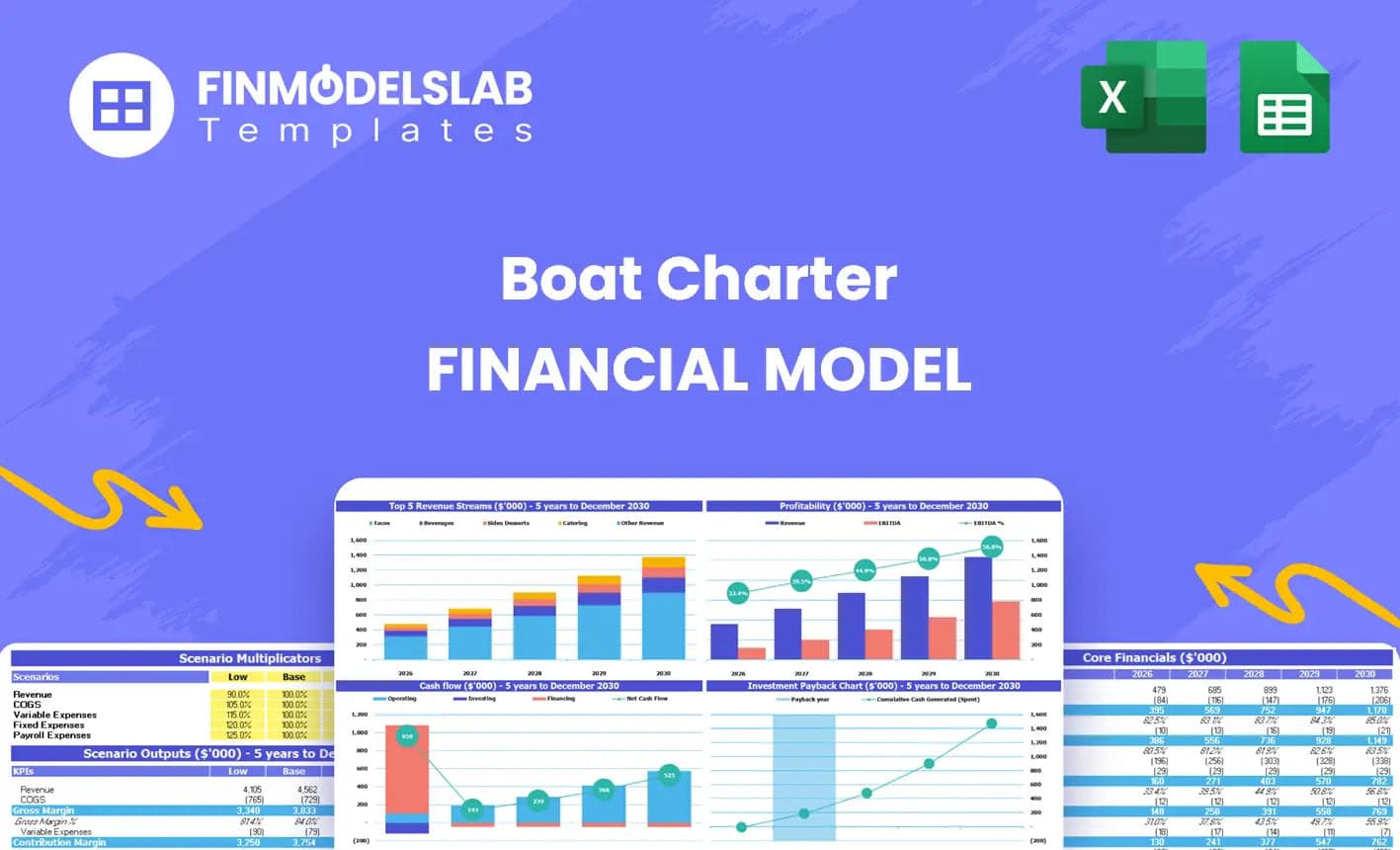
Boat Trip Financial Model Excel Template
The Boat Charter Financial Model Template helps entrepreneurs, founders, consultants, analysts, and ... Read more

Tow Truck Financial Model Excel Template
This Tow Truck Service Financial Model Template helps users turn a towing business idea into a struc... Read more
You must log in to submit a review.