
0 ITEMS

Meditation Center Financial Model Excel Template
The Meditation Center Financial Model helps users turn a mindfulness, meditation, or wellness studio concept into a structured financial forecast. Instead of starting from a blank spreadsheet, buyers receive a ready-to-use model designed around the economics of a meditation center, including memberships, workshops, class capacity, occupancy assumptions, retail add-ons, instructor costs, rent, payroll, startup costs, operating expenses, cash flow, and profitability. It gives entrepreneurs and planners a practical way to understand what it may take to launch, operate, and grow the business over a multi-year period. This financial model template is built for founders, business owners, consultants, analysts, and anyone preparing a business plan, investor pitch, lender package, or internal planning document. Users can adjust assumptions such as membership pricing, customer volume, class utilization, service mix, cost structure, staffing levels, marketing spend, and launch investment to reflect their own market and strategy. The model then connects those inputs to financial projections, helping users see how revenue assumptions affect margins, cash flow, break-even timing, and long-term profitability. The template is especially useful for decision-making before committing capital to a meditation center. It supports planning around recurring membership revenue, single-session workshops, premium offerings, ancillary sales, fixed overhead, instructor fees, payroll, and working capital needs. Users can test different scenarios, review key performance indicators, analyze investor metrics, and identify the assumptions that have the greatest impact on financial outcomes. This makes it easier to evaluate whether the business can sustain operations, scale profitably, and remain adequately funded. Designed to be editable and presentation-ready, the Meditation Center Financial Model can be customized for startups, expansions, wellness studios, mindfulness centers, and related service businesses. It helps simplify complex financial planning by organizing the core assumptions and outputs in one place, including revenue forecasts, expense planning, cash flow projections, profitability analysis, break-even analysis, visual dashboards, and stakeholder-ready reports. Whether used for funding preparation, strategic budgeting, or operational planning, the template provides a professional framework for building a clearer financial story.
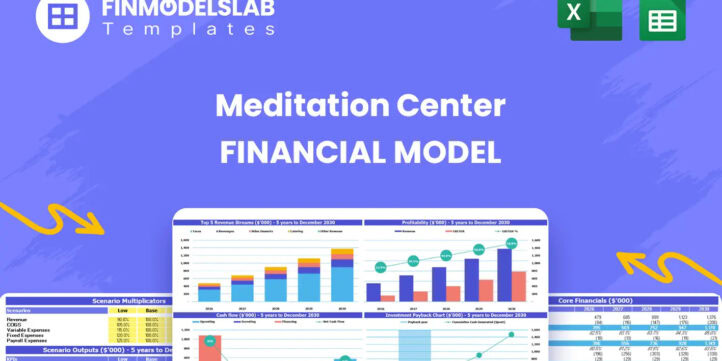


Financial Model Overview
The Meditation Center Financial Model is a ready-to-use financial model template created for entrepreneurs, founders, consultants, analysts, and business owners who need to plan the financial side of a meditation center, mindfulness studio, or wellness-focused service business. It helps users organize the key assumptions behind the business model, including membership pricing, workshop fees, occupancy rates, class capacity, instructor costs, rent, payroll, startup investment, operating expenses, and cash flow. Rather than building a forecast from scratch, users can work from a structured model that connects inputs to outputs across revenue, profitability, liquidity, and investor metrics. This is especially valuable for business planning, funding preparation, lender conversations, investor presentations, and internal decision-making because it translates the operational plan into a clear financial forecast. The model is designed to be editable, so users can replace the included assumptions with their own numbers, adapt the forecast to different markets, and evaluate whether the meditation center can reach sustainable profitability over time.
All-in-One Dashboard
The all-in-one dashboard brings the most important inputs and outputs into a central planning view, giving users a quick way to understand the overall financial position of the meditation center. This section is useful because a meditation business can include multiple moving parts, such as recurring memberships, drop-in workshops, instructor scheduling, rent, marketing, retail sales, payroll, startup investment, and cash reserves. The dashboard helps summarize these drivers so users can review the business at a high level without getting lost in individual worksheets. It may include core assumptions such as occupancy rate, membership mix, average pricing, class volume, expense categories, and financing inputs, along with key outputs such as projected revenue, EBITDA, cash balance, profit margins, break-even timing, and return metrics. For business planning and funding discussions, this section allows users to show the financial story quickly and clearly. It also supports faster decision-making because changes to assumptions can be reflected across the model, helping users see whether a new price point, marketing plan, staffing level, or launch budget improves or weakens the forecast.
Low, Base, and High Scenario Analysis
The Low, Base, and High scenario analysis component allows users to test how the meditation center may perform under different market and operating conditions. This is important because actual results can vary depending on membership conversion, class occupancy, customer retention, instructor availability, local competition, pricing acceptance, and marketing effectiveness. The low scenario can be used to model conservative assumptions, such as slower membership growth, lower workshop attendance, or higher expenses. The base scenario can reflect the most realistic operating plan, while the high scenario can show the upside potential if demand is stronger, premium programs perform well, or occupancy improves faster than expected. Inputs may include membership counts, pricing tiers, workshop volumes, retail sales, cost inflation, staffing requirements, and overhead levels. Outputs can include revenue, gross margin, EBITDA, cash flow, profitability, and funding needs across each scenario. This section is valuable for investors, lenders, and internal planning because it demonstrates that the user has considered risk, not just the best-case outcome. It also helps identify which assumptions matter most, allowing the business owner to prepare contingency plans before problems arise.
Professional Charts
The professional charts component converts financial data into presentation-ready visuals that make the meditation center forecast easier to understand. Financial models often contain detailed calculations, but charts help communicate trends, patterns, and business performance in a format that stakeholders can absorb quickly. This section may visualize revenue growth, monthly cash flow, profitability, expense composition, membership expansion, margin development, break-even timing, and other key financial indicators. For a meditation center, charts can be especially useful when explaining how recurring membership revenue builds over time, how fixed costs such as rent and salaries become more efficient as occupancy increases, or how cash balances change as the business moves from launch to stabilization. These visual outputs are useful in investor decks, bank meetings, business plans, and management reviews because they support a more polished financial presentation. They also help the user personally understand the model better by showing whether growth is smooth, whether costs are scaling appropriately, and whether cash flow remains healthy across the forecast period. Instead of relying only on rows of numbers, the chart section gives users a clearer way to communicate financial performance.
ROE Components and DuPont Analysis
The ROE components section uses a DuPont-style analysis to break return on equity into the drivers behind financial performance. Instead of looking only at a single return percentage, this component helps users understand why returns are changing and which parts of the business are contributing to overall investor value. The analysis may consider profitability, asset efficiency, and leverage, showing how net income, revenue generation, capital usage, and financing structure interact. For a meditation center, this is useful because investors may want to know whether returns are being driven by strong operating margins, efficient use of startup capital, recurring revenue growth, or the way the business is funded. Inputs can include net profit, revenue, total assets, owner equity, debt assumptions, and operating performance metrics. Outputs can include return on equity and its underlying components, helping users assess whether the business is improving because it is more profitable, more efficient, or more financially leveraged. This section is particularly useful for funding preparation because it gives stakeholders a deeper view of investment performance. It also helps owners evaluate whether expansion, additional equipment, a larger studio, or changes in financing could improve or weaken long-term returns.
Revenue Inputs
The revenue inputs component provides the foundation for forecasting sales in the Meditation Center Financial Model. This section allows users to define the commercial assumptions that drive income, such as membership tiers, monthly pricing, number of members, occupancy rate, workshop attendance, single-session fees, premium class offerings, retreats, corporate mindfulness programs, and ancillary retail sales. Since a meditation center often depends on a mix of recurring and event-based revenue, this section helps users model how each income stream contributes to total sales. For example, users can adjust assumptions for Basic, Standard, and Premium memberships, test different monthly pricing levels, estimate class utilization, or add seasonal workshop demand. The model then uses these assumptions to generate revenue forecasts over time, helping users evaluate whether expected customer volume can support rent, payroll, marketing, instructor fees, and other operating expenses. This component is valuable because revenue forecasting is one of the most important parts of the business plan. It lets users test pricing strategies, compare service mixes, plan capacity, and understand how customer acquisition affects financial results. By making revenue assumptions visible and editable, the model helps replace guesswork with a structured planning approach.
Bank-Ready Reports
The bank-ready reports component organizes the forecast into professional financial outputs that can support lender conversations, funding applications, and stakeholder review. Banks and financing partners typically want to see more than a general business idea. They need structured financial statements, clear assumptions, projected profitability, debt service capacity, cash flow stability, and evidence that the business can operate without running into liquidity problems. This section helps present the meditation center’s numbers in a lender-friendly format, including outputs such as projected profit and loss statements, cash flow forecasts, balance sheet summaries, and key financial metrics. Inputs from the rest of the model, including revenue assumptions, startup costs, operating expenses, payroll, financing, and working capital, flow into these reports to create a cohesive financial package. For users preparing a business loan request or investor documentation, this component saves time and improves professionalism. It also helps business owners identify weaknesses before presenting the plan, such as insufficient cash reserves, unrealistic margins, excessive fixed costs, or funding gaps. By creating structured reports, the model supports more confident conversations with banks, investors, landlords, partners, and advisors.
Revenue Breakdown
The revenue breakdown component gives users a detailed view of how each income stream contributes to total meditation center revenue. Rather than showing only one consolidated sales number, this section separates revenue categories so users can understand the role of memberships, workshops, drop-in sessions, premium programs, retreats, retail sales, and other service lines. This matters because each revenue stream may have different pricing, volume, margin, seasonality, and growth potential. Memberships may provide predictable monthly recurring revenue, while workshops can create higher-margin bursts of income. Retail sales may add incremental revenue but require inventory planning. Premium sessions or specialized programs may improve profitability if demand is strong. Inputs may include member counts by tier, session fees, attendance levels, purchase frequency, product margins, and growth rates. Outputs help show the percentage contribution of each revenue source, projected monthly and annual revenue by category, and changes in revenue mix over time. This section is useful for strategic decision-making because it helps users identify which offerings deserve more marketing attention, which services drive the strongest returns, and whether the business is too dependent on one revenue stream. It also supports investor discussions by showing that the revenue model is diversified and thoughtfully planned.
KPI Dashboard
The KPI dashboard tracks the performance metrics that matter most for a meditation center and compares them against planning targets or benchmarks. While financial statements show the end results, key performance indicators help explain what is happening inside the business. This section may include metrics such as occupancy rate, active members, revenue per member, average monthly revenue, class utilization, gross margin, EBITDA margin, cash balance, customer growth, payback period, return on equity, and break-even progress. For a wellness or meditation business, these indicators help users connect operational performance with financial outcomes. For example, if occupancy increases but profitability does not improve, the KPI dashboard may point to rising instructor costs or underpriced memberships. If revenue grows but cash flow weakens, the user may need to review working capital, startup spending, or payment timing. This component is useful for ongoing management because it gives owners and managers a concise way to monitor business health after launch. It is also helpful for investors and advisors because it summarizes performance in a way that is easier to evaluate than detailed spreadsheets alone. By tracking key metrics in one place, the model supports faster reviews, better decisions, and more disciplined financial management.
Break-Even Analysis
The break-even analysis component helps users identify when the meditation center is expected to cover its costs and begin generating profit. This is one of the most important questions for founders, lenders, and investors because it shows how quickly the business can move from startup spending to financial sustainability. The section may use inputs such as monthly fixed costs, rent, payroll, instructor fees, marketing expenses, software subscriptions, utilities, average membership pricing, workshop contribution margins, retail margins, and expected customer volume. It then estimates the level of revenue, number of members, or time period required to cover operating expenses. For a meditation center with recurring membership revenue, break-even analysis is especially useful because it shows how many paying members are needed to support the cost structure. It can also help users test whether pricing changes, higher occupancy, premium workshops, or cost reductions accelerate the path to profitability. Outputs may include break-even month, break-even revenue, margin of safety, and sensitivity to key assumptions. This section supports decision-making by helping users understand whether the launch plan is realistic, whether additional funding may be needed, and which levers can improve the business model before opening.
Startup Costs and Operating Expense Planning
The startup costs and operating expense planning component helps users estimate the capital required to launch the meditation center and the monthly expenses needed to keep it running. Startup costs may include studio build-out, furnishings, meditation cushions and props, sound equipment, signage, website development, booking software, licenses, deposits, launch marketing, initial inventory, professional fees, and working capital reserves. Operating expenses may include rent, instructor compensation, administrative payroll, utilities, insurance, marketing, cleaning, software, supplies, maintenance, merchant fees, and other recurring overhead. Separating one-time costs from ongoing expenses is important because it helps users understand both the initial funding requirement and the monthly cash burn after opening. This component connects directly to cash flow, profitability, and funding needs, allowing users to see whether the business has enough capital to launch and operate through the early ramp-up period. It is also useful for budgeting because it helps founders avoid underestimating common expenses that can create cash pressure. For funding documents, a clear startup cost and operating expense plan shows lenders and investors how the requested capital will be used and how the business expects to manage costs over time.
File types:
Excel – Single-User: .xlsx
Excel – Multi-User: .xlsx
Similar ProductsOther customers were also interested in...

 HenrySheykin
Mental Health Center Financial Model Excel Templat...
The Mental Health Clinic Financial Model helps users build a structured financial forecast for a the... Read more

Orthopedic Center Financial Model Excel Template
The Orthopedic Clinic Financial Model helps users build a structured five-year forecast for a capita... Read more
Drug Treatment Center Financial Model Excel Templa...
The Residential Treatment Center Financial Model helps users turn a live-in behavioral health, menta... Read more

Hypnotherapy Center Financial Model Excel Template
The Hypnotherapy Practice Financial Model helps users turn a wellness practice concept into a struct... Read more
Yoga Studio Financial Model Excel Template
The Yoga Studio Financial Model helps entrepreneurs, founders, studio owners, consultants, and finan... Read more
Weight Loss Center Financial Model Excel Template
The Weight Loss Center Financial Model helps entrepreneurs, clinic owners, consultants, and analysts... Read more

Sports Therapy Financial Model Excel Template
The Sports Medicine Clinic Financial Model helps users turn a clinic concept, launch plan, or expans... Read more
Tai Chi Center Financial Model Excel Template
The Martial Arts School Financial Model helps founders, school owners, consultants, and business pla... Read more
Osteopathic Center Financial Model Excel Template
The Holistic Health Center Financial Model helps entrepreneurs, founders, consultants, analysts, and... Read more

Oriental Medicine Center Financial Model Excel Tem...
The Traditional Chinese Medicine Clinic Financial Model helps entrepreneurs, clinic owners, consulta... Read more
You must log in to submit a review.