
0 ITEMS

Mental Health Center Financial Model Excel Template
The Mental Health Clinic Financial Model helps users build a structured financial forecast for a therapy, counseling, behavioral health, or psychiatric practice. Instead of relying on a generic healthcare spreadsheet, this financial model template is designed around the real operating drivers of a mental health clinic, including clinician capacity, session volume, utilization rates, service pricing, payer mix, payroll, operating expenses, startup costs, and cash flow. It gives entrepreneurs and planners a practical way to turn clinic assumptions into a clear five-year financial outlook. This template is built for founders, clinic owners, consultants, analysts, business plan writers, and teams preparing funding documents for a new or expanding mental health clinic. It helps users organize the financial planning process by connecting revenue assumptions with staffing needs, treatment capacity, fixed costs, variable costs, and profitability. Whether you are opening a private counseling practice, launching a multi-provider therapy center, adding psychiatric services, or preparing a lender presentation, the model gives you a ready-to-use structure for estimating what the business may require and how it may perform. The model supports practical decision-making by showing how changes in patient volume, practitioner utilization, pricing, marketing spend, payroll, and operating expenses affect revenue, cash flow, and profit. Users can estimate startup costs, review funding needs, test different growth assumptions, evaluate monthly and annual performance, and understand when the clinic may reach break-even. This makes it useful not only for launch planning, but also for budgeting, hiring decisions, service mix planning, and stakeholder discussions. Because the Mental Health Clinic Financial Model is fully editable, users can replace the built-in assumptions with their own clinic details and adapt the forecast to local market conditions, staffing plans, service offerings, and reimbursement expectations. The template is compatible with Excel and Google Sheets, making it easy to update, share, and refine with partners, advisors, investors, or lenders. It saves time compared with building a model from scratch while still providing the depth needed for professional financial planning, profitability analysis, and funding preparation.
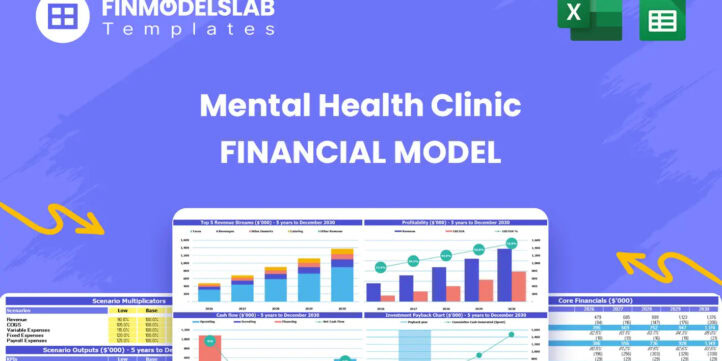


Financial Model Overview
The Mental Health Clinic Financial Model is a ready-to-use financial model template created for therapy centers, counseling practices, behavioral health facilities, psychiatric clinics, and multi-provider mental health businesses. It helps users translate the core operating assumptions of a clinic into a complete financial forecast, including revenue, expenses, payroll, cash flow, profitability, startup investment, and funding needs. Unlike a generic healthcare model, this template is structured around the way a mental health clinic actually operates, using drivers such as practitioner count, monthly treatment capacity, utilization rate, session pricing, service mix, and operating cost structure. Entrepreneurs, business owners, consultants, analysts, and funding teams can use it to prepare a clinic launch plan, evaluate an expansion, build a business plan financial section, or present financial projections to banks and investors. The model is fully editable, works in Excel and Google Sheets, and provides a professional framework for making decisions before committing capital, hiring staff, signing a lease, or scaling services.
All-in-One Dashboard
The all-in-one dashboard gives users a central place to view the most important inputs and outputs of the Mental Health Clinic Financial Model without searching through every supporting worksheet. It brings together the clinic’s core assumptions, such as opening timeline, revenue drivers, treatment capacity, practitioner mix, pricing, operating costs, payroll assumptions, startup investment, and funding structure, then connects those assumptions to high-level financial results. The dashboard helps summarize projected revenue, EBITDA, net income, cash balance, runway, return metrics, and other key indicators that matter to founders, lenders, and investors. For a mental health clinic, this is especially useful because small changes in utilization, staffing, rent, payer mix, or marketing spend can materially affect the financial outlook. By placing major results in one location, the dashboard supports faster review, easier stakeholder communication, and more confident decision-making. It also allows users to quickly test updates and see how the overall clinic plan responds, making the model practical for both early-stage planning and ongoing financial management.
Low, Base, and High Scenario Analysis
The low, base, and high scenario analysis section helps users evaluate how the clinic may perform under different business conditions. Instead of relying on a single forecast, users can compare conservative, expected, and optimistic cases based on changes in the most important financial drivers. For a mental health clinic, scenario inputs may include patient ramp-up speed, practitioner utilization rates, session pricing, payer reimbursement assumptions, clinician hiring pace, marketing efficiency, rent, administrative staffing, and variable operating costs. The outputs show how each scenario affects revenue, expenses, profitability, cash flow, funding needs, and investment returns over the forecast period. This is valuable for planning because new clinics often face uncertainty around patient acquisition, referral growth, insurance claim timing, staffing availability, and local competition. A low case can show what happens if the clinic grows more slowly than expected, while a high case can show the resources needed to support faster demand. The scenario structure helps users prepare for risk, identify upside opportunities, and present a more credible financial plan to lenders, investors, partners, or internal stakeholders.
Professional Charts and Visual Reports
The professional charts and visual reports section turns the clinic’s financial projections into clear visuals that are easier to understand and present. Rather than relying only on rows of numbers, the model uses charts and graphs to display revenue growth, expense trends, EBITDA movement, cash flow, profitability, and other performance indicators across the forecast period. For a mental health clinic business plan, visual reporting can be especially helpful when explaining how the clinic moves from early operating losses to sustainable profitability as patient volume grows and practitioner utilization improves. Inputs from the revenue model, expense model, payroll plan, capital expenditure section, and cash flow forecast flow through to the visual outputs, allowing users to update assumptions and see charts refresh accordingly. These reports are useful for investor meetings, lender discussions, board reviews, internal planning sessions, and consultant deliverables. They help communicate the financial story of the clinic in a concise way, showing whether the business model can support its staffing plan, cover overhead, manage cash needs, and generate acceptable returns over time.
ROE Components and DuPont Analysis
The ROE components and DuPont analysis section helps users understand what is driving return on equity rather than viewing returns as a single isolated percentage. This component breaks return performance into underlying drivers such as profitability, asset efficiency, and leverage, giving clinic owners and investors a more detailed view of how the business creates value. In the context of a mental health clinic, this can help assess whether return improvement is coming from higher session margins, better practitioner productivity, stronger utilization, controlled overhead, efficient use of startup capital, or the way the clinic is financed. Inputs may include net income, revenue, assets, equity, debt, and other balance sheet and income statement figures produced by the model. The outputs help users evaluate whether the clinic’s return profile is improving for healthy operational reasons or because of increased financial leverage. This is useful for funding conversations, investor analysis, and strategic planning because it adds depth to the profitability review. It also helps decision-makers identify which levers have the greatest impact on long-term owner returns.
Revenue Inputs and Assumptions
The revenue inputs and assumptions section is one of the most important parts of the Mental Health Clinic Financial Model because it connects sales projections directly to the operating reality of a clinic. Revenue can be modeled based on the number of practitioners, service categories, monthly treatment capacity, expected utilization rates, session pricing, and growth over time. A clinic may include revenue streams such as clinical psychologist services, licensed counselor sessions, social worker consultations, psychiatrist appointments, specialty therapy services, group therapy, telehealth sessions, or other mental health offerings. Users can adjust assumptions to reflect their local market, business model, payer mix, appointment length, provider productivity, reimbursement levels, and expected patient demand. The model then translates these assumptions into monthly and annual revenue forecasts. This bottom-up approach is useful because it avoids unsupported top-line estimates and instead shows whether the clinic’s planned staffing and schedule capacity can realistically generate the projected income. It also helps users test pricing, hiring, utilization, and service mix decisions before launching or expanding the practice.
Bank-Ready Financial Reports
The bank-ready financial reports section provides structured financial outputs that can support loan applications, funding discussions, business plans, and stakeholder presentations. This component organizes projections into professional summaries that may include profit and loss statements, cash flow forecasts, balance sheet outputs, sources and uses of funds, funding requirements, debt assumptions, repayment schedules, and key return metrics. For a mental health clinic, lenders and investors typically want to understand how the clinic will use capital, when revenue begins to cover expenses, how payroll and overhead are managed, and whether cash balances remain adequate during the early ramp-up period. The model helps answer these questions in a clean, lender-friendly format. Inputs from startup costs, revenue assumptions, staffing plans, operating expenses, financing structure, and working capital assumptions flow into the reports automatically. This saves time compared with manually building financial statements and reduces the risk of inconsistent figures across the business plan. The result is a more polished and credible financial package for banks, investors, partners, grant reviewers, or internal decision-makers.
Revenue Breakdown by Service Stream
The revenue breakdown section gives users a detailed view of how each service category contributes to total clinic revenue. Instead of showing only one combined sales figure, the model can separate income by provider type, therapy format, appointment category, or service line. A mental health clinic may want to track clinical psychologist sessions, licensed counselor visits, social worker consultations, psychiatrist appointments, specialty therapy, assessments, telehealth, or other offerings separately because each stream may have different prices, utilization levels, salary implications, and margin characteristics. Inputs may include session price, monthly capacity, ramp-up assumptions, practitioner count, utilization percentage, and timing of each revenue stream. The outputs help users see which services generate the most revenue, which are growing fastest, and which may require more staffing or marketing support. This is useful for service mix planning, hiring decisions, pricing reviews, and profitability analysis. It can also help stakeholders understand whether the clinic is overly dependent on one revenue stream or whether it has a balanced model that can support sustainable growth across multiple mental health service categories.
KPI Dashboard and Benchmarks
The KPI dashboard and benchmarks section helps users evaluate clinic performance using practical metrics that go beyond revenue and profit alone. Key performance indicators for a mental health clinic may include practitioner utilization, revenue per provider, sessions per month, average session price, gross margin, EBITDA margin, payroll as a percentage of revenue, client acquisition cost, cash runway, break-even timing, payback period, and return metrics. The model can use the clinic’s own forecast assumptions to calculate these indicators and compare them against internal targets or industry benchmarks where relevant. This helps users identify strengths, weaknesses, and areas requiring operational improvement. For example, a clinic with strong pricing but low utilization may need a better referral strategy, while a clinic with high demand but weak margins may need to review payroll structure, billing costs, or administrative overhead. The KPI dashboard is useful for founders, managers, analysts, and consultants because it turns the financial model into a management tool. It supports better decision-making by showing whether the clinic is operating efficiently and whether the forecast aligns with realistic performance standards.
Startup Costs and Capital Expenditure Planning
The startup costs and capital expenditure planning section organizes the initial investment required to launch or expand the mental health clinic. This component helps users estimate one-time costs such as clinic build-out, renovation, office furniture, therapy room fixtures, IT hardware, network setup, telehealth equipment, software implementation, security deposits, licenses, professional fees, initial marketing, insurance, training, and pre-opening working capital. Users can adjust each line item to match their location, clinic size, lease terms, equipment needs, service model, and launch strategy. The outputs show the total capital required before operations begin, helping users understand how much funding may be needed from owner investment, loans, investor capital, or other sources. For a mental health clinic, startup cost planning is especially important because the business may require meaningful upfront spending before patient revenue reaches a stable level. A clear capital expenditure plan helps prevent underfunding, supports funding applications, and gives decision-makers a better view of how initial cash will be used. It also connects directly to depreciation, cash flow, and the long-term financial statements where applicable.
Break-Even Analysis and Profitability Timing
The break-even analysis section helps users estimate when the mental health clinic’s revenue is expected to cover its operating costs. This component compares projected monthly revenue against fixed expenses, variable costs, practitioner payroll, administrative payroll, marketing, rent, software, billing costs, insurance, and other overhead expenses to identify the point at which the clinic moves from operating losses toward sustainable profitability. Inputs may include service pricing, appointment volume, practitioner utilization, staff salaries, rent, vendor costs, and marketing spend. The outputs can show break-even timing in months, the revenue level required to break even, and the operational assumptions needed to reach that milestone. This is useful for founders and investors because many clinics experience an early cash burn period while building patient volume, referral relationships, and utilization. Knowing the break-even point helps users plan working capital, set realistic funding requirements, manage hiring pace, and avoid overextending the business before demand is proven. It also provides a practical target for management, making it easier to track whether the clinic is progressing toward financial sustainability.
File types:
Excel – Single-User: .xlsx
Excel – Multi-User: .xlsx
Similar ProductsOther customers were also interested in...


 HenrySheykin
Orthopedic Center Financial Model Excel Template
The Orthopedic Clinic Financial Model helps users build a structured five-year forecast for a capita... Read more
Drug Treatment Center Financial Model Excel Templa...
The Residential Treatment Center Financial Model helps users turn a live-in behavioral health, menta... Read more
Hypnotherapy Center Financial Model Excel Template
The Hypnotherapy Practice Financial Model helps users turn a wellness practice concept into a struct... Read more

Yoga Studio Financial Model Excel Template
The Yoga Studio Financial Model helps entrepreneurs, founders, studio owners, consultants, and finan... Read more
Weight Loss Center Financial Model Excel Template
The Weight Loss Center Financial Model helps entrepreneurs, clinic owners, consultants, and analysts... Read more

Sports Therapy Financial Model Excel Template
The Sports Medicine Clinic Financial Model helps users turn a clinic concept, launch plan, or expans... Read more

Tai Chi Center Financial Model Excel Template
The Martial Arts School Financial Model helps founders, school owners, consultants, and business pla... Read more
Osteopathic Center Financial Model Excel Template
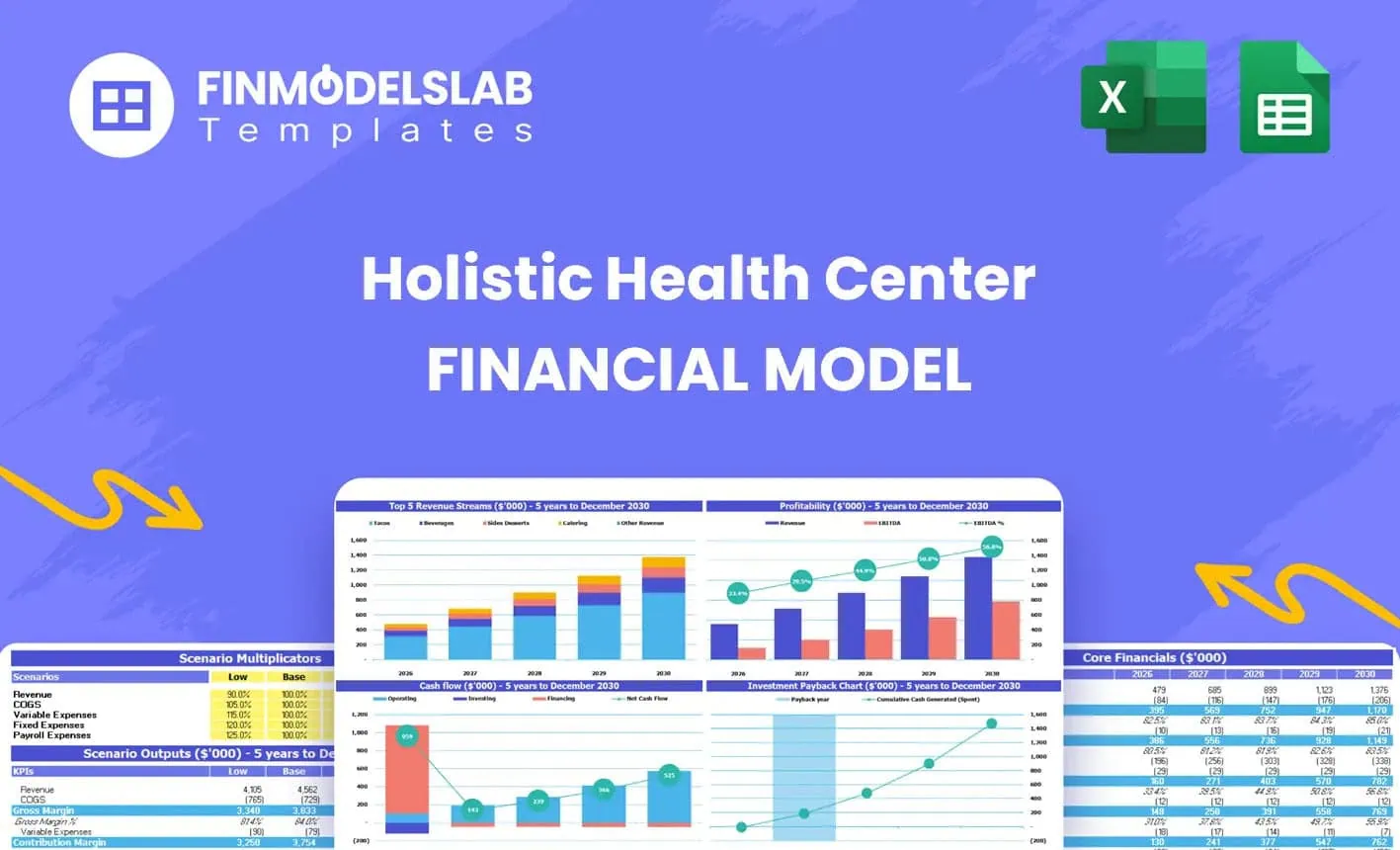
The Holistic Health Center Financial Model helps entrepreneurs, founders, consultants, analysts, and... Read more

Oriental Medicine Center Financial Model Excel Tem...
The Traditional Chinese Medicine Clinic Financial Model helps entrepreneurs, clinic owners, consulta... Read more

Naturopathy Center Financial Model Excel Template
The Naturopathic Clinic Financial Model Template helps practitioners, founders, consultants, and bus... Read more
You must log in to submit a review.