
0 ITEMS

Massage Center Financial Model Excel Template
The Massage Center Financial Model helps entrepreneurs, spa owners, wellness founders, consultants, and financial analysts turn a massage therapy business idea into a structured five-year forecast. Instead of estimating revenue, expenses, payroll, cash flow, and profitability in disconnected spreadsheets, this template brings the main planning assumptions into one editable model. It is designed for massage centers, massage spas, wellness studios, and therapy practices that need to understand how daily visits, service pricing, memberships, retail sales, add-ons, staffing, and operating costs affect financial performance over time. This financial model template is useful for preparing a business plan, evaluating a new location, requesting lender financing, presenting to investors, or managing an existing massage center more strategically. Users can customize the assumptions to reflect their own pricing, appointment volume, service mix, membership growth, therapist scheduling, rent, marketing, supplies, payroll, startup costs, and working capital needs. The model helps users move from broad expectations to practical financial planning by showing how decisions at the operating level flow into revenue forecasts, profit margins, cash flow, and funding requirements. For a massage center, profitability depends on more than simply filling appointment slots. The business must balance therapist utilization, recurring membership revenue, one-time sessions, retail and enhancement sales, labor costs, room capacity, customer acquisition spending, and fixed overhead. This template gives users a ready-made framework for testing those drivers before committing capital or expanding operations. It supports better decision-making by helping users compare assumptions, identify weak points, monitor cash flow timing, and understand whether the business can reach sustainable profitability. The Massage Center Financial Model is fully editable and built for users who want a professional, investor-ready planning tool without creating a model from scratch. It includes structured outputs for revenue planning, operating expense forecasting, payroll, profit and loss, cash flow, scenario analysis, break-even analysis, charts, KPI tracking, and financial reports. Whether you are launching your first massage therapy studio, improving an existing wellness center, or advising a client, the template provides a practical way to evaluate performance, communicate the financial plan, and make more confident business decisions.


Financial Model Overview
The Massage Center Financial Model is a ready-to-use financial model template created for planning, launching, funding, or expanding a massage therapy business. It helps users connect the practical drivers of a massage center, such as daily client visits, 60-minute and 90-minute session pricing, membership revenue, retail product sales, service enhancements, therapist staffing, rent, supplies, and startup investment, with a complete financial forecast. Instead of relying on rough estimates, entrepreneurs and business owners can work from a structured model that organizes assumptions, calculates outputs, and presents results in a format suitable for internal planning, lender review, investor discussions, and business plan preparation. The model is especially useful for founders, spa operators, wellness consultants, financial analysts, and advisors who need to understand how a massage center may perform over time. By combining five-year projections, cash flow forecasting, profitability analysis, scenario planning, investor metrics, and presentation-ready summaries, the template gives users a practical framework for assessing whether the business can generate enough revenue, manage costs effectively, reach break-even, and support sustainable growth.
All-in-One Dashboard
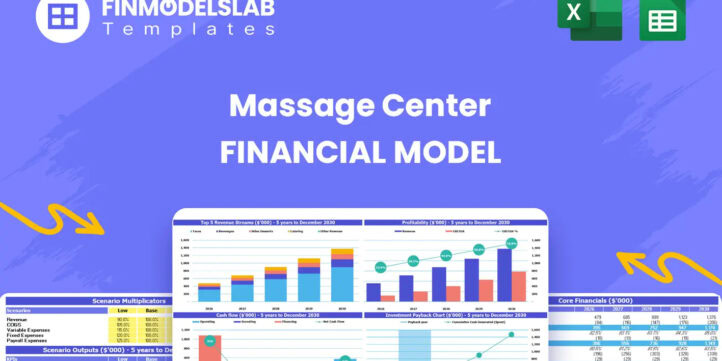
The all-in-one dashboard brings the core inputs and core outputs of the Massage Center Financial Model into a single planning view, helping users understand the business quickly without searching through separate worksheets. This component may include key assumptions such as daily visits, average service price, membership mix, retail sales, add-on revenue, payroll structure, rent, operating expenses, startup investment, and financing assumptions, while also displaying important outputs such as projected revenue, EBITDA, net profit, cash balance, funding needs, break-even timing, and return metrics. For a massage center, this is especially valuable because several small operational assumptions can meaningfully change performance, including therapist utilization, membership adoption, and service mix. The dashboard helps users see the connection between assumptions and results, making it easier to review the business case, test changes, and explain the forecast to lenders, investors, partners, or internal stakeholders. It also supports faster decision-making by summarizing the most important indicators in one place, allowing users to identify whether the plan is financially viable before reviewing the detailed schedules.
Low, Base, and High Scenario Analysis
The low, base, and high scenario analysis component helps users evaluate how the massage center may perform under different business conditions. Rather than relying on one forecast, users can compare a conservative case, a realistic base case, and an optimistic growth case using changes to assumptions such as average daily visits, membership conversion, service pricing, repeat customer behavior, retail product sales, add-on uptake, payroll requirements, marketing efficiency, and operating cost inflation. The outputs can show how each scenario affects revenue growth, profit margins, cash flow, funding needs, payback period, and break-even timing. This is useful for entrepreneurs and analysts because a massage center often experiences a ramp-up period before reaching stable appointment volume and recurring membership revenue. Scenario analysis helps users understand downside risk, identify which assumptions matter most, and prepare contingency plans if customer acquisition takes longer or expenses rise faster than expected. It also strengthens funding presentations by showing lenders or investors that the business plan has been stress-tested rather than built around a single optimistic projection.
Professional Charts
The professional charts component converts key financial results into clear visual reports that are easier to review, present, and discuss. This section may display revenue growth, expense trends, gross profit, EBITDA, net income, cash flow movement, cumulative cash balance, revenue stream mix, break-even progress, and other important business metrics. For a massage center, visual reporting is useful because it can highlight trends that are not immediately obvious in rows of numbers, such as whether membership revenue is becoming a larger share of sales, whether payroll is scaling efficiently with appointment volume, or whether cash reserves remain healthy during the early growth phase. These charts support planning meetings, investor presentations, lender discussions, and internal performance reviews by turning detailed model calculations into understandable financial stories. A founder can use the charts to explain how the business moves from startup investment to revenue ramp-up and eventual profitability, while an advisor can use them to compare operating assumptions and recommend improvements. The presentation-ready format saves time and helps make financial outputs more credible and accessible.
ROE Components and DuPont Analysis
The ROE components and DuPont analysis section helps users understand the drivers behind return on equity and overall investment performance. Instead of showing only a single return number, this component breaks performance into underlying factors such as profitability, asset efficiency, and leverage, allowing users to see how operational and financial decisions influence shareholder returns. Inputs may include projected net income, revenue, assets, equity investment, debt levels, and financing structure, while outputs can include return on equity, margin analysis, asset turnover, and related investor metrics. For a massage center, this is useful because return potential depends on both operating performance and capital efficiency. A business with a high build-out cost, heavy equipment investment, or excessive debt may produce lower returns even if revenue grows. DuPont-style analysis helps users evaluate whether the model is generating value from the capital invested, whether the initial startup cost is reasonable, and whether improvements in pricing, utilization, payroll control, or membership revenue could improve investor appeal. It is a practical tool for owners and stakeholders who want to assess more than basic profit.
Revenue Inputs
The revenue inputs component is where users define the commercial assumptions that drive the massage center forecast. This section may include the expected number of daily visits, appointment growth over time, pricing for 60-minute and 90-minute massage sessions, monthly membership fees, membership adoption rates, service enhancements, retail product sales, average spend per client, and changes in service mix over the five-year projection period. Because revenue in a massage center is strongly connected to capacity, therapist availability, appointment volume, and repeat customer behavior, this component helps users build a forecast from realistic operating drivers rather than broad top-down estimates. The model can then calculate monthly and annual revenue by stream, making it easier to evaluate how much income comes from one-time sessions compared with recurring memberships, retail sales, or add-ons. This is useful for business planning because it allows users to test different pricing strategies, membership campaigns, promotional plans, and capacity assumptions before launching or expanding. It also helps lenders and investors understand the logic behind projected sales.
Bank-Ready Reports
The bank-ready reports component organizes financial outputs in a format that lenders, investors, and professional stakeholders can review more easily. This section may include projected profit and loss statements, cash flow statements, balance sheet summaries, debt repayment views, funding requirement summaries, key assumptions, profitability metrics, and liquidity indicators. For a massage center seeking financing, clean financial reporting is important because lenders want to see whether the business can cover startup costs, support ongoing expenses, maintain positive cash flow, repay debt, and reach profitability within a reasonable timeframe. The reports help users present a structured financial plan rather than disconnected assumptions, improving the credibility of funding discussions. They can also support business plan submissions, grant applications, partner meetings, and internal budget approvals. By summarizing the forecast in a lender-friendly way, this component helps answer practical questions about revenue potential, operating costs, cash reserves, break-even timing, and repayment capacity. It is designed to make the financial model easier to communicate, review, and update as business assumptions change.
Revenue Breakdown
The revenue breakdown component provides a detailed view of each income stream in the massage center business model. Instead of showing only total revenue, it separates revenue from single massage sessions, longer premium sessions, recurring membership fees, retail product sales, service enhancements, add-ons, packages, or other income categories that the user chooses to include. Inputs may include pricing, volume, customer mix, membership share, add-on attachment rates, retail conversion, and growth assumptions, while outputs can show monthly and annual revenue by category and each stream’s share of total sales. This is useful because massage centers often improve profitability by shifting from purely transactional bookings toward recurring memberships and higher-margin add-ons. A detailed revenue breakdown helps users see which services drive growth, which offerings contribute most to average revenue per client, and whether the business is overly dependent on one source of income. It also supports marketing and operational decisions by helping owners decide where to focus promotions, therapist scheduling, product inventory, and customer retention efforts. For investors, it provides transparency behind the headline revenue forecast.
KPI Dashboard
The KPI dashboard component tracks the performance metrics that matter most for managing a massage center. It may include revenue growth, average daily visits, average revenue per client, membership contribution, therapist utilization, payroll as a percentage of revenue, gross margin, EBITDA margin, net profit margin, cash balance, customer volume growth, break-even progress, and benchmark comparisons. These metrics help users understand not only whether the business is profitable, but why performance is improving or falling behind expectations. For a massage center, KPI tracking is especially important because operational efficiency can have a major impact on financial results. A modest change in therapist utilization, membership retention, retail attachment rate, or appointment volume can significantly influence profit and cash flow. The dashboard gives owners and managers a practical way to monitor the business against the plan, identify issues early, and make informed adjustments to pricing, staffing, marketing, or cost control. It also helps consultants and analysts communicate performance clearly to clients or stakeholders by translating detailed financial projections into practical management indicators.
Startup Cost Breakdown
The startup cost breakdown component helps users estimate the initial capital required to open or prepare a massage center for operations. It may include studio build-out, renovation, treatment rooms, massage tables, equipment, linens, oils and supplies, reception furniture, point-of-sale systems, booking software, website development, branding, signage, licenses, deposits, initial inventory, pre-opening marketing, professional fees, and working capital reserves. The output helps users understand the total investment needed before the business begins generating revenue and can separate one-time launch costs from recurring operating expenses. This is useful because many massage center plans underestimate the cash needed for build-out, staffing preparation, inventory, and early operating losses during the ramp-up period. A clear startup cost schedule helps founders determine how much funding to raise, how much personal capital to contribute, whether debt financing is required, and how long cash reserves may need to support the business. It also improves lender and investor discussions by showing that the launch budget has been planned in detail. Users can adjust the assumptions to reflect a small studio, premium spa, franchise-style location, or expansion project.
Break-Even Analysis
The break-even analysis component helps users identify when the massage center is expected to cover its fixed and variable costs and begin generating sustainable profit. It can use assumptions such as service pricing, client volume, membership revenue, retail sales, variable supplies, therapist compensation, payment processing fees, rent, utilities, marketing, administration, insurance, software, and other operating expenses to estimate the level of revenue or monthly visits required to reach break-even. The outputs may include break-even month, break-even revenue, required appointment volume, margin of safety, and the impact of changes in pricing or cost structure. For a massage center, this analysis is critical because the early months often involve a ramp-up period while the business builds awareness, fills appointment slots, and develops recurring member relationships. Knowing the break-even point helps users set realistic sales targets, plan cash reserves, decide how much funding is needed, and evaluate whether the cost structure is manageable. It also supports better decision-making by showing which actions, such as increasing memberships, improving therapist utilization, reducing fixed overhead, or promoting higher-value services, can shorten the path to profitability.
File types:
Excel – Single-User: .xlsx
Excel – Multi-User: .xlsx
Similar ProductsOther customers were also interested in...







 HenrySheykin
Mental Health Center Financial Model Excel Templat...
The Mental Health Clinic Financial Model helps users build a structured financial forecast for a the... Read more
Orthopedic Center Financial Model Excel Template
The Orthopedic Clinic Financial Model helps users build a structured five-year forecast for a capita... Read more
Drug Treatment Center Financial Model Excel Templa...
The Residential Treatment Center Financial Model helps users turn a live-in behavioral health, menta... Read more
Hypnotherapy Center Financial Model Excel Template
The Hypnotherapy Practice Financial Model helps users turn a wellness practice concept into a struct... Read more
Yoga Studio Financial Model Excel Template
The Yoga Studio Financial Model helps entrepreneurs, founders, studio owners, consultants, and finan... Read more
Weight Loss Center Financial Model Excel Template
The Weight Loss Center Financial Model helps entrepreneurs, clinic owners, consultants, and analysts... Read more
Sports Therapy Financial Model Excel Template
The Sports Medicine Clinic Financial Model helps users turn a clinic concept, launch plan, or expans... Read more
Tai Chi Center Financial Model Excel Template
The Martial Arts School Financial Model helps founders, school owners, consultants, and business pla... Read more
Osteopathic Center Financial Model Excel Template
The Holistic Health Center Financial Model helps entrepreneurs, founders, consultants, analysts, and... Read more
Oriental Medicine Center Financial Model Excel Tem...
The Traditional Chinese Medicine Clinic Financial Model helps entrepreneurs, clinic owners, consulta... Read more
You must log in to submit a review.