
0 ITEMS

Spa Financial Model Excel Template
The Spa Financial Model helps entrepreneurs, spa owners, consultants, analysts, and business planners turn a wellness concept into a structured five-year financial forecast. Instead of building a spreadsheet from scratch, users can work from a ready-to-use financial model template designed around the operating realities of a spa business, including service-based revenue, retail product sales, staffing, rent, equipment, build-out costs, and ongoing operating expenses. It provides a practical framework for estimating startup costs, setting revenue assumptions, reviewing profitability, and understanding how the business may perform as customer visits grow over time. This template is useful for new spa launches, wellness center planning, day spa expansion, massage studio forecasting, and funding preparation. Users can customize core inputs such as daily visits, service mix, pricing, operating days, add-ons, retail sales, payroll assumptions, fixed overhead, and variable costs. These assumptions flow through the model to produce projected financial statements, cash flow visibility, profitability analysis, and investor-ready outputs. By connecting commercial assumptions with financial outcomes, the model helps users evaluate whether the spa can support its cost structure, reach sustainable profitability, and generate enough cash to operate confidently. The Spa Financial Model is also designed to support better decision-making before major commitments are made. Users can test different growth paths, compare low, base, and high scenarios, assess the impact of pricing changes, review staffing levels, and evaluate the timing of break-even. This makes it helpful for business plans, lender discussions, investor presentations, internal budgeting, and strategic planning. Clear dashboards, charts, and key performance indicators make it easier to communicate financial expectations to partners, advisors, banks, or stakeholders who need a concise view of the business opportunity. Because the template is editable and compatible with Excel and Google Sheets, it can be adapted to a wide range of spa concepts, from boutique day spas to larger wellness centers. It helps organize financial planning into a logical workflow: enter assumptions, review outputs, adjust strategy, and present results. For founders and managers who want a more credible view of revenue potential, startup investment, operating expenses, cash flow, profitability, and break-even analysis, this template provides a structured and time-saving planning tool.
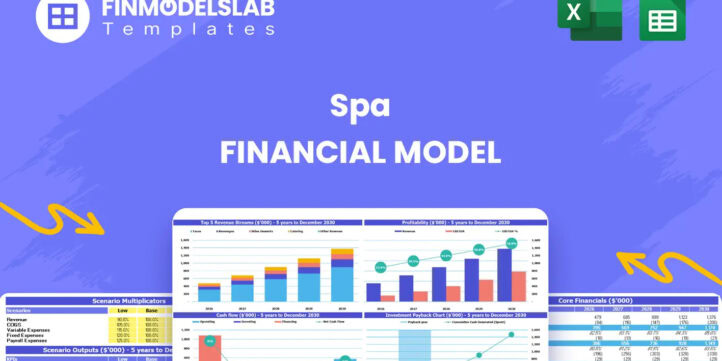


Financial Model Overview
The Spa Financial Model is a ready-to-use financial model template built to help entrepreneurs, spa owners, consultants, analysts, and business planners forecast the financial performance of a spa business over a five-year period. It brings together the major assumptions that drive a wellness business, including daily visits, service pricing, service mix, retail product sales, payroll, rent, operating expenses, capital investment, cash flow, profitability, and investor returns. For a spa, where success depends on treatment room utilization, staff productivity, customer volume, premium service pricing, and high-margin add-ons, a structured model is especially useful because it connects day-to-day operating assumptions with financial outcomes. Users can customize the model for a new day spa, wellness center, massage studio, med spa concept, or expansion plan, then use the outputs for business planning, funding discussions, budgeting, scenario testing, and stakeholder presentations. The template is designed to reduce spreadsheet setup time while giving users a clear, editable framework for understanding what it may take to launch, operate, and grow a profitable spa.
All-in-One Dashboard
The all-in-one dashboard gives users a central place to review the most important inputs and outputs of the Spa Financial Model without moving through every detailed worksheet. This component is useful because it brings together key drivers such as revenue assumptions, customer visits, pricing, operating costs, startup investment, cash balance, profitability, and performance metrics into one practical view. A spa owner or founder can use the dashboard to see how changes in service volume, pricing, payroll, or expenses affect revenue, EBITDA, net profit, cash flow, and funding needs. For planning purposes, the dashboard helps users quickly identify whether the spa is financially balanced, whether projected sales are strong enough to cover fixed costs, and whether the business has enough cash to support the early ramp-up period. For presentations, it provides a concise overview that can be shared with lenders, investors, partners, or internal stakeholders who need to understand the forecast without reviewing every line of the model. The result is a faster, clearer way to manage assumptions, review outputs, and communicate the financial story of the spa.
Low, Base, and High Scenario Analysis
The low, base, and high scenario analysis component allows users to test how the spa performs under different business conditions. This is important for a spa business because customer traffic, average transaction value, retail conversion, treatment utilization, and staffing efficiency can vary significantly depending on location, marketing effectiveness, seasonality, customer retention, and competitive pressure. The model lets users compare a conservative case, an expected case, and an optimistic case by adjusting key assumptions such as daily visits, service prices, service mix, margins, payroll levels, or operating expense growth. The outputs help show how revenue, gross profit, EBITDA, cash flow, break-even timing, and investor returns may change under each scenario. This is valuable for decision-making because it helps founders understand downside risk, set realistic operating targets, and prepare contingency plans before committing capital. It is also useful for funding discussions because investors and lenders often want to see that the business plan has been stress-tested and that management understands what must happen for the spa to remain viable in slower growth conditions as well as higher growth opportunities.
Professional Charts
The professional charts component turns the financial forecast into visual reports that are easier to understand, review, and present. Spa financial data can include many moving parts, such as monthly revenue growth, service revenue, retail product income, payroll, operating costs, EBITDA, net profit, cash flow, and cumulative returns. Charts help simplify this information by showing trends, comparisons, and key movements over time. Users can use this component to visualize revenue growth across the five-year forecast, compare costs against income, monitor profitability improvement, and track cash flow development as the spa moves from launch to maturity. For internal planning, these visuals can highlight when costs rise faster than revenue, when margins improve, or when cash reserves need attention. For external presentations, professional charts make the model more investor-ready and lender-friendly because they communicate complex financial outputs in a format that is quick to interpret. This component is especially helpful when preparing pitch decks, business plans, loan packages, management updates, or board presentations where stakeholders need clear evidence of the business trajectory.
ROE Components and DuPont Analysis
The ROE components and DuPont analysis section helps users understand the drivers behind return on equity rather than looking only at a single profitability figure. For a spa business, return on equity can be influenced by net margin, asset utilization, leverage, capital investment, and the timing of cash generation. This component breaks return performance into more detailed factors so users can see whether projected returns are being driven by stronger margins, better use of invested assets, improved operating efficiency, or financing structure. Inputs and outputs may connect to revenue, operating profit, net income, balance sheet items, equity investment, debt assumptions, and asset levels. The value of this section is that it helps users think more strategically about how the business creates returns for owners and investors. If return metrics are weak, the model can help identify whether the issue is pricing, payroll, rent, underutilized treatment rooms, excessive startup investment, or slow customer ramp-up. For investor presentations and strategic planning, this analysis provides a more sophisticated view of performance and supports better conversations about capital efficiency, profitability, and long-term value creation.
Revenue Inputs
The revenue inputs section is where users define the commercial assumptions that drive the spa’s income forecast. This component is central to the Spa Financial Model because service-based businesses depend heavily on customer volume, pricing, capacity, utilization, and service mix. Users can enter assumptions such as operating days, daily visits, average price for massages, facials, body treatments, add-on services, and retail product sales. The model may also reflect growth in visits over time, changes in service mix, premium service pricing, and customer purchase behavior. These inputs flow into the revenue forecast and help estimate total sales by month and year. For a spa business plan, this is useful because it forces users to move beyond a broad sales estimate and instead build revenue from practical business drivers. It also allows users to test different strategies, such as increasing premium treatments, improving retail attachment rates, introducing packages, or raising prices. By making revenue assumptions explicit and editable, the model helps users create a more credible forecast that can be reviewed, challenged, and refined before launch or expansion.
Bank-Ready Reports
The bank-ready reports component organizes financial outputs into a format that is suitable for lenders, funding applications, and professional stakeholder review. A spa business often requires upfront investment for build-out, treatment room equipment, furniture, lease deposits, initial inventory, marketing, working capital, and operating reserves, so lenders usually need a clear view of repayment capacity and financial stability. This component helps present core statements and supporting outputs such as profit and loss projections, cash flow forecasts, balance sheet forecasts, debt-related assumptions, and key financial metrics. The reports allow users to show how revenue grows, how expenses are controlled, when profitability improves, and whether cash flow is sufficient to support operations and financing obligations. For banks, clear reporting can make the plan easier to evaluate because it presents the financial forecast in a structured, professional, and consistent format. For business owners, it helps identify possible weaknesses before submitting a loan request, such as insufficient cash reserves, unrealistic revenue growth, or heavy fixed costs. This component supports more confident funding preparation and helps users present their spa plan with greater financial clarity.
Revenue Breakdown
The revenue breakdown component provides a more detailed view of how total spa revenue is generated across different streams. Instead of treating revenue as one single number, this section helps users separate income from massages, facials, body treatments, add-on enhancements, packages, memberships, and retail product sales where applicable. This matters because each revenue stream may have different pricing, margins, demand patterns, staff requirements, and growth potential. A high-margin retail product sale may improve profitability differently from a labor-intensive service, while premium treatments may raise average revenue per visit if the spa can maintain demand. The revenue breakdown helps users evaluate which services contribute most to sales, which categories may deserve more marketing attention, and how changes in service mix affect the overall forecast. It can also support capacity planning because different services use treatment rooms, staff time, and supplies in different ways. For decision-making, this component gives owners and planners a clearer view of the business model, helping them refine pricing, promote profitable services, improve retail strategy, and build a more defensible revenue plan for investors or lenders.
KPI Dashboard
The KPI dashboard focuses on the key performance indicators that help users monitor whether the spa is operating according to plan. A spa’s financial health is not measured only by total revenue or net profit; it also depends on operational and financial metrics such as revenue per visit, average ticket size, gross margin, payroll as a percentage of revenue, EBITDA margin, cash balance, customer volume, treatment utilization, and operating expense ratios. This component helps translate the detailed forecast into performance metrics that can be tracked over time and compared against targets or industry benchmarks. Users can use the KPI dashboard to identify early warning signs, such as rising payroll costs, weaker margins, slower customer growth, or insufficient cash reserves. It is also helpful for monthly management review because it gives owners and managers a practical way to compare actual performance against the forecast once the spa is operating. For funding and investor presentations, KPIs help demonstrate that the business plan is built around measurable drivers, not just high-level assumptions. This makes the Spa Financial Model more useful as both a planning tool and an ongoing management tool.
Break-Even Analysis
The break-even analysis component helps users identify when the spa is expected to generate enough revenue to cover its costs. This is one of the most important planning questions for a new spa because the early months often include ramp-up costs, marketing expenses, payroll commitments, rent, utilities, supplies, insurance, and other operating expenses before customer volume reaches maturity. The break-even section may use assumptions from revenue, fixed costs, variable costs, gross margin, and operating expenses to determine the point at which total revenue equals total costs. It can show the expected break-even month, the level of sales needed to break even, and how changes in pricing, daily visits, service mix, or cost structure affect that timeline. This information is valuable for founders because it helps estimate the amount of working capital needed before the spa becomes self-sustaining. It is also useful for lenders and investors because it shows whether the business has a realistic path to profitability. By understanding break-even, users can make better decisions about launch marketing, staffing levels, pricing, memberships, retail sales, and cost control.
Startup Cost and Funding Requirements
The startup cost and funding requirements component helps users estimate the capital needed before the spa opens and during the early operating period. A spa launch can require significant upfront investment, including leasehold improvements, treatment room equipment, reception furniture, lounge setup, initial product inventory, technology systems, licenses, deposits, branding, pre-opening marketing, professional fees, and working capital reserves. This section organizes those costs so users can see the total investment required and understand how much funding may be needed from owner equity, loans, investors, or other financing sources. It also helps separate one-time capital expenditures from recurring operating expenses, which is important for accurate budgeting and cash flow planning. By documenting startup costs in detail, users can avoid underestimating launch requirements and reduce the risk of cash shortages after opening. For funding preparation, this component provides a clear explanation of how capital will be used, which can strengthen discussions with banks, investors, landlords, or partners. It also supports strategic decision-making by allowing users to test different launch budgets, scale the spa concept up or down, and align the investment plan with expected returns.
File types:
Excel – Single-User: .xlsx
Excel – Multi-User: .xlsx
Similar ProductsOther customers were also interested in...


 HenrySheykin
Nail Salon Financial Model Excel Template
The Nail Salon Financial Model Financial Model Template helps entrepreneurs, salon owners, consultan... Read more
Skin Care Financial Model Excel Template
The Skin Care Clinic Financial Model helps entrepreneurs, clinic owners, consultants, analysts, and ... Read more

Hair Salon Financial Model Excel Template
The Hair Salon Financial Model helps salon owners, founders, consultants, and business planners turn... Read more
Barber Shop Financial Model Excel Template
The Barber Shop Financial Model Financial Model Template helps entrepreneurs, business owners, consu... Read more

Hair Salon Chain Financial Model Excel Template
The Hair Salon Chain Financial Model helps entrepreneurs, salon owners, consultants, analysts, and b... Read more

Beauty Salon Financial Model Excel Template
The Beauty Salon Financial Model helps entrepreneurs, salon owners, consultants, analysts, and found... Read more

Reiki Center Financial Model Excel Template
The Reiki Center Financial Model helps entrepreneurs, wellness business owners, consultants, and ana... Read more

 Andreas
Dog Grooming Services Financial Model (10+ Yrs DCF...
The Dog Grooming Services financial model is a comprehensive tool designed to analyze the financial ... Read more

 Giorgos
Hair and Beauty Salon – 5 Year Financial Mod...
5-year financial model for a hair and beauty salon providing revenue forecasts, cost analysis, and i... Read more
Barber Shop – 5 Year Financial Model
5-year financial model for a barber shop providing revenue forecasts, cost analysis, and profitabili... Read more
You must log in to submit a review.