0 ITEMS

What Investors Want to See in a Financial Model: Worked Example

Investors want a financial model whose assumptions can be traced to a source, whose unit economics are tested in a downside case and whose cash runway reaches the next funding milestone. This guide explains traceability through public investor guidance, applies the downside and runway tests to a labelled hypothetical seed-stage model and shows how independent model review adds assurance.
Key Takeaways
- Investors judge a model by whether each driver has a stated source and a single place on the sheet where it can be changed.
- Public investor guidance says diligence teams open the monthly model and review its assumptions, so each driver needs a source.
- Venture firm CRV labelled burn multiples of 2.0x to 3.0x concerning in its July 2026 guidance on how Series A investors read burn.
- In the hypothetical example, runway is 26.7 months in the base case and 23.5 in the downside, against a 24 to 30 month guide.
- Independent model review gives lenders assurance beyond the founder’s own checks; the Operis cases are large debt financings, not startup equity rounds.
Investors Want Assumptions They Can Trace and Test
A financial model earns investor confidence when every number leads back to a stated assumption and survives a downside case. Anthony Millin, a TechCrunch contributor, described what happens after the first read of the annual summary in April 2023:
“During due diligence, many investors will then dig into the more detailed monthly model and review all of its assumptions.”
Due diligence is the structured check an investor runs on a company’s claims before committing money. That stage is where weak sourcing shows first, because a reviewer who opens the monthly sheet looks for the driver behind each line, and related models are grouped under the eFinancialModels Financial Due Diligence tag. Joe Wallin and Pete Baltaxe, authors of the Holloway angel investing guide, give angel investors similar advice in an August 2023 update:
“Ask for a copy of the model and work with it until you understand what the key drivers of growth and profitability are.”
The two sources agree that the monthly model gets opened and its assumptions get read. A practical reading is that the investor wants to change an input, watch the result move and see that the founder already knows why.
Independent Review Gives Lenders Assurance Beyond the Founder’s Checks
Outside readers cannot see inside a founder’s spreadsheet, so larger financings often add a model audit, an independent check of a model’s logic and formulas by a team that did not build it. In January 2026, the model audit firm Operis reported an independent review of the financial model behind a €135 million non-recourse financing for Encavis. Non-recourse means the lenders are repaid from the financed assets’ own cash flows, with no claim on the parent company. The financing funds a portfolio of onshore wind and solar plants in Spain, and the page names no lenders.
An earlier Operis release from October 2021 describes a €88 million refinancing of Italian solar plants for the same owner, funded by four banks, among them Bankinter, Bayerische Landesbank and Société Générale. Operis provided both financial modelling and model audit services there, and the page says the audit came from a separate and independent team.
Both pages are the audit firm’s own case notes. They show that independent review is part of how large financings are documented, but they quote no lender and say nothing about what a lender concluded. A seed-stage founder rarely buys a formal audit. The practical equivalent is a self-review run with the checks in this guide, ideally by a colleague who did not build the sheet.
Worked Example: A Hypothetical Seed Model Sized to the Runway Investors Expect
The example below is hypothetical. It is not the record of a funded company, and every input is an assumption chosen to show the arithmetic. The company sells subscriptions, has no cash before the raise and plans to raise a Series A when the money runs out. Year-1 spending is planned in detail, and the example assumes the year-1 average burn continues after month 12.
Net burn is the cash a company spends minus the cash it collects in a period. Runway is the cash balance divided by average monthly net burn, which gives the number of months the money lasts. In this example, the cash balance is the $2,000,000 raised, because the company holds no cash before the raise. Annual recurring revenue (ARR) is the yearly value of active subscriptions. The burn multiple is net burn divided by net new ARR, so it shows how much cash the company consumes for each dollar of new recurring revenue. Customer acquisition cost (CAC) is the sales and marketing spend needed to win one customer.
The downside case lowers net new ARR by 40%, from $600,000 to $360,000, and holds spending fixed. The missing $240,000 of ARR would have been billed evenly across the year, so about half of it, $120,000, is not collected in year 1 and net burn rises by that amount. CAC rises to $10,000, because the same sales spend wins 40% fewer customers.
| Item | Base case | Downside case | Calculation |
|---|---|---|---|
| Cash balance | $2,000,000 | $2,000,000 | Raise of $2,000,000 plus $0 existing cash |
| Net new ARR | $600,000 | $360,000 | Downside is 40% lower |
| Year-1 net burn | $900,000 | $1,020,000 | Base: $75,000 × 12. Downside: $900,000 + $120,000 |
| Average monthly net burn | $75,000 | $85,000 | Year-1 net burn ÷ 12 |
| Runway | 26.7 months | 23.5 months | Cash balance ÷ average monthly net burn |
| Burn multiple | 1.5x | 2.8x | Net burn ÷ net new ARR |
| CAC | $6,000 | $10,000 | Base: assumption. Downside: $6,000 ÷ 0.6 |
| Monthly gross profit per customer | $500 | $500 | Assumption |
| CAC payback | 12 months | 20 months | CAC ÷ monthly gross profit |
CRV, a venture capital firm, wrote in July 2026 that a burn multiple of 2.0x to 3.0x is concerning, the level at which investors start asking detailed questions about spending, and that founders should plan for 24 to 30 months of runway before beginning Series A outreach. Both are Series A benchmarks, and the example uses them as a proxy because seed investors publish fewer thresholds. The base case passes both tests, with 26.7 months of runway and a burn multiple of 1.5x. The downside case fails both, with 23.5 months and 2.8x, inside the concerning band.
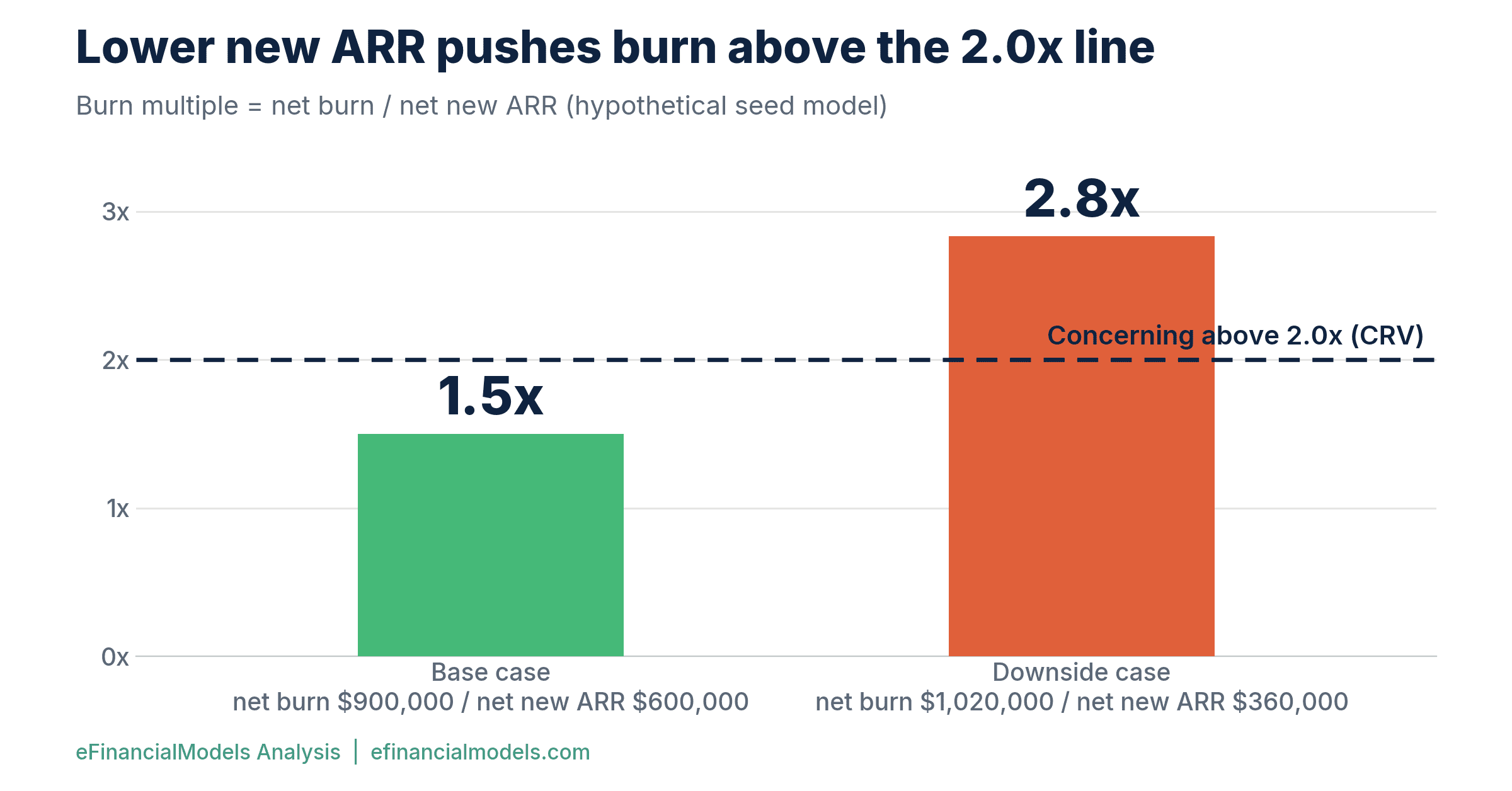
Lower new ARR and the missing collections lift the burn multiple from 1.5x to 2.8x, above the 2.0x line. Source: eFinancialModels Analysis
A model that shows only the base case hides that gap. A model that shows both lets the founder present the response, such as slowing hiring until new ARR recovers, and shows the spending cut that would bring the downside back under 2.0x. The 12-month payback is an illustrative target, not a sourced benchmark, and the downside lifts it to 20 months.
Four Checks to Run Before the Model Reaches an Investor
The bar keeps moving: CRV reports that median annual recurring revenue at Series A reached $2.5 million in 2025, so a seed model should show a believable path toward that scale. The four checks below can each be run by the founder before the model is shared.
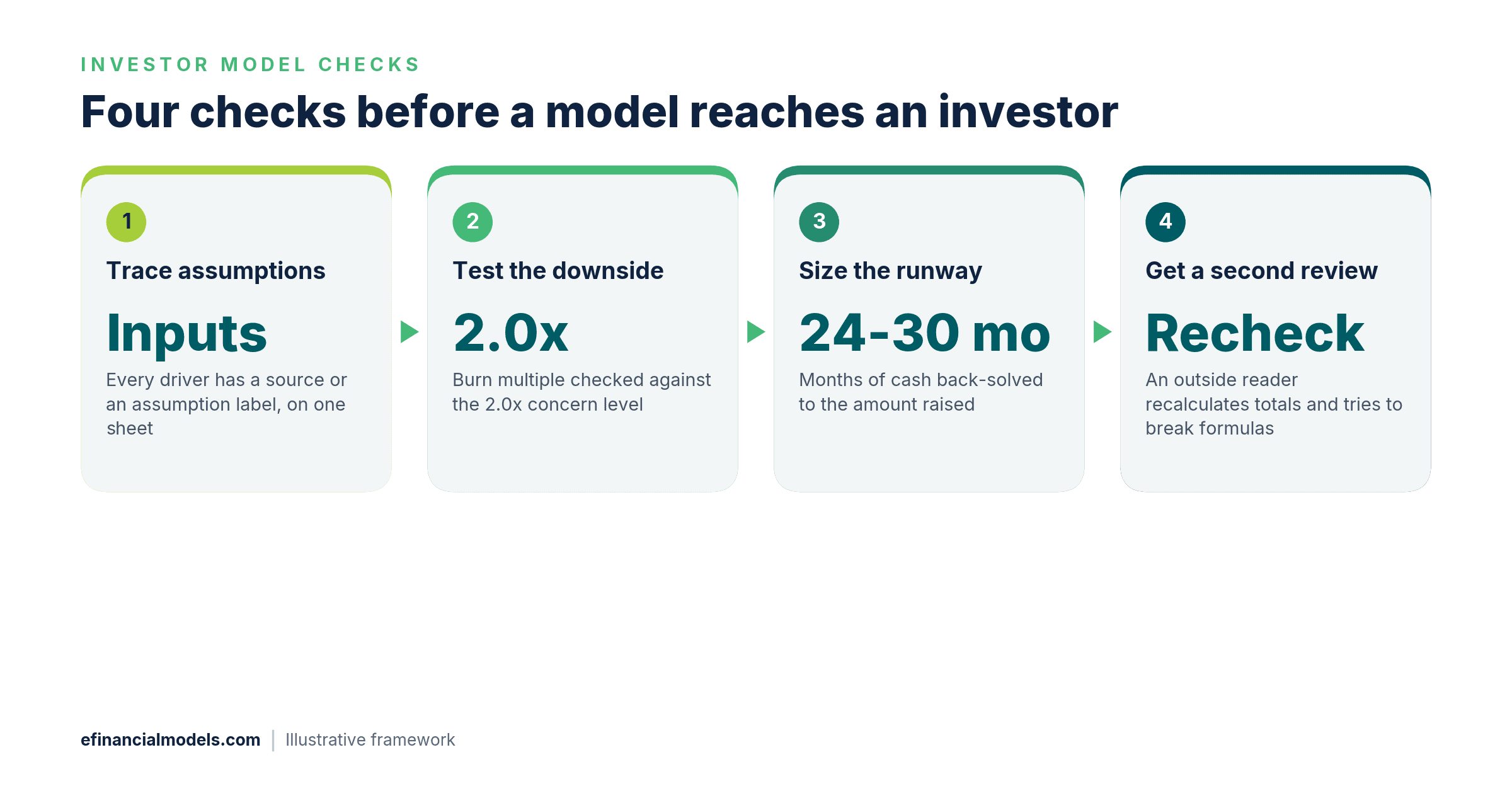
The four checks to run before the model is shared with an investor. Source: eFinancialModels Analysis
- Trace every input to a source or label it as an assumption, and keep inputs on one sheet.
- Test unit economics, the revenue and cost of serving one customer, against the downside case and not only the base case.
- Size the raise from the runway, working back from months of cash to the amount, and state what the money pays for.
- Have someone who did not build the file recalculate the totals and try to break the formulas.
Scope: the checks assume an equity raise by an early-stage subscription company. Debt financings and other stages add their own tests, and the target investor’s own materials or an adviser can say which apply.
Founders raising capital can pair the model with a fundraising narrative that names the same drivers, so the deck and the spreadsheet never tell different stories.
Frequently Asked Questions
Should the model be monthly or annual?
Both, in layers. A short annual summary suits a first read, while the monthly grid carries the detail behind it. Monthly columns matter for the first two to three years because hiring dates, invoice timing and payment terms disappear inside annual totals. Beyond that horizon, annual columns are more honest, since forecasting individual months years ahead implies precision that no founder has.
How many scenarios should a model show?
Three is a common set: a base case, a downside case and an upside case. The downside case is the one reviewers read hardest, because it shows how the founder thinks when plans fail. Change only a few drivers between cases, such as new customers and price, and label each change, so a reader can see which assumption moved the result and by how much.
Which spreadsheet mistakes do reviewers find first?
Typed numbers hidden inside formulas are a frequent find, along with totals that skip a row, cash entered with the wrong sign and balance checks that were switched off. A reviewer finds these by changing one input and watching whether every dependent cell moves. A single check cell that reads OK only when the sheet balances catches many of them before anyone else sees the file.
Does a seed-stage founder need a formal model audit?
Usually not. Formal audits are a paid service and suit large debt financings, where lenders need written assurance. At seed stage, a peer review by someone outside the build, plus a written list of assumptions and their sources, gives most of the same protection. If an investor asks for more, the request itself tells the founder which part of the model that investor doubts.
What should a founder do when the deck and the model disagree?
Fix the model first and the deck second. Investors compare headline figures in the deck with the totals in the sheet, and a gap of any size makes them question every other number. Link the deck’s charts to the model’s output cells, date each version and keep one master copy so the figures presented always match the file that diligence receives.
Conclusion
Investors want a model with traceable assumptions, a downside case that stays inside known thresholds, or comes with a response plan when it does not, and a runway that reaches the next milestone. Founders who want a ready structure for a subscription business can start from the eFinancialModels SaaS Business Financial Model, an Excel template with a monthly and annual three-statement forecast and scenario simulation, and then test it against the four checks above before sharing numbers with an investor.