0 ITEMS

UK Distilleries 2026-2031: 3 Tariff Shifts Change Everything

Three simultaneous trade-policy events in 2025-2026 have reset the export demand curve for Scotch whisky for the first time since the 2017-2019 peak — and the supply side hasn’t caught up yet.
Key Takeaways
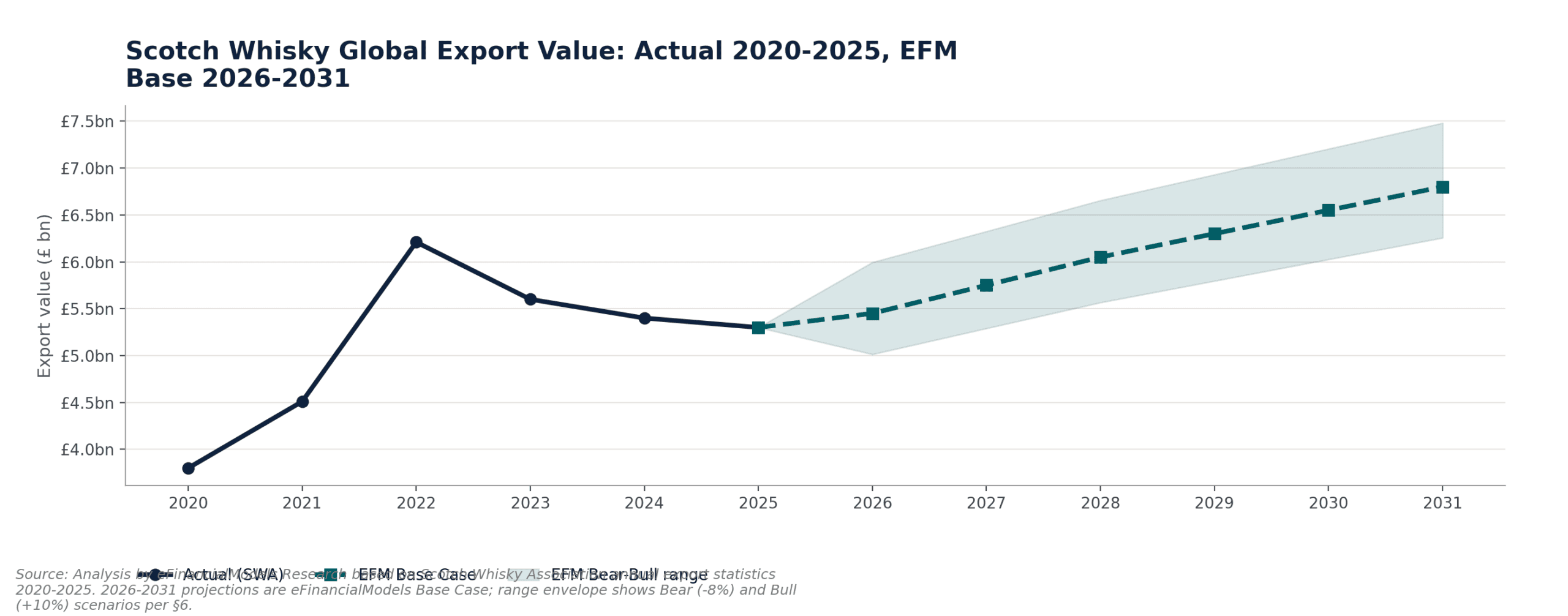
- The EFM Base Case projects global Scotch export revenue reaching £6.8 billion by 2031, a 5.5% CAGR, sitting between analyst consensus extremes of 4.6% (Mordor Intelligence) and 9.3% (Research and Markets).
- Scotland’s 152 operating Scotch distilleries hold approximately 22 million casks of maturing stock, equal to roughly 9 years of demand cover at the current 350 million LPA (liters of pure alcohol) outshipment rate — supply is not the constraint; mature-stock allocation is.
- The UK-India Comprehensive Economic and Trade Agreement (CETA), in force from Q1 2026, halved the Indian Scotch tariff from 150% to 75% on day one, with a glide path to 40% by 2036; the Scotch Whisky Association estimates this could add £1 billion of incremental exports over five years.
- The US 10% reciprocal tariff, which cost Scotch approximately £38 million in 2025, was scrapped on 30 April 2026; China cut its MFN spirits tariff from 10% to 5% in February 2026.
- Diageo reported a 14% volume drop and 20% net-sales drop in single malt for fiscal 2025, confirming that premiumisation is intact directionally but narrower and slower than consensus implies.
- UK gin volumes were flat in the 52 weeks to April 2025, pressuring the dual gin-and-whisky business models that financed many new-distillery openings since 2018.
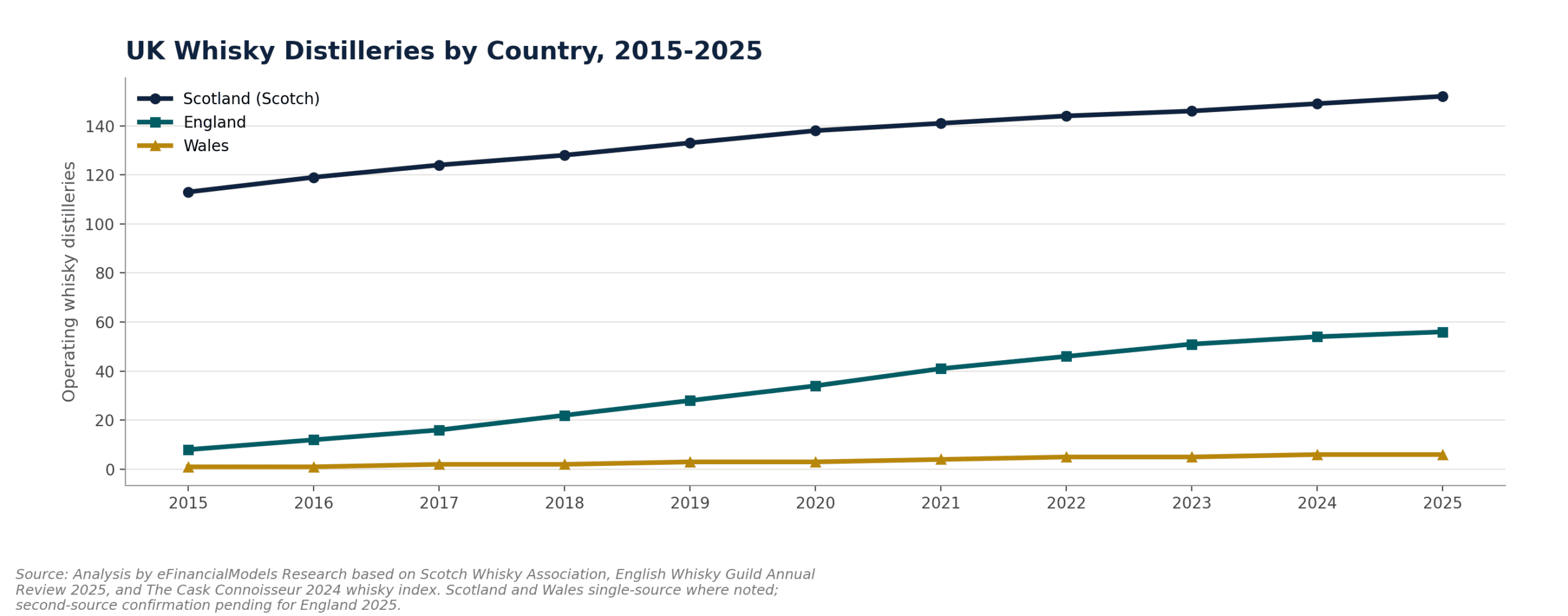
- English whisky now spans roughly 56 operating distilleries; Cotswolds Distillery passed £20 million in annual revenue in 2024 and distributes into 40+ markets.
The UK Distilling Industry Today
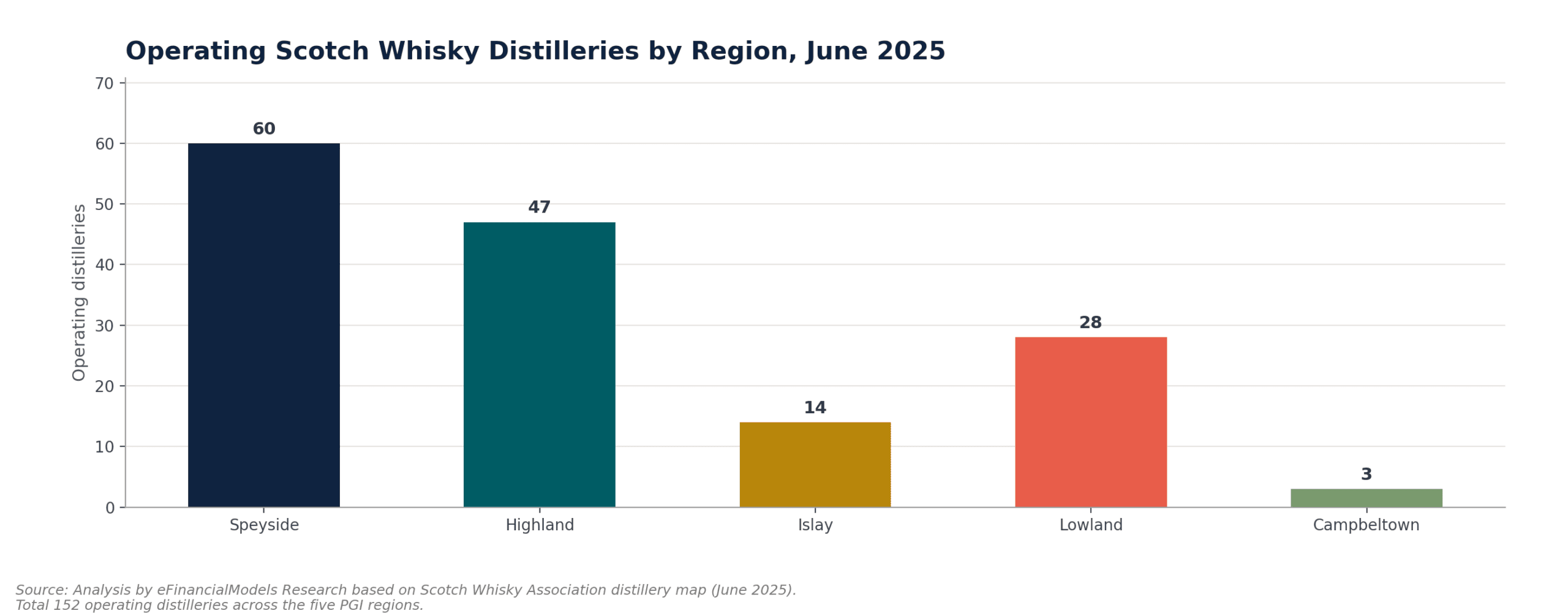
The UK distilling industry is dominated by Scotch whisky but is broader than most investors model. Scotland’s 152 operating Scotch distilleries (as of June 2025) produce the world’s most exported whisky category, while approximately 56 English distilleries and 6 Welsh distilleries form a fast-growing adjacent segment. Together, English and Welsh whisky add an estimated £80-100 million in annual revenue to the UK distilling industry — small relative to Scotch but growing faster.

Scotch whisky is defined by the Scotch Whisky Regulations 2009 (SI 2009/2890) as spirit produced and matured in Scotland for a minimum of three years. The five legally recognized categories are single malt (malted barley, single distillery), single grain (other cereals, single distillery), blended malt, blended grain, and blended Scotch. Single malt commands the highest FOB (free-on-board, meaning the export price before shipping and tariffs) prices and the strongest brand equity; blended Scotch drives the volume base.
Regionally, Scotch production concentrates in five named areas: Speyside (the largest cluster by distillery count, home to Glenfiddich, The Glenlivet, Macallan), Islay (peat-forward malts: Ardbeg, Laphroaig, Bowmore), Highland (the broadest geographic region), Lowland (lighter style, growing craft presence), and Campbeltown (three operating distilleries: Springbank, Glengyle, Glen Scotia).
Three Tariff Inflections That Reset the Outlook
The single most consequential regulatory development for the 2026-2031 period is a cluster of three trade-policy events that resolved within 12 months of each other. Each one shifts a different major export market.
India: The UK-India CETA, signed 6 May 2025 and in force from Q1 2026, halved the Scotch tariff from 150% to 75% on day one and sets a linear glide to 40% by 2036. According to the Scotch Whisky Association, this could lift Scotch exports to India by an additional £1 billion over five years. Here’s the retail math: a standard mid-tier Scotch bottle currently priced around ₹5,000 (approximately £47) could fall to roughly ₹3,500 once the 75% tariff applies — a price point that materially expands the addressable Indian consumer base. India was already the largest Scotch export market by volume in 2025 at 220 million bottles, up 15.3% year-on-year according to Scotch Whisky Association 2025 export statistics.
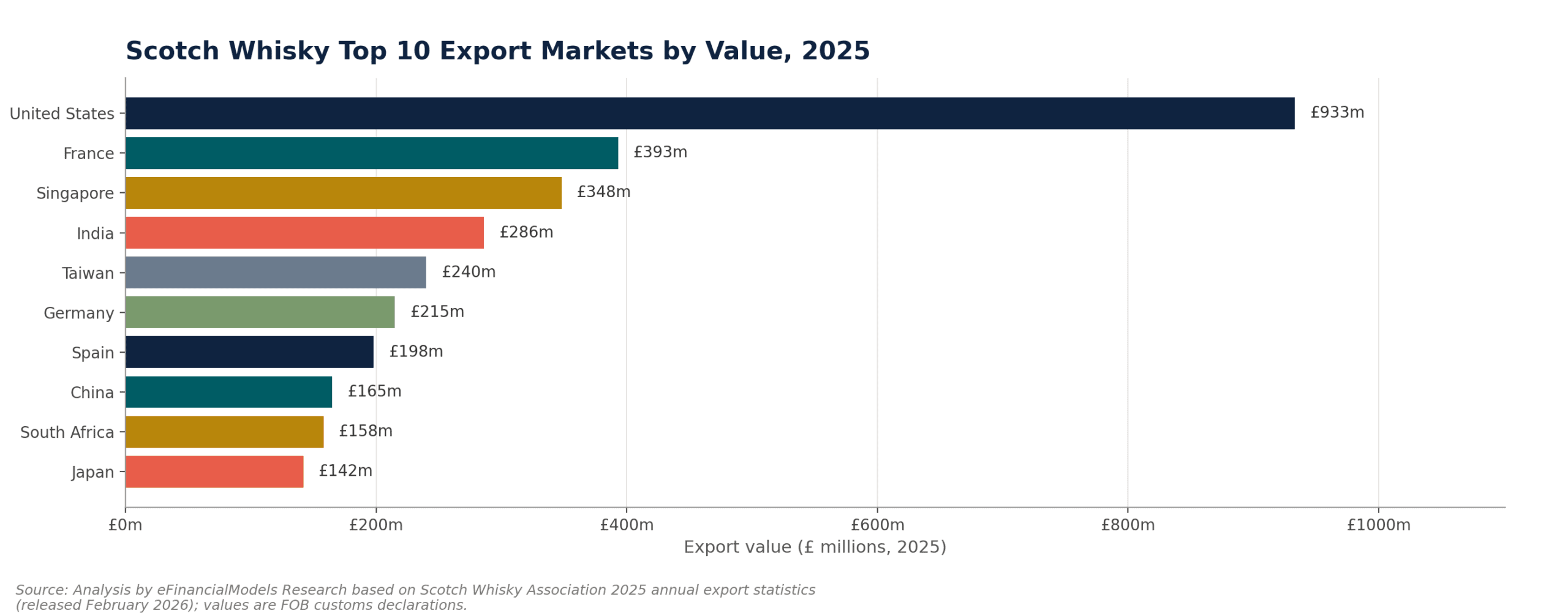
United States: The US 10% reciprocal tariff, imposed 1 April 2025 under executive authority, cost Scotch approximately £38 million in export value before it was scrapped on 30 April 2026. US Scotch export value fell from £971 million in 2024 to £933 million in 2025 (Scotch Whisky Association 2025 export statistics). The tariff removal recovers approximately half the lost value within fiscal 2026, with the balance recovering through 2027 as channel inventory rebuilds.
China: China’s MFN (Most-Favoured-Nation) spirits tariff cut from 10% to 5% in February 2026 begins to unwind a 31.5% collapse in Chinese Scotch export value during 2025. However, consumption tax and VAT keep the effective duty stack on premium imported single malt at approximately 60%, so the tariff cut alone is not sufficient to restore the 2019-2022 boom trajectory. The EFM Base Case assumes modest positive growth in China from 2027, not a V-shaped recovery.
Scotch Whisky Export Value: Top Markets 2024 vs 2025
| Market | 2024 Value (£m) | 2025 Value (£m) | YoY Change |
|---|---|---|---|
| United States | 971 | 933 | -3.9% |
| France | 405 | 393 | -3.0% |
| Singapore | 362 | 348 | -3.9% |
| India | 248 | 286 | +15.3% |
| Taiwan | 263 | 240 | -8.7% |
| Germany | 225 | 215 | -4.4% |
| China | 241 | 165 | -31.5% |
| South Africa | 150 | 158 | +5.3% |
Source: Scotch Whisky Association 2025 annual export statistics, released February 2026.
{{CHART_1}}
Supply Side: 22 Million Casks and the Allocation Problem
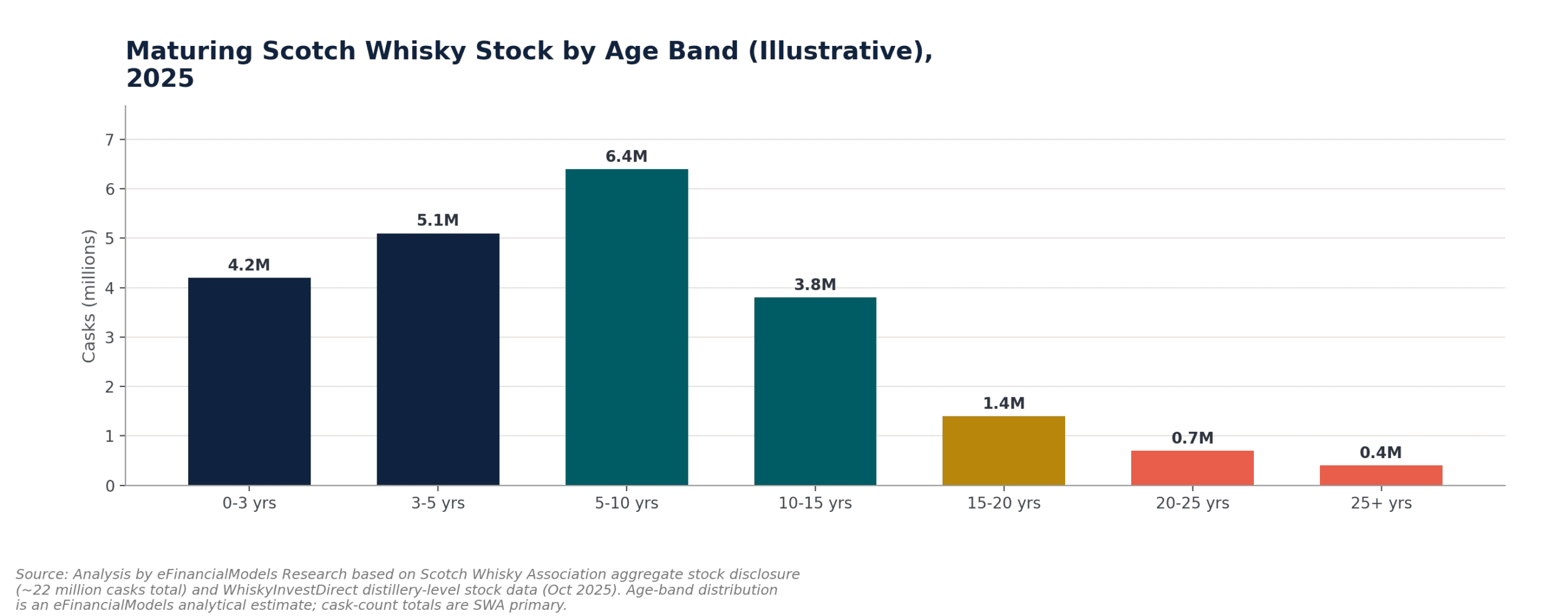
Supply is not the binding constraint for 2026-2031 — mature-stock allocation is. Scotland’s bonded warehouses hold approximately 22 million casks of maturing Scotch, equivalent to roughly 12 billion 70cl bottles. At the industry’s 2025 outshipment rate of approximately 350 million LPA per year, this represents about nine years of demand cover, the level at which the industry historically considers itself well-stocked (Scotch Whisky Association aggregate stock disclosure, cited in the United Kingdom Distilleries Market Study 2026-2031).
The age-band distribution of that stock matters enormously for competitive positioning. Based on distillery-level disclosures on WhiskyInvestDirect (October 2025 dataset) and production-rate reconstruction by EFM Research, approximately 25% of casks are under three years old (legally not yet Scotch), 32% are in the 3-10 year band, 24% are in the 10-15 year band, and 19% are above 15 years. The stock skews young.
Operators that allocated mature single-malt stock to the premium and super-premium tier during the 2018-2021 demand peak now hold disproportionate option-value on the post-tariff demand pulse — particularly in India, where premium and super-premium single malt is the fastest-growing tier. Operators that allocated to blended Scotch or younger NAS (No Age Statement) releases have less near-term flexibility but more 2028-2031 optionality once current laydowns reach the 10-year age threshold.
Three Scenarios for 2026-2031: A Worked Example
The EFM scenario framework assigns three probability-weighted outcomes for global Scotch export revenue by 2031. Each scenario rests on different assumptions about India CETA pass-through, China recovery timing, and US consumer demand.
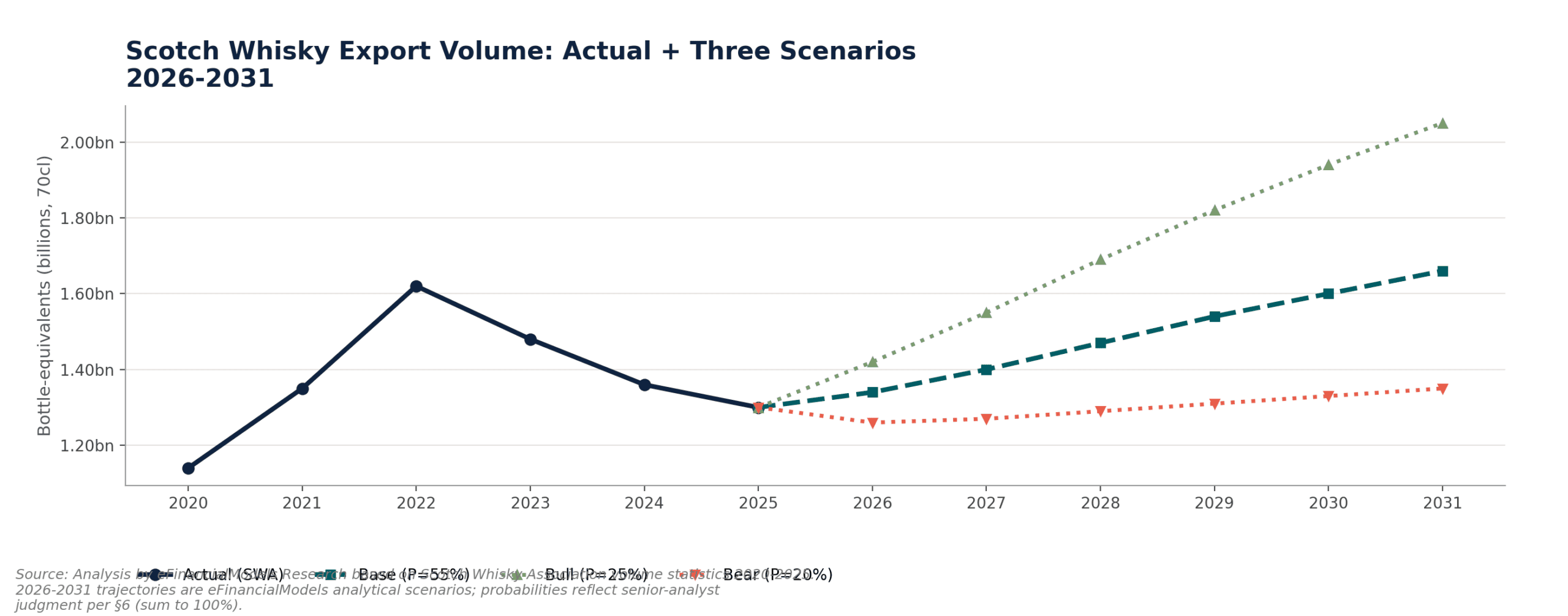
Base Case (probability: 55%): Global Scotch export revenue reaches £6.8 billion by 2031, implying a 5.5% revenue CAGR from the 2025 base. This assumes the SWA’s £1 billion India increment materialises over five years, China returns to modest positive growth from 2027, and the US recovers its 2024 value level by 2027.
Bull Case (probability: 25%): Revenue reaches £7.6 billion by 2031 (approximately 2.05 billion bottles), implying a 7.8% CAGR. This requires India to scale faster than the SWA’s own forecast, China to recover from 2026, and no new US tariff disruption.
Bear Case (probability: 20%): Revenue falls to £5.8 billion by 2031 (approximately 1.35 billion bottles), implying a 1.8% CAGR. This scenario combines a US recession, a slower China rebound (2028 or later), and distributor margin capturing most of the India CETA duty saving rather than passing it to consumers.
Here’s the math on the India price-pass-through sensitivity: if the 75% tariff (down from 150%) reduces the landed cost of a £47 retail bottle by roughly £14, and the distributor captures 60% of that saving as margin, the consumer price falls by only £5.60 to approximately £41.40 — still a meaningful shift but well below the full £33 implied by full pass-through. The Bear Case India assumption (£300-600 million incremental over five years vs the Base Case £1 billion) reflects exactly this distributor-capture scenario.
Scenario Comparison: 2031 Scotch Export Revenue
| Scenario | Probability | 2031 Revenue | CAGR | Key Driver |
|---|---|---|---|---|
| Base Case | 55% | £6.8bn | 5.5% | India CETA + US recovery |
| Bull Case | 25% | £7.6bn | 7.8% | India outperforms, China 2026 |
| Bear Case | 20% | £5.8bn | 1.8% | US recession, China 2028+ |
Pricing Dynamics: Bulk vs Bottled and the Premium Shift
Scotch whisky pricing has bifurcated materially over 2020-2025. The standard-tier blended category (£15-25 retail in the UK off-trade) has compressed in margin as duty rises, raw material costs, and packaging costs all moved upward while consumer willingness to pay at the entry tier stayed flat. The premium-and-above tier expanded both in absolute volume and in average realized price.
The category mix has shifted approximately 6 percentage points from standard toward super-premium and above between 2020 and 2025. The EFM Base Case pricing assumptions (from Appendix A of the study) project the weighted-average export price rising from £34 per LPA in 2026 to £41 per LPA by 2031, while the luxury-tier FOB price rises from £175 per LPA in 2026 to £235 per LPA by 2031.
UK alcohol duty adds a structural cost layer. As of 1 August 2023, HMRC set the duty rate on spirits at £28.50 per liter of pure alcohol (HMRC), which translates to £7.98 on a standard 40% ABV 70cl bottle — a rate that has risen with subsequent upratings and directly compresses producer margins at the standard tier. The Scotch Whisky Association has publicly opposed the RPI uprating on the grounds that Scotch already carries one of the highest tax burdens of any G7 spirit category.
Competitive Landscape: The Big Six and the English Whisky Challenge
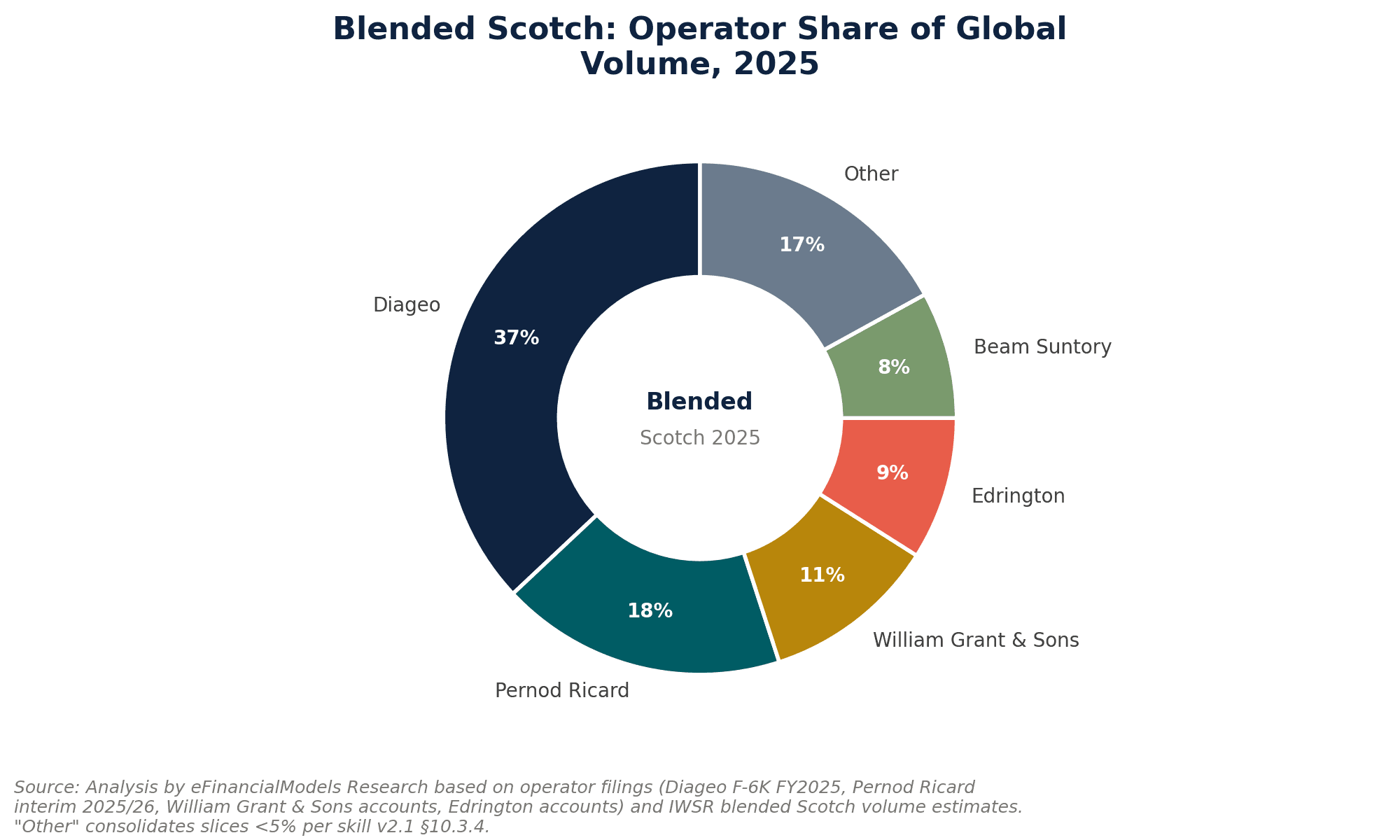
The UK distilling competitive landscape is concentrated at the top and fragmented at the bottom. The top six operators by global Scotch volume — Diageo, Pernod Ricard, William Grant & Sons, Edrington, Beam Suntory, and Brown-Forman — together account for an estimated 80%+ of global Scotch blended volume and approximately 60-65% of global Scotch single-malt volume.
Diageo remains the largest UK distiller globally. Its Scotch portfolio reported -5% net sales in fiscal 2025, with single malt down 14% by volume and 20% by net sales. The flagship Johnnie Walker franchise fell 13% in North America. Despite near-term softness, Diageo committed strategic capex: the $185 million Port Ellen reopening (Islay, 2024) and the Johnnie Walker Princes Street brand-home in Edinburgh signal long-term conviction.
The most consequential 2025 M&A event was William Grant & Sons’ finalisation of the Famous Grouse acquisition from Edrington in July 2025. This positions William Grant as a top-three blended-Scotch operator alongside Glenfiddich and The Balvenie, while freeing Edrington to concentrate capital fully on The Macallan (approximately $1.26 billion global retail value, 900,000 cases) and Highland Park at the ultra-premium tier.
English whisky has emerged from the craft tier into a recognized competitive set. Cotswolds Distillery passed £20 million in annual revenue in 2024 and distributes into 40+ markets. The pending English Whisky Geographical Indication (GI), draft-approved February 2025 and awaiting ministerial sign-off, will codify the category internationally and is expected to catalyse export development from 2027 onward.
Capex, Decarbonisation, and New-Build Economics
New-distillery capex composition has shifted materially since 2020. A 2018-vintage new-build distillery allocated roughly 40% of capex to production equipment, 25% to buildings and warehousing, and 15% to process services. The 2026-vintage stack shifts the process-services line to 18-25% to accommodate hydrogen-readiness, biomass, or MVR (mechanical vapour recompression) options — a £2-4 million premium on a £20 million project that increasingly attracts Scottish Government and UK Government grant co-funding.
For a 200,000 LPA craft Lowland distillery with a visitor center, the indicative all-in capex range is £14-22 million, plus £4-8 million of working capital to fund the three-year minimum maturation period before first release. Payback is typically 8-12 years on production economics alone. The visitor center (50,000-150,000 annual visitors at £20-40 per-head spend) generates £1.5-5 million of additional annual revenue with a separate, faster payback profile.
Distillery tourism generated 2.7 million visits in 2024 and £85 million in direct visitor spend, up 8.65% per head year-on-year, according to Scotch Whisky Association tourism statistics. Major capex programs — Diageo’s Port Ellen reopening, Edrington’s Macallan Estate, Pernod Ricard’s Glenturret revamp — concentrate this category and function as integrated brand-marketing channels. For context on the scale of the UK spirits sector, HMRC collected approximately £3.4 billion in spirits duty in the 2022-23 fiscal year (HMRC UK Alcohol Bulletin, published by HM Revenue & Customs), underscoring why duty-rate decisions carry outsized consequences for distillery margin planning across the 2026-2031 window.
Common Mistakes Investors and Operators Make
Five specific errors recur when analysts and operators build 2026-2031 UK distillery models.
1. Treating the India CETA as a direct revenue uplift. The £1 billion SWA forecast assumes meaningful consumer price pass-through. If distributors capture the majority of the duty saving, the revenue uplift falls to £300-600 million. Always model distributor-margin capture as a separate sensitivity.
2. Conflating volume and value trends. Scotch single-malt volumes are in absolute decline (Diageo -14% volume in FY2025) while revenue per case rises. A model that extrapolates volume trends to revenue will understate the premium-mix shift and overstate the volume recovery needed to hit revenue targets.
3. Underpricing decarbonisation capex. The 12-18% decarbonisation premium on new-build capex (rising from 12% in 2026 to 18% by 2031 in the EFM Base Case) is one of the fastest-moving lines in any distillery DCF. Operators that treat it as optional risk stranded capital if EU CBAM-style carbon pricing reaches alcohol-spirit trade by 2030.
4. Relying on gin cash flow to bridge the maturation gap. UK gin volumes were flat in the 52 weeks to April 2025 and the category lost 7 percentage points of UK spirits volume share between 2020 and 2024. New entrants that built their business plan around gin revenue funding the 3-5 year whisky maturation period now face a structural funding gap.
5. Sizing cask investment exposure too large. The FCA does not regulate cask investment as a financial product. The City of London Police fraud investigations of 2024 and the 2025 WOWGR reforms reshaped the market, but the regulatory gap remains the single largest reputational risk to the consumer-investor channel. Keep cask investment below 5% of any distilling-segment portfolio and require independent storage verification.
Tools and Templates for Distillery Financial Modeling
Building a credible 2026-2031 distillery model requires scenario-ready inputs across demand, pricing, capex, and regulatory assumptions. The EFM Base Case pricing assumptions (weighted-average export £34-41/LPA, luxury FOB £175-235/LPA, UK duty £9.52-11.15 per 70cl bottle) provide a calibrated starting point that modellers can overlay with operator-specific data.
For investors building operator-level DCFs, the study recommends building separate scenarios for premium-skewed operators (Edrington, William Grant, Glenmorangie/Ardbeg) and blend-heavy operators (Diageo, Pernod Ricard), since the two cohorts have materially different EBITDA trajectories under the Base Case. For new-entrant craft distillery models, the £85-95/LPA capex range for Lowland new-builds is the appropriate starting point; major-operator expansions of existing facilities achieve £25-45/LPA by using existing infrastructure.
The United Kingdom Distilleries Market Study 2026-2031 includes Base, Bear, and Bull scenario assumptions across 14 chapters and 9 data tables that lift directly into a distillery financial model. For broader marketplace and investment platform modeling, the Investment Marketplace Financial Model Excel Template and the Goods and Products Marketplace Financial Model provide complementary frameworks for distribution and cask-trading economics.
Frequently Asked Questions
What is the EFM Base Case forecast for UK Scotch whisky exports by 2031?
The EFM Base Case projects global Scotch export revenue reaching £6.8 billion by 2031, representing a 5.5% compound annual growth rate (CAGR) from the 2025 base. This sits between the Mordor Intelligence consensus estimate of 4.6% CAGR and the Research and Markets upper bracket of 9.3% CAGR. The Base Case carries a 55% probability weighting and assumes the UK-India CETA delivers approximately £1 billion of incremental exports over five years, China returns to modest positive growth from 2027, and the US market fully recovers its 2024 export value of £971 million by 2027. The Bull Case (25% probability) reaches £7.6 billion; the Bear Case (20% probability) falls to £5.8 billion.
How does the UK-India CETA actually affect Scotch whisky prices in India?
The UK-India Comprehensive Economic and Trade Agreement, signed 6 May 2025 and in force from Q1 2026, reduces the Indian import tariff on Scotch whisky from 150% to 75% on day one, with a linear glide to 40% by 2036. In practical terms, a mid-tier Scotch bottle currently priced around ₹5,000 (approximately £47) could fall to roughly ₹3,500 once the 75% tariff applies — if the full duty saving passes through to the consumer. The critical variable is distributor margin capture: if distributors absorb 60% of the saving, the consumer price falls by only about £5.60, not £14. The EFM Bear Case India assumption (£300-600 million incremental over five years) reflects this distributor-capture scenario, versus the Base Case £1 billion that assumes meaningful consumer pass-through.
Why are UK gin revenues no longer a reliable cash-flow bridge for new distilleries?
UK gin volumes were flat in the 52 weeks to April 2025, and the category lost 7 percentage points of UK spirits volume share between 2020 and 2024, according to The Spirits Business and Mintel analysis. The flavoured-gin sub-segment is the largest source of volume decline. Many new distilleries that opened after 2018 used gin as a cash-flow bridge to fund the 3-5 year Scotch or English whisky maturation period before their first whisky release. With gin revenues stagnating, these operators now face a structural funding gap. New entrants should secure dedicated first-whisky-release financing rather than relying on gin cash flow, and should engage with Scottish Enterprise or UK Government grant programs for decarbonisation capex co-funding.
What does 9 years of maturing stock cover mean for supply risk?
“Years of cover” is the ratio of total maturing stock (in liters of pure alcohol) to annual outshipment. Scotland’s approximately 22 million casks hold the equivalent of roughly 350 million LPA per year times 9 years of demand. Historically, the industry considers 9 years of cover a well-stocked position. The practical implication is that supply volume is not the binding constraint for 2026-2031 growth: the constraint is mature-stock allocation. Operators that allocated premium single-malt casks during the 2018-2021 demand peak hold the most optionality on the post-tariff demand pulse, particularly in India. Operators with younger stock (the 32% in the 3-10 year band) gain flexibility from 2028-2031 as those casks reach the 10-year age threshold.
How should investors size cask investment exposure in a distillery portfolio?
Cask investment should be kept below 5% of any distilling-segment portfolio, given the FCA regulatory gap. Cask investment (buying whole maturing casks as an asset) is not regulated as a financial product by the FCA, which means investors have limited recourse if a broker misrepresents returns or storage conditions. The City of London Police fraud investigations of 2024 and the March 2025 WOWGR amendment (which removed the registration requirement for owners of warehoused goods) reshaped the market but did not close the regulatory gap. Require independent storage verification, apply material discounting to broker return claims, and treat cask investment as an illiquid alternative asset with a 5-15 year horizon rather than a liquid investment.
What is the English Whisky GI and why does it matter for investors?
A Geographical Indication (GI) is a legal designation that protects a product’s name and standards based on its geographic origin — similar to how Scotch Whisky enjoys Protected Geographical Indication (PGI) status under the Scotch Whisky Regulations 2009. The English Whisky GI was draft-approved in February 2025 and is awaiting ministerial sign-off. Once enacted, it will codify production standards for English whisky and make the category internationally recognisable, catalysing export development from 2027 onward. Cotswolds Distillery, which passed £20 million in annual revenue in 2024 and distributes into 40+ markets, is the current revenue leader. Investors should focus on the £20-30 million annual revenue cohort; below £10 million, the category remains craft and lifestyle rather than scalable.
What are the main decarbonisation capex options for UK distilleries?
The four main decarbonisation pathways for UK distilleries, with indicative capex ranges per LPA of production capacity, are: anaerobic digestion (lowest cost, approximately £1.05/LPA), biomass boiler replacement (£1.80-2.50/LPA), mechanical vapour recompression or MVR (£2.20-3.00/LPA), and green hydrogen (highest cost, approximately £4.80/LPA). The EFM Base Case projects the decarbonisation premium on new-build capex rising from 12% of total project cost in 2026 to 18% by 2031. The upper bound of this range assumes EU CBAM-style carbon pricing reaches alcohol-spirit trade by 2030, making low-carbon production a competitive necessity rather than a marketing differentiator. Scottish Enterprise hydrogen hub programs offer early-mover grant co-funding for operators that commit in the 2026-2028 window.
Conclusion
The UK distilling industry enters 2026 with three tailwinds that didn’t exist 18 months ago: a scrapped US tariff, a halved Indian tariff, and a reduced Chinese tariff. None of them resolves the structural challenges — slower younger-consumer occasions in Western markets, a gin cash-flow bridge that no longer works, and a decarbonisation capex bill that is rising faster than most models assume. The investors and operators who outperform between now and 2031 will be those who allocate mature single-malt stock into the right premium tiers, build owned distribution in India during the CETA implementation window, and commit to a decarbonisation pathway before carbon pricing makes it compulsory.
I recommend downloading the United Kingdom Distilleries Market Study 2026-2031 from eFinancialModels to access the full Base, Bear, and Bull scenario assumptions, the 9 data tables, and the pricing model inputs that lift directly into a distillery DCF — whether you’re an investor sizing operator exposure or an operator planning your next capex cycle.