
0 ITEMS

Japan Distilleries Market 2026-2031: Founder Entry Guide
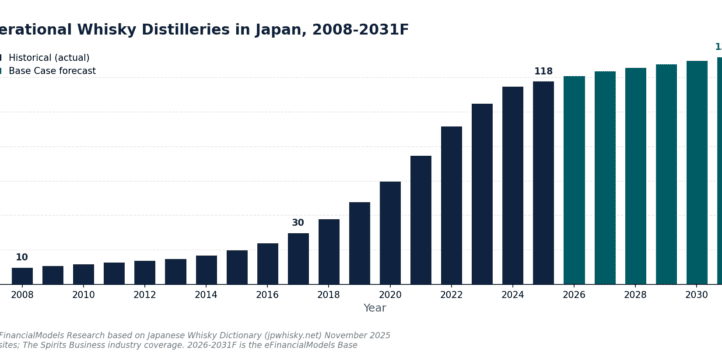
Japan’s whisky industry has spent most of the past two decades in expansion mode. That run ended in 2024. Export value fell, the collectible market cooled, and Washington added a 15 percent tariff on the sector’s largest overseas market, yet the number of operating distilleries kept climbing toward 118. This guide works through what that contradiction means for anyone considering building a distillery in Japan between 2026 and 2031: how large the opportunity actually is, what capital it demands, and how long it takes before the cash comes back.
Key Takeaways
- Japan hosts 118 active whisky distilleries as of November 2025, up from 10 in 2008, with a base-case forecast of 132 by 2031 (Japan Distilleries Market Study 2026-2031).
- Whisky export value fell 12.8 percent to JPY 43.7 billion in 2024; the base case recovers to JPY 60 billion by 2031 (Japanese Whisky Dictionary).
- A 15 percent US tariff applies retroactively from August 7, 2025; the US takes 38 percent of exports by value.
- Mid-tier collectible bottles corrected 15-30 percent from the 2022 peak: build revenue on drinking demand, not resale prices.
- A representative craft entry needs roughly JPY 450 million upfront and breaks even on cumulative cash around year 8.
Japanese whisky just finished its first real correction after fifteen years of expansion. For a first-time founder, that is the setup, not a warning: corrections compress asset prices and reward entrants with a funded plan. This guide turns the Japan Distilleries Market Study 2026-2031 into a market-entry decision framework.
Should You Enter Japan’s Distillery Market in 2026?
Enter only if you can fund 6-8 years of negative cumulative cash flow; if you can, 2026 offers the most attractive entry economics since 2018-2019. The study’s base case puts export value back on a growth path to JPY 60 billion by 2031, while distressed balance sheets and a corrected cask market let entrants buy capacity and inventory below replacement cost (Japan Distilleries Market Study 2026-2031).
The category absorbed three shocks in 2023-2025: a China demand collapse that cut high-end spirits value 28 percent in 2024, an inventory glut, and a new US tariff. None reversed the structural story: enforceable standards, a pending Geographical Indication, and deep maturing stock anchoring future premium releases.
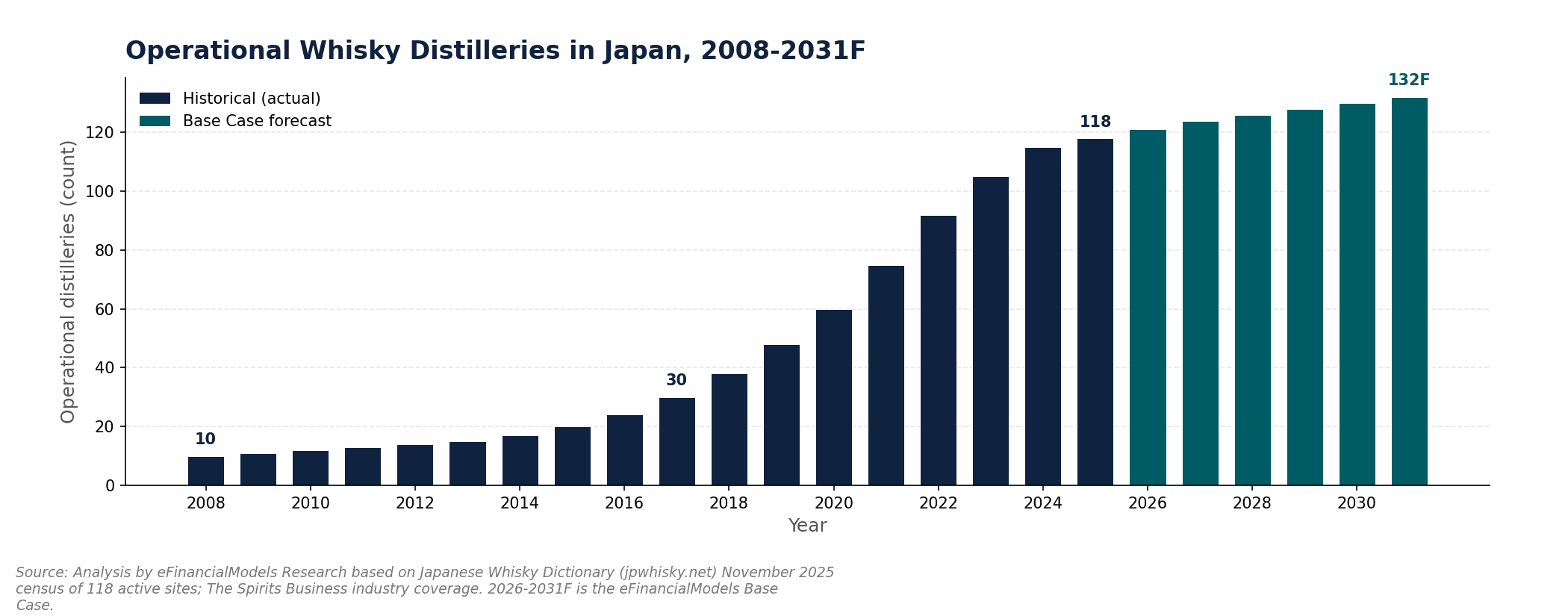
Distillery count, 2008-2031 base case — Source: eFinancialModels, Japan Distilleries Market Study 2026-2031
How Big Is the Japanese Whisky Market Today?
Japan counts 118 active whisky distilleries, and whisky remains the country’s largest alcohol export category. Export value reached 43,651 million yen in 2024, down 12.8 percent year on year, yet whisky still supplied 34.6 percent of all Japanese alcoholic beverage export value (Japanese Whisky Dictionary).
Three structural facts matter most for a founder:
- Concentration at the top. Suntory holds about 38 percent of production capacity and Nikka about 22 percent. Craft entrants compete on story, terroir, and scarcity, not volume.
- Export dependence on the US. The US took 38 percent of export value in 2024, ahead of China including Hong Kong at 14 percent and Taiwan at 9 percent. Your export plan is, first, a US plan.
- A supply wave is coming. Maturing inventory stands near 290 million liters in bond, and Venture Whisky’s 2.4 million LPA Tomakomai grain distillery is the largest single capacity addition of 2025-2026. In bond means spirit aging under tax suspension; LPA means liters of pure alcohol, the standard capacity measure.
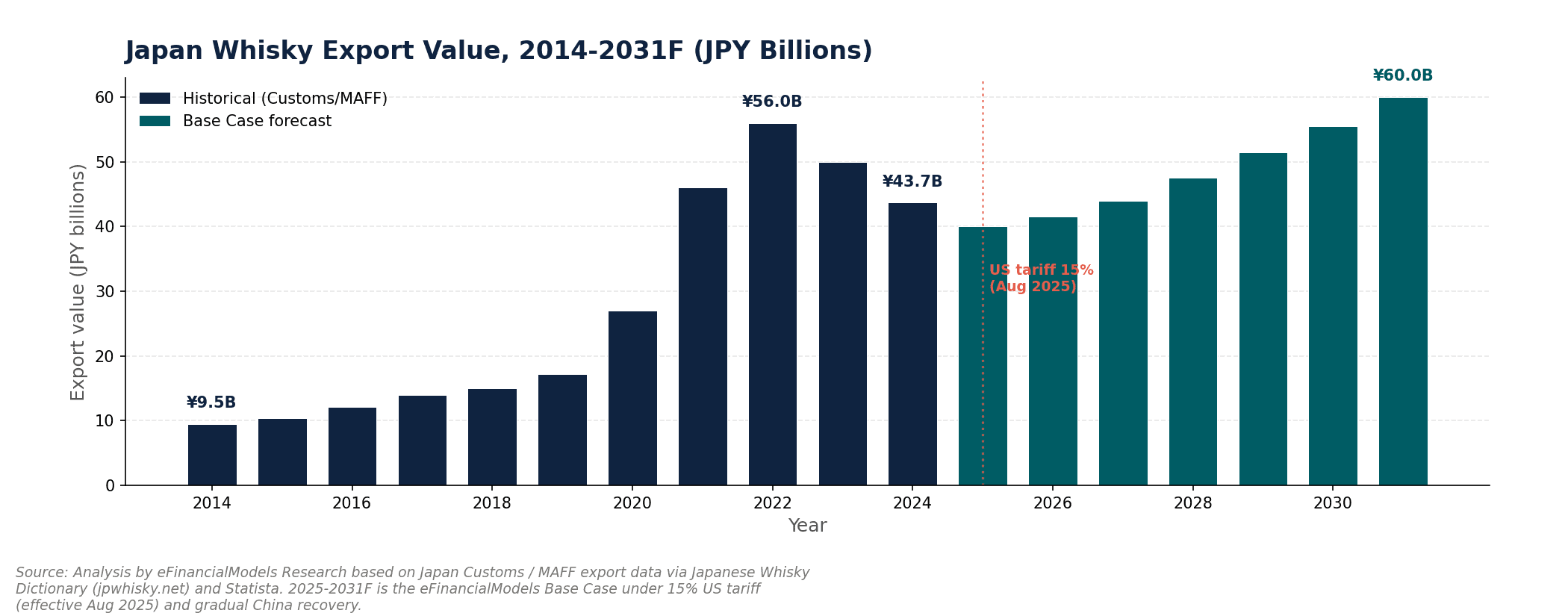
Export value, 2014-2031F — Source: eFinancialModels, Japan Distilleries Market Study 2026-2031
What Do the JSLMA Standards and GI Application Mean for Founders?
The rules now define what you may call Japanese whisky, and they protect compliant newcomers. The Japan Spirits & Liqueurs Makers Association (JSLMA), the industry body with 104 members, issued Labeling Standards in February 2021 requiring Japanese whisky to be fermented, distilled, matured, and bottled in Japan with Japanese water; the transition period ended in April 2024 (The Spirits Business).
In March 2025 the JSLMA applied to register Japanese whisky as a Geographical Indication (GI) with the National Tax Agency. A GI is a legally protected origin label, like Scotch or Champagne, turning voluntary standards into enforceable law. That blocks pseudo-Japanese bulk imports and hard-codes the provenance premium your releases will command. Build to the standard from day one.
How Does the 15% US Tariff Change Entry Economics?
The tariff compresses margins in your largest export market, but it does not close it. The US applies a flat 15 percent tariff to most Japanese imports, retroactive to goods entered on or after August 7, 2025 (Barnes Richardson).
The study models a representative producer’s EBIT, meaning earnings before interest and taxes, indexed to 2025 = 100. By 2031 the index lands at 66 bear, 124 base, and 175 bull (Japan Distilleries Market Study 2026-2031). The spread comes down to pricing power: premium positioning and direct-allocation channels pass the tariff on; price competitors absorb it.
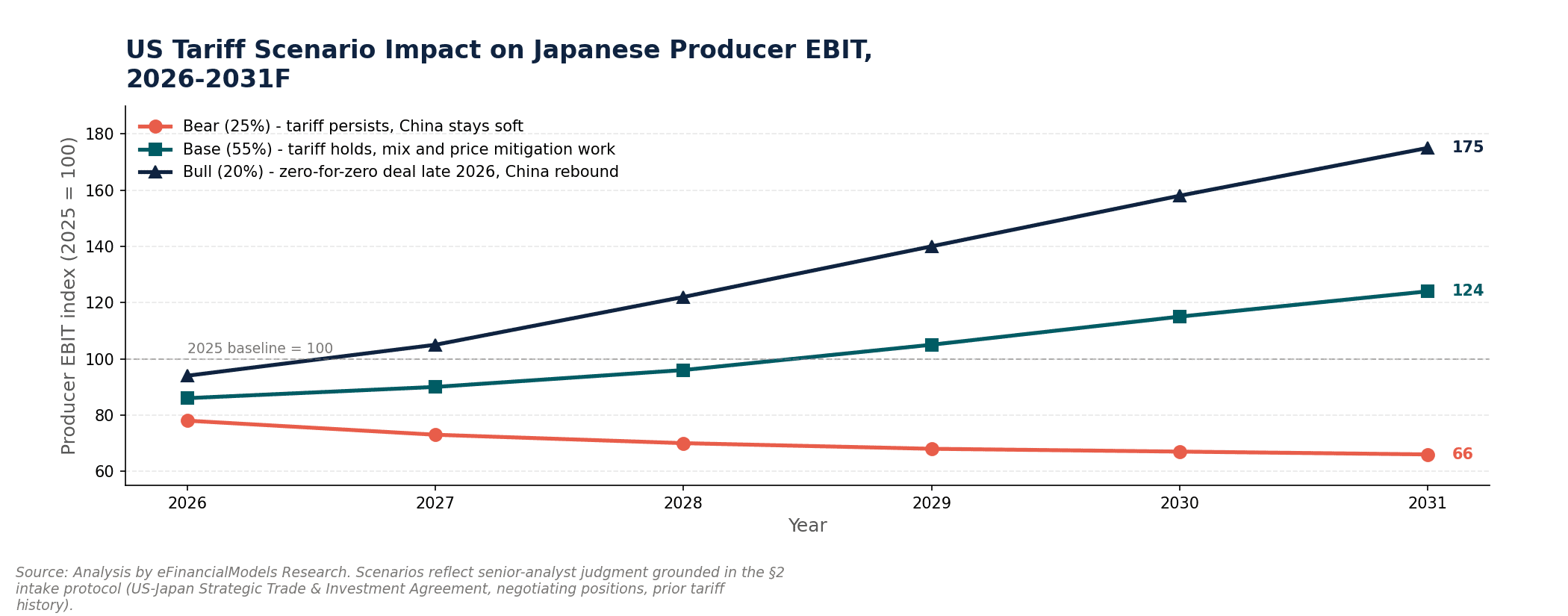
US tariff scenarios, producer EBIT index — Source: eFinancialModels, Japan Distilleries Market Study 2026-2031
What Does Starting a Craft Distillery in Japan Cost?
Plan on roughly JPY 450 million of initial capital and cumulative cash breakeven around year 8. The walkthrough, using our worked example:
- License and site. Whisky production requires a National Tax Agency license. Location matters: 32 percent of active sites cluster in Kanto-Chubu and 12 percent in Hokkaido.
- Build and equip. A 60,000 LPA distillery with stills, washbacks, and a bonded warehouse anchors the JPY 450 million capex.
- Fund the silent years. Years 1-3 earn only bulk new-make and gin revenue, about JPY 43 million per year, against JPY 90 million of operating costs. New-make is unaged spirit straight off the still.
- Release and scale. From year 4, bottled single malt at a net JPY 2,500 per bottle lifts revenue to about JPY 230 million per year.
- Reach breakeven. Cumulative cash flow turns positive in year 8, matching the study’s craft cash profile.
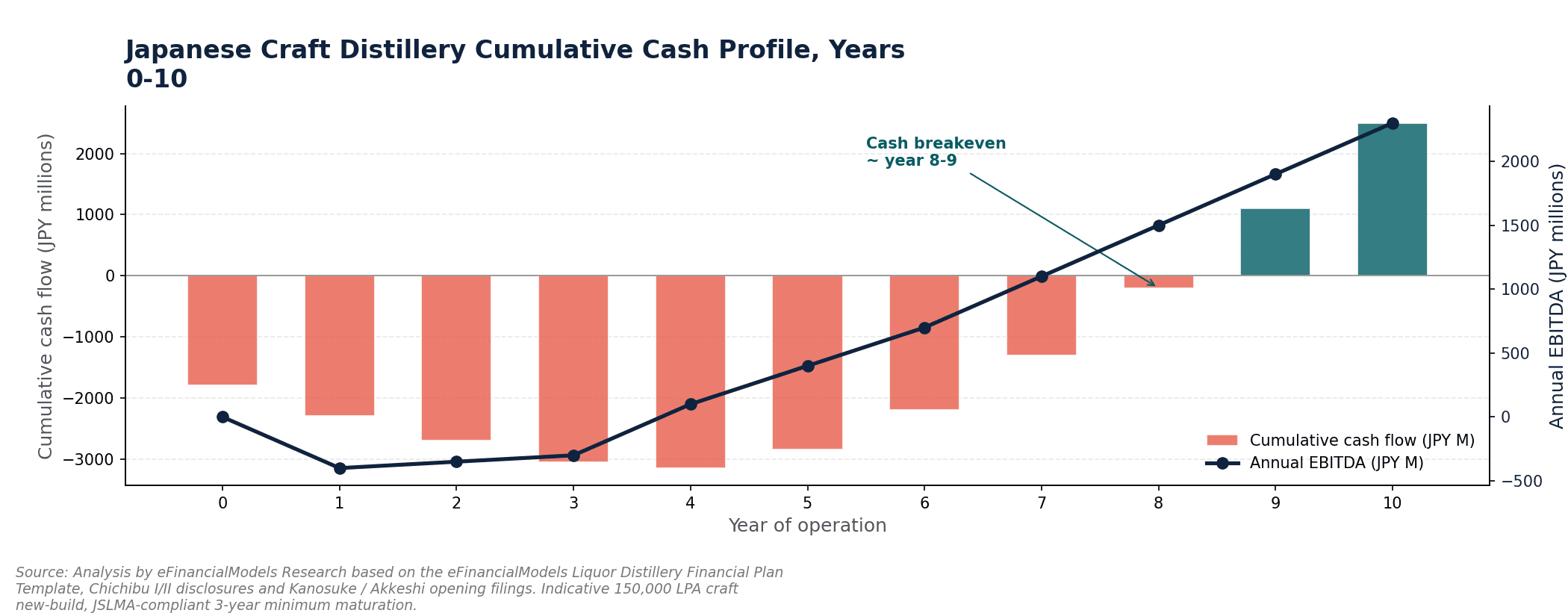
Craft distillery cash profile: breakeven around year 8 — Source: eFinancialModels, Japan Distilleries Market Study 2026-2031
A live Excel version of this worked example (craft-distillery-entry-economics.xlsx) accompanies this article.
Energy is a cost line founders miss: Japanese distilleries average 12.8 kWh per LPA of distillate versus 9.2 for Scotch producers, so efficient plant design is a durable cost advantage (Japan Distilleries Market Study 2026-2031).
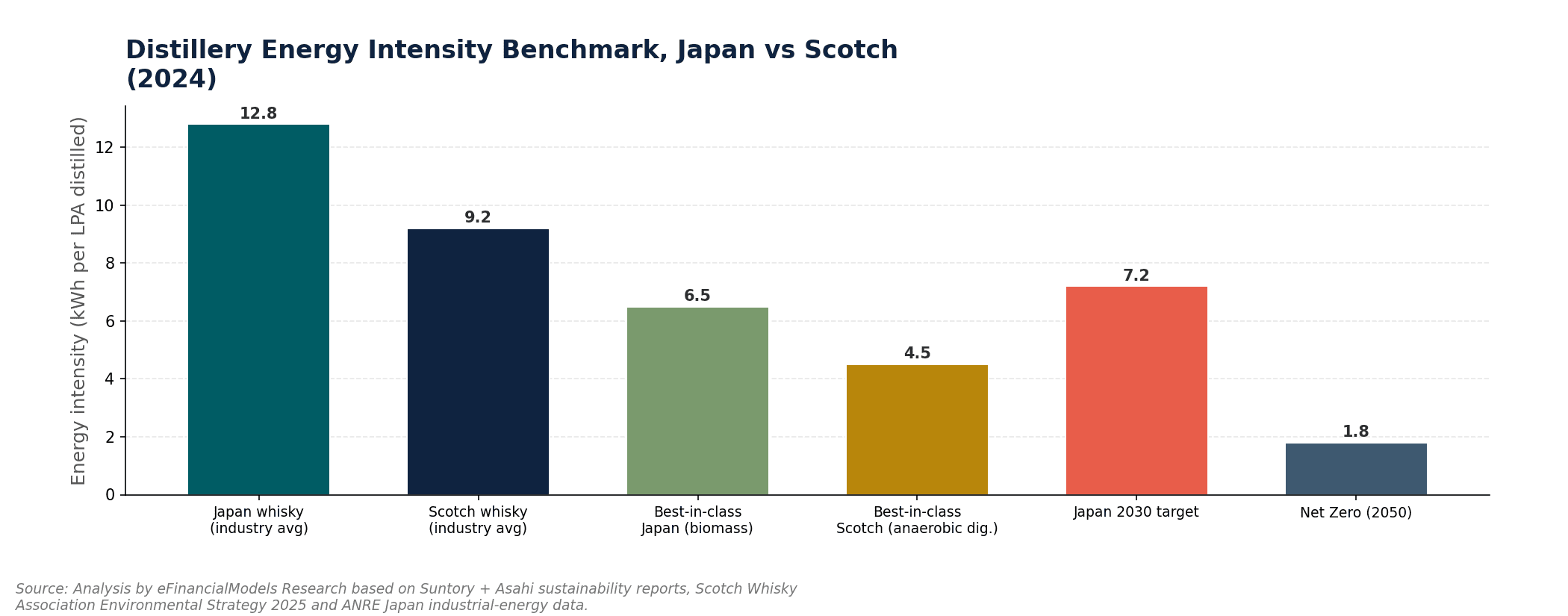
Energy intensity benchmark, kWh per LPA — Source: eFinancialModels, Japan Distilleries Market Study 2026-2031
Which Entry Route Fits Your Capital?
Match the route to your funding depth and timeline, not your ambition:
| Entry route | Typical capital | Time to first whisky revenue | Risk profile | Best for |
|---|---|---|---|---|
| New-build craft distillery | JPY 300-600 million | 4-5 years | High: full maturation-period burn | Funded founders building a long-term brand |
| Distressed asset acquisition | JPY 150-500 million | 0-2 years | Medium: inherited liabilities | Buyers who can move fast in 2026 |
| Contract distilling plus casks | JPY 30-100 million | 1-3 years | Lower: no site capex, thinner margins | First-timers testing the category |
The distressed route is unusually open: the study flags stressed craft balance sheets and cask-fund dislocation as the defining feature of the 2026 window.
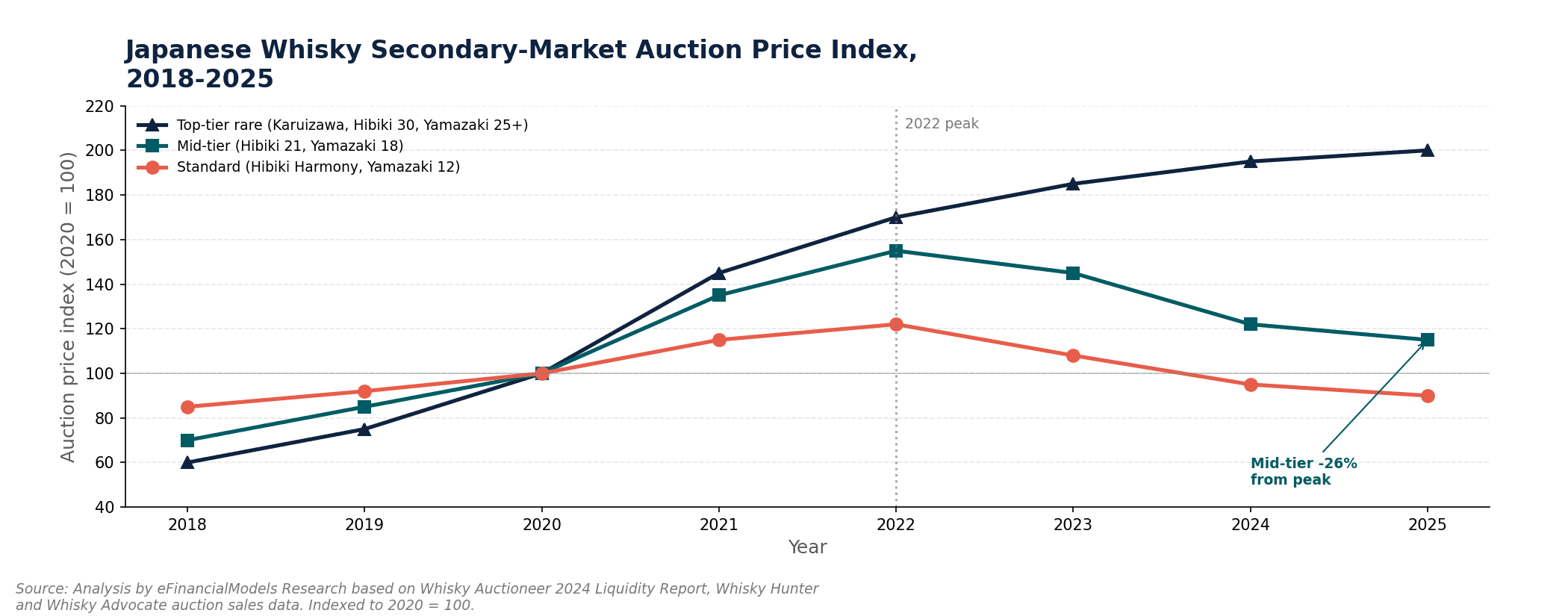
Secondary-market price index by tier, 2018-2025 — Source: eFinancialModels, Japan Distilleries Market Study 2026-2031
Five Mistakes That Sink First-Time Distillery Founders
- Underfunding the silent years. Three-plus years pass before whisky revenue. Fix: raise the full maturation budget upfront.
- Pricing the plan off 2022 auction peaks. Mid-tier bottles corrected 15-30 percent, and only 12 percent of mid-tier lots cleared at auction in 2024 versus 68 percent of top-tier lots (Japan Distilleries Market Study 2026-2031). Fix: build revenue on drinking demand.
- Ignoring the tariff. A 15 percent tariff on a 38 percent market moves the whole P&L. Fix: run all three scenarios before committing capex.
- Skipping JSLMA compliance. Non-compliant labels face GI enforcement risk and distributor rejection. Fix: build to the standard.
- Building volume into a glut. With 290 million liters in bond, undifferentiated volume has no buyer. Fix: size capacity to your brand plan.
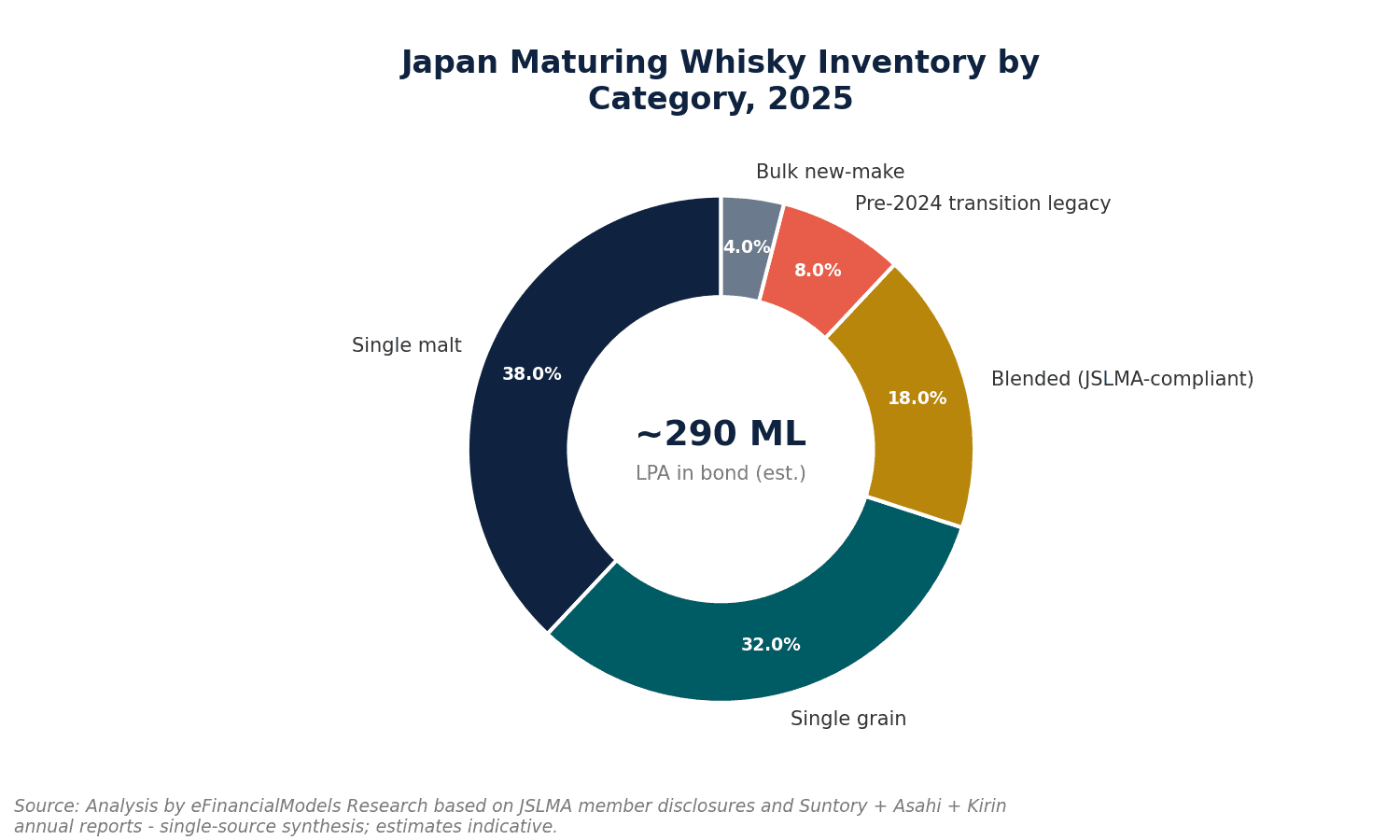
Maturing inventory by category, 2025 — Source: eFinancialModels, Japan Distilleries Market Study 2026-2031
Tools and Templates for Your Japan Distillery Model
Model the decision before you spend a yen on it:
- The Japan Distilleries Market Study 2026-2031 carries the full 37-page analysis, 12 charts, and the scenario tables this article summarizes.
- The Liquor Distillery Financial Plan Template, in the product block below, builds bottom-up production, revenue, and cash flow with up to five liquor types.
- The Micro Distillery Business Plan Financial Model, also below, fits the smaller contract-distilling route.
- The guide on how to start a distillery business covers licensing, equipment, and feasibility basics.
FAQ
How much does it cost to start a craft whisky distillery in Japan?
Plan for JPY 300-600 million of capex; our worked example anchors at JPY 450 million for a 60,000 LPA plant with stills, washbacks, and a bonded warehouse. The number founders miss is operating losses during maturation: at roughly JPY 90 million of annual costs against JPY 43 million of early bulk revenue, you need another JPY 130-170 million of runway before whisky revenue starts in year 4. A fully funded plan runs JPY 600-800 million.
Is the Japanese whisky market still growing after the 2024 correction?
Exports fell 12.8 percent to JPY 43.7 billion in 2024, but the study’s base case returns the category to a record JPY 60 billion by 2031. The correction hit collectible resale prices and China demand hardest; drinking demand in the US, Taiwan, and Southeast Asia stayed structurally intact. The distillery count keeps rising, from 118 active sites toward a base-case 132 by 2031, which tells you operators with capital still back the long-term story.
Do I have to follow the JSLMA labeling standards if I am not a member?
The standards formally bind only the JSLMA’s 104 members today, but treating them as optional is a strategic error. The association applied for Geographical Indication status with the National Tax Agency in March 2025, and a granted GI makes the requirements legally enforceable for everyone. Distributors and importers already screen for compliance. A founder who ferments, distills, matures, and bottles in Japan with Japanese water meets the standard by design and inherits the category’s provenance premium.
How long until a Japanese craft distillery becomes profitable?
Expect positive EBITDA around year 4-5 and cumulative cash breakeven around year 8. In our worked example, years 1-3 run at roughly JPY 47 million annual cash losses while spirit matures, year 4 turns EBITDA positive as bottled releases begin, and the accumulated deficit clears in year 8. Faster paths exist: selling casks forward, or acquiring a distressed distillery with mature stock, pulls revenue years earlier in exchange for thinner margins or acquisition risk.
What does the 15 percent US tariff mean for a small exporter?
Your landed cost in your biggest market rose 15 percent, and your pricing strategy decides who absorbs it. The tariff applies to most Japanese goods entered on or after August 7, 2025. The study’s scenario spread, an EBIT index of 66 to 175 by 2031, shows the outcome rests on pricing power: premium craft bottles with allocation demand pass most of it to consumers, while value-positioned volume cannot. Prioritize direct-allocation channels and diversify into Taiwan and Southeast Asia.
Conclusion
Japan’s distillery market rewards prepared entrants precisely because the easy money left. The correction reset asset prices, the standards and pending GI hardened the category’s moat, and the base case still points to record exports by 2031. Pick the entry route whose silent years you can survive, and model the tariff honestly.
I recommend downloading the Japan Distilleries Market Study 2026-2031 so your assumptions match the market you are entering, then pressure-testing your entry numbers with the Liquor Distillery Financial Plan Template in the product block below.
downloads ids=”638790,385713,318942″ columns=”3″ buy_button=”yes” price=”yes” thumbnails=”yes”


