0 ITEMS

Australia’s 700 Craft Distilleries: Gin, Whisky & What’s Next
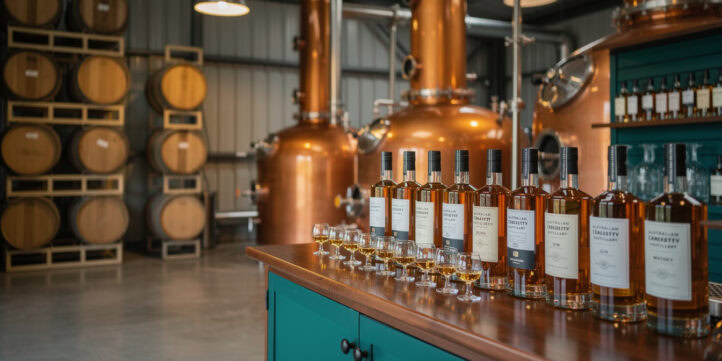
Australia’s craft distilling sector has grown from roughly 75 licensed producers in 2018 to approximately 700 by 2026, making it one of the fastest-expanding alcoholic-beverage categories in the country. The Australia Craft Distilleries Market Study 2026–2031 puts the combined craft segment at AUD 1.1–1.5 billion at retail in 2025, with two sub-segments driving the story: craft gin and craft whisky.
Key Takeaways
- Australia had approximately 700 licensed craft distilleries in 2026, up from 75 in 2018, a near tenfold increase in eight years.
- The Base Case (55% probability) projects active craft distilleries growing from ~600 in 2026 to ~690 by 2031, with revenue rising from AUD 1.3 billion to AUD 1.95 billion.
- Federal excise duty of AUD 108.00 per liter of pure alcohol (LAL) as of 2 February 2026 is the world’s third-highest spirits excise and consumes 22–25% of a typical craft gin’s recommended retail price (RRP).
- The Excise Remission Scheme cap rises from AUD 350,000 to AUD 400,000 per producer from 1 July 2026, delivering roughly AUD 50,000 of additional annual cash relief per eligible distillery.
- A mid-tier craft gin build requires AUD 1.0–1.5 million in Year-1 capital and can reach positive EBITDA in Years 2–3; a mid-tier craft whisky build requires AUD 3–5 million and locks capital for 3–8 years.
- Australia’s spirit exports are estimated at AUD 200–300 million annually today, against an industry target of AUD 1 billion by 2035.
- The single highest-leverage forward variable for every financial model is excise policy: a tap-spirits indexation freeze adds AUD 3–5 of per-bottle EBITDA for craft gin and whisky operators.
The State of Australia’s Craft Distillery Sector in 2026
Australia’s craft distilling sector is large, geographically diverse, and still growing, though the breakneck 30% year-on-year expansion of 2018–2022 has settled into a steadier trajectory. Of approximately 700 licensed producers, around 600 are actively producing as of 2026, according to analysis based on Australian Distillers Association data and Australian Taxation Office (ATO) Excise Manufacturer Licensee records.
Geography shapes the category split. Tasmania hosts roughly 70 active whisky distilleries and has built a single-malt category with global awards and accelerating international distribution. Victoria leads gin production with approximately 125 active gin distilleries, followed by New South Wales with around 95. Western Australia, South Australia, and Queensland form mid-tier emerging clusters. The Australian Institute of Health and Welfare has documented a generational shift toward lower per-capita alcohol consumption, particularly among 18–29-year-olds, with no-and-low alcoholic beverages estimated at 6–8% of total consumption by 2026. Craft spirits skew toward older, higher-income consumers, which insulates the segment somewhat, but the moderation trend still compresses the long-term volume growth envelope.
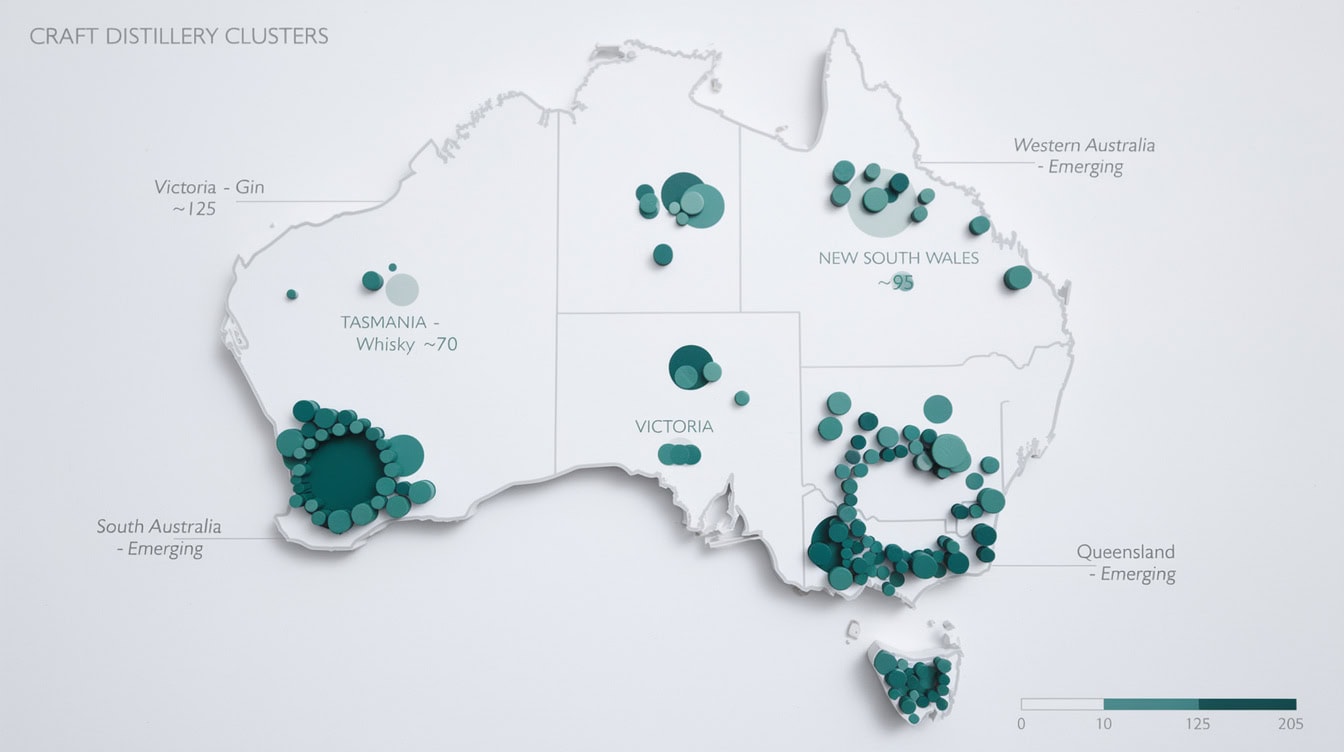
Tasmania dominates whisky with ~70 active distilleries; Victoria leads gin with ~125 producers.
Craft Gin vs Craft Whisky: Economics Side by Side
Gin and whisky operate under fundamentally different financial models, and understanding that difference is essential before building any forecast or valuation.
| Factor | Craft Gin | Craft Whisky |
|---|---|---|
| Year-1 Capital | AUD 1.0–1.5M | AUD 3–5M |
| Time to Positive EBITDA | Years 2–3 | Years 5–8+ |
| Working Capital Lock-up | Low | High (3–8 yr maturation) |
| Entry RRP (700 mL) | AUD 75–95 | AUD 110–160 |
| Premium RRP (700 mL) | AUD 95–130 | AUD 200–600+ |
| Excise as % of Entry RRP | ~25% | ~22% |
| Cellar-Door Gross Margin | 35–45% | 35–45% |
| Wholesale Gross Margin | 10–18% | 10–18% |
| Production Cost (mid-craft) | AUD 22–26/LAL | AUD 22–26/LAL + AUD 38/LAL fill |
| EBITDA Margin (scaled) | 20–25% | 15–17% (Lark FY25 benchmark) |
LPA (liters of pure alcohol) is the standard unit for distillery production capacity and excise calculation. A 700 mL bottle at 40% ABV contains 0.28 LPA. EBITDA (earnings before interest, tax, depreciation, and amortisation) is the operating profit measure used throughout this analysis.
Gin’s working-capital efficiency is its defining advantage. A new mid-tier craft gin build reaches positive EBITDA in Years 2–3 because there is no mandatory maturation period. Whisky, by contrast, requires a minimum 2 years of oak-cask maturation under Australian regulation, with commercial standards running 3–8 years. That maturation pipeline locks capital and delays cash conversion, which is why whisky needs AUD 130+ RRP to be economic at craft scale.
Lark Distilling Co (ASX: LRK) reported AUD 12.4 million in revenue for FY25, up 28% year-on-year, with an EBITDA margin of approximately 17% and a 15,000-cask inventory. That public-market benchmark illustrates the operating leverage a scaled whisky model can achieve once the maturation pipeline matures.
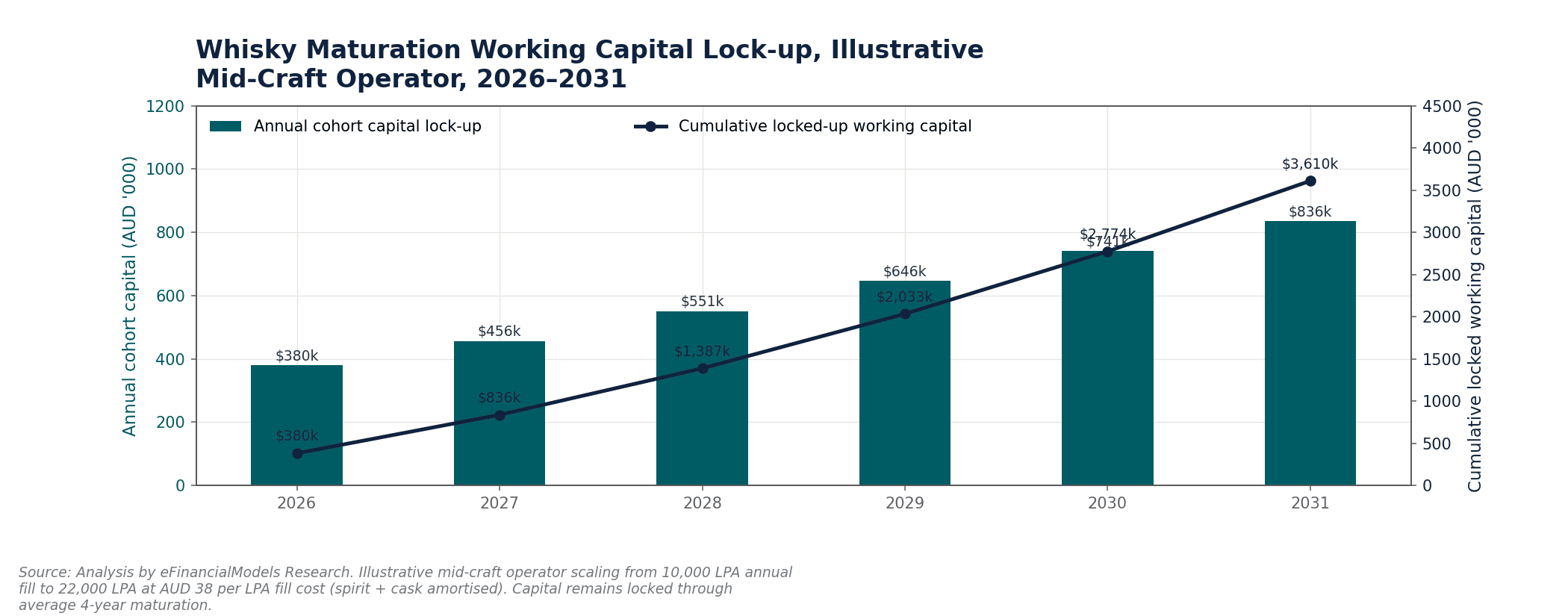
Gin reaches positive EBITDA in Years 2–3; whisky locks AUD 3–5M in capital for up to 8 years.
How Excise Duty Shapes Every Bottle’s Economics
Federal excise is the dominant unit-economics variable for every Australian craft distillery, and no financial model is credible without running it correctly.
At AUD 108.00 per liter of pure alcohol (LAL), effective 2 February 2026, Australia carries the world’s third-highest spirits excise rate. The ATO indexes this rate twice yearly, and the current excise rate schedule for spirits is published by the Australian Taxation Office (ATO). Here is the math for a standard 700 mL bottle:
Craft gin at 37% ABV: 0.700 L × 0.37 × AUD 108.00 = AUD 27.97 excise per bottle
Craft whisky at 43% ABV: 0.700 L × 0.43 × AUD 108.00 = AUD 32.51 excise per bottle
For an entry-level craft gin retailing at AUD 85 RRP, the price stack breaks down as follows:
- Federal excise: 25% (AUD 21.25)
- GST (goods and services tax, 10%): 9% (AUD 7.65)
- Combined retail and distributor margin: 27% (AUD 22.95)
- Producer net revenue (FOB): 39% (AUD 33.15)
For a premium craft whisky at AUD 220 RRP, the producer’s share rises to 47% because the fixed per-LAL excise becomes a smaller fraction of the total price. This structural dynamic explains why Australian craft producers concentrate on premium pricing tiers: producer net-revenue economics improve disproportionately as RRP rises.
The Excise Remission Scheme (Subdivision 311-D, Income Tax Assessment Act 1997) provides eligible craft producers a cash remission of excise paid, capped at AUD 400,000 per producer per financial year from 1 July 2026, up from AUD 350,000. That AUD 50,000 increase is material at the micro tier but becomes immaterial above approximately 100,000 LPA of annual production.
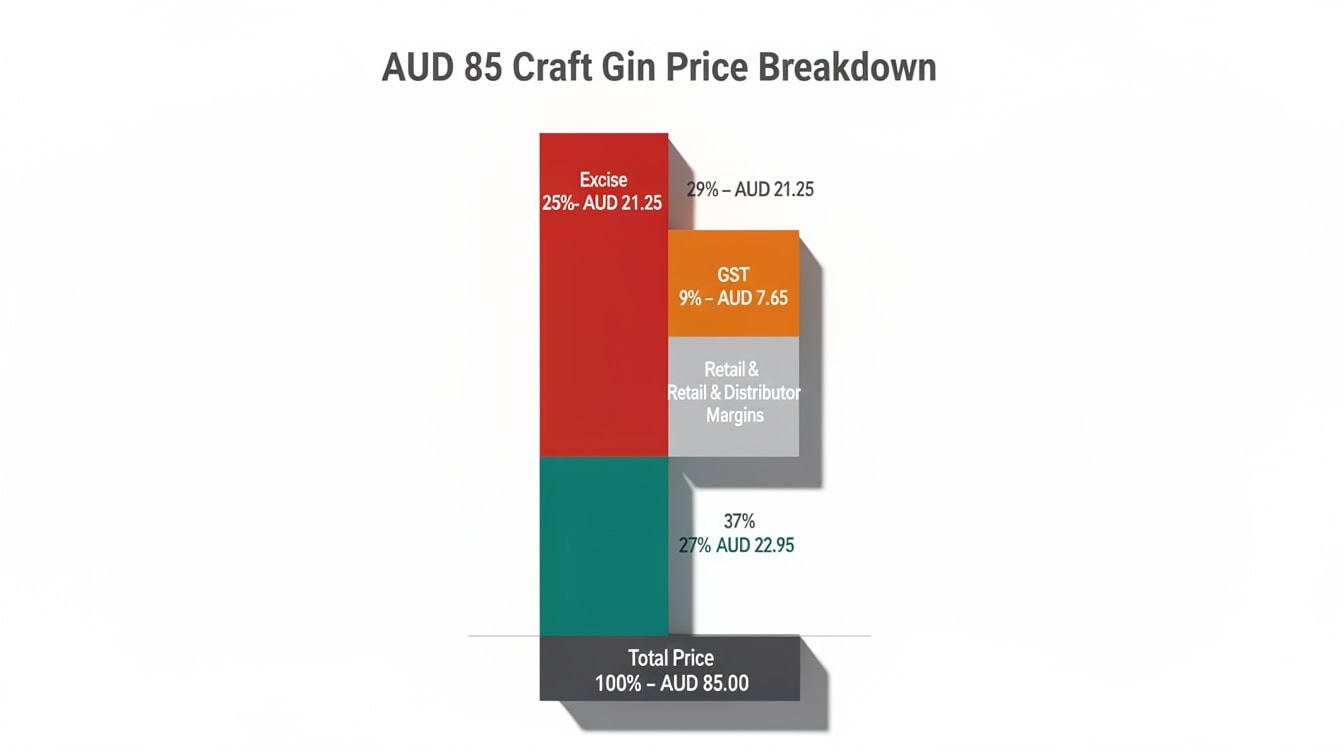
Federal excise consumes 25% of an AUD 85 craft gin’s RRP; the producer retains 39% as net revenue.
Worked Example: Per-Bottle EBITDA for a Mid-Craft Gin
The following calculation walks through the producer-level economics for a craft gin retailing at AUD 85 per 700 mL bottle, assuming the operator is within the Excise Remission Scheme cap.
Starting point: RRP = AUD 85.00
- Less GST (10% of RRP): AUD 7.73 → price ex-GST = AUD 77.27
- Less retail margin (35% of ex-GST): AUD 27.04 → price to distributor = AUD 50.23
- Less distributor margin (15% of distributor price): AUD 7.55 → producer FOB = AUD 42.68
- Less excise (remission-adjusted allocation at this tier): AUD 11.42 → producer net revenue = AUD 31.26
- Less COGS: ingredients + packaging = AUD 8.20; direct labor + utilities = AUD 4.50 → total COGS = AUD 12.70
- Producer EBITDA per bottle = AUD 31.26 − AUD 12.70 = AUD 18.56
That AUD 18.56 represents a 22% EBITDA margin on RRP, or 59% on producer FOB. Scale this to a mid-craft operator producing 50,000 bottles per year and the annual EBITDA contribution is approximately AUD 928,000 before fixed overhead.
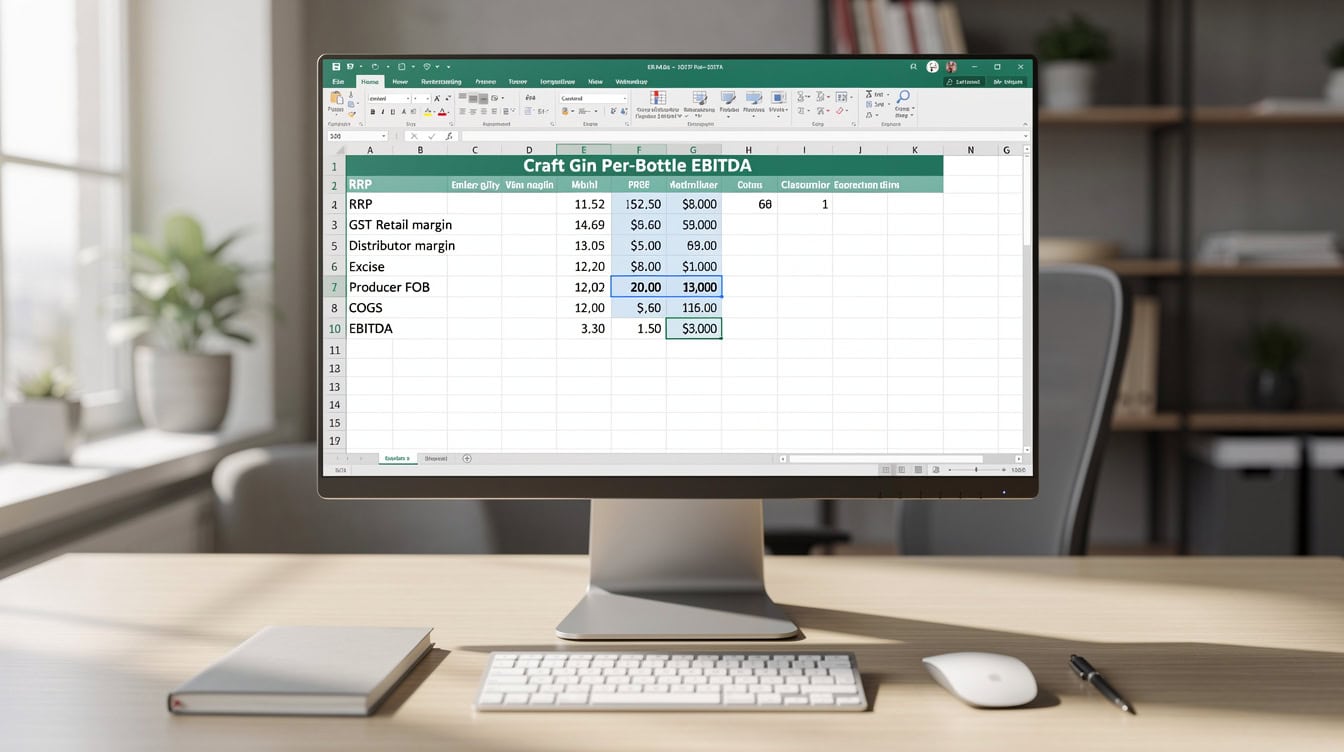
A mid-craft gin operator within the Remission Scheme cap earns approximately AUD 18.56 EBITDA per bottle at AUD 85 RRP.
Three Scenarios for 2031: Base, Bear, and Bull
The study models three forward scenarios for the Australian craft distillery sector through 2031. Each scenario assigns a probability based on regulatory trajectory, demand-driver evolution, and capital-market conditions.
| Scenario | Probability | Active Distilleries (2031) | Revenue (2031) | EBITDA Margin (2031) | Exports (2031) |
|---|---|---|---|---|---|
| Bear | 25% | ~550 | AUD 1.45B | ~9% | ~AUD 280M |
| Base | 55% | ~690 | AUD 1.95B | ~14% | ~AUD 420M |
| Bull | 20% | ~820 | AUD 2.65B | ~19% | ~AUD 690M |
The Bear scenario assumes domestic premium-spirits demand stagnates, excise indexation continues without policy intervention, and the sub-scale tail of micro-distilleries (below 5,000 LPA) loses approximately 100 operators. The Base scenario assumes 3–5% volume CAGR for craft, steady export growth supported by the UK Free Trade Agreement and India Economic Cooperation and Trade Agreement (ECTA), and EBITDA margins improving as scale economies compound. The Bull scenario requires a tap-spirits indexation freeze matching the August 2025 to February 2027 draught-beer freeze, plus an export-promotion policy boost.
The single highest-leverage variable across all three scenarios is excise policy. A tap-spirits indexation freeze adds approximately AUD 3–4 of per-bottle EBITDA for a craft gin operator and AUD 4–5 for a craft whisky operator. A 50% rate cut on the first 50,000 LPA, modeled on US small-distillery frameworks, would add AUD 7–10 per bottle. The US hosts approximately 2,500 active craft distilleries (American Craft Spirits Association data), and the federal craft-distillery excise relief in the US is materially more generous: the first 100,000 proof gallons of production carries a tax of approximately USD 2.70 per proof gallon (Alcohol and Tobacco Tax and Trade Bureau), versus AUD 108.00/LAL in Australia, a roughly 27-times lower effective rate for a scaling craft distiller.
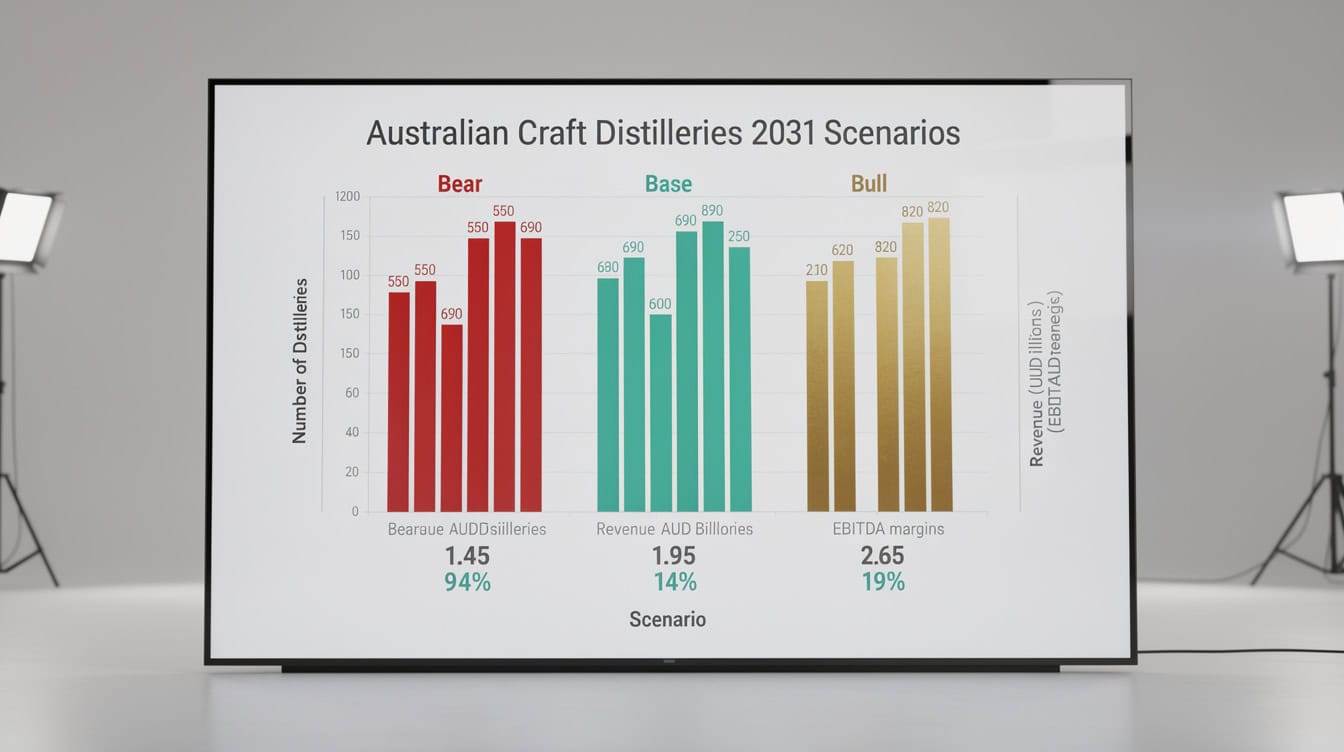
The Base Case (55% probability) projects AUD 1.95B revenue and 14% EBITDA margins by 2031; the Bull scenario requires excise policy reform.
Export Opportunity: AUD 700–800 Million Growth Wedge
Export is the most under-exploited structural opportunity for Australian craft distilleries, and operators that build the channel before 2031 capture a disproportionate share of the growth.
Australia’s spirit exports are estimated at AUD 200–300 million annually in 2024–25, against a stated industry target of AUD 1 billion by 2035 (Spirits and Cocktails Australia). New Zealand holds the largest share at approximately 33%, followed by China at 14%, South Korea at 11%, the United States at 9%, and the United Kingdom at 9%. The UK FTA eliminates spirit tariffs into the UK; the India ECTA reduces tariffs into a major prospective whisky market. The binding constraints are domestic excise economics, which compress the FOB-discount window, and brand recognition outside niche enthusiast circles.
Tasmania alone receives an estimated 200,000+ distillery tourists annually, contributing 20–30% of revenue for tourism-led whisky producers. Cellar-door pricing captures full retail margin plus a tourism premium, translating to 35–45% gross margin on cellar-door sales versus 10–18% on the same SKU sold wholesale.
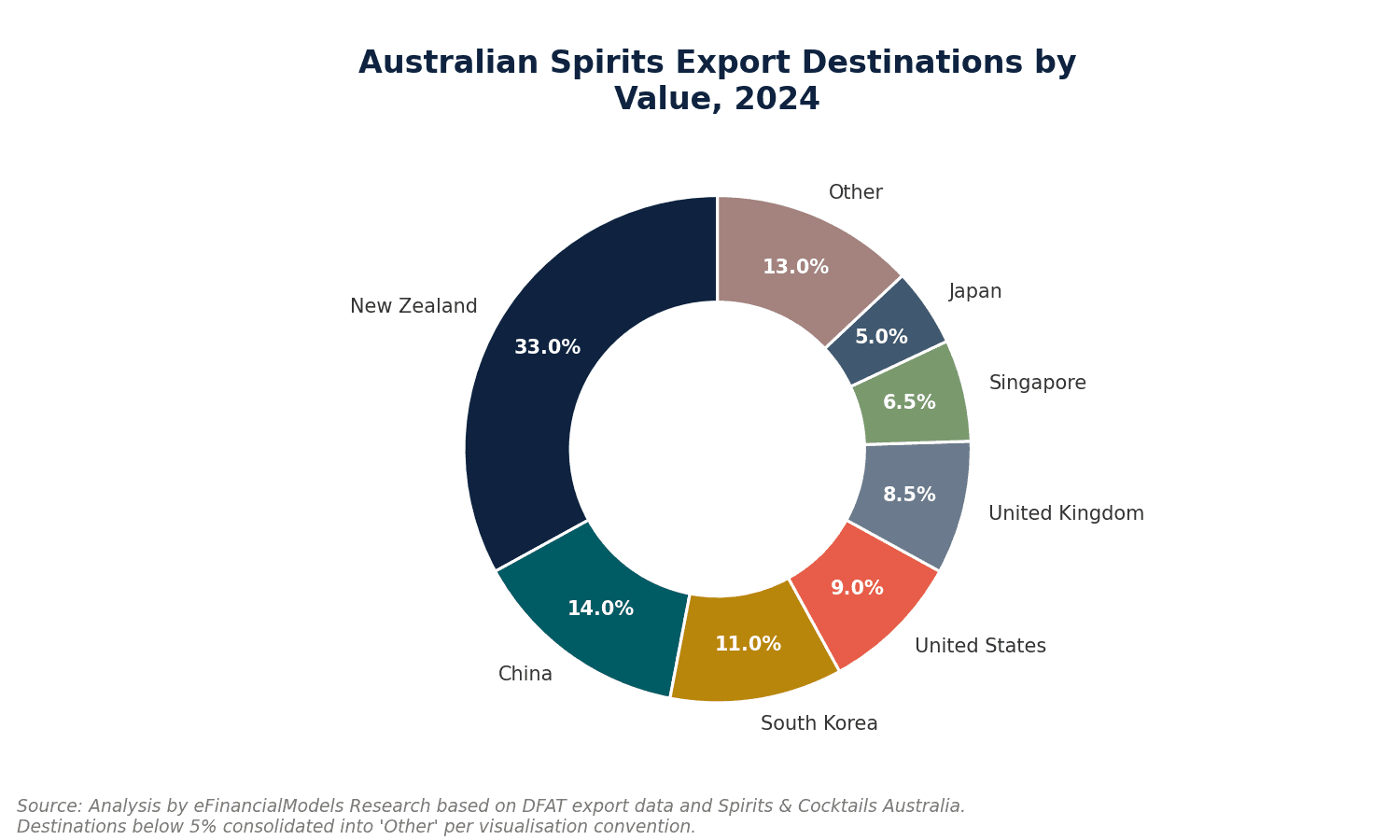
New Zealand takes 33% of Australian spirit exports by value; China and South Korea together account for another 25%.
Common Mistakes in Modeling Australian Craft Distilleries
Financial models for Australian craft distilleries fail in predictable ways. Here are the five most common errors and how to fix them.
1. Embedding excise in COGS rather than as a separate line. Excise is a per-LAL federal tax, not a production cost. Mixing it into cost of goods sold (COGS) obscures the Remission Scheme benefit and makes scenario analysis on excise policy impossible. Fix: model excise as a discrete line item, then apply the Remission Scheme cap as a cash credit. The ATO requires excise manufacturers to hold a valid manufacturer license (ATO), and producers must lodge excise returns on a weekly basis once production exceeds certain thresholds.
2. Ignoring the Remission Scheme binary cliff. The AUD 400,000 cap is binary: operators inside it receive the full remission; operators above it receive nothing on incremental production. A model that linearly interpolates the benefit across production tiers will overstate EBITDA for scaling operators. Fix: build a switch in the model that turns off the remission once production exceeds the cap threshold.
3. Treating whisky maturation cost as a COGS item. The AUD 38/LAL fill cost for a 4-year whisky, plus the 7% cost of capital on locked-up inventory, adds AUD 5–8 per bottle to the all-in producer cost. Embedding this in COGS conflates operating performance with financing decisions. Fix: model maturation-fill capital as a working-capital line on the balance sheet, with a separate finance cost.
4. Using a single channel-mix assumption. A mid-craft distillery’s revenue mix is approximately 42% wholesale, 22% cellar-door, 14% retail direct-to-consumer (DTC), 13% export, and 9% on-premise direct. Wholesale and cellar-door carry very different gross margins (10–18% vs 35–45%). A blended-margin model will misstate profitability as the channel mix shifts. Fix: model each channel separately with its own margin assumption.
5. Targeting micro-scale production. Below 5,000 LPA, all-in production cost runs AUD 38–45/LAL. At 25,000–100,000 LPA (mid-craft), it falls to AUD 22–26/LAL. New-build models that target micro-scale without a cellar-door or premium-scarcity strategy will show uneconomic unit costs. Fix: target the 25,000–100,000 LPA tier as the base case for new builds.
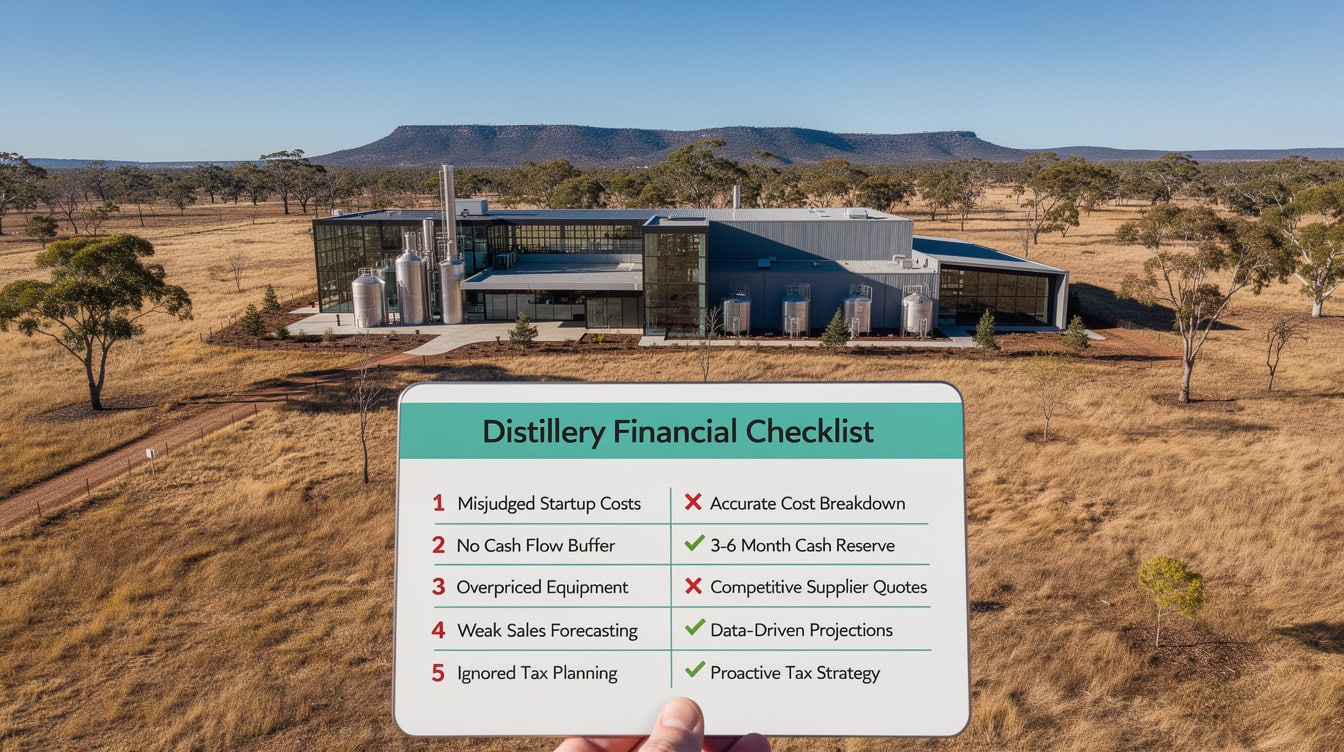
Embedding excise in COGS and ignoring the AUD 400,000 Remission Scheme cliff are the two most costly modeling errors.
Valuation Benchmarks and M&A Reference Points
For investors and consolidators evaluating existing distilleries, the study provides credible transaction multiples anchored to public-market and strategic-investor data.
Established mid-tier operators in the Base scenario trade at 2.0–2.8 times revenue and 12–15 times EBITDA, using Lark Distilling Co (ASX: LRK) as the public-market reference. Category-leader brands with international distribution, such as Four Pillars, Starward, and Sullivans Cove, command 3.2–4.5 times revenue. Sub-scale operators with revenue below AUD 5 million trade at 1.5–2.5 times revenue but offer optionality on roll-up consolidation strategies.
Key KPIs for due diligence: three-year revenue CAGR, EBITDA margin trajectory with maturation-cost normalisation for whisky operators, cask inventory as a forward-revenue proxy, channel mix (cellar-door and DTC versus wholesale), export channel maturity, and Remission Scheme utilisation status. Suntory Oceania is the most plausible large-corporate acquirer for premium-tier brands through 2031; mid-tier consolidators will likely emerge from the existing top-10 operators.
For founders building a new craft distillery, the recommended sequencing is to launch gin or vodka in Year 1 to generate cash flow while whisky matures. This is the pattern followed by Lark, Archie Rose, and Adams Distillery.
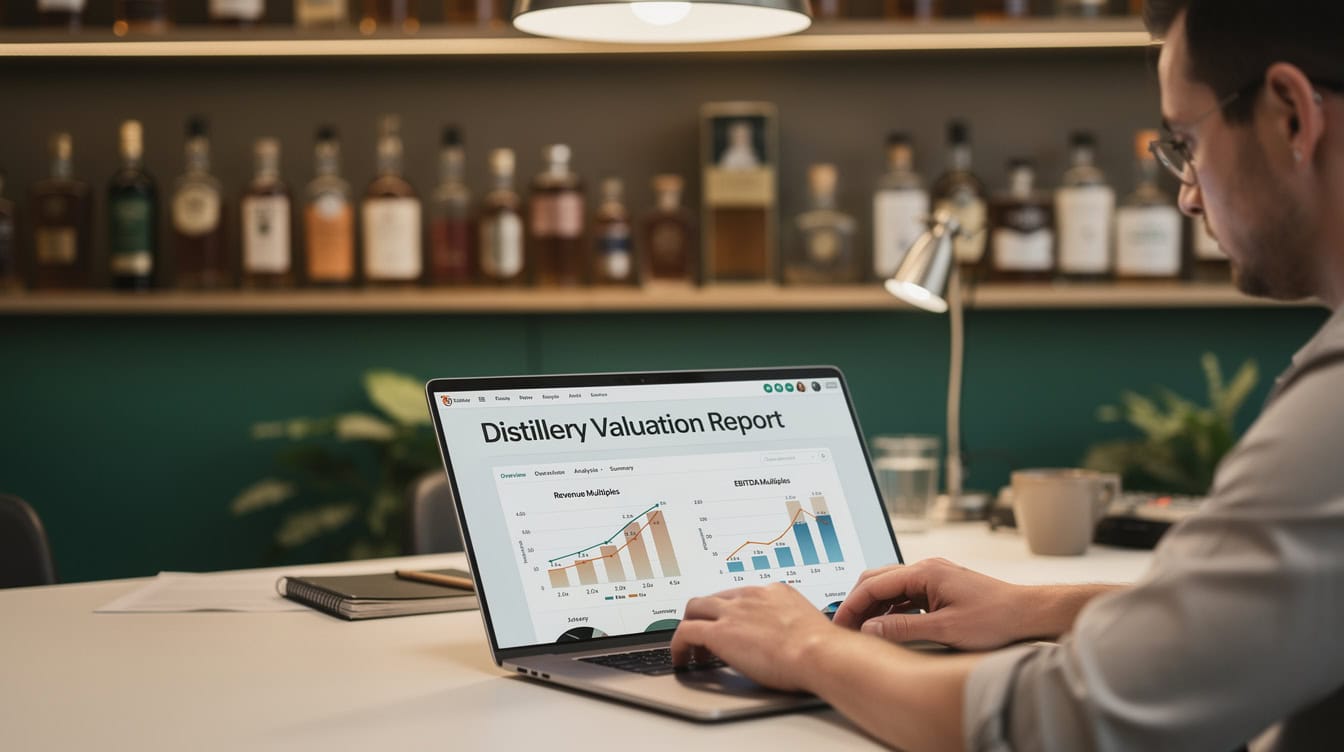
Established mid-tier Australian distilleries trade at 2.0–2.8x revenue; category leaders command 3.2–4.5x.
Frequently Asked Questions
How many craft distilleries are operating in Australia in 2026?
Approximately 600 craft distilleries are actively producing in Australia in 2026, out of roughly 700 licensed producers. The licensed base grew from about 75 distilleries in 2018, representing a near tenfold increase in eight years. The Base Case projection from the Australia Craft Distilleries Market Study 2026–2031 takes the active count to approximately 690 by 2031, with continued churn at the micro tier (below 5,000 LPA) and consolidation at the mid tier (25,000–100,000 LPA). Tasmania hosts around 70 active whisky distilleries; Victoria leads gin with approximately 125 active gin distilleries.
What is Australia’s federal excise rate on spirits and how does it affect craft distilleries?
Australia’s federal excise rate on spirits is AUD 108.00 per liter of pure alcohol (LAL), effective 2 February 2026, making it the world’s third-highest spirits excise. The ATO indexes this rate twice yearly. For a 700 mL bottle of craft gin at 37% ABV, the excise calculation is: 0.700 × 0.37 × 108.00 = AUD 27.97. That represents approximately 25% of an AUD 85 entry-level craft gin’s RRP. The Excise Remission Scheme (Subdivision 311-D, Income Tax Assessment Act 1997) caps cash remissions at AUD 400,000 per producer per year from 1 July 2026, delivering roughly AUD 50,000 of additional annual relief compared to the prior AUD 350,000 cap.
What capital does a new craft distillery need to get started in Australia?
Capital requirements depend heavily on whether you’re building a gin or whisky operation. A mid-tier craft gin build requires AUD 1.0–1.5 million in Year-1 capital covering stills, facility, and brand, and can reach positive EBITDA in Years 2–3. A mid-tier craft whisky build requires AUD 3–5 million in total capital, including 5 years of maturation-cohort fills at approximately AUD 38/LAL, plus ongoing annual maturation capital of AUD 0.5–1.0 million locked for 3–8 years. The recommended production target for new builds is 25,000–100,000 LPA, where all-in production cost falls to AUD 22–26/LAL versus AUD 38–45/LAL at micro-distillery scale.
What are the three revenue scenarios for Australian craft distilleries through 2031?
The study models three scenarios. The Bear scenario (25% probability) sees active distilleries fall to approximately 550 and revenue stall at AUD 1.45 billion by 2031, driven by continued excise indexation and accelerating consumer moderation. The Base scenario (55% probability) projects approximately 690 active distilleries and AUD 1.95 billion in revenue, representing an approximately 8% revenue CAGR from 2026, with EBITDA margins improving from ~9% to ~14%. The Bull scenario (20% probability) requires a tap-spirits indexation freeze and export-policy boost, projecting 820 distilleries, AUD 2.65 billion revenue, and 19% average EBITDA margins by 2031.
How does cellar-door sales compare to wholesale for craft distillery margins?
Cellar-door sales are materially more profitable than wholesale for craft distilleries. Wholesale gross margin runs at 10–18% for the producer because it must absorb distributor margin (12–18%) and retail margin (30–38%). Cellar-door eliminates both layers, delivering 35–45% gross margin on the same product. A typical mid-craft distillery generates approximately 22% of revenue from cellar-door and tours, and 14% from retail DTC online, versus 42% from wholesale. Tasmania alone receives an estimated 200,000+ distillery tourists annually, contributing 20–30% of revenue for tourism-led whisky producers. This margin differential is the primary reason small operators can survive at sub-scale production volumes.
What are the main export markets for Australian craft spirits?
Australia’s spirit exports are estimated at AUD 200–300 million annually in 2024–25. New Zealand is the largest destination at approximately 33% of export value, followed by China at 14%, South Korea at 11%, the United States at 9%, and the United Kingdom at 9%, with Singapore at approximately 7%. The UK Free Trade Agreement eliminates spirit tariffs into the UK; the India ECTA reduces tariffs into India, a major prospective whisky market. The binding constraints are domestic excise economics, which compress the FOB-discount window available to exporters, and limited brand recognition outside niche enthusiast circles. Operators that build export channels between 2026 and 2028 are positioned to capture a disproportionate share of the AUD 700–800 million growth wedge if industry export targets materialise.
How should a financial model treat whisky maturation costs?
Whisky maturation costs should be separated from operating COGS and modeled as a working-capital line on the balance sheet. The maturation-fill cost for a 4-year-old whisky at AUD 38/LAL, combined with a 7% cost of capital on locked-up inventory, adds approximately AUD 5–8 per 700 mL bottle to the all-in producer cost. Embedding this in COGS conflates operating performance with financing decisions and makes it impossible to correctly model the cash-conversion cycle. The correct approach is to record the fill cost as a working-capital asset (maturing inventory), accrue a finance charge annually, and recognize the cost in COGS only when the whisky is excise-cleared for sale. This structure also makes the Remission Scheme binary cliff visible in the model.
Conclusion
Australia’s craft distillery sector offers a compelling combination of structural growth, premium-pricing power, and export optionality, but the financial case is only as strong as the model behind it. The sector’s unit economics are dominated by a federal excise rate of AUD 108.00/LAL, a Remission Scheme cap that creates a binary cliff at AUD 400,000, and a channel mix where cellar-door margins are three times wholesale margins. Get those inputs right and the Base Case projects AUD 1.95 billion in craft revenue by 2031 at 14% EBITDA margins. Get them wrong and you’ll misstate profitability by 25–35% per bottle.
I recommend downloading the Australia Craft Distilleries Market Study 2026–2031 for the full scenario analysis, RRP decomposition waterfall, maturation working-capital model, and valuation benchmarks calibrated to Australian-specific excise and channel economics. Pair it with the EFM market studies template library to build a defensible financial model for any craft distillery investment or new-build decision.