
0 ITEMS

Spa Hotel Financial Model Excel Template
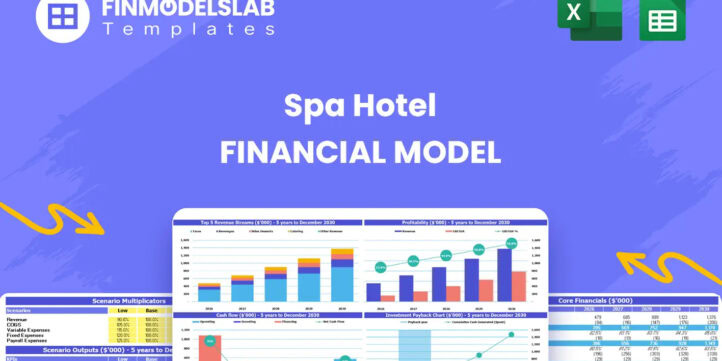
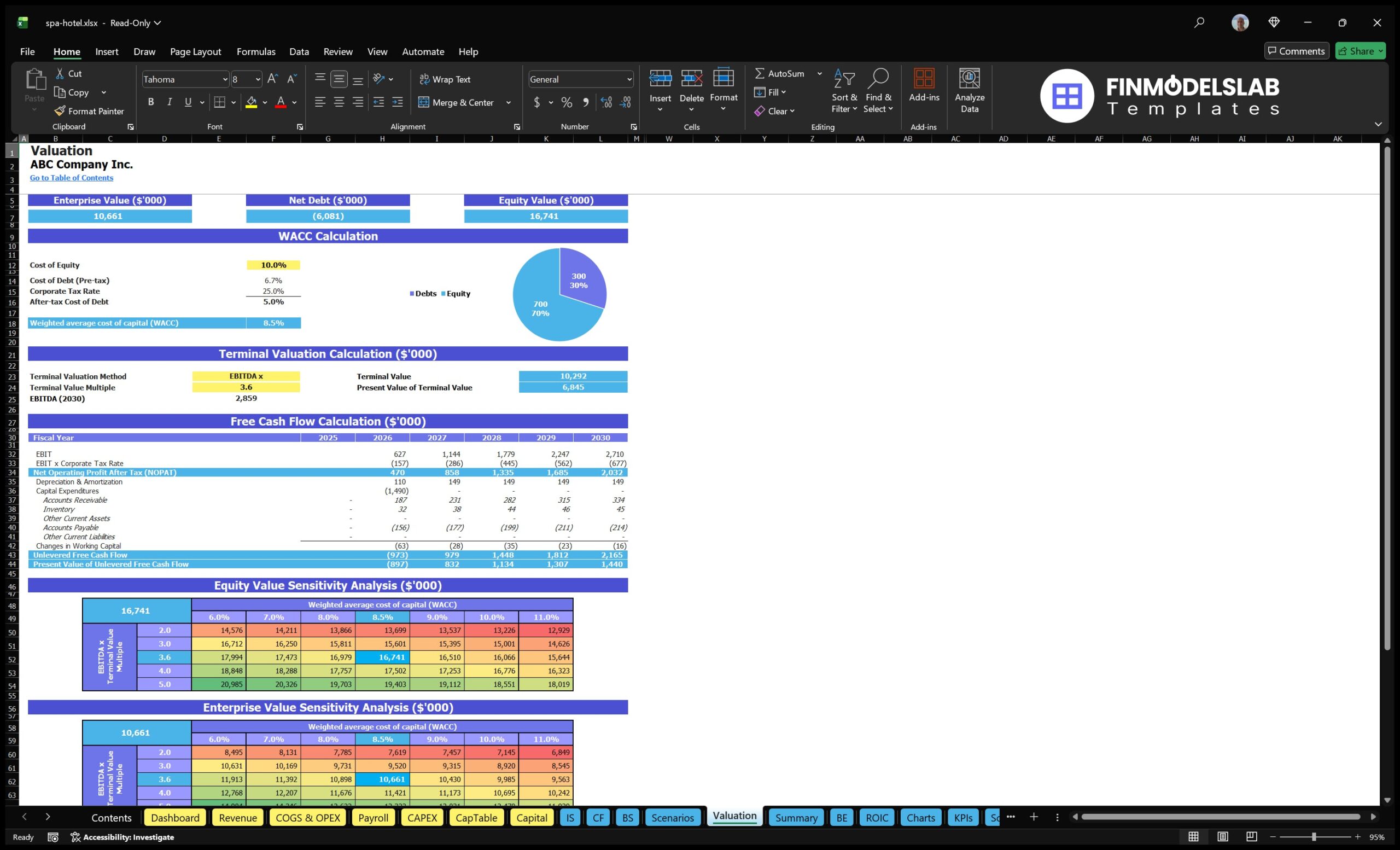
The Spa Hotel Financial Model is a ready-to-use financial model template designed to help entrepreneurs, hotel owners, consultants, analysts, and business planners evaluate the financial potential of a spa hotel before launch, expansion, or funding discussions. It gives users a structured way to estimate room revenue, spa and wellness income, food and beverage sales, event rentals, memberships, startup costs, operating expenses, payroll, cash flow, profitability, and capital requirements in one connected model. Instead of building a complex forecast from scratch, users can begin with a practical framework tailored to the hospitality and wellness industry. This template is especially useful for founders preparing a spa hotel business plan, boutique hotel finance plan, wellness resort feasibility study, or lender and investor presentation. It allows users to document key revenue assumptions such as room count, occupancy, average daily rate, suite mix, spa retail sales, memberships, dining revenue, and event income. It also helps organize the major cost drivers of a spa hotel, including capital expenditures, property costs, staffing, food and beverage costs, spa supplies, marketing, maintenance, utilities, and general overhead. By linking these assumptions to financial outputs, the model helps users see how operational decisions affect profit, cash runway, and long-term business performance. The Spa Hotel Financial Model supports financial planning and decision-making with five-year projections, scenario analysis, profitability metrics, break-even analysis, cash flow forecasting, and presentation-ready outputs. Users can test low, base, and high cases, compare changes in occupancy or pricing, review return metrics, and assess whether the business can reach sustainable profitability. The template is fully editable, compatible with Microsoft Excel and Google Sheets, and structured for use by both finance professionals and non-financial users who need clear, credible projections. For anyone seeking funding, evaluating a new location, planning a premium wellness hospitality concept, or expanding an existing property, this financial model template provides a practical foundation for organized decision-making. It helps reduce guesswork, clarify the amount of startup funding required, identify potential cash shortfalls, and present assumptions in a professional format. With built-in dashboards, revenue detail, KPI tracking, charts, reports, and automated formulas, the Spa Hotel Financial Model helps turn a spa hotel concept into a measurable financial plan.
Financial Model Overview
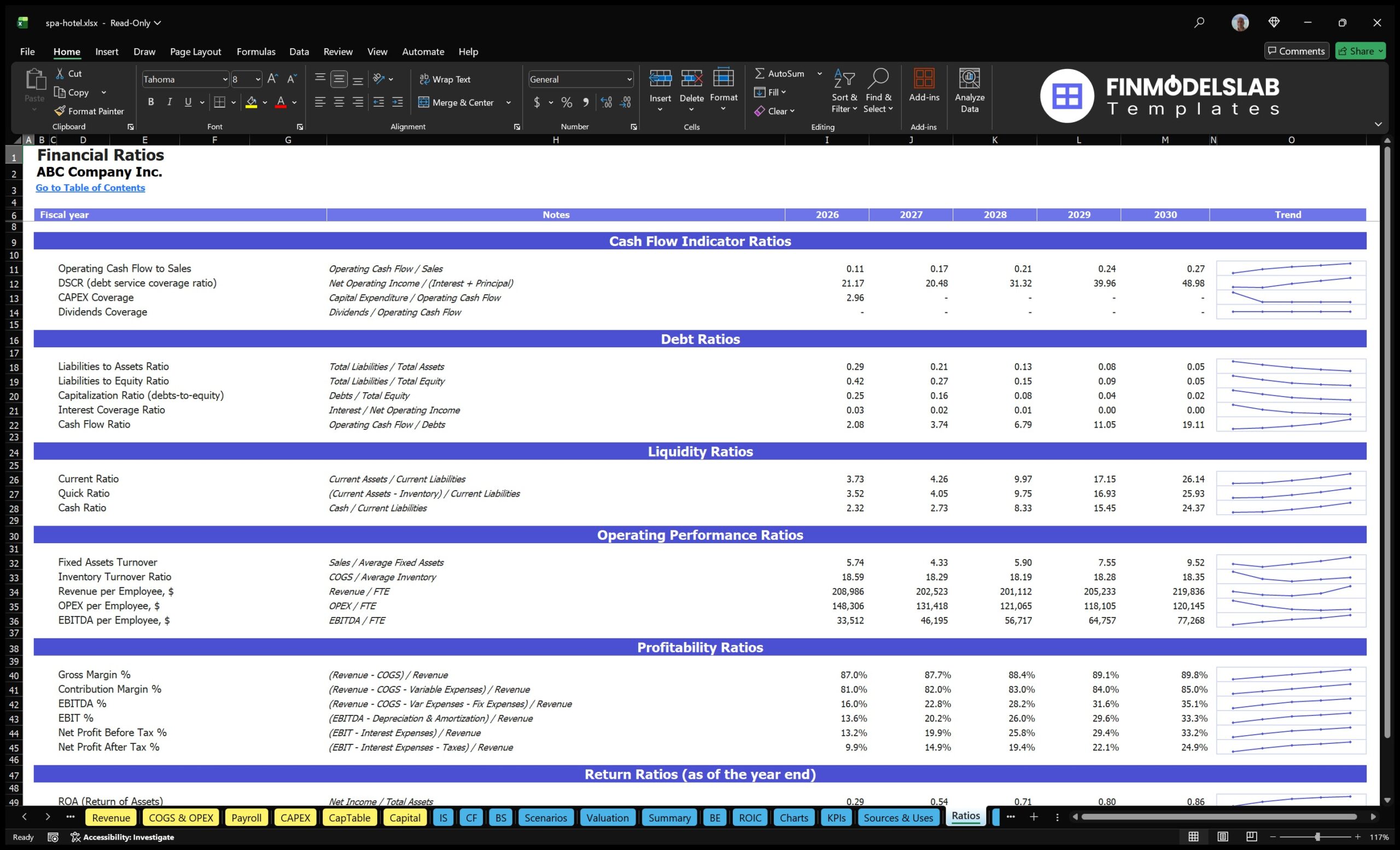
The Spa Hotel Financial Model is a ready-to-use financial model template built for planning, evaluating, and presenting the financial outlook of a spa hotel, boutique wellness resort, or hospitality concept with spa, accommodation, dining, event, and membership revenue streams. It helps entrepreneurs, business owners, consultants, analysts, and founders replace rough estimates with a structured forecast that connects operational assumptions to financial outcomes. Users can model room nights, occupancy, average daily rate, spa income, retail sales, event rentals, food and beverage revenue, startup investment, operating expenses, payroll, cash flow, and profitability over a multi-year forecast period. Because a spa hotel has both lodging economics and wellness service economics, the template is designed to bring these moving parts together in one editable planning tool. It can support business plans, loan applications, investor discussions, internal budgeting, feasibility studies, and strategic decision-making. The model is fully customizable, compatible with Excel and Google Sheets, and formatted to help users understand the financial story behind the business without building formulas from the ground up.
All-in-One Dashboard
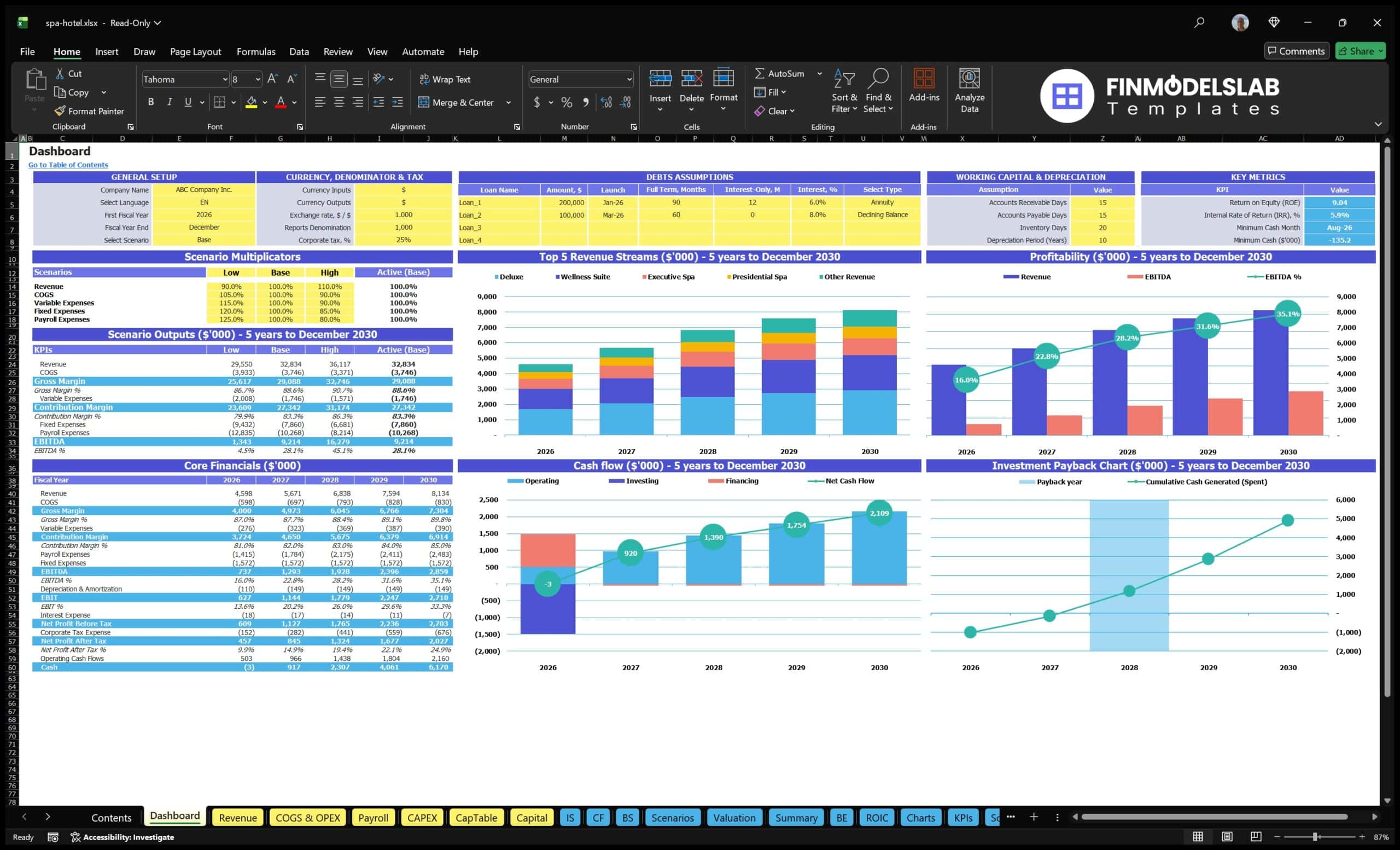
The all-in-one dashboard gives users a central view of the most important inputs and outputs in the Spa Hotel Financial Model. This component is designed to help decision-makers quickly understand how core assumptions translate into revenue, profit, cash flow, and investment performance. Inputs may include room count, occupancy rate, average daily rate, suite category mix, spa retail assumptions, event rental income, food and beverage sales, membership revenue, staffing levels, expense percentages, and capital expenditure timing. Outputs may include total revenue, EBITDA, net profit, cash balance, payback period, return metrics, funding needs, and other high-level indicators. For a spa hotel, this is especially useful because the business depends on multiple connected revenue drivers and cost centers rather than one simple sales line. The dashboard helps users avoid getting lost in the details by bringing the model’s financial story into one practical view. It is useful for founders who need to review assumptions, owners who want to monitor performance targets, consultants who need a summary for clients, and investors or lenders who want to understand the overall economics quickly. By combining core inputs and core outputs in a single section, the dashboard makes the model easier to use, easier to explain, and more effective for planning conversations.
Low Base High Scenario Analysis
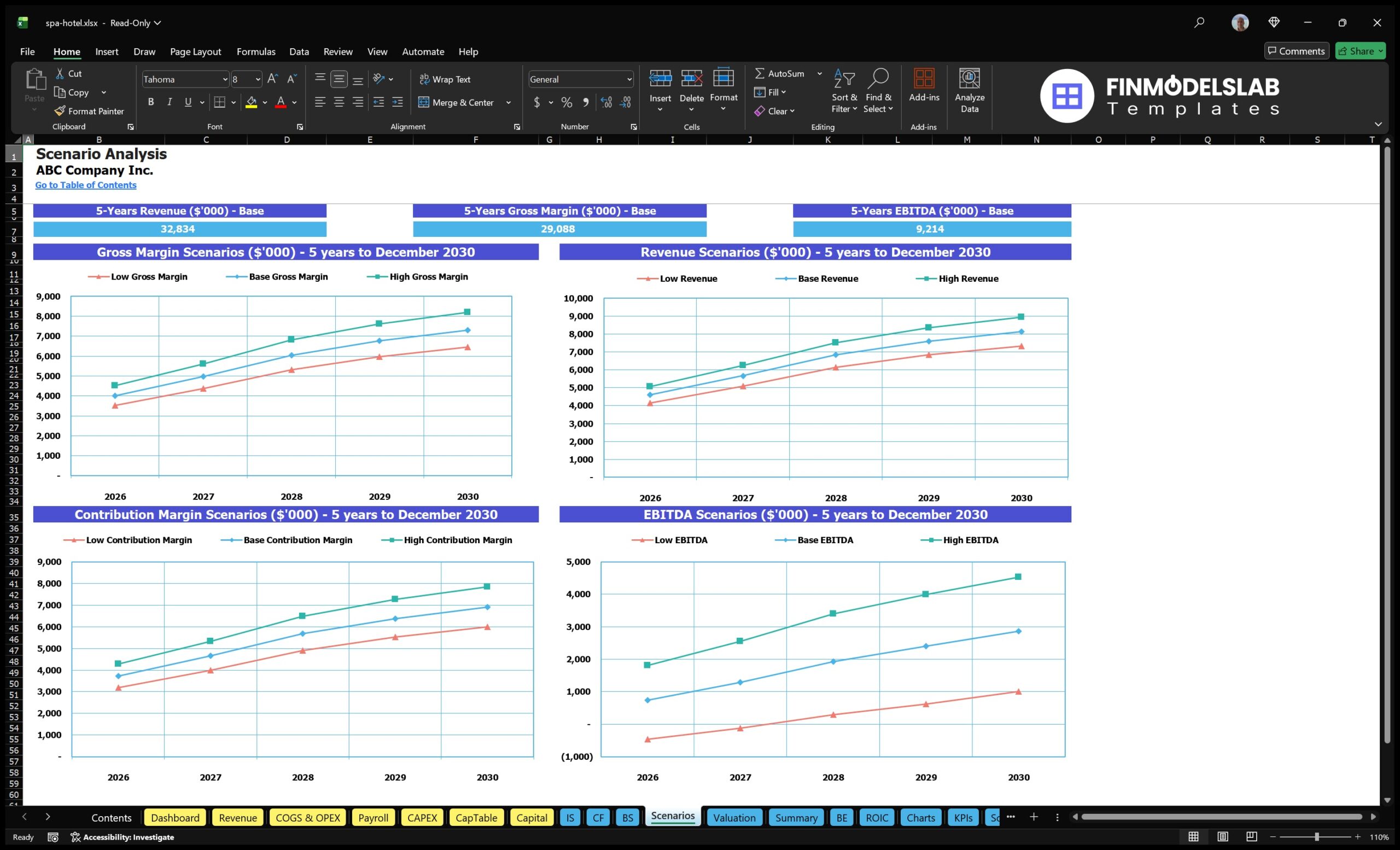
The low base high scenario analysis component allows users to test how the spa hotel performs under different operating conditions. Rather than relying on a single forecast, users can compare a conservative case, a realistic base case, and an optimistic growth case to understand the range of possible outcomes. Key assumptions that may be adjusted include occupancy rates, average daily rates, room revenue growth, spa service demand, food and beverage margins, event bookings, membership uptake, payroll levels, operating cost inflation, and capital investment timing. This component helps reveal how sensitive the business is to changes in market demand, pricing, cost control, and launch performance. For example, a lower occupancy case may show reduced cash runway and delayed profitability, while a higher average daily rate or stronger ancillary revenue case may improve EBITDA and shorten the payback period. This is valuable for business planning because hospitality and wellness demand can fluctuate due to seasonality, local competition, economic conditions, and customer travel patterns. The scenario section supports better decision-making by showing what must happen for the spa hotel to remain financially stable in a downside case and what upside may be available if the concept performs above expectations. It can also help users prepare stronger investor and lender discussions by demonstrating that the plan has been stress-tested instead of presented as a single static forecast.
Professional Charts
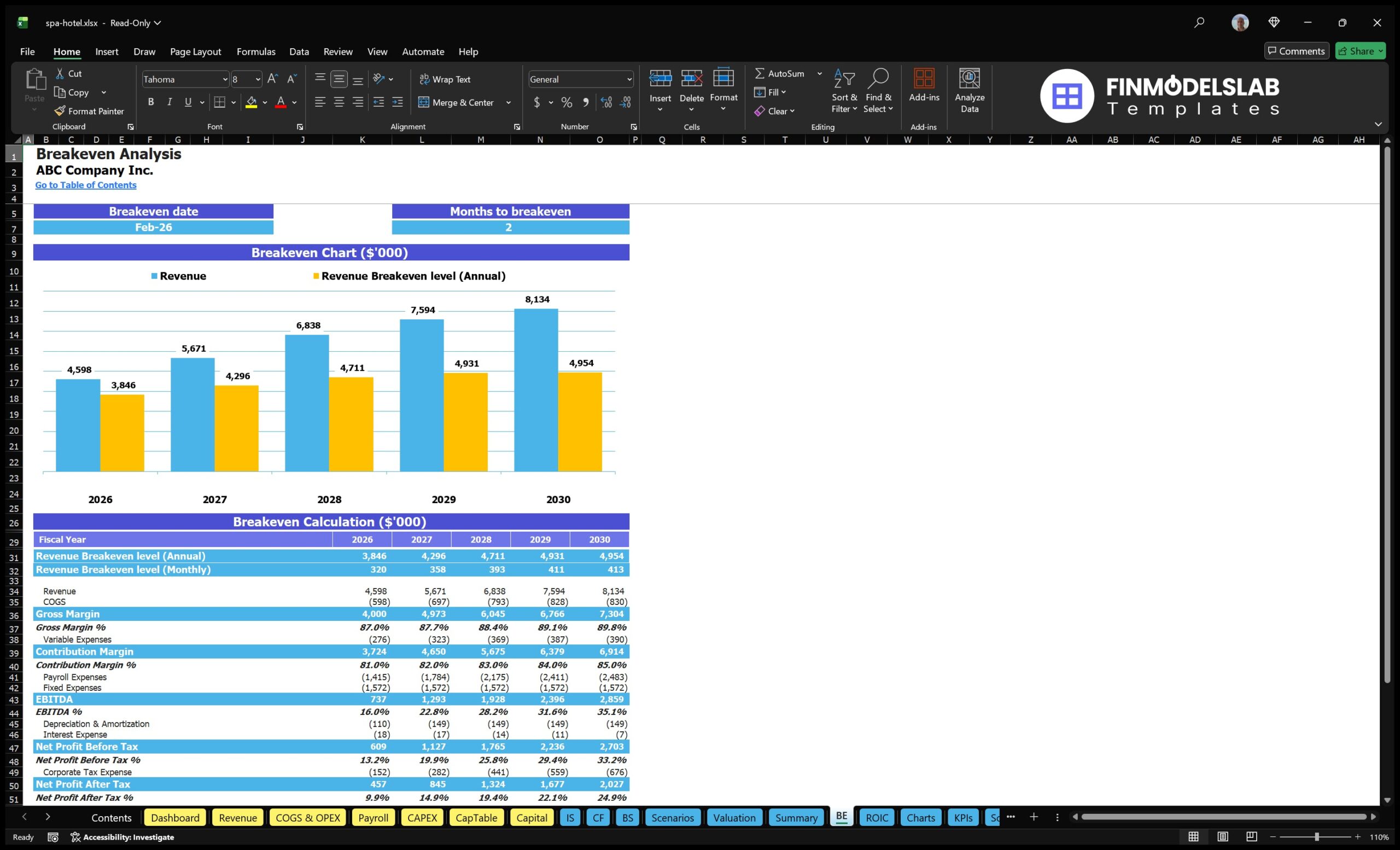
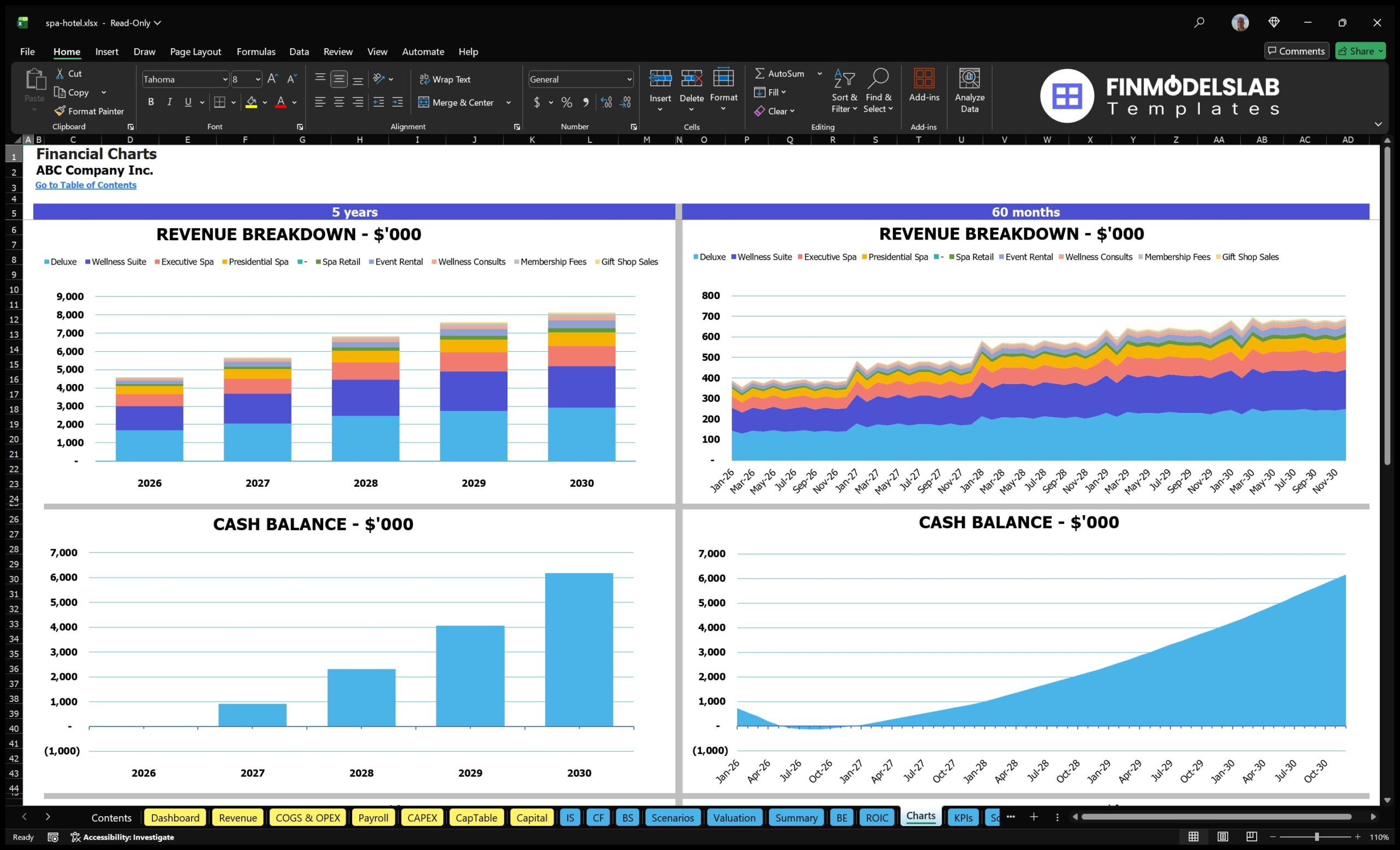
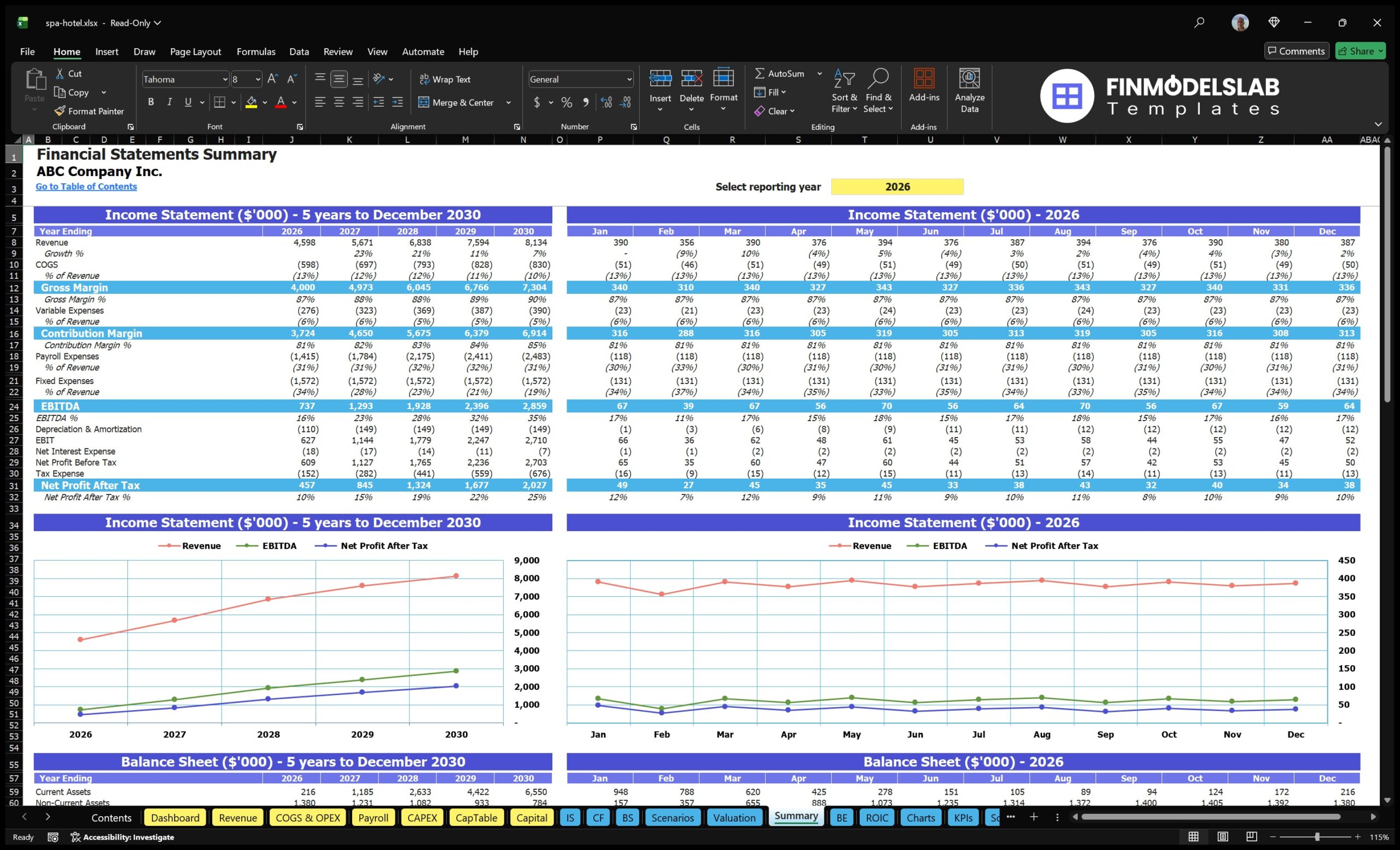
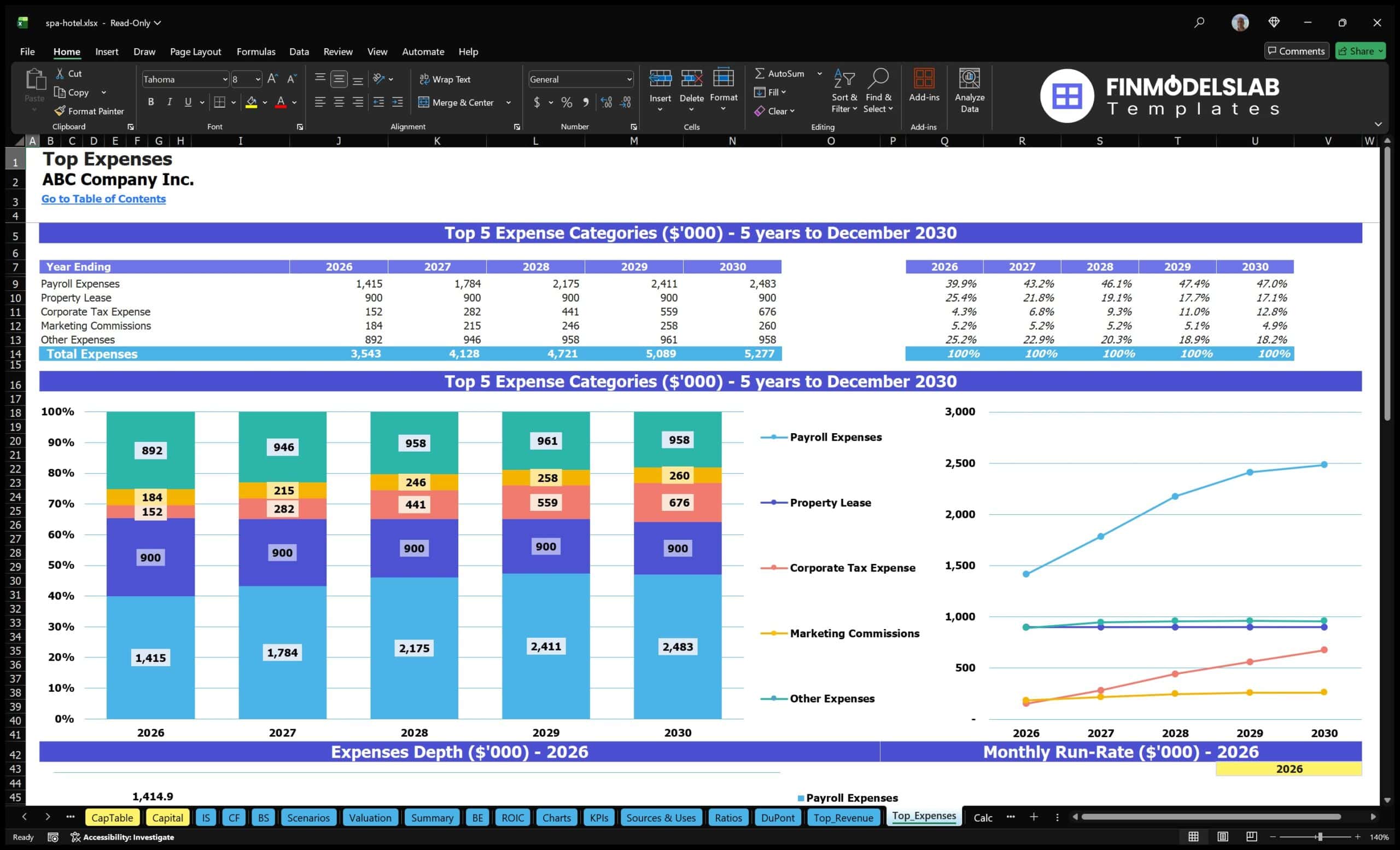
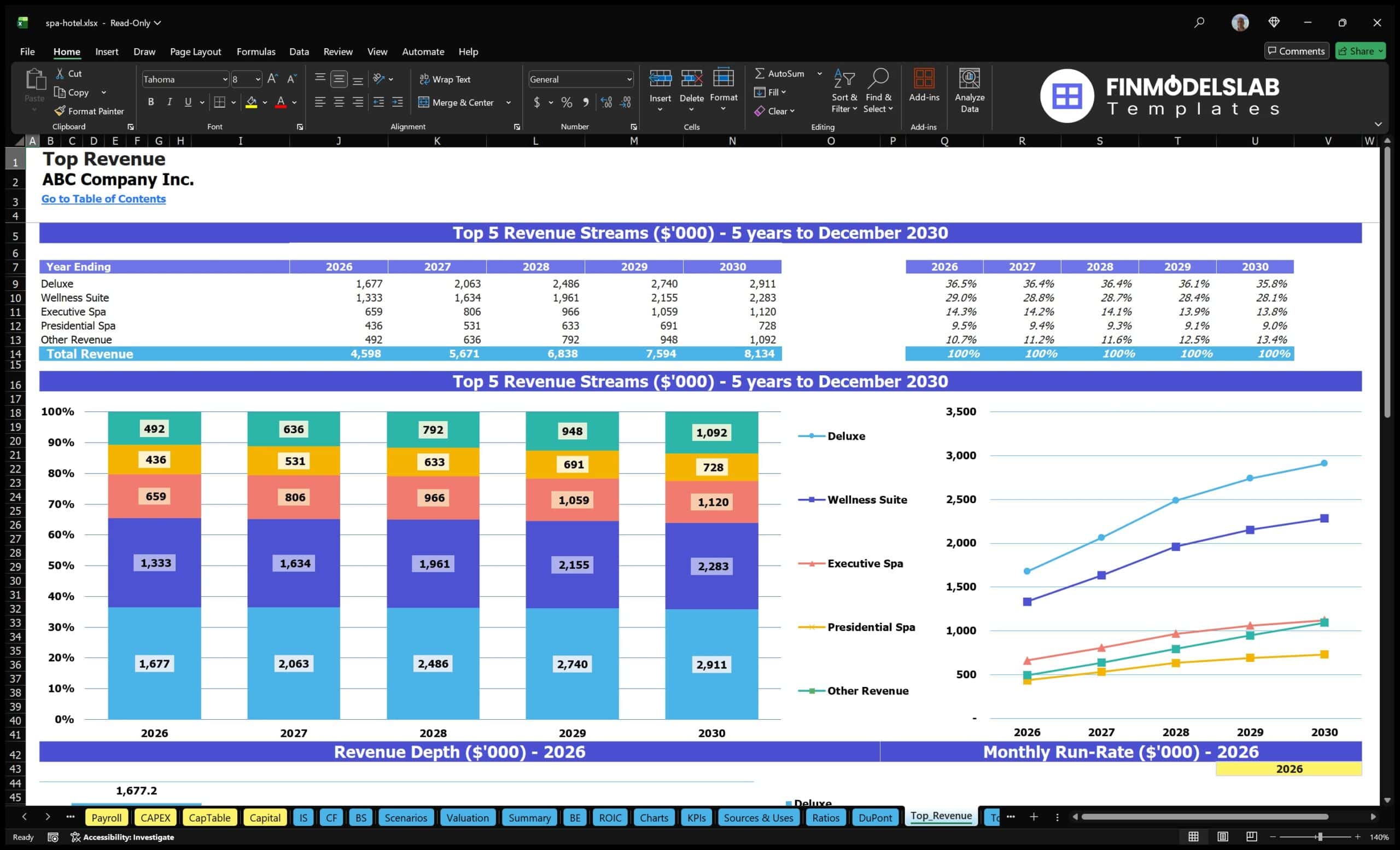
The professional charts component translates the spa hotel’s financial projections into clear visual reports that are suitable for presentations, planning meetings, and stakeholder reviews. Charts may show revenue growth, expense trends, EBITDA development, cash balance movement, profit margins, break-even timing, revenue mix, and other key outputs from the model. For users preparing a business plan or investor deck, visual summaries make it easier to communicate the forecast without requiring readers to inspect every worksheet or line item. In a spa hotel model, charts are especially helpful because the business includes several revenue streams, such as room sales, spa and wellness services, food and beverage, events, retail, and memberships. A visual breakdown can show whether the property is overly dependent on accommodation revenue or whether ancillary revenue provides meaningful margin support. Professional charts also help identify trends that may not be obvious from raw numbers, such as improving margins as occupancy rises, seasonal cash pressure, or the point at which fixed costs become easier to absorb. This component supports decision-making by allowing users to compare periods, track growth patterns, and present the financial story in a polished format. Whether used with lenders, investors, partners, advisors, or internal teams, the chart section makes the Spa Hotel Financial Model more accessible and presentation-ready.
ROE Components
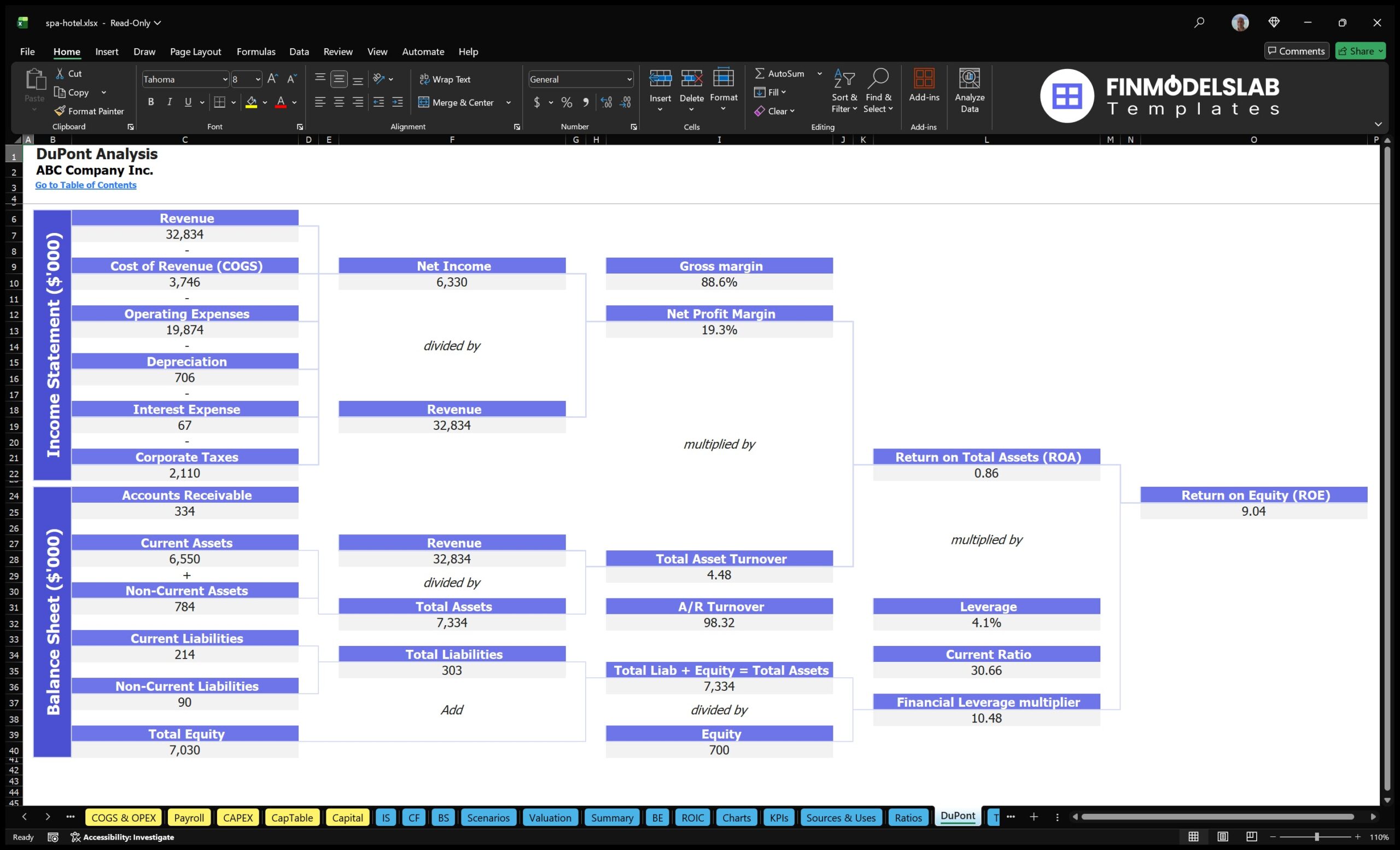
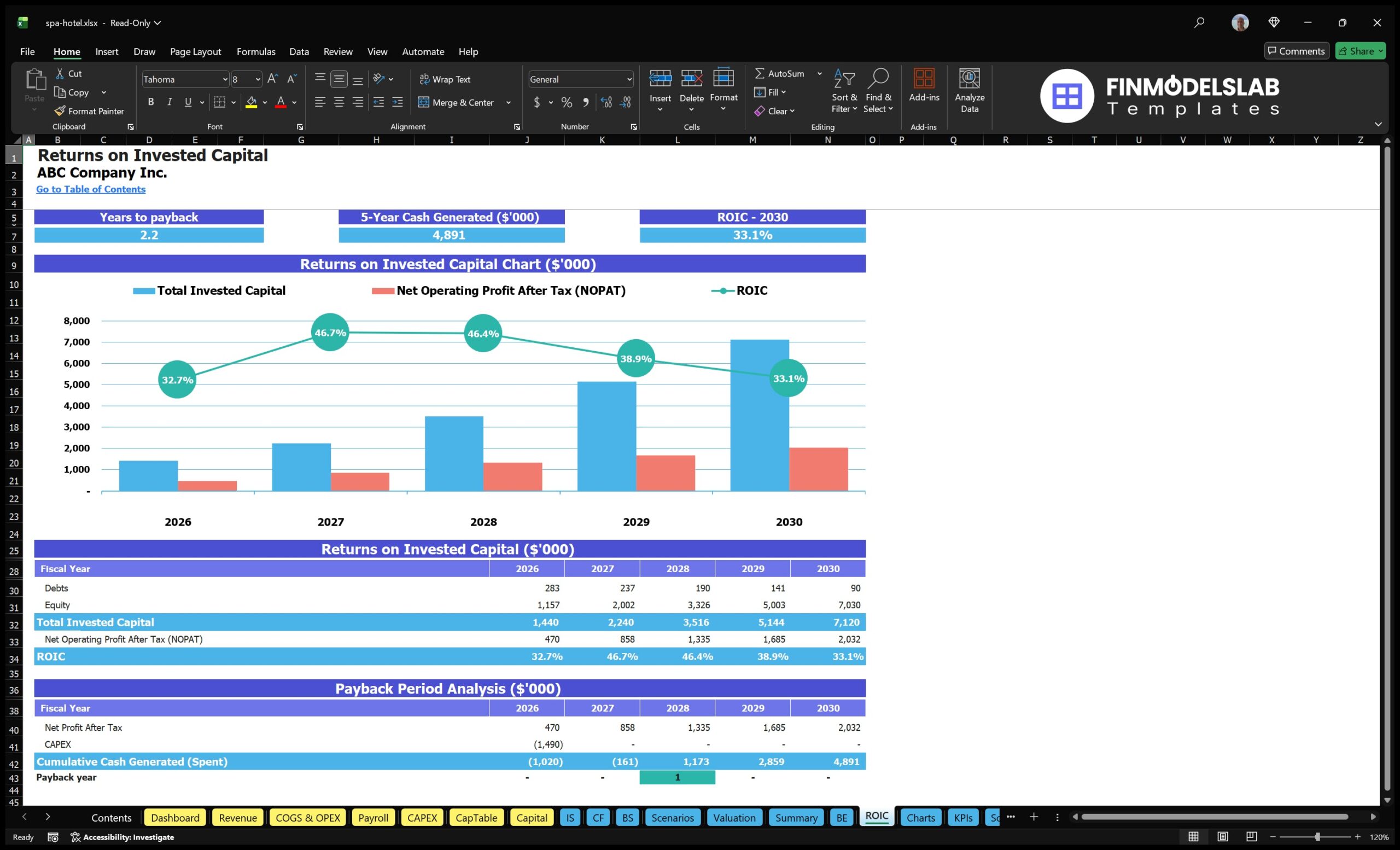
The ROE components section uses a return on equity framework to help users understand what is driving shareholder or owner returns in the spa hotel business. This type of analysis can break return on equity into underlying drivers such as profitability, asset efficiency, and financial leverage, helping users see whether returns are coming from strong margins, effective use of assets, or the capital structure of the business. Inputs may include net income, equity investment, total assets, debt financing, revenue levels, profit margins, and balance sheet assumptions. Outputs may include return on equity, supporting ratios, and a clearer view of how operational and financing decisions affect investor outcomes. For a spa hotel, this is important because major upfront capital is often required for room furnishings, spa equipment, kitchen and bar fit-out, property improvements, pre-opening costs, and working capital. Owners and investors need to understand whether that equity investment is likely to generate an acceptable return over time. The ROE component helps users examine the efficiency of the business model beyond revenue growth alone. It can support funding conversations by showing how returns may improve as occupancy stabilizes, ancillary income grows, margins improve, and fixed costs are spread across a larger revenue base. This section is useful for investment analysis, partnership planning, and evaluating whether the projected return justifies the capital committed to the spa hotel.
Revenue Inputs
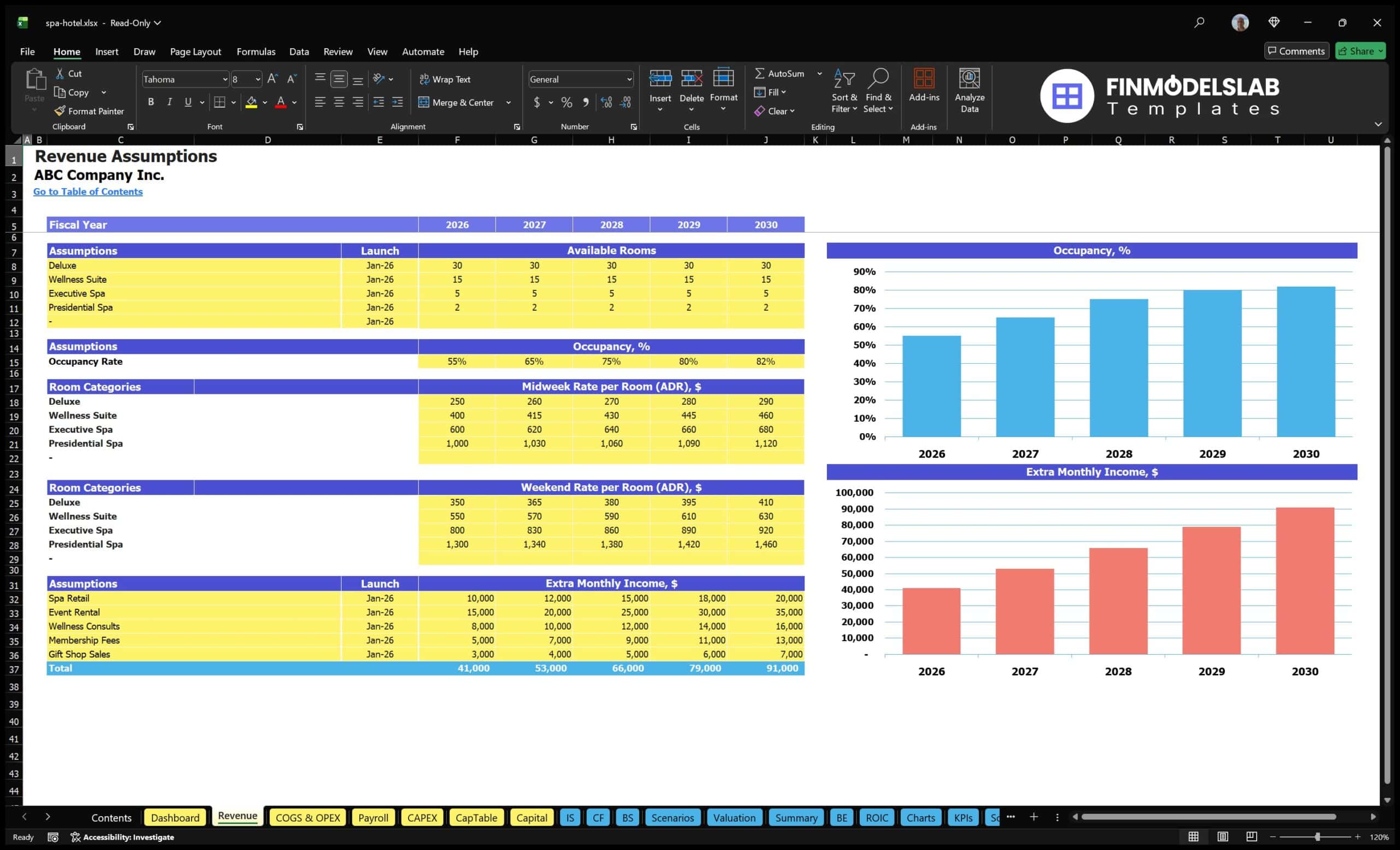
The revenue inputs component is where users define the commercial assumptions that drive the Spa Hotel Financial Model. For a spa hotel, revenue planning typically begins with room count, available room nights, occupancy rate, average daily rate, suite categories, and pricing assumptions for different accommodation types. The model may also include spa and wellness services, spa retail, food and beverage sales, event rentals, memberships, packages, and other ancillary income sources that are relevant to the property. By entering assumptions for each revenue stream, users can build a more realistic forecast than a simple top-down sales estimate. This component helps users connect strategy to numbers by showing how pricing, guest volume, capacity, and service mix affect total revenue. For example, changing occupancy growth, adjusting ADR, adding high-margin wellness packages, or increasing event bookings can flow through the forecast and affect cash flow, profitability, and investor metrics. The revenue inputs section is useful for founders preparing launch plans, hotel operators reviewing expansion opportunities, and consultants building feasibility studies because it documents the logic behind the forecast. It also helps users defend their assumptions when speaking with lenders or investors, since the model can show how revenue is built from practical operating drivers rather than unsupported projections. A clear revenue input structure is essential for decision-making because small changes in occupancy or pricing can materially affect the financial performance of a spa hotel.
Bank-Ready Reports
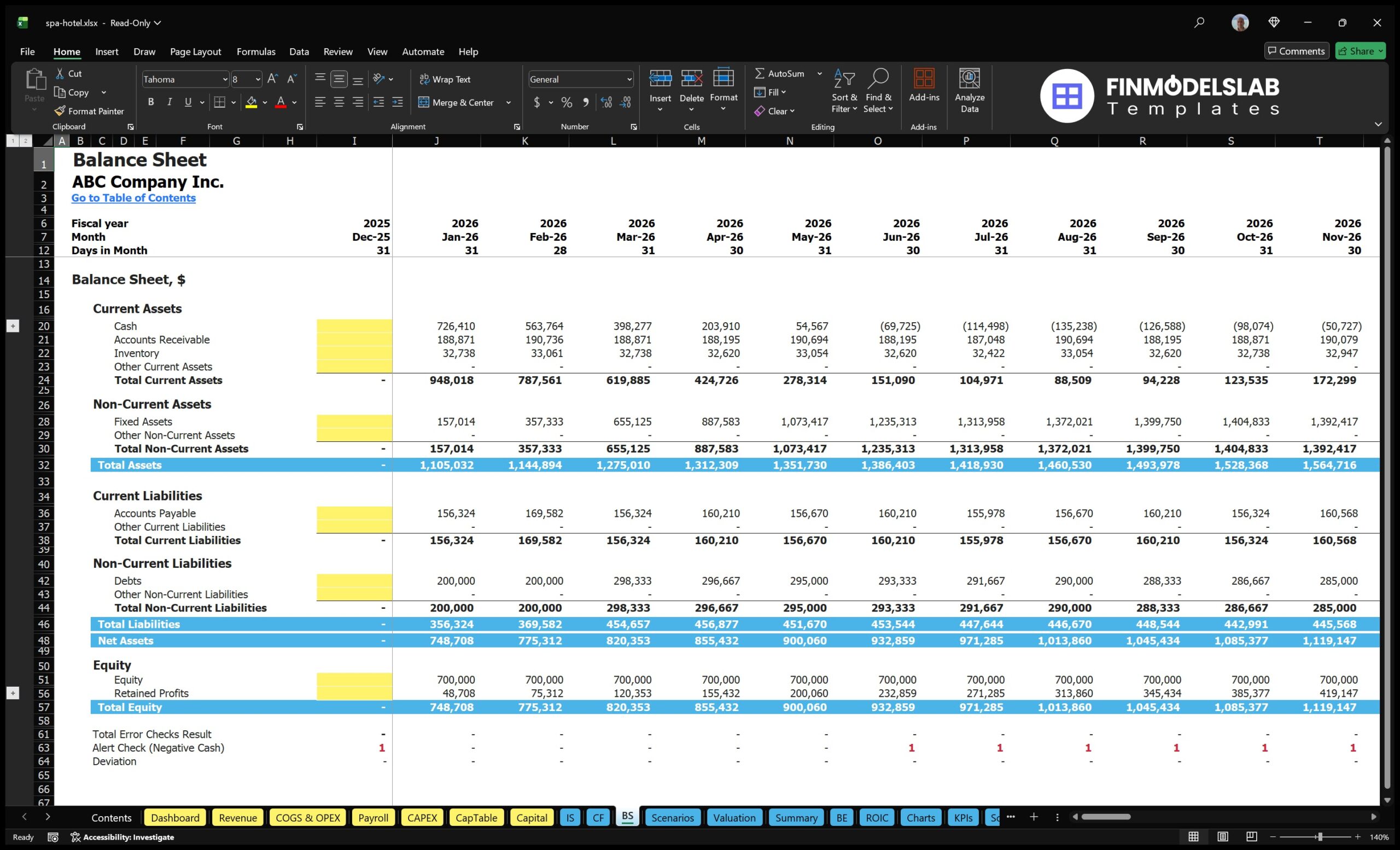
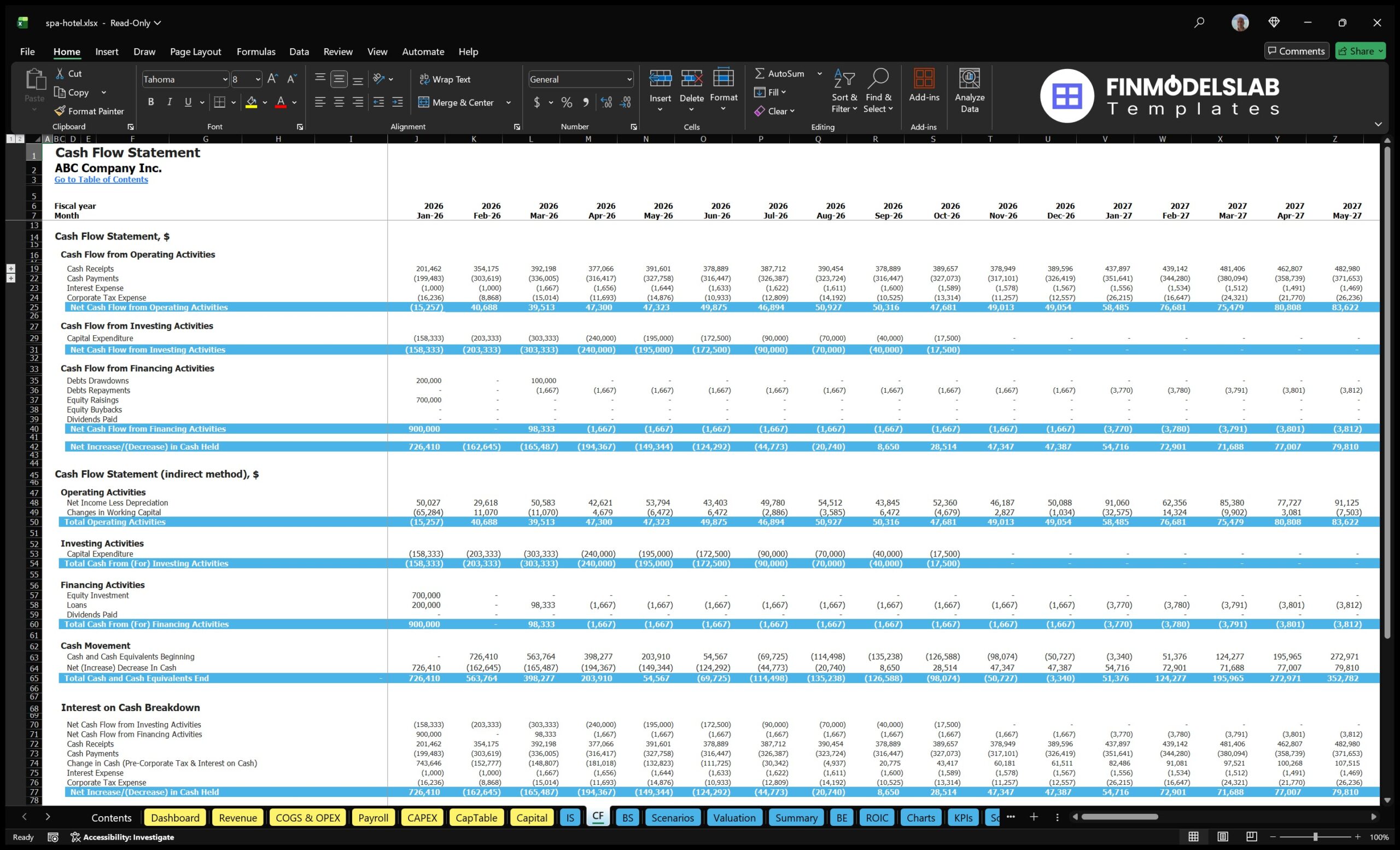
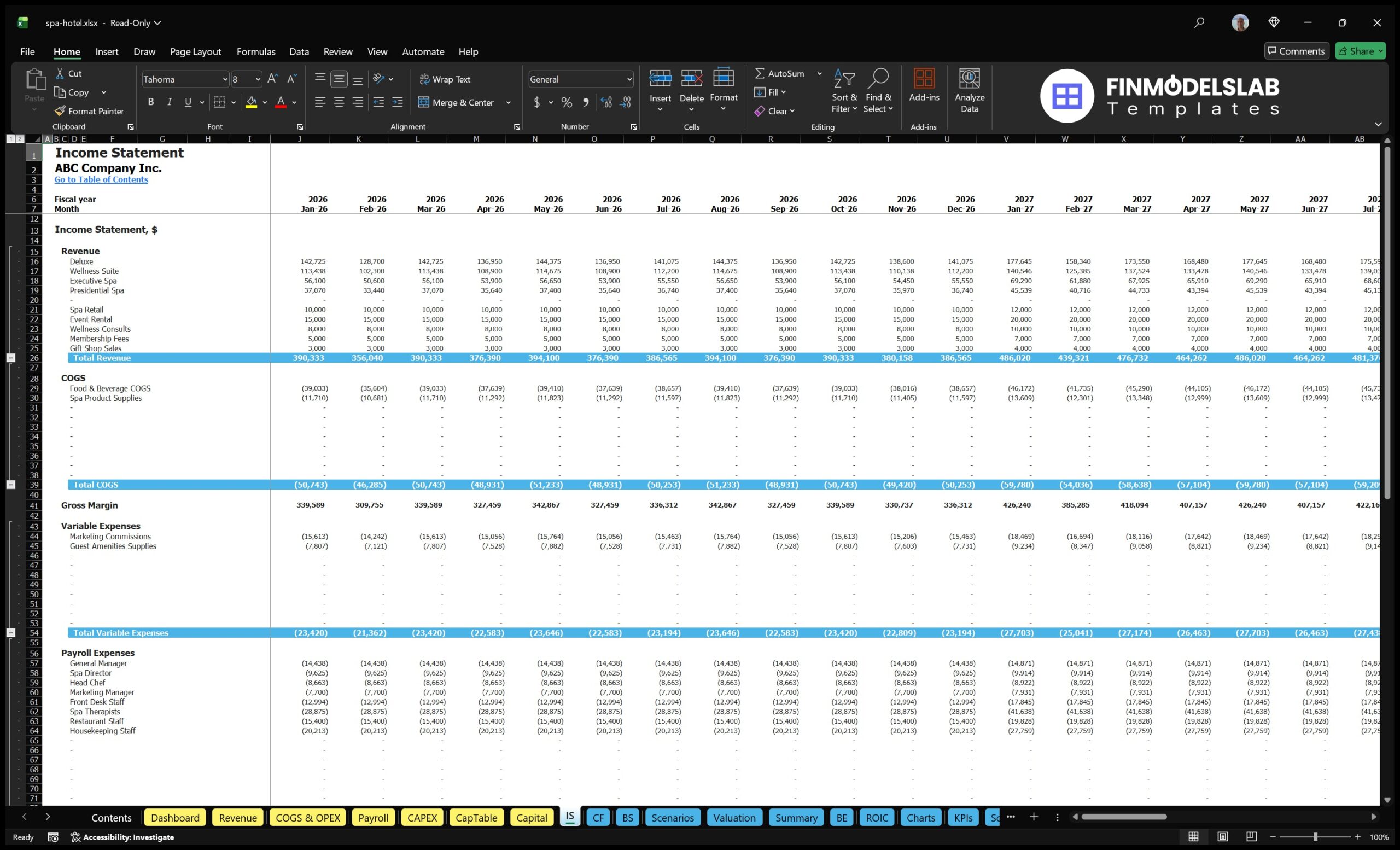
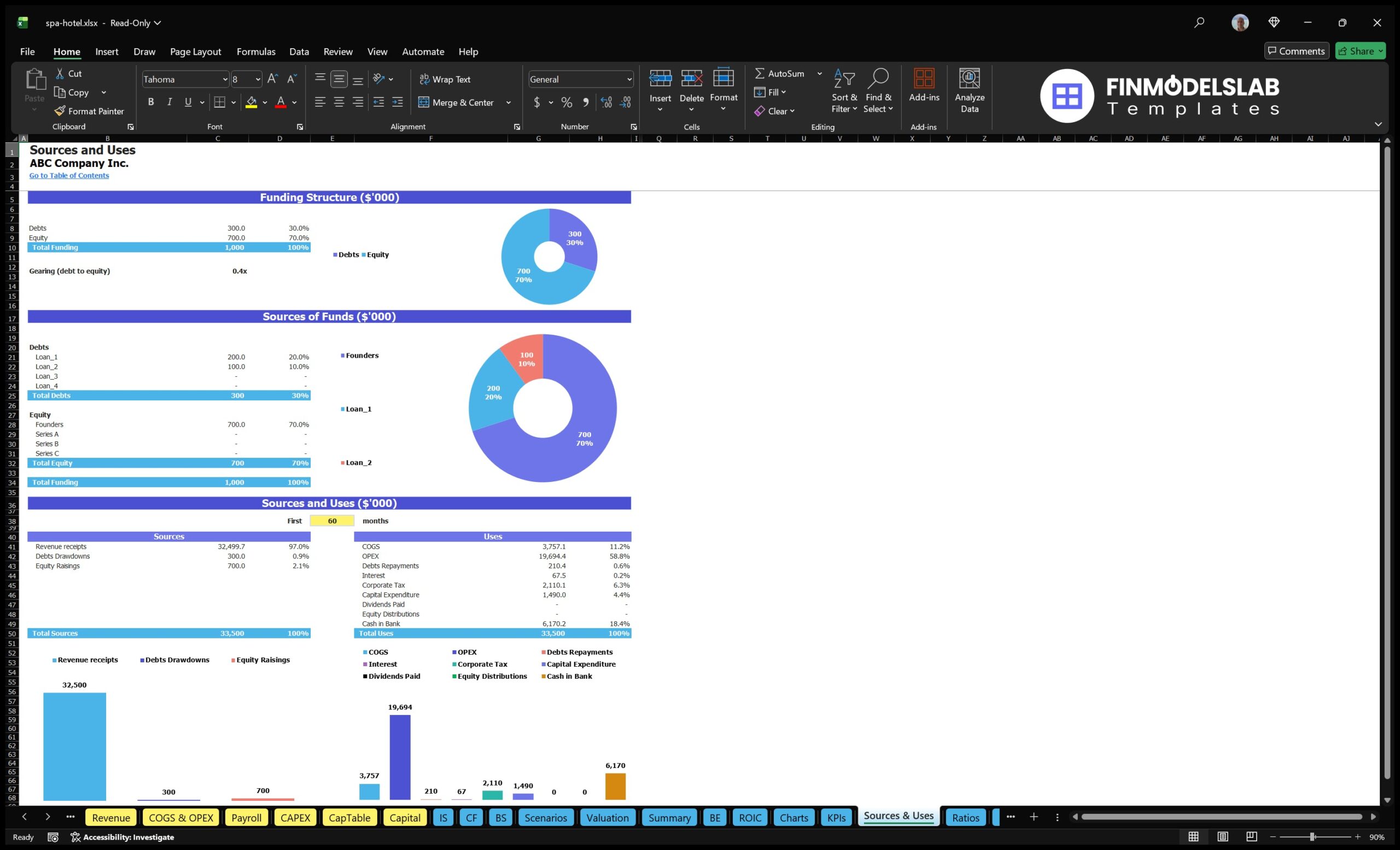
The bank-ready reports component organizes the financial outputs into a format that is easier for lenders, investors, and stakeholders to review. This section may include projected income statements, cash flow statements, balance sheet summaries, funding requirements, profitability metrics, and key assumptions in a professional structure. For a spa hotel seeking financing, lender-friendly reporting is important because banks and credit providers want to understand how the business will generate revenue, cover operating costs, service debt, maintain liquidity, and reach sustainable profitability. The reports help translate the detailed assumptions in the model into financial statements and summaries that support funding applications and business plan documents. Inputs from the revenue, expense, payroll, startup cost, capital expenditure, and financing sections are automatically reflected in the outputs, saving time and reducing the risk of inconsistent calculations. Users can review revenue growth, EBITDA, net income, cash balance, debt service capacity, and other important indicators before sharing the plan externally. This component is useful because it helps users prepare more credible financial documents and respond to common lender questions with organized numbers. It also supports internal decision-making by presenting the financial forecast in a familiar reporting format. Instead of manually creating separate statements for a loan package or investor review, users can rely on the model’s structured outputs to present the spa hotel opportunity more clearly.
Revenue Breakdown
The revenue breakdown component provides a detailed view of how total income is generated across the spa hotel’s different business lines. Rather than viewing revenue as one combined number, users can analyze room revenue, spa service income, retail sales, food and beverage revenue, event rentals, memberships, packages, and other ancillary streams separately. This detail is important because each revenue stream may have different pricing, demand patterns, margins, capacity limits, and growth potential. Room revenue may be driven by occupancy and average daily rate, while spa retail may depend on guest conversion rates, product mix, and monthly retail sales assumptions. Food and beverage may be affected by guest count, restaurant pricing, event demand, and cost of goods sold. Event rental income may fluctuate based on bookings, seasonality, and local demand. By breaking revenue into components, the model helps users identify which areas contribute most to growth and which areas may need operational attention. This section can also support strategic decisions, such as whether to invest more in wellness packages, increase room rates, expand event offerings, promote memberships, or improve spa retail merchandising. For funding and business planning, the revenue breakdown makes the forecast more transparent and easier to validate. It gives owners, consultants, and investors a clearer understanding of the business model and helps ensure that the revenue plan reflects the real economics of a spa hotel rather than a generic hospitality forecast.
KPI Dashboard
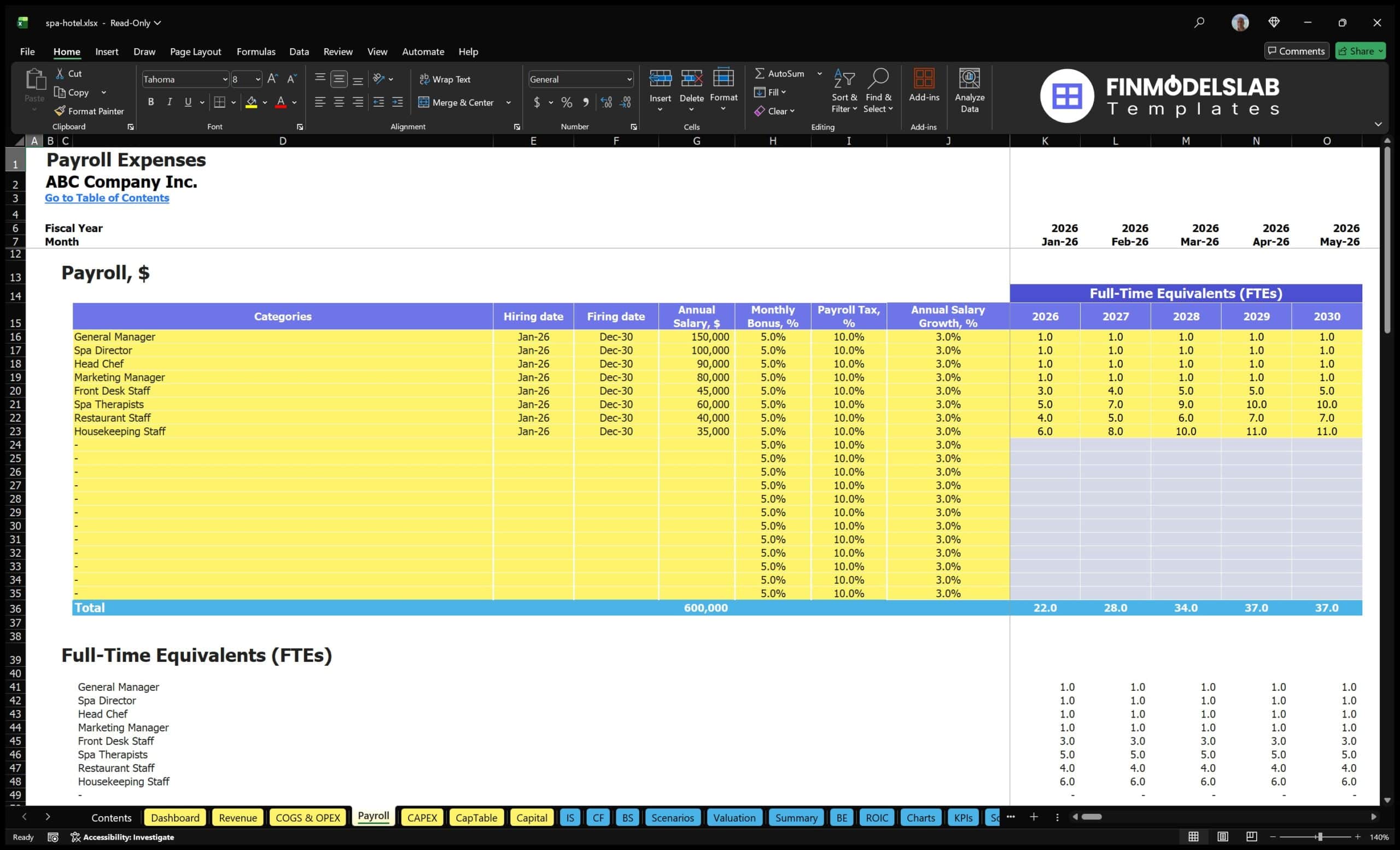
The KPI dashboard component tracks key performance indicators that are especially relevant to spa hotel planning and performance management. These may include occupancy rate, average daily rate, revenue per available room, total revenue, ancillary revenue share, EBITDA margin, net profit margin, cash balance, payroll as a percentage of revenue, cost of goods sold, return metrics, and other operating benchmarks. The purpose of this section is to help users measure the health of the business beyond the basic profit and loss statement. For a spa hotel, KPIs are essential because management needs to understand not only whether revenue is growing, but also whether growth is efficient, profitable, and sustainable. A property could increase sales while still facing pressure from payroll, supplier costs, utility expenses, maintenance, or uneven cash flow. The KPI dashboard helps users monitor the drivers that matter most and compare projected performance against realistic operating targets or industry expectations. This component is valuable for owners and managers who want to track progress after launch, as well as founders and consultants who need to present performance assumptions in a concise format. It also supports decision-making by highlighting areas that may require adjustment, such as pricing, staffing, marketing, cost control, or service mix. By placing important metrics in one accessible section, the KPI dashboard makes the Spa Hotel Financial Model more practical for both planning and ongoing management.
Startup Cost Breakdown
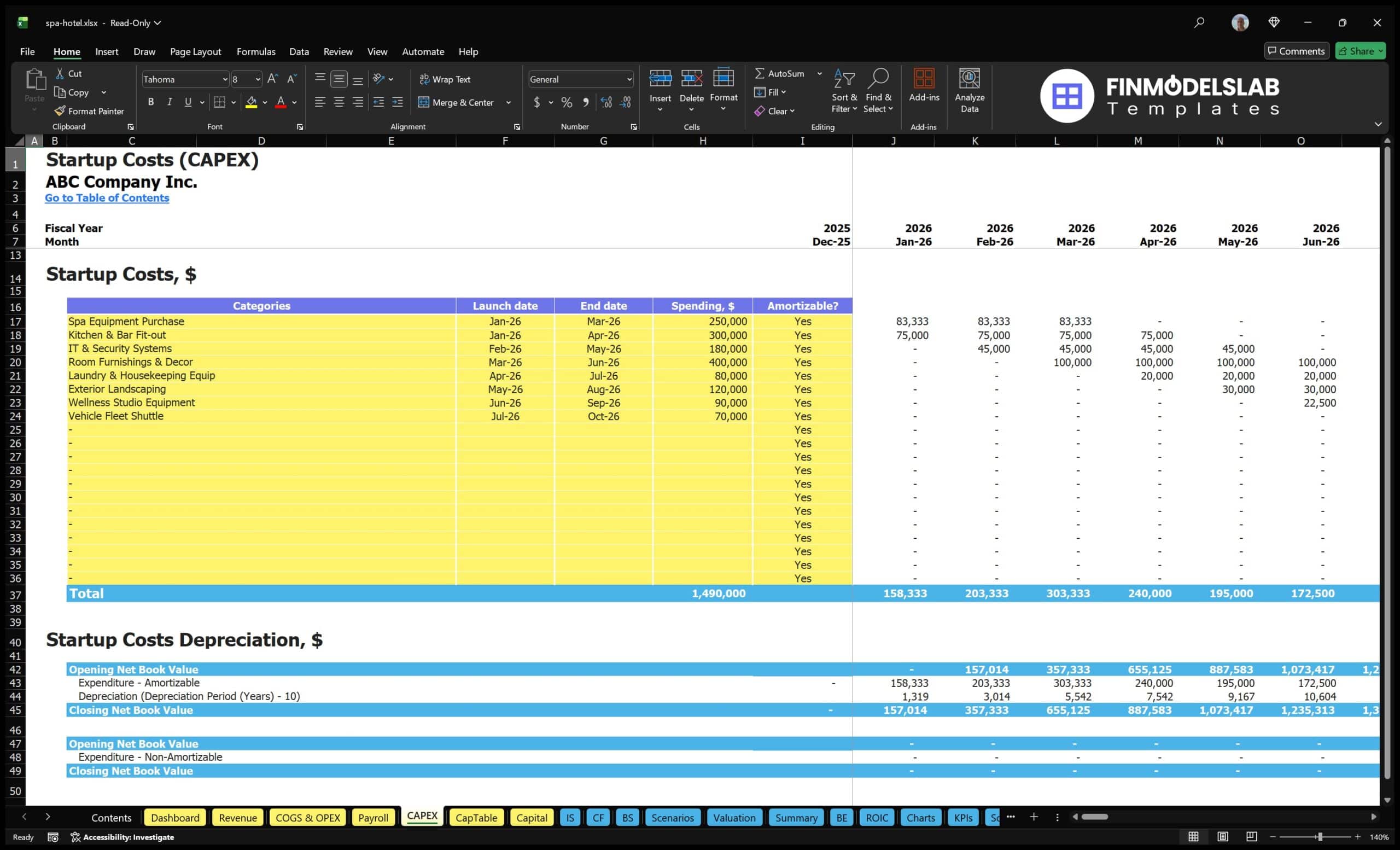
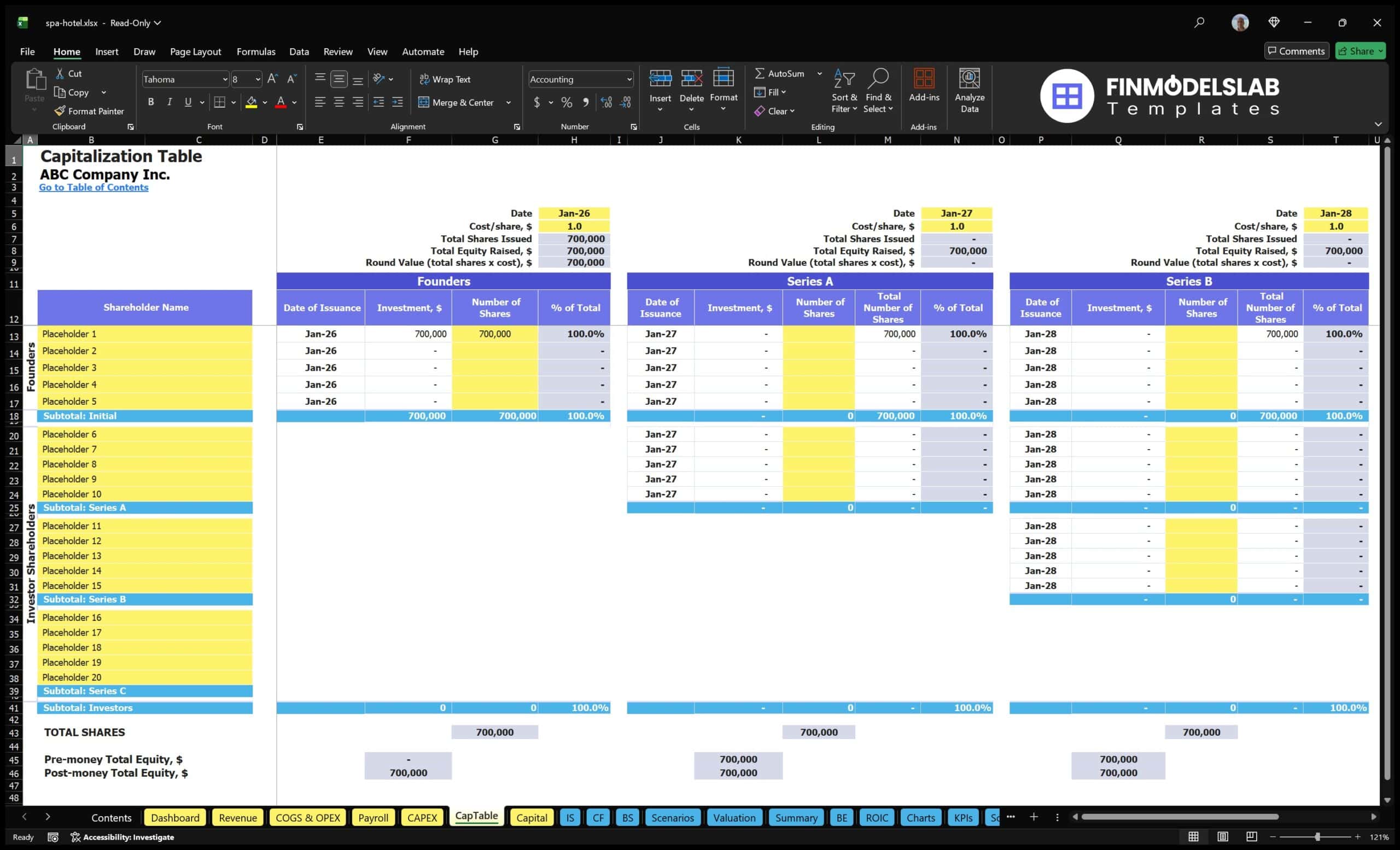
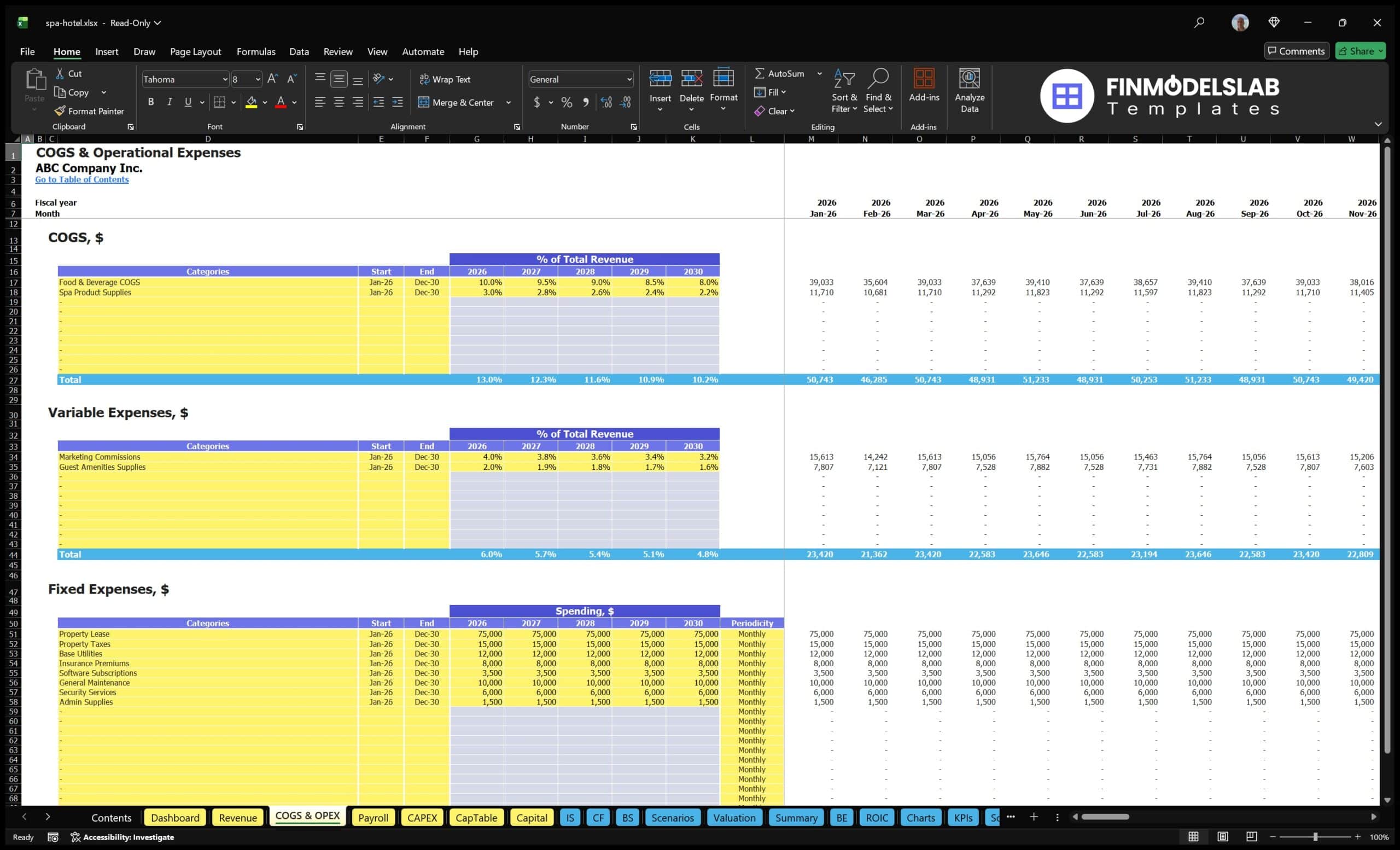
The startup cost breakdown component helps users estimate the initial investment required to launch or prepare a spa hotel for operations. A spa hotel often requires significant upfront capital before revenue begins, including room furnishings and decor, spa equipment, kitchen and bar fit-out, property improvements, deposits, licenses, technology systems, booking platforms, initial inventory, opening marketing, professional fees, staff recruitment, training, and working capital reserves. This section allows users to itemize these costs, adjust assumptions for their specific property, and understand the total funding requirement before opening. It is useful because startup costs are frequently underestimated in hospitality projects, especially when the concept includes premium guest rooms, wellness facilities, food and beverage operations, and event spaces. The component may also help users time capital expenditures across pre-opening months and early operating periods, which is important for cash flow planning. Outputs can include total capital needed, category-level cost summaries, funding gap analysis, and the impact of startup spending on cash balance and investment returns. For entrepreneurs and business owners, this section provides a realistic view of how much money must be secured before launch.
File types:
Excel – Single-User: .xlsx
Excel – Multi-User: .xlsx
Similar ProductsOther customers were also interested in...

 HenrySheykin
Boutique Hotel Financial Model Excel Template
The Boutique Hotel Financial Model Financial Model Template helps entrepreneurs, hotel owners, consu... Read more
Hotel Financial Model Excel Template
The Hotel Financial Model helps users build a structured financial forecast for a hotel business usi... Read more
Resort Financial Model Excel Template
The Resort Financial Model Financial Model Template helps resort developers, hospitality entrepreneu... Read more
Vacation Rentals Hotel Financial Model Excel Templ...
The Vacation Rental Financial Model helps users turn a short-term rental concept, property managemen... Read more
Condo Hotel Financial Model Excel Template
The Condo Hotel Financial Model helps users turn a condo hotel concept, launch plan, or investment o... Read more
Ski Resort Hotel Financial Model Excel Template
The Ski Lodge Financial Model Template helps entrepreneurs, hospitality founders, consultants, analy... Read more

Casino Hotel Financial Model Excel Template
The Casino Hotel Financial Model helps users build a structured five-year forecast for an integrated... Read more

Golf Course Financial Model Excel Template
The Golf Course Financial Model Financial Model Template helps entrepreneurs, owners, consultants, a... Read more
Eco Hotel Financial Model Excel Template
The Eco-Friendly Hotel Financial Model helps turn a sustainable hospitality concept into a structure... Read more
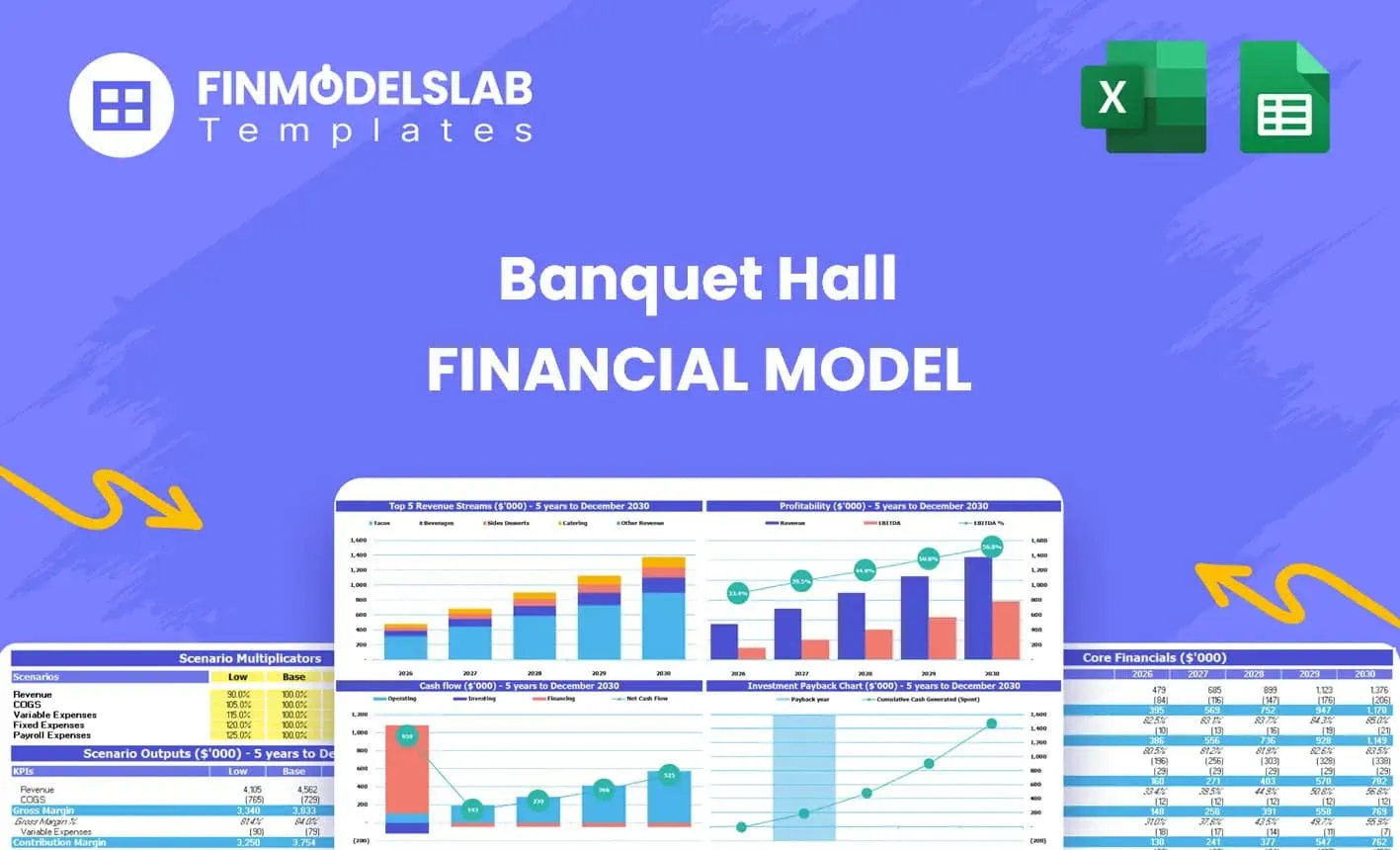
Banquet Hall Financial Model Excel Template
The Banquet Hall Financial Model helps entrepreneurs, venue owners, consultants, analysts, and busin... Read more
Reviews
You must log in to submit a review.