
0 ITEMS

Pilates Studio Financial Model Excel Template
The Pilates Studio Financial Model helps entrepreneurs, studio owners, consultants, analysts, and business plan writers turn a Pilates studio concept into a structured financial forecast. Instead of starting with a blank spreadsheet, users get a ready-to-use planning tool designed around the economics of a boutique fitness business, including class capacity, occupancy, monthly fees, reformer-based offerings, retail sales, staffing, operating expenses, startup costs, cash flow, profitability, and funding needs. The template is built to support practical financial planning before launch, during expansion, or when preparing documentation for lenders, investors, partners, or internal decision-makers. This financial model template allows users to organize revenue assumptions across different Pilates services and supporting income streams, then connect those assumptions to projected costs and financial statements. It helps estimate how many members or class spots are needed, how pricing changes may affect revenue, how payroll and instructor scheduling influence margins, and how initial investments such as reformers, studio build-out, equipment, furniture, and working capital shape the overall funding requirement. By combining revenue, startup costs, operating expenses, payroll, and profitability in one editable model, it gives users a clearer view of whether the studio can operate sustainably. The model is useful for both new Pilates studios and existing fitness businesses evaluating growth, new locations, or updated pricing strategies. Users can review monthly and annual projections, test low, base, and high scenarios, assess cash flow dynamics, evaluate break-even timing, and prepare bank-ready financial outputs. It also supports decision-making by showing how changes in occupancy rates, capacity, membership pricing, retail assumptions, cost controls, and staffing plans affect profit, liquidity, and return potential over time. Designed for Excel and Google Sheets, the Pilates Studio Financial Model is fully customizable and built for professional presentation. Editable assumptions make it adaptable to different studio sizes, local markets, pricing models, and operating strategies, while dashboards, charts, and KPI views help communicate the financial story clearly. Whether the goal is to validate a business idea, prepare a funding package, budget for launch expenses, or manage growth with more confidence, this template provides a structured framework for planning a Pilates studio with greater clarity and control.


Financial Model Overview
The Pilates Studio Financial Model is a ready-to-use financial model template built to help entrepreneurs, studio owners, consultants, analysts, and business plan writers evaluate the financial potential of a Pilates studio. It brings together the core assumptions needed to plan a boutique fitness business, including class capacity, occupancy rates, monthly pricing, retail sales, startup investment, payroll, operating expenses, cash flow, profitability, and funding needs.
For a Pilates studio, the quality of the forecast depends on understanding both capacity and utilization, because revenue is driven by how many spots can be sold, how consistently clients attend, and how pricing differs across mat classes, reformer classes, advanced sessions, and supporting sales.
This template gives users a structured way to replace guesswork with organized financial planning, making it easier to prepare investor-ready projections, lender discussions, business plans, internal budgets, and expansion decisions. The model is editable, compatible with Excel and Google Sheets, and designed to show the financial impact of key decisions over a multi-year forecast period.
All-in-One Dashboard
The all-in-one dashboard gives users a central view of the most important inputs and outputs in the Pilates Studio Financial Model. It is designed to summarize the financial performance of the studio without requiring the user to search through multiple worksheets for every key figure. Inputs may include pricing assumptions, occupancy levels, class capacity, revenue streams, staffing requirements, fixed costs, variable costs, startup investment, and financing assumptions, while outputs can include total revenue, gross margin, EBITDA, net profit, cash balance, payback timing, and return metrics.
For a Pilates studio, this is especially useful because many operating decisions are connected, such as whether a higher reformer class price can offset lower utilization, or whether adding more class capacity requires additional instructors and equipment. The dashboard helps users see those relationships quickly and makes the model easier to use in meetings with partners, lenders, investors, or management teams. It also supports ongoing decision-making by presenting financial health in a clear, practical format that can be updated as assumptions change.
Low, Base, and High Scenario Analysis
The low, base, and high scenario analysis component helps users test how the Pilates studio may perform under different business conditions. Instead of relying on a single forecast, the model allows planning around a conservative case, an expected case, and an upside case. Inputs may include different occupancy rates, membership growth assumptions, class utilization levels, pricing changes, retail sales performance, payroll intensity, marketing spend, and operating cost levels. The outputs show how each scenario affects revenue, cash flow, profit margins, EBITDA, cash balance, and overall business viability.
This is particularly valuable for a Pilates studio because performance can vary based on local demand, instructor availability, competition, seasonality, retention, and the success of pre-opening membership campaigns. Scenario analysis gives users a more realistic view of risk and opportunity, helping them prepare contingency plans, set achievable targets, and communicate a more credible financial story to stakeholders. It is also useful for funding conversations because lenders and investors often want to know whether the business can still survive if sales ramp more slowly than expected.
Professional Charts
The professional charts component turns the financial model’s calculations into visual reports that are easier to understand and present. Charts may display revenue growth, expense trends, cash flow movement, profitability, EBITDA, gross margin, net income, cash balance, occupancy rates, revenue mix, and performance over time. For a Pilates studio, visual reporting helps users explain how revenue builds from class capacity and utilization, how startup spending is recovered, and how operating leverage improves as the studio fills more class spots.
These charts are helpful for business plans, investor decks, bank meetings, internal planning sessions, and management updates because they make financial results easier to interpret than raw spreadsheet data. They also support better decision-making by highlighting trends that may not be obvious from numbers alone, such as rising labor costs, margin improvement, cash pressure during early months, or the impact of stronger retail sales. The professional chart format gives the Pilates Studio Financial Model a polished presentation style, helping users communicate financial assumptions and results clearly to both financial and non-financial audiences.
ROE Components and DuPont Analysis
The ROE components and DuPont analysis section helps users evaluate how efficiently the Pilates studio uses equity capital to generate returns. Rather than showing return on equity as a single isolated percentage, this component breaks performance into underlying drivers such as profitability, asset efficiency, and financial leverage. Inputs may include net income, revenue, total assets, equity investment, debt assumptions, and balance sheet projections, while outputs can show how margins, turnover, and capital structure combine to influence ROE.
This is useful for owners and investors because a Pilates studio may appear profitable, but the return profile depends on how much capital is tied up in reformers, build-out, leasehold improvements, furniture, technology, and working capital. DuPont analysis helps users understand whether returns are being driven by strong profit margins, efficient use of assets, or leverage. It can also highlight whether planned expansion is improving or weakening financial efficiency. For funding and investment discussions, this section adds analytical depth and helps show that the forecast considers not only revenue and profit, but also the quality of capital returns.
Revenue Inputs
The revenue inputs section is where users define the assumptions that drive sales for the Pilates studio. This may include class types, class capacity, available spots, occupancy rates, monthly fees, pricing tiers, membership assumptions, reformer class packages, mat class participation, advanced class demand, ancillary retail sales, and potential add-on services. Because Pilates studios are highly capacity-driven, this section is central to building a realistic forecast. A small change in occupancy, pricing, or available class slots can have a major impact on monthly revenue and profitability.
By organizing these assumptions in a clear input area, the template allows users to customize the model for their own market, whether they are planning a boutique mat studio, a reformer-focused concept, a premium membership model, or a hybrid studio with retail and specialty offerings. The outputs generated from these inputs feed the revenue forecast, cash flow forecast, profit and loss statement, dashboard, and scenario analysis. This makes it easier to test commercial decisions before committing to staffing, equipment purchases, marketing budgets, or lease obligations.
Bank-Ready Reports
The bank-ready reports component provides lender-friendly financial outputs that can support loan applications, funding conversations, and formal business planning. These reports may include projected profit and loss statements, cash flow forecasts, balance sheet summaries, startup cost schedules, funding requirements, break-even timing, debt service capacity, and multi-year financial projections. For a Pilates studio, banks and lenders often want to understand how much capital is needed before opening, how quickly revenue can cover monthly expenses, whether the business can maintain positive cash flow, and whether the owner’s assumptions are realistic.
This section helps present those answers in a structured and professional format. The reports are useful for showing the relationship between initial investment, operating costs, expected revenue, and repayment ability. They also help users prepare for questions about rent, payroll, instructor costs, equipment purchases, marketing spend, and cash reserves. By using bank-ready outputs, the Pilates Studio Financial Model helps users present a more credible funding case and reduces the time required to assemble financial documents from separate spreadsheets.
Revenue Breakdown
The revenue breakdown section gives users a detailed view of how total studio revenue is generated across multiple income streams. Instead of showing one combined sales figure, this component separates revenue by source, such as foundational mat work classes, intermediate reformer classes, advanced reformer classes, memberships, private or semi-private sessions, retail sales of apparel and gear, workshops, and other add-on offerings if customized by the user.
Inputs may include pricing, number of spots, occupancy rates, number of classes, client volume, purchase frequency, and average transaction values. Outputs help users understand which revenue streams contribute the most to sales, which services have the strongest growth potential, and where pricing or capacity changes may produce the greatest financial impact. This is important for Pilates studio planning because a diversified revenue mix can reduce reliance on a single offering and improve overall profitability. The revenue breakdown also helps with marketing strategy, staffing decisions, equipment planning, and investor communication by showing how the studio expects to earn money in a detailed and transparent way.
KPI Dashboard
The KPI dashboard tracks the operating and financial metrics that matter most for a Pilates studio. Key performance indicators may include occupancy rate, revenue per client, revenue per class spot, gross margin, net profit margin, EBITDA margin, cash balance, payroll as a percentage of revenue, customer volume, class capacity utilization, break-even progress, and return metrics. The purpose of this component is to help users monitor whether the business is performing in line with its plan and to identify areas that need management attention.
For example, if revenue is growing but payroll is increasing faster than sales, the KPI dashboard can help highlight margin pressure. If occupancy is below expectations, the user can revisit pricing, marketing, class scheduling, or membership offers. If cash balance is declining, the owner can review expenses, timing of payments, or working capital requirements. The KPI dashboard is also useful for comparing projected performance against industry benchmarks and internal targets. For owners, lenders, and investors, it provides a concise performance snapshot that supports faster and more informed decision-making.
Startup Cost Breakdown
The startup cost breakdown component helps users estimate the initial investment required to launch or expand a Pilates studio. It may include reformers, towers, chairs, mats, small equipment, studio build-out, flooring, mirrors, lighting, sound systems, reception furniture, office equipment, deposits, permits, licenses, technology setup, website development, pre-opening marketing, professional fees, insurance, inventory, and initial working capital. These inputs generate a clearer view of how much funding is needed before the studio begins generating revenue.
This is especially important for Pilates studios because equipment and build-out costs can be substantial, and underestimating launch expenses can create cash pressure before the business has had time to build a stable client base. The startup cost section supports budgeting, funding requests, investor discussions, and owner planning by separating one-time setup costs from ongoing operating expenses. It also helps users compare different launch strategies, such as opening with fewer reformers, delaying certain upgrades, negotiating tenant improvements, or allocating more capital to marketing and member acquisition. A clear startup cost breakdown makes the overall business plan more realistic and easier to defend.
Break-Even Analysis
The break-even analysis component helps users estimate when the Pilates studio’s revenue will cover its fixed and variable costs. Inputs may include monthly rent, payroll, instructor costs, marketing, utilities, software, insurance, equipment-related costs, pricing, occupancy, class capacity, and variable costs tied to service delivery or retail sales. Outputs may show the break-even month, required monthly revenue, required number of members or class spots, margin of safety, and the effect of different assumptions on profitability timing.
For a Pilates studio, break-even analysis is one of the most important planning tools because it connects pricing, utilization, and cost structure in a simple decision-making framework. It helps users answer practical questions such as how many memberships are needed to cover rent and payroll, how much occupancy must improve to reach profit targets, or whether a new class type can support its instructor cost. This component is valuable for lenders and investors because it shows the path to sustainability, and it is equally useful for owners who need to set sales goals, manage cash reserves, and make confident launch or expansion decisions.
File types:
Excel – Single-User: .xlsx
Excel – Multi-User: .xlsx
Similar ProductsOther customers were also interested in...


 HenrySheykin
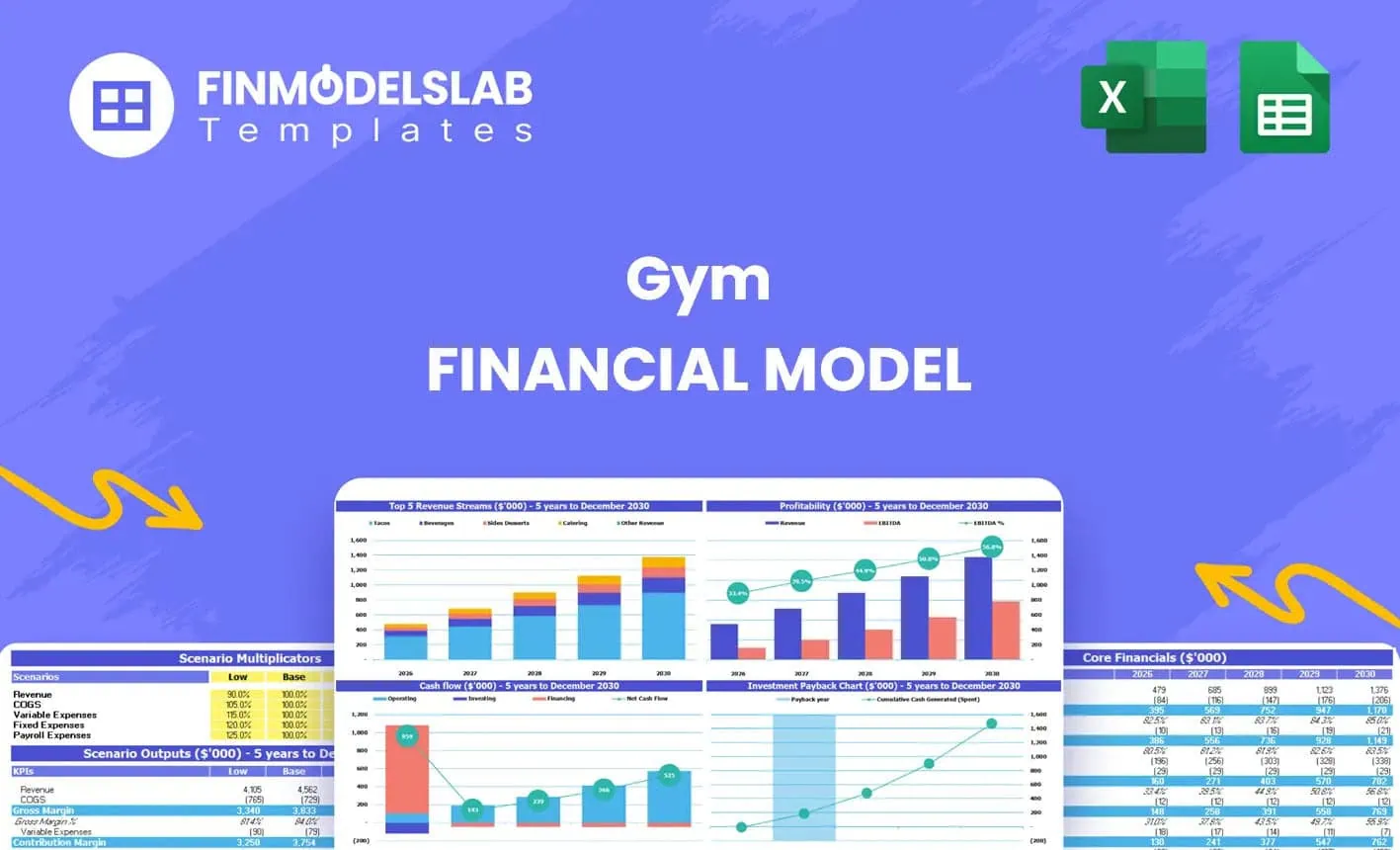
Gym Financial Model Excel Template
The Gym Financial Model Financial Model Template helps entrepreneurs, gym owners, consultants, analy... Read more
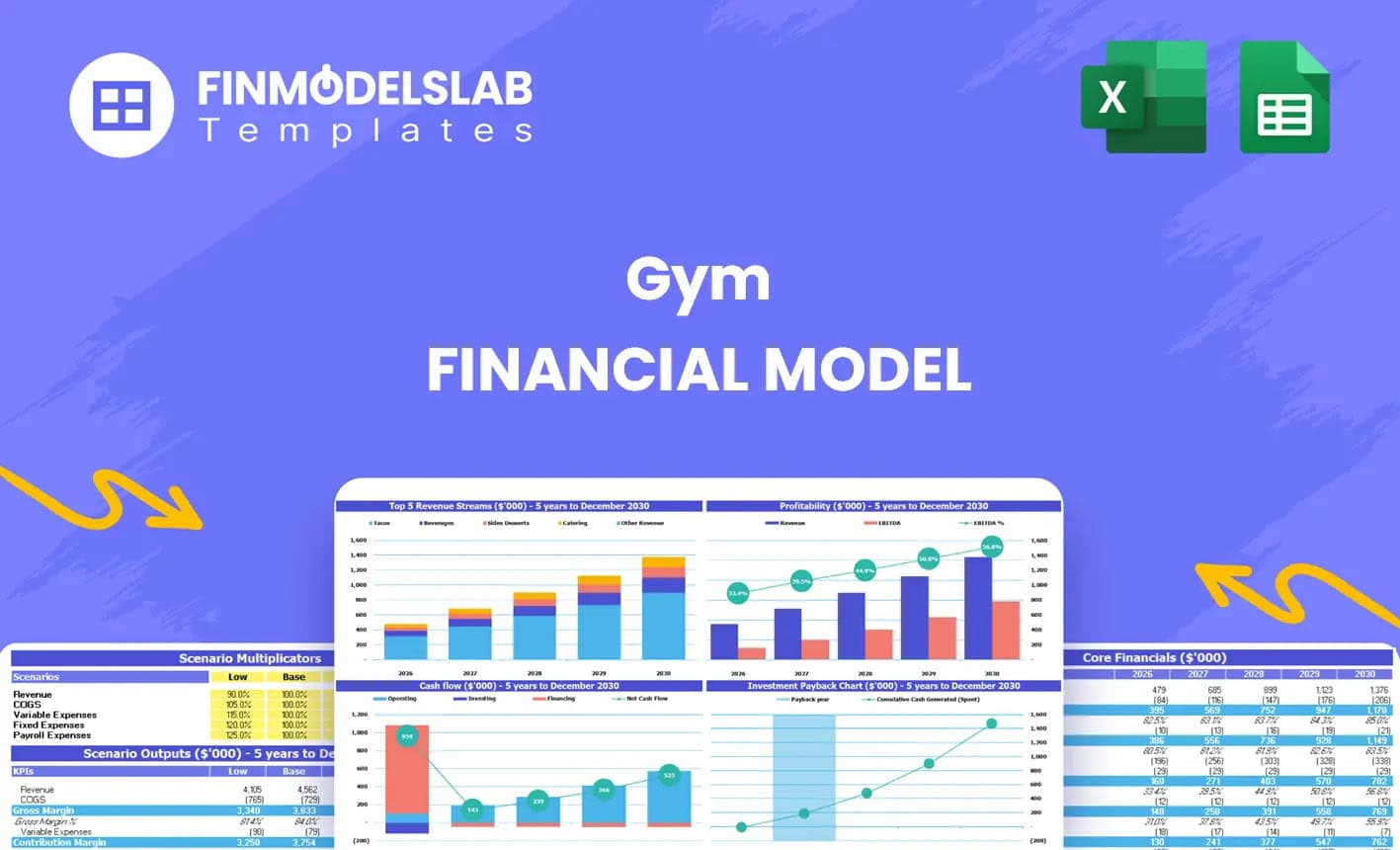
Physical Fitness Gym Financial Model Excel Templat...
The Gym Financial Model Template helps entrepreneurs, gym owners, consultants, analysts, and busines... Read more
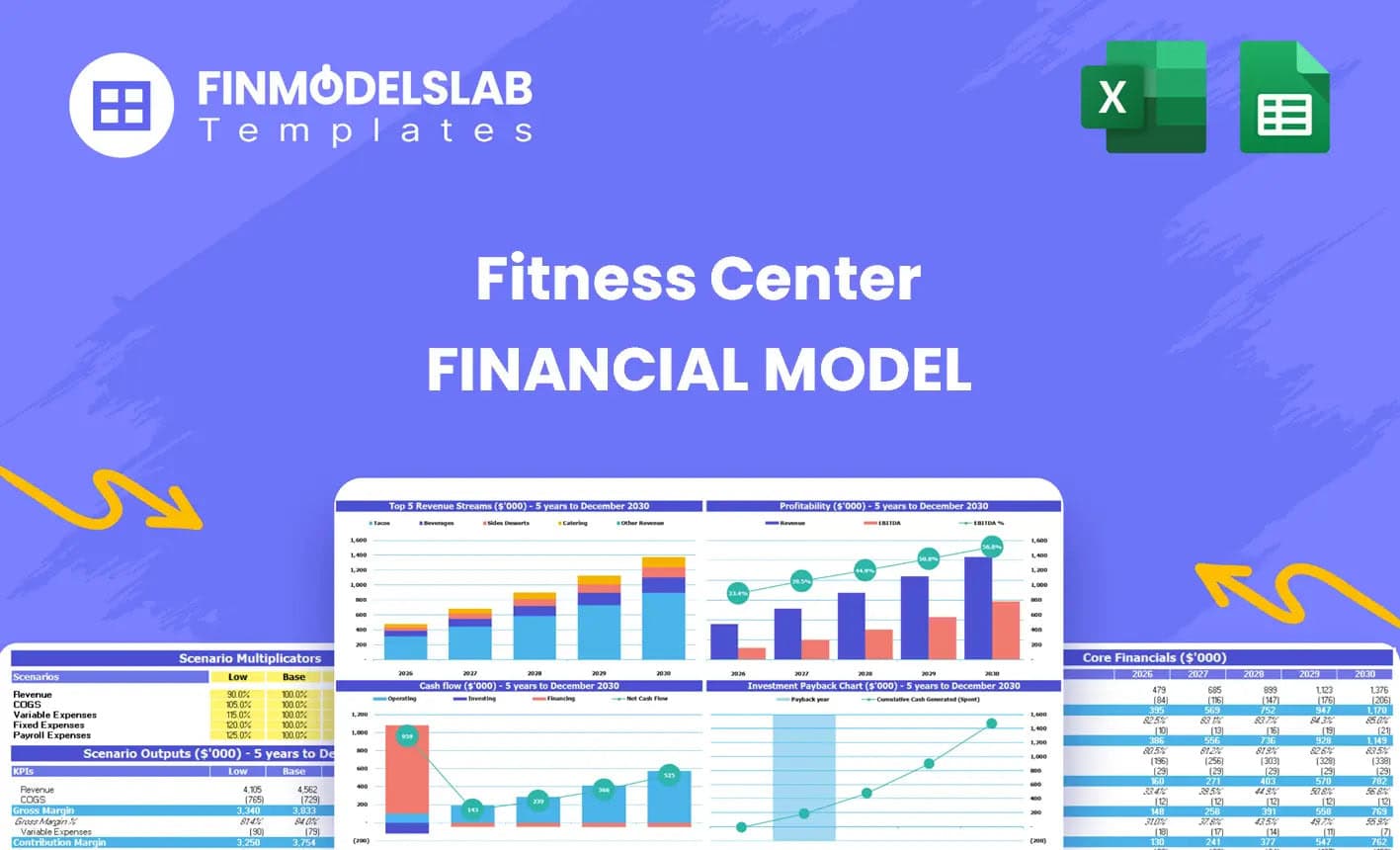
Fitness Center Financial Model Excel Template
The Fitness Center Financial Model Template helps entrepreneurs, gym owners, consultants, analysts, ... Read more

Personal Training Service Financial Model Excel Te...
The Personal Training Financial Model helps entrepreneurs, fitness studio owners, consultants, analy... Read more

Personal Training Financial Model Excel Template
The Personal Training Financial Model helps entrepreneurs, fitness studio owners, consultants, analy... Read more
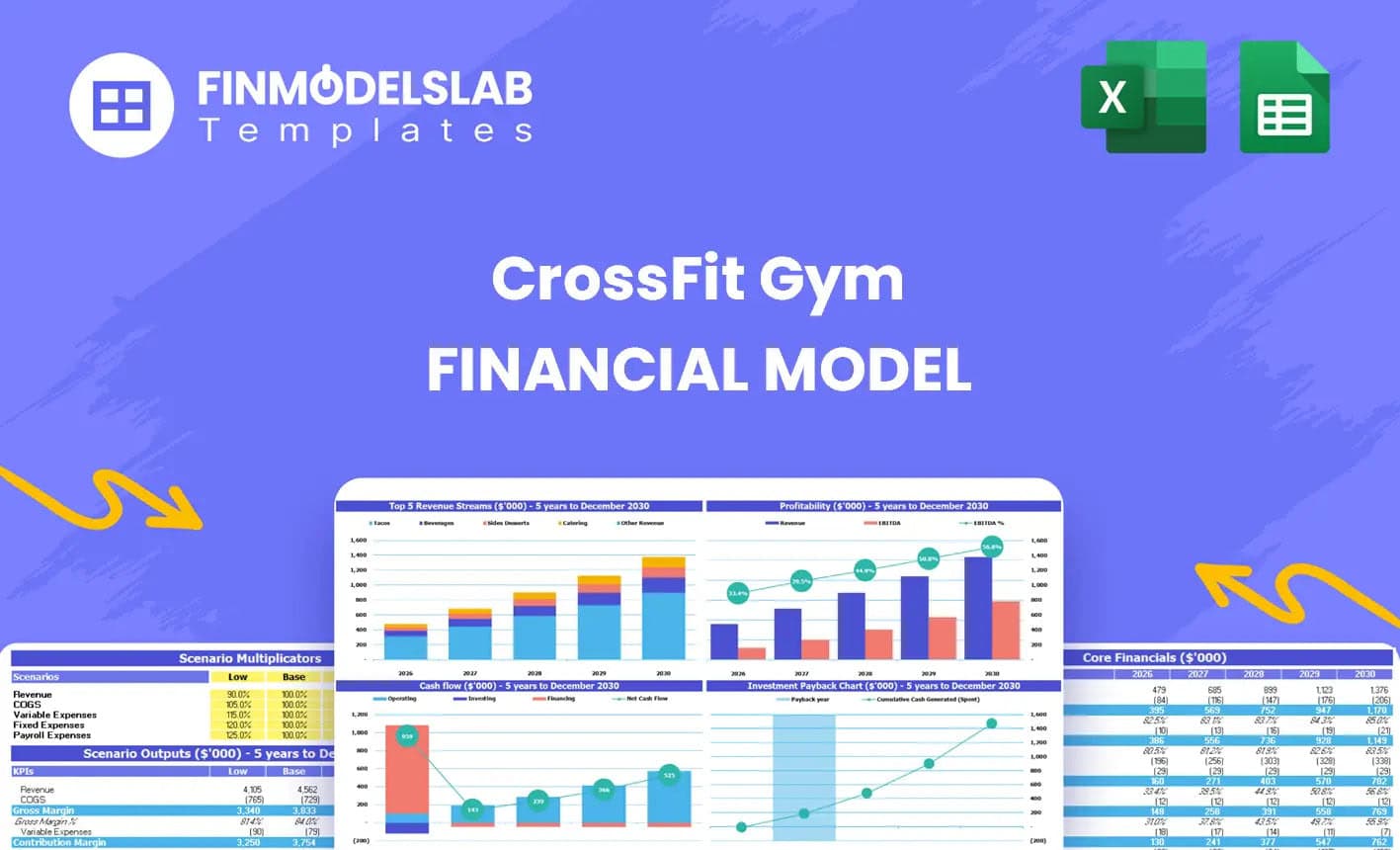
Crossfit Gym Financial Model Excel Template
The CrossFit Gym Financial Model helps founders, gym owners, consultants, and analysts turn a fitnes... Read more

 Giorgos
Pilates & Yoga Studio Financial Model – 5 Ye...
Financial Model provides an advanced 5-year financial plan for a startup or operating Pilates & ... Read more

 anthony
Racket Sports Financial Model Bundle
This bundle of financial model templates tailored to racket sports businesses aims to provide a soph... Read more

Multi Sports Complex Financial Model – Dynam...
Financial Model presenting a development and operating scenario of an Indoor Multi-Sports & Fitn... Read more
You must log in to submit a review.