
0 ITEMS

Invoice Factoring Company Financial Model: Freight, Trucking and Staffing Factoring, Receivables Finance, Borrowing Base Credit Line, US and Canada
Monthly Excel model of an invoice factoring company. Six client segments with advance rates, tiered fees, recourse and losses; a borrowing-base credit line; equity needs; three statements; IRR and ROE. US and Canada presets.
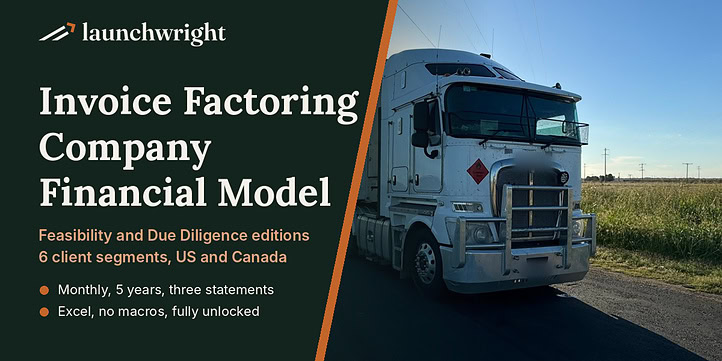
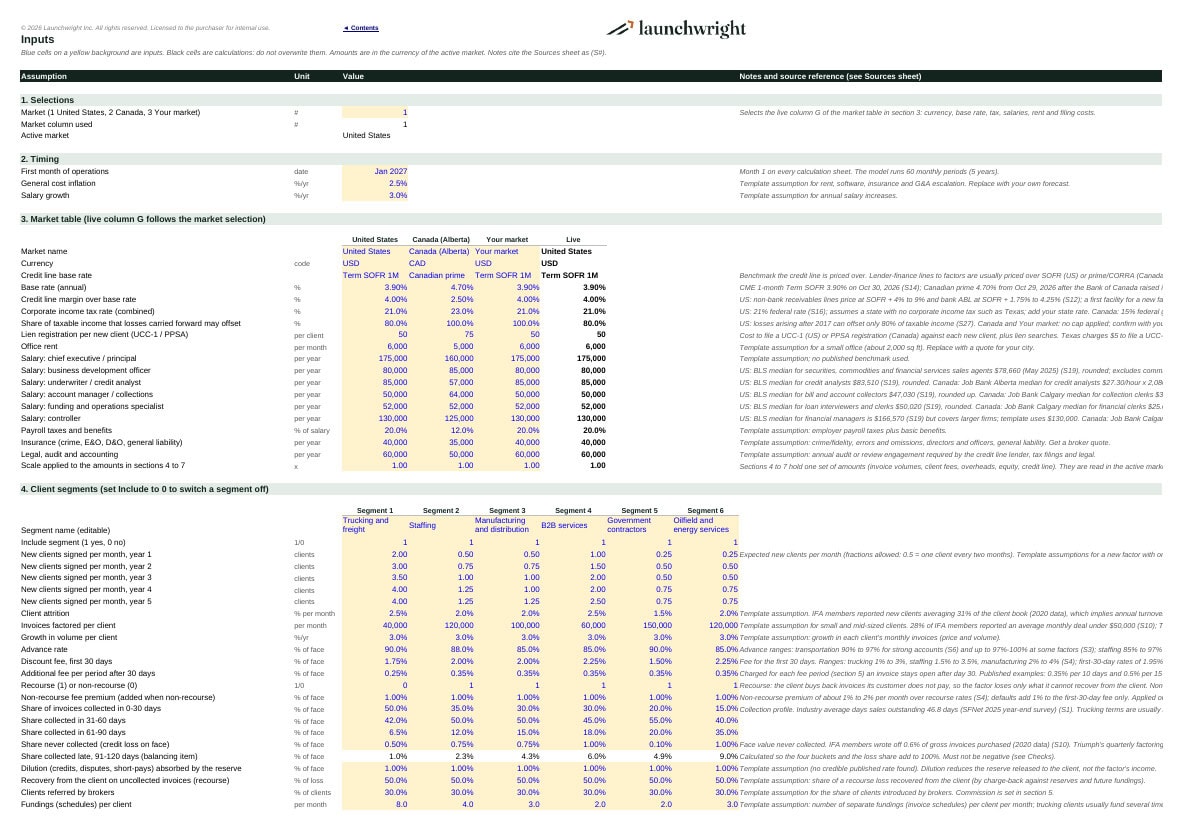
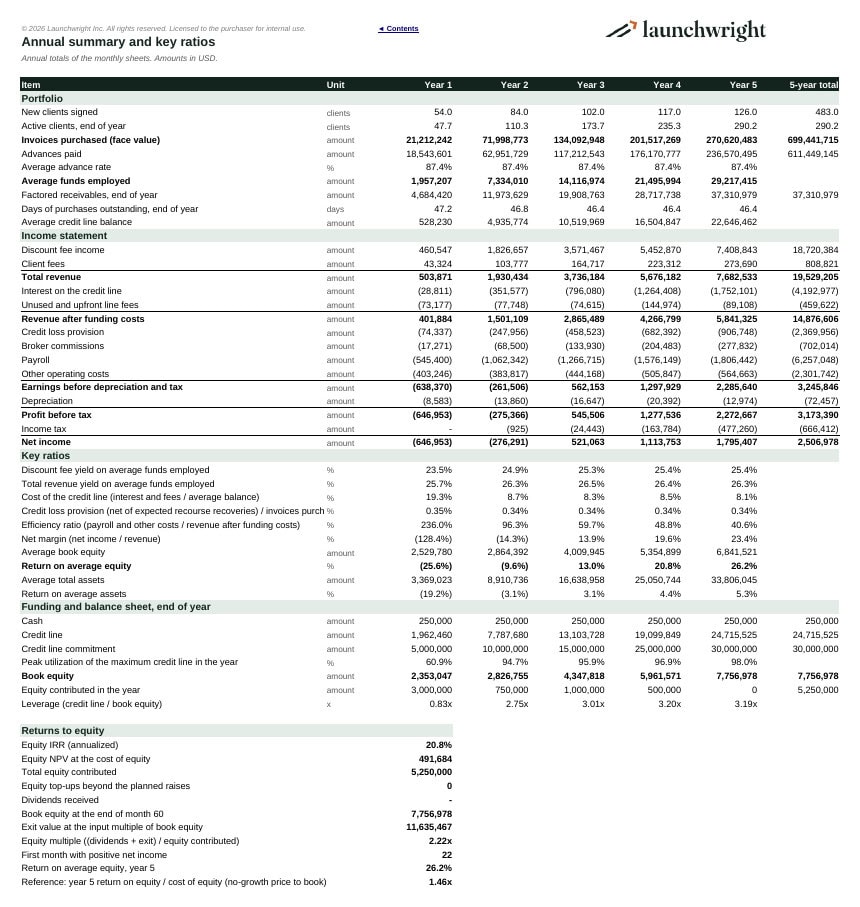
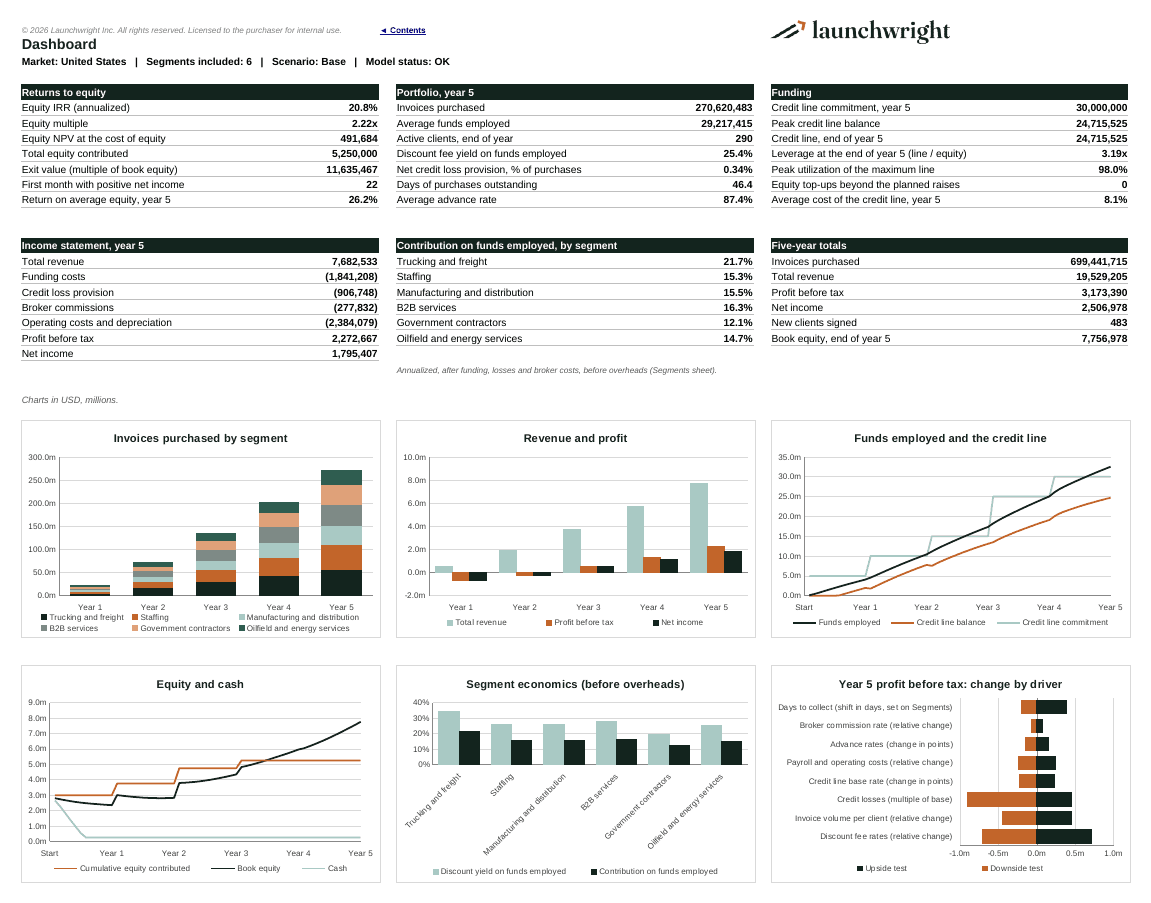
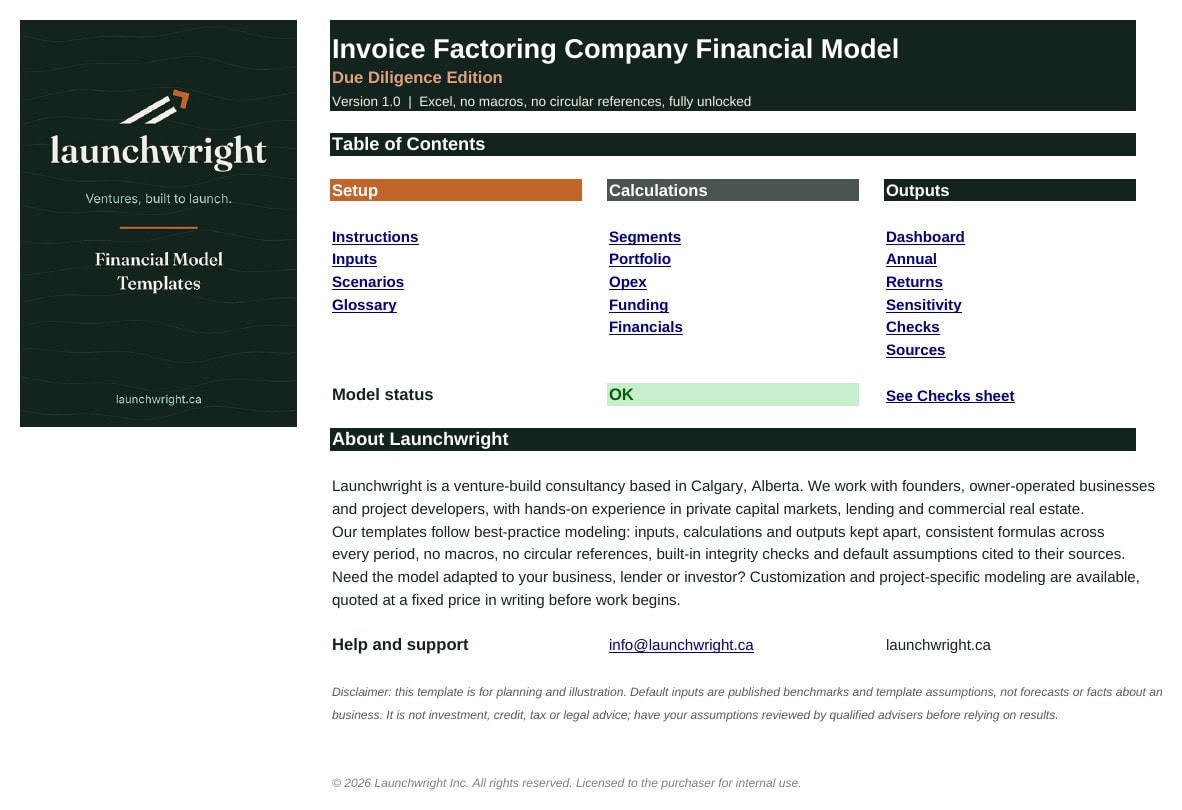
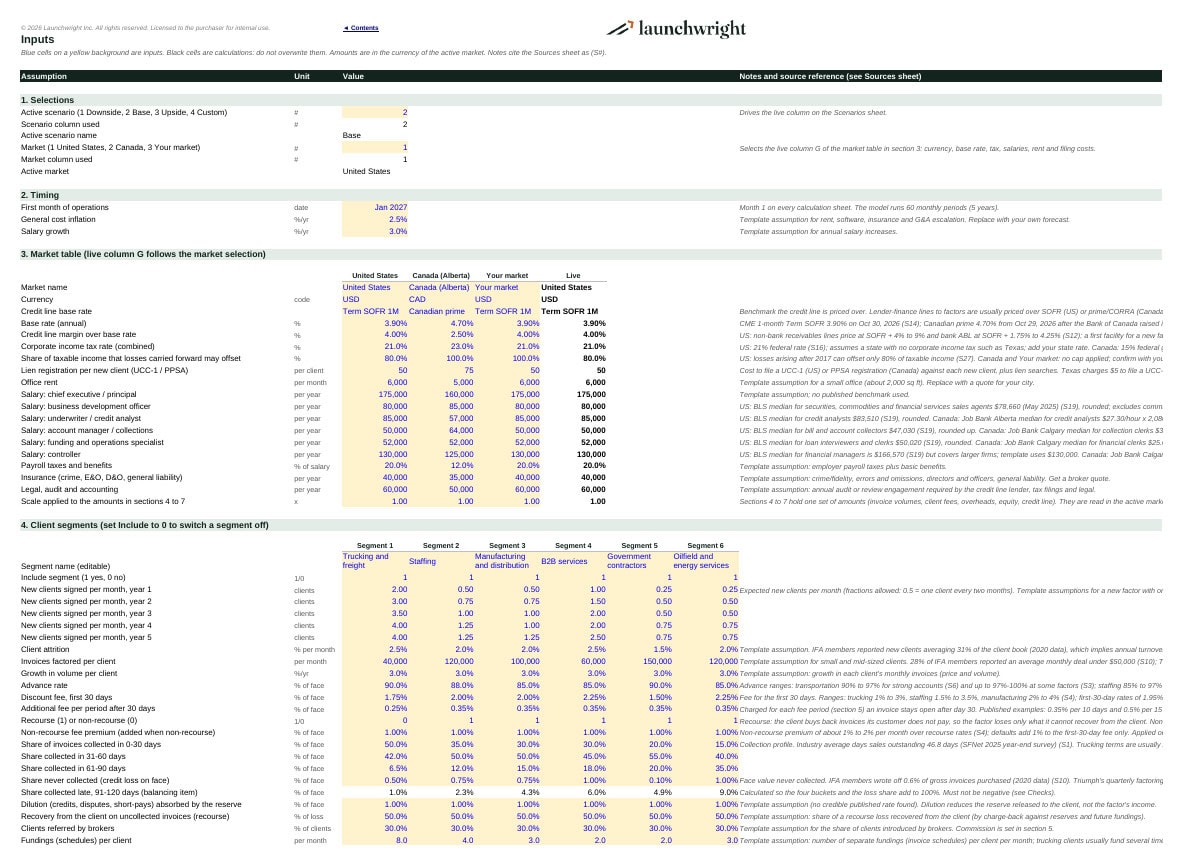
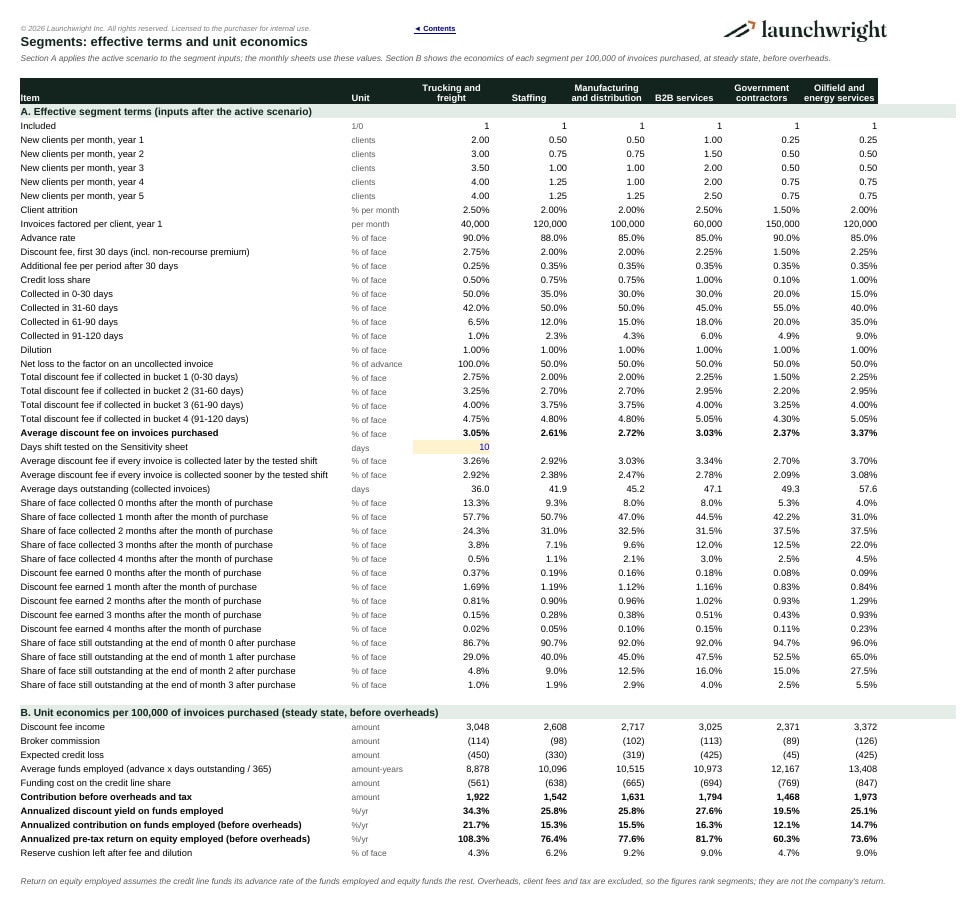
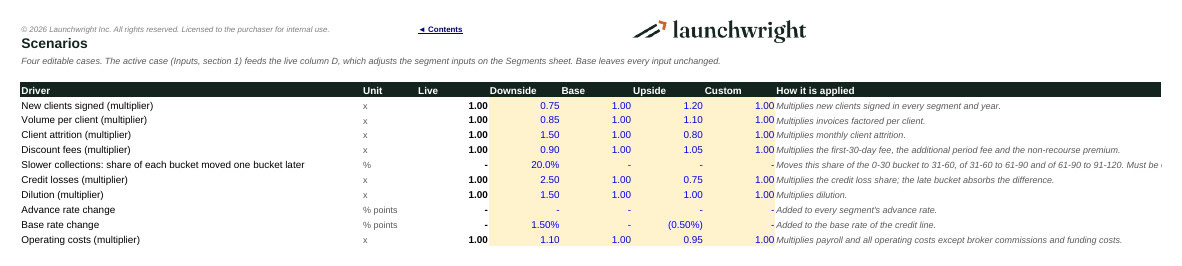
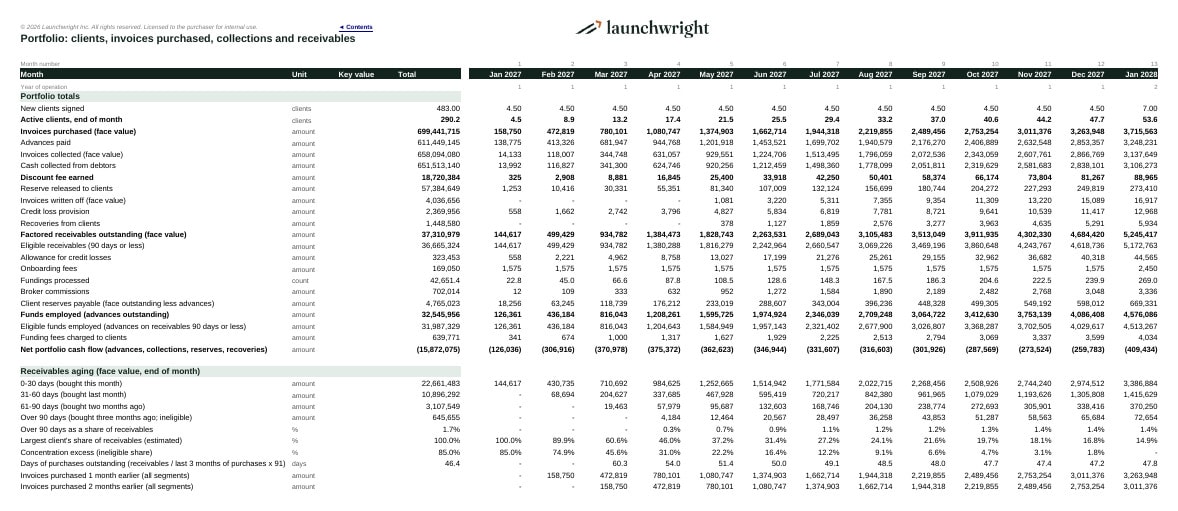
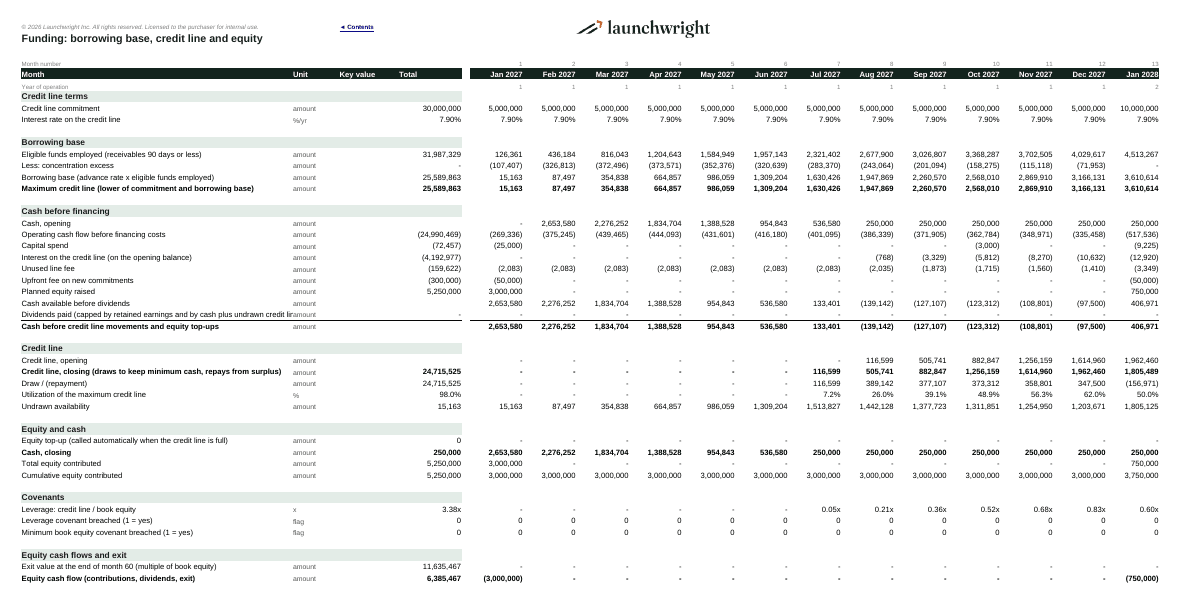
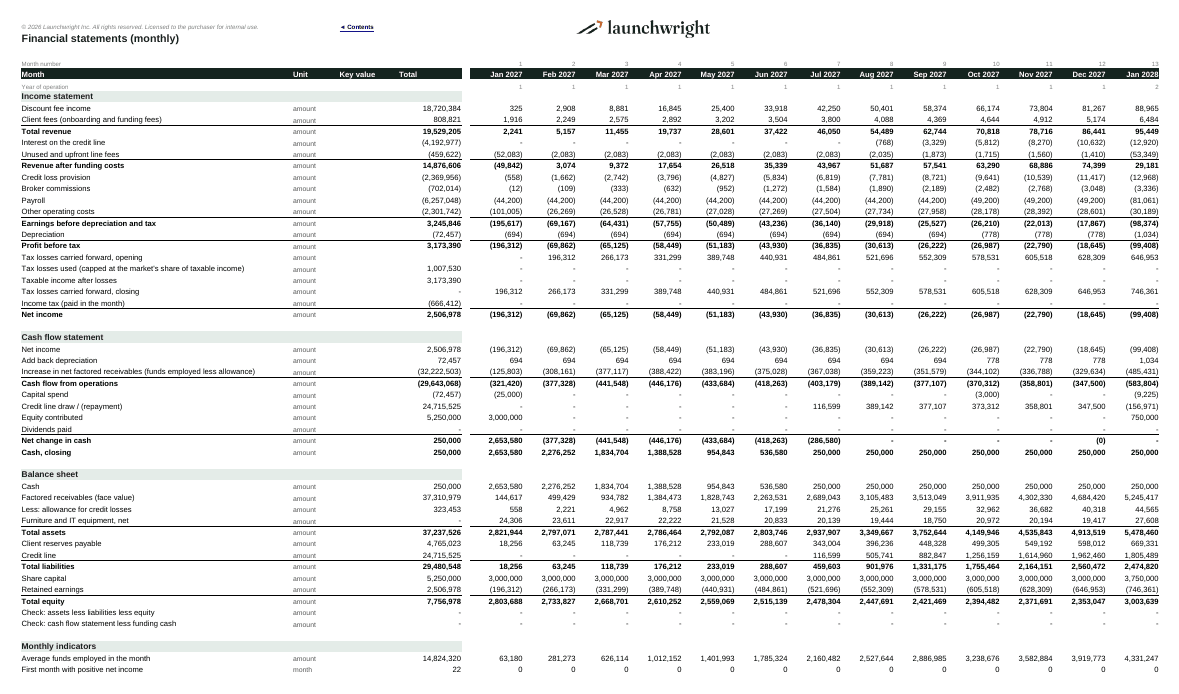
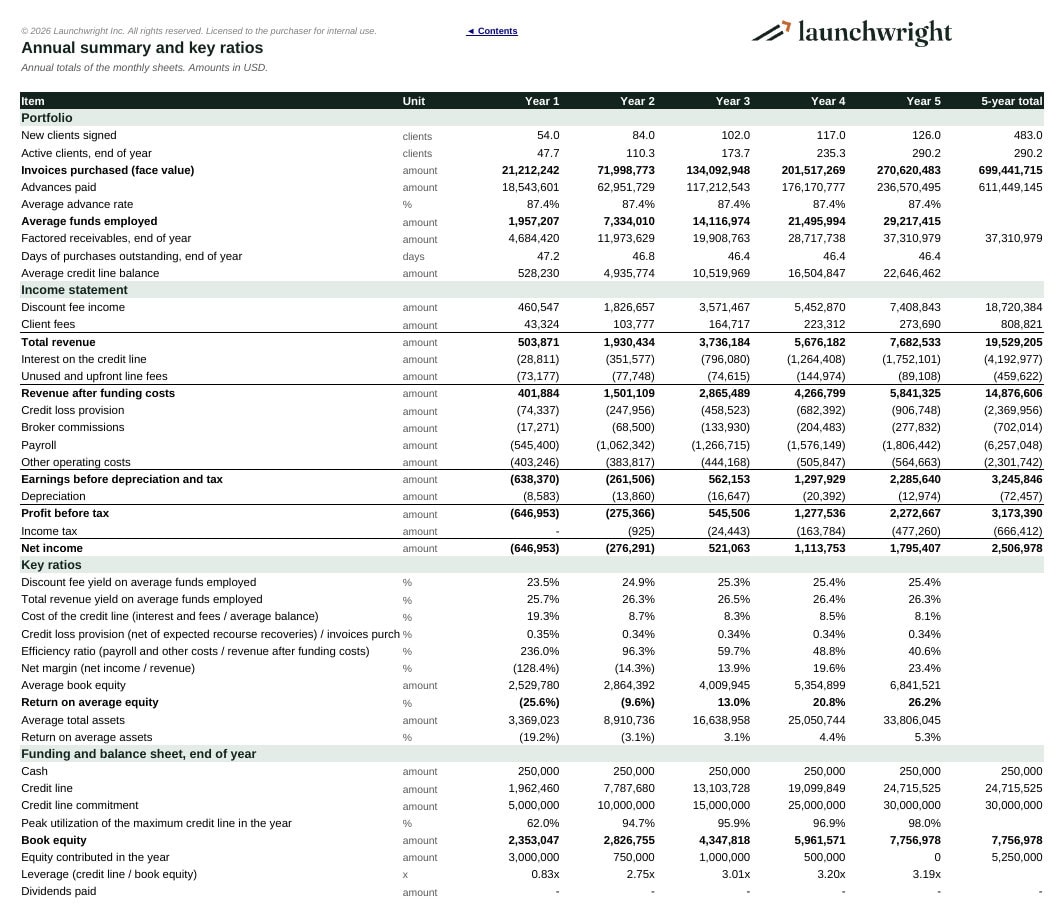
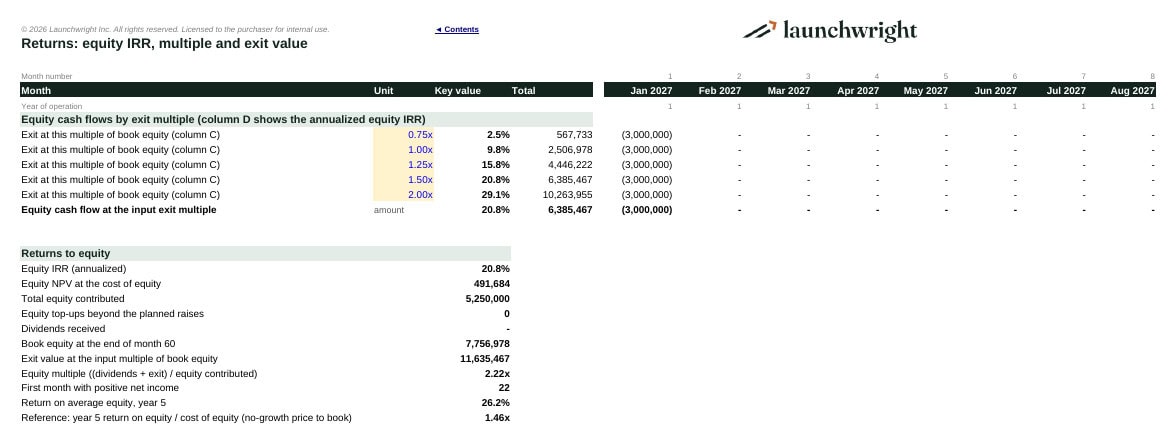
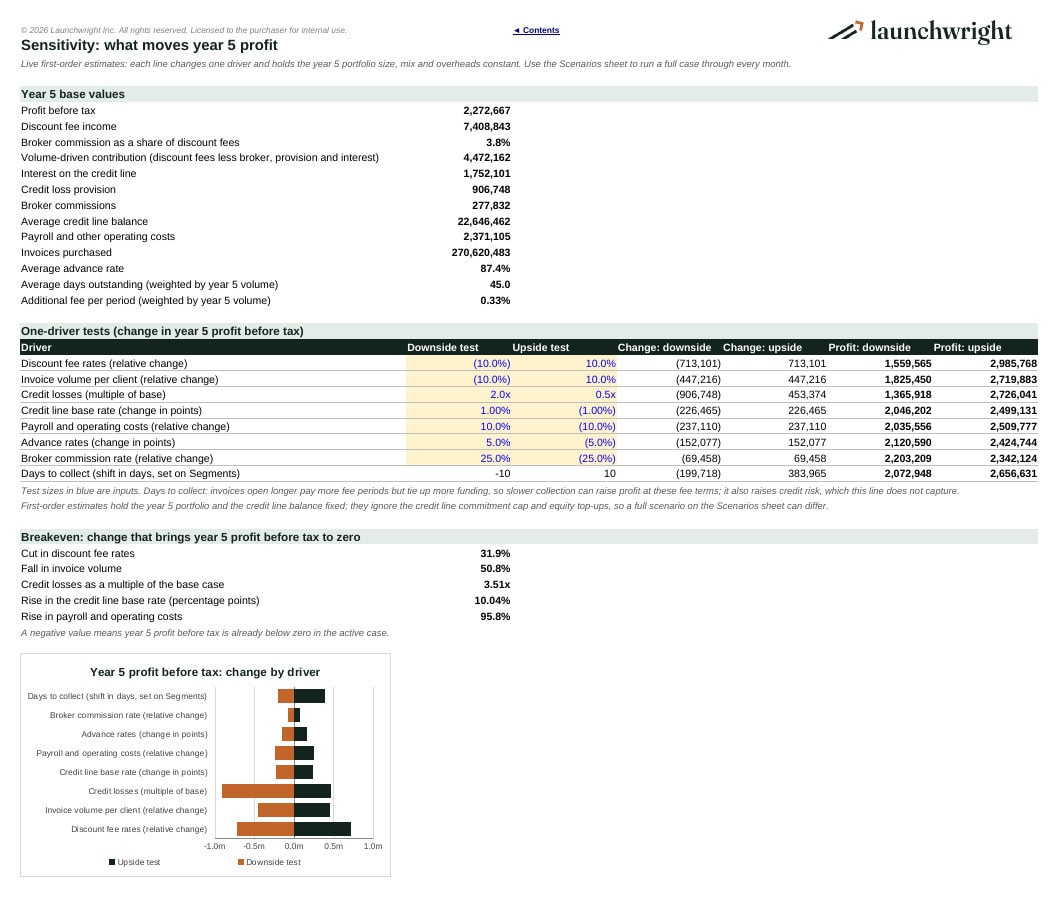
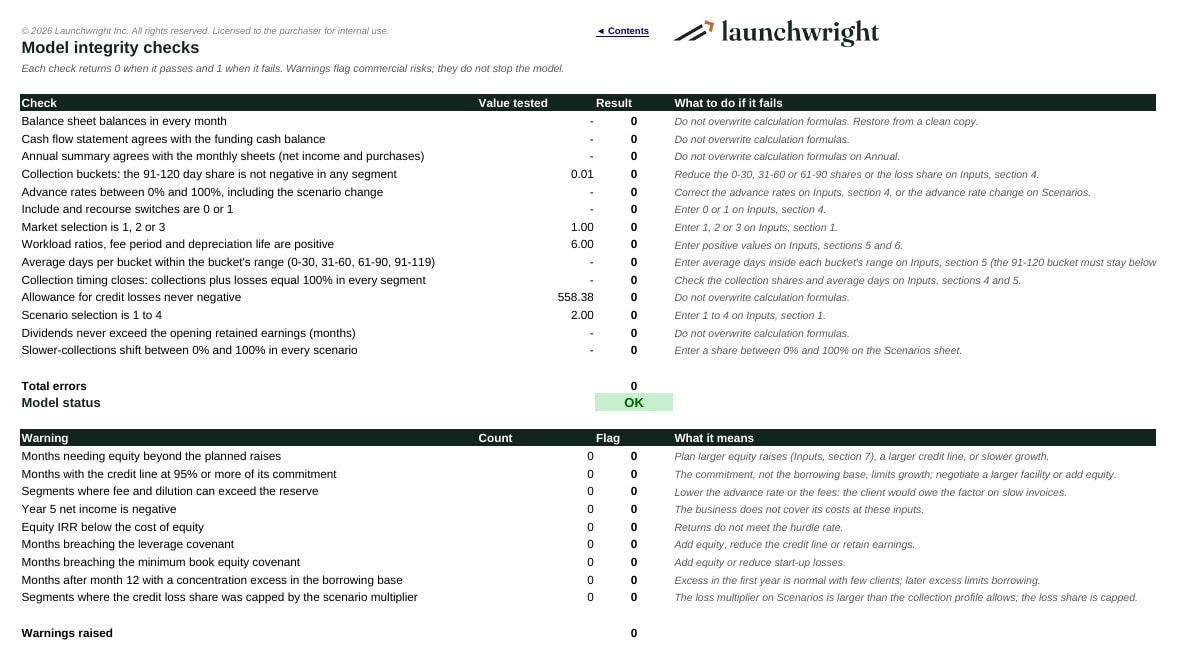
Starting an invoice factoring company, adding a factoring line to a lending business, or reviewing one for investors or a credit line lender? This Excel model builds the full financial case from the factor’s side: you buy your clients’ invoices, advance cash against them, collect from their customers and earn a discount fee. It answers the questions that decide whether a factor works: how much equity the growth really needs, what the credit line can fund, and what the business returns after funding costs, credit losses and overheads.
Why this model
Generic lending templates treat factoring as a loan with an interest rate. A factor does not earn interest: it earns a tiered fee that depends on how long each invoice stays unpaid, it holds back a reserve, and its own lender advances only part of the receivables. This model is built around those mechanics. Each of six client segments (trucking and freight, staffing, manufacturing and distribution, B2B services, government contractors, oilfield and energy services) has its own client growth, invoice volume, advance rate, first-30-day fee and additional fee per period, recourse or non-recourse terms, collection profile, credit losses and dilution. Switch segments off, rename them or re-use them for other niches.
Invoices are collected across four buckets (0-30, 31-60, 61-90 and 91-120 days) plus a credit loss share, so the model shows how slower collections change fees, funds employed and borrowing. Losses are provided for at purchase and written off later, with recoveries from the client under recourse. The balance sheet carries factored receivables at face value, the allowance and the client reserves payable, and it balances in every month.
Funding works the way a lender to a factor sets it up: a credit line commitment by year, a borrowing base equal to an advance rate on eligible receivables of 90 days or less, interest over SOFR or Canadian prime, unused and upfront fees, and planned equity raises. If growth outruns the line, the model calls the extra equity automatically and reports it, so you see your true capital requirement instead of a cash balance that quietly goes negative.
Three market columns hold the currency, credit line base rate and margin, tax rate (with the US 80% limit on losses carried forward), salaries, rent and lien filing costs: a United States preset in USD, a Canada (Alberta) preset in CAD and a column for your own market.
Two editions
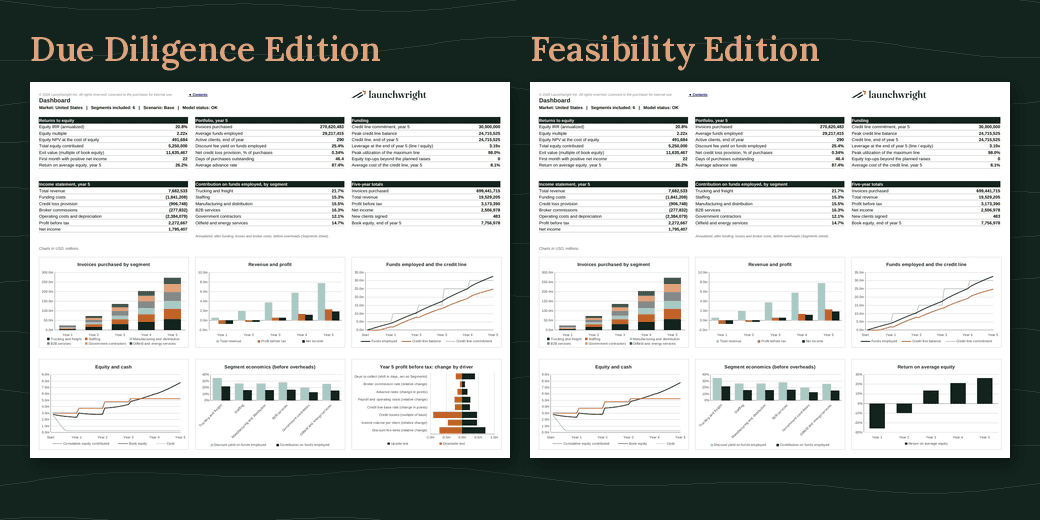
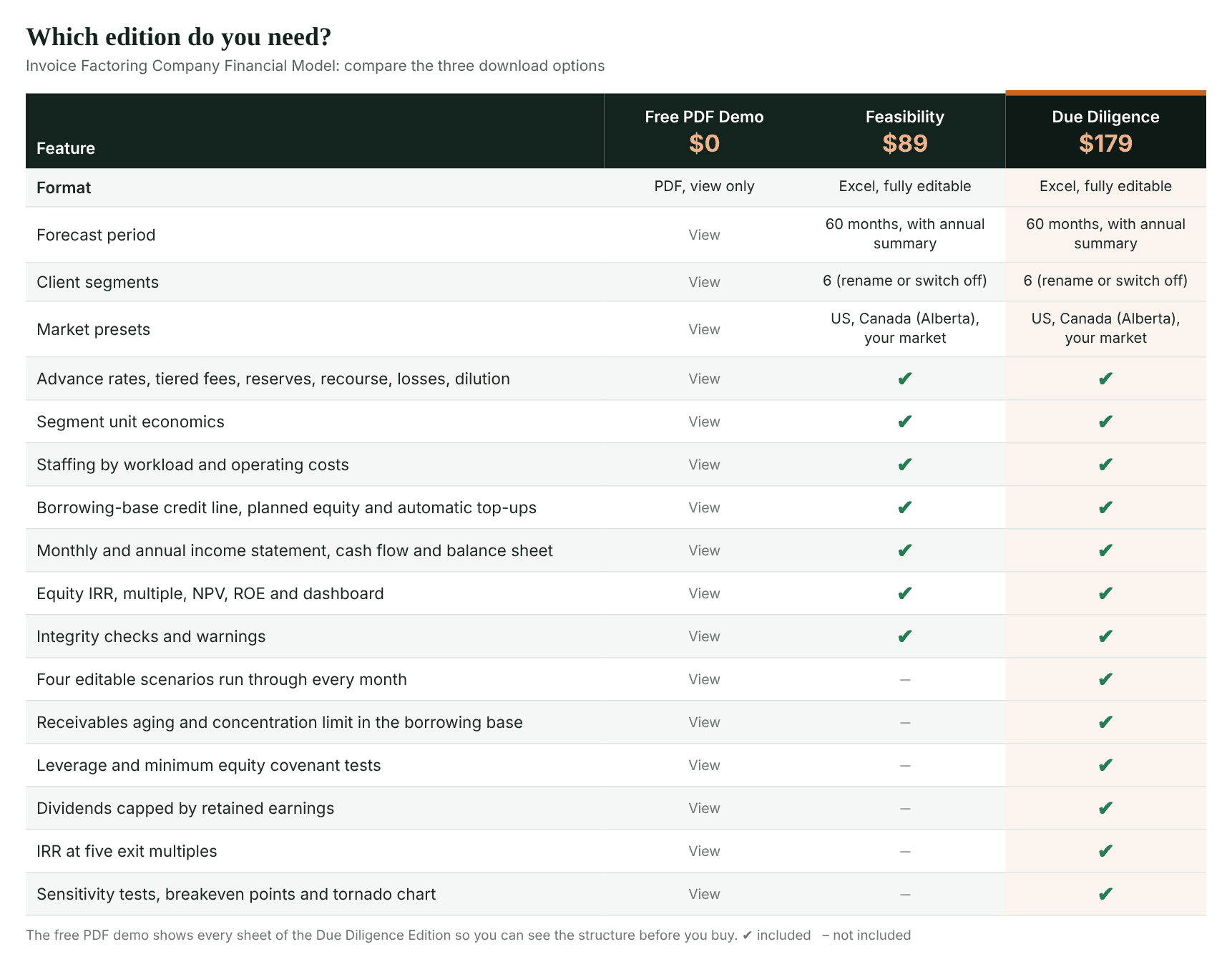
- Feasibility Edition: 60 monthly periods with an annual summary; six segments; three market columns; tiered fees, reserves, recourse and losses; segment unit economics; staffing by workload; borrowing-base credit line with automatic equity top-ups; three linked statements; equity IRR, multiple and NPV; dashboard and integrity checks.
- Due Diligence Edition: everything in the Feasibility Edition, plus four editable scenarios run through every month, receivables aging, a concentration limit in the borrowing base, leverage and minimum equity covenant tests, dividends capped by retained earnings, IRR at five exit multiples, and live sensitivity tests with breakeven points and a tornado chart.
Key outputs
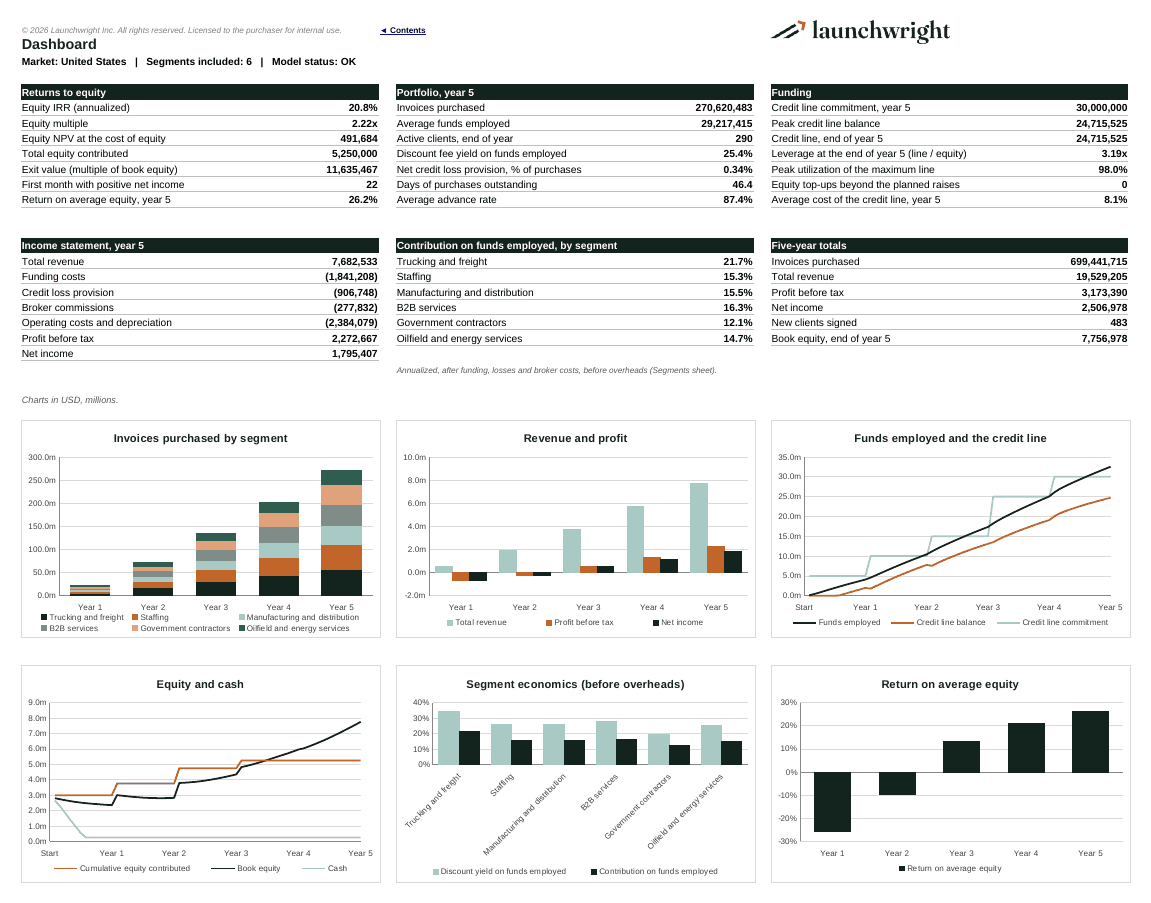
- Equity IRR, equity multiple, NPV at your cost of equity, exit value at a multiple of book equity, first profitable month
- Invoices purchased, funds employed, active clients, days of purchases outstanding, average advance rate
- Discount fee yield and total revenue yield on funds employed, cost of the credit line, credit losses, efficiency ratio, return on equity and on assets
- Credit line balance, borrowing base, utilization, leverage and equity contributed, month by month
- Contribution and return on funds employed for each segment, so you can see which niches to target
- Income statement, cash flow statement and balance sheet for every month, rolled up by year
Built to modeling best practice
- Inputs, calculations and outputs on separate sheets; inputs in blue on yellow, formulas in black
- Consistent formulas across all 60 months; start month, inflation and salary growth are inputs
- No macros, no circular references (interest is charged on the opening line balance), no hidden or protected sheets, no external links
- Checks sheet confirms the balance sheet balances, the cash flow agrees, the annual summary ties to the monthly sheets, collection profiles close to 100% and selections are valid; warnings flag equity shortfalls, covenant breaches and returns below the hurdle
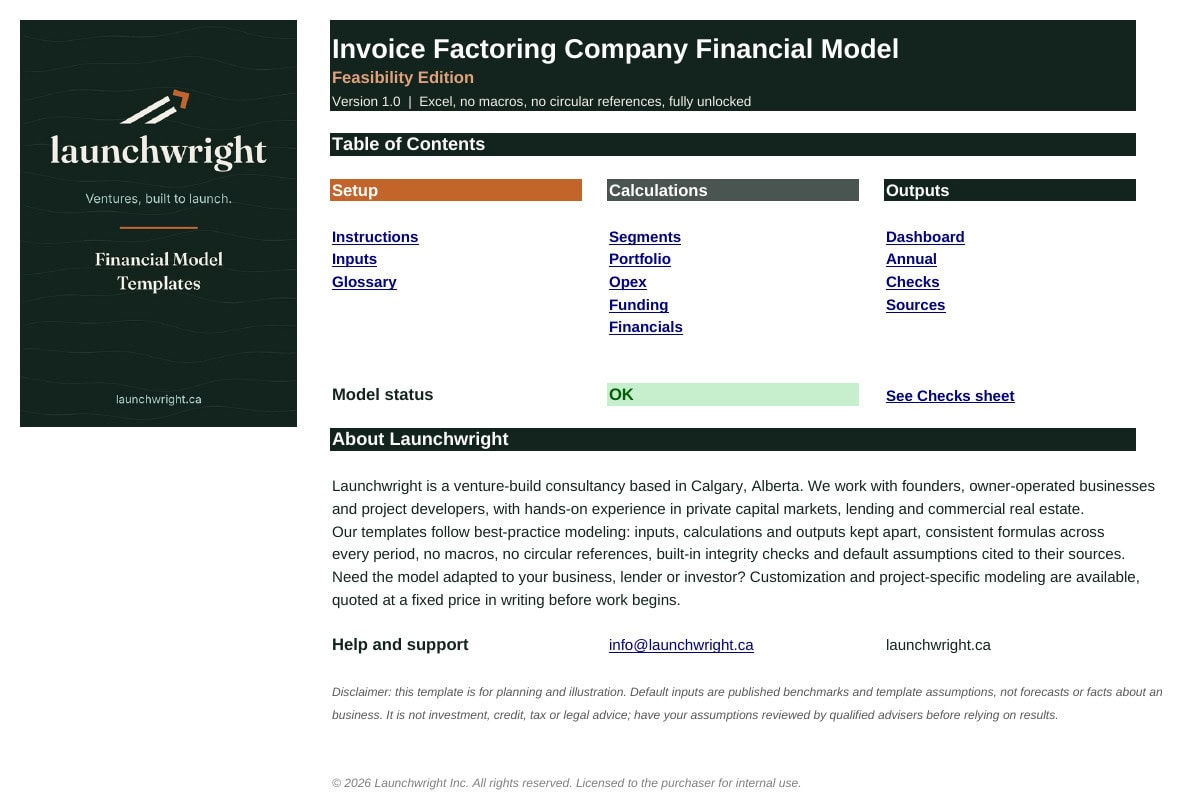
- Contents sheet with links, step-by-step instructions, a glossary and a source list for every default
Default assumptions
Defaults describe a new US factor that raises $5.25 million of equity over four years and grows to about 290 clients and $270 million of invoices purchased in year 5. Advance rates, fees, tiered fee periods, collection times, loss rates, credit line terms and salaries come from published sources listed in the model, including industry surveys, a public factor’s filings, lender and broker rate guides, the US Bureau of Labor Statistics and Canada’s Job Bank. Where no credible figure was published, the input is marked as a template assumption. In the base case, year 5 return on equity is about 26% and the equity IRR is about 21% with an exit at 1.5 times book equity; at 1.0 times book it falls to about 10%, which is why the exit multiple matters as much as the operating case. Year 5 profit before tax reaches zero if discount fees fall about 32% or credit losses run about 3.5 times the base case. The downside scenario loses money in year 5 and needs about $4.2 million of extra equity. The model shows this rather than hiding it. Replace the defaults with your own figures.
Download options
The model comes in two Excel editions, both fully editable .xlsx files, and a free PDF demo shows every sheet of the Due Diligence Edition so you can see the exact structure before you buy. The demo, the Feasibility Edition ($89) and the Due Diligence Edition ($179) side by side:
What you get
- One Excel workbook (.xlsx) for the edition purchased, built only with functions available since Excel 2010 (no dynamic arrays, no macros)
- A free PDF demo showing every sheet of the Due Diligence Edition
Support and customization
Questions about how the template works are answered by email us via the Contact Author button or through customer support chat. Adapting the model to your business, lender or investor is available as a custom service ordered through eFinancialModels.
Similar ProductsOther customers were also interested in...



 eFinancialModels
Electric Vehicle (EV) Charging Station Financial M...
With this comprehensive 5- or 10-year monthly tool, investors can assess the viability of setting up... Read more

Financial Model for Mobile App | Mobile App Busine...
The Mobile App Financial Plan Template in Excel allows you to develop financial projections when lau... Read more

 HenrySheykin
Food Truck Financial Model Excel Template
The Food Truck Financial Model helps entrepreneurs, founders, business owners, consultants, and anal... Read more

Green Hydrogen Production from Wind Energy Financi...
The Green Hydrogen from Wind Financial Model aims to comprehensively forecast a horizon of 40 years ... Read more

Simple Mutual Non-Disclosure Agreement Template
Protect your business secrets with ease using our Simple Mutual Non-Disclosure Agreement Template. S... Read more

Solar Energy Financial Model
The Solar Energy Financial Model Spreadsheet Template in Excel assists you in preparing a sophistica... Read more

 Peter Graf
The Customer-Centric Financial Model for Restauran...
Starting a restaurant without a financial plan is like driving a car blindfolded. You wouldn´t do i... Read more
You must log in to submit a review.