
0 ITEMS

Intangible Asset Valuation and Purchase Price Allocation Model (IFRS 3, IVS 210: MPEEM, Relief from Royalty, Goodwill and WARA)
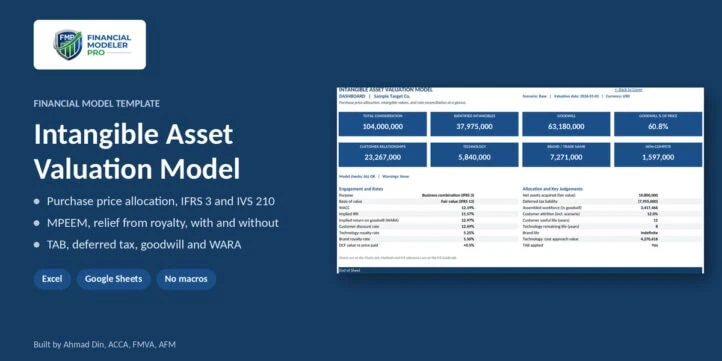
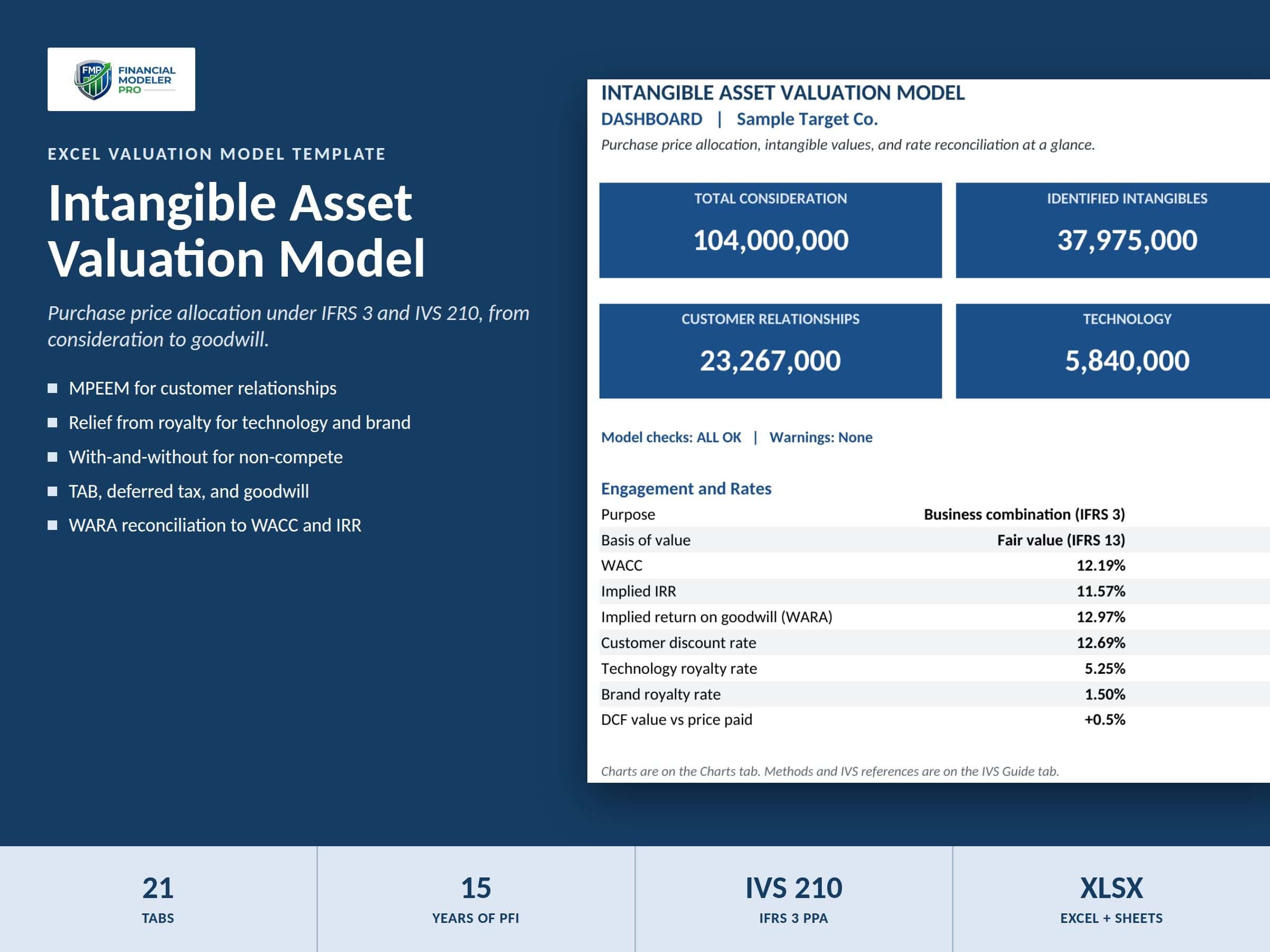
A complete purchase price allocation in one workbook. The model values customer relationships (multi-period excess earnings), technology and brand (relief from royalty), a non-compete agreement (with and without), and the assembled workforce (replacement cost), then allocates the price paid to net assets, intangibles, deferred tax, and goodwill under IFRS 3 and IVS 210. A WARA reconciliation tests the asset returns against WACC and the implied IRR of the deal. Tax amortization benefit is solved in closed form, with no circular references. Works in Excel and Google Sheets, with no macros.
What is this model used for?
When one company buys another, the price paid has to be split between the assets acquired: net assets at fair value, each identifiable intangible asset, and goodwill. This is the purchase price allocation, or PPA, required by IFRS 3 and similar standards. This template runs the whole exercise, from the consideration paid down to goodwill, using the methods set out in IVS 210 Intangible Assets.
Most templates you will find stop at a single relief from royalty calculation. This one is built for the full job a valuer, auditor, or deal team has to deliver. Use it to prepare a PPA report, to review a client’s allocation, to close the accounting for an acquisition, or to learn intangible valuation on a complete working example. The sample deal is in USD and every figure can be replaced with your own.
What is included?
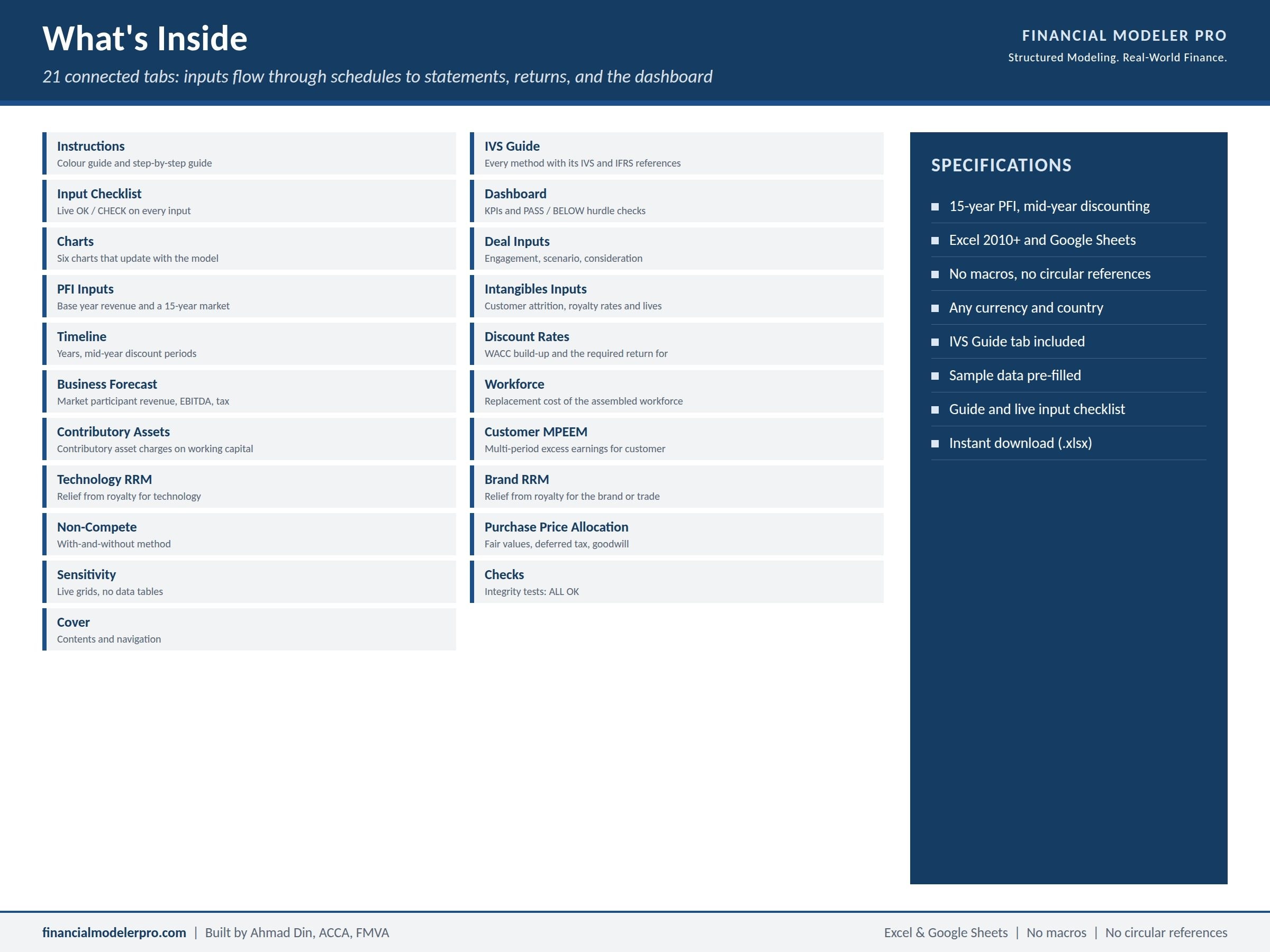
One Excel workbook with 21 linked tabs:
- Cover, Instructions, and an Input Checklist with 16 items
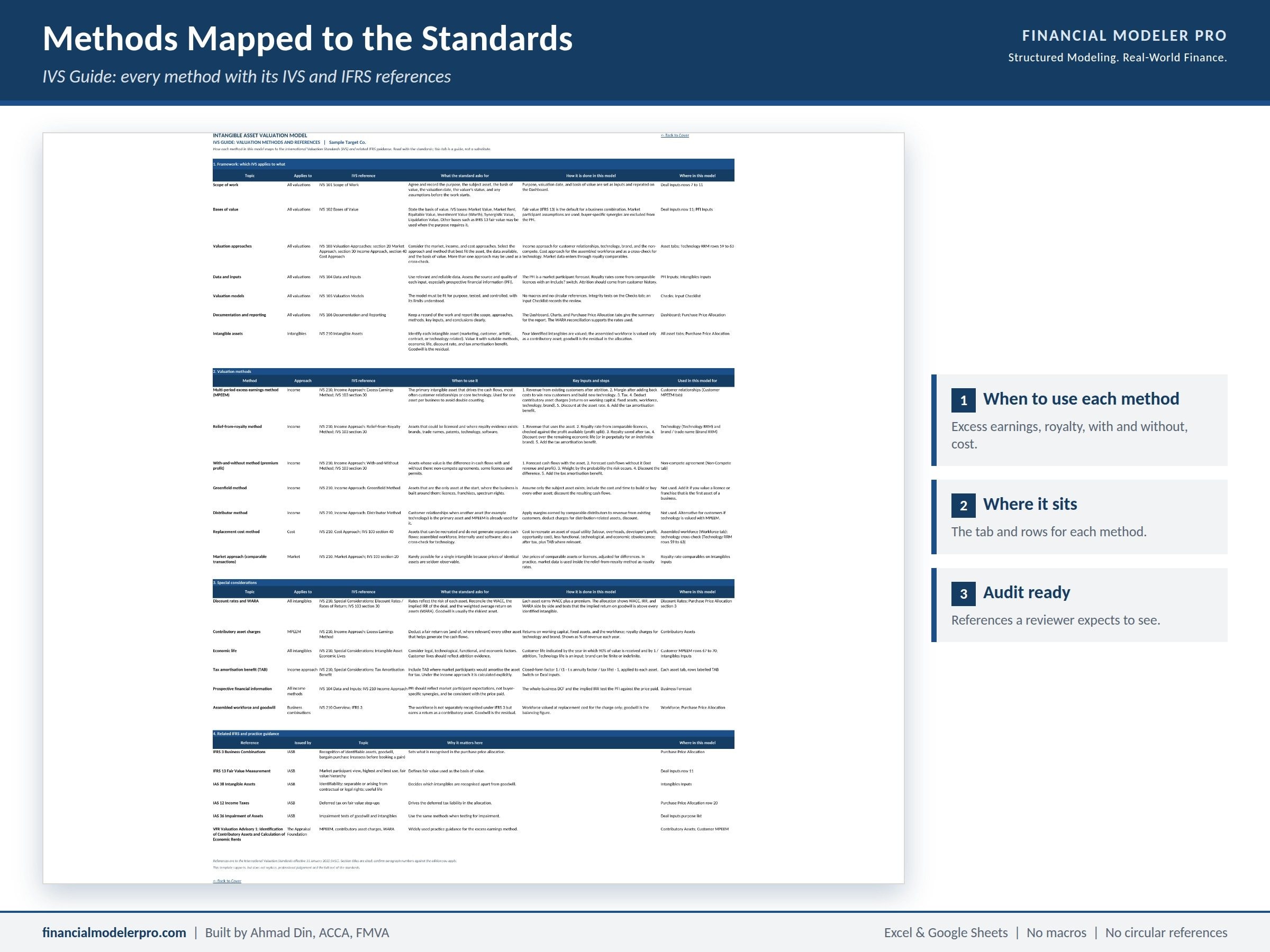
- IVS Guide: every method mapped to its IVS and IFRS reference, when to use it, and where it sits in the model
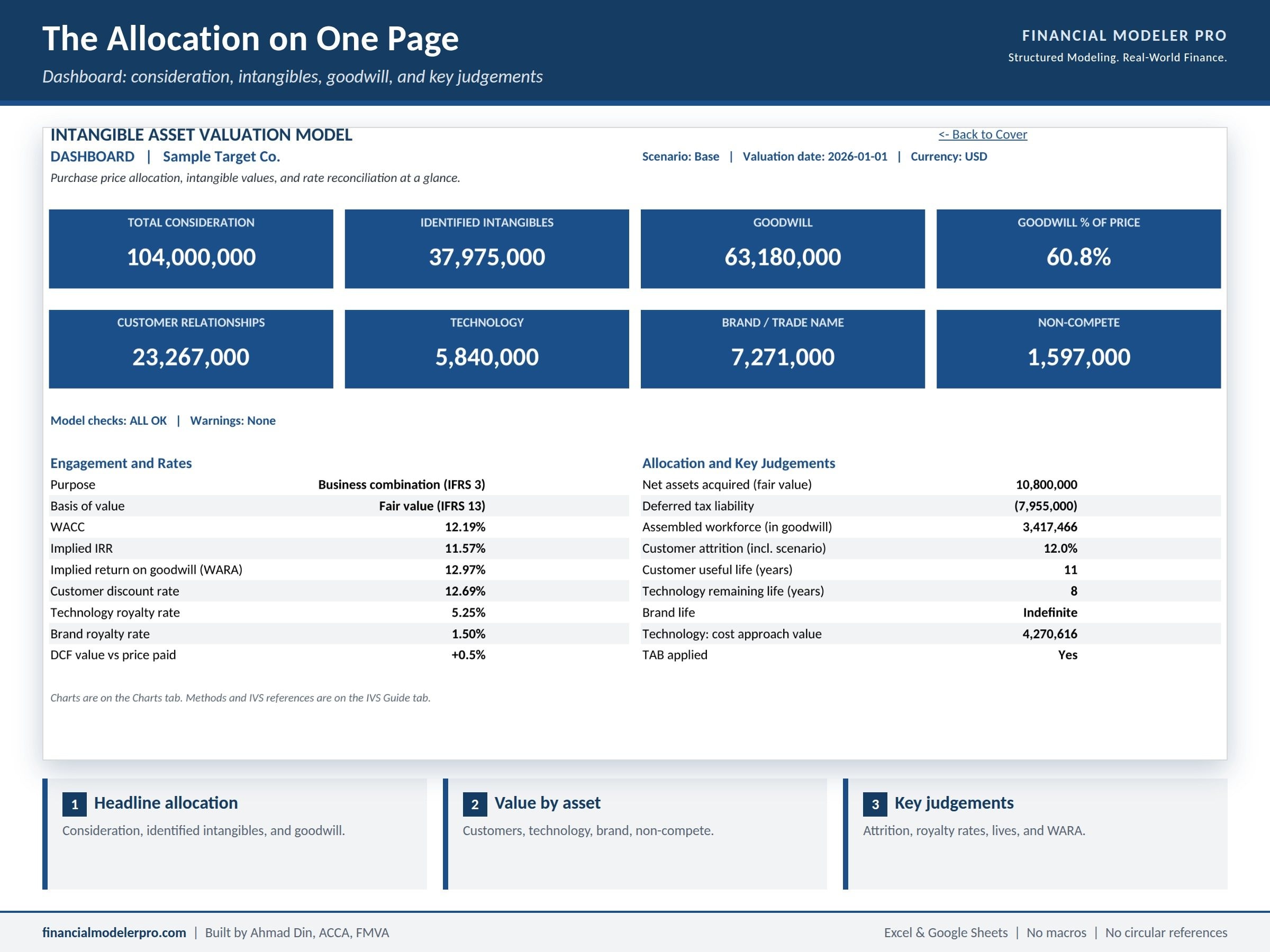
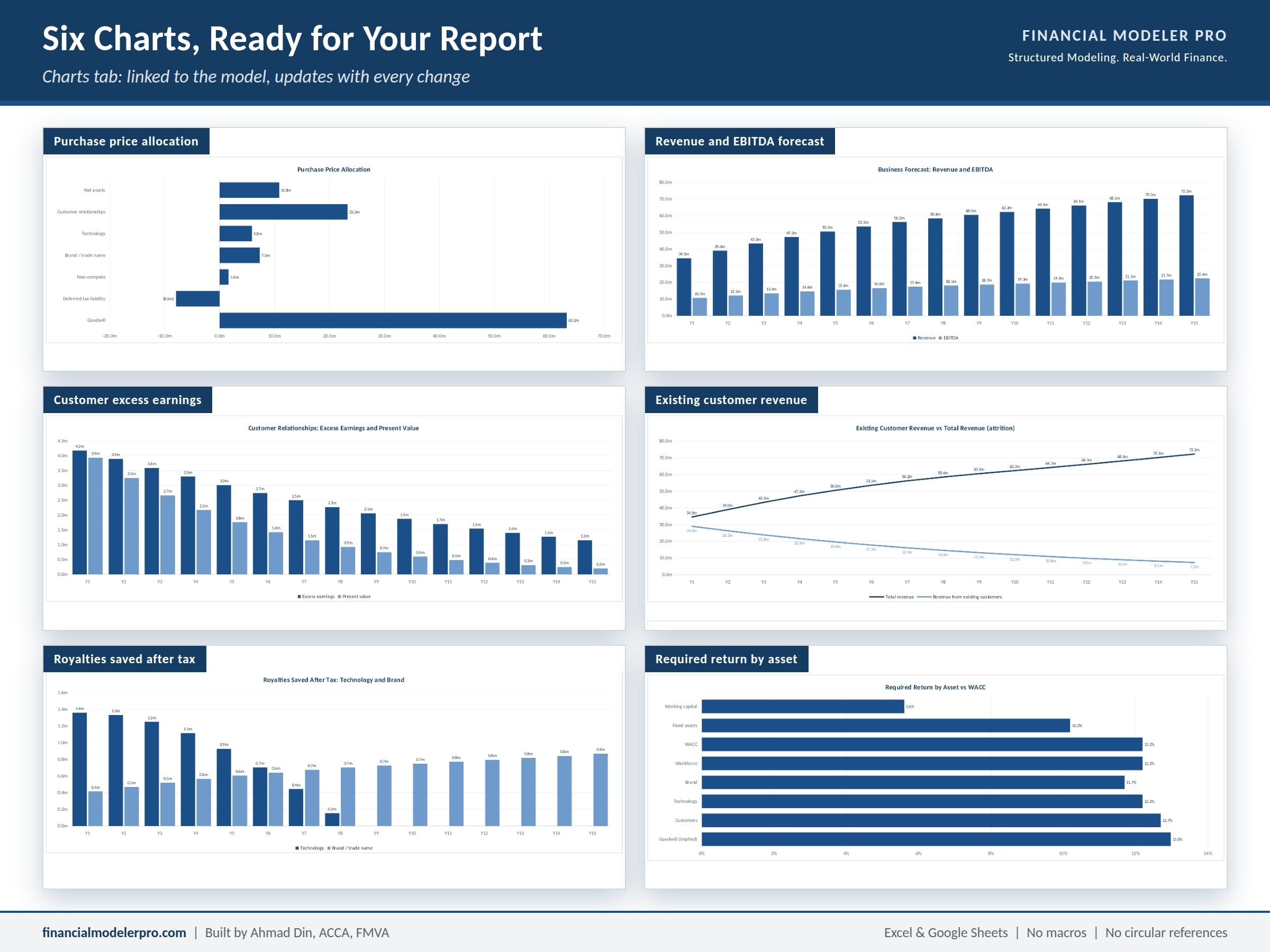
- Dashboard with the allocation and key judgements on one page, plus a Charts tab with six charts
- Deal Inputs, PFI Inputs, and Intangibles Inputs
- Timeline, Discount Rates, Business Forecast, Workforce, and Contributory Assets
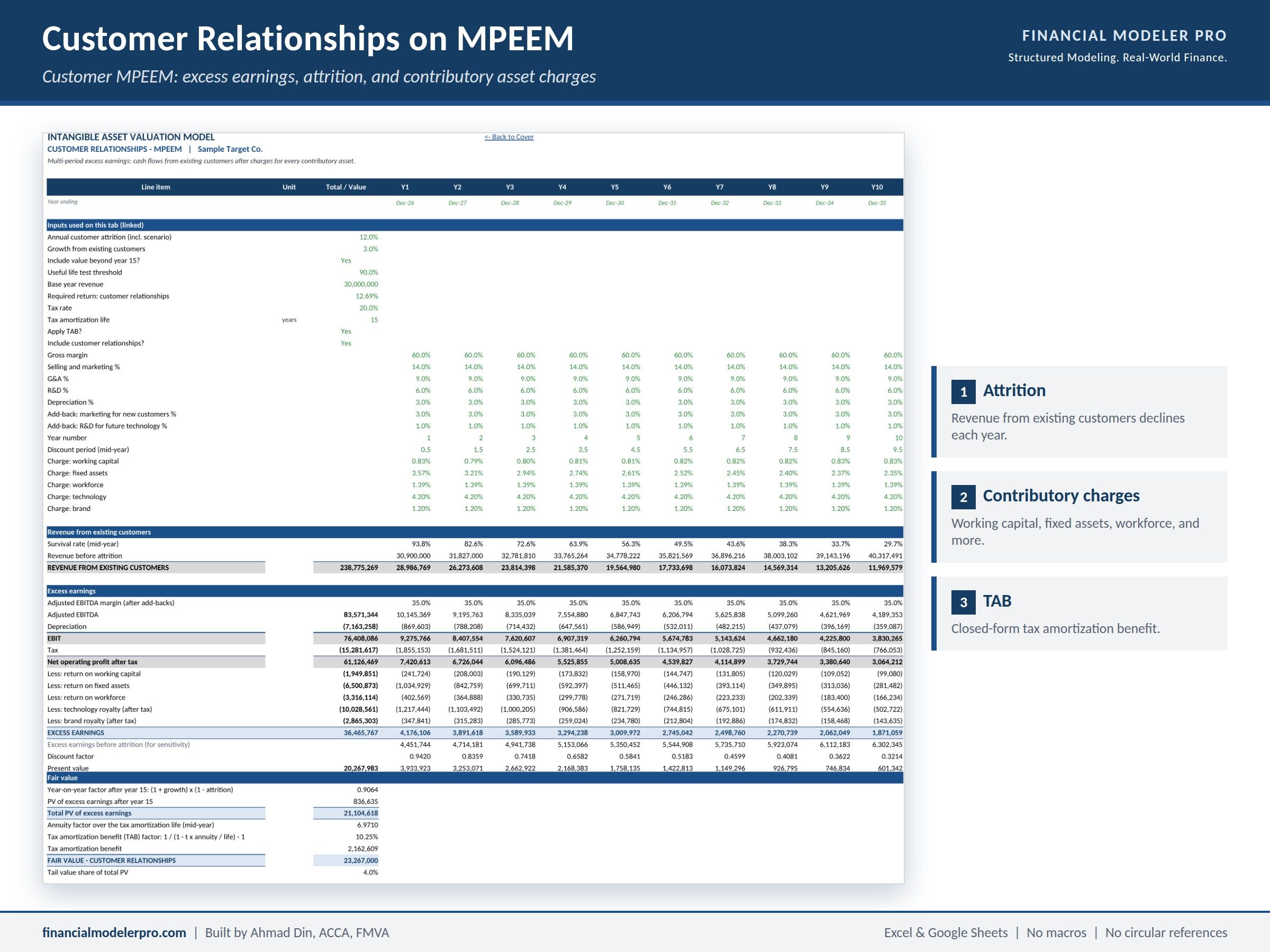
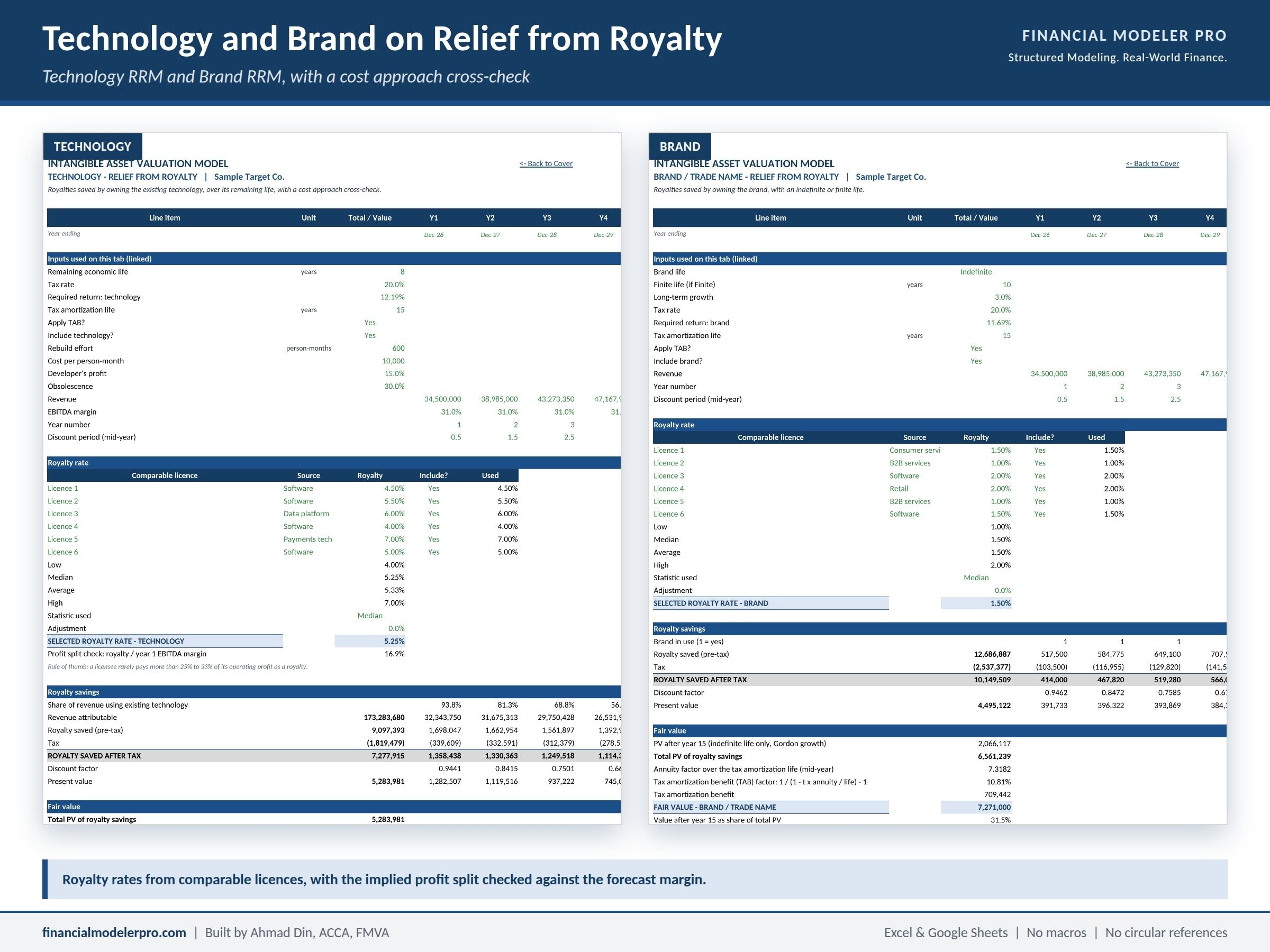
- Customer MPEEM, Technology RRM, Brand RRM, and Non-Compete
- Purchase Price Allocation, Sensitivity, and Checks
What it values, and how
- Customer relationships on the multi-period excess earnings method (MPEEM): attrition, growth from existing customers, marketing and R&D add-backs, and a useful life test
- Contributory asset charges for working capital, fixed assets, assembled workforce, technology, and brand
- Technology on relief from royalty, using up to 6 comparable licences with a median, average, low, or high rate, and a cost approach cross-check
- Brand or trade name on relief from royalty, with an indefinite or a finite life
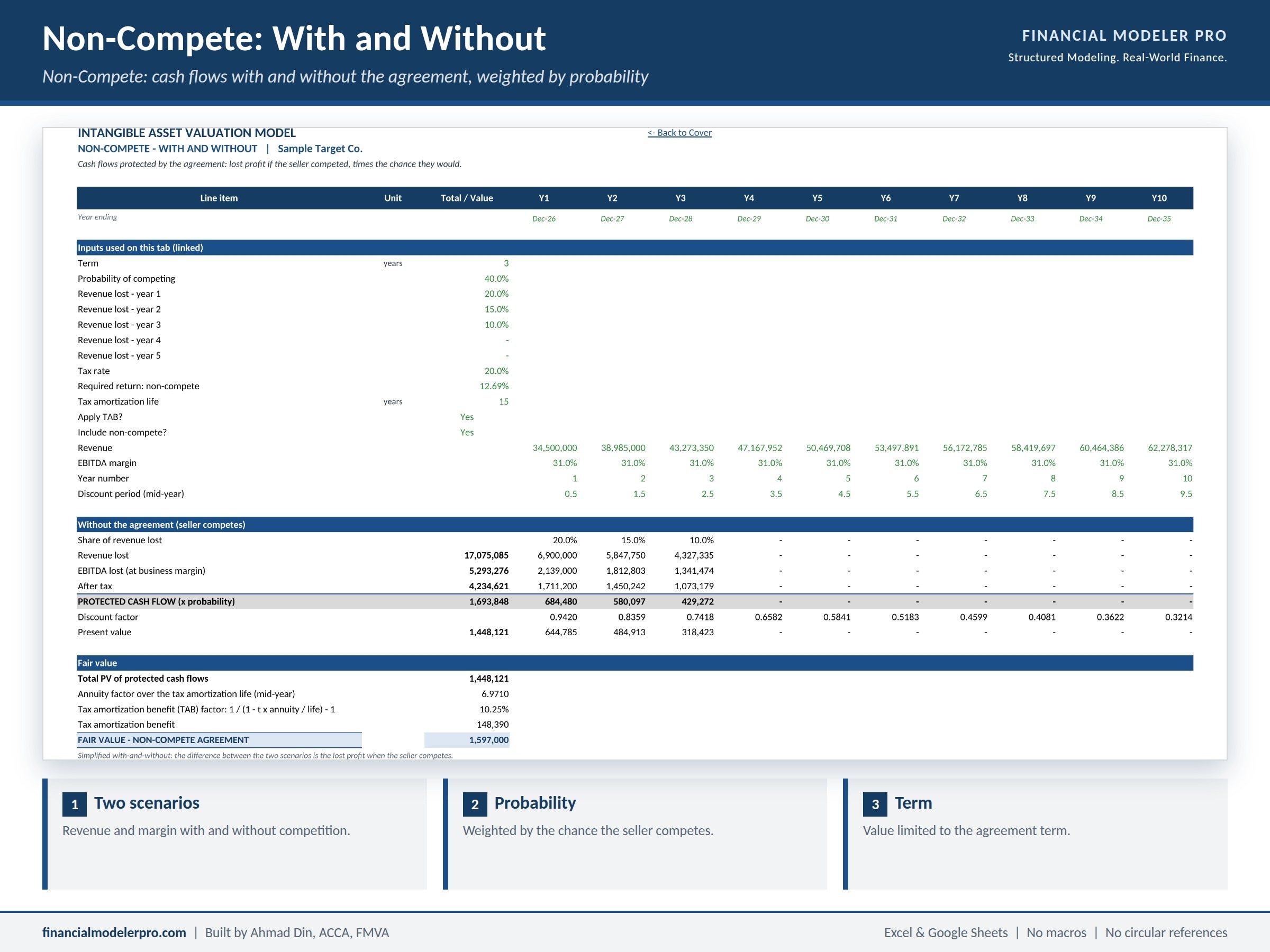
- Non-compete agreement on the with-and-without method, weighted by the probability that the seller would compete
- Assembled workforce at replacement cost by employee group, used as a contributory asset and kept inside goodwill
Main features
- A 15-year market participant forecast, with enterprise value at WACC and the implied IRR of the price paid
- A discount rate for each asset: WACC build-up plus a premium or discount by asset
- Tax amortization benefit calculated in closed form with mid-year discounting, so there is no circular reference
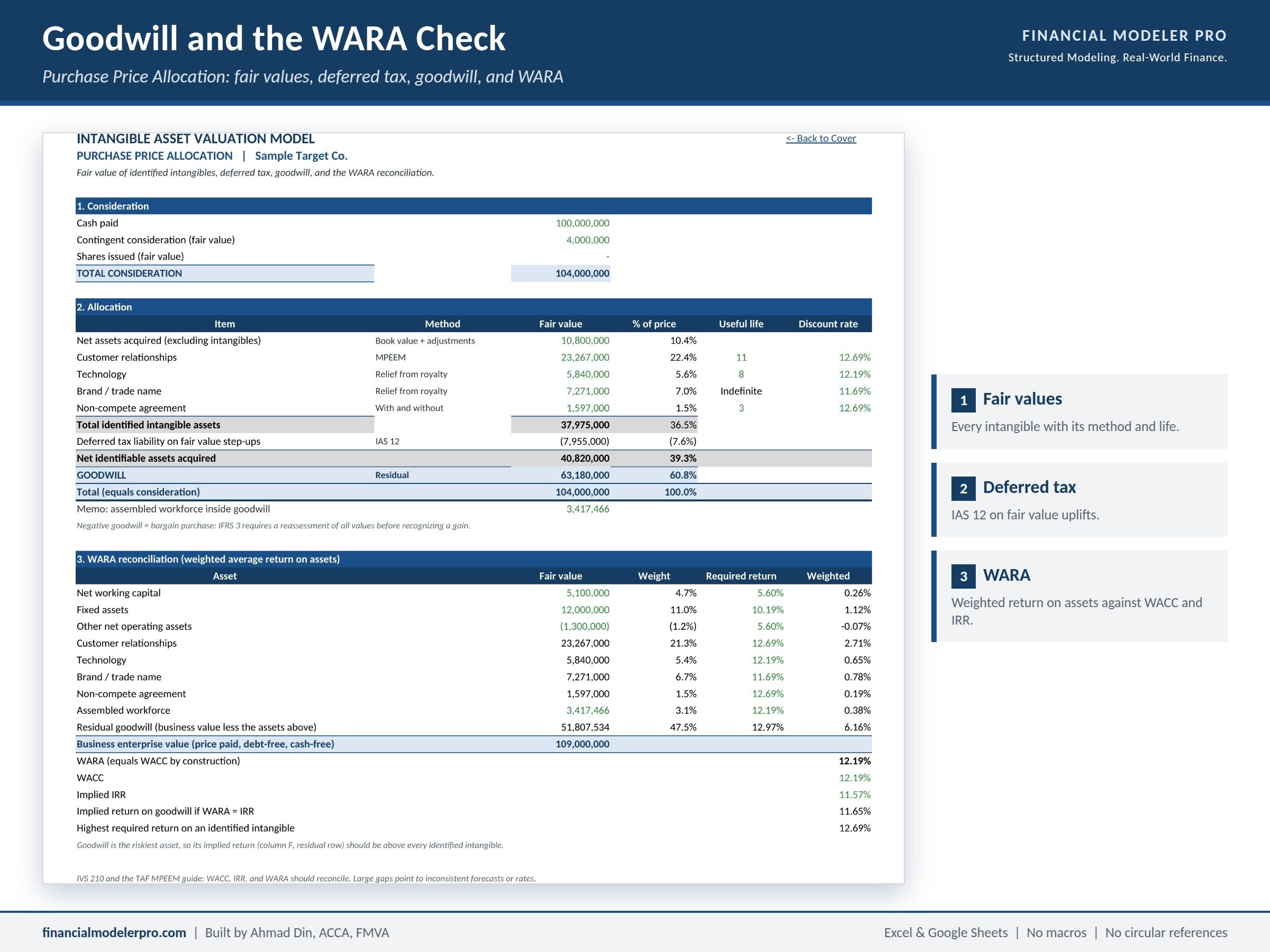
- Deferred tax liability on fair value step-ups, goodwill as the residual, and a bargain purchase warning
- WARA reconciliation: WACC, IRR, and the weighted average return on assets side by side, with a test that goodwill carries the highest implied return
- Each intangible can be switched on or off
- Base, Downside, and Upside scenarios on growth, margin, attrition, royalty rates, and discount rates
- Two live sensitivity grids: customer value by attrition and discount rate, and technology value by royalty and discount rate
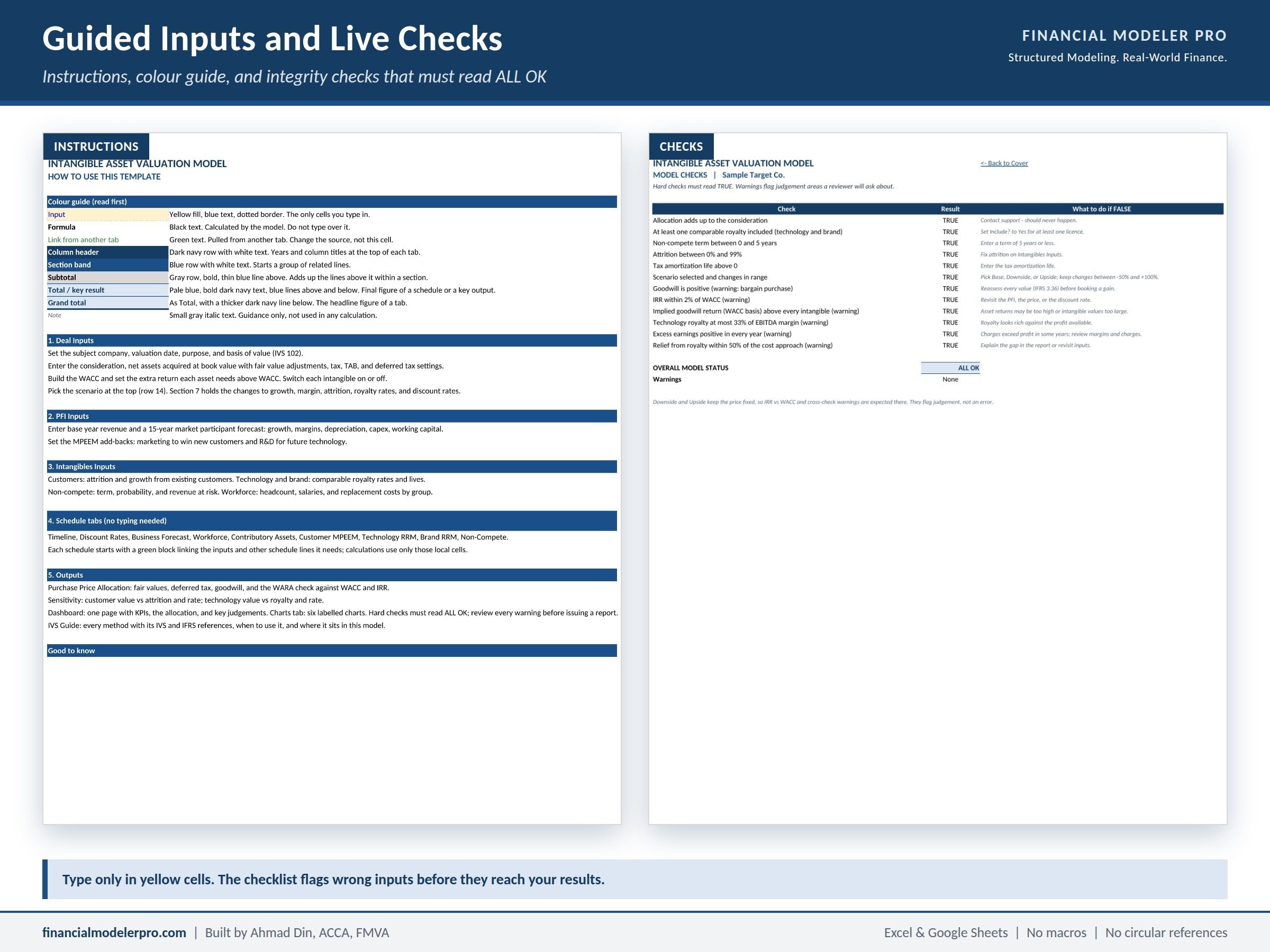
- 12 integrity checks that must read ALL OK before a report is issued
How to work with the template
- Save a copy and read the Instructions and IVS Guide tabs.
- On Deal Inputs, enter the consideration, the net assets acquired with fair value adjustments, tax settings, and the WACC build-up.
- On PFI Inputs, enter base year revenue and the 15-year forecast. On Intangibles Inputs, enter attrition, royalty comparables, lives, the non-compete terms, and the workforce data.
- Confirm the Checks tab reads ALL OK, review every warning, and read the Purchase Price Allocation tab, starting with the WARA check.
You type in yellow cells only. All formulas are visible and no cell is locked, so a reviewer can trace every figure back to its input.
Why you need this model
A PPA is judged on whether it hangs together. An auditor will ask why the customer relationships are worth what you say, whether the royalty rate has support, and whether the returns on the assets reconcile to the price paid. This model is built around those questions. Every asset value ties back to the deal through the WARA reconciliation, and the IVS Guide tab shows the reviewer which standard each step follows.
Technical notes
- 15 annual periods
- Excel 2010 or later and Google Sheets
- No macros, no circular references, no data tables, no external links, no merged cells
- References are to the International Valuation Standards effective 31 January 2025
- The template supports, but does not replace, professional valuation judgement
Licences
- Free PDF Preview: shows the layout and outputs before you buy
- Excel Model, Business Licence: for use inside your own company
- Excel Model, Consulting Licence: for use on client engagements
About the author
Built by Ahmad Din, ACCA, FMVA, AFM, a corporate finance and transaction advisory practitioner with 12+ years of experience across Saudi Arabia, the GCC, and Pakistan, and the founder of Financial Modeler Pro. Custom versions of this model are available on request through eFinancialModels.
Similar ProductsOther customers were also interested in...



 eFinancialModels
Electric Vehicle (EV) Charging Station Financial M...
With this comprehensive 5- or 10-year monthly tool, investors can assess the viability of setting up... Read more

Financial Model for Mobile App | Mobile App Busine...
The Mobile App Financial Plan Template in Excel allows you to develop financial projections when lau... Read more

 HenrySheykin
Food Truck Financial Model Excel Template
The Food Truck Financial Model helps entrepreneurs, founders, business owners, consultants, and anal... Read more

Green Hydrogen Production from Wind Energy Financi...
The Green Hydrogen from Wind Financial Model aims to comprehensively forecast a horizon of 40 years ... Read more

Simple Mutual Non-Disclosure Agreement Template
Protect your business secrets with ease using our Simple Mutual Non-Disclosure Agreement Template. S... Read more

Solar Energy Financial Model
The Solar Energy Financial Model Spreadsheet Template in Excel assists you in preparing a sophistica... Read more

 Peter Graf
The Customer-Centric Financial Model for Restauran...
Starting a restaurant without a financial plan is like driving a car blindfolded. You wouldn´t do i... Read more
You must log in to submit a review.