
0 ITEMS

Canada Small Business Startup Financial Model: GST/HST, CPP/EI Payroll, CCPC Tax, CSBFP Loan, All Provinces
Excel model for starting an incorporated small business in Canada: 60 months of revenue, payroll with CPP/EI, GST/HST registration and refunds, CCA, the CSBFP loan and small business corporate tax for every province, with cash flow, DSCR and break-even. No macros, fully unlocked.
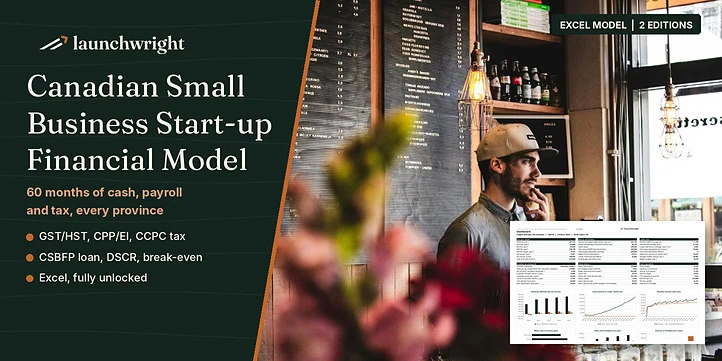
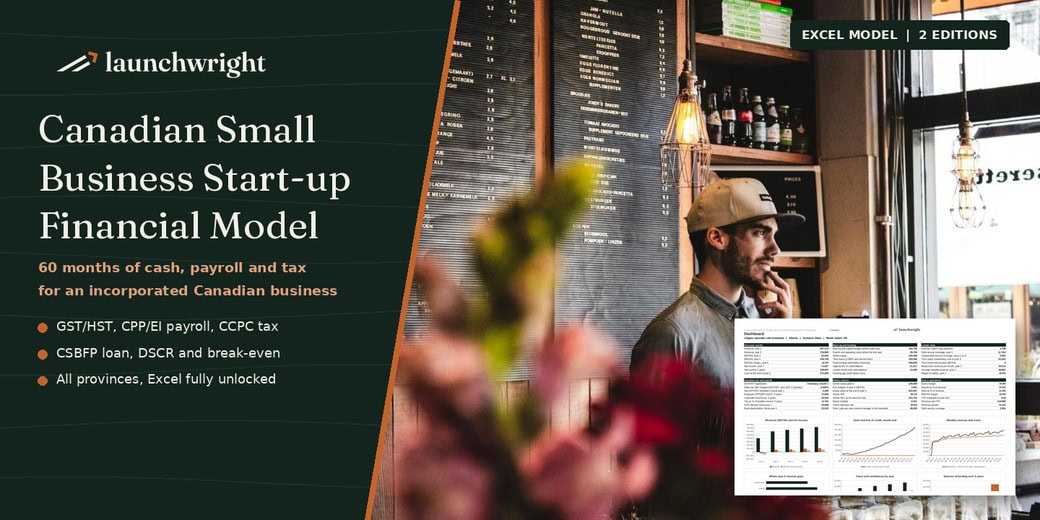
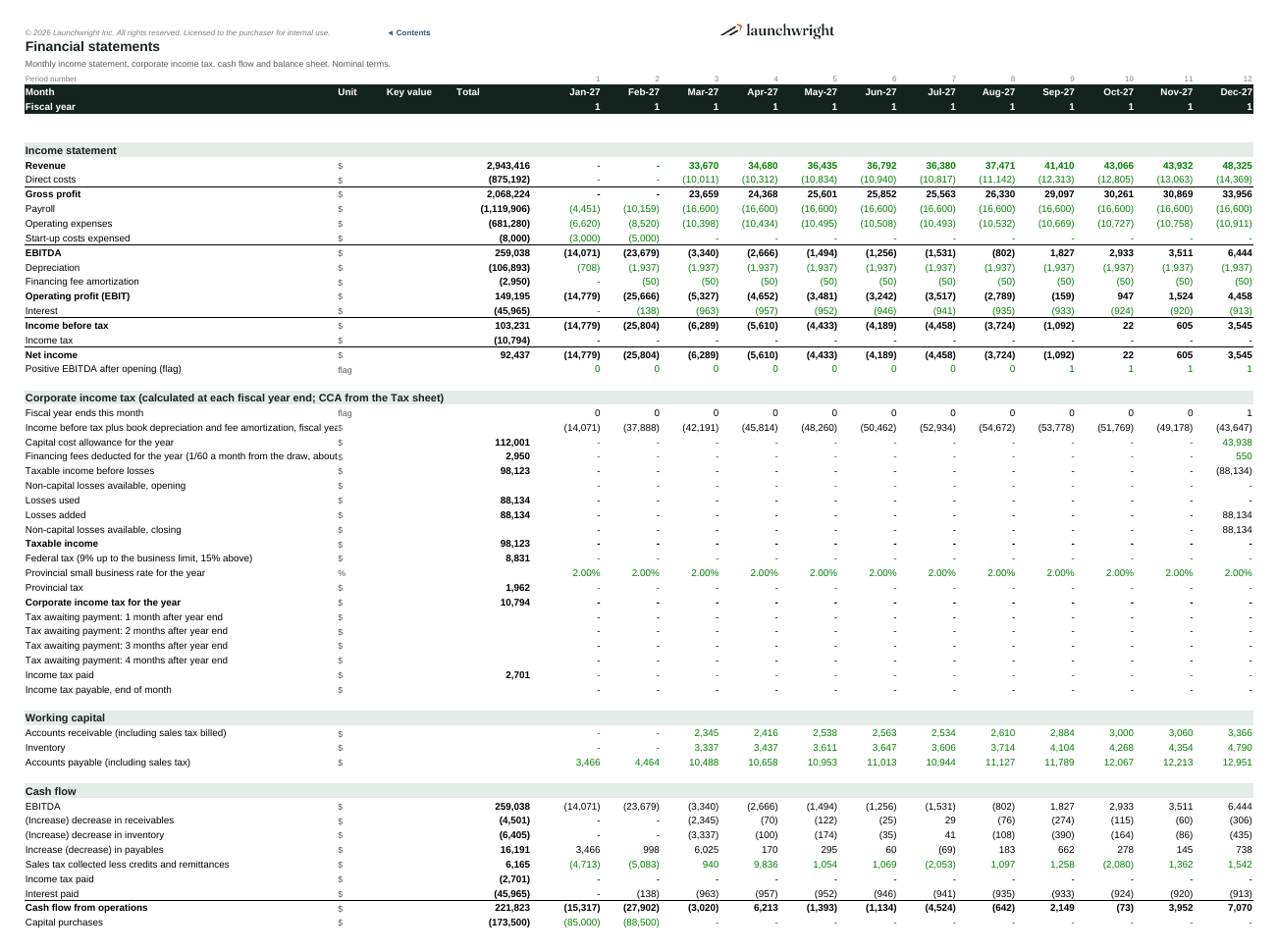
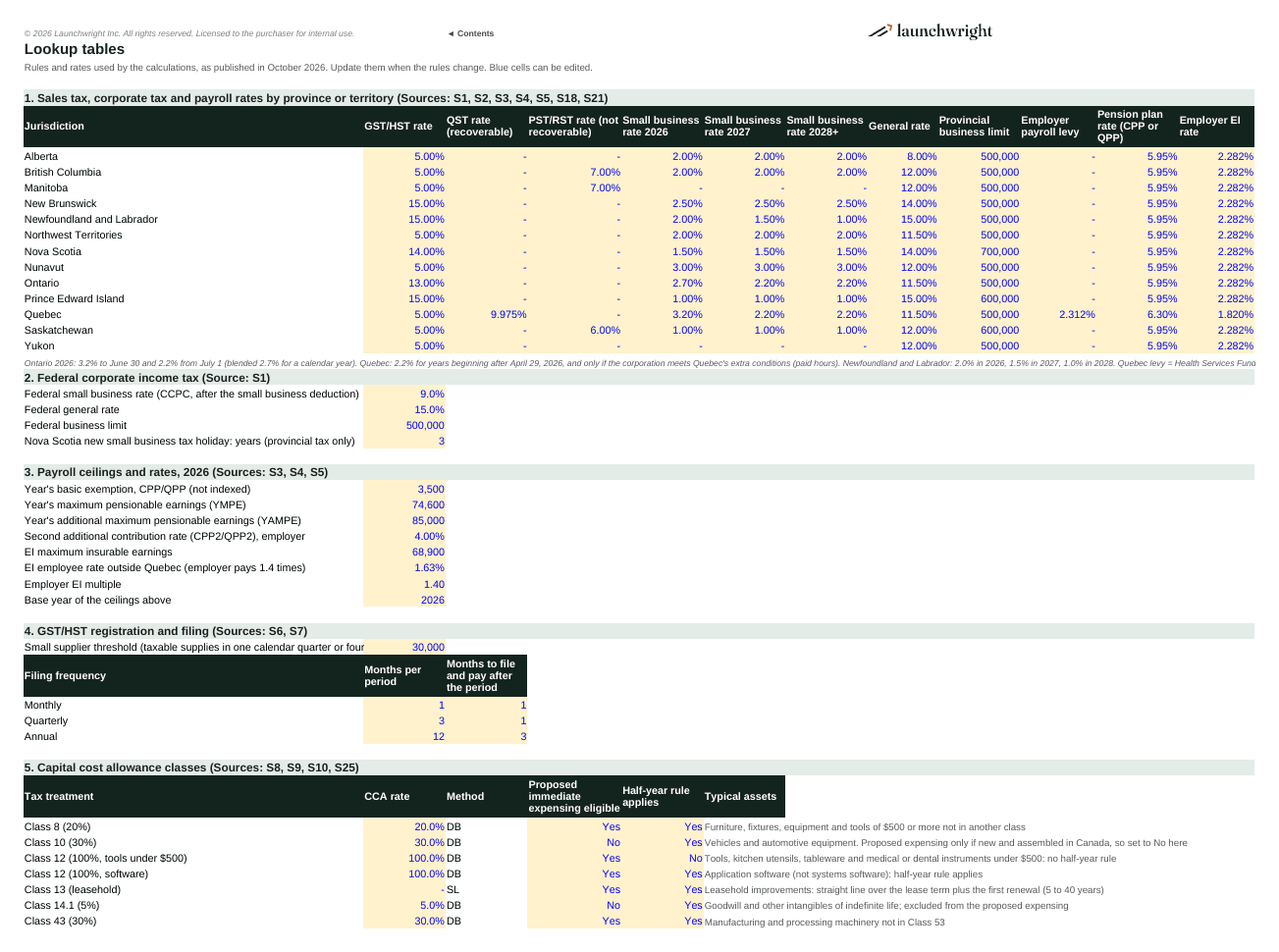
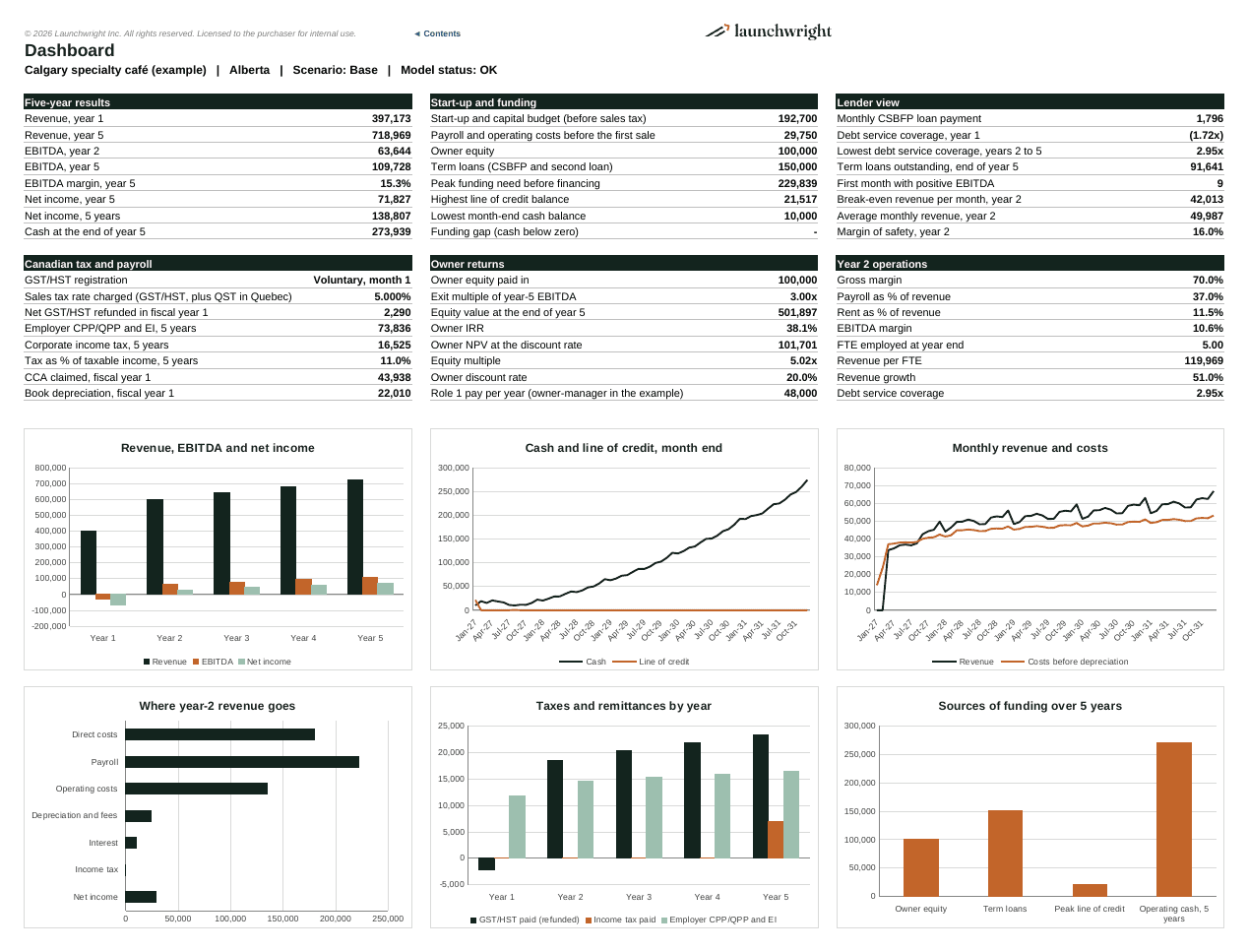
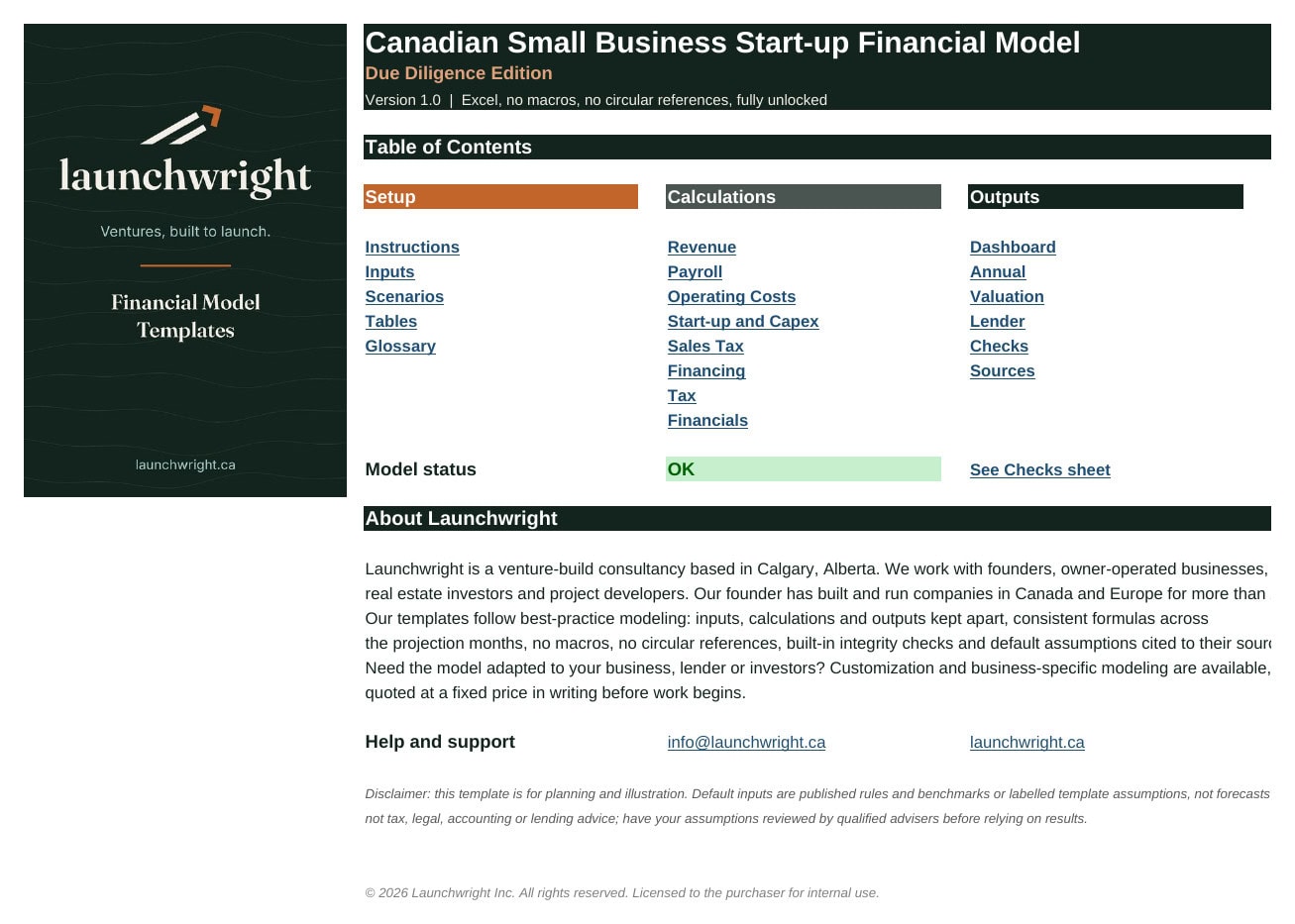
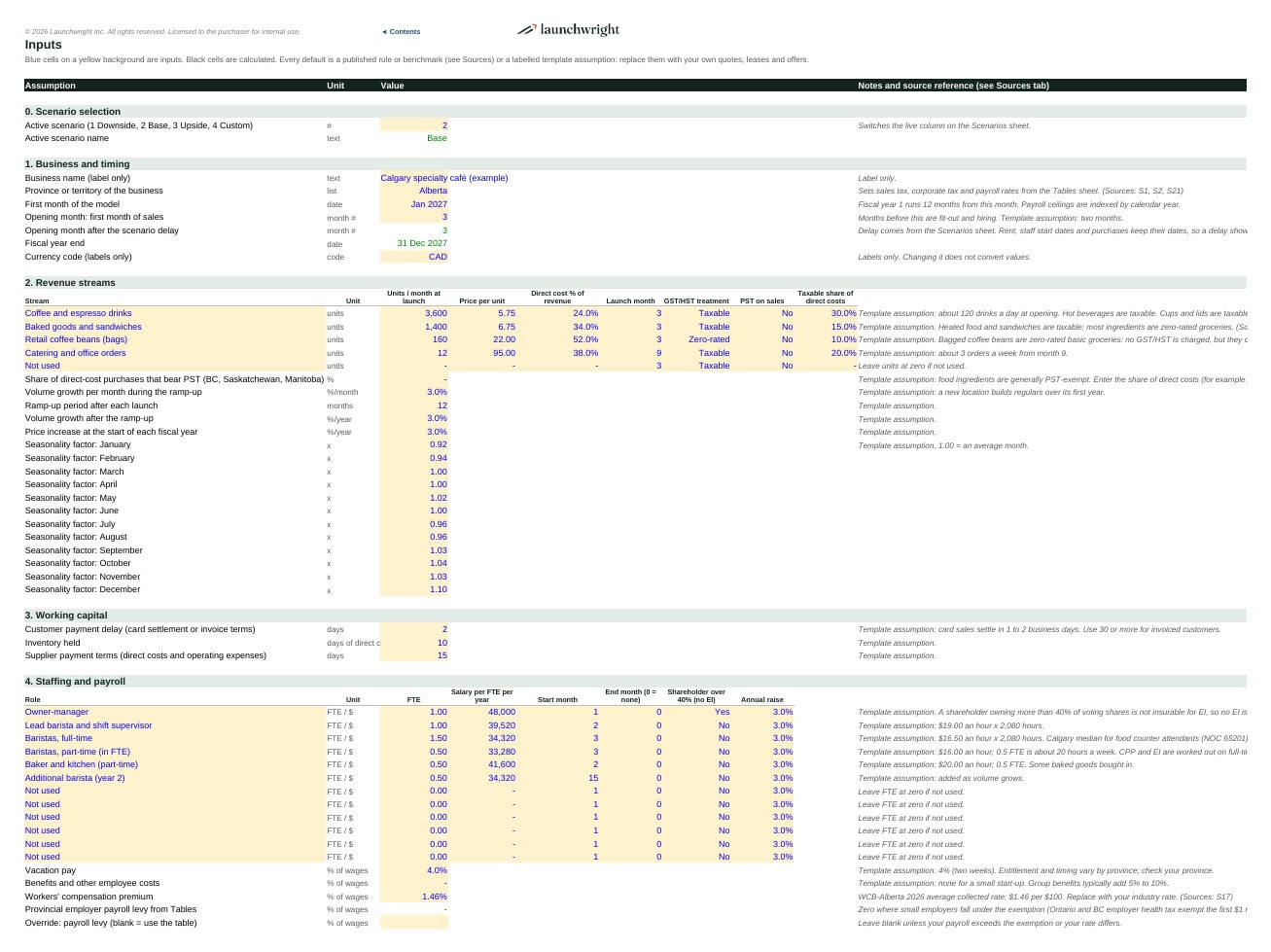
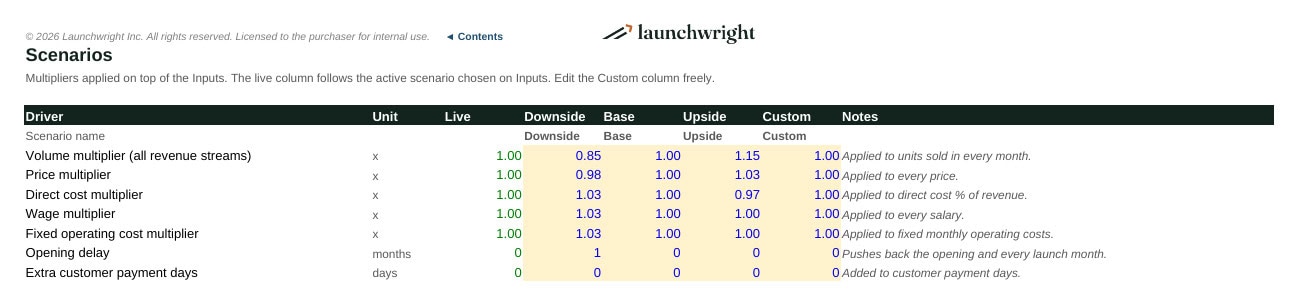
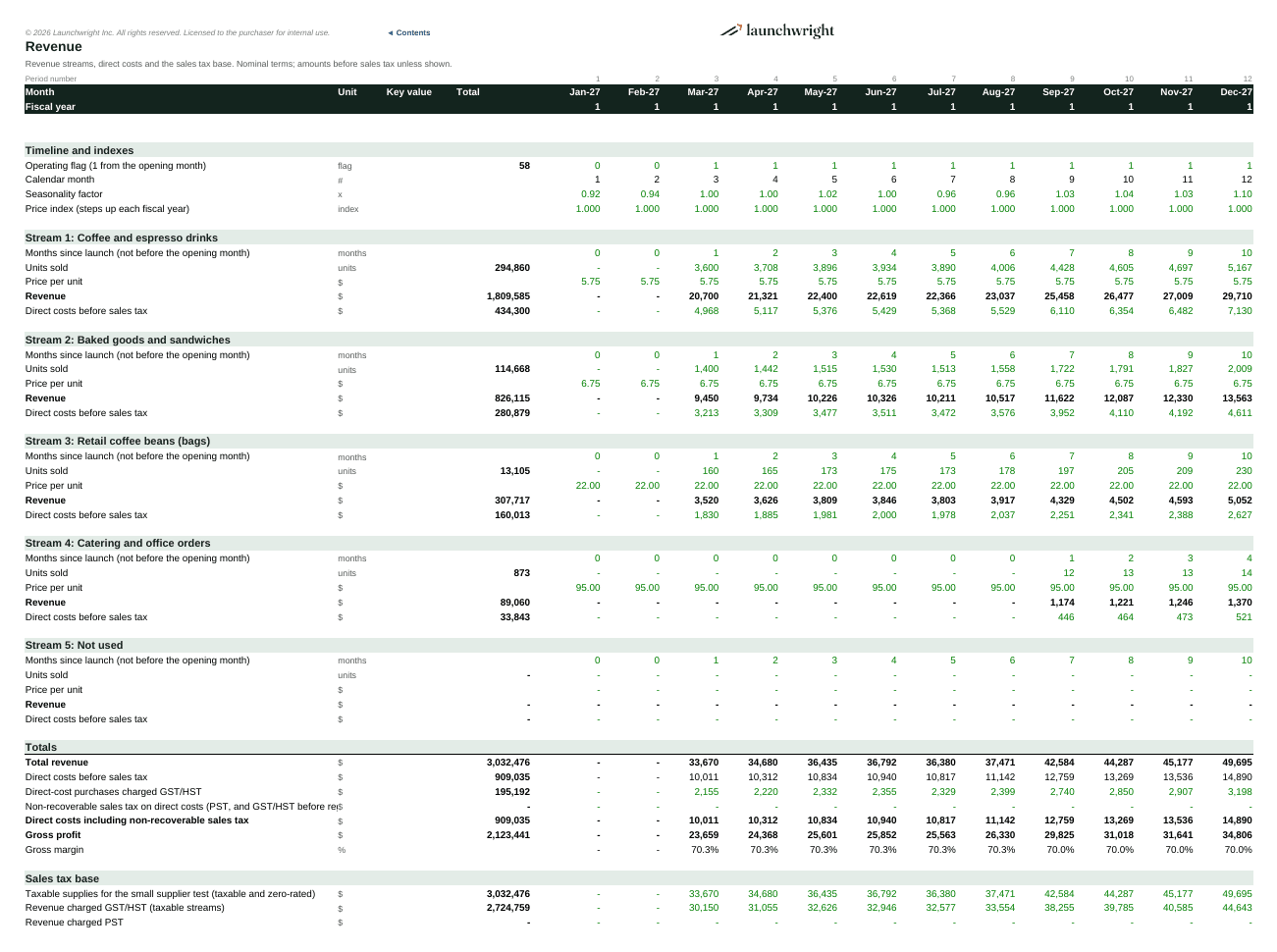
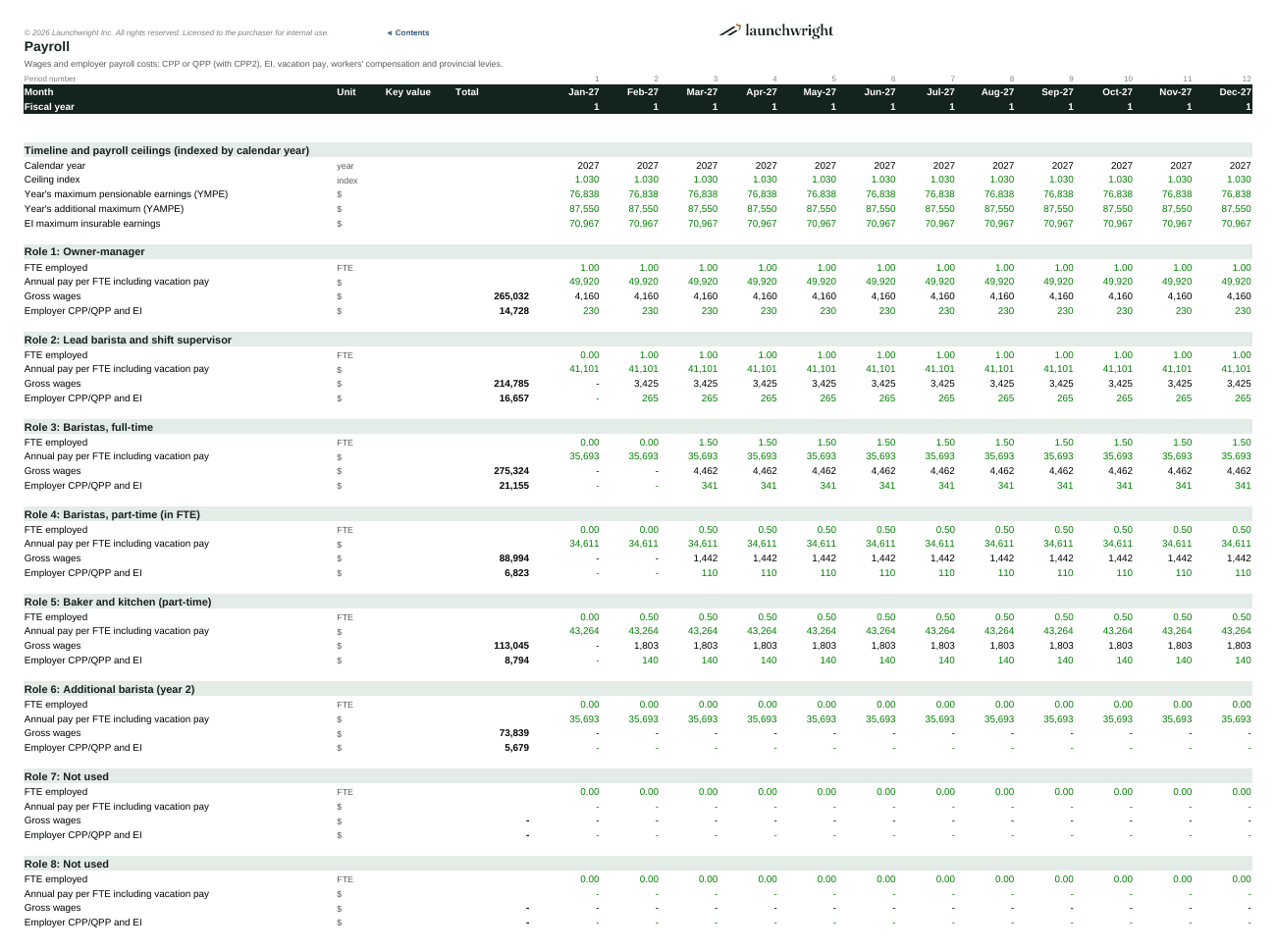
Starting a business in Canada? Generic startup templates leave out the rules that decide whether a Canadian business has cash in month six: when you must start charging GST/HST, how input tax credits on your fit-out come back, what CPP and EI really add to payroll, how the small business deduction and capital cost allowance change your tax, and what a Canada Small Business Financing Program loan costs. This Excel model builds all of that into a 60-month plan for an incorporated small business, in any province or territory.
Why this model
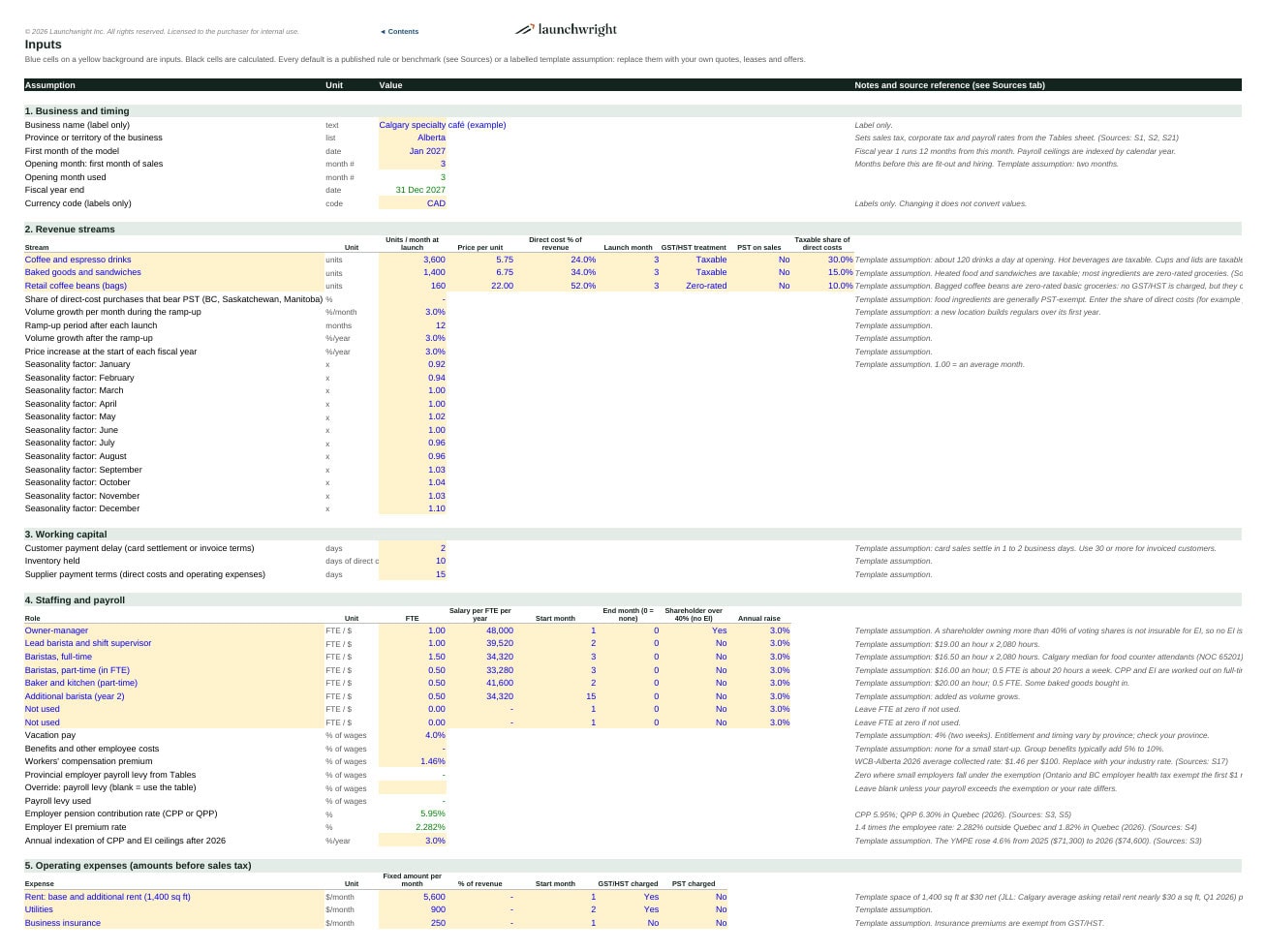
Choose your province and the model applies its sales tax, corporate tax and payroll rates. Every default is a published 2026 Canadian rule or a cited benchmark, listed on a Sources tab, so you can see where each starting value comes from before you replace it. The example is a Calgary café with three revenue streams, including a zero-rated one, so you can see every rule work with real numbers.
Canadian rules built in
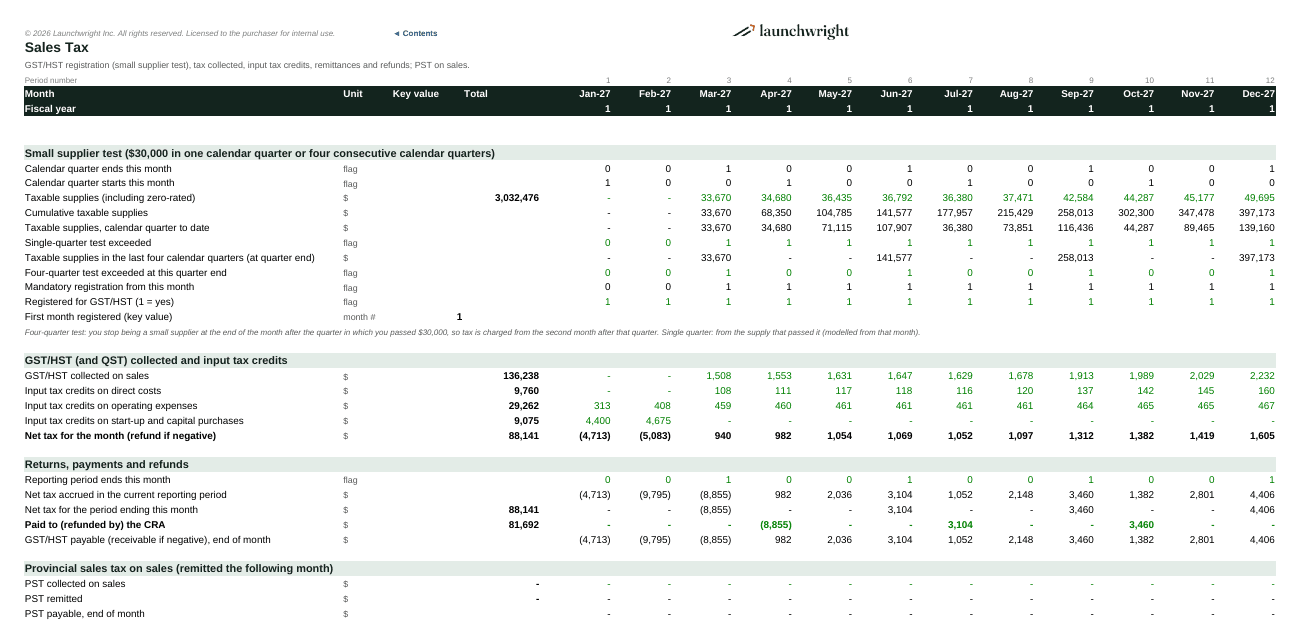
- GST/HST small supplier test: $30,000 in one calendar quarter or four consecutive quarters, with the correct month you must start charging tax, or voluntary registration from day one
- Taxable, zero-rated and exempt sales; input tax credits; monthly, quarterly or annual filing with the matching payment and refund timing; HST, QST and non-recoverable PST
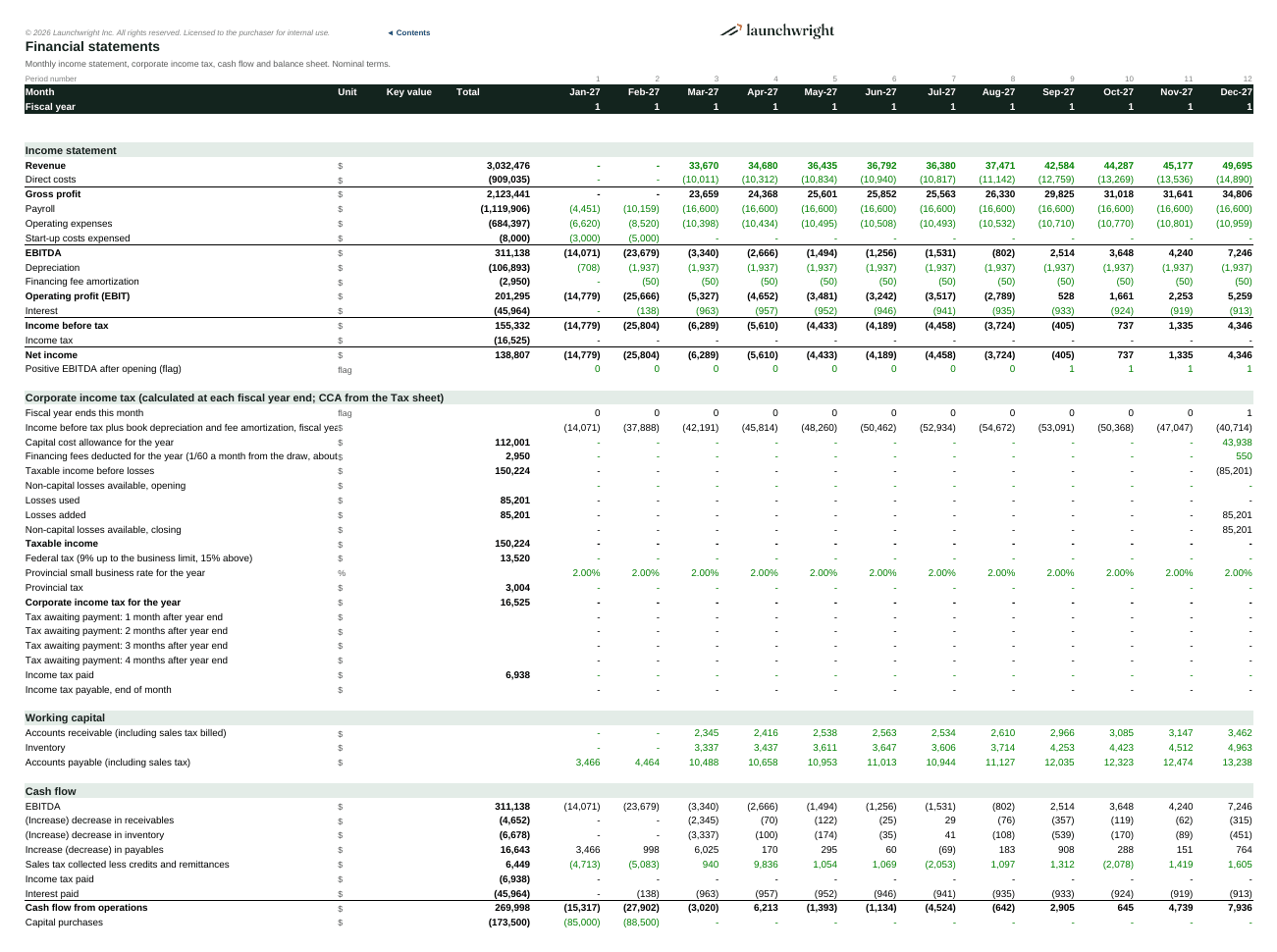
- Employer CPP or QPP with the 2026 ceilings and CPP2, EI at 1.4 times the employee rate, no EI for shareholders over 40%, vacation pay, workers’ compensation and provincial payroll levies
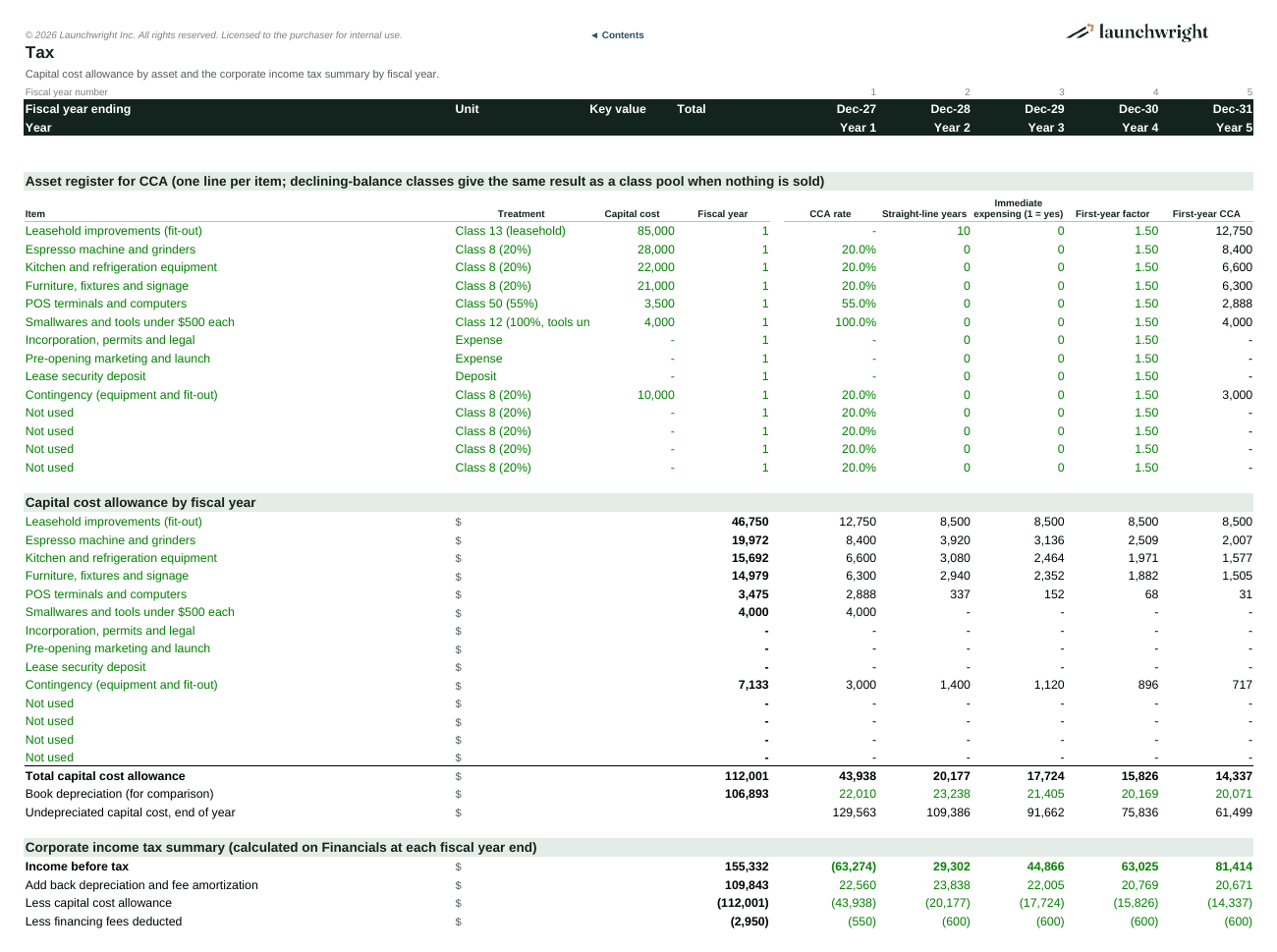
- Corporate tax for a Canadian-controlled private corporation: 9% federal plus the provincial small business rate up to the business limit, the general rate above it, rates that change by year, loss carryforward and the 3-month balance-due date
- Capital cost allowance by asset: the Accelerated Investment Incentive, the proposed September 2026 immediate expensing, or the half-year rule; Class 13 leaseholds over the lease term
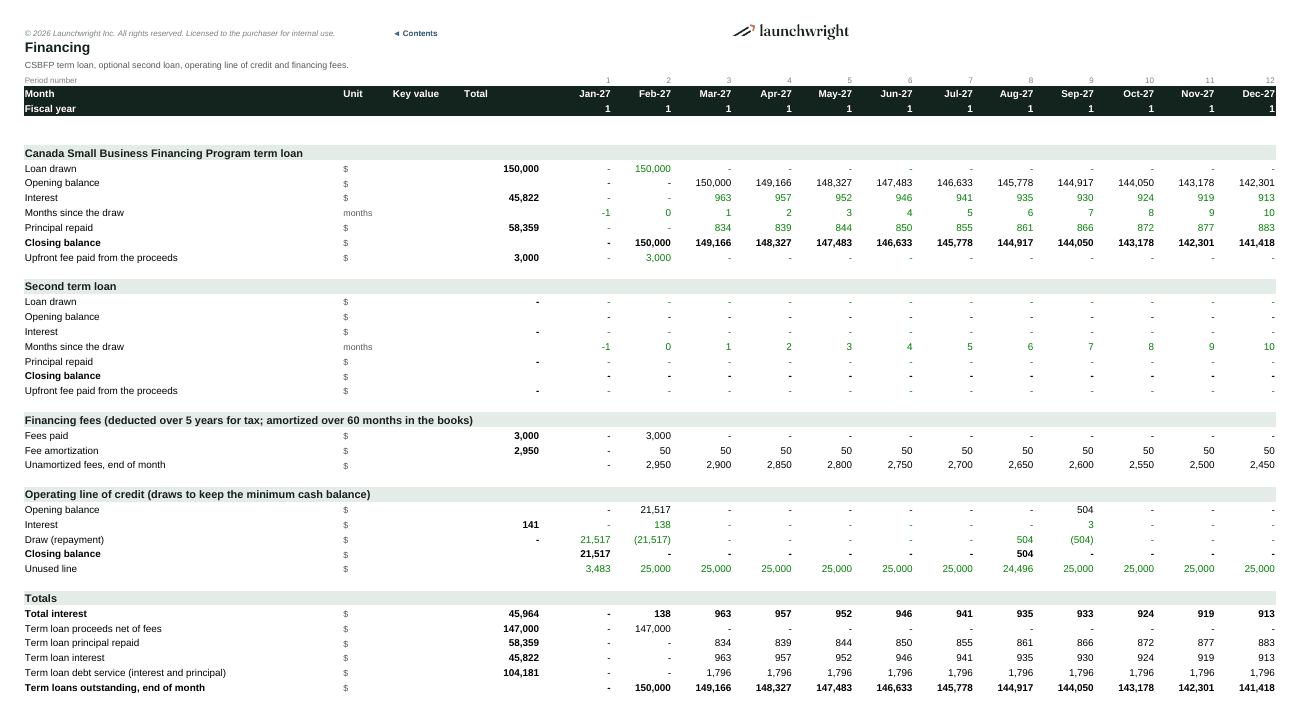
- CSBFP term loan: 2% registration fee, prime plus up to 3%, the $500,000 non-real-property limit, plus an operating line that draws and repays automatically
Two editions
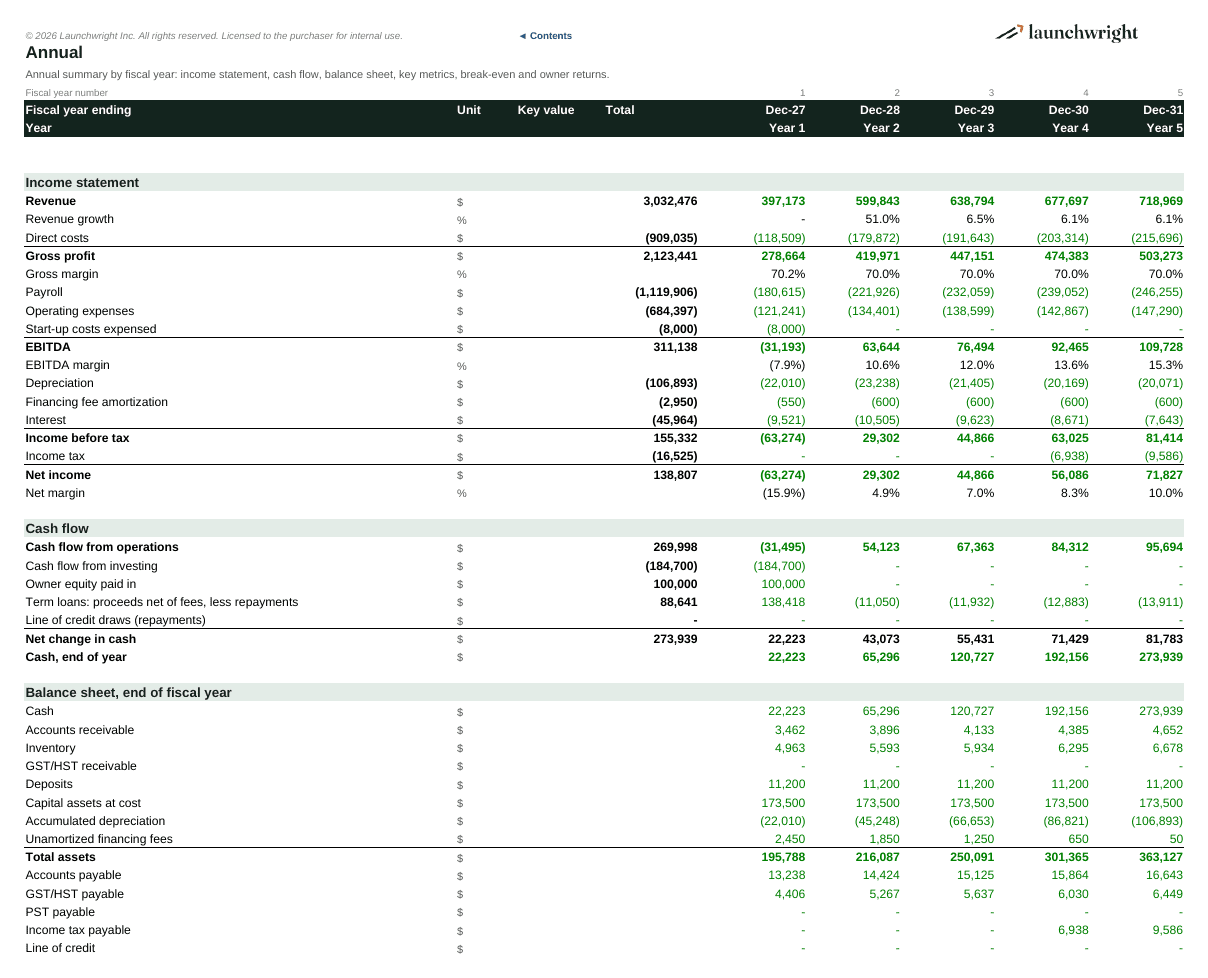
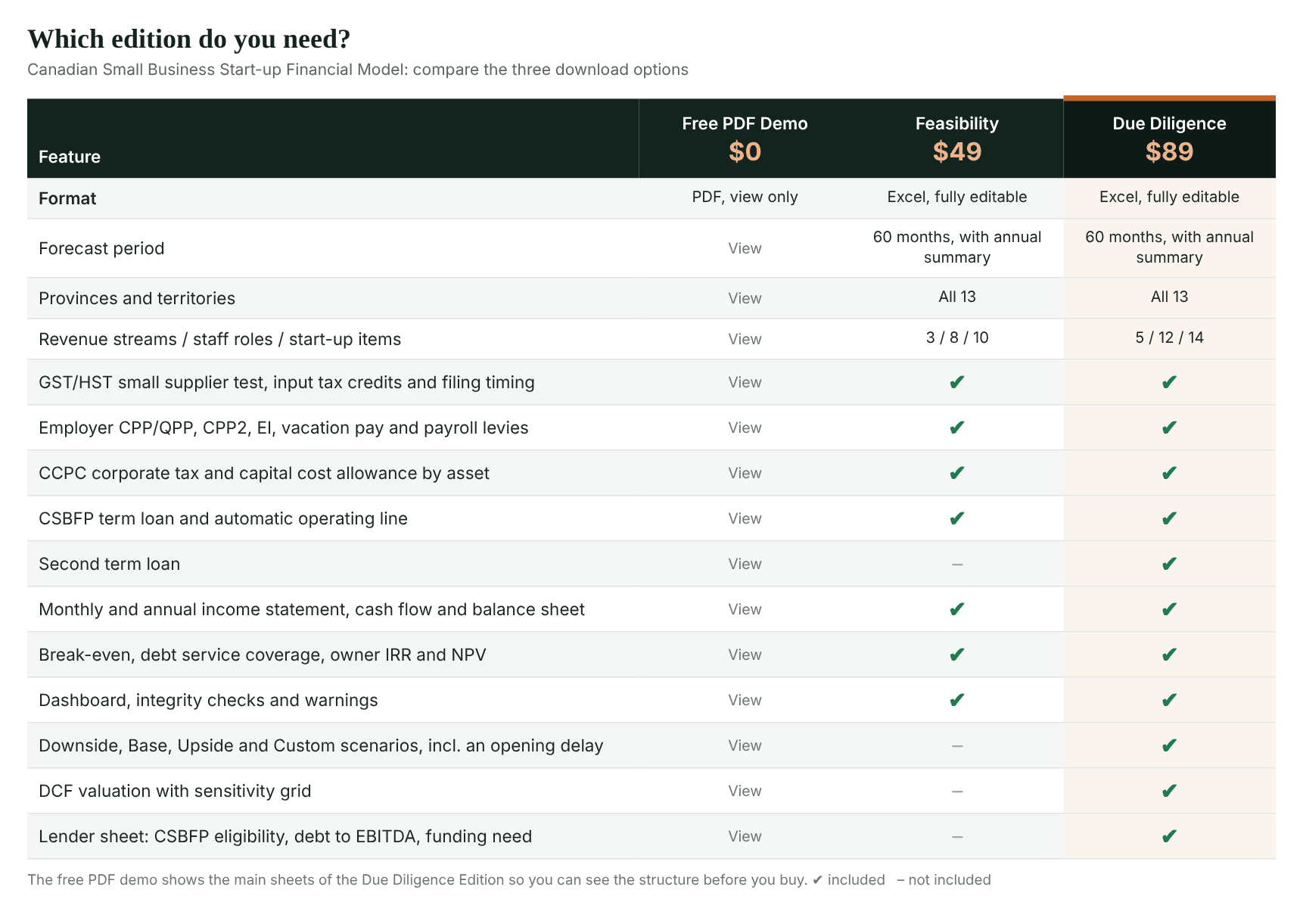
- Feasibility Edition: 60 monthly columns with up to 3 revenue streams, 8 roles, 12 expense lines and 10 start-up items. It has the full GST/HST, payroll, CCA and corporate tax logic, the CSBFP loan and line of credit, an income statement, cash flow and balance sheet, an annual summary, break-even, debt service coverage, owner returns, a dashboard and integrity checks.
- Due Diligence Edition: everything in the Feasibility Edition, plus:
- Downside, Base, Upside and Custom scenarios for volume, price, costs, wages and an opening delay
- up to 5 revenue streams, 12 roles and 14 start-up items, and a second term loan
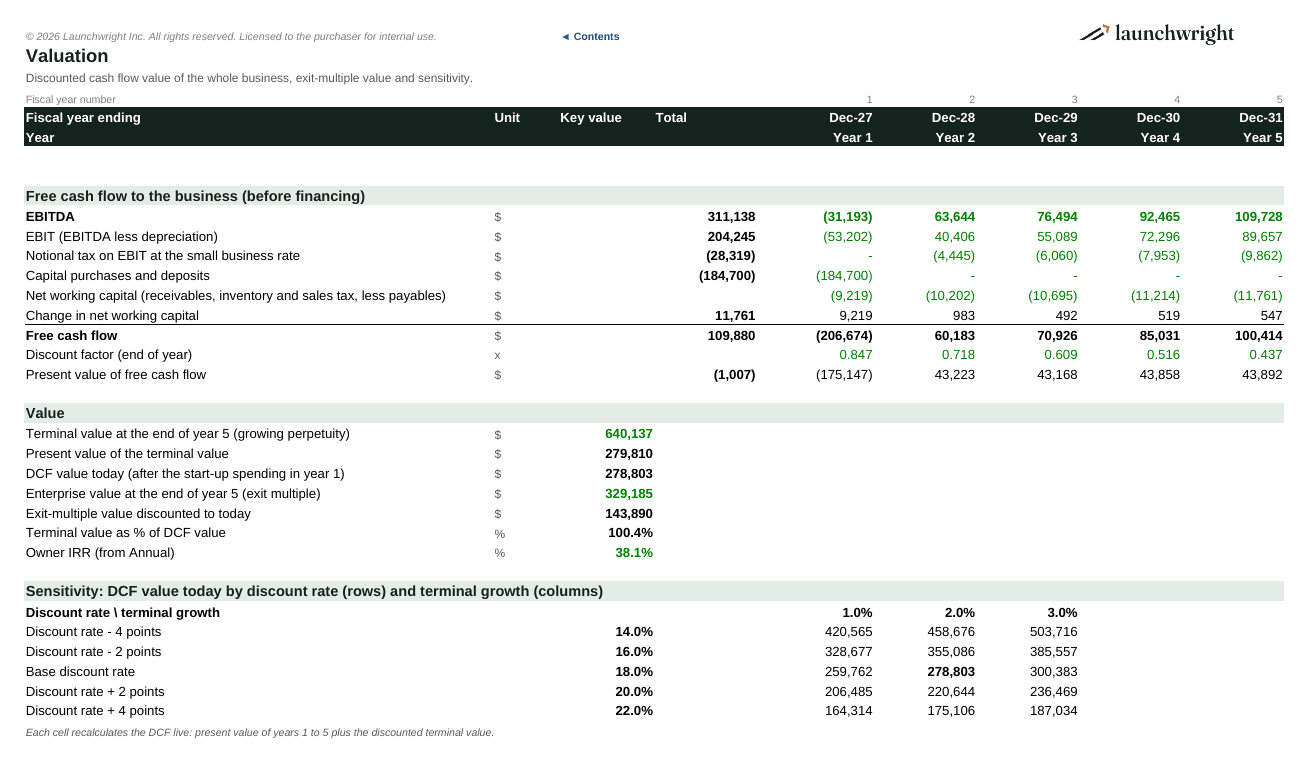
- DCF valuation with a live discount-rate and growth sensitivity grid
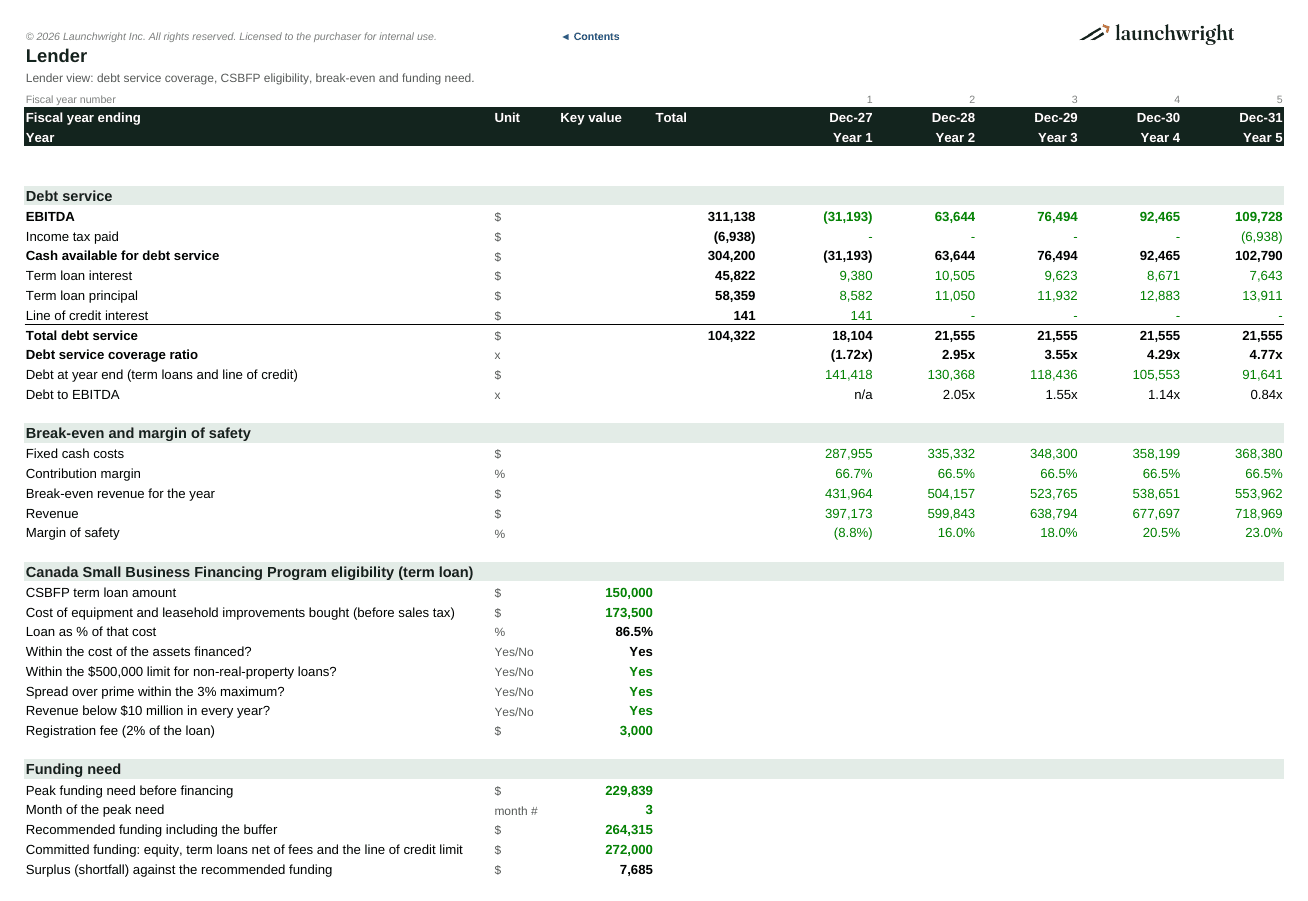
- a lender sheet with debt service coverage, debt to EBITDA, CSBFP eligibility tests, break-even and the funding need with a buffer
Key outputs
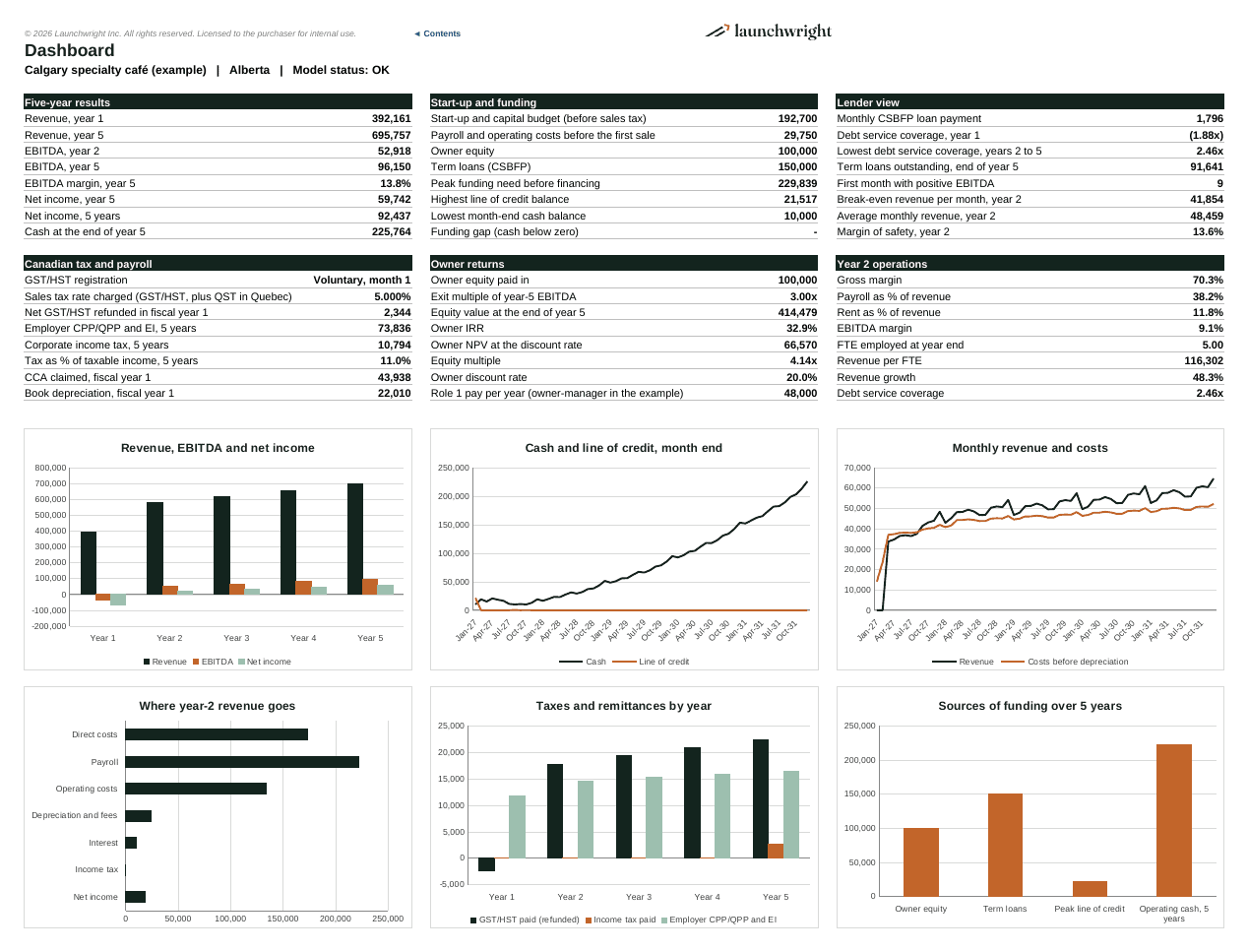
- Start-up budget, operating costs before the first sale, peak funding need and the lowest cash balance, with the month it happens
- Monthly revenue, costs, EBITDA and cash; the first month of positive EBITDA; annual income statement, cash flow and balance sheet
- GST/HST registration month, refunds and remittances; employer CPP/EI; corporate tax and CCA by year
- Debt service coverage, break-even revenue per month and margin of safety
- Owner IRR, NPV and equity multiple at an exit multiple of EBITDA
- Dashboard charts: revenue and EBITDA by year, monthly cash and line of credit, revenue against costs, cost structure, taxes by year and funding sources
Built to modeling best practice
- Inputs, calculations and outputs on separate sheets; color-coded inputs (blue on yellow), formulas (black) and cross-sheet links (green)
- One formula per row across all 60 months; no macros, no circular references, no hidden or protected sheets, no external links
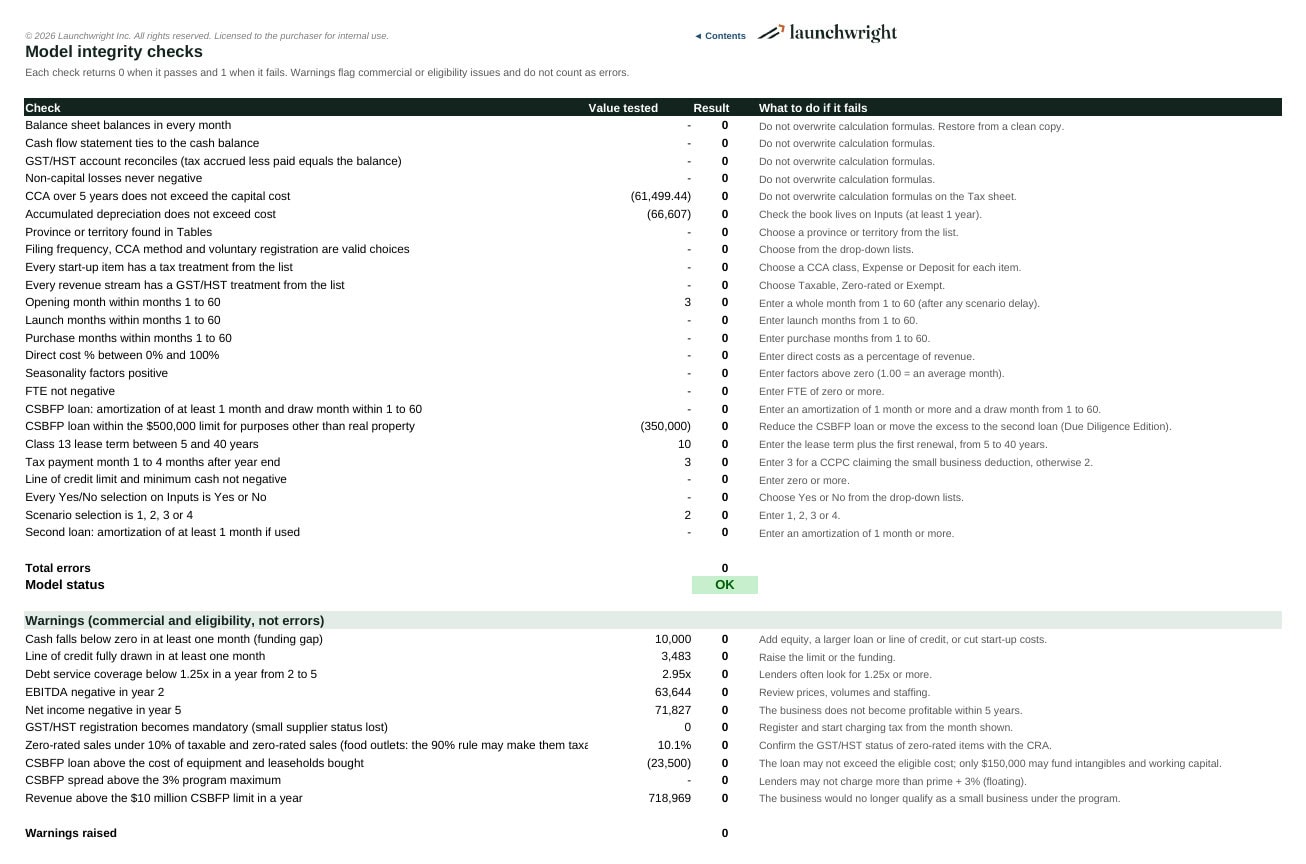
- Checks sheet confirms the balance sheet balances every month, cash flow ties, the GST/HST account reconciles, CCA never exceeds cost and every selection is valid; warnings flag funding gaps, weak coverage and CSBFP limits
- Contents sheet, step-by-step instructions, a glossary and a full source list
Default assumptions
Defaults describe a Calgary specialty café opening in month 3. Its start-up budget is $192,700, funded by $100,000 of owner equity, a $150,000 CSBFP loan at prime plus 3% and a $25,000 operating line. Rent is based on JLL’s Q1 2026 Calgary retail average and wages on Job Bank’s Calgary median for counter staff. In the Feasibility Edition, revenue grows from $392,161 in year 1 to $695,757 in year 5. EBITDA turns positive in month 9, and debt service coverage is at least 2.46x from year 2. The Due Diligence Edition adds a catering stream. Replace the defaults with your own quotes, leases and offers.
Compare the editions
The free PDF demo, the Feasibility Edition ($49) and the Due Diligence Edition ($89) side by side:
What you get
- One Excel workbook (.xlsx) for the edition purchased, built only with functions available since Excel 2010 (no dynamic arrays, no macros)
- A free PDF demo showing the main sheets of the Due Diligence Edition
Support and customization
Questions about how the template works are answered by email. Launchwright can also adapt the model to your business, lender or investors, quoted at a fixed price in writing before work begins. Contact details are inside the model.
Important
This template is for planning and illustration. It is not tax, legal, accounting or lending advice. Tax rules and rates change; the proposed immediate expensing is draft legislation. Confirm your situation with your accountant and lender.
Similar ProductsOther customers were also interested in...



 eFinancialModels
Electric Vehicle (EV) Charging Station Financial M...
With this comprehensive 5- or 10-year monthly tool, investors can assess the viability of setting up... Read more

Financial Model for Mobile App | Mobile App Busine...
The Mobile App Financial Plan Template in Excel allows you to develop financial projections when lau... Read more

 HenrySheykin
Food Truck Financial Model Excel Template
The Food Truck Financial Model helps entrepreneurs, founders, business owners, consultants, and anal... Read more

Green Hydrogen Production from Wind Energy Financi...
The Green Hydrogen from Wind Financial Model aims to comprehensively forecast a horizon of 40 years ... Read more

Simple Mutual Non-Disclosure Agreement Template
Protect your business secrets with ease using our Simple Mutual Non-Disclosure Agreement Template. S... Read more

Solar Energy Financial Model
The Solar Energy Financial Model Spreadsheet Template in Excel assists you in preparing a sophistica... Read more

 Peter Graf
The Customer-Centric Financial Model for Restauran...
Starting a restaurant without a financial plan is like driving a car blindfolded. You wouldn´t do i... Read more
You must log in to submit a review.