
0 ITEMS

Beverage Manufacturing Start-Up Financial Model
The beverage manufacturing industry is a dynamic and rapidly growing sector that caters to a diverse market ranging from soft drinks and juices to alcoholic beverages. A comprehensive, diversified 10-year financial model template is essential for any beverage manufacturing startup aiming to achieve long-term success.
This template provides a detailed roadmap for financial planning, helping entrepreneurs and investors project volume sales for up to 150 market segments distributed to different channels. The model also helps investors understand and manage cash flow, and make informed decisions. By leveraging a robust financial model, businesses can identify potential risks and opportunities, optimize resource allocation, and strategize for sustainable growth.


With consumers increasingly seeking new flavors and health-oriented options, a significant demand exists for innovative and diverse beverage products. Investing in a beverage manufacturing startup can yield substantial returns, especially for those who innovate and effectively manage their operations.
Investing in a beverage startup requires strategic foresight and meticulous planning to navigate market dynamics and ensure profitability. This 10-year financial model equips investors with critical insights into revenue projections, cost structures, and cash flow management, enabling informed decision-making.
The model effectively empowers investors to evaluate the business’s viability and growth prospects by providing a comprehensive view of potential returns and financial risks. With detailed forecasts and investment strategies, this model is essential for investors looking to maximize returns and minimize risks in the competitive beverage industry.
Explore our latest video walkthrough of the Beverage Manufacturing Startup Financial Model and learn how to master financial planning:
Key Insights to Unlock Your Beverage Business Potential
Understanding the intricacies of beverage manufacturing is essential for success. This financial model template is designed to answer critical questions that guide strategic planning and operational decisions.
- Beverage Products: What types of beverage products will maximize market penetration and profitability?
- Monthly Production Volume Schedule: How can production be scheduled to align with sales forecasts and beverage industry statistics?
- Production Volume Capacity: How can production be scaled to meet growing demand?
- Pricing Strategy: How does the beverage manufacturing template enable investors to optimize pricing strategies across different SKUs and market segments to enhance financial gains?
- Investment Requirements: What is the initial beverage company startup costs and capital expenditures, and what are the investment requirements for scaling operations?
- Direct Cost Breakdown: What are the primary cost drivers, and how can direct and operating expenses be minimized for better profit margins?
- Cash Flow: What are the projected cash flows, and how can they be managed to ensure financial stability?
- Debt Financing: What are the best strategies for leveraging debt to fuel growth?
- Equity Financing: How can equity financing be structured to attract investors and maximize company profit?
- Investors’ Return: What funding strategies will attract and retain investor interest?
- Scenario Analysis: Explore scenarios and see how key assumptions impact the financial plan and metrics in real-time.
Comprehensive Path to a Successful Beverage Manufacturing Start-Up
This financial model template offers a structured approach to understanding the financial dynamics of a beverage manufacturing business. Each feature is meticulously crafted to provide actionable insights and strategic guidance.
The Excel spreadsheet template offers a bottom-up approach that encompasses every aspect of the financial planning needs of a Beverage Manufacturing Startup Business.
1. Revenue Model
The model foresees revenue from the Beverage sales volume per market segment and other sources of income.
- Beverage Packaging Size – Identify up to 5 types of beverage packaging sizes and their respective volume units to align with consumer preferences and maximize sales.
- Stock Keeping Units (SKUs) and Beverage Types – Categorize up to 40 beverage types to enhance product management and marketing strategies.
- Product Type – Identify and categorize SKUs into up to 2 product types to reflect product diversification. The model also allows users to decide whether a product will be included in the forecast, helping them analyze each product type individually and as part of the overall product mix.
- Forecasting Beverage sales by market segment allows you to identify and analyze the impact of different growth and pricing opportunities when selling to distribution channels such as retailers, wholesalers, direct consumers, ecommerce shops, and exports.
- Multiple Dimensions to Analyze Sales by Market and Beverage Type – Gain a comprehensive view of up to 150 market segments and their sales performance, allowing for informed business decisions.
- Beverage Sales Volume is divided into a 3-phase growth model. You can define the start and duration of Phase 1, set the initial volume, and adjust the volume growth for each phase. While these are default assumptions, the model allows full customization of the assumptions for the entire 120-month forecast period.
- Pricing Strategy – Developing competitive pricing strategies is fundamental for optimizing beverage prices and driving profitability. The beverage manufacturing template enables investors to fine-tune these strategies across different SKUs, market segments, and distribution channels, enhancing financial gains and ensuring a competitive edge.
- Cost Plus Analysis – This approach helps better set prices by ensuring it covers all costs and generates a profit margin. It provides a simple and transparent pricing structure that accounts for direct costs and operating expenses, with adjustments for market conditions through the markup percentage.
- Other Income – Explore additional revenue streams beyond traditional beverage offerings, such as licensing income.
2. Cost Structure Analysis
Optimize direct costs, employee costs, and Operating Expenses (OPEX) to enhance efficiency.
- Startup Expenses – Identify up to 10 startup expenses for Year 0 and the first 9 months of Year 1. Proper planning of these non-capex costs is crucial for managing cash flow and ensuring a smooth business launch.
- Direct Costs – Consider the different direct costs to which each market segment and beverage type may be subject. These include different beverage costs such as direct labor, ingredients, wastage allowance, packaging, logistics, and storage.
- Employee Costs – Understand the impact of direct and indirect labor.
- Operating Expenses – Determine up to 21 OPEX of the beverage manufacturing business.
3. Expansion of Beverage Production Capacity
The model includes an initial and four expansion plans for beverage volume production capacity. Gain insights on how much additional capital expenditure is needed and if the beverage production capacity is sufficient to meet the sales volume, ensuring optimal utilization.
4. Debt Schedule
- Identify up to six debt financing sources and forecast debt drawdown schedules, interest rates, and repayment terms.
- Presents financial ratios and analyses to banks and investors, demonstrating the project’s financial viability.
5. Multiple Fundraising Rounds
- The template offers the option to plan multiple funding rounds (depending on the model version) from Equity Investors.
- This feature allows users to split the required financing requirements into funding phases such as Seed, Series A, Series B, and Series C and understand their effects on the implied Pre- and Post-Money Valuations, Dilution of Equity Shareholders, and anticipated returns of investors.
- The model also calculates expected investor returns based on a cash flow forecast at the investor level.
6. Historic Financials
Input historical financial data to enhance future projections and support informed financial decision-making.
7. Ten-Year Financial Forecast
- Detailed Operations Schedule: This section delves into details with breakdowns of the revenue model, direct costs forecast, gross profit analysis, and operating expenses.
- 2-years of Monthly Budgets – The model develops a monthly bottom-up financial forecast for the first two years of the forecast horizon. This lets you understand your budget and multi-year forecast of Beverage sales volumes, relevant costs, and financial statements.
- Financial Statements Projection: The spreadsheet is designed logically, outlining the calculations of the Beverage manufacturing business revenues and costs, which adds to the transparency and understanding of the model. This then results in forecasted financial statement projections –
- Financial Statements: Income Statement, Balance Sheet, Cash Flow Statement, and Financial Ratios
- Forecasted Business Valuation: The valuation is divided into Business and Property values. This approach enables investors to optimize their exit value through potential sale and leaseback scenarios at exit.
* Weighted Average Cost of Capital and Discount Rate: The model includes a WACC calculator that estimates a company’s Discount Rate (or its cost of capital) by analyzing the target financing structure of equity and debt and their cost of capital.
- Free Cash Flow Projections: Unlevered and levered cash flow projections are provided. The differentiation between levered and unlevered allows users to understand how much debt financing affects the expected project and investor returns.
- Funding Amount, Uses and Sources of Funds and Financial Metrics: The model calculates the required financing amount to execute your business plan, provides a suggested breakdown of uses and sources of funds and the resulting financial metrics of your business plan: Internal Rate of Return, Cash on Cash Yield, Payback Period, Net Present Value (NPV).
8. Executive and Detailed Summary
Contains tables and charts that illustrate the result of the projected financial plan and allow for deep analysis.
- Financial Statements
- Significant Financial Ratios
- Financial Debt Summary
- Initial and Expansion of CAPEX Schedule
- Revenue Breakdown and Pricing Strategy
- Beverage Sales Volume by Beverage Type and Distribution Channel
- Beverage Production Capacity Utilization
- Gross Profit Margin Breakdown
- Costs Breakdowns
- Cash Flow Statements
- Business and Property Forecasted Valuation
- Financial Metrics including IRR, NPV, and funding and payback periods.
- Uses and Sources of Funds
- Investor Returns Analysis
9. Break-Even Analysis
Calculate the required Beverage sales volume (SKUs) and the average price to break even at an EBIT level in a chosen year.
10. Scenario Analysis
An Executive Summary provides a set of scenario parameters that enable users to simulate essential changes in key assumptions quickly. This functionality allows users to directly observe the impact on the resulting financial plan and its key metrics, allowing them to explore a nearly limitless number of scenarios to understand the range of potential outcomes better.
The Excel model analysis tool was developed to provide a solid understanding of how assumptions will impact the financial performance of a beverage manufacturing business. It allows for modeling countless financial scenarios, equipping entrepreneurs with the tools to navigate the industry’s complexities. Improve your financial decision-making today using this comprehensive spreadsheet template to achieve business success.
Seize Opportunities: Who Can Benefit from This Beverage Manufacturing Template?
This template is designed for entrepreneurs launching a beverage business who need a detailed financial plan for rollout and fundraising. It’s also perfect for established companies seeking to expand, raise additional capital, or prepare for a sale.
The beverage manufacturing financial model offers a comprehensive bottom-up forecast that includes volume and pricing projections by market segment, considers different pricing strategies, and aids in capacity planning. The template also supports modeling multiple fundraising rounds and estimating business valuation at exit. Additionally, it allows for quick scenario simulations, enabling users to understand key value driver sensitivities effectively.
Propel Your Beverage Business Forward: Try This Template Now
Starting a beverage manufacturing venture is an exciting journey that demands a deep understanding of both the art of manufacturing and the science of financial management. This template enables beverage startups to navigate the complexities of financial planning, paving the way for sustainable growth and profitability.
The financial model template comes pre-filled with an example forecast of a Beverage Manufacturing Startup to illustrate clearly how the spreadsheet works. The forecast can be easily changed by altering the assumptions in blue and light blue font color.
The fully editable Excel model is currently in version 5.3. A free downloadable PDF demo version is available to help you understand the model structure.
File Types:
.xlsx (MS Excel)
.pdf (Adobe Acrobat Reader)
Gain an edge in fundraising or launch a successful beverage manufacturing business with a robust 10-year financial model. This model supports your business plan, secures funding, and provides comprehensive financial analysis to unlock your business’s full potential amidst rising demand and innovative offerings. Create your blueprint for long-term profitability and scalability in this competitive market.
Similar ProductsOther customers were also interested in...



 eFinancialModels
Liquor Distillery Financial Plan Template
Distilleries, with their rich history of crafting spirits, have experienced a resurgence in populari... Read more
Manufacturing Financial Model Templates Bundle
This is a collection of financial model templates in Excel for businesses in the Manufacturing indus... Read more
 HenrySheykin
Micro Distillery Business Plan Financial Model Exc...
The Micro-Distillery Financial Model helps founders, operators, consultants, analysts, and business ... Read more
 David
Manufacturing Startup/Existing Business Financial ...
3 statement 5 year rolling financial projection Excel model for a startup /existing manufacturing bu... Read more
Brewery Business Plan Financial Model Excel Templa...
The Brewery Financial Model helps founders, brewery operators, consultants, and analysts turn a brew... Read more
 Giorgos
Fruit Processing Facility – 10 Year Financia...
Financial Model providing a dynamic up to 10-year financial forecast for a startup Fruit Processing ... Read more
Microbrewery – 10 Year Financial Model
Financial Model providing a dynamic up to 10-year financial forecast for a startup or existing Micro... Read more
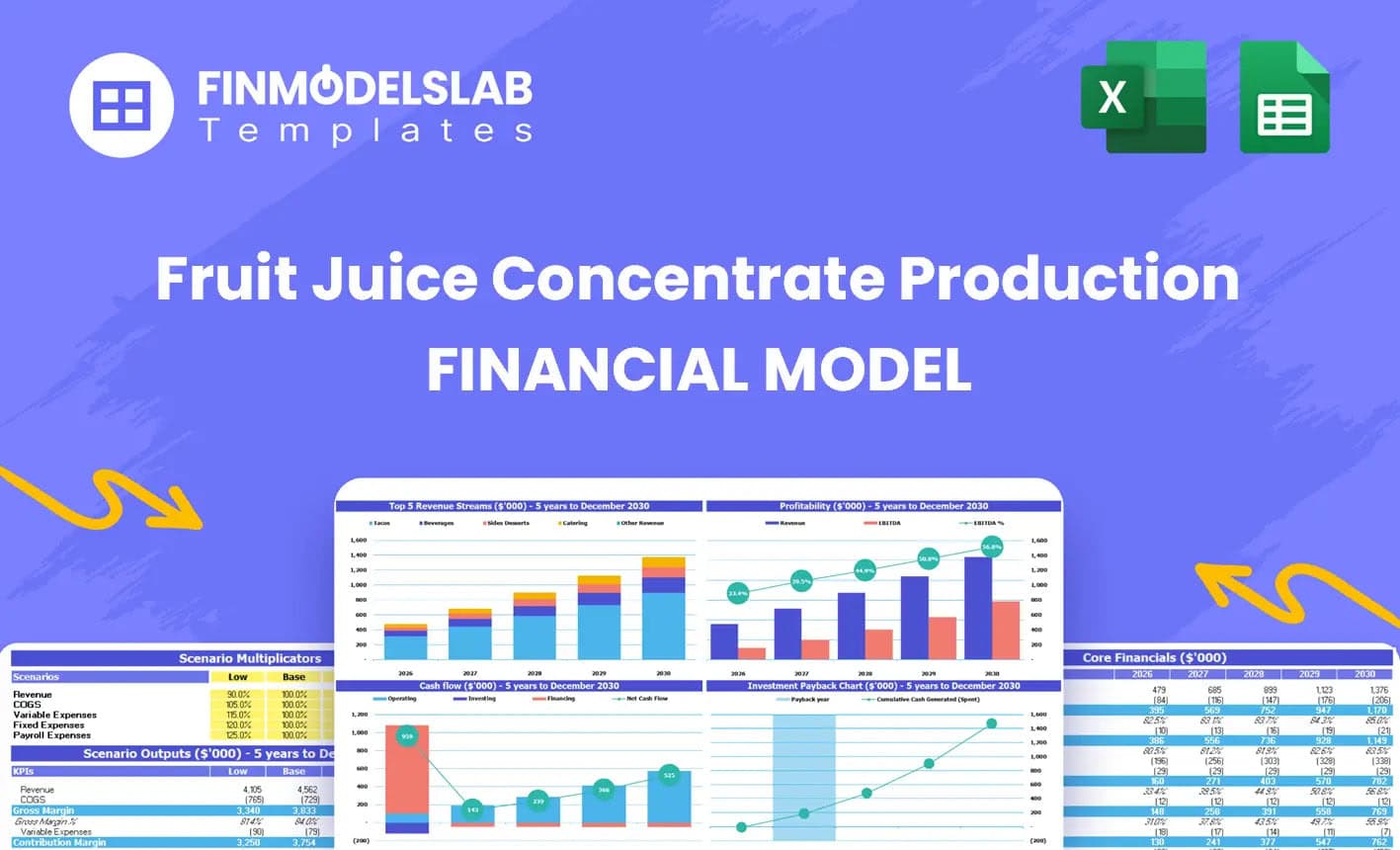
Juice Production Business Plan Financial Model Exc...
The Fruit Juice Concentrate Production Financial Model helps users turn a capital-intensive beverage... Read more
Business Plan for a Biodiesel Manufacturing Plant
Setting up a biodiesel manufacturing plant requires a comprehensive and executed business strategy. ... Read more
Carbon Capture and Sequestration Project Analysis
The Carbon Capture and Sequestration (CCS) Project Analysis Template is an indispensable tool for bu... Read more
Reviews
 Great
 Incredible!
As someone who is currently looking to start his own line of canned beverages, this model was extremely helpful is terms of helping me navigate the financing needs for the company.
467 of 908 people found this review helpful.
Help other customers find the most helpful reviews
Did you find this review helpful?
 updated overview/instruction video
The model I received seems to have a more elaborate equity stakes section after the FCFF and FCFE sections but the video above, I can only assume, refers to an earlier version. Could you please send the relevant updated video covering the different sections in this version? Thank you.
Thank you for your feedback.
721 of 1462 people found this review helpful.
-
We will replace the video at some point. This model is not very complicated and all formulas are disclosed. You can simply go through the formulas in Excel and check how they are linked to understand the logic. Keep in mind, this is a template only and you might prefer to do things differently
759 of 1502 people found this review helpful.
Help other customers find the most helpful reviews
Did you find this review helpful?
 circular reference error
Hi, I received a circular reference error when I changed the starting year to 2021 instead of the default 2018 that came with the model. I assume this the natural thing to do in 2021 – unless I am missing something.
Please help as I should not need to troubleshoot this type of error out of the box. Thank you.
697 of 1390 people found this review helpful.
Help other customers find the most helpful reviews
Did you find this review helpful?
-
Hi Kelly, as mentioned, you will need to update the exit year as well. Kindly change it from 2023 to 2026 so that your investment case reflects a standard holding period of 5 years. If the model results in an error, very often it can mean that the underlying assumptions are not consistent. That is all.
799 of 1520 people found this review helpful.
Help other customers find the most helpful reviews
Did you find this review helpful?
Looks promising
Have not purchased this model yet. Nevertheless, after comparing it with the manufacturing models, it seems more updated and detailed. it is also essentially for a startup whereas the manufacturing model has a historical and projections setup. Finally, the manufacturing model seems to be designed for the sanitary/ceramics industry, whereas the beverage manufacturing model seems to be modelled after a beer manufacturer.
723 of 1461 people found this review helpful.
Help other customers find the most helpful reviews
Did you find this review helpful?
You must log in to submit a review.