
0 ITEMS

Online WACC Calculator
Table of Content
- Try Our Online WACC Calculator Now!
- Online WACC Calculator
- What is the Weighted Average Cost of Capital?
- How to Calculate WACC in Excel
- Why Use a WACC Online Calculator?
- Optimize Investment Decisions with Precise WACC Analysis

Calculating the weighted average cost of capital (WACC) is essential for assessing a business’s funding costs and investment potential.
- WACC combines the cost of equity and debt, weighted by their proportion in the company’s capital structure.
- It plays a key role in discounted cash flow (DCF) valuation and capital budgeting decisions.
- An online WACC calculator simplifies complex calculations by allowing quick input of variables like risk premiums and tax rates.
- Accurate WACC analysis helps determine the viability of projects and optimize financing strategies.
- Understanding how to calculate WACC in Excel and through online tools supports better financial planning and decision-making.
This article provides clear guidance on how to use WACC effectively in your business analysis.
Try Our Online WACC Calculator Now!
An Online WACC Calculator is a sophisticated financial tool designed to compute the average rate of return a company is expected to pay its security holders to finance its assets. Our Online WACC Calculator simplifies this complex calculation by allowing users to input relevant data such as the cost of equity, cost of debt, tax rate, and the respective debt and equity weights in the company’s capital structure.
Step-By-Step Instruction:
Enter the following data as whole numbers:
- Equity Weight
- Risk-Free Interest Rate
- Unlevered Beta
- Market Risk Premium USA
- Other Premium
- Debt Risk Premium
- Corporate Tax Rate
Execute the calculation to calculate the WACC. Our Online WACC Calculator facilitates a quick and efficient way to gauge the cost of funding new projects or acquisitions.
What is the Weighted Average Cost of Capital?
The Weighted Average Cost of Capital (WACC) is a fundamental financial metric used to assess the cost of a company’s financing. It represents the average rate of return a company is expected to pay to its security holders to finance its assets. WACC is significant because it’s used as a benchmark to evaluate investment opportunities and has several key characteristics:
- Average Rate for Financing Business: WACC provides an average rate that a company is expected to pay for financing its operations and growth. It includes the cost of issuing debt, such as bonds or loans, and the cost of equity, which can be the dividends paid to shareholders or the expected return required by equity investors.
- Blended Cost of Capital Across All Sources: WACC considers the cost of all sources of a company’s capital, including equity, debt, and any other funding sources. It weighs these costs according to the proportional use of each source of capital.
- Discount Rate for Future Cash Flows: In discounted cash flow (DCF) analysis, WACC is used as the discount rate to calculate the present value of future cash flows. It is crucial for valuing businesses, projects, or investment opportunities. The higher the WACC, the lower the present value of future cash flows, affecting the valuation and financial decision-making.
- Expressed as a Percentage or Ratio: WACC is typically represented as a percentage or ratio. This format makes it easy to compare the cost of capital among different companies or to assess changes in a company’s capital structure over time.
- Hurdle Rate for Investment Decisions: Companies often use WACC as a hurdle rate when evaluating the desirability of investment projects or acquisitions. Suppose the expected return on an investment is higher than the WACC. In that case, the project may be considered financially viable as it’s expected to generate a return above the overall cost of capital.
Understanding WACC is essential for entrepreneurs, startup founders, business owners, investors, and finance professionals. It helps make informed decisions about investments, funding, and the overall strategic direction of a company. By accurately calculating and analyzing WACC, businesses can better assess the cost-effectiveness of their financial strategies and investment opportunities, leading to more sound financial planning and decision-making.


















































How to Calculate WACC in Excel
Calculating the Weighted Average Cost of Capital (WACC) in Excel is a fundamental financial analysis and valuation process. Understanding how to calculate WACC in Excel is crucial in financial analysis, fundraising, and valuation. The general formula to calculate WACC in Excel can be mathematically represented as:

This general formula does not incorporate risk premiums, such as the risk-free rate and other risk-related components. Excluding risk premiums from the WACC calculation can lead to an inaccurate estimation of a company’s cost of capital. To ensure a more comprehensive and realistic financial analysis, we must consider the various risk dimensions associated with a company’s operations and the broader market. So, we calculate WACC in Excel by following these steps:
Step 1 – Acquire the Necessary Data
First, you must gather and input the necessary data in Excel, including the following:
- Equity Weight: The proportion of a company’s capital structure financed through equity.
- Debt Weight: The fraction of total capitalization represented by debt in a company’s capital structure.
- Cost of Equity: The return a firm theoretically pays to its equity investors, i.e., shareholders, to compensate for the risk they undertake.
- Cost of Debt: The effective rate a company pays on its borrowed funds.
- Risk-Free Interest Rate: The yield on a debt instrument with zero default risk, typically associated with government bonds.
- Unlevered Beta (as per applicable industry): A measure of systemic risk of a company’s stock without the impact of its financial leverage, reflecting the industry average.
- Levered Beta is the beta we can observe by measuring the relative volatility of a stock toward the stock market over the course of several years. Please note that the levered beta is influenced by the financing structure. Companies with high leverage (using a lot of debt financing) will have a higher levered beta than companies with low leverage (next to using no debt financing). Therefore, we need a formula (e.g., the Harris-Pringle Formula) to lever an estimated unlevered beta.
- Prevailing Market Risk Premium in the Company Location: This is the additional return over the risk-free rate demanded by investors for holding a market portfolio specific to the company’s geographical location. Generally, businesses start with the Market Risk Premium USA as the prevailing market risk premium. This is because US Government bonds are viewed as the safest investment and the only one with a large enough data set.
- Country Spread: The additional risk premium associated with investing in a specific country, over and above the market risk premium. Excluding or including this in the WACC calculation depends on the particular risk profile of the country where the company operates.
- Other Premiums (in our case, the Small Cap Premium): In some cases, other premiums need to be added that offer additional compensation to investors to carry specific risk factors not captured by market risk, such as investing in small-cap companies. Examples of such risks are if a company is significantly smaller than its peers, if a company is dependent on a key man, or if it shows high customer concertation. The common denominator in such cases is that the standard WACC model does not capture all these risks, therefore we need to adjust the cost of equity as equity investors will have to carry such risks and need to be compensated for.
- Debt Risk Premium: The difference between the effective interest rate paid by a company on its debt and the risk-free interest rate, reflecting the additional risk assumed by lenders due to the company’s specific financial situation.
- Corporate Tax Rate: The percentage of a corporation’s profits paid as tax to the government.
Step 2 – Apply the WACC Formula Cost of Equity
The WACC Formula Cost of Equity equals the sum of the risk-free interest rate, equity risk premium, and other premiums. Before getting the sum, we first need to calculate the following:
- Levered beta reflects the risk of a company’s equity, adjusted for its specific level of debt. To get the levered beta, multiply the unlevered beta by (1+Equity Weight/Debt Weight).
- Market risk premium reflects the additional return investors expect for holding a diversified equity portfolio instead of a risk-free asset. It compensates for the type of investment, which in this case are stocks and not risk-free government bonds. Please note, for company’s located in other jurisdictions than the United States, it may be difficult to obtain a large enough data set to estimate such. In such cases, what we can do is to start with the estimated market risk premium in the United States, and then we add a country risk premium (e.g. for Sri Lanka) to obtain the local market risk premium (in Sri Lanka). This is an elegant way to estimate such.
- Equity risk premium refers to the return equity investors require for investing into the equity of a company. We need to start off with the risk-free return we can get when investing in a US Government bond and then require compensation for holding stocks and depending on the type of industry a correction for the relative expected correlation with the stock market with respect to the levered beta. And lastly, we also need to check if we need additional compensation in form of a higher return for carrying the risk of small cap stocks, key man or customer dependencies (other premium).
Step 3 – Apply the WACC Calculation Cost of Debt
The WACC Calculation Cost of Debt (after-tax) equals the pre-tax cost of debt multiplied by (1 – tax rate). It represents the effective rate that a company pays on its current debt. Add the risk-free interest rate and debt risk premium to calculate the pre-tax cost of debt. Interest payments on debt are tax-deductible, lowering the effective cost of borrowing. This tax shield makes debt a less expensive capital source than equity, which does not enjoy such tax benefits.
Step 4 – Calculate the Cost of Equity and Cost of Debt (After-Tax)
The WACC calculation reflects the proportionate contribution of each capital source (equity and debt) to the total capital structure, accounting for their respective costs and tax impacts. So, in the fourth step, we multiply the Cost of Equity by the Equity Weight and the After-Tax Cost of Debt by the Debt Weight.
Step 5 – Sum Up the WACC Formula Cost of Equity with the After-Tax WACC Calculation Cost of Debt
Combining the WACC Formula Cost of Equity with the adjusted WACC Calculation Cost of Debt is fundamental for providing a comprehensive picture of the total cost of financing a company’s operations. It represents the cost of capital and expenses associated with securing capital to support a company’s operational activities and expansion. Adding both factors reflects the blended equity and debt financing cost, enabling more informed financial decision-making.
Sample Calculation:
Suppose we have the following assumptions for a target company in the United States:
- Equity Weight = 70%
- Debt Weight = 30%
- Risk-Free Interest Rate = 2%
- Unlevered Beta = 1
- Market Risk Premium (USA) = 6%
- Other Premium (Small Cap Premium) = 2%
- Debt Risk Premium = 2%
- Corporate Tax Rate = 25%
Please note that we don’t have a value for the country spread because the United States is generally considered a risk-free country for investments because of its stable economic and political environment, strong legal system, and, most importantly, its ability to issue debt in its own currency, the US dollar, which is the world’s primary reserve currency, reducing the risk of default.
The WACC Excel calculation will yield the following results.
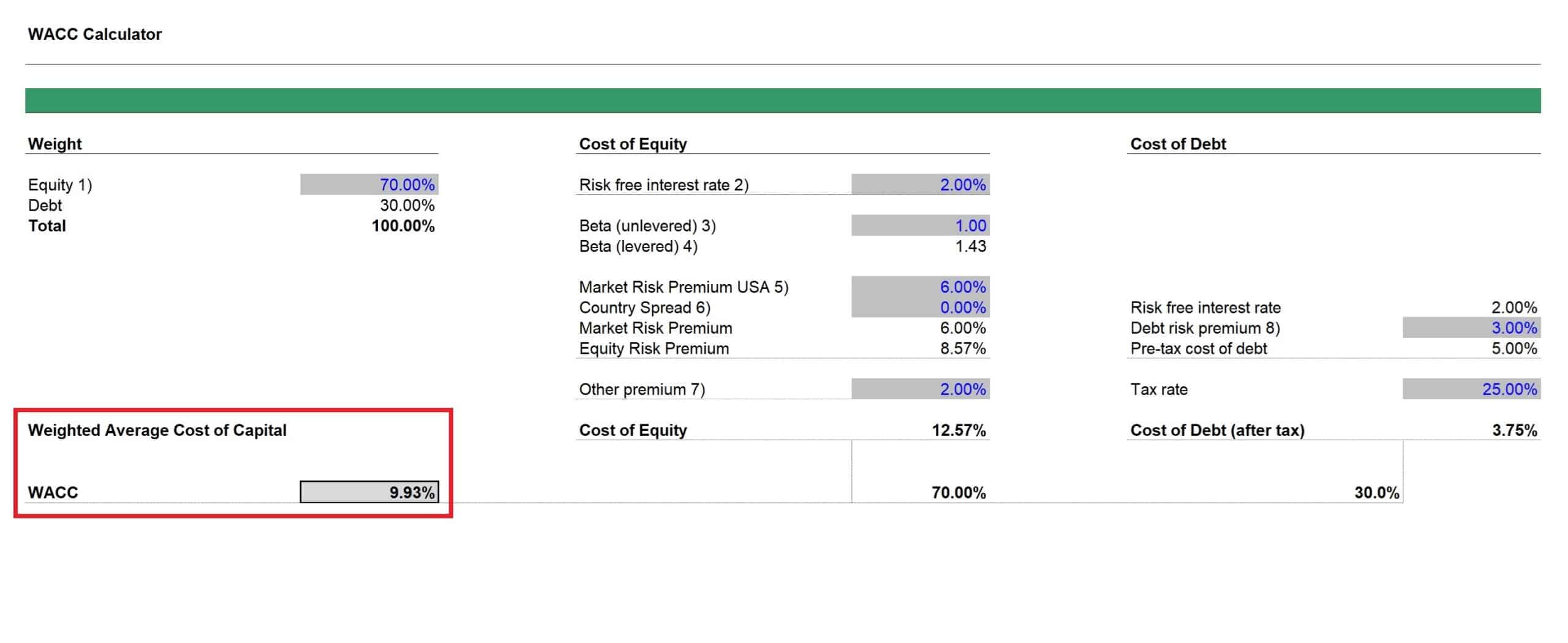
The above spreadsheet shows that the WACC for the given assumption is 10%. Remember, the accuracy of WACC depends heavily on the accuracy of the inputs. Also, the capital structure (% of Equity and % of Debt) should ideally reflect the company’s target or optimal structure rather than its current structure, as it provides a more forward-looking perspective.
Why Use a WACC Online Calculator?
Using an Online WACC Calculator offers practical benefits in business contexts and everyday financial decisions. It’s a pivotal tool for understanding the cost of financing a business or project, which has broader implications in various scenarios:
Practical Uses in Business
- Capital Budgeting: WACC assists in prioritizing various capital projects. Companies often have multiple opportunities but limited resources; using WACC as a discount rate in Net Present Value (NPV) calculations can highlight which projects will likely yield the best returns relative to their cost.
- Corporate Finance Decisions: When companies consider funding options (equity, debt, or a mix), WACC helps determine the most cost-effective way to finance operations or growth. It balances risk and return, influencing decisions like issuing new stock or taking on debt.
- Investment Appraisal: Businesses often use WACC as a benchmark for evaluating the potential returns of new projects or investments. If a project’s expected return exceeds the WACC, it will likely add value to the company.
- Mergers and Acquisitions: In M&A activities, WACC is crucial for valuing target companies. It helps determine the present value of future cash flows, guiding negotiations and pricing decisions.
- Performance Evaluation: By comparing a project or a business unit’s return on invested capital (ROIC) with the WACC, managers can assess how effectively they generate value over the cost of capital.
Everyday Financial Applications
- Loan Assessment: For personal loans or mortgages, understanding concepts similar to WACC can help evaluate the actual cost of borrowing and compare different loan options.
- Personal Investment Decisions: Individual investors might use WACC to assess companies’ financial health and risk profile before investing in their stocks or bonds. A lower WACC typically indicates a less risky investment.
- Real Estate Investments: For those investing in real estate, mainly commercial real estate, WACC can be instrumental in evaluating property investments or development projects, considering the cost of mortgages and equity investments.

On top of these reasons, an Online WACC Calculator offers the following benefits:
- Accessibility: It is easily accessible from various devices, providing convenience and flexibility.
- Accuracy: It reduces the risk of manual errors in complex calculations.
- Efficiency: It simplifies the WACC calculation.
- Speed: It saves time for busy professionals and individuals.
- User-Friendly: It is designed to be intuitive, catering to both financial experts and those with basic financial knowledge.
In summary, a WACC online calculator is a versatile tool with wide-ranging applications in both business and personal financial contexts. It aids in making informed and strategic decisions by clearly understanding the cost of capital, ultimately guiding towards more financially sound and profitable outcomes.
No Downloads found
Optimize Investment Decisions with Precise WACC Analysis
In summary, precise Weighted Average Cost of Capital (WACC) analysis provides a benchmark for evaluating investment returns. It plays a critical role in assessing new projects, corporate finance strategies, and mergers and acquisitions. Implementing a meticulous WACC analysis ensures that your financial decisions are grounded in solid, quantitative assessments, optimizing your investment strategies and enhancing value creation.
Utilizing a WACC Calculator is a practical and efficient step toward implementing a meticulous WACC analysis. This tool streamlines the complex process of calculating the weighted average cost of capital, providing investors and finance professionals with immediate, accurate insights. By harnessing such technology, you can make more informed investment decisions, ensuring that your strategies are both cost-effective and aligned with your financial goals. Calculate WACC now!
You might also like:
- 10 Main Elements of a Business Plan
- Business Valuation
- How to Write a Business Plan Step-by-Step
- 10 Tips to Develop a First Class Business Valuation Report
- Financial Planning for Small Business Owners – Taking an SBA Loan
- Understanding What is Yield to Maturity and Why It Matters
- How to Make a Startup Financial Plan for Fundraising?
- Financial Ratios Analysis and Its Importance
- Finding the Balance in Your Optimal Capital Structure
- Startup Financial Models
- Understanding Debt Sizing & Project Finance Ratios
- Financial Model Templates Easy to Use
- Financial Analysis
- 10-Step Financial Planning Checklist for Smart Executives
- Monthly Budget Template (with Financial Statements)
- Evaluation of Financial Feasibility Study
- Business Valuation Service
- Researching Business Funding Options
- Debt Amortization Table
- WACC (Weighted Average Cost of Capital)
Tags: Online Calculators