
0 ITEMS

5 Year 3 Statement Construction Company Finance Model
A comprehensive editable, MS Excel spreadsheet for tracking construction company finances, including opportunities and development channels, summary tabs, Income Statements, Balance Sheets, & Cash Flow Statements, provides a comprehensive view of financial performance.


Detailed Description of a Financial Model for a Construction Company
This financial model for a construction company integrates the Income Statement, Balance Sheet, and Cash Flow Statement into a comprehensive, interconnected framework. It evaluates financial performance, profitability, liquidity, and overall business health. Below is a detailed description of each component tailored for a construction company.
—
1. Income Statement (Profit and Loss Statement)
The income statement provides a snapshot of the company’s profitability over a specific period, taking into account the unique aspects of construction projects, such as long-term contracts, milestone payments, and variable project costs.
Key Sections & Line Items:
1. Revenue:
– Contract Revenue: Recognized from completed and ongoing construction projects, based on percentage-of-completion or completed-contract accounting methods.
– Change Orders: Additional revenue from project scope adjustments.
– Other Income: Rental income, consulting fees, or other non-core income streams.
2. Direct Costs (Cost of Revenue):
– Materials Costs: Cost of raw materials such as cement, steel, or wood.
– Labor Costs: Wages for construction workers, project managers, and subcontractors.
– Equipment Costs: Depreciation or leasing of machinery used on projects.
– Overhead Allocation: Project-specific indirect costs such as insurance, utilities, or project management fees.
3. Gross Profit: Automatically calculated as `Revenue – Direct Costs`.
4. Operating Expenses:
– General & Administrative (G&A): Salaries of back-office staff, office rent, software costs, etc.
– Marketing and Bid Costs: Costs for securing new projects or advertising.
– Depreciation and Amortization: Depreciation of office equipment or amortization of intangible assets.
5. Operating Income: `Gross Profit – Operating Expenses`
6. Other Income/Expenses:
– Interest income or expense.
– Gains or losses from asset sales.
7. Net Income: The final profitability metric after taxes and non-operating items.
Features:
– Revenue and cost inputs linked to detailed project schedules and budgets.
– Variance analysis to track planned vs. actual project margins.
– Breakdown of recurring and one-time expenses for better forecasting.
—
2. Balance Sheet
The balance sheet provides a snapshot of the company’s financial position at a specific point in time. For construction companies, the balance sheet captures assets and liabilities related to projects in progress, retainage, and fixed assets.
Key Sections & Line Items:
1. Assets:
Current Assets:
– Cash & Cash Equivalents: Available cash or short-term liquid investments.
– Accounts Receivable: Amounts due from clients for completed milestones.
– Construction Work-in-Progress (WIP): Costs incurred on incomplete projects, recorded as assets.
– Retention Receivable: Payment amounts withheld by clients until project completion.
– Inventory: Unused construction materials or spare parts.
– Prepaid Expenses: Advanced payments for insurance, rent, or machinery leases.
Non-Current Assets:
– Property, Plant, and Equipment (PP&E): Land, buildings, and construction equipment, net of depreciation.
– Intangible Assets: Goodwill, software licenses, or trademarks.
– Long-term Investments: Bonds or equity in other companies.
2. Liabilities:
Current Liabilities:
– Accounts Payable: Outstanding payments to suppliers or subcontractors.
– Short-term Loans/Lines of Credit: Temporary financing for cash flow needs.
– Deferred Revenue (Billings in Excess): Client payments received for uncompleted milestones.
Non-Current Liabilities:
– Long-term Debt: Financing for acquiring equipment or property.
– Lease Liabilities: Obligations for long-term equipment or property leases.
3. Equity:
– Owner’s Equity: Capital contributions by the owner(s).
– Retained Earnings: Cumulative net income retained for reinvestment in the business.
– Dividends/Distributions: Withdrawals or payouts to owners.
Features:
– Depreciation schedules tied to PP&E.
– Dynamic integration with cash flow and income statements for consistent updates.
—
3. Cash Flow Statement
The cash flow statement tracks the movement of cash in and out of the business and ensures liquidity for project execution. Construction companies often experience uneven cash flows due to milestone-based payments.
Key Sections:
1. Operating Cash Flow:
Cash Inflows:
– Client Payments: Collections from invoices and milestone payments.
– Retention Released: Funds received from previously held retention balances.
Cash Outflows:
– Payments to Suppliers/Subcontractors.
– Labor Costs.
– Overhead and Administrative Costs.
2. Investing Cash Flow:
Cash Inflows:
– Sale of Equipment: Proceeds from selling old machinery.
Cash Outflows:
– Purchase of PP&E: Acquisition of new construction equipment or office property.
– Investments: Long-term investments in other entities or projects.
3. Financing Cash Flow:
Cash Inflows:
– Proceeds from Loans: Funds raised from banks or investors.
– Equity Injection: New contributions by owners or shareholders.
Cash Outflows:
– Loan Repayments: Principal and interest on borrowed funds.
– Dividend Payments: Distributions to owners or investors.
Features:
– Forecasts cash flow requirements for projects with high upfront costs and delayed revenues.
– Tracks loan schedules and repayment impacts on cash flow.
– Compares cash flow forecasts to actuals to refine projections.
—
Integrated Model Features
1. Scenario Analysis:
– Simulate the impact of winning/losing new contracts.
– Adjust input assumptions for labor costs, material costs, or payment terms.
2. KPIs and Ratios:
– Profitability Metrics: Gross Profit Margin, Net Income Margin.
– Liquidity Metrics: Current Ratio, Quick Ratio.
– Leverage Ratios: Debt-to-Equity Ratio, Interest Coverage.
3. Visualizations:
– Charts for revenue growth, and cash flow trends.
– Dynamic dashboards summarize performance across the income statement, balance sheet, and cash flow statement.
4. Linked Inputs/Outputs:
– Changes in one statement (e.g., cash flow from project payments) automatically update other statements (e.g., income and balance sheets).
– Breakout models for individual projects feed into the company-wide financial summary.
—
Custom Considerations for Construction Companies
1. Retention Accounting: Ensure retained payments and receivables are accurately tracked.
2. Milestone Revenue Recognition: Align with contracts to recognize revenue appropriately.
3. Variable Costs: Include adjustable rates for labor and material price fluctuations.
4. WIP Reconciliation: Automatically adjust Work-in-Progress accounts for billing status and costs incurred.
This robust financial model will provide a clear picture of the construction company’s financial health, guide project budgeting, and enable strategic decision-making.
Similar ProductsOther customers were also interested in...


 City Finance
20 Year 3 Statement Architect Company Finance Mode...
A comprehensive 20 Year 3 Statement editable, MS Excel spreadsheet for tracking Architect Company fi... Read more
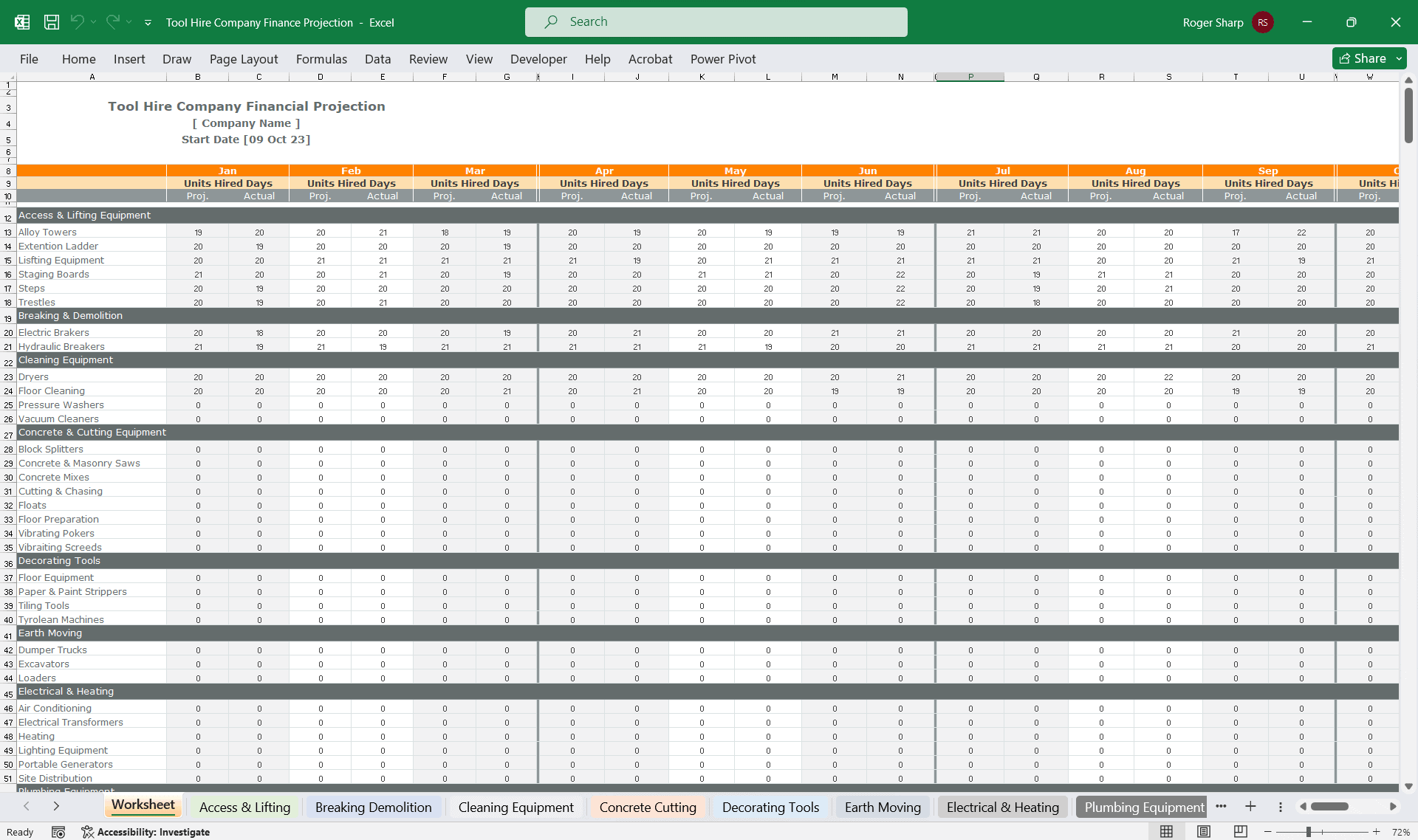
Tool Hire Company Finance Model
A very comprehensive editable Excel spreadsheet for tracking your tool hire financials throughout th... Read more

Plant Hire Business Financial Model
A comprehensive editable MS Excel spreadsheet for tracking your plant hire financials throughout the... Read more
 Jason Varner
Equipment Rental Cash Flow Model
Highly dynamic financial model that is specific to renting equipment out. High attention paid to the... Read more
 Giorgos
Plumbing Business Financial Model – 5 Year Forec...
Financial Model presenting an advanced 5-year financial plan for a startup or operating Plumbing Bus... Read more

Carpentry Business – 5 Year Financial Model
Financial Model providing an advanced 5-year financial plan for a startup or operating Carpentry Bus... Read more

Electrician Business Financial Model – 5 Year Fo...
Financial Model presenting an advanced 5-year financial plan for a startup or operating Electrician ... Read more
 Pushkar
Discounted Cash Flow (DCF) Valuation Excel Model (...
This is a very detailed and user-friend financial model with the three financial statements i.e. Inc... Read more

Artisan Contractor Business – 5 Year Financial M...
Financial Model providing an advanced 5-year financial plan for an Artisan Contractor Business scena... Read more
 eFinancialModels
Crane Truck Rental Company Financial Model
Step into the world of crane rental business success with our Crane Truck Rental Company Financial M... Read more
You must log in to submit a review.