0 ITEMS

Finding the Right Financial Model Template: A Buyer’s Guide

A financial model template is worth buying when it passes five checks: full three-statement coverage, visible formulas with built-in error checks, clear inputs, a fit with the industry and proof of support. This guide explains each check, compares four ways to source a template and scores three hypothetical templates so a first-time founder can decide with numbers.
Key Takeaways
- Score a template on five checks before comparing prices: statement coverage, visible formulas, clear inputs, industry fit and proof of support.
- The U.S. Small Business Administration asks for a five-year outlook that includes forecasted income statements, balance sheets, cash flow statements and capital expenditure budgets.
- A template that shows its formulas and carries check cells lets a founder catch errors before an investor does.
- A demo, instructions and a named support route are the cheapest proof of quality a seller can offer before purchase.
- In a hypothetical scorecard, the industry-specific template scores 89 of 100 points, against 57 and 40 for the other two.
What Makes a Financial Model Template Worth Buying
A template is worth buying when a buyer can inspect how it calculates, test it and rely on it to flag its own mistakes, because a founder builds the plan, the budget and the investor story on its numbers.
The setting for a first-time founder is also unforgiving. The U.S. Bureau of Labor Statistics (BLS) reported in January 2024 that 34.7 percent of U.S. private-sector business establishments born in March 2013 were still operating in March 2023, so most of that cohort had closed within ten years. The same January 2024 report says the survival rate fell by 20.4 percentage points from 2013 to 2014, the largest drop in the first year of operation. The figures count establishments, which include new branches of existing firms, so they are a rough guide to startup survival, but a model that hides a cash gap still leaves little room for error.
The Five Checks That Separate a Good Template from a Risky One
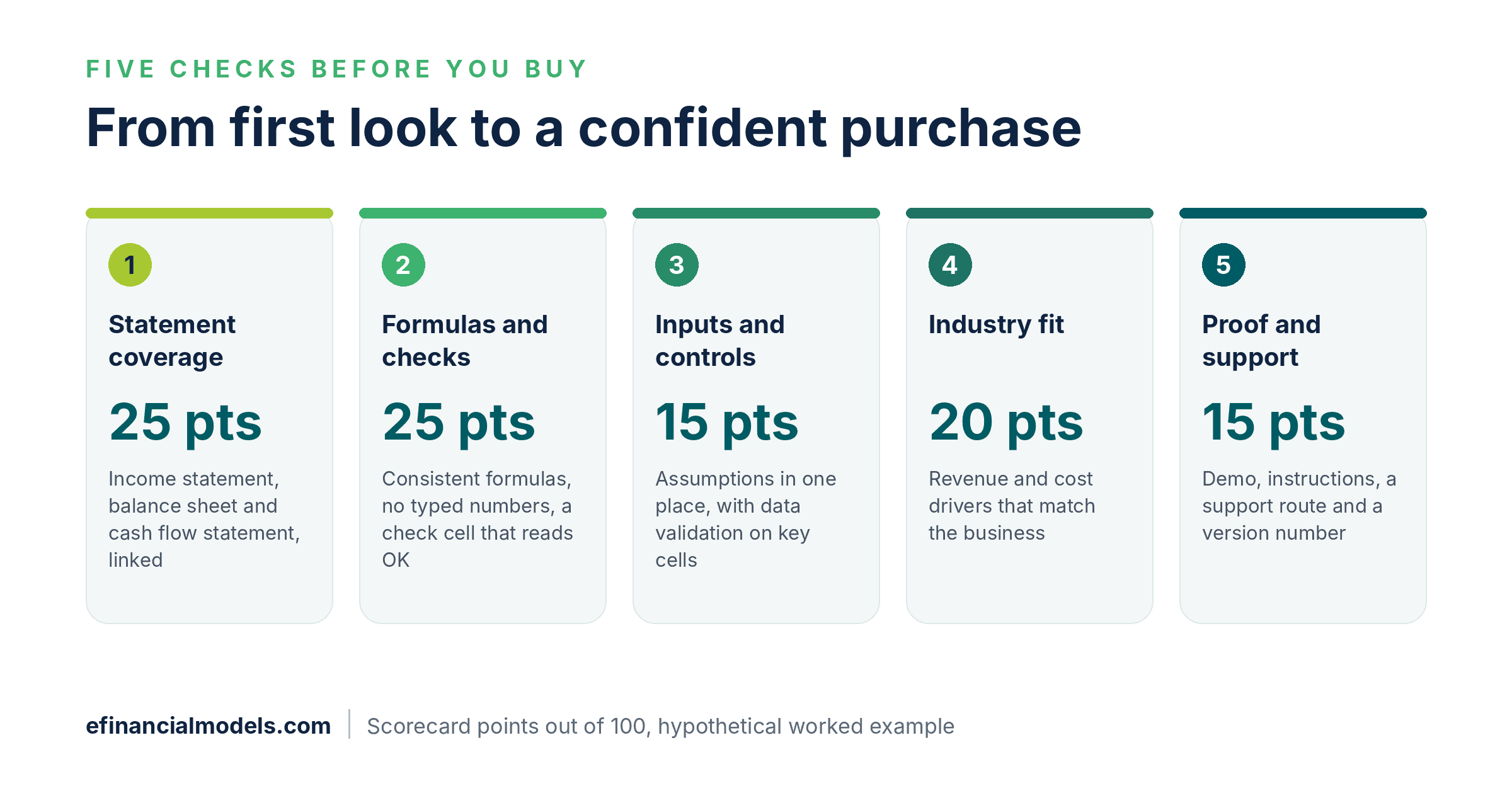
Each check below can be run on a demo file or a free sample, and each maps to one row of the scorecard used later in the worked example.
Check 1: The template covers all three statements and links them
The U.S. Small Business Administration (SBA) guidance on writing a business plan says to provide a prospective financial outlook for the next five years and to include forecasted income statements, balance sheets, cash flow statements and capital expenditure budgets, which are the planned spending on long-lived assets. The first three items are the three core statements, and a template that offers only a profit forecast cannot answer that request. A template should therefore cover a five-year horizon and include a capital expenditure schedule. The SBA and BLS figures in this guide are U.S. benchmarks, so founders elsewhere should look for the equivalent guidance from their own lender or regulator. The three statements should also be linked, so that profit flows into the balance sheet and the closing cash on the cash flow statement equals the cash on the balance sheet.
Check 2: The formulas are visible and the model checks itself
The Institute of Chartered Accountants in England and Wales (ICAEW) publishes a Financial Modelling Code of principles for robust models. Three of them translate directly into a buyer’s test: keep formulas consistent across ranges, avoid using fixed values within formulas, and build in checks, controls and alerts from the outset. In practice, a buyer clicks across a row of forecast cells to confirm the formula does not change, scans for typed numbers inside formulas and looks for a check cell that flags an error when the balance sheet stops balancing.
Check 3: Inputs are clear and protected
Good templates separate assumptions from calculations, so a founder changes numbers in one place. Microsoft explains that data validation can restrict the type of data or the values that users enter into a cell, like a dropdown list, which stops a growth rate typed as text from breaking the forecast. Locked cells also guard against accidental edits, so a buyer should confirm that formula cells are protected while input cells stay open.
Check 4: The drivers match the industry
A subscription business forecasts customers and churn, a restaurant forecasts covers, the number of diners served, and average spend, and a farm forecasts yield and seasonality. A generic template forces the founder to rebuild those drivers, which reintroduces the error risk the purchase was meant to remove. The Startup Financial Models collection at eFinancialModels lists startup-focused models, and the General Excel Financial Models category holds cross-industry options for businesses without a dedicated template.
Check 5: The seller shows proof before payment
Proof comes in four forms: a demo file, written instructions, a support route and a visible version history. A seller page that offers a sample download, a walkthrough video, a named support address and a current version number lets a buyer test the claims before paying, while a page with only a price and a screenshot does not. A buyer should ask for any missing form and treat a refusal as a low rating on this check.
How the Four Sourcing Routes Compare
No route wins on every check, so the same five checks apply to every seller, including eFinancialModels. The table summarises typical strengths and risks, which are editorial judgements rather than measured data.
| Route | What a buyer typically gets | Main risk | Check first |
|---|---|---|---|
| Free generic download | Simple structure at no cost | Thin documentation, unknown author | Formulas and check cells |
| Low-cost marketplace listing | Wide choice, quick delivery | Quality varies by seller | Demo and support route |
| Consultant-built custom model | Exact fit to the business | Cost, time and dependence on one builder | Handover documentation |
| eFinancialModels catalogue | Excel templates sorted by industry, with free options | Detail varies from one product page to the next | Demo, formulas and support route on each page |
At eFinancialModels, the Simple Fundraising Model is described as a free Excel template with income statement, balance sheet and cash flow projections for five years plus three years of historic financials. A free file like that is a low-cost first test of the checks above.
Worked Example: Scoring Three Hypothetical Templates
In this example, assume a first-time founder compares three hypothetical templates. Template A is a free generic download, Template B is a low-cost marketplace listing and Template C is an industry-specific template with a demo, instructions and support. The weights are illustrative choices. Each check carries a weight in points out of 100, each template earns a rating per check from 0 (absent) through 3 (present but weak) to 5 (clear, complete and demonstrated), and weighted points equal the weight multiplied by the rating and divided by 5.
| Check | Weight (points) | Template A: rating (weighted points) | Template B: rating (weighted points) | Template C: rating (weighted points) |
|---|---|---|---|---|
| Statement coverage | 25 | 3 (15) | 4 (20) | 5 (25) |
| Visible formulas and error checks | 25 | 1 (5) | 2 (10) | 4 (20) |
| Clear inputs and controls | 15 | 3 (9) | 3 (9) | 4 (12) |
| Industry fit | 20 | 2 (8) | 3 (12) | 5 (20) |
| Proof and support | 15 | 1 (3) | 2 (6) | 4 (12) |
| Total points | 100 | 40 | 57 | 89 |
Adding the weighted points in each column gives 15 + 5 + 9 + 8 + 3 = 40 for Template A, 20 + 10 + 9 + 12 + 6 = 57 for Template B and 25 + 20 + 12 + 20 + 12 = 89 for Template C. Assume the founder sets two buying rules: a total of at least 70 points, and a rating of at least 2 on the formulas and error checks line, because that line protects every other number.
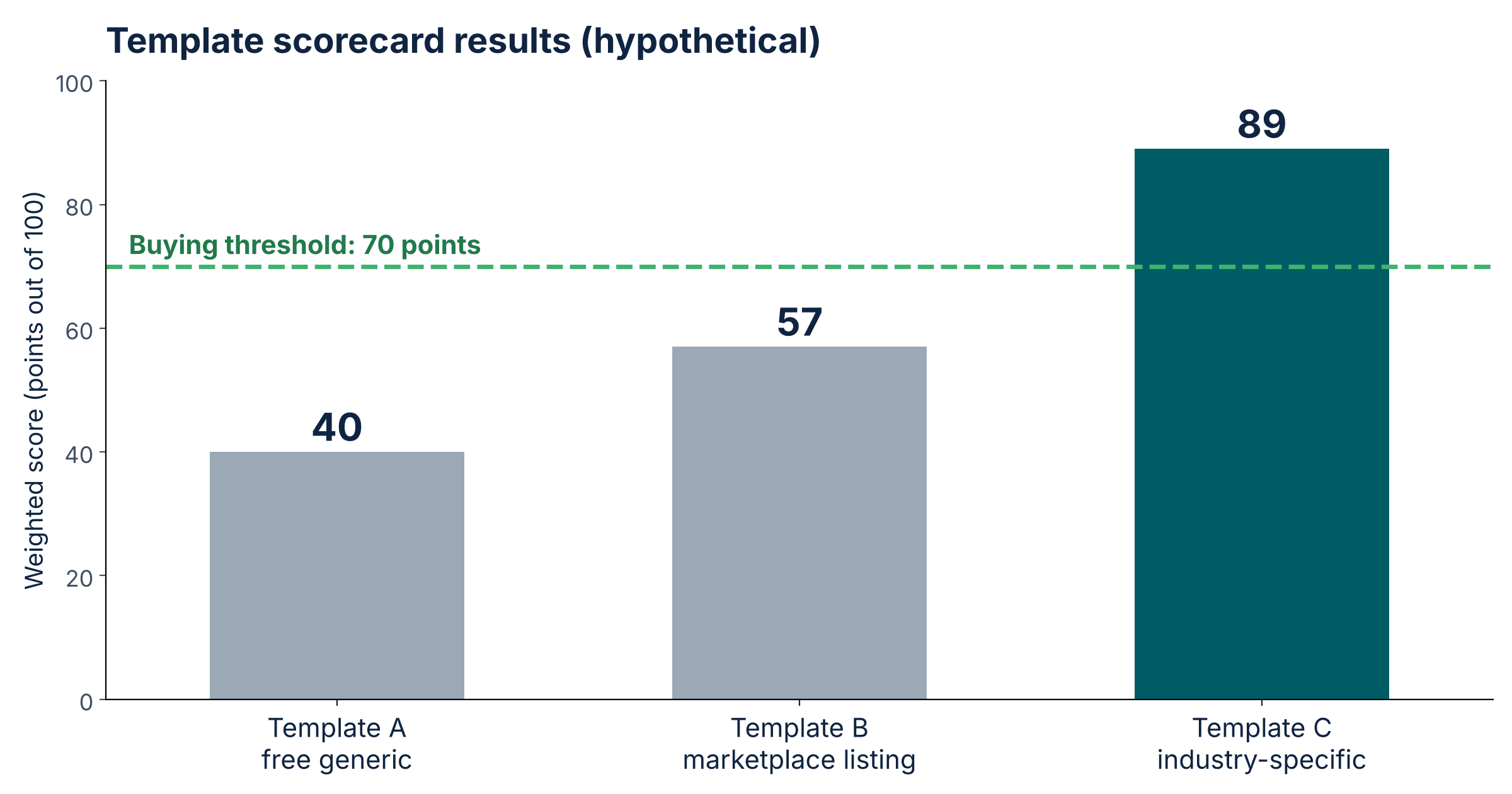
Template A fails both rules, with 40 points and a formulas rating of 1. Template B passes the formulas rule but misses the threshold by 13 points. Only Template C clears both, and its biggest gain over Template B is on the formulas line, where it earns 20 points against 10. The lesson is that this scorecard rewards visible, self-checking formulas, because that line separates the three templates most, at 5, 10 and 20 points.
Conclusion
A good template is one a buyer can inspect, test and trust, and the five checks turn that judgment into a score. A first-time founder can start by running the free Simple Fundraising Model from eFinancialModels through the scorecard above, then compare any paid template against an illustrative buying threshold such as the 70 points used in the example.
Frequently Asked Questions
Is a free financial model template good enough for a first-time founder?
A free template can be good enough when it passes the same checks as a paid one. The decisive question is whether the file shows its formulas, balances its own statements and documents its assumptions. Free files suit early planning, a first investor conversation or learning how the statements connect. They become a poor fit when the business needs industry-specific drivers, multiple scenarios or a model that a lender will audit line by line.
What is the fastest way to test a template before paying?
Stress the file with extreme inputs. Set revenue to zero, double the main cost line and enter a very high growth rate, then watch whether the balance sheet still balances, whether cash turns negative where it should and whether any cell shows an error. A model that stays coherent under abuse is usually built on consistent formulas. A model that breaks quietly, with no alert, should be rejected whatever its price.
Should a founder buy an industry-specific template or a general one?
An industry-specific template saves the most time when the business has distinctive drivers, such as capacity, seasonality or unit economics, the revenue and cost of selling one unit, that differ sharply from a typical company. A general template suits a business whose logic is simple, or a founder who wants to learn how each statement is built. A useful compromise is to buy the specific template and read its assumptions sheet first, because the list of drivers reveals how well the author understood the sector.
How does a buyer judge support and updates when no policy is published?
Ask the seller direct questions before buying: who answers questions, how quickly, which version is current and what changed in the last release. Replies that arrive promptly and name specific changes are a good sign. Silence, vague answers or a file with no version number suggest the template may not be maintained. Keep the messages as a record, because a seller’s own words about scope are the best evidence if the file later disappoints.
When is a custom model better than a template?
A custom model is better when the business has unusual revenue mechanics, several entities or contractual terms that no template anticipates, or when an investor requires a model that an adviser has reviewed. It costs more and takes longer, and it depends on the builder staying available. Many founders start with a template to clarify their assumptions, then commission a custom build only for the parts that the template cannot represent.