
0 ITEMS

EU CBAM Importer Cost, Pricing & Supplier Strategy Model – 2026-2034 CBAM Cost, Cash, Pricing & Supplier Decision Model
A 32-sheet editable Excel decision model for EU CBAM importers that links certificate requirements, eligible origin-carbon-price adjustments, cash timing, working capital, freight, customs duties, full landed cost, supplier choices, customer pass-through, margin impact, break-even analysis, scenarios, sensitivities, and executive procurement/CFO outputs.
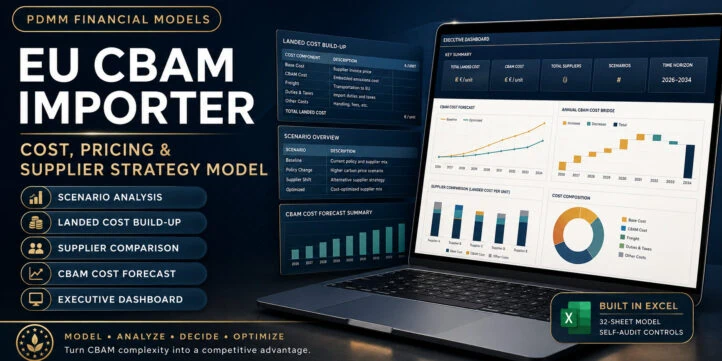






EU CBAM Importer Cost, Pricing & Supplier Strategy Model
Overview
The EU CBAM Importer Cost, Pricing & Supplier Strategy Model is an editable 32-sheet Excel model designed for importers, procurement teams, finance teams, and advisers evaluating the commercial impact of the EU Carbon Border Adjustment Mechanism (CBAM). The model covers an annual 2026-2034 planning horizon and connects carbon-related obligations to supplier economics, cash requirements, pricing decisions, and profitability.
Rather than treating CBAM as a stand-alone compliance cost, the workbook links certificate requirements to import volumes, selected supplier emissions, origin-country carbon-price adjustments, certificate price assumptions, freight, customs duties, working capital, customer pass-through, gross margin, and EBITDA. The result is a practical decision-support model for understanding how CBAM can affect both sourcing and financial performance.
Verified Model Features
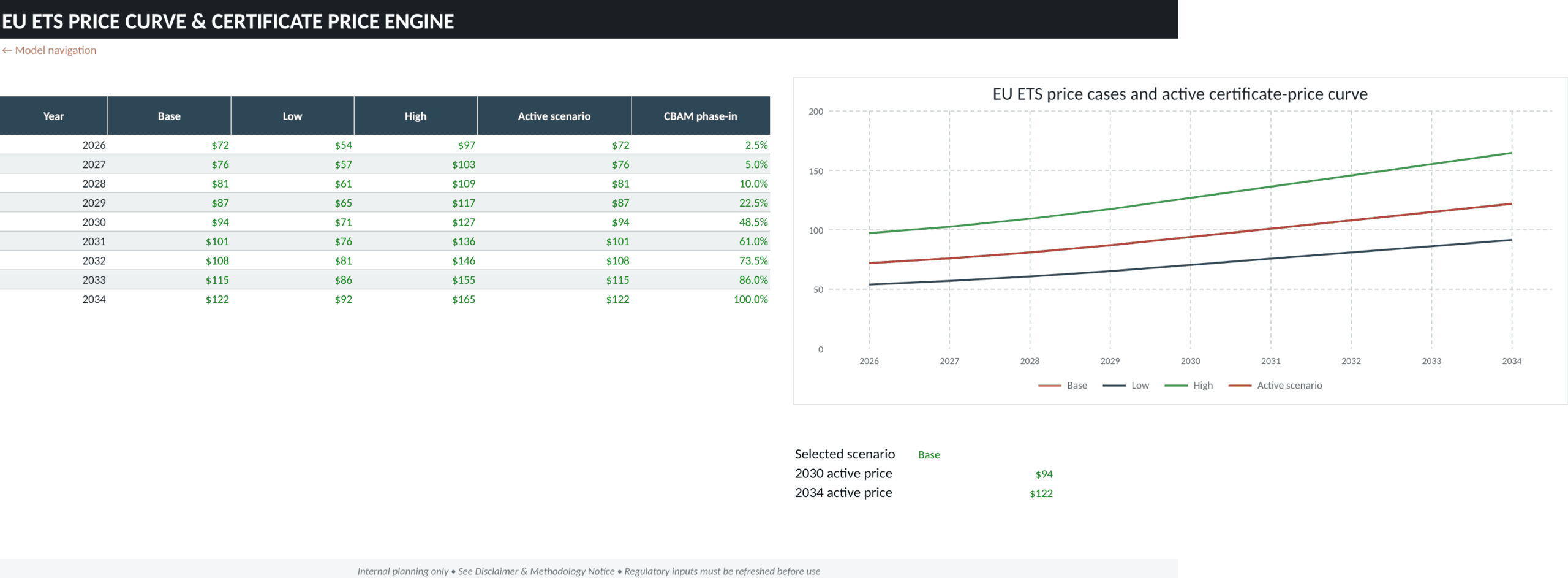
- Low / Base / High scenario manager driven by a single scenario selector on the Executive CFO Dashboard.
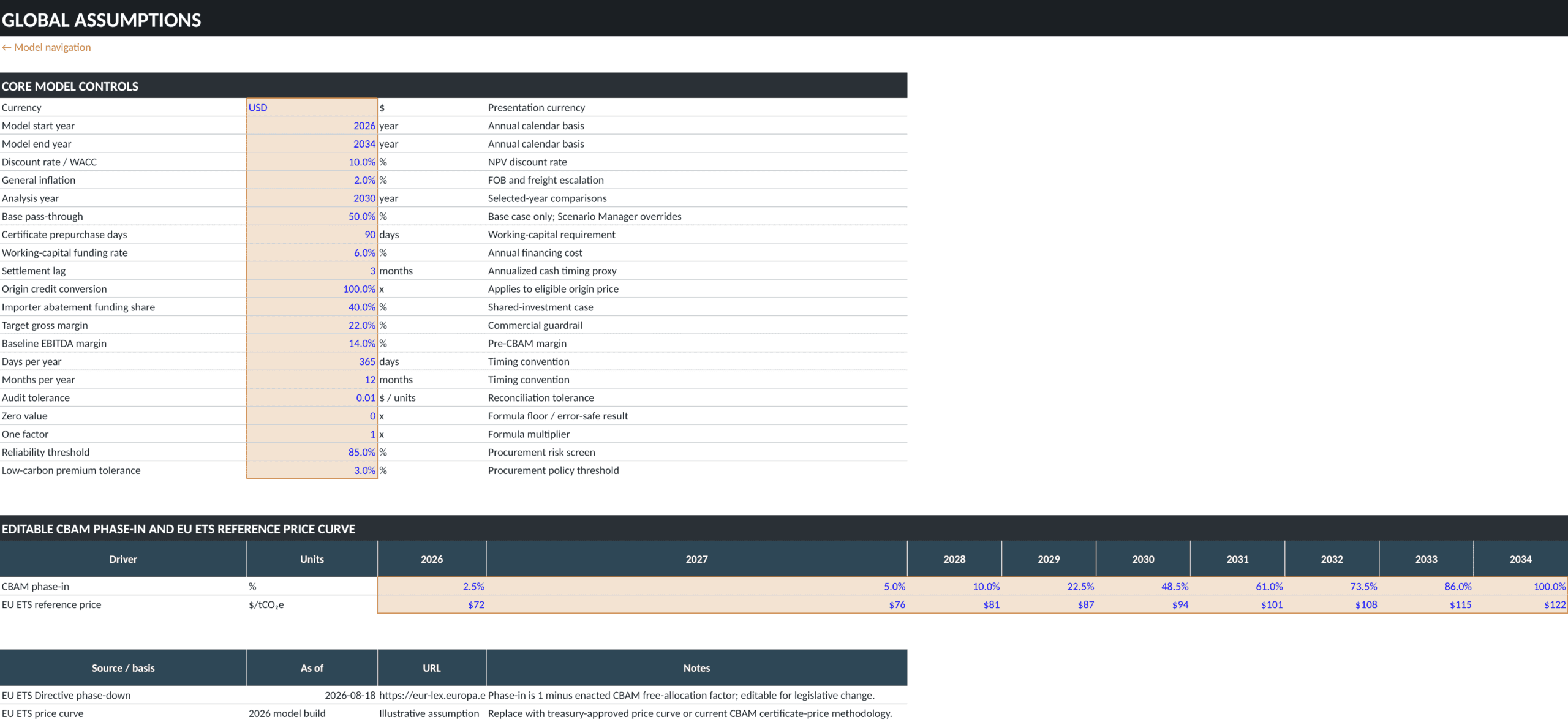
- Editable 2026-2034 EU ETS reference-price and CBAM phase-in curves used by the certificate engine.
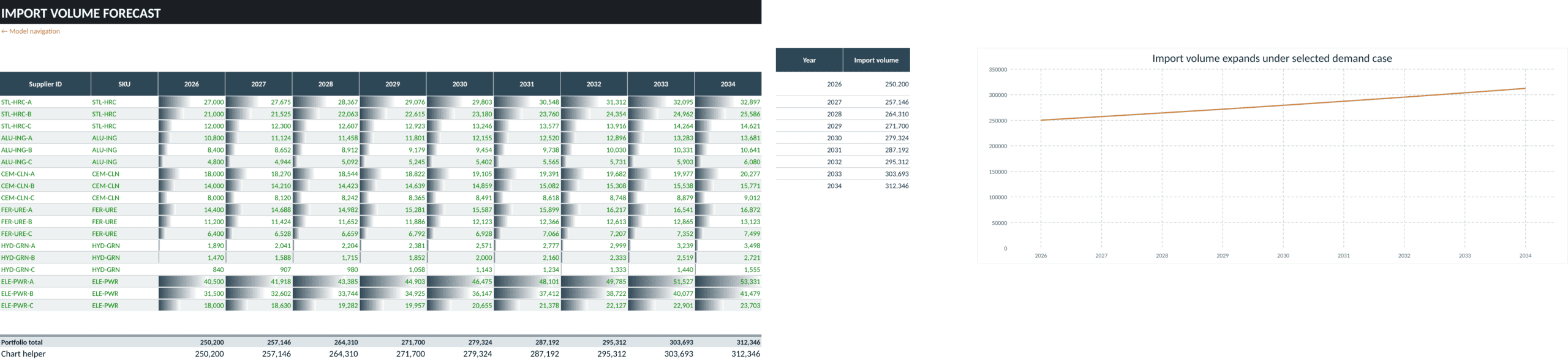
- Product and SKU database with demand, growth, customs duty, customer pricing, sector, unit of measure, and CN-code fields.
- Supplier database covering supplier country, actual/default emissions basis, direct and indirect emissions, data quality, reliability, volume allocation, FOB cost, freight, decarbonisation rate, abatement investment, and abatement potential.
- CBAM certificate requirement engine by supplier and year.
- Eligible origin carbon-price adjustment engine with the modelled credit capped against gross certificate cost.
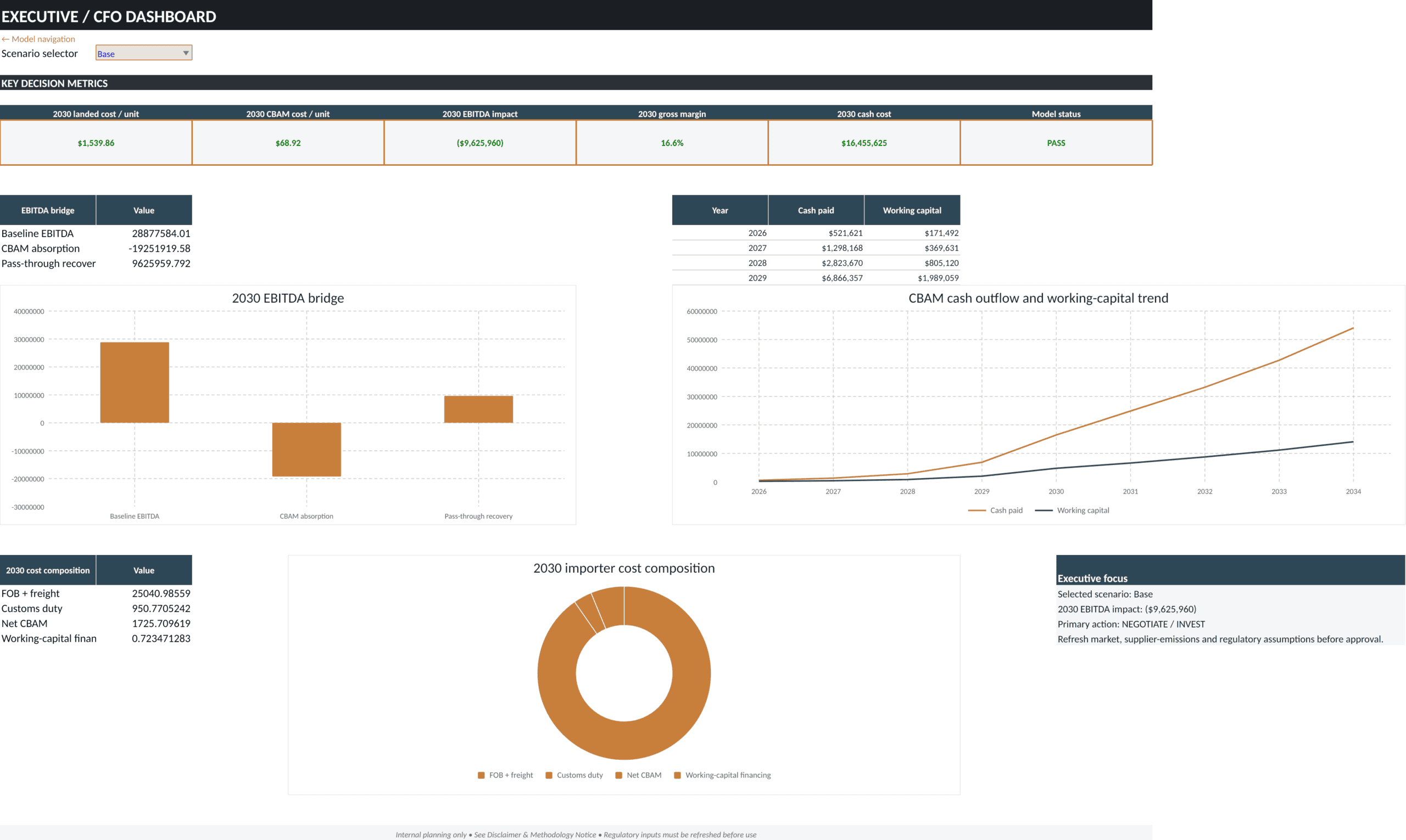
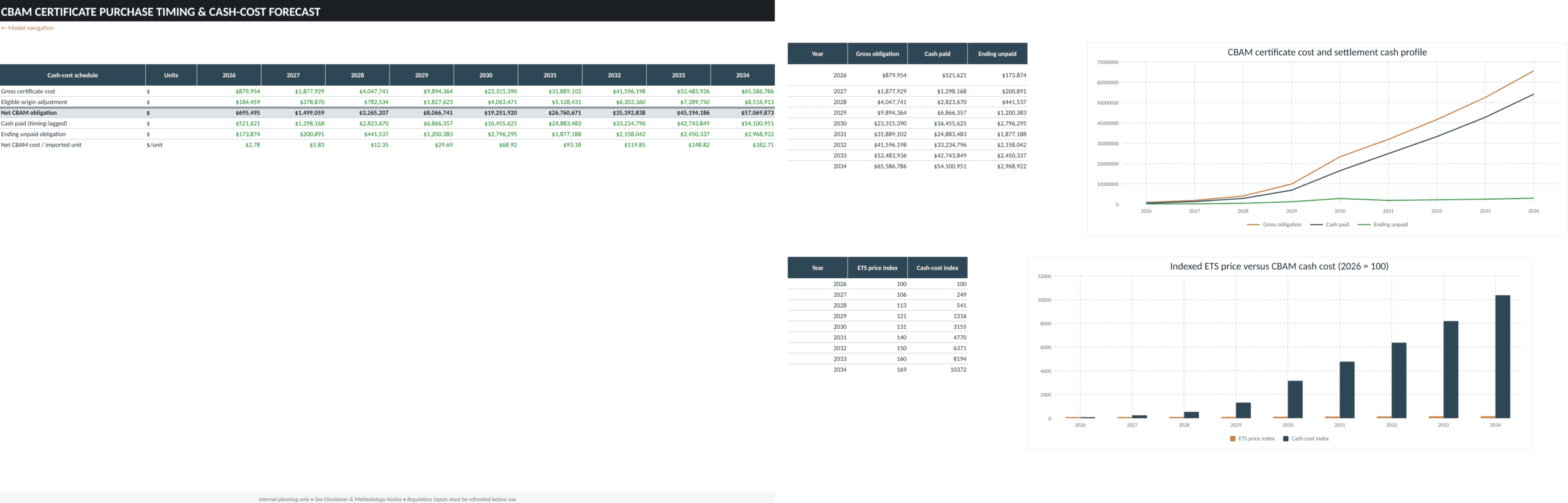
- CBAM cash-cost forecast with gross certificate cost, origin adjustment, net obligation, timing-lagged cash paid, unpaid obligation, and cost per imported unit.
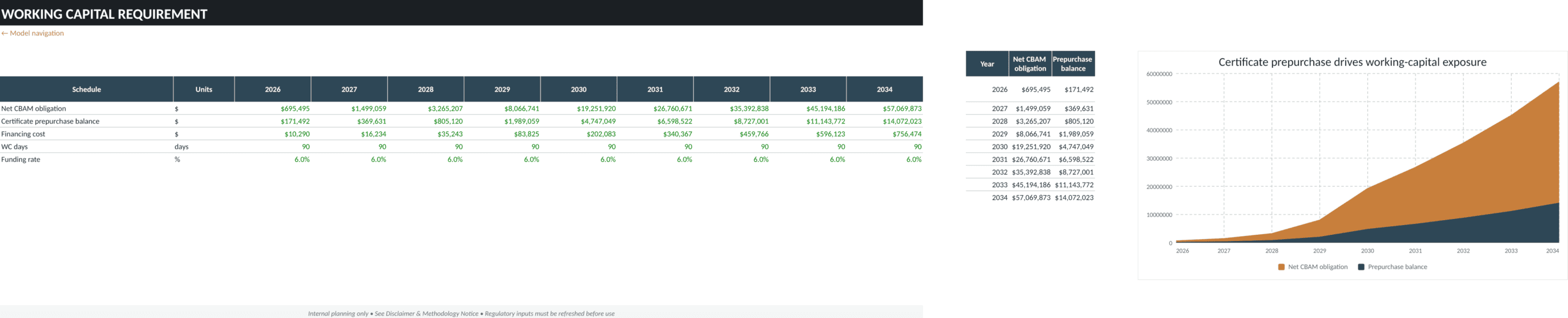
- Working-capital requirement including certificate prepurchase balance and financing cost.
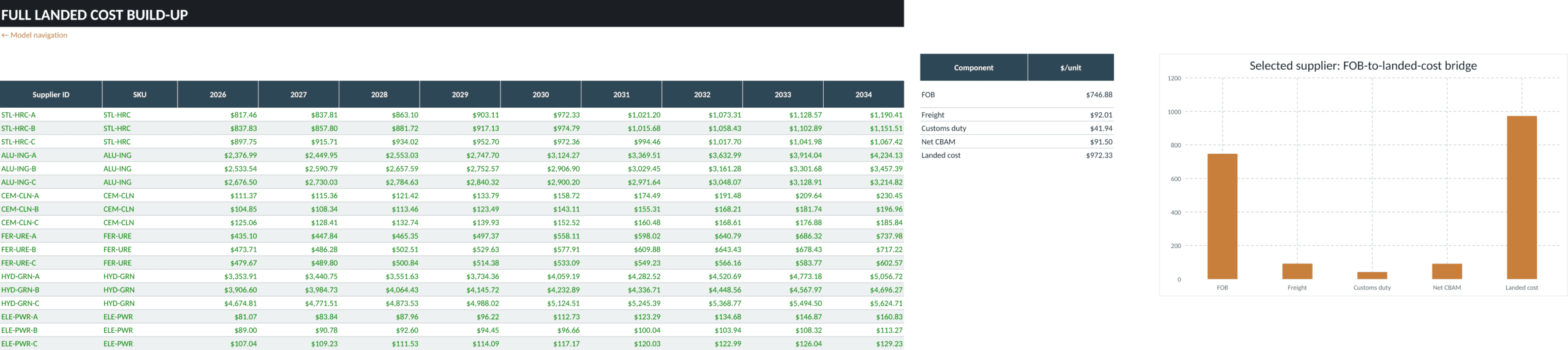
- Freight differential and tariff/customs-duty schedules feeding the full landed-cost calculation.
- Full landed-cost build-up combining FOB, freight, customs duty, and net CBAM cost.
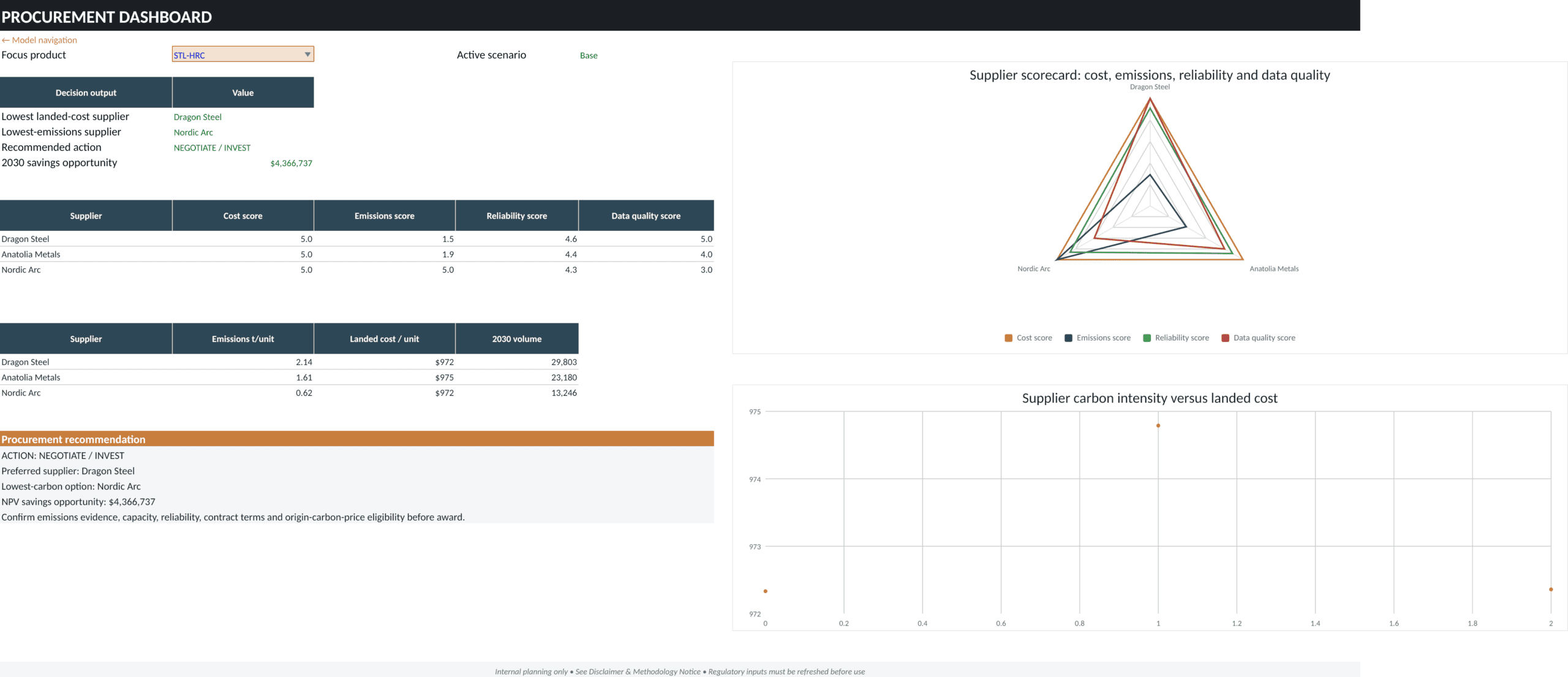
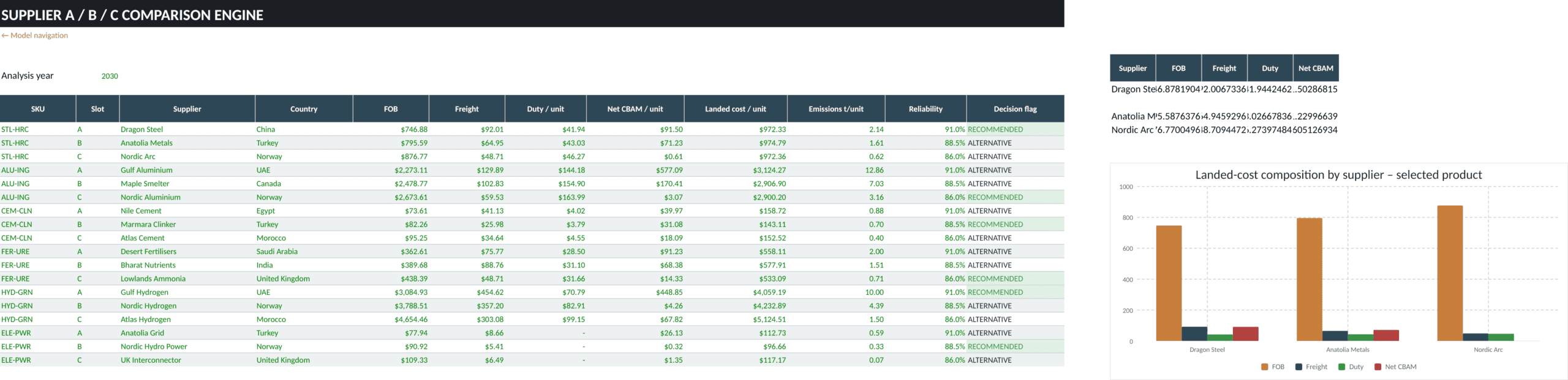
- Supplier A/B/C comparison using landed cost, emissions intensity, reliability, and decision flags.
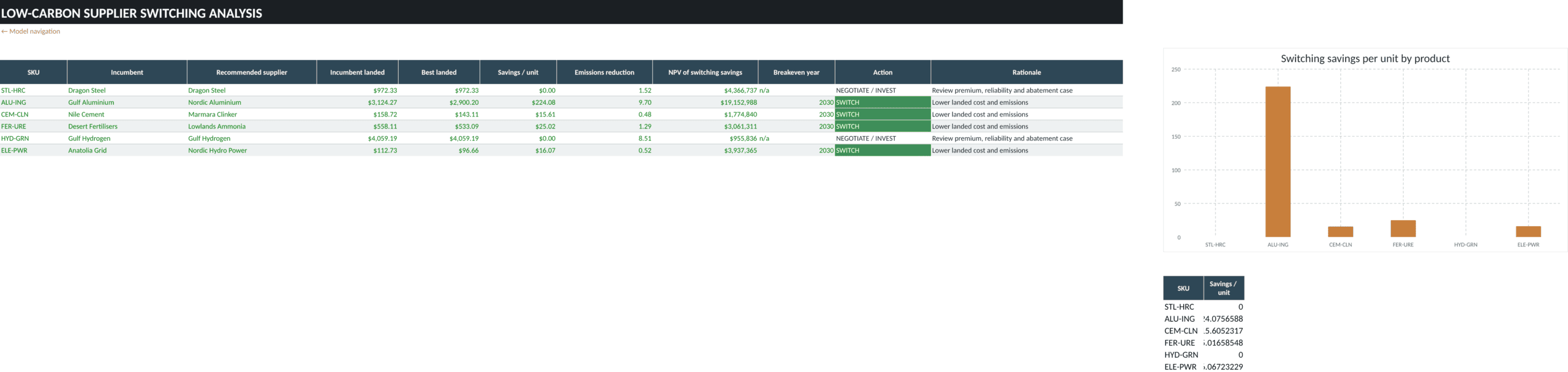
- Low-carbon supplier switching analysis with savings per unit, emissions reduction, NPV of switching savings, breakeven year, action, and rationale.
- Supplier decarbonisation investment appraisal with importer funding share, abatement value, NPV, IRR, payback, and investment decision.
- Pricing and customer pass-through engine linking net CBAM cost to customer recovery and unrecovered CBAM.
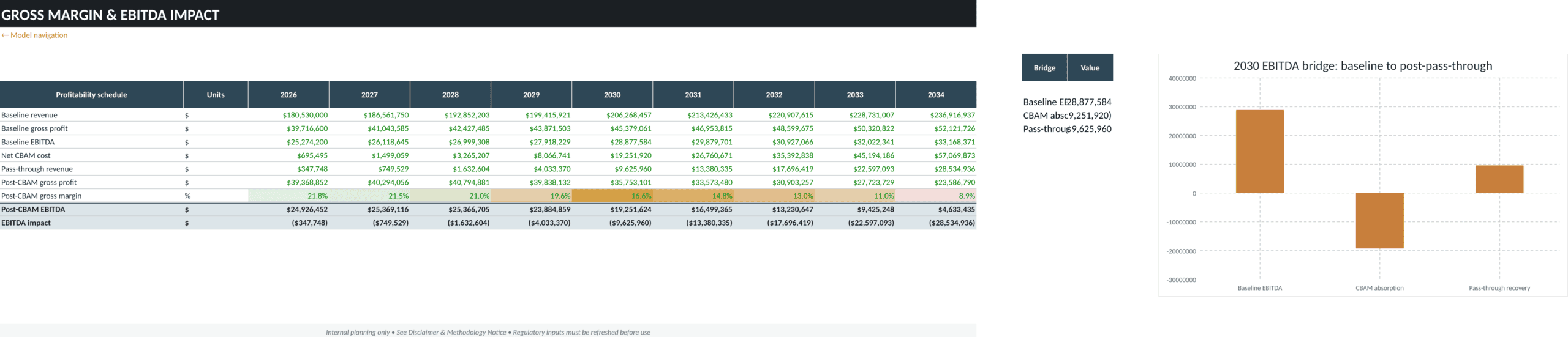
- Gross margin and EBITDA impact analysis with an EBITDA bridge.
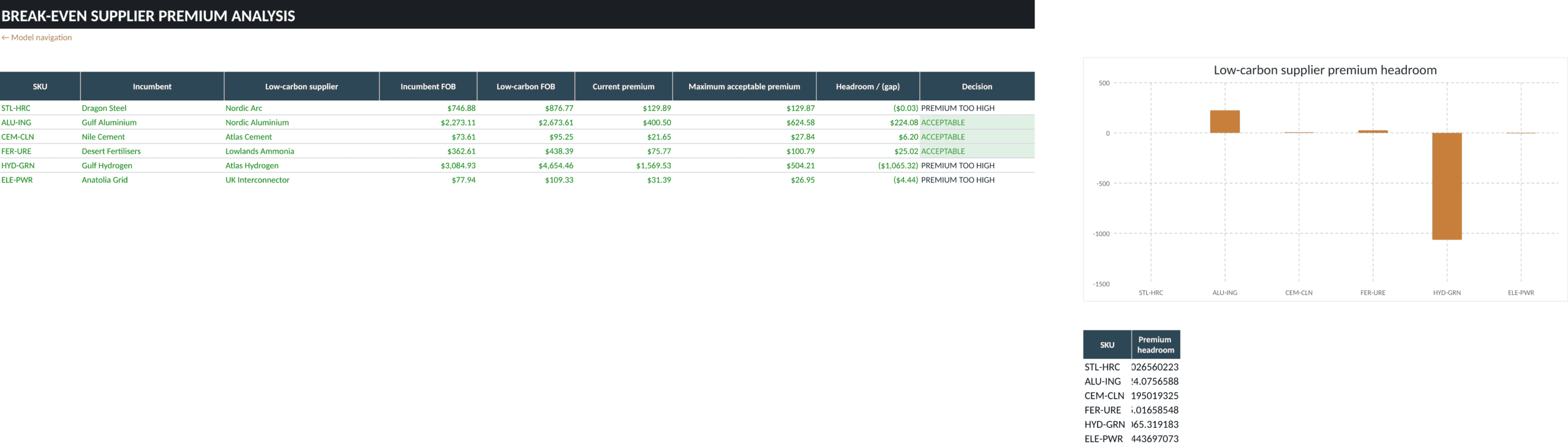
- Break-even carbon-intensity and break-even supplier-premium analysis.
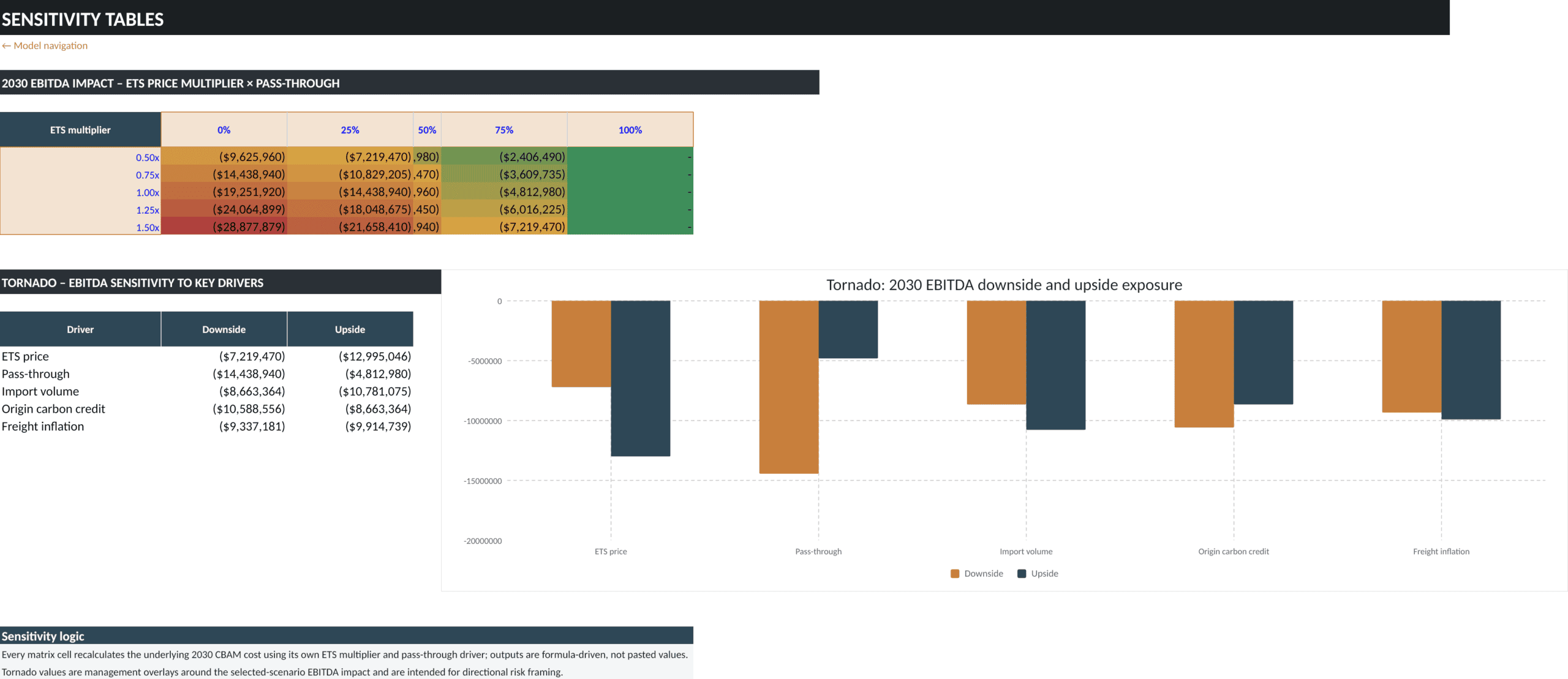
- Two-way sensitivity table and tornado analysis for key CBAM and commercial drivers.
- Executive CFO Dashboard summarising landed cost, CBAM cost per unit, EBITDA impact, gross margin, cash cost, cash/working-capital trends, and management focus.
- Procurement Dashboard summarising lowest-cost and lowest-emissions supplier options, supplier scores, recommended action, and switching economics.
- Audit & QA sheet with live reconciliation checks and a master model status.
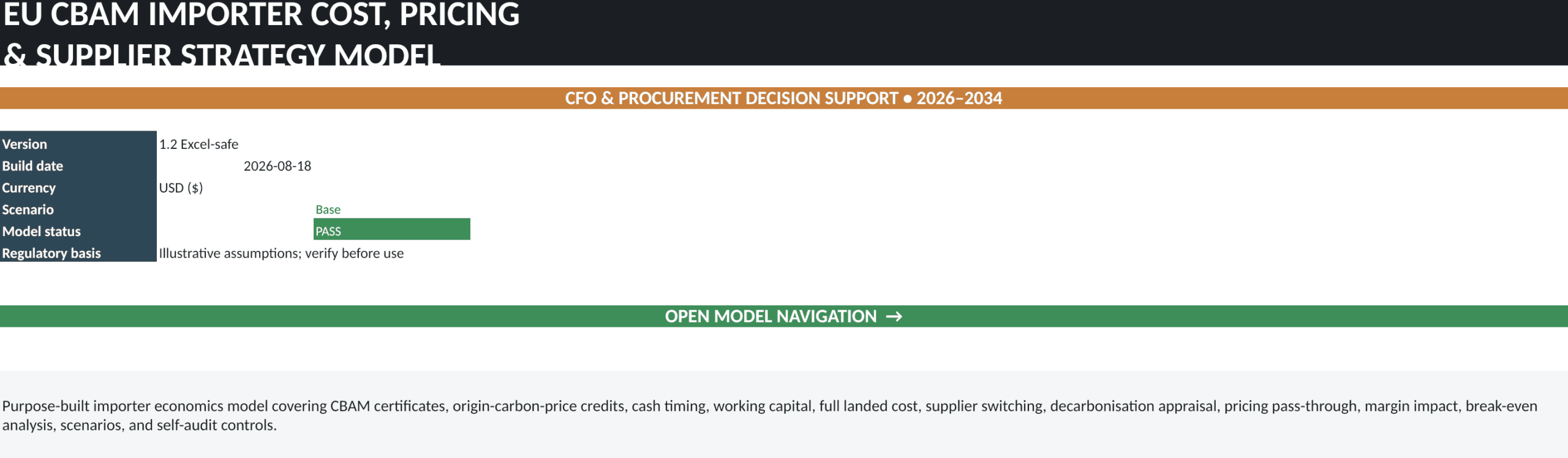
- Clickable navigation, instructions, disclaimer/methodology, and version-control sheets.
Inputs and Workflow
Start by selecting the scenario on the Executive CFO Dashboard. The selected scenario drives ETS price, demand, and pass-through assumptions across the model. Users can then replace the blue editable inputs for products, demand, supplier data, embedded emissions, freight, tariffs, origin carbon prices, FX/macro assumptions, and commercial parameters.
The workbook contains sample data for steel, aluminium, cement, fertiliser, hydrogen, and imported electricity. These data illustrate the model workflow and should be replaced with company-specific information where the model will support a real procurement or finance decision.
After updating inputs, users can review the certificate and cash-cost engines, landed-cost calculations, supplier comparison and switching sheets, pricing and margin impacts, break-even outputs, scenarios, sensitivities, and the CFO and procurement dashboards. The Audit & QA sheet should be checked before relying on outputs.
Who the Model Is For
This model is suited to:
- CFO, FP&A, treasury, and corporate-finance teams assessing CBAM cash and profitability exposure.
- Procurement and sourcing teams comparing suppliers on landed cost, emissions, reliability, and strategic alternatives.
- Importers building CBAM budgets, commercial pass-through strategies, and sourcing plans.
- Consultants and advisers who need a structured Excel framework for importer-side CBAM economics.
- Management teams evaluating supplier switching or supplier decarbonisation support.
Practical Decision Uses
The model can help users quantify future CBAM exposure, compare supplier choices, identify the cost of carbon-intensity differences, test acceptable low-carbon supplier premiums, evaluate customer pass-through, estimate cash and working-capital needs, and frame the EBITDA effect of CBAM under alternative scenarios.
Important Limitations
The workbook itself states that its regulatory inputs, sample CN-code mappings, embedded-emissions values, origin carbon prices, EU ETS/CBAM price curves, and other sample assumptions are illustrative and must be refreshed or verified before real-world use. It is an internal planning and decision-support model and is not customs, tax, legal, accounting, investment, or regulatory advice.
Similar ProductsOther customers were also interested in...



 eFinancialModels
Electric Vehicle (EV) Charging Station Financial M...
With this comprehensive 5- or 10-year monthly tool, investors can assess the viability of setting up... Read more

Financial Model for Mobile App | Mobile App Busine...
The Mobile App Financial Plan Template in Excel allows you to develop financial projections when lau... Read more

 HenrySheykin
Food Truck Financial Model Excel Template
The Food Truck Financial Model helps entrepreneurs, founders, business owners, consultants, and anal... Read more

Green Hydrogen Production from Wind Energy Financi...
The Green Hydrogen from Wind Financial Model aims to comprehensively forecast a horizon of 40 years ... Read more

Simple Mutual Non-Disclosure Agreement Template
Protect your business secrets with ease using our Simple Mutual Non-Disclosure Agreement Template. S... Read more

Solar Energy Financial Model
The Solar Energy Financial Model Spreadsheet Template in Excel assists you in preparing a sophistica... Read more

 Peter Graf
The Customer-Centric Financial Model for Restauran...
Starting a restaurant without a financial plan is like driving a car blindfolded. You wouldn´t do i... Read more
You must log in to submit a review.